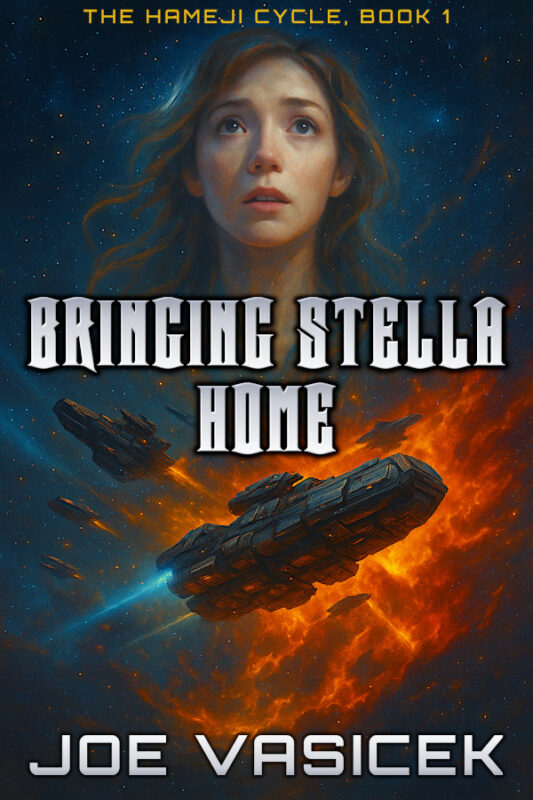
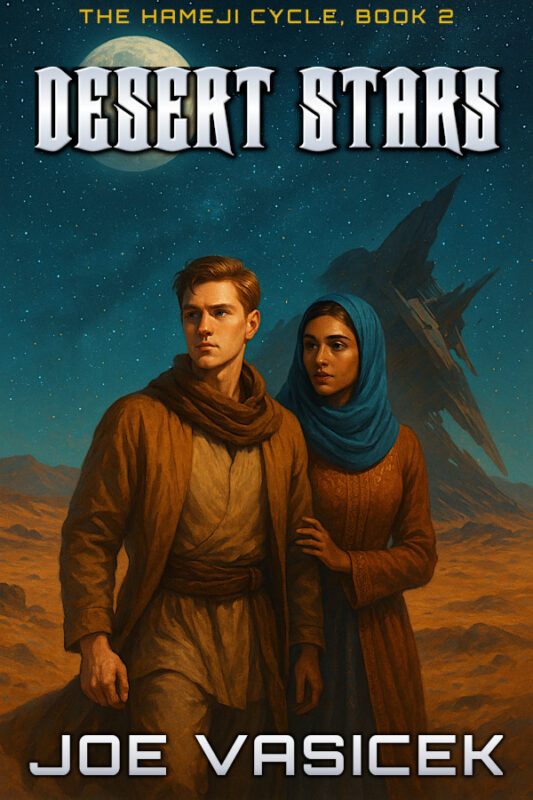
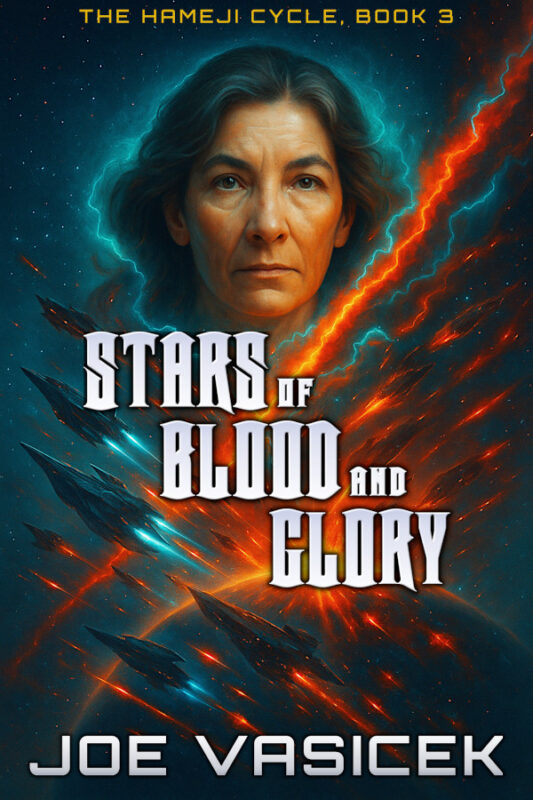
What Makes a “Joe Vasicek” Book?

I recently uploaded all of my books to ChatGPT and asked it to read them all and tell me what makes a “Joe Vasicek” book. The result was a fascinating conversation with the chatbot. It was too long to share in its entirety, so I asked ChatGPT to summarize it as a 1500 word blog post. Here is what it gave me:


Every author has recurring patterns. Sometimes they are obvious: favorite settings, familiar plot structures, beloved tropes. Sometimes they run deeper, beneath genre and surface premise, shaping the emotional and moral logic of the stories themselves. Looking across Joe Vasicek’s published science fiction and fantasy, a clear pattern emerges. His books are not simply space operas, frontier adventures, sword-and-sorcery tales, or clean romantic fantasies. At their core, they are stories about people trying to find, build, defend, or become worthy of home.

A Joe Vasicek book is usually set on the edge of civilization. That edge may be literal outer space: a far-flung colony, an isolated station, a small merchant starship, a dangerous trade route, or a frontier beyond the reach of stable law. It may also be a fantasy frontier: a seacoast, a ruined kingdom, a cursed wilderness, a lonely homestead, or a world recovering from plague, war, and desolation. But whatever form the frontier takes, it is rarely just a backdrop for adventure. It is a moral testing ground.

The central question is not merely whether the hero will survive. It is whether the hero can preserve the things that make survival meaningful: family, faith, freedom, love, loyalty, honest work, and moral courage.

This is why exile appears so often in Vasicek’s fiction. His protagonists are frequently displaced people: wanderers, captives, refugees, orphans, widows, failed apprentices, disgraced sons, forgotten daughters, fugitive lovers, and people who no longer belong in the world that formed them. They may dream of a lost Earth, flee an oppressive warrior culture, survive famine on a failing station, escape slavery, seek a ship, or defend a fragile home from powers that would destroy it. Their longing is not abstract. They want something deeply concrete: a place at the table, a family, a ship, a marriage, a household, a people, a future.

That longing for home is one of the defining features of Vasicek’s voice and vision. In many of his books, home is not something the characters simply return to. It must be built, chosen, earned, or restored. Sometimes it is a starship crew. Sometimes it is a marriage. Sometimes it is a frontier colony. Sometimes it is a homestead in the woods, a kingdom healed from corruption, or a family formed under impossible circumstances. His stories tend to end not merely with enemies defeated, but with the possibility of a stable moral order: a household, a child, a promise, a voyage, a free people, a new beginning.

Closely connected to this is Vasicek’s recurring interest in family formation. Marriage, children, inheritance, kinship, motherhood, fatherhood, and legitimacy are not decorative details in his fiction. They are often central to the worldbuilding. Societies in his books are shaped by who marries whom, who inherits, who belongs, who is cast out, who is enslaved, who is protected, and who is allowed to have a future. This gives even his space opera a domestic and anthropological depth. Starships are not just machines. They are households. Frontier settlements are not just adventure locations. They are embryos of civilization.

This family-centered quality sets Vasicek apart from much of contemporary science fiction and fantasy. In a market often dominated by antiheroes, irony, grimdark despair, eroticized power dynamics, or purely individual self-actualization, Vasicek’s books keep returning to older and more ordinary goods: marriage, children, duty, faith, work, and home. That does not mean the books are soft. His stories include captivity, slavery, war, famine, coercion, betrayal, exile, monsters, corrupt rulers, and civilizational collapse. But the darkness does not usually become the point. It is the pressure under which characters reveal what they truly love.

Another recurring element is freedom versus domination. Vasicek’s villains and oppressive systems often seek control over the intimate foundations of human life. They enslave, coerce, corrupt, conquer, manipulate marriage, break families, reduce people to tools, or turn sacred things into instruments of power. Against them stand people who may be weak, wounded, or compromised, but who still recognize that some things must not be surrendered. A recurring moral pattern in Vasicek’s work is that power becomes evil when it severs itself from love, covenant, humility, and responsibility.

This is especially visible in his fantasy. In the fantasy stories, magic frequently tests the soul. Treasure corrupts. Dark orders twist noble purposes. Forbidden power promises victory while hollowing out the one who wields it. Sacred objects and magical gifts are not merely tools; they expose character. The question is often whether the hero can become worthy of the power placed in his or her hands.

The science fiction handles similar concerns differently. In Vasicek’s SF, the central question is more often civilizational: what kind of society will human beings build on the frontier? Technology, star travel, colonization, lost Earth, trade routes, empires, and small ships all become ways to explore whether freedom and family can survive across distance. The fantasy asks whether the soul is worthy to wield power. The science fiction asks whether civilization is worthy to endure.

Yet the two sides of Vasicek’s work are recognizably connected. A sea mage searching for a crew and a star wanderer seeking a place among the stars are spiritual cousins. A cursed treasure that tests a fantasy hero and a civilization-changing technology that threatens an Outworld culture are variations on the same concern: what happens when power outruns virtue?

Faith is another quiet but persistent current. Vasicek’s books are not always explicitly religious, and many are not “religious fiction” in the usual bookstore sense. But they are shaped by a religious imagination. Providence matters. The universe has moral structure. Choices echo beyond immediate consequences. Suffering is not meaningless. Death is not always the final word. Love, sacrifice, chastity, loyalty, mercy, repentance, and covenant are treated as real forces, not sentimental illusions.

This gives his work what might be called moral gravity. The stories are generally clean, but “clean” is too weak a word for what they are doing. Clean can sound bland, safe, or sanitized. Vasicek’s better books are not harmless. They are morally serious. They often deal with brutal worlds, but without surrendering to brutality. They offer hope, but usually after loss.

That balance—dark trials, hopeful destination—is one of the most marketable aspects of his brand. Readers who are tired of nihilism may find in his books a kind of old-fashioned adventure that does not feel cynical. Readers who enjoy romance but do not want explicit heat may respond to the way his stories treat love as courtship, marriage, loyalty, and family destiny. Readers who enjoy frontier survival may respond to the practical details of ships, homesteads, trade, hunger, labor, and settlement. Readers who want faith-friendly speculative fiction may find his work welcoming without feeling confined to the Christian-fiction aisle.

At the same time, the analysis reveals some challenges. Vasicek’s books cross several genre lanes: hard SF, space opera, sword-and-sorcery, seafaring fantasy, frontier survival, time travel, post-apocalyptic fiction, captivity drama, and short-form idea fiction. That range can make the brand feel scattered. A reader who comes for small-ship space opera may not immediately understand how that connects to a fantasy homestead story or a cursed-treasure adventure. The underlying themes are consistent, but the surface packaging varies widely.

There is also a tonal challenge. Vasicek often writes “clean” fiction, but some of his recurring material is intense: slavery, captivity, concubinage, forced marriage, sexual coercion, famine, genocide, and patriarchal warrior cultures. These are not cozy stories. If marketed carelessly, they can send the wrong signal. The captivity material, in particular, needs to be framed around dignity, survival, identity, and freedom rather than dark-romance titillation or grimdark shock.

The clearest author brand, then, is not simply “clean science fiction and fantasy.” That is accurate but incomplete. The stronger brand is this:

Joe Vasicek writes clean, morally serious frontier science fiction and fantasy about wanderers, captives, exiles, and ordinary heroes building homes and families in dangerous worlds.

Or shorter:

Frontier science fiction and fantasy about faith, family, freedom, and finding home among the stars.

Or more distilled still:

A Joe Vasicek book is about finding home on the frontier without losing your soul.

That is the through-line. Whether the story involves starships, sea mages, cursed treasure, lost Earth, warrior clans, alien worlds, magical swords, or widowed mothers, the deeper movement is the same. The world is dangerous. Civilization is fragile. Power corrupts when severed from virtue. But love, faith, family, and moral courage can still make a home in the wilderness.

That is what makes a Joe Vasicek book.
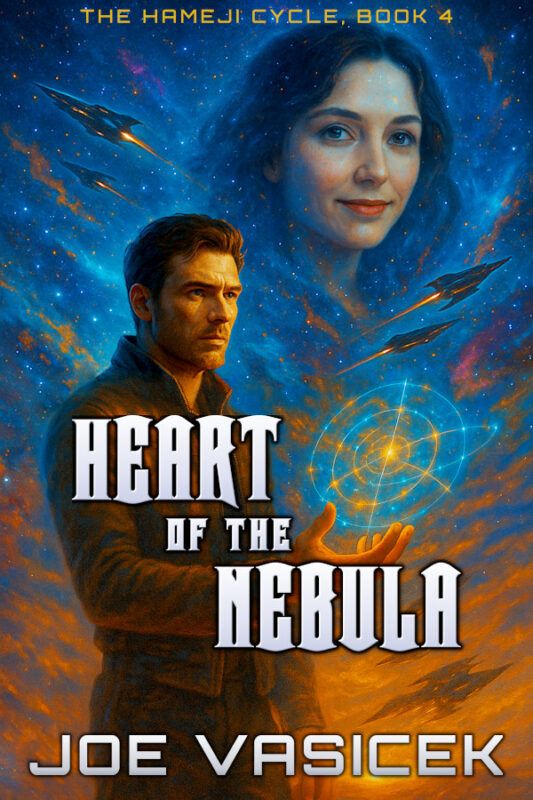
Survival After Catastrophe in Heart of the Nebula

Most science fiction stories focus on the catastrophe itself—the war, the invasion, the moment everything breaks. Heart of the Nebula asks a harder question: what comes after? This novel explores survival not as escape or victory, but as the long, grinding work of holding a shattered people together once the worst has already happened.

Heart of the Nebula is a character-driven space opera about survival after a devastating interstellar war, focused on leadership, scarcity, and the fragile work of rebuilding when victory is no longer an option. This is a story about living in the aftermath—when supply lines are fragile, authority is contested, and every decision carries consequences that can’t be undone.

Where the Idea Came From

The theme of survival after catastrophe grew out of thinking about what happens between history’s big moments. Wars end, empires fall, and invasions retreat—but the survivors are left to deal with the damage. In the author’s note, I talk about being interested in the liminal space after disaster, when the adrenaline fades and people are forced to confront loss, responsibility, and the reality that survival itself can be exhausting. I wanted to write a science fiction story set squarely in that aftermath—a post-war space opera where the central tension isn’t winning the conflict, but preventing a fragile civilization from quietly collapsing afterward.

How Survival After Catastrophe Shapes the Story

In Heart of the Nebula, the Hameji invasion is already over—but its consequences dominate every aspect of the plot, shaping a post-war survival narrative where rebuilding, scarcity, and leadership under pressure matter more than battlefield victories, even for readers new to the series. The surviving colonies are isolated, under-resourced, and barely holding together. Medical supplies, food shipments, and functioning infrastructure matter more than heroic speeches or decisive battles. Survival is measured in convoys protected, hospitals kept running, and fragile alliances maintained under pressure.

This theme also shapes the novel’s political and moral conflicts. Leadership becomes a form of triage: deciding what can be saved, what must be sacrificed, and how much compromise is acceptable before survival loses its meaning. Characters aren’t choosing between good and evil so much as between bad options and worse ones, all while knowing that a single failure could push their society from instability into total collapse.

What Survival After Catastrophe Says About Us

At its core, survival after catastrophe asks what we owe each other when the world no longer offers easy answers. When institutions fail and certainty disappears, morality becomes less about ideals and more about responsibility. For readers drawn to science fiction that explores rebuilding, moral responsibility, and the cost of survival after war, this theme asks not how we endure catastrophe—but how we remain human afterward. That’s why in Heart of the Nebula, survival isn’t just about staying alive—it’s about preserving trust, dignity, and a sense of shared purpose even when fear and scarcity make that difficult. It’s a reminder that rebuilding is not a single act, but a daily choice.

Why This Theme Matters to Me

I’ve always been drawn to stories about aftermath rather than explosions. The moments that interest me most are the quiet ones—when people have to live with what’s already happened and decide who they’re going to be next. Writing Heart of the Nebula was my way of exploring survival after catastrophe—the exhaustion, the moral weight, and the stubborn hope that survival can still mean something more than endurance.

Where to Get the Book

Related Posts and Pages

Explore the series index for The Hameji Cycle.

Return to the book page for Heart of the Nebula.

Is Heart of the Nebula for You?

Heart of the Nebula is a character-driven space opera and political military science fiction novel about leadership, sacrifice, and the cost of protecting a people who are barely holding together. Set after a brutal alien occupation and a desperate refugee exodus into deep space, the story follows survivors of the Hameji War as they struggle to remain unified while haunted by past choices. This is a story about moral courage under pressure—when there are no clean victories, only necessary and costly decisions.

Heart of the Nebula is part of The Hameji Cycle, a character-driven science fiction series about occupation, resistance, exile, and the long aftermath of interstellar war. It continues The Hameji Cycle’s exploration of occupation, exile, resistance, and the moral cost of survival after interstellar war. It is the fourth book of the series, but can be read as a standalone book.

What Kind of Reader Will Love Heart of the Nebula?

If you love…

  • character-driven science fiction that treats leadership and responsibility as moral burdens, where decisions affect entire communities
  • space opera focused on refugees, displaced peoples, and survival after catastrophe
  • stories about sacrifice, loyalty, and the tension between individual conscience and communal good
  • thoughtful science fiction that explores politics, ethics, and power without cynicism

…then Heart of the Nebula is probably your kind of story.

What You’ll Find Inside

At the center of Heart of the Nebula is James McCoy, a reluctant leader trying to guide a fractured colony of refugees through the aftermath of war, betrayal, and long-term displacement. The story balances tense action—mutiny, political fracture, and survival in deep space—with quiet emotional reckoning, including moments where every available option carries moral cost, tracing the psychological cost of command and the lingering weight of past choices. The tone is serious and reflective, with moments of intensity and tenderness, and a steady pace that prioritizes character, consequence, and ethical decision-making over spectacle alone.

What Makes Heart of the Nebula Different

Unlike many space operas that celebrate charismatic heroes and clear-cut triumphs, Heart of the Nebula interrogates what happens after a hero becomes a legend—and that legend begins to divide the people it was meant to save. It blends military science fiction with political and ethical science fiction, focusing on how legends distort truth and fracture communities. The story also centers an exodus narrative—less about conquest or discovery, and more about survival, memory, and the fragile act of rebuilding a society in exile.

What You Won’t Find

This is not a lighthearted or quippy adventure, and it doesn’t offer easy moral answers or fast resolutions. You won’t find simplistic good-versus-evil framing, power fantasies, or violence treated as consequence-free. Romance exists, but it remains grounded and secondary, serving the emotional journey rather than driving the plot.

Why I Think You Might Love Heart of the Nebula

I wrote Heart of the Nebula because I couldn’t let go of a question that kept resurfacing: when people willingly sacrifice themselves for the greater good, is it right—or even moral—to intervene and undo that sacrifice as a leader responsible for others? This book is my attempt to wrestle honestly with leadership, responsibility, regret, and the cost of choosing “no one left behind” in a universe that punishes mercy. If you enjoy science fiction that treats ethical dilemmas seriously and allows characters—and societies—to live with the consequences, I think this story will stay with you.

Where to Get the Book

Related Posts and Pages

Explore the series index for The Hameji Cycle.

Return to the book page for Heart of the Nebula.

April update

Sorry to go dark for so long. I’ve been sick off and on for the last two months, first with a sinus infection, then with a lung infection, and lately with a persistent stomach flu. Thankfully, I’ve been functional through all of it, but not at 100%, which is why I’ve neglected the blog.

I have been writing, though. I’m currently about a third of the way through Victors in Liberty, and should finish it within the next few weeks. I’m also revising it as I go along, so as to have a publishable final draft. We’re still on track for a July release date.

In the last few weeks, I’ve been crunching a lot of book sales numbers and formulating a better business plan. The goal is to make the writing profitable enough to pay myself more than sweatshop wages. I think I’ve figured out a way to get there before the end of this year.

I also recently discovered Jordan Peterson, and have been listening to many of his lectures while doing mindless chop-wood carry-water tasks. He’s an incredible guy. One of the last few sane and reasonable people in the world with a large enough platform to counteract the constant assault of insanity that passes for today’s news cycle.

I’ve also published a double novel bundle for Bringing Stella Home and Heart of the Nebula. I originally published it exclusively on Kobo, to get around Amazon’s price matching policy so I could run useful promotions with KWL. But the Kobo promotions use coupon codes now, which means there’s no reason not to make this title available everywhere.

Nothing Found

I’m also experimenting a lot with my email list, trying out a new style for my newsletter and cycling through promotions more regularly. Makes a lot more work, since Amazon won’t make a book free unless you price match it first, but hey it’s not as bad as digging ditches.

Lots of other stuff going on behind the scenes, which I’d rather not get into just yet. When there’s significant movement, I’ll be sure to let you know.

I am so ready to finish the Sons of the Starfarers series. It’s been difficult to write at times, but I’m excited with how the last book is turning out and think it will provide an excellent ending to a story that has turned out better than I expected it to. Really looking forward to get it out there.

That’s just about it for now. Don’t worry about me: life is good and I’m still writing.

Trope Tuesday: Manic Pixie Dream Girl

Oh dear. I’m probably going to take some heat for this one, especially if it gets picked up by File 770.

What is a “manic pixie dream girl”? Tvtropes puts it this way:

An upbeat young woman whose love gives the brooding male hero a new lease on life.

Wikipedia puts it this way:

…the MPDG “exists solely in the fevered imaginations of sensitive writerdirectors to teach broodingly soulful young men to embrace life and its infinite mysteries and adventures.” MPDGs are said to help their men without pursuing their own happiness, and such characters never grow up; thus, their men never grow up.

You know how the term “space opera” was originally a derogatory term for crappy science fiction? I’m going to go out on a lark, invoke tropes are tools, and argue that Wikipedia is wrong and there’s nothing inherently bad about this trope.

Anita Sarkeesian is not a huge fan of the manic pixie dream girl. In fact, it was the first trope she deconstructed way back 2011, before her scammy kickstarter. I’m not a huge fan of Anita Sarkeesian, but it’s worth rewatching her take on it:

In particular:

The manic pixie perpetuates the myth of women as caregivers at our very core—that we can go fix these lonely, sad men, so that they can go fix the world.

Here’s the thing, though: when you study the men who have fixed the world, you almost always find a strong, caregiving woman behind them. This is portrayed very well in The Darkest Hour, with Winston Churchill’s wife, Clementine:

Granted, Clementine Churchill is no manic pixie, but she did provide critical support to her husband, and was one of the key influences that shaped him into the great man of history that he ultimately proved to be.

Here’s the thing: men need women, just as women need men. All the feminist eye-rolling in the world doesn’t make that untrue. And for men who are lonely, depressed, or overly introspective, a perky outgoing woman can really have a positive impact.

The key to doing this trope well is to make the MPDG a complete character in her own right. Critics rightly point out that something is wrong when she exists solely for the benefit of the male protagonist. That’s not a feature of this trope, though: that’s just bad writing in general.

The best example of a MPDG in my own work is probably Deirdre from Heart of the Nebula. The rest of this post is going to be full of spoilers, so if it’s on your TBR list, you should probably skip to the end now.

Deirdre is very much a character in her own right. She’s the ship’s historian of the Chiran Spirit, a generation ship that James liberates from pirates before going into cryosleep. In spite of her perky, cheerful demeanor, she has experienced deep pain in her life. She immediately latches onto James, but over time this transforms from an interest in a living historical figure to genuine attraction and love.

James and Deirdre round off each others’ rough edges. She helps him to recover his optimism and self-respect, while he helps her to understand herself better and decide what she truly wants. They both help each other to reconcile with difficult baggage from each of their pasts, and though they both go through a period of disillusionment, they ultimately come out stronger for it on the other side.

Here’s the thing, though: if Deirdre was anything but a manic pixie dream girl, she wouldn’t have been able to help James through his darkest hour. It’s her bouncy enthusiasm, clumsy excitement, and unfailing optimism that draws him out of his callused shell. Without those characteristics, the story—and her character—wouldn’t have worked.

In short, I believe that the manic pixie dream girl trope very much has a place, and isn’t inherently sexist or mysoginistic at all. It can be, if done poorly, but when done well it points to the reality that men need women just as women need men, and that’s actually a good thing, no matter what the feminists say.

Trope Tuesday: The Chessmaster

The Chessmaster is a fun trope, especially when done well. A good villain is always at least one step ahead of the good guys, so when it turns out that he’s three or four or ten steps ahead of them, it can make for some interesting plot twists.

Of course, the chessmaster isn’t always the bad guy. Sometimes, it turns out that the mysterious figure behind the scenes pulling all the strings is actually working for good, even though he may sacrifice a few pawns along the way. Or is he? There’s always that tension, simply because of the chessmaster’s manipulative nature.

I’ve played it both ways. The last time I wrote a chessmaster was Gunslinger to the Stars, but the Patrician in Heart of the Nebula definitely also qualifies. In both cases, the character was introduced as a mysterious employer. I won’t tell you which one was the bad guy, and which one was the good guy.

I’ve never written a story from the perspective of the chessmaster. I imagine it would be quite difficult, since all of the plot twists would have to be telegraphed and/or th reader would have to be kept in the dark about the main character’s plans. Dune is an excellent example of the former, but I can’t think of any good examples of the latter. The Davinci Code comes to mind, but the way it kept the viewer in the dark (seen the movie, haven’t read the book) didn’t work for me.

Even as a non-viewpoint character, the chessmaster can be difficult to write. Careful plotting is key, of course, but so is the iceberg principle. For everything the reader can see, there has to be a bunch of stuff beneath the surface that they can’t see. It doesn’t require the same level of detail as the surface level stuff, of course, but you have to at least have an idea of what the chessmaster would do if the story went in a very different direction. Even if the chessmaster never reveals those plans, you can bet that he still has them figured out.

In part, this is what made Heart of the Nebula so difficult to write. The final draft bears little resemblance to the first draft, with characters and subplots cut out or combined with others. Still, I’m satisfied with how it turned out, and it seems that the readers are as well.

In Sons of the Starfarers, Gulchina isn’t a chessmaster so much as a magnificent bastard with delusions of grandeur. She has plans and does tend to be three or four steps ahead of everyone else, but she’s less interested in manipulating events than she is in manipulating people. Her ultimate goal, as revealed in Captives in Obscurity, is to establish a proud warrior race that will one day wipe out and take over both the Empire and the Outworlds. She doesn’t know how that’s going to happen, but she knows what needs to be done to lay the foundation for that work.

The chessmaster is a challenging trope to write well, but I’m sure I’ll use it many more times in the future. The storytelling potential is just too great to leave it out.

Beginning of September Update

It’s September, my favorite month of the year! Maybe I’ll revisit that post in a blast from the past or something. So many reasons why September is awesome.

Things are going well on the writing front. I’ve switched up my daily routine to make more writing time, and it’s working well so far. My alarm goes off at 5:45 am (just after oh-dark-thirty) and I write for about an hour before heading off to my part time job. I’ve found that I tend to write a lot more when I start first thing in the day, so the earlier I can start, the better.

I won’t bore you with the rest of my routine, unless you want me to write a post about it. There’s a bunch of interesting lifestyle tweaks I’ve been trying out, like reading a couple chapters from one of the books I’m reading as soon as I get back from work in the afternoon, in order to refill the creative well and not get caught in a Youtube / general internet trap. Stuff like that.

My current WIP is A Queen in Hiding (Sons of the Starfarers, Book 7) which is proving to be a surprisingly difficult book. It’s definitely one of the weirdest things I’ve ever written, and that’s saying a lot. In Captives in Obscurity, Reva and Isaac get assimilated into a hive mind, and things only get crazier from there.

Sometimes, stories come really easy, almost like they spring fully formed from the mind. Other times, I’ve found I have to throw out almost the entire first draft before I discover the story.

The weird thing is that it has nothing to do with actual book length. Stars of Blood and Glory and Outworlder are totally different lengths, but they both came out almost perfect in the first draft. However, almost all of the Star Wanderers novellas took multiple drafts filled with stuff that had to be cut. Heart of the Nebula took years to finish, and I had to throw out multiple characters and subplots. I struggled for a long time with Genesis Earth, until I decided to throw the whole thing out and start with a blank page. The book was finished less than four weeks later.

The holy grail, of course, is to write a perfect book in four to six weeks (or less!) every time I set off to start a new one. But as awesome as it would be to barf rainbows and poop gold, all of those things sadly remain out of reach.

My goal at this point is to publish the last four Sons of the Starfarers books in 2018, two months apart from each other. Ideally, I’d like to have the next one up for preorder in time for the previous one’s release. It’s going to take some coordination, but I already have all the covers, which leaves just the writing and editing (metadata and formatting doesn’t take more than a day).

Unfortunately, that isn’t going to happen unless I can get A Queen in Hiding ready to go by December. So that’s what I’m trying to do.

Gunslinger to the Galaxy is on hold for now, though so far it’s coming along very nicely. I should be able to pick it up and finish without too much trouble. Edenfall is also on hold, for how much longer I really don’t know. Before the end of 2018, I’d like to publish either the one or the other, but publishing them both is probably a bit of a stretch.

Also, I haven’t even started The Sword Bearer yet (second book in the Twelfth Sword Trilogy), though I have lots of great ideas for it. Since The Sword Keeper is coming out in just a couple weeks, I should probably get on that.

On the publishing side, I dropped the ball a bit in August. It took so much energy to get The Sword Keeper ready for publication that I totally spaced publishing anything. I do have a bunch of shorts that are nearing the end of the submissions gauntlet, and some bundles that can go up too.

I don’t sell many print books, but I want to get print versions of all of my books up, including short stories. That’s going to be an ongoing project for a while. I also want to put up audiobook versions eventually, but it’s going to take some time to get that ball rolling. However, it has moved up the priority list.

That’s pretty much it. So much stuff I want to do, so little time to do it. Time, money, or youth: you can only pick two (and one of them isn’t your choice).

Take care, and thanks for reading!

All of my books and stories, in series order

A friend of mine recently asked me to give him a list of all my books in series order. That was just the kick in the pants I needed to put this page together. For your convenience, I’m putting it up as a blog post too. The links to all the book pages will appear on the series page as soon as I can get around to it.

Joe Vasicek

Gaia Nova

The Gaia Nova books are all mid-sized novels (75k to 110k words). It is a far-future space opera series that takes place in a galactic empire long after Earth has been lost to legend. They can be read in any order, but they take place in the same universe with recurring characters. They are listed in the order in which they were published. Heart of the Nebula is a direct sequel to Bringing Stella Home.

Bringing Stella Home
Desert Stars
Stars of Blood and Glory
Heart of the Nebula
Mercenary Savior (forthcoming)
Empress of the Last Free Stars (forthcoming)

Star Wanderers

The Star Wanderers books are novellas (15k to 35k). They take place in the same universe as Gaia Nova one thousand years earlier. The first four books are linear, while the last four books are parallaxes of the first four, from the point of view of the side characters.

Outworlder
Fidelity
Sacrifice
Homeworld
Dreamweaver
Benefactor
Reproach
Deliverance

The Jeremiah Chronicles (Omnibus 1-4)
Tales of the Far Outworlds (Omnibus 5-6)

Sons of the Starfarers

The Sons of the Starfarer books are short novels (35k to 45k words) that take place in the same universe as Star Wanderers, with a few recurring minor characters from those books. It is a linear series.

Brother in Exile
Comrades in Hope
Strangers in Flight
Friends in Command
Captives in Obscurity
Patriots in Retreat (forthcoming)
A Queen in Hiding (forthcoming)
An Empire in Disarray (forthcoming)
Victors in Liberty (forthcoming)

Sons of the Starfarers (Omnibus 1-3)

Gunslinger Trilogy

These books are all short to mid-sized novels (50k to 90k words). They take place about 40 years in the future, after Earth makes contact with the galactics.

Gunslinger to the Stars
Gunslinger to the Galaxy (forthcoming)
Gunslinger to Earth (forthcoming)

The Twelfth Sword Trilogy

These epic fantasy books are all mid-sized to long novels (85k words and up).

The Sword Keeper (forthcoming)
The Sword Bearer (forthcoming)
The Sword Mistress (forthcoming)

Genesis Earth Trilogy

These are all mid-sized novels (about 70k words) that take place in the near to mid-future.

Genesis Earth
Edenfall (forthcoming)
The Stars of Redemption (forthcoming)

Short Stories and Novelettes

Below are all of my short stories and novelettes, in the order in which they were published. If they first appeared in a magazine or anthology, I’ve included that in parentheses.

Decision LZ1527 (Leading Edge Magazine, December 2009)
Memoirs of a Snowflake
A Hill on Which to Die
Starchild
L’enfer, c’est la Solitude
(Perehilion SF, March 2016)
The Curse of the Lifewalker
(Sci Phi Journal, June 2016)
The Gettysburg Paradox
Utahraptors at Dawn
Welcome to Condescension
Killing Mister Wilson
My Name is For My Friends
Jane Carter of Earth and the Rescue that Never Was
The Open Source Time Machine

J.M. Wight

Short Stories

Worlds Without Number

Thoughts on series and perma-free

For the last five years, the conventional wisdom among most indie writers has been to write short books in sequential series and make the first book permanently free. It’s a strategy that works, to a certain extent. It’s what got me from making pizza money on my book sales to making a humble living at this gig. However, I’m starting to question that wisdom.

I have two books available for free this month: Genesis Earth and Star Wanderers: Outworlder (Part I). Genesis Earth was my first indie published novel, a “standalone with series potential” (specifically, a trilogy) written according to the conventional wisdom for breaking into traditional publishing. Outworlder is a very different book: the first in an eight-book novella series, strong enough to stand alone but short enough to leave the reader wanting more. And for several years, it was perma-free.

Outworlder was the first of my books to make it big. It’s gotten tens of thousands of free downloads and driven thousands of sales (I don’t have the exact numbers because I haven’t yet collated all of my sales reports from the past five years, but that’s something I plan to do). It was largely on the success of Outworlder and the Star Wanderers series that I built my early career.

But over time, downloads of Outworlder slowed to a bare trickle, and sales did as well. I could give it a short-term boost by running a few strategically placed ads, but it would always fall back down to a baseline that was simply unacceptable.

Also, when you have a book that’s permanently free, it tends to accumulate a lot of negative reviews. It’s strange, but some people seem to feel more entitled to XYZ when they get it for free, as opposed to paying for it. Or maybe these are the people who try to go through life without actually paying for anything? Who hoard everything, even the stuff that they hate, so long as they can get it for free? I don’t know.

Certainly, that’s not true of everyone who reads free books. But when you have a perma-free book, it tends to accumulate more of the barely-coherent “dis buk sux” kinds of reviews from people who probably weren’t in the target audience to begin with. And over time, that tends to weigh the book’s overall rating down, which unfortunately can be a turn-off for people who are in the book’s audience.

Contrast that with Genesis Earth. I launched it at full price with a blog tour (which I put together myself, among writer friends whom I knew personally and who had readers who would probably enjoy the book). It sold about a hundred copies in the first ninety days, then slowed to a very low trickle—maybe one or two sales each month, if that. Things continued like this for several years.

Then, back in December, I made it free for one month. Downloads immediately shot up, and continued strong throughout the entire month. Even without any advertising, I was still getting maybe 50 downloads per day on Amazon, plus a constant trickle on the other platforms. For the next couple of months, sales of all my other books grew as well

For April, I decided to make it free again, just to see if I could duplicate that kind of success. I haven’t done any paid advertising for it, but I have submitted it to various sites and newsletters that will promote free books. The result? Thousands of downloads, with a baseline rate of more than a hundred downloads per day.

Genesis Earth has never been perma-free, but every time I set it free for a limited time, it’s like I’ve released the pent-up flood waters. In contrast, Outworlder struggles to get any downloads at all, even when it’s free for only a limited time.

Part of this may have to do with the reviews. Genesis Earth has a much better overall book rating, simply because most of the people who read it over the years were the ones willing to pay full price. This also means that the book has grown into its own niche organically, since the people who have bought Genesis Earth also tend to buy other books similar to it. Retailers like Amazon take note of this, and tend to associate these books with each other in things like also-bought recommendations.

This is all just speculation, but when all of this comes together, it seems to result not only in a higher download rate when the book is free, but more downloads from people who are in the book’s targeted audience.

The mos fascinating result of this is that when the book goes back to full price, sales get a small but long-lasting boost. I’ve seen this with Bringing Stella Home, which was free in March. It’s not a huge boost—maybe only five or six books a month—but it boosts all of the other books in the series as well, and lasts for a couple of months. It’s not just Amazon where this is happening, either—in fact, it may be boosting sales on the non-Amazon platforms even more.

Bringing Stella Home is different, though, because it’s a full-length novel (about 110k words, or +300 pages) in a series that can be read out of order just fine. In other words, more of the “stand-alone with series potential” that was the convential wisdom in the old tradpub world. Like Genesis Earth, it has never been perma-free.

So what’s the takeaway?

That maybe the convential wisdom among indies is all wrong. That perma-free actually taints books and makes it harder for them to stick in the rankings, or to grow into their natural audience. That longer stand-alone books with recurring characters set in the same universe may be better for gaining long-term traction than shorter, more episodic books. Also, that the more books you give away for free—not just first in series—the better that all of your books will sell.

My experience is purely anecdotal, and there’s a lot more analysis I need to do before I can say anything for sure. From what I can tell, though, it seems that the best strategy is to write longer, fuller books that satisfy more than they entice, and to use free as a marketing strategy for only a limited time.

In other words, the collective wisdom of KBoards is completely off the mark, and Kris Rusch (who regularly gets vilified on KBoards) actually knows what she’s talking about most of the time.

Like I said, this is all anecdotal and more analysis is required. But I’m very curious now to make some of my non- first-in-series books free for a month, just to see if it has a similar boost. With Bringing Stella Home, for example, a lot of readers seem to be jumping over books 2 and 3 to read Heart of the Nebula, the direct sequel (but book 4 in the Gaia Nova series order). It would be very interesting to see if Desert Stars has an awesome free run as well, resulting in more sales after it reverts back to full price.

Lots of interesting stuff to consider. It’s definitely going to inform my writing and marketing efforts in the future.