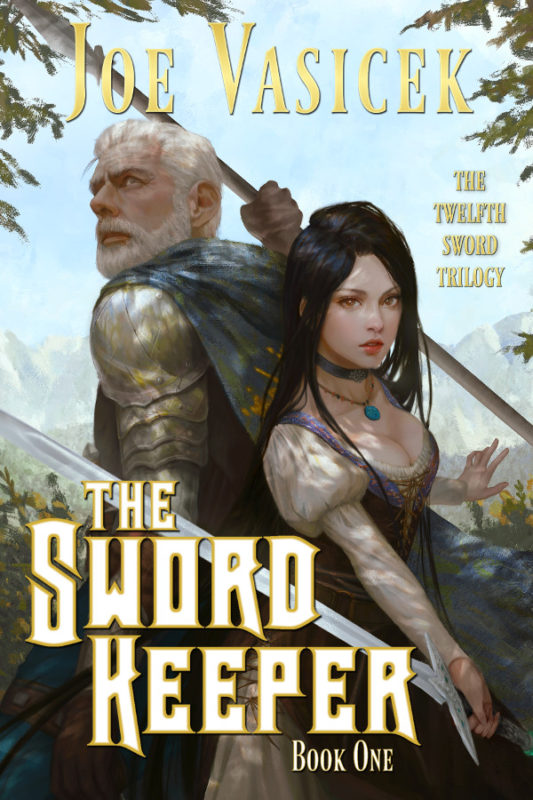
Humility and Leadership in The Sword Keeper

What makes someone worthy to lead: strength, status, skill, or something deeper? The Sword Keeper is a chosen-one fantasy about a tavern girl who is handed a legendary sword, a dangerous prophecy, and a responsibility she never asked to carry. At the heart of the story is the idea that true leadership begins not with power, but with humility.

Where the Idea Came From

The first spark for The Sword Keeper came when I was taking Brandon Sanderson’s writing class at BYU, around the time he had just published Warbreaker. I loved the idea of a sentient sword as one of the characters, but the story truly came alive later, after I moved to the Republic of Georgia to teach English. The mountains, villages, dances, family names, food, roads, and little backcountry details of the book all grew out of my time there, especially in Kutaisi and the mountain village of Rokhi.

How Humility and Leadership Shape the Story

Tamuna is not the obvious person to bear Imeris. She is not a warrior, a noble, a trained monk, or a commander. She is a tavern girl from a mountain village, more familiar with chores, travelers, and local gossip than with swords, strategy, or war. That is exactly what makes the theme work. The sword does not choose the strongest person in the room. It chooses someone who can learn, listen, care, and carry power without treating it as a prize.

Alex is the clearest contrast. He has the training, discipline, courage, and martial skill that Tamuna lacks. He once hoped the sword would choose him, and part of him still believes he would have been the better bearer. But his struggle shows why humility matters. He has to learn that service is not failure, and that leadership is not always given to the person who looks most qualified. By the end, he recognizes Tamuna as the true sword bearer because she treats command as a sacred burden rather than a personal honor.

This theme also shapes Tamuna’s growth. She does not become a leader by pretending she is fearless or invincible. She becomes a leader by accepting responsibility, listening to counsel, protecting her friends, and slowly learning how to make decisions that affect more lives than her own. When she realizes that leadership means deciding life and death for those who follow her, Alex tells her that the fact she treats that responsibility seriously is probably why Imeris chose her.

What Humility and Leadership Say About Us

Most of us are tempted to think leadership belongs to the confident, the talented, the powerful, or the people who seem born for greatness. But real leadership often begins with the person who understands the weight of responsibility. Humility does not mean weakness. It means knowing that other people’s lives matter, that power can corrupt, and that courage is only noble when it serves something beyond itself. That is why Tamuna’s journey matters: she is not chosen because she wants glory, but because she can learn to serve.

Why This Theme Matters to Me

I care about this theme because I know what it feels like to be unprepared for the road ahead. When I first began working on this story, I was trying to launch a writing career during a difficult season, with discouraging book sales and few good prospects outside dead-end jobs. Moving to Georgia became one of those unexpected life turns that gave me more than I knew I needed. In a way, Tamuna’s story grew out of that same feeling: being called into something larger than yourself, not because you feel ready, but because the road has opened and you have to decide whether to take the next step.

Where to Get the Book

Related Posts and Pages

Explore the series index for The Twelfth Sword Trilogy.

Return to the book page for The Sword Keeper.

Is The Sword Keeper for You?

The Sword Keeper is a coming-of-age epic fantasy about a village tavern girl chosen by an ancient sentient sword to stand against a rising empire of corrupted blades, dark mages, and enslaving powers. It delivers a classic quest-fantasy experience with mountain passes, warrior monks, sword training, prophecy, friendship, danger, and a young heroine slowly learning that wisdom matters as much as strength.

What Kind of Reader Will Love The Sword Keeper?

If you love…

  • classic epic fantasy quests with ancient prophecies, enchanted swords, lost orders, and rising dark empires
  • young heroines who start ordinary, frightened, and untrained, then grow into courage and command
  • sentient magical weapons with personality, memory, moral purpose, and ancient secrets
  • friendship-driven fantasy where loyalty, sacrifice, and trust matter as much as battle skill
  • mountain settings, old fortresses, warrior cultures, road journeys, and a sense of mythic history

…then The Sword Keeper is probably your kind of story.

What You’ll Find Inside

Tamuna Leladze is a curious tavern girl from the mountain kingdom of Kutaisa whose life changes when she touches Imeris, the twelfth and final enchanted sword of an ancient order. Suddenly bonded to a blade that can speak into her mind, share the memories of past bearers, and train her for a war she never asked for, Tamuna is forced to flee her home with Nika, her loyal childhood friend, and Alex, a proud warrior monk who resents that the sword chose her instead of him. The story is adventurous, earnest, and emotionally sincere, with fast-moving escapes, training sequences, strategic lessons, battlefield danger, and a hopeful but serious tone.

What Makes The Sword Keeper Different

Readers who enjoy the chosen-one structure of classic fantasy will find familiar pleasures here: a humble protagonist, a sacred weapon, a broken order, and a shadowy enemy moving across the map. But The Sword Keeper stands apart by making the sword itself one of the central characters, not just a magical object or symbol of power. Imeris is teacher, mentor, conscience, strategist, and ancient witness, while Tamuna’s growth depends less on becoming physically unstoppable and more on learning judgment, courage, leadership, and self-command. The setting also draws heavily from the Caucasus and the Republic of Georgia, giving the mountain villages, dances, names, roads, food, and landscapes a flavor that feels distinct from more familiar medieval-Western fantasy worlds.

What You Won’t Find

This is not grimdark fantasy, and it is not a cynical deconstruction of the chosen-one story. Readers looking for morally gray nihilism, graphic sensuality, or a story where everyone is corrupt may not find what they are looking for here. The violence and danger are real, but the heart of the book is earnest, heroic, and fundamentally hopeful.

Why I Think You Might Love It

I wrote The Sword Keeper out of my love for stories where ordinary people are called to become more than they ever imagined. Much of the world building grew out of my time teaching English in the Republic of Georgia: the city of Kutaisa, the mountain pass, the dancing, the family names, the backcountry details, and even small moments like Nika caring for the weakest chick in a brood all came from things I saw or experienced firsthand. I think that gives the story a lived-in texture beneath the fantasy adventure—a sense that Tamuna’s world is not just a backdrop, but a place worth saving.

Where to Get the Book

Related Posts and Pages

Explore the series index for The Twelfth Sword Trilogy.

Return to the book page for The Sword Keeper.

Curiosity is…

Curiosity is one of the defining traits of all great people. It is the driving force behind every dreamer, and the imperative behind all those who seek to improve the lives of their fellow men.

The Sword Keeper by Joe Vasicek

Fantasy from A to Z: I is for Immortality

Immortality is one of those fantasy tropes that shows up everywhere once you start looking for it. Vampires, elves, gods, liches, ancient dragons hoarding gold through the centuries—we’re fascinated by the idea of beings that can’t die. Sometimes they’re terrifying, sometimes noble, sometimes weary and wise. But always, they strike a chord.

Why? Because they brush up against one of our deepest human anxieties: death.

Death is one of those universal aspects of the human experience. Everybody dies. And compared to the lifespan of things like mountains, or forests, or stars, the human lifespan is remarkably short and fleeting. Some of us live a long and a full life, and are ready to go when the time comes, but many of us are not. Tragedy can strike us at any time. No one knows when the reaper will come for them.

This is why, in fantasy fiction, immortality often comes wrapped in awe and mystery. It’s a mark of otherworldliness, a symbol of something beyond the ordinary cycles of birth and death. Sometimes it’s a gift. Sometimes it’s a curse. Often, it’s a little bit of both.

Personally, my favorite fantasy author who captured this complexity is J.R.R. Tolkien. His elves are perhaps the most iconic immortal race in all of fantasy. They don’t age or grow frail. They don’t die of disease. They are not eternal in the divine sense, but their lives are bound to the life of the world. When they are slain, their spirits travel to the Halls of Mandos, where they can eventually be re-embodied. But they are still bound to the world. They don’t pass beyond it. They don’t get to move on.

That’s the heart of their tragedy.

Elves in Tolkien’s legendarium aren’t happy fairytale creatures dancing in the moonlight. They are ancient beings with long memories, deep sorrows, and wounds that don’t always heal. They remember battles and betrayals that happened millennia ago. They carry the weight of history like a cloak that can never be removed. And for all their beauty and wisdom, they are fading. Slowly, subtly, inevitably. Their time is passing, and they know it.

In contrast, humans are mortal and thus are not subject to this curse. As Tolkien writes in The Silmarillion:

“And the Doom of Men, that they should depart, was at first a gift of Ilúvatar. It became a grief to them only because coming under the shadow of Morgoth it seemed to them that they were surrounded by a great darkness, of which they grew afraid.”

That’s a remarkable insight. Mortality, which we so often view as a curse, was originally a gift. The elves envy us not because we die, but because we get to leave. To move beyond the world. To have an end.

And yet, we don’t often treat it like a gift. In fact, we go to absurd lengths to avoid it.

You don’t have to look far to see that our obsession with immortality isn’t limited to fantasy stories. In Silicon Valley and other corners of the tech world, there’s a growing movement of wealthy futurists who are pouring money into the dream of defeating death. Some want to reverse aging at the cellular level. Some are working on brain-uploading technology, convinced they can digitize the human soul. Others are experimenting with biological “enhancements,” anti-aging therapies, or even transfusions from younger people in an effort to extend their lifespans.

This hunger for immortality is as old as the Epic of Gilgamesh, but today it wears a lab coat and calls itself “biohacking.” The names have changed, but the impulse remains the same. We want to stay. To cling to life. To hold onto what we have, no matter the cost.

But is that really such a noble goal?

Fantasy offers us a counterpoint. Again and again, stories show that immortality comes at a price. Vampires lose their humanity. Liches surrender their souls. Gods become detached from the world of mortals. Even the elves, for all their grace, are caught in a long decline.

Immortality often brings with it a kind of existential exhaustion. Without death, there is no closure. Without loss, there is no growth. Without time running out, nothing truly matters.

Mortality, by contrast, sharpens everything. Because we are mortal, our choices matter. Because time is a scarce resource—indeed, perhaps the only resource in our world that is truly scarce—our relationships carry weight. Because we will one day die, every act of love, courage, sacrifice, or faith becomes immeasurably precious.

And that’s something that fantasy, at its best, understands better than any philosophical treatise or TED Talk ever could. Again, Tolkien writes:

“But the sons of Men die indeed, and leave the world; wherefore they are called the Guests, or the Strangers. Death is their fate, the gift of Ilúvatar, which as Time wears even the Powers shall envy.”

The elves call us guests. Strangers. Not because we are lesser, but because we do not belong to the world in the same way they do. We are pilgrims passing through this world—strangers in a strange land. Our road leads elsewhere, and that elsewhere—whatever lies beyond the circles of the world—is part of the hope that makes us human.

In my own fantasy, I like to play with this idea. My characters all live in the Mortal Realm, but there is an Immortal Realm that lies beyond the bounds of their current existence, and the veil that separates the two can sometimes grow quite thin. In The Sword Keeper, there is a Void between the two realms that Tamuna must cross in order to confront the evil that afflicts her world, and to find the lost spirit of her father. In Bloodfire Legacy, when Lord Arion is assassinated in the first chapter, he temporarily gives up the indescribable glory of the Immortal Realm in order to linger as a ghost and help guide his orphaned daughter. 

All of these characters are bound, in time, to pass from this Mortal Realm, but that isn’t a curse—it’s a gift. There is far more to this life than the bounds of our material existence. There are more things in heaven and in earth than we can comprehend with our mortal understanding.

In the end, fantasy doesn’t just explore our fear of death. It teaches us how to find meaning in the brief time we’re given. So the next time you read about some deathless sorcerer or ageless elf queen, remember: you have something they never will. An ending, and a beginning. A home beyond this world. A story that can reach its conclusion.

Fantasy from A to Z: H is for Heroes

When David Gemmell, my favorite fantasy author, broke into the field in the 1980s, his books were considered to be part of the “heroic fantasy” subgenre. If the two major divisions of fantasy were epic fantasy (sometimes also known as “high fantasy”) and sword & sorcery (sometimes known as “low fantasy”), heroic fantasy was very much in the sword & sorcery vein. Then the stars of George R.R. Martin and Joe Abercrombie began to rise, and heroic fantasy gave way to what we now know as “grimdark.” 

On a superficial level, both grimdark and heroic fantasy appear to have much in common. Both subgenres tend to feature morally gray characters, worlds that are dark and brutal, and a great deal of graphic violence. George R.R. Martin is famous for killing off his characters, and David Gemmell likewise tends to kill off about half of his starting characters in every book. 

But if you spend enough time with both subgenres to get past the superficialities, you’ll see that they are totally different—and in some key ways, diametrically opposed. Not all grimdark descends into total nihilism, but much of it unfortunately does. But heroic fantasy is defined by the fact that it is not utterly nihilistic. Which isn’t to say that all heroes are noble and bright—gray morality is still very much a trope of the subgenre—but the very fact that heroes exist is enough to keep heroic fantasy from delving too deep into nihilism.

This is why I love practically everything that David Gemmell has written, but I couldn’t get past the first book in George R.R. Martin’s Song of Ice and Fire. I acknowledge that Martin is a brilliant and gifted writer. There were parts of A Game of Thrones where I felt more immersed in Martin’s fantasy world than in almost any other book I’d read. But by the end of the book, I hated all of the characters and was rooting for Danaerys to come with her dragons and burn them all to cinders (which was apparently the plan all along, if season 8 of the show followed Martin’s outline).

The thing is, George R.R. Martin is obsessed with the idea of victimhood. All of the characters in A Song of Ice and Fire are either victims or victimizers, or both. That is, apparently, the most interesting aspect that Martin finds about them. Which explains why his series did so well in the 00s and the 10s, when intersectionality was on the rise and critical theory came to dominate so many aspects of our culture. In any other time, Martin’s obsession with victimhood would not have gained such a following—which explains why it took him nearly five decades to hit his big break.

But where Martin is obsessed with victimhood, Gemmell was obsessed with heroism. He had a penchant for taking the most despicable and morally bankrupt characters, putting them in circumstances that demanded something more of them, and showing them rise to the occasion, making a heel-face turn and becoming the hero that the story demanded. It’s so immensely satisfying for me, every single time. Even the villains will sometimes turn into heroes by the end—though when they don’t, you can always expect them to have creative and satisfying deaths. No “creative subversion” of reader expectations there!

For Gemmell, there’s nothing very complicated about being a hero. There’s no list of defining characteristics or attributes. There’s also nothing particularly complex that a character has to do. For Gemmell, a hero is simply a person who does something heroic. Nothing more, and nothing less.

At this point, I’d usually give examples, but since all of them are spoilers, all I can say is go and read David Gemmell’s books! Some of the best heel-face turns are in Winter Warriors and Hero in the Shadows. I also really loved the protagonist’s redemption in The Swords of Night and Day. And of course, if you really want a great example of an unlikely hero, read Morningstar. That’s basically the whole plot of the book.

Like Gemmell, I prefer to write stories with heroes rather than anti-heroes. My Sea Mage Cycle books are generally more light on violence than a typical Gemmell book, but in The Widow’s Child and The Winds of Desolation, I put the main characters into some tough circumstances that forced them to step up and play the part. Same with The Sword Keeper, my first fantasy novel. And of course, with the Soulbond King books that I’m currently writing, where the main character is patterned after King David, there will be lots of opportunities for him to do heroic things, even if he is a more complicated character.

Heroes are so important to me that I honestly cannot read any fantasy book that doesn’t have one. When I look back on all of the big-name fantasy books that I’ve DNFed, that honestly is the major defining factor. Fortunately, the fantasy genre is full of excellent heroes—and with the way trends are shifting, I think we are going to see a lot more of them soon.

THE SWORD KEEPER is out!

It’s finally out, guys! The Sword Keeper is now available for your reading pleasure. If you haven’t already preordered it, pick up your copy today!

The Sword Keeper

The Sword Keeper

Only those who rise to their calling discover why they were chosen.

Tamuna Leladze always dreamed of adventure, but never expected to answer its call. That changes when a wandering knight arrives at her aunt's tavern. He is the keeper of a magic sword that vanished from the pages of history more than a thousand years ago. The sword has a mind and a memory, and it has chosen Tamuna for purpose far greater than she knows.

Order Now!
About the Book

Only those who rise to their calling discover why they were chosen.

A thousand years ago, an order of twelve magic swords kept the world at peace. Each sword had a personality, a mind, and a memory. Through the bonds they shared with their bearers, the wisdom and skill of generations was preserved.

But the swords became corrupted. They turned on each other, shattering the order and plunging the world into war. The twelfth sword went into hiding until the day of prophecy, when the last sword bearer would free the world of men.

That day has come, and the sword bearer of prophecy is a mere tavern girl.

Tamuna Leladze never sought for this honor. Raised by her aunt Sopiko, her only knowledge of foreign lands came from the travelers who passed through her aunt’s tavern. She always dreamed of adventure, but never thought she would answer its call.

But when a wandering knight arrives at the end of the harvest season, all that begins to change. The old knight is the keeper of the sword Imeris, who has chosen her in the eleventh hour. For far to the north, a terrible empire has unleashed a reign of blood, fire, and steel. Led by an evil brotherhood more ancient than the sword itself, their darkness will soon sweep the land.

As events carry Tamuna far from her village home, she cannot help but wonder if the sword has made a mistake.

Details
Author: Joe Vasicek
Series: The Twelfth Sword Trilogy, Book 1
Genres: Epic, Fantasy
Tag: 2017 Release
Publication Year: September 2017
Length: Novel
List Price: $12.99
eBook Price: $4.99
Joe Vasicek

Joe Vasicek fell in love with science fiction and fantasy when he read The Neverending Story as a child. He is the author of more than twenty books, including Genesis Earth, Gunslinger to the Stars, The Sword Keeper, and the Sons of the Starfarers series. As a young man, he studied Arabic at Brigham Young University and traveled across the Middle East and the Caucasus Mountains. He lives in Utah with his wife and two apple trees.

Some of the links in the page above are "affiliate links." This means if you click on the link and purchase the item, I will receive an affiliate commission. You will not receive any additional charge. As an Amazon Associate I earn from qualifying purchases.

The Sword Keeper — excerpt 8

Master Ivanar looked Tamuna in the eye, putting both hands on her trembling shoulders. “We must go south, to the kingdom of Aramand. You’ll be safer there.”

“But what if Araste gives chase?” someone asked.

Ivanar turned to face the room. “We’ll split up to confuse him. I’ll travel to the coast and alert the Aramandi people so that they’ll be ready to receive us. In the meantime, we must do all we can to keep the sword bearer from being discovered.”

The faces around the room were grim, but several of them nodded in approval. Ivanar searched them until his eyes settled on a tall, blond-haired young man. He nodded, and the young man stepped forward, his expression as hard as flint.

Alex, I’m entrusting the girl to you. Take her west over the mountains, until you reach the stronghold at Akalika. Wait for me there.”

“Yes, Master Ivanar.”

Alex bowed curtly and turned to Tamuna. His arms were strong and muscular, his chest broad. He had a sharp chin and high cheekbones, with deep blue eyes. Even though he was clearly a warrior, he couldn’t have been more than a few years older than her.

You do realize that you may never come back, said Imeris. A war is coming, and this village may not be here when—or if—you return. I wish that you had more time to say goodbye, but that is a luxury neither of us can afford.

Tamuna swallowed, and her knees went weak. She glanced at Sopiko, whose face was red with rage. Part of her longed to hug her, but she hesitated, worried that her aunt would nag her for being so sentimental. In that brief moment of indecision, Aunt Sopiko turned and stormed out of the room before she could say goodbye.

“Here,” said Ivanar, fitting a cloak over her shoulders. “It’s a bit large, but it will have to do until we can get you a proper one.” He reached into his rucksack and pulled out what looked like a belt, but wider and with broad leather straps. As Tamuna adjusted the cloak, he put on the belt and fastened the scabbard to it.

“This may feel a bit cumbersome, but you’ll soon get used to it.”

Alex bent down and pulled the leather straps tight. When he was done, it felt as if she were carrying a bag of rocks on her hip, but the strap across her chest and shoulder offered enough support to make it comfortable.

You’ll grow used to it with time, said Imeris. I won’t always be such a burden.

“No, it’s fine,” she said aloud, blushing as she remembered that only she could hear him. But Alex and Master Ivanar were too busy conferring with each other to hear, and most of the others had already left. She glanced at the door, hoping to catch sight of her aunt, and instead saw Nika. Her eyes widened, and her heart skipped a beat.

“Nika!” she said, hurrying over to him. “Did you hear what happened? There’s so much to tell you, I—”

“Mistress Leladze,” said Master Ivanar, putting a hand on her shoulder. “I’m sorry, but we have to go.”

Nika looked from her to the sword keeper and back again, thoroughly confused. A horrible sinking feeling rose in Tamuna’s stomach, and without thinking she threw her arms around him.

“I have to go, Nika,” she said. “I don’t know when or if I’ll come back, so… goodbye.”

“Goodbye?” he said, giving her a stunned look as she drew back. “Where are you going?”

“I don’t know. Away, far away.”

“But when will you—”

“Goodbye!”

She turned her face to hide her tears and followed the sword keeper out into the yard. A rooster crowed as the sun began its descent behind the mountains, while all around her the monks took to their restless horses. She glanced one last time at Aunt Sopiko’s tavern—the only home she’d ever known—before following Alex onto a chestnut mare. He spurred the horse forward, and she held tightly onto him as they galloped southward.

The Sword Keeper

The Sword Keeper

$12.99eBook: $4.99
Author: Joe Vasicek
Series: The Twelfth Sword Trilogy, Book 1
Genres: Epic, Fantasy
Tag: 2017 Release

Tamuna Leladze always dreamed of adventure, but never expected to answer its call. That changes when a wandering knight arrives at her aunt's tavern. He is the keeper of a magic sword that vanished from the pages of history more than a thousand years ago. The sword has a mind and a memory, and it has chosen Tamuna for purpose far greater than she knows.

More info →

Late September update

I am not a pleasant person to be around when I’m struggling to finish a difficult book.

Me: There’s just not enough time in the day.

Dad: I know how you feel, son.

Me: I don’t think that you do. You’ve never been self-employed.

Later…

Me: I need to quit my job.

Dad: But Joe, what about the benefits?

Me: Screw the benefits! I don’t want to be dependent on anyone for “benefits.” Besides, there’s a public pension crisis looming over this country, and in ten years your teacher’s pensions are all going to dry up. You can thank a decade of 0% interest rates for those “benefits.”

Like I said, not very pleasant.

So I had to push the deadline back another week for A Queen in Hiding. Really hate to do that. Problem is, the only writing time I can carve out of my schedule comes in short 1-2 hour chunks, and a single interruption can throw off everything. Like when a truck shows up during my lunch break. Or like when I’m playing catch-up and sleep in past my alarm.

It doesn’t help that every chapter, I run up against a wall that forces me to go back two or three chapters and completely change the direction of the story. This is definitely one of the weirdest books I’ve ever written. It’ll come together eventually, but it’s definitely taking more effort than it’s worth. Should lead the series in an interesting direction, though, and tie into the Gaia Nova series much further down the road. If I ever write any more of those books.

Anyway, so that’s coming along slowly. On the marketing end, I’m trying out a bunch of new things and/or working harder at things I’ve been doing for a while. All of my free and 99¢ book deals are scheduled through August 2018—now I just need to figure out how I’m going to promote them.

Not much is happening on the publishing front, other than The Sword Keeper which comes out this weekend. I’ve got a release schedule that runs through August 2018, which is part of the reason why I’m so stressed about getting Sons of the Starfarers finished. That series WILL be complete before the end of 2018, hopefully before July 2018. Four more books, of which 1.5 are currently written.

So that’s what I’ve been up to. Time to get back to writing.

The Sword Keeper — excerpt 7

“Hey! Where do you think you’re going?”

Nika stopped at the farmhouse gate and sheepishly turned to face his father. “To the tavern,” he muttered, hoping that was an acceptable response.

“Why, boy? The tavern’s closed.”

Sopiko said she still needs me.” And Tamuna’s been sick all day.

His father jabbed the pitchfork into the ground and swore. “That damn woman had better be paying you for this. Have you had your supper yet?”

“No, sir, I—”

“Good. Eat it there.” He turned to the yard, where Nika’s two older brothers had paused in their work. “Giga! Lasha! What are you doing standing around? Get back to stacking those cornstalks!”

“Yes, sir.”

Remember: Who doesn’t work, doesn’t eat!”

Nika took that as his cue to leave. He slipped out the gate and pulled it shut before dashing across the dusty lane and into the fallow field on the other side. The tall grass brushed against his legs, ticking his skin through the holes in his pants, but he kept running until he was well out of sight. Only then did he slow down enough to catch his breath.

Tamuna was so sick that Sopiko had closed the tavern—which she never, ever did. When he’d arrived in the morning, the door had been locked. Only after knocking for several minutes had Sopiko finally opened it.

“Come back later,” Sopiko had told him when he’d come around back. “Tamuna’s taken ill, and we’ve closed down the tavern until she’s better.”

“She’s ill?” Nika had asked, his stomach falling. “What do you mean? Is she going to be all right? What happened?”

We don’t know. We found her passed out on the floor in the private room, and she hasn’t woken up since. Come back this evening; we may need you then.”

Nika had wanted to ask more, but Sopiko had pressed a few coppers into his hand and sent him on his way home. His father had thrown the meager coin angrily against the wall, and probably would have beaten him, except that his mother had intervened. He was a harsh man, and Nika wasn’t his favorite. Sometimes, Nika wondered if his father cared about him at all.

Thoughts like these always made his heart heavy. But the cool autumn breeze and the splash of gold across the evening sky soon lightened his spirits. A rooster crowed somewhere in the distance, and the sound of cows mooing in the thicket made him smile. Old Giorgi’s cow had just had a calf a few days ago, and he’d been there to witness the birth. It was amazing how the little ones could walk almost from the moment they left the womb.

Sometimes, when he wasn’t busy, he liked to sit in the shade of a tree and watch the mother hens roam the yard with their broods. While the little chicks pecked and played, the mother hen stood watch, chasing away anyone who dared come too close. And in the evening, while the other chickens flew into the trees to roost, the mother hen would stay on the ground and gather all her chicks under her wings, protecting them throughout the night.

Of course, there was always a straggler who didn’t get to the food as fast, or couldn’t keep up with the rest. Whenever he could, Nika would take the straggler aside and hand-feed it to make sure it grew up strong. Sometimes, it was enough to make a difference.

The footpath turned into the wide lane that led from the village to the western mountains. He passed a few cows and a small clutch of geese, who moved to the other side of the dirt road as he walked past.

In a lot of ways, his friend Tamuna was a straggler. Just as the mother hens knew the difference between their chicks and the ones that didn’t truly belong to them, Sopiko clearly knew that Tamuna wasn’t her true daughter. It showed in her stern demeanor and overly-critical eye. Of course, Tamuna never saw it that way. When she needed someone to talk to, though, he always tried to be there for her. He often stayed in the stables late into the night just to talk with her, after all her chores were done.

The Sword Keeper

The Sword Keeper

$12.99eBook: $4.99
Author: Joe Vasicek
Series: The Twelfth Sword Trilogy, Book 1
Genres: Epic, Fantasy
Tag: 2017 Release

Tamuna Leladze always dreamed of adventure, but never expected to answer its call. That changes when a wandering knight arrives at her aunt's tavern. He is the keeper of a magic sword that vanished from the pages of history more than a thousand years ago. The sword has a mind and a memory, and it has chosen Tamuna for purpose far greater than she knows.

More info →

The Sword Keeper — excerpt 6

Tamuna swallowed again, shooting a nervous glance at her aunt. I’m sorry for all this, she wanted desperately to tell her. Please, forgive me.

“Well?”

“Y-yes,” she stammered. “Yes, I did.”

The man’s eyes narrowed, and he withdrew his hand from her shoulder. For a moment, she wondered if he thought she was lying, but then he held the sword out to her, hilt first. Once again, the room fell silent.

“If what you say is true, then prove it by drawing the sword.”

She hesitated, unsure what to do. Her aunt shook her head, but once again she felt as if some unseen hand was pushing her forward, down the path of destiny.

Don’t be afraid, Tamuna, came Imeris’s voice. You made your choice, and you made it wisely. These men are here to help you, I promise.

Taking a deep breath, she wrapped her fingers around the ancient hilt. To her surprise, the sword practically leaped into her hands. She stumbled backward, the blade ringing in the stunned silence, and for a very brief moment she lost her balance. The tip swung down and hit the wooden floor with a thud.

“I’m sorry,” she said, horrified at herself. “I didn’t mean to—”

Before she could finish, the silver-haired traveler went down on one knee and bowed. Words failed her, and it was all she could do to keep from dropping the sword entirely.

All my life, I’ve longed for this moment,” the traveler said reverently. “For almost a thousand years, we have kept the sword Imeris hidden from the eyes of the world, searching for the one who would fulfill the ancient prophecy, and now, our search has finally come to an end.”

He looked up, and his eyes shimmered with tears. Tamuna didn’t know what to say. All around them, the silence gave way to a torrent of hurried and excited words, like the patter of rain from the breaking of a storm.

He’s right, said Imeris. You are the sword bearer.

“I don’t—”

Hold on.

For an instant, she saw a man on a black horse, galloping full strength at the head of an evil storm. In his hand, he held a sword that shimmered like lightning, a red-speckled black stone embedded in the hilt. She shuddered in fright, but the image fled as quickly as it had come to her.

We’re in danger, said Imeris. The others have seen your face and know our location.

“But—”

There isn’t time to explain. We need to go now!

Tamuna’s stomach fell, and her heart began to race. The memory of the darkening shadows came back to her, and she knew, intuitively, that Imeris was right.

The Sword Keeper

The Sword Keeper

$12.99eBook: $4.99
Author: Joe Vasicek
Series: The Twelfth Sword Trilogy, Book 1
Genres: Epic, Fantasy
Tag: 2017 Release

Tamuna Leladze always dreamed of adventure, but never expected to answer its call. That changes when a wandering knight arrives at her aunt's tavern. He is the keeper of a magic sword that vanished from the pages of history more than a thousand years ago. The sword has a mind and a memory, and it has chosen Tamuna for purpose far greater than she knows.

More info →