Trope Tuesday: Chess Motifs

Chess is quite possibly the oldest, deepest, most well known and widely played board game in the world.  It should come as no surprise, then, that it’s often used as a motif in works of fiction.

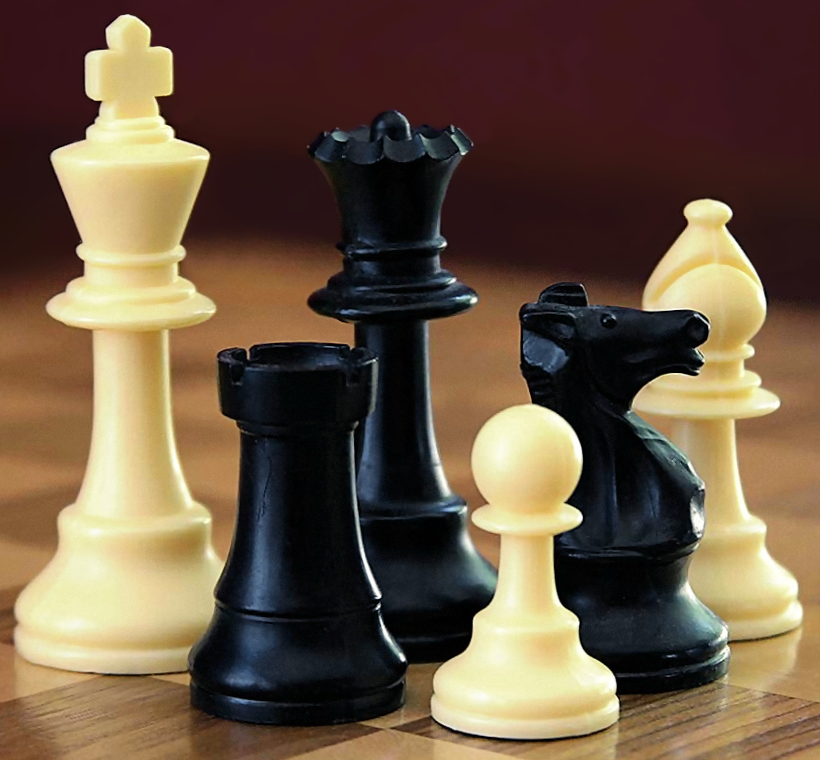
The interesting thing is how well the pieces fit some of the classic character archetypes:

  • The King is like the Hero: the most indispensable character around whom the story revolves.
  • The Queen is like the Chick (or perhaps the Heart): less appreciated than the Hero but a powerful character who holds the team together (and whose loss often makes the team fall apart).
  • The Rook is like the Big Guy: the stoic, straightforward heavy-lifter who might not be quick (rooks are often the last pieces to be developed) but pulls a lot of weight, especially in the endgame.
  • The Bishop is like the Smart Guy: quick and versatile, mystical and unpredictable, striking from a long distance and often performing two or three jobs at once, but lacking the power by himself to achieve victory.
  • The Knight is like the Lancer: likely to go over the others’ heads and the one most likely to sacrifice himself for the cause (knights before bishops, after all).
  • The Pawns are like the Red Shirts: expendable minor characters who may, if they push forward bravely and stay faithful to the end, eventually become queens.

And that’s not all.  The major chess strategies also correlate loosely to major story tropes.  For example, at the beginning of the game, it’s important to move the king to safety, while in the endgame, the king becomes a much more important offensive piece.  Likewise, the hero often spends the first half of the story running away from the bad guys, while in the second half, he starts to take real action.

And the list goes on.  The more I learn about chess, the more parallels I see.  It’s gotten to the point where I want to try diagramming a novel, or perhaps a series, according to a chess game, with that fact being part of the big reveal.  Or perhaps to have one of the major characters have a long-standing chess rivalry with another character who ends up being a major bad guy.

Or something.  I’m just starting a new novel, so everything looks fresh and exciting.  The story will probably change and evolve considerably over the course of writing it, but since it’s a fantasy novel, I think that some chess motifs may be especially appropriate.  Fantasy, after all, is about taking the reader back to a golden age of magic lost in the pages of history, and chess is perhaps the oldest popular game in the world.

In the meantime, is anyone up for a game of chess?

Image (cc) from wikimedia commons.

Struggling not to settle

I’m in the middle of my first revision pass through Heart of the Nebula, direct sequel to Bringing Stella Home, and…I don’t know exactly how to put this, but the story seems to be simultaneously smoother and more shallow.  Plot-wise, everything works great; character-wise, there just doesn’t seem to be as much depth as my other work.

I remember finishing the first draft in May, and being surprised at how well structured it was.  Each of the three major plot points happened after exactly five chapters, and each of the chapters was almost perfectly balanced–a far cry from my previous work.  I had a few stops and starts in the first part, but everything after the first hundred pages was smooth as gravy.  What’s more, I’m finding in this revision that not a whole lot needs to change; it works pretty well as-is.

And yet…I can help but feel as if something is missing.  The characters just aren’t coming alive the way they did in my previous works.  The story isn’t quite as engaging, the climaxes quite as gut-wrenching as I would like.  It feels like a good story, but not a great story.

Here’s the thing: my previous stories were all broken in this phase.  Desert Stars was so broken I had to write another novel to figure out how to finish it–and even then, the second half of the book went entirely in the wrong direction and had to be thrown out.  Bringing Stella Home had a solid storyline, but Stella’s character was completely broken and had to be rebuilt from the bottom up.  And Genesis Earth had half a dozen false starts, and at least as many chapters that had to be thrown out because they did nothing to advance the plot.

But Heart of the Nebula isn’t exactly broken, it’s just…not at the level I would like.  And I worry that because it isn’t broken, I won’t feel as compelled to make it better.  I worked hard on the others, and learned a lot of lessons which helped me to write this book, but even if I’ve hit my stride and this is the result, it feels too much like settling.  I can do better.

None of this probably makes any sense if you haven’t read the manuscript, but I hope it doesn’t sound too much like whining.  Even if these are problems, these are good problems and I’m happy to have them.  When I share this with my first readers, they will probably have all sorts of insights that will make me smack my forehead and make everything awesome again.

I guess my point is that I don’t want to settle, even though this draft will probably not be as good as I’d like it to be.  I’ll fix all the known problems, then send it out to my first readers and trust them to help me find the unknown problems.

In the meantime, I should probably start something new.  I have a ton of great ideas for the fantasy novel, and bouncing them off of friends has really helped me to figure out what else the story needs.  After I finish reading American Gods, I’ll stock up on some fantasy to get into the right mindset, starting with David Gemmell (incidently, at dinner group tonight, I literally squeed while talking about David Gemmell.  It was simultaneously embarrassing and really awesome).

Enough of this.  Time for sleep.

Managing excitement and an idea for an epic fantasy novel

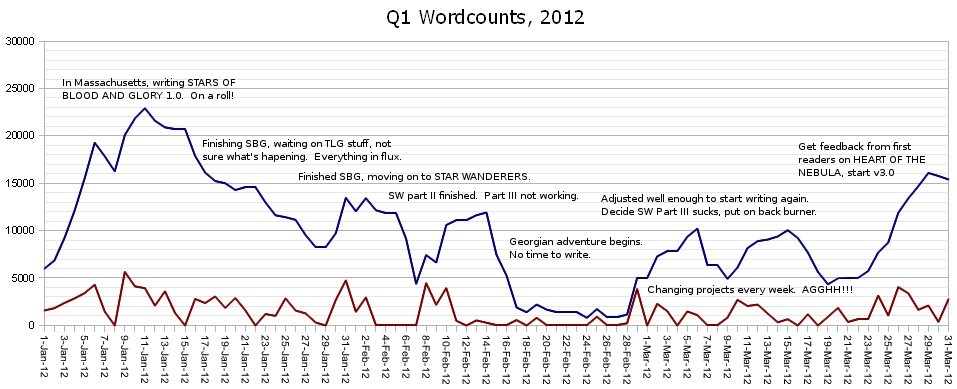
After getting about 40% through Star Wanderers 1.0, I hit a wall and decided to put the project on the back burner for now.  The beginning part, which I’m hoping to shop around as a novelette, has some issues with it and those are keeping me from making any real progress in the rest of the story.

I wish I could just wave my hand and pretend as if I’ve already fixed those problems, but my creative process just doesn’t work like that.  I guess I’m more of a discovery writer in that way, because I can only build on stuff that I’ve already written.  I have to figure out my characters as I write, otherwise they just fall flat.

It’s discouraging, because I feel like I don’t have enough control or discipline over my creative process.  Other writers seem to be able to pick up a project and finish it, even when that project is commissioned by someone else (editors, franchise owners, etc).  But with me, if I can’t get excited about a project, I can’t finish it.

Fortunately, even if I can’t always control which project I’m excited about, I always seem to be excited about something.  After finishing the last revision for Desert Stars, I felt this unusually strong urge to work on Into the Nebulous Deep (which, after the last post, I’ve tentatively decided to rename Heart of the Nebula).  I totally didn’t see that coming, but I’m glad that it did, because that project is getting due for its first major revision.  It’ll probably be a quick one, just to fix some major known issues before sending it off to first readers.

As for new projects, I’m not quite sure what to pick up next.  I’ve got a feeling I could give Edenfall another shot, though it’s dubious at this point, and I still have a bit of lingering excitement over the untitled Gaia Nova novel that involves Roman, Danica, Rina, and Stella’s son.

At the same time, though, I have a really cool idea for a fantasy novel involving magic swords.  The idea is that the swords are actual characters, with the ability to think, feel, remember, and communicate with those who wield them.  They can only be wielded by those whose minds have been melded to them, however, kind of like the Dragonriders of Pern.

As the swords get passed down from generation to generation, they pass on their skills and memories, so that those who wield them become legendary warriors.  However, all but one of the swords goes insane, turning their wielders to evil.  The one sword that remains has refused to take on a new master, even though war and destruction sweeps the land.  A prophecy states that the one who wields this sword will eventually defeat the evil of the others, but when the good sword finally does take on a new owner, it ends up being a farmgirl / tavern wench (I haven’t really decided).

I don’t have a lot of experience writing fantasy, but this story is starting to really excite me.  If I can combine it with a few other ideas and read some good fantasy novels to get into that mood, I think I can make some good progress on it.

So yeah–I have plenty of projects to work on, so things aren’t that bad.  I just need to find one that I can really get into for the next couple of months; if I keep bouncing around from project to project without finishing any of them, that’ll be bad.