Fantasy from A to Z: Y is for Yearning

What kind of fantasy books do you hope to see more of in the next few years? What direction do you hope the genre goes next?

Personally, I would like to see the genre return to its roots. But that probably isn’t a surprise, if you’ve read the other blog posts in this series. I’ve invoked Robert E. Howard and J.R.R. Tolkien in almost all of them. Those two men are the grandfathers of modern fantasy: Howard from the sword & sorcery side, and Tolkien from the epic fantasy side. Until just the last few years, most fantasy authors stood on the shoulders of those great authors.

I’m not opposed to rules-based magic on principle. I do think that it can be done quite well, such as with Brandon Sanderson’s earlier work. But I would like to see a revival of more traditional fantasy magic systems, which aren’t really “systems” at all, but mysterious forces of nature rooted in folklore and mythology. With its overemphasis on game-like dynamics and quirky rules-based magic systems, much of modern fantasy seems to have lost sight of the ancient archetypes that gave the works of Tolkien and Howard their staying power.

As the modern world drifts further from its roots, forgetting all the stories that were handed down to us from countless generations past, so too has our fantasy lost sight of its roots, thinning out to the point where it’s little more than an aesthetic—a bundle of tropes and caricatures that evoke a nostalgia not of our pre-modern past, but of other popular fantasy stories. Thus, with each new work in this vein, the genre is diluted just a little bit more, becoming a pale shadow of what it once was.

That is why I would like to see fantasy return to its roots. I would like to see more fantasy that draws deeply from the well of history and mythology, not just to create an aesthetic, but to embed those themes and archetypes deeply into the story itself. I don’t care whether that mythology is European or not (though as a pan-European mutt, that is the culture that resonates most with me), but I do want to read books that do more than file the serial numbers off of another culture and wear it like a skin suit. 

It’s not so much that I’m worried about “cultural appropriation”—hell, as the son of medieval vikings, cultural appropriation is my culture—but if that’s what you’re going to do, you should damn right do it well. There’s a reason why we all got sick and tired of all the Tolkien clones. If we’re going to take fantasy back to its roots, we’ve got to do more than copy all the greats who came before us. We’ve got to understand, in a deep and visceral way, just what exactly they were trying to build, and then build upon it with something new.

Fantasy and science fiction are all about evoking that sense of wonder. Science fiction evokes that wonder by looking to the future; fantasy evokes that wonder by looking to the past. Our modern world has forgotten far too much of its cultural heritage. I want to see more fantasy that brings it back.

Three common tropes that I hate (and what I’d like to see more of instead)

So I’ve been reading a lot of books in the last few months, which means that I’ve been DNFing a lot of books too, and I’ve noticed some recurring patterns in the books that I’ve DNFed. A lot of these are tropes that I’ve either gotten sick of seeing, or that tend to make for a much weaker book. Or both.

I thought it might be interesting to point a few of them out, but I don’t want this post to be totally negative, so I’ll counteract that by also sharing some positive tropes that I’d like to see more of instead. If you guys enjoy this post, maybe I’ll do something like it again in a couple of months.

The Only True Love is LGBTQ Love

I see this one all the time in SF&F these days. Basically, if there are two characters who are romantically involved with each other, or if there is a romantic subplot to the story (not the main plot: sci-fi romance is a separate thing, for purposes of this trope), then that romantic relationship has to be gay, trans, or queer in some way. Or polyamorous, I suppose (does poly fall under the “+” in “LGBTQ+”? Maybe it’s the “P” in “LMNOP.”)

From what I gather, this trope began when LGBTQ activists pointed out that their particular kinks and orientations were “under-represented” in SF&F. Publishers, editors, and authors responded by filling their stories with more LGBTQ relationships, in order to avoid getting singled out as not being sufficiently LGBTQ-friendly. It’s the same principle as the zombie apocalypse: you don’t actually have to be the fastest runner, you just have to run faster than the guy behind you. Of course, since the SF&F field is so thoroughly dominated by leftists, pretty soon every story had an LGBTQ romance in it, to the point where straight romantic sub-plots are now actually kind of rare, at least in the books that are winning all the awards. Which is how you know the “under-representation” angle was a lie from the beginning.

It’s gotten to the point where if any character at all announces themselves as LGBTQ in the first few chapters of a novel, or the first few paragraphs of a short story, I immediately DNF. Call me homophobic; I don’t really care. These stories are so predictable that I can often pick out both which characters are going to be LGBTQ and which ones will end up together, within a page or two of them stepping into the story.

Of course, the main reason I don’t like these stories is because I’m not LGBTQ myself, and personally find straight romantic subplots to be much more interesting and satisfying. But there is another reason, and it has to do with the way that all of these stories aren’t just about entertaining readers, but about promoting LGBTQ pride.

This is going to get me a lot of hate, but it’s true so I’m going to say it anyway: the only thing that unites the LGBTQ movement together is the normalization of sexual perversity.

Think about it for a moment: what do each of the letters in LGBTQ really have to do with each other? Most gays would be happy to live in a world without women, and most lesbians would be happy to live in a world without men. Both of them view bisexuals with veiled suspicion and sometimes outright hostility, as if they’re somehow traitors to the wider homosexual cause. Transgenders affirm their identity by playing into as many stereotypes of masculinity and femininity as they can, which puts them directly at odds with masculine women and feminine men. And queers adopt all sorts of positions that contradict—or even negate—every other letter in the pantheon.

The LGBTQ movement is so full of internal contradictions that the only way it can hold together is to unite against a common enemy, and the only enemies that they all have in common are the people who affirm that there is a moral dimension to human sexuality, and that some forms of sexual expression are immoral. Even the modern notion that all consensual sex is fine goes too far for these people, because it excludes pedophilia, since children are not capable of giving their consent. And does anyone really doubt that one of the LGBTQ movement’s ultimate goals is to normalize pedophilia? When it’s not uncommon to see children under 12 at pride parades, drag shows, and drag queen story hour at the local library, sometimes as the very stars of the show?

I’ll say it again: the only thing that unites the LGBTQ movement is the normalization of sexual perversity. As soon as the leaders of the movement draw a line in the sand and say “this is not okay, this goes too far,” the movement will turn on itself and the revolution will eat its own. Thus, every new form of sexual perversion must be one-upped by something even more perverse. That is why we are literally butchering and chemically castrating children now.

(As a side note, it’s worth pointing out that being gay does not automatically make you part of the LGBTQ movement. My brother in law is openly gay, but he’s also a practicing Latter-day Saint who rejects all of this stuff. His faith is directly at odds with the LGBTQ movement, and he has chosen to keep his faith.)

So now, whenever I read a book with two (or more) characters in an LGBTQ relationship, I can’t help but feel that I’m reading “message” fiction, where the message is ultimately to normalize some other aspect of sexual perversion. Sorry (not sorry), but no thanks.

Instead: More pro-family, pro-natalist, life affirming fiction

So what do I want see instead? More stories with strong, healthy families. Stories about motherhood and fatherhood, that affirm the importance of both parents in raising children. Pro-natalist stories where having children is seen as a good thing, not as destroying the environment or burdening the world with more mouths to feed. In other words, stories that affirm and celebrate the intrinsic value of life—every life.

The one thing that all LGBTQ relationships have in common is that they cannot naturally produce children. Because of this, stories that follow the “all true love is LGBTQ love” tend to be about found families, rather than natural families. Parents are often absent or abusive in these stories, and children are either adopted or non-existant. A significant number of these stories also tend toward the macabre, since affirming the intrinsic value of life ultimately invalidates many of these LGBTQ relationships.

But that’s not why I want more pro-family, pro-natalist, life affirming stories. It isn’t about bashing LGBTQ, but about presenting a vision that stands apart from the LGBTQ movement, and doesn’t kowtow to the activists’ demands. It can even have room for some LGBTQ characters and relationships. Kings of the Wyld by Nicholas Eames is a good example of that, where one of the side characters is monogamously gay, and the protagonist is very much a family man. Another life affirming book I really enjoyed was To Sleep in a Sea of Stars by Christopher Paolini.

All Christians are Evil or Stupid

This is one you probably don’t notice if you aren’t Christian yourself, but I see it all the time, as do most other Christian readers that I know. If a character in a book or a story is some sort of Christian, then invariably they will turn out to be a villain, or so stupid that they’re less of a help and more of an obstacle to the protagonist. Or an eccentric curiosity.

It wasn’t always this way. Back in the 80s and 90s, there were lots of science fiction novels where the good guys were Christians. But these days, if the Christian character turns out to be a good guy, the author is either indie or a pariah to the rest of the SF&F field, like Larry Correia, John C. Wright, or Orson Scott Card.

Activists like to point out that if a majority of books tend to portray a particular race, gender, or sexuality in a negative light, it’s a sign that the field itself is racist/sexist/etc. They aren’t wrong. Now apply that to how mainstream science fiction and fantasy tends to portray Christians, and you begin to see the problem. There is a ton of anti-Christian bigotry in the culture right now, and it shows when you read most of these books.

Instead: More badass Mormons

So what do I want to see instead? More stories with badass Mormons. I’m only partially joking. As a member of the Church of Jesus Christ of Latter-day Saints, of course I would love to see more books with members of my faith doing awesome and inspiring things, but I’d be happy to see other kinds of Christians too.

Even books with generic Christians as good guys would be nice, but it would be better if something unique about their faith is central to the story. For that, you need to go deeper than a generic approach, so it would be better to make the character a member of a particular church or creed. And even though we Christians have our own theological differences, and sometimes argue quiet passionately over them, I wouldn’t at all mind to read stories with more Catholic main characters, or Evangelical, or even a well-written Jehovah’s Witness.

But personally, I want to see more badass Latter-day Saints.

An Innocently Profane and Vulgar Childhood

This one isn’t quite as prevalent as the other two, at least in the books I’ve read recently. However, it is definitely a common trope, especially in more recent books. Basically, it’s when something profane or vulgar invades a character’s childhood, but that isn’t portrayed as bad or even significant. For example, when there’s a child on the page and the people around them are swearing, or maybe even the children themselves. Or as a child, a character is exposed to something sexual, but it’s not a big deal.

In most of these books, it doesn’t seem like the author is doing it intentionally. But as Jonathan Haidt points out, liberals tend not to value things like purity and innocence as much as conservatives, or even really at all. Since the SF&F field is so thoroughly dominated by leftists, I think they often tend to violate the innocence of childhood without realizing that they’re doing it.

But in some books, it seems like the author is doing it intentionally to make a point: either that innocence itself is an illusion, or that children do better when they aren’t sheltered from the harsh realities of the world (they don’t). Or often, the author just thinks it’s funny to juxtapose childhood innocence with the profane (it isn’t—at least, not to me).

Instead: More noblebright

This isn’t generally a trope that you see in noblebright fiction. Not that noblebright doesn’t wrestle with questions of profanity, vulgarity, and evil, but it does tend to respect the boundaries of childhood innocence. And even after the characters lose their innocence, they still tend to become purified by the events of the story. There is a difference between being innocent and being pure, and a lot of really excellent noblebright stories explore the finer nuances of that difference.

Noblebright isn’t very popular right now, but I hope that will change in the coming years. There are some very good reasons to think that it will. Of course, noblebright can be done poorly, and stories that don’t put their characters into any real peril tend to be boring and unengaging. But it is possible to put children in peril without violating their innocence, or rejecting the concept of innocence to begin with. That is what I want to see.

2019-09-19 Newsletter Author’s Note

This author’s note originally appeared in the September 19th edition of my author newsletter. To subscribe to my newsletter, click here.

It’s September, which means (among other things) that it’s time to revisit my business plan and update it for the next year. Every January 1st, I print out a new and revised copy of my business plan, which provides a great opportunity to evaluate my efforts and hone in on the things I need to do better.

For the last couple of weeks, I’ve been working on the section titled “What I Write.” In this year’s business plan, it was a pretty straightforward breakdown of all of the series in my catalog. But for next year, I took a few steps back to address things like what is a Joe Vasicek book? or what are some of my books’ recurring themes? or what kind of science fiction and fantasy do I write specifically, and how does my work contribute to the genre?

The exercise really got me to think about why I write. In the day to day life of a writer, it’s very easy to lose sight of the forest for the trees. Deadlines and daily word count goals keep the focus on the page right in front of you, and when you do think ahead it’s usually just to the next chapter. But without taking time to step back and look at the bigger picture, it’s easy to lose that creative drive, or settle for second-rate work.

So what is a Joe Vasicek book? I hope it’s a book that’s memorable and meaningful. It may be dark, but never dismal. It may push you out of your comfort zone, but it also leaves you feeling rejuvenated and inspired. It features interesting characters wrestling with complex ethical dilemmas and struggling to do the right thing as best as they know how.

What are some of my books’ recurring themes? The balance between liberty and responsibility is a huge one. Actions have consequences, and true liberty is taking ownership of those consequences as well as your actions. Another is the sanctity of sex, contrasting selfish gratification with the affirmation of commitment and love. The yearning for God is another recurring theme, with a great deal of religious diversity in the starfaring civilizations of my books. Another theme I keep coming back to is the call of the frontier.

I’m curious, though, to hear what you guys think. What do you think makes a Joe Vasicek book? What tropes or recurring themes have you enjoyed in my books? As a writer, I’m often too close to my own work to see what’s obvious to everyone else. What do you think is my biggest contribution to the genre?

Trope Tuesday: Manic Pixie Dream Girl

Oh dear. I’m probably going to take some heat for this one, especially if it gets picked up by File 770.

What is a “manic pixie dream girl”? Tvtropes puts it this way:

An upbeat young woman whose love gives the brooding male hero a new lease on life.

Wikipedia puts it this way:

…the MPDG “exists solely in the fevered imaginations of sensitive writerdirectors to teach broodingly soulful young men to embrace life and its infinite mysteries and adventures.” MPDGs are said to help their men without pursuing their own happiness, and such characters never grow up; thus, their men never grow up.

You know how the term “space opera” was originally a derogatory term for crappy science fiction? I’m going to go out on a lark, invoke tropes are tools, and argue that Wikipedia is wrong and there’s nothing inherently bad about this trope.

Anita Sarkeesian is not a huge fan of the manic pixie dream girl. In fact, it was the first trope she deconstructed way back 2011, before her scammy kickstarter. I’m not a huge fan of Anita Sarkeesian, but it’s worth rewatching her take on it:

In particular:

The manic pixie perpetuates the myth of women as caregivers at our very core—that we can go fix these lonely, sad men, so that they can go fix the world.

Here’s the thing, though: when you study the men who have fixed the world, you almost always find a strong, caregiving woman behind them. This is portrayed very well in The Darkest Hour, with Winston Churchill’s wife, Clementine:

Granted, Clementine Churchill is no manic pixie, but she did provide critical support to her husband, and was one of the key influences that shaped him into the great man of history that he ultimately proved to be.

Here’s the thing: men need women, just as women need men. All the feminist eye-rolling in the world doesn’t make that untrue. And for men who are lonely, depressed, or overly introspective, a perky outgoing woman can really have a positive impact.

The key to doing this trope well is to make the MPDG a complete character in her own right. Critics rightly point out that something is wrong when she exists solely for the benefit of the male protagonist. That’s not a feature of this trope, though: that’s just bad writing in general.

The best example of a MPDG in my own work is probably Deirdre from Heart of the Nebula. The rest of this post is going to be full of spoilers, so if it’s on your TBR list, you should probably skip to the end now.

Deirdre is very much a character in her own right. She’s the ship’s historian of the Chiran Spirit, a generation ship that James liberates from pirates before going into cryosleep. In spite of her perky, cheerful demeanor, she has experienced deep pain in her life. She immediately latches onto James, but over time this transforms from an interest in a living historical figure to genuine attraction and love.

James and Deirdre round off each others’ rough edges. She helps him to recover his optimism and self-respect, while he helps her to understand herself better and decide what she truly wants. They both help each other to reconcile with difficult baggage from each of their pasts, and though they both go through a period of disillusionment, they ultimately come out stronger for it on the other side.

Here’s the thing, though: if Deirdre was anything but a manic pixie dream girl, she wouldn’t have been able to help James through his darkest hour. It’s her bouncy enthusiasm, clumsy excitement, and unfailing optimism that draws him out of his callused shell. Without those characteristics, the story—and her character—wouldn’t have worked.

In short, I believe that the manic pixie dream girl trope very much has a place, and isn’t inherently sexist or mysoginistic at all. It can be, if done poorly, but when done well it points to the reality that men need women just as women need men, and that’s actually a good thing, no matter what the feminists say.

Trope Tuesday: Death Seeker

The Death Seeker is a character who wants to die, but for whatever reason isn’t willing to commit outright suicide. The TVtropes page has a good summary:

At some point in the past, some characters have had a traumatic experience, found themselves dishonored, committed a crime they could not repay, or lost everything worth living for. For whatever reason, rather than turning to suicide, they went off seeking battles to fight, hoping to find an enemy who would kill them, and achieve an honorable, heroic, awesome, or otherwise acceptable death, sometimes going as far as outright surrendering and offering their life to their enemies.

I’ve written a surprising number of these characters, but more often than not they end up living instead of dying. Quite often, they have a mentor who used to be a death seeker themselves, who makes them promise to find a reason to keep on living.

Escapist fiction is fun, but I like to read stories that are meaningful as well. The two are not mutually exclusive. When the protagonist is a death seeker, the question “what is worth living for?” tends to be a major driver for the story.

One character who’s very much on my mind right now is Mara Soladze from Sons of the Starfarers. A refugee turned marine, she has a traumatic experience in Comrades in Hope that very nearly pushes her over the despair event horizon. She can’t just give up and die, though, because there are people depending on her. As she climbs up the ranks from first mate, to captain, and finally to commodore, that tension never goes away.

Probably the biggest difference between a death seeker and someone who’s simply suicidal is that the death seeker is looking for something to die for. They’re much more likely to make a heroic sacrifice or go out in a Bolivian army ending.

But if something is worth dying for, isn’t it also worth living for? That is ultimately the question.

Trope Tuesday: The Alliance

In fiction, the fight against the Empire usually follows a clear progression.

First, you have the Resistance, a scrappy band of misfit freedom fighters who take up arms, barricade the streets, and fight back against all odds. Think Rogue One, or Les Miserables.

If they aren’t immediately crushed, the Resistance eventually turns into the Alliance. Only slightly more organized than the Resistance, it’s still not unheard of for members of the alliance to turn on each other if the right opportunity arises. That said, when they’re united, the Alliance can muster a lot more firepower than the Resistance could ever hope to bring.

The Alliance is what happens when the local powers commit to the fight. It’s what happens when a low-level insurgency turns into a full-blown civil war. Whether or not everyone in the alliance trusts each other, together they have all crossed the Rubicon in the fight against the Empire.

If the Alliance is successful and defeats the Empire, it will either turn into the Republic or the Federation. The Republic is much more centralized and behaves like a single nation, whereas the Federation is a collection of semi-autonomous states united under one banner.

To pull a page from history, the United States started as the Resistance, with the patriots dumping the tea at the Boston tea party. With the Declaration of Independence, the Resistance turned into the Alliance as the minutemen became the Continental Army. With the Constitution of the United States, the Alliance became the Federation, which (depending on your reading of history) has either endured to the present day, or transformed into the Republic and/or Empire.

Star Wars used to have a very clear progression from Republic to Empire (episodes I-III) and Resistance to Alliance to Republic (Rogue One, episodes IV-VI, and the expanded Star Wars universe), but the new movies have apparently thrown all that out and moved us from Resistance to Alliance to… Resistance again? And the Empire went from Remnant to Empire, even after losing Starkiller Base in episode VII? Yet another reason why The Last Jedi really did not impress me.

In my own books, this progression figures prominently in Sons of the Starfarers. It starts with the Resistance in Comrades in Hope, but soon transforms into the Alliance and stays that way for most of the rest of the series. It’s on my mind right now, as I finish An Empire in Disarray and get ready to write the last book, Victors in Liberty.


Trope Tuesday: The Chessmaster

The Chessmaster is a fun trope, especially when done well. A good villain is always at least one step ahead of the good guys, so when it turns out that he’s three or four or ten steps ahead of them, it can make for some interesting plot twists.

Of course, the chessmaster isn’t always the bad guy. Sometimes, it turns out that the mysterious figure behind the scenes pulling all the strings is actually working for good, even though he may sacrifice a few pawns along the way. Or is he? There’s always that tension, simply because of the chessmaster’s manipulative nature.

I’ve played it both ways. The last time I wrote a chessmaster was Gunslinger to the Stars, but the Patrician in Heart of the Nebula definitely also qualifies. In both cases, the character was introduced as a mysterious employer. I won’t tell you which one was the bad guy, and which one was the good guy.

I’ve never written a story from the perspective of the chessmaster. I imagine it would be quite difficult, since all of the plot twists would have to be telegraphed and/or th reader would have to be kept in the dark about the main character’s plans. Dune is an excellent example of the former, but I can’t think of any good examples of the latter. The Davinci Code comes to mind, but the way it kept the viewer in the dark (seen the movie, haven’t read the book) didn’t work for me.

Even as a non-viewpoint character, the chessmaster can be difficult to write. Careful plotting is key, of course, but so is the iceberg principle. For everything the reader can see, there has to be a bunch of stuff beneath the surface that they can’t see. It doesn’t require the same level of detail as the surface level stuff, of course, but you have to at least have an idea of what the chessmaster would do if the story went in a very different direction. Even if the chessmaster never reveals those plans, you can bet that he still has them figured out.

In part, this is what made Heart of the Nebula so difficult to write. The final draft bears little resemblance to the first draft, with characters and subplots cut out or combined with others. Still, I’m satisfied with how it turned out, and it seems that the readers are as well.

In Sons of the Starfarers, Gulchina isn’t a chessmaster so much as a magnificent bastard with delusions of grandeur. She has plans and does tend to be three or four steps ahead of everyone else, but she’s less interested in manipulating events than she is in manipulating people. Her ultimate goal, as revealed in Captives in Obscurity, is to establish a proud warrior race that will one day wipe out and take over both the Empire and the Outworlds. She doesn’t know how that’s going to happen, but she knows what needs to be done to lay the foundation for that work.

The chessmaster is a challenging trope to write well, but I’m sure I’ll use it many more times in the future. The storytelling potential is just too great to leave it out.

Trope Tuesday: Chekhov’s Armory

The famous Russian writer Anton Chekhov had a rule:

Remove everything that has no relevance to the story. If you say in the first chapter that there is a rifle hanging on the wall, in the second or third chapter it absolutely must go off. If it’s not going to be fired, it shouldn’t be hanging there.

This is, of course, where we get the trope called Chekhov’s Gun. If a gun shows up at the beginning of a story, you can almost always be sure that it will be fired at some point before the end.

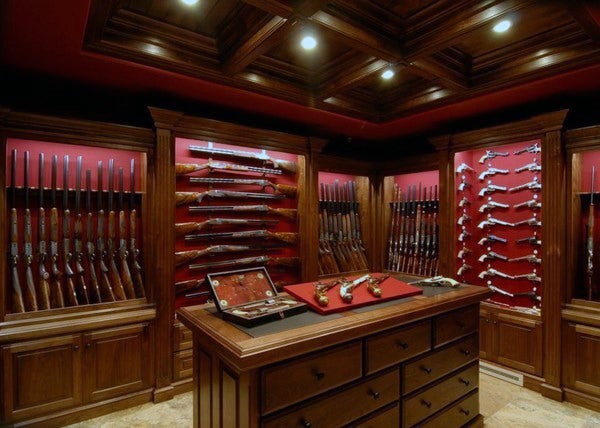
Chekhov’s armory is where the story starts out in a place like this:

Or this:

Or this:

What the hell, I might as well just give you the link to the blog where I got all these photos. There’s plenty more gun porn where that came from.

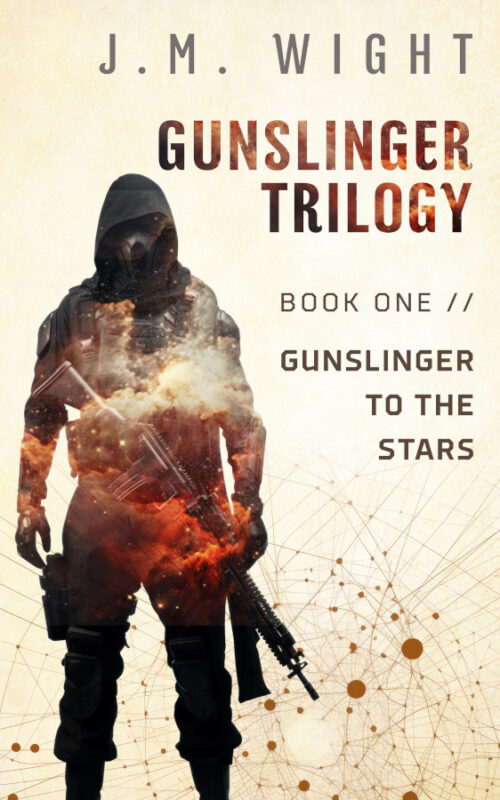
My first time playing with this trope was Gunslinger to the Stars, and I have to say, it made for a really fun story. My outline literally consisted of listing a different gun for every chapter, and figuring out how to work it in. Chapter two was where all most of the guns were listed, but after that, it was pretty much “open fire” and “reload” right up to the grand finale at the end (with a little bit of kissing thrown in for good measure).

Seriously, though, it’s not a bad way to write a book: list all the things that need to go boom and figure out which order to put them in.

The biggest criticism I’ve received for Gunslinger to the Stars is that I should have described the guns in a more personalized detail. To be honest, my life experience is sadly lacking in this regard. I own a couple of guns, most notably an old Mosin 91/30, but most of my shooting experience comes from the Boy Scouts (though to be fair, I did impress the shotgun shooting instructor with a 40+ shot streak). This is a shortcoming that I am eagerly working to rectify.

So yeah, Chekhov’s Armory. It’s a really fun trope to write. When I’m finished with Sons of the Starfarers, I look forward to doing it all again with the next two books in the trilogy: Gunslinger to the Galaxy and Gunslinger to Earth. Expect book two before the end of 2018!

Gunslinger to the Stars

Gunslinger to the Stars

$15.99eBook: free sale!Audiobook: $2.99 sale!

Sam Kletchka here, freelance gunslinger and interstellar privateer. This, my friends, is how I went from being stranded in the armpit of the galaxy to becoming the luckiest human being in the universe.

More info →

Trope Tuesday: Childhood Friends

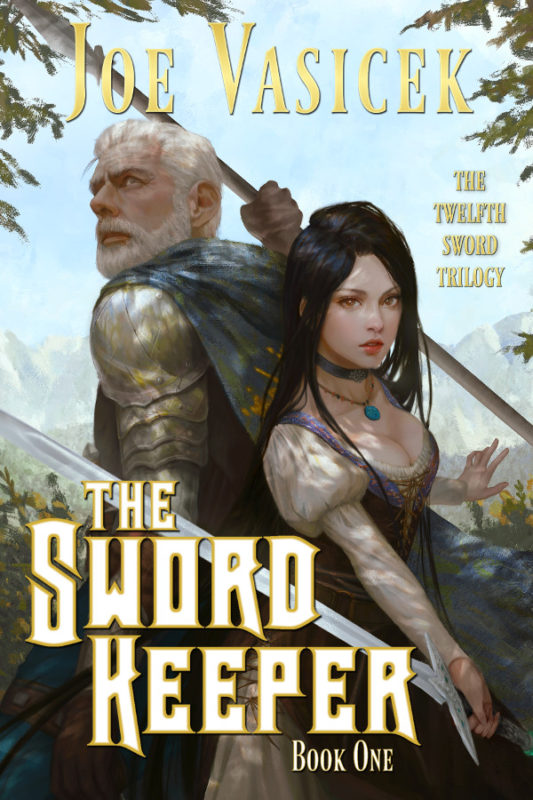
Friendship comes in a lot of flavors. In The Sword Keeper, Tamuna’s most loyal friend (and arguably a deuteragonist of the book) is Nika, the stable boy at her aunt’s tavern. Where Tamuna initially refuses the call to adventure, Nika jumps at the call, quickly catching up to her (which is good, because the call knows where they live).

Where Alex’s loyalty is based in honor, Nika’s loyalty is based in pure friendship, at times even flirting with (but never quite achieving) childhood friend romance. (Of course, this is only the first book in a trilogy…) These two different kinds of loyalty lead to some interesting differences between the characters, which I can’t really discuss since I don’t want to spoil the book.

I guess I can say this much: at the beginning of the book, Nika believes that he is Tamuna’s only friend. But when it becomes clear that Tamuna is no shrinking violet, the roles become reversed as Tamuna comes into her own. Since Nika has never known a world outside of their village, he does not take this well.

According to Dramatica, each story can be broken into four throughlines: the overworld story, the main character’s story, the impact character’s story, and the story of how each of them… well, impact each other. In The Sword Keeper, the overworld story is all about the return of the twelfth sword to a dark and troubled world. The main character, Tamuna’s story, is about her rise from the most unlikely beginnings to become the prophesied sword bearer. Her childhood friend Nika is the character who impacts her the most, and while I won’t spoil his story or the main vs. impact character story for you, it’s definitely a key part of the book.


The Sword Keeper comes out in less than two weeks! Preorder your copy today!

The Sword Keeper

The Sword Keeper

$12.99eBook: $4.99
Author: Joe Vasicek
Series: The Twelfth Sword Trilogy, Book 1
Genres: Epic, Fantasy
Tag: 2017 Release

Tamuna Leladze always dreamed of adventure, but never expected to answer its call. That changes when a wandering knight arrives at her aunt's tavern. He is the keeper of a magic sword that vanished from the pages of history more than a thousand years ago. The sword has a mind and a memory, and it has chosen Tamuna for purpose far greater than she knows.

More info →

Trope Tuesday: Knight in Sour Armor

What happens when the knight in shining armor realizes that war is hell and he lives in a crapsack world? When everything he believes about morality and honor is shattered?

Does he suffer a heroic BSOD and become a shell shocked veteran?

Does he cross the moral event horizon and become the one who hunts monsters?

Does he turn lawful evil and become the knight templar?

Or does he put on his jade-colored glasses, pick up his sword, and soldier on?

It’s one thing to follow a code of honor when you believe that people are basically good. It’s another thing entirely when you realize that people are filthy scumbags. Yet we often mistake starry-eyed idealism for the real thing. Underneath his hardened and deeply cynical demeanor, the knight in sour armor is driven by honor and ideals far more than he lets on.

In The Sword Keeper, one of the viewpoint characters, Alex Andretzek, is a young warrior prince who has lost his kingdom. He’s pledged his life to the service of the sword Imeris, with the understanding that one day he will be the new sword keeper. Then Tamuna comes into the picture, and all of that suddenly changes.

The most aggravating thing for Alex is that he has no idea why the sword choose Tamuna over him. Was he not worthy, or has the sword chosen poorly? It’s hard for him to tell which one is worse.

Of course, there is a third option: that there’s some hidden quality in Tamuna that he doesn’t yet see. But the same sour armor that allows him to cope with the injustice of the world also fills him with doubts. It’s a difficult balance to strike.

Underneath it all, though, Alex is a good and honorable man. Without his sour armor, he would have given all that up years ago.

To me, Alex is the embodiment of the saying that you should assume that everyone you meet is struggling through the most difficult challenge of their lives. If you do, you’ll be right about half of the time. On the outside, Alex is cold, aloof, and even somewhat rude. But beneath his sour armor, the struggle is real.


The Sword Keeper comes out in 18 days! Preorder the ebook now!

The Sword Keeper

The Sword Keeper

$12.99eBook: $4.99
Author: Joe Vasicek
Series: The Twelfth Sword Trilogy, Book 1
Genres: Epic, Fantasy
Tag: 2017 Release

Tamuna Leladze always dreamed of adventure, but never expected to answer its call. That changes when a wandering knight arrives at her aunt's tavern. He is the keeper of a magic sword that vanished from the pages of history more than a thousand years ago. The sword has a mind and a memory, and it has chosen Tamuna for purpose far greater than she knows.

More info →