What Makes a “Joe Vasicek” Book?

I recently uploaded all of my books to ChatGPT and asked it to read them all and tell me what makes a “Joe Vasicek” book. The result was a fascinating conversation with the chatbot. It was too long to share in its entirety, so I asked ChatGPT to summarize it as a 1500 word blog post. Here is what it gave me:


Every author has recurring patterns. Sometimes they are obvious: favorite settings, familiar plot structures, beloved tropes. Sometimes they run deeper, beneath genre and surface premise, shaping the emotional and moral logic of the stories themselves. Looking across Joe Vasicek’s published science fiction and fantasy, a clear pattern emerges. His books are not simply space operas, frontier adventures, sword-and-sorcery tales, or clean romantic fantasies. At their core, they are stories about people trying to find, build, defend, or become worthy of home.

A Joe Vasicek book is usually set on the edge of civilization. That edge may be literal outer space: a far-flung colony, an isolated station, a small merchant starship, a dangerous trade route, or a frontier beyond the reach of stable law. It may also be a fantasy frontier: a seacoast, a ruined kingdom, a cursed wilderness, a lonely homestead, or a world recovering from plague, war, and desolation. But whatever form the frontier takes, it is rarely just a backdrop for adventure. It is a moral testing ground.

The central question is not merely whether the hero will survive. It is whether the hero can preserve the things that make survival meaningful: family, faith, freedom, love, loyalty, honest work, and moral courage.

This is why exile appears so often in Vasicek’s fiction. His protagonists are frequently displaced people: wanderers, captives, refugees, orphans, widows, failed apprentices, disgraced sons, forgotten daughters, fugitive lovers, and people who no longer belong in the world that formed them. They may dream of a lost Earth, flee an oppressive warrior culture, survive famine on a failing station, escape slavery, seek a ship, or defend a fragile home from powers that would destroy it. Their longing is not abstract. They want something deeply concrete: a place at the table, a family, a ship, a marriage, a household, a people, a future.

That longing for home is one of the defining features of Vasicek’s voice and vision. In many of his books, home is not something the characters simply return to. It must be built, chosen, earned, or restored. Sometimes it is a starship crew. Sometimes it is a marriage. Sometimes it is a frontier colony. Sometimes it is a homestead in the woods, a kingdom healed from corruption, or a family formed under impossible circumstances. His stories tend to end not merely with enemies defeated, but with the possibility of a stable moral order: a household, a child, a promise, a voyage, a free people, a new beginning.

Closely connected to this is Vasicek’s recurring interest in family formation. Marriage, children, inheritance, kinship, motherhood, fatherhood, and legitimacy are not decorative details in his fiction. They are often central to the worldbuilding. Societies in his books are shaped by who marries whom, who inherits, who belongs, who is cast out, who is enslaved, who is protected, and who is allowed to have a future. This gives even his space opera a domestic and anthropological depth. Starships are not just machines. They are households. Frontier settlements are not just adventure locations. They are embryos of civilization.

This family-centered quality sets Vasicek apart from much of contemporary science fiction and fantasy. In a market often dominated by antiheroes, irony, grimdark despair, eroticized power dynamics, or purely individual self-actualization, Vasicek’s books keep returning to older and more ordinary goods: marriage, children, duty, faith, work, and home. That does not mean the books are soft. His stories include captivity, slavery, war, famine, coercion, betrayal, exile, monsters, corrupt rulers, and civilizational collapse. But the darkness does not usually become the point. It is the pressure under which characters reveal what they truly love.

Another recurring element is freedom versus domination. Vasicek’s villains and oppressive systems often seek control over the intimate foundations of human life. They enslave, coerce, corrupt, conquer, manipulate marriage, break families, reduce people to tools, or turn sacred things into instruments of power. Against them stand people who may be weak, wounded, or compromised, but who still recognize that some things must not be surrendered. A recurring moral pattern in Vasicek’s work is that power becomes evil when it severs itself from love, covenant, humility, and responsibility.

This is especially visible in his fantasy. In the fantasy stories, magic frequently tests the soul. Treasure corrupts. Dark orders twist noble purposes. Forbidden power promises victory while hollowing out the one who wields it. Sacred objects and magical gifts are not merely tools; they expose character. The question is often whether the hero can become worthy of the power placed in his or her hands.

The science fiction handles similar concerns differently. In Vasicek’s SF, the central question is more often civilizational: what kind of society will human beings build on the frontier? Technology, star travel, colonization, lost Earth, trade routes, empires, and small ships all become ways to explore whether freedom and family can survive across distance. The fantasy asks whether the soul is worthy to wield power. The science fiction asks whether civilization is worthy to endure.

Yet the two sides of Vasicek’s work are recognizably connected. A sea mage searching for a crew and a star wanderer seeking a place among the stars are spiritual cousins. A cursed treasure that tests a fantasy hero and a civilization-changing technology that threatens an Outworld culture are variations on the same concern: what happens when power outruns virtue?

Faith is another quiet but persistent current. Vasicek’s books are not always explicitly religious, and many are not “religious fiction” in the usual bookstore sense. But they are shaped by a religious imagination. Providence matters. The universe has moral structure. Choices echo beyond immediate consequences. Suffering is not meaningless. Death is not always the final word. Love, sacrifice, chastity, loyalty, mercy, repentance, and covenant are treated as real forces, not sentimental illusions.

This gives his work what might be called moral gravity. The stories are generally clean, but “clean” is too weak a word for what they are doing. Clean can sound bland, safe, or sanitized. Vasicek’s better books are not harmless. They are morally serious. They often deal with brutal worlds, but without surrendering to brutality. They offer hope, but usually after loss.

That balance—dark trials, hopeful destination—is one of the most marketable aspects of his brand. Readers who are tired of nihilism may find in his books a kind of old-fashioned adventure that does not feel cynical. Readers who enjoy romance but do not want explicit heat may respond to the way his stories treat love as courtship, marriage, loyalty, and family destiny. Readers who enjoy frontier survival may respond to the practical details of ships, homesteads, trade, hunger, labor, and settlement. Readers who want faith-friendly speculative fiction may find his work welcoming without feeling confined to the Christian-fiction aisle.

At the same time, the analysis reveals some challenges. Vasicek’s books cross several genre lanes: hard SF, space opera, sword-and-sorcery, seafaring fantasy, frontier survival, time travel, post-apocalyptic fiction, captivity drama, and short-form idea fiction. That range can make the brand feel scattered. A reader who comes for small-ship space opera may not immediately understand how that connects to a fantasy homestead story or a cursed-treasure adventure. The underlying themes are consistent, but the surface packaging varies widely.

There is also a tonal challenge. Vasicek often writes “clean” fiction, but some of his recurring material is intense: slavery, captivity, concubinage, forced marriage, sexual coercion, famine, genocide, and patriarchal warrior cultures. These are not cozy stories. If marketed carelessly, they can send the wrong signal. The captivity material, in particular, needs to be framed around dignity, survival, identity, and freedom rather than dark-romance titillation or grimdark shock.

The clearest author brand, then, is not simply “clean science fiction and fantasy.” That is accurate but incomplete. The stronger brand is this:

Joe Vasicek writes clean, morally serious frontier science fiction and fantasy about wanderers, captives, exiles, and ordinary heroes building homes and families in dangerous worlds.

Or shorter:

Frontier science fiction and fantasy about faith, family, freedom, and finding home among the stars.

Or more distilled still:

A Joe Vasicek book is about finding home on the frontier without losing your soul.

That is the through-line. Whether the story involves starships, sea mages, cursed treasure, lost Earth, warrior clans, alien worlds, magical swords, or widowed mothers, the deeper movement is the same. The world is dangerous. Civilization is fragile. Power corrupts when severed from virtue. But love, faith, family, and moral courage can still make a home in the wilderness.

That is what makes a Joe Vasicek book.
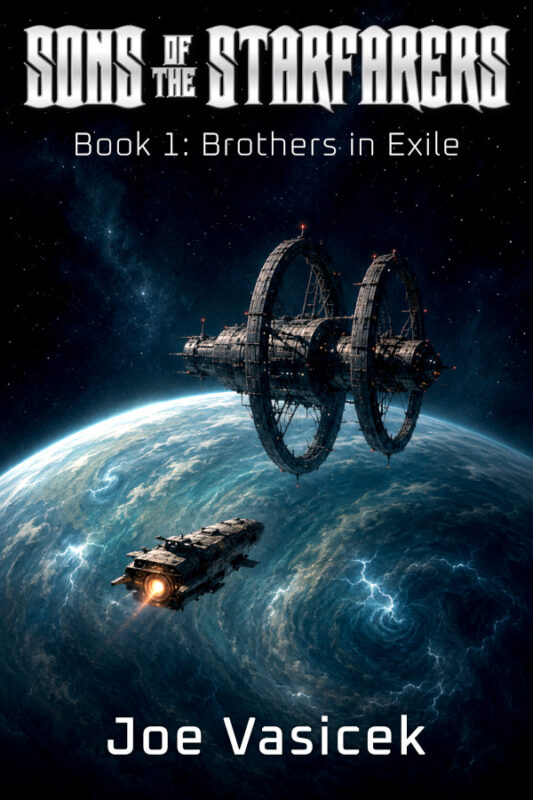
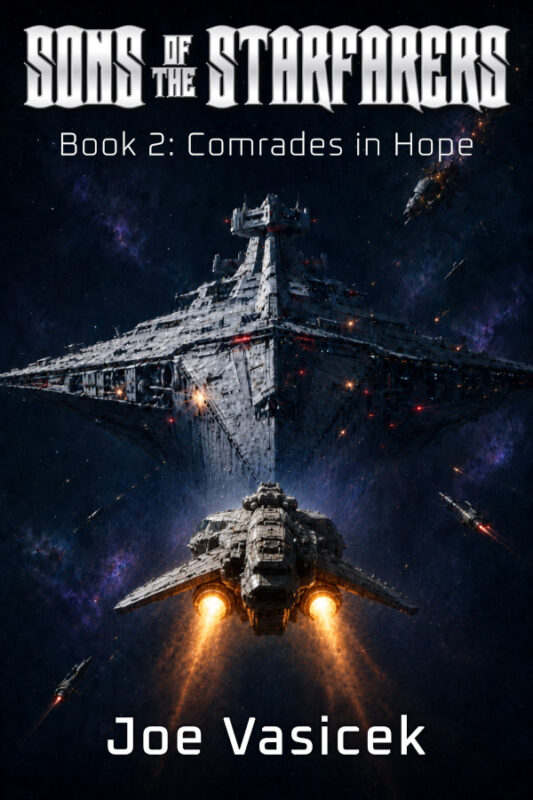
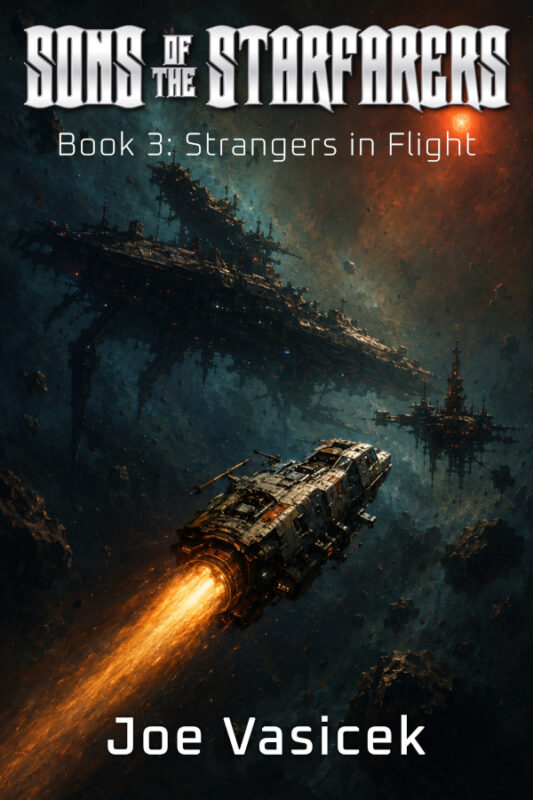
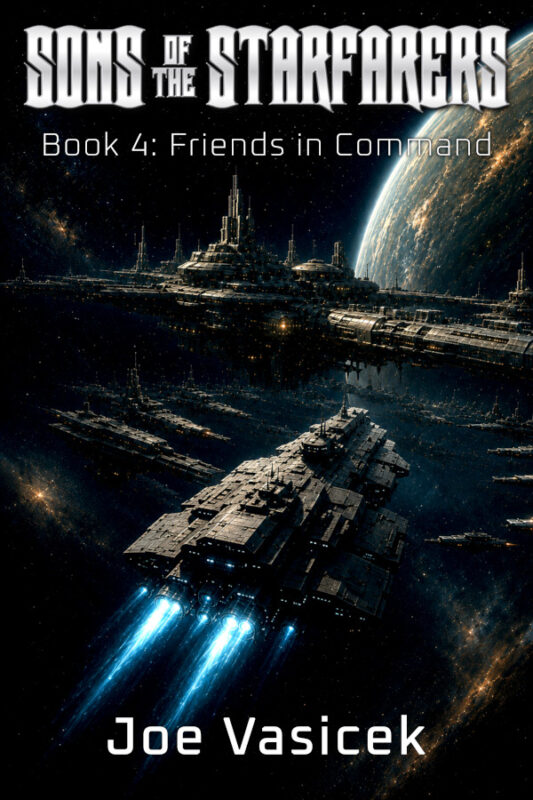
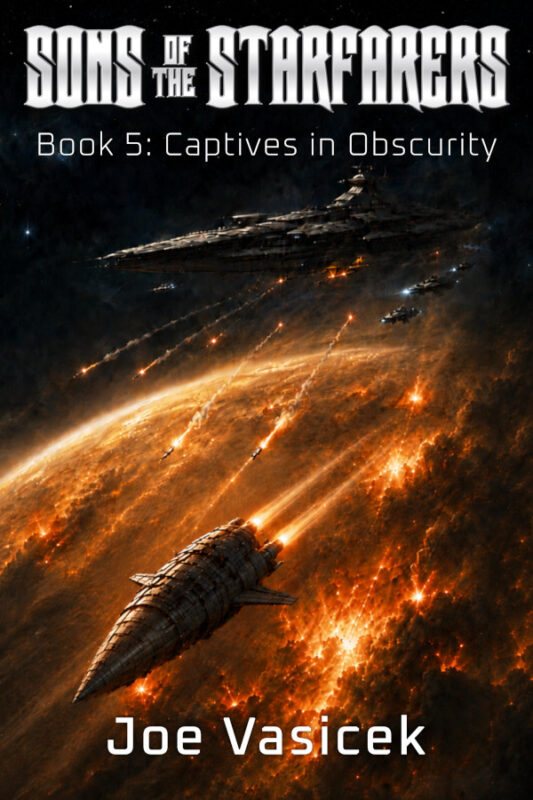
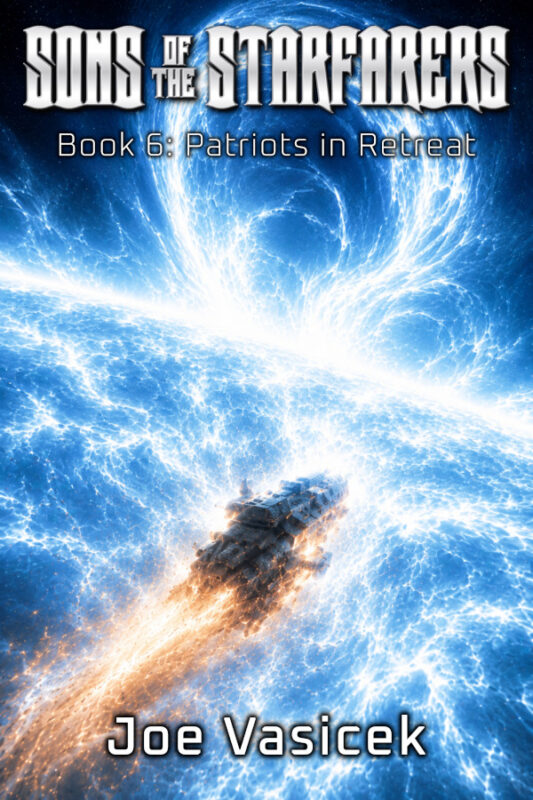
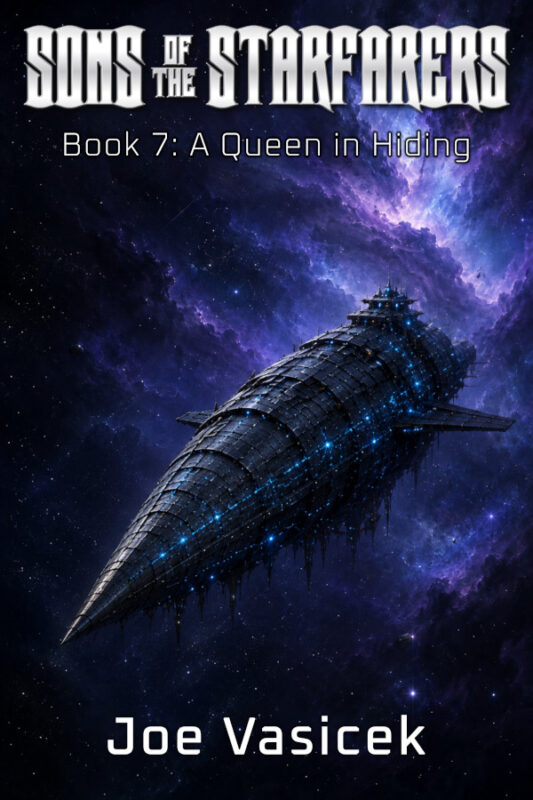
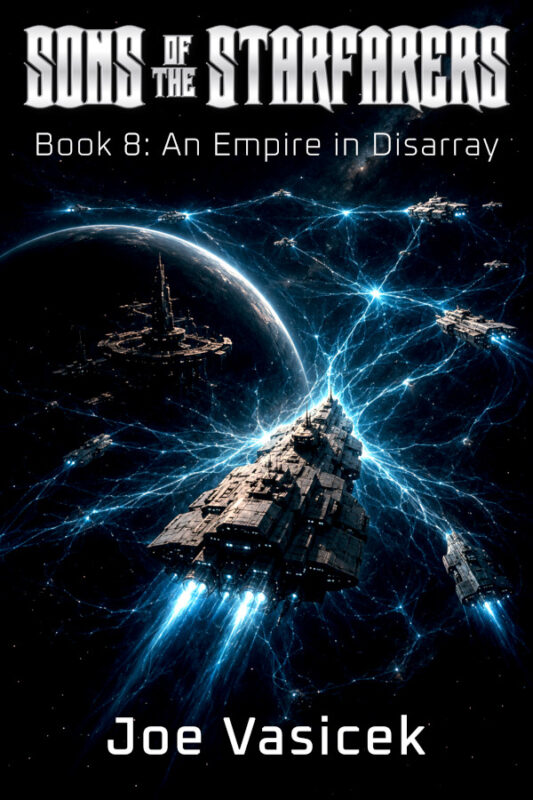
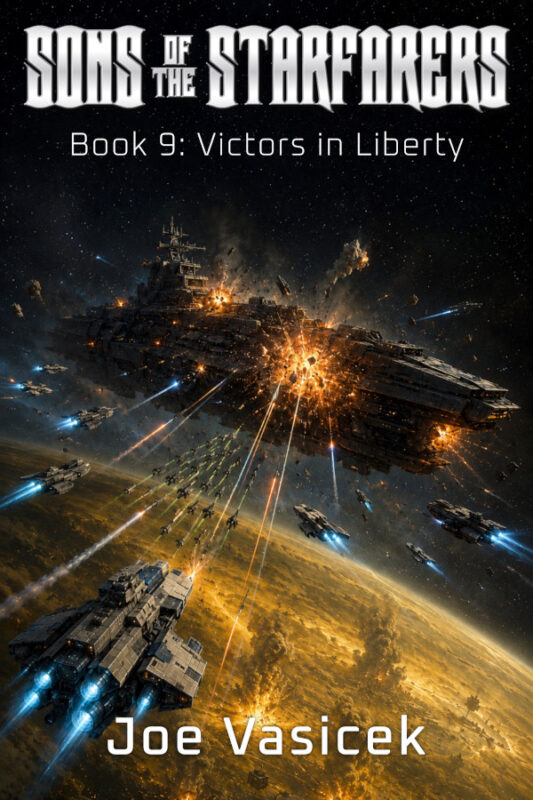
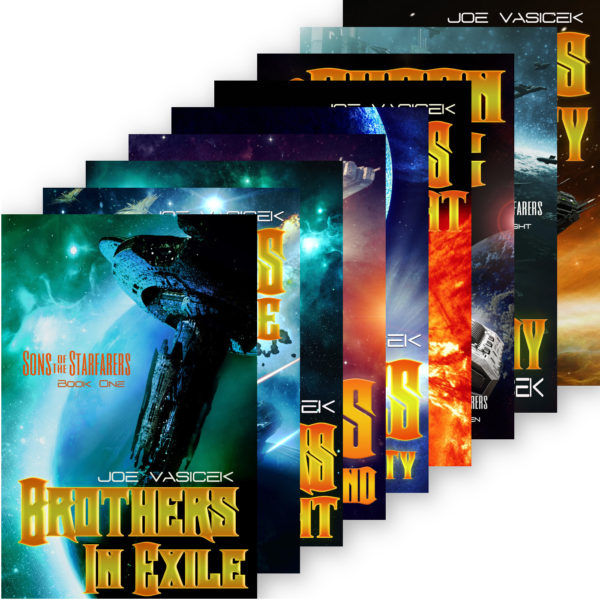
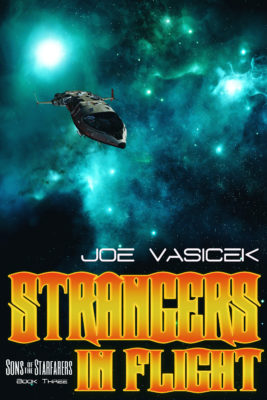
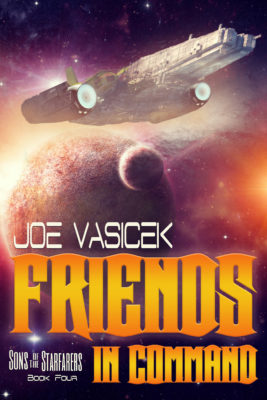
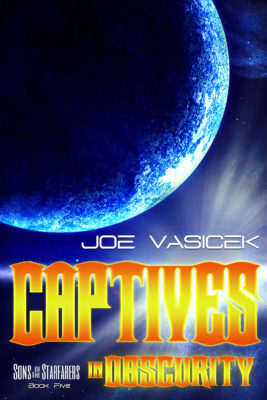
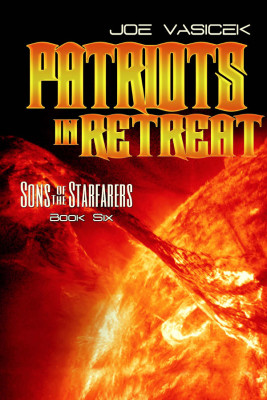
New Sons of the Starfarers Covers!

Ever since I got the pro version of ChatGPT (and/or the AWESOME Patron Toolbox over at Author Media), I’ve been sloooooowly going through my backlist, updating blurbs, covers, and metadata. One of my old series that really needs new covers is Sons of the Starfarers. Check out these new ones!

These will hopefully go up over the next week or so. Next up: the Genesis Earth Trilogy!

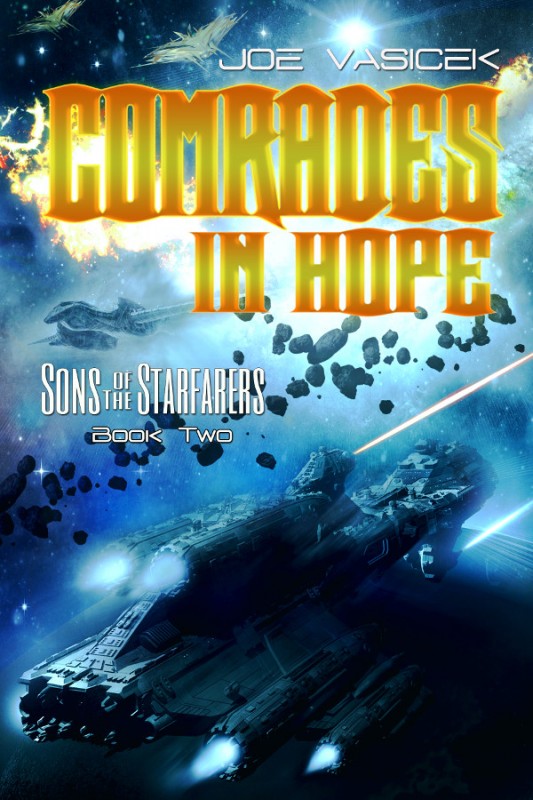
The Hope That Survives Trauma in Comrades in Hope

War has a way of shrinking the future until all you can see is the next breath, the next corridor, the next impossible choice. Comrades in Hope is a character-driven military science fiction novel that asks a simple question with a hard edge: what does hope look like when you’ve already seen the worst—and you don’t get to look away? In this book, hope isn’t optimism or denial. It’s what you do after the damage, when survival alone isn’t enough.

Where the Idea Came From

Part of the spark for this theme came from pairing two kinds of characters I wanted in the same story: a young man who still believes the universe can bend toward good, and a survivor who has learned—through loss—that the universe doesn’t care what you believe. Aaron arrives in the Outworld Flotilla carrying naïve expectations and a private vow, while Mara has already been forged by catastrophe, grief, and the long-term psychological trauma of war. Their shared culture and language create a lifeline between them, but it also forces the question into the open: can hope survive trauma without becoming a lie?

How Hope and Trauma Shape the Story

From the beginning, Aaron is out of place—linguistically, culturally, militarily—and that displacement matters, because Comrades in Hope is not a story about winning battles, but about surviving war with your humanity intact. It comes from not understanding the world you’ve been thrown into, from feeling helpless at the exact moments when competence would save lives. Aaron leans on translation tools and improvisation, while Mara carries the grim competence of someone who’s already paid the price of being unprepared. Their relationship becomes a pressure chamber where hope and trauma argue with each other in real time: Aaron keeps reaching for the possibility of a better outcome, while Mara keeps pointing to the body count and the way war turns people into numbers. Yet even her pessimism has a wound behind it—she doesn’t reject hope because it’s childish; she rejects it because she’s afraid of what it costs to believe again.

As the conflict escalates, the book keeps putting hope in the least comfortable place: inside terror, exhaustion, and grief. There are moments where survival narrows to shared oxygen, sealed compartments, and the blunt math of “who made it and who didn’t.” In those scenes, hope stops being a feeling and becomes a decision—sometimes as small as refusing to abandon someone, sometimes as stubborn as continuing the search when every rational signal says it’s over. One of the most revealing turns comes when Aaron challenges Mara’s refusal to hope for herself, and she answers that she can still hope for someone else. That’s the heart of the book: trauma isolates, but hope reconnects—often first as hope for another person, when you can’t yet hold hope for yourself.

What This Theme Says About Us

Most of us won’t fight aboard captured battleships or live under the constant threat of empire, but we do know what it’s like to be changed by pain—and to wonder whether what we lost can ever be rebuilt. Comrades in Hope leans into a truth that shows up again and again in real life: trauma doesn’t only injure the body or the memory; it injures the imagination. It makes the future feel unsafe to picture. And yet, again and again, people choose hope anyway—not because they’re sure things will work out, but because they refuse to let suffering have the final word on who they are. This is why stories like Comrades in Hope resonate with readers who care about resilience, found family, and the quiet moral choices people make under pressure—especially in times of war and displacement.

Why This Theme Matters to Me

I wrote Comrades in Hope fast, almost breathless, and in a very “discovery writer” way—following the characters into the war and letting their struggles shape what the book became. What I love about this story is that it doesn’t treat hope as a motivational poster, especially in the context of war and trauma. It treats it as something you earn, something you protect, and sometimes something you borrow from the people beside you when you’ve got nothing left. And on a personal level, I keep coming back to how much this whole career—and every book I get to write—depends on readers choosing to care, choosing to share, choosing to keep stories alive. That’s its own kind of hope, and I don’t take it for granted.

Where to Get the Book

Related Posts and Pages

Explore the series index for the Sons of the Starfarers series.

Return to the book page for Comrades in Hope.

Is Comrades in Hope for you?

Comrades in Hope (Sons of the Starfarers: Book 2) is a classic military science fiction space-war adventure that balances pulse-pounding starship combat with a character-driven choice to keep going when morale—and manpower—are running out. It has military SF boarding actions, starship danger, tight comradeship, and a thread of mystery and longing centered on a captured young woman—known only as the “henna girl”—and what it costs Aaron to keep hoping she can be saved.

What Kind of Reader Will Love Comrades in Hope?

If you love…

  • military science fiction and space opera with starship battles, drop-ship runs, and boarding actions
  • ragtag underdogs vs. an empire, where victory is possible but never easy
  • comrades-in-arms stories about loyalty, survival, and carrying each other through the worst of it
  • a hope-in-the-dark emotional tone (grim circumstances, but not nihilistic)

…then Comrades in Hope is probably your kind of story.

What You’ll Find Inside

The story follows Aaron Deltana, a young pilot thrown into a sprawling interstellar war before he’s fully ready for it. As missions grow more dangerous and losses mount, he must rely on his crew, risky technology, and sheer determination to keep people alive during desperate missions behind enemy lines. The mood is tense and urgent, balancing fast-paced action with quieter moments of fear, resolve, and hard-earned trust. The style is mission-driven and cinematic, with a strong emotional core rooted in comradeship. While this is the second book in the series, the story provides enough context to follow the conflict while deepening the larger arc of the war.

What Makes Comrades in Hope Different

Fans of classic space opera and military science fiction will recognize familiar elements—campaign briefings, shipboard action, and soldiers doing their best under impossible pressure. What sets this story apart is its focus on a protagonist who begins as a cultural and linguistic outsider, forced to learn, adapt, and grow in real time. Layered beneath the war narrative is a haunting personal mystery that gives the conflict a deeply human stake, turning survival into something more than just winning the next battle.

What You Won’t Find

You won’t find grimdark nihilism or cruelty for its own sake. The violence and hardship are real, but the story consistently returns to loyalty, sacrifice, and the choice to protect others. You also won’t find a romance-driven plot—the emotional heart of the story lies in duty, rescue, and standing by your comrades under fire.

Why I Think You Might Love It

I wrote this story as a love letter to classic space adventure—the kind that believes courage and loyalty still matter, even in the middle of chaos. At its core, it’s about choosing hope, courage, and responsibility when giving up would be easier, and about the bonds formed when people rely on each other in the worst conditions imaginable. If you enjoy science fiction that looks hardship in the eye and still insists on meaning, I think this story will resonate with you.

Where to Get the Book

Related Posts and Pages

Explore the series index for the Sons of the Starfarers series.

Return to the book page for Comrades in Hope.

$9.99 sale for Sons of the Starfarers series bundle. Merry Christmas!

I’m currently running a sale for my Sons of the Starfarers series bundle, available only on my online author bookstore. From now to the end of December, you can get all nine books in my flagship series for just $9.99.

Merry Christmas!

Free and 99¢ books for February

Free:

Nothing Found

Brothers in Exile

Brothers in Exile

eBook: free!

Isaac and Aaron are nothing if not survivors. Their homeworld lost and their people scattered, all they have left is each other. Then, in the Far Outworlds, they find a dead colony with a beautiful young woman frozen in cryostasis. She is also a survivor—and she needs their help.

More info →


99¢

Strangers in Flight

Strangers in Flight

$9.99eBook: $2.99

When Reva went into cryosleep, she wasn't prepared to be the sole survivor of a people that history never remembered. Isaac wants to help her, but he carries a secret that may decide the outcome of the war. Little does he know, the Imperials aren't the only ones hunting him.

More info →

Comrades in Hope

Comrades in Hope

$9.99eBook: $0.99

Isaac and Aaron have joined the war effort, and not a moment too soon. The Imperials are poised to strike at the heart of the New Pleiades and obliterate the ragtag flotilla standing in their way. Aaron always wanted to prove himself, but he was never ready to make the ultimate sacrifice—until now.

More info →

Trope Tuesday: Death Seeker

The Death Seeker is a character who wants to die, but for whatever reason isn’t willing to commit outright suicide. The TVtropes page has a good summary:

At some point in the past, some characters have had a traumatic experience, found themselves dishonored, committed a crime they could not repay, or lost everything worth living for. For whatever reason, rather than turning to suicide, they went off seeking battles to fight, hoping to find an enemy who would kill them, and achieve an honorable, heroic, awesome, or otherwise acceptable death, sometimes going as far as outright surrendering and offering their life to their enemies.

I’ve written a surprising number of these characters, but more often than not they end up living instead of dying. Quite often, they have a mentor who used to be a death seeker themselves, who makes them promise to find a reason to keep on living.

Escapist fiction is fun, but I like to read stories that are meaningful as well. The two are not mutually exclusive. When the protagonist is a death seeker, the question “what is worth living for?” tends to be a major driver for the story.

One character who’s very much on my mind right now is Mara Soladze from Sons of the Starfarers. A refugee turned marine, she has a traumatic experience in Comrades in Hope that very nearly pushes her over the despair event horizon. She can’t just give up and die, though, because there are people depending on her. As she climbs up the ranks from first mate, to captain, and finally to commodore, that tension never goes away.

Probably the biggest difference between a death seeker and someone who’s simply suicidal is that the death seeker is looking for something to die for. They’re much more likely to make a heroic sacrifice or go out in a Bolivian army ending.

But if something is worth dying for, isn’t it also worth living for? That is ultimately the question.

Trope Tuesday: The Alliance

In fiction, the fight against the Empire usually follows a clear progression.

First, you have the Resistance, a scrappy band of misfit freedom fighters who take up arms, barricade the streets, and fight back against all odds. Think Rogue One, or Les Miserables.

If they aren’t immediately crushed, the Resistance eventually turns into the Alliance. Only slightly more organized than the Resistance, it’s still not unheard of for members of the alliance to turn on each other if the right opportunity arises. That said, when they’re united, the Alliance can muster a lot more firepower than the Resistance could ever hope to bring.

The Alliance is what happens when the local powers commit to the fight. It’s what happens when a low-level insurgency turns into a full-blown civil war. Whether or not everyone in the alliance trusts each other, together they have all crossed the Rubicon in the fight against the Empire.

If the Alliance is successful and defeats the Empire, it will either turn into the Republic or the Federation. The Republic is much more centralized and behaves like a single nation, whereas the Federation is a collection of semi-autonomous states united under one banner.

To pull a page from history, the United States started as the Resistance, with the patriots dumping the tea at the Boston tea party. With the Declaration of Independence, the Resistance turned into the Alliance as the minutemen became the Continental Army. With the Constitution of the United States, the Alliance became the Federation, which (depending on your reading of history) has either endured to the present day, or transformed into the Republic and/or Empire.

Star Wars used to have a very clear progression from Republic to Empire (episodes I-III) and Resistance to Alliance to Republic (Rogue One, episodes IV-VI, and the expanded Star Wars universe), but the new movies have apparently thrown all that out and moved us from Resistance to Alliance to… Resistance again? And the Empire went from Remnant to Empire, even after losing Starkiller Base in episode VII? Yet another reason why The Last Jedi really did not impress me.

In my own books, this progression figures prominently in Sons of the Starfarers. It starts with the Resistance in Comrades in Hope, but soon transforms into the Alliance and stays that way for most of the rest of the series. It’s on my mind right now, as I finish An Empire in Disarray and get ready to write the last book, Victors in Liberty.


All of my books and stories, in series order

A friend of mine recently asked me to give him a list of all my books in series order. That was just the kick in the pants I needed to put this page together. For your convenience, I’m putting it up as a blog post too. The links to all the book pages will appear on the series page as soon as I can get around to it.

Joe Vasicek

Gaia Nova

The Gaia Nova books are all mid-sized novels (75k to 110k words). It is a far-future space opera series that takes place in a galactic empire long after Earth has been lost to legend. They can be read in any order, but they take place in the same universe with recurring characters. They are listed in the order in which they were published. Heart of the Nebula is a direct sequel to Bringing Stella Home.

Bringing Stella Home
Desert Stars
Stars of Blood and Glory
Heart of the Nebula
Mercenary Savior (forthcoming)
Empress of the Last Free Stars (forthcoming)

Star Wanderers

The Star Wanderers books are novellas (15k to 35k). They take place in the same universe as Gaia Nova one thousand years earlier. The first four books are linear, while the last four books are parallaxes of the first four, from the point of view of the side characters.

Outworlder
Fidelity
Sacrifice
Homeworld
Dreamweaver
Benefactor
Reproach
Deliverance

The Jeremiah Chronicles (Omnibus 1-4)
Tales of the Far Outworlds (Omnibus 5-6)

Sons of the Starfarers

The Sons of the Starfarer books are short novels (35k to 45k words) that take place in the same universe as Star Wanderers, with a few recurring minor characters from those books. It is a linear series.

Brother in Exile
Comrades in Hope
Strangers in Flight
Friends in Command
Captives in Obscurity
Patriots in Retreat (forthcoming)
A Queen in Hiding (forthcoming)
An Empire in Disarray (forthcoming)
Victors in Liberty (forthcoming)

Sons of the Starfarers (Omnibus 1-3)

Gunslinger Trilogy

These books are all short to mid-sized novels (50k to 90k words). They take place about 40 years in the future, after Earth makes contact with the galactics.

Gunslinger to the Stars
Gunslinger to the Galaxy (forthcoming)
Gunslinger to Earth (forthcoming)

The Twelfth Sword Trilogy

These epic fantasy books are all mid-sized to long novels (85k words and up).

The Sword Keeper (forthcoming)
The Sword Bearer (forthcoming)
The Sword Mistress (forthcoming)

Genesis Earth Trilogy

These are all mid-sized novels (about 70k words) that take place in the near to mid-future.

Genesis Earth
Edenfall (forthcoming)
The Stars of Redemption (forthcoming)

Short Stories and Novelettes

Below are all of my short stories and novelettes, in the order in which they were published. If they first appeared in a magazine or anthology, I’ve included that in parentheses.

Decision LZ1527 (Leading Edge Magazine, December 2009)
Memoirs of a Snowflake
A Hill on Which to Die
Starchild
L’enfer, c’est la Solitude
(Perehilion SF, March 2016)
The Curse of the Lifewalker
(Sci Phi Journal, June 2016)
The Gettysburg Paradox
Utahraptors at Dawn
Welcome to Condescension
Killing Mister Wilson
My Name is For My Friends
Jane Carter of Earth and the Rescue that Never Was
The Open Source Time Machine

J.M. Wight

Short Stories

Worlds Without Number

What’s going on with Sons of the Starfarers?

ssf-i-large-coverssf-ii-large-coverssf-iii-large-coverssf-iv-large-coverssf-v-large-coverSSF-VI (cover)

I don’t know how many people are looking forward to the last four Sons of the Starfarers books, but I feel like I owe you an explanation for what is (or rather, isn’t) going on with the series.

I started the series back in 2014, after publishing the last Star Wanderers novella. Star Wanderers was an experiment with the trendy advice among indie authors at the time, to split up a wider story arc into lots of short books in a linear series, with the first one permanently free.

For the first two years, the experiment paid off—so much so that I decided to write another series using the same trendy publishing advice. That series was Sons of the Starfarers.

But then, things started to go downhill. Amazon introduced Kindle Unlimited, and the algorithms changed in ways that no longer favored the trendy publishing advice. Star Wanderers began to languish, and Sons of the Starfarers never took off in the way I’d hoped that it would. Up to this point, 90% of my sales were on Amazon. Needless to say, my career took an enormous hit.

Most indie authors in my position reacted by going all in with Kindle Unlimited. Essentially, they dumped 2012’s trendy advice for 2014’s trendy advice. I took the opposite tact and went back to basics.

This still left the awkward question of what to do with the unfinished Sons of the Starfarers series. Abandon it? That was unthinkable. But it wasn’t practical to finish it either, seeing as I needed something that would actually pay the bills.

So I kicked it around for a couple of years, working on it between other projects but not making it a huge priority. In this way, I wrote and published Friends in Command and Captives in Obscurity. But as more time passed, it soon became clear that this wouldn’t work. The books were getting harder to write as I became more distanced from the story, and releasing them piecemeal wasn’t exactly boosting sales of the previous books in the series.

A couple of days ago, I wrote up a publishing schedule for 2017. My goal is to have a new release every month. A couple of novels are on the schedule, including Gunslinger to the Stars and The Sword Keeper, but as of now there are no Sons of the Starfarers books.

This is not because I’m abandoning the series, however. Far from it. My goal is to release all of the last four books together, within a month of each other. In order to do this properly, I’m going to write them all together in one big sprint, probably sometime next year.

I haven’t planned out everything yet, but I do have all the titles figured out. They are:

  • Brothers in Exile
  • Comrades in Hope
  • Strangers in Flight
  • Friends in Command
  • Captives in Obscurity
  • Patriots in Retreat
  • A Queen in Hiding
  • An Empire in Disarray
  • Victors in Liberty

If I had the money, I would commission all of the covers right now (my poor cover designer thought this job would be finished a year ago—at least he got an advance!), but what money I have needs to go toward producing Gunslinger to the Stars. No idea how long it will take. And the books themselves probably won’t come out until 2018.

So don’t worry, I have not and will not abandon this series. If you’re waiting, I apologize for taking so long, and also for the fact that you’re probably going to be waiting a while longer. But the good news is that when the last four books do come out, they will come out in quick succession. So there’s only one more big wait. Hopefully that’s good news.

Sorry!