What Makes a “Joe Vasicek” Book?

I recently uploaded all of my books to ChatGPT and asked it to read them all and tell me what makes a “Joe Vasicek” book. The result was a fascinating conversation with the chatbot. It was too long to share in its entirety, so I asked ChatGPT to summarize it as a 1500 word blog post. Here is what it gave me:


Every author has recurring patterns. Sometimes they are obvious: favorite settings, familiar plot structures, beloved tropes. Sometimes they run deeper, beneath genre and surface premise, shaping the emotional and moral logic of the stories themselves. Looking across Joe Vasicek’s published science fiction and fantasy, a clear pattern emerges. His books are not simply space operas, frontier adventures, sword-and-sorcery tales, or clean romantic fantasies. At their core, they are stories about people trying to find, build, defend, or become worthy of home.

A Joe Vasicek book is usually set on the edge of civilization. That edge may be literal outer space: a far-flung colony, an isolated station, a small merchant starship, a dangerous trade route, or a frontier beyond the reach of stable law. It may also be a fantasy frontier: a seacoast, a ruined kingdom, a cursed wilderness, a lonely homestead, or a world recovering from plague, war, and desolation. But whatever form the frontier takes, it is rarely just a backdrop for adventure. It is a moral testing ground.

The central question is not merely whether the hero will survive. It is whether the hero can preserve the things that make survival meaningful: family, faith, freedom, love, loyalty, honest work, and moral courage.

This is why exile appears so often in Vasicek’s fiction. His protagonists are frequently displaced people: wanderers, captives, refugees, orphans, widows, failed apprentices, disgraced sons, forgotten daughters, fugitive lovers, and people who no longer belong in the world that formed them. They may dream of a lost Earth, flee an oppressive warrior culture, survive famine on a failing station, escape slavery, seek a ship, or defend a fragile home from powers that would destroy it. Their longing is not abstract. They want something deeply concrete: a place at the table, a family, a ship, a marriage, a household, a people, a future.

That longing for home is one of the defining features of Vasicek’s voice and vision. In many of his books, home is not something the characters simply return to. It must be built, chosen, earned, or restored. Sometimes it is a starship crew. Sometimes it is a marriage. Sometimes it is a frontier colony. Sometimes it is a homestead in the woods, a kingdom healed from corruption, or a family formed under impossible circumstances. His stories tend to end not merely with enemies defeated, but with the possibility of a stable moral order: a household, a child, a promise, a voyage, a free people, a new beginning.

Closely connected to this is Vasicek’s recurring interest in family formation. Marriage, children, inheritance, kinship, motherhood, fatherhood, and legitimacy are not decorative details in his fiction. They are often central to the worldbuilding. Societies in his books are shaped by who marries whom, who inherits, who belongs, who is cast out, who is enslaved, who is protected, and who is allowed to have a future. This gives even his space opera a domestic and anthropological depth. Starships are not just machines. They are households. Frontier settlements are not just adventure locations. They are embryos of civilization.

This family-centered quality sets Vasicek apart from much of contemporary science fiction and fantasy. In a market often dominated by antiheroes, irony, grimdark despair, eroticized power dynamics, or purely individual self-actualization, Vasicek’s books keep returning to older and more ordinary goods: marriage, children, duty, faith, work, and home. That does not mean the books are soft. His stories include captivity, slavery, war, famine, coercion, betrayal, exile, monsters, corrupt rulers, and civilizational collapse. But the darkness does not usually become the point. It is the pressure under which characters reveal what they truly love.

Another recurring element is freedom versus domination. Vasicek’s villains and oppressive systems often seek control over the intimate foundations of human life. They enslave, coerce, corrupt, conquer, manipulate marriage, break families, reduce people to tools, or turn sacred things into instruments of power. Against them stand people who may be weak, wounded, or compromised, but who still recognize that some things must not be surrendered. A recurring moral pattern in Vasicek’s work is that power becomes evil when it severs itself from love, covenant, humility, and responsibility.

This is especially visible in his fantasy. In the fantasy stories, magic frequently tests the soul. Treasure corrupts. Dark orders twist noble purposes. Forbidden power promises victory while hollowing out the one who wields it. Sacred objects and magical gifts are not merely tools; they expose character. The question is often whether the hero can become worthy of the power placed in his or her hands.

The science fiction handles similar concerns differently. In Vasicek’s SF, the central question is more often civilizational: what kind of society will human beings build on the frontier? Technology, star travel, colonization, lost Earth, trade routes, empires, and small ships all become ways to explore whether freedom and family can survive across distance. The fantasy asks whether the soul is worthy to wield power. The science fiction asks whether civilization is worthy to endure.

Yet the two sides of Vasicek’s work are recognizably connected. A sea mage searching for a crew and a star wanderer seeking a place among the stars are spiritual cousins. A cursed treasure that tests a fantasy hero and a civilization-changing technology that threatens an Outworld culture are variations on the same concern: what happens when power outruns virtue?

Faith is another quiet but persistent current. Vasicek’s books are not always explicitly religious, and many are not “religious fiction” in the usual bookstore sense. But they are shaped by a religious imagination. Providence matters. The universe has moral structure. Choices echo beyond immediate consequences. Suffering is not meaningless. Death is not always the final word. Love, sacrifice, chastity, loyalty, mercy, repentance, and covenant are treated as real forces, not sentimental illusions.

This gives his work what might be called moral gravity. The stories are generally clean, but “clean” is too weak a word for what they are doing. Clean can sound bland, safe, or sanitized. Vasicek’s better books are not harmless. They are morally serious. They often deal with brutal worlds, but without surrendering to brutality. They offer hope, but usually after loss.

That balance—dark trials, hopeful destination—is one of the most marketable aspects of his brand. Readers who are tired of nihilism may find in his books a kind of old-fashioned adventure that does not feel cynical. Readers who enjoy romance but do not want explicit heat may respond to the way his stories treat love as courtship, marriage, loyalty, and family destiny. Readers who enjoy frontier survival may respond to the practical details of ships, homesteads, trade, hunger, labor, and settlement. Readers who want faith-friendly speculative fiction may find his work welcoming without feeling confined to the Christian-fiction aisle.

At the same time, the analysis reveals some challenges. Vasicek’s books cross several genre lanes: hard SF, space opera, sword-and-sorcery, seafaring fantasy, frontier survival, time travel, post-apocalyptic fiction, captivity drama, and short-form idea fiction. That range can make the brand feel scattered. A reader who comes for small-ship space opera may not immediately understand how that connects to a fantasy homestead story or a cursed-treasure adventure. The underlying themes are consistent, but the surface packaging varies widely.

There is also a tonal challenge. Vasicek often writes “clean” fiction, but some of his recurring material is intense: slavery, captivity, concubinage, forced marriage, sexual coercion, famine, genocide, and patriarchal warrior cultures. These are not cozy stories. If marketed carelessly, they can send the wrong signal. The captivity material, in particular, needs to be framed around dignity, survival, identity, and freedom rather than dark-romance titillation or grimdark shock.

The clearest author brand, then, is not simply “clean science fiction and fantasy.” That is accurate but incomplete. The stronger brand is this:

Joe Vasicek writes clean, morally serious frontier science fiction and fantasy about wanderers, captives, exiles, and ordinary heroes building homes and families in dangerous worlds.

Or shorter:

Frontier science fiction and fantasy about faith, family, freedom, and finding home among the stars.

Or more distilled still:

A Joe Vasicek book is about finding home on the frontier without losing your soul.

That is the through-line. Whether the story involves starships, sea mages, cursed treasure, lost Earth, warrior clans, alien worlds, magical swords, or widowed mothers, the deeper movement is the same. The world is dangerous. Civilization is fragile. Power corrupts when severed from virtue. But love, faith, family, and moral courage can still make a home in the wilderness.

That is what makes a Joe Vasicek book.

Writers Cantina 2026

Writers Cantina was this last weekend. I had a great time! It was really good to catch up with my local writing friends, and there were some really great panels too. My wife was also able to come up with me on Saturday, so we had a good time together. Great little local convention!

Probably my biggest takeaway from the convention was that I should rethink how I do my blog and my newsletter. Instead of selling a book with each newsletter, as I’ve been doing for nearly the last ten years, I should only be selling every 4-5 emails or so. So instead of doing a monthly newsletter with the whole kitchen sink, I think I should channel some of my blogging energy into the newsletter and make it a shorter, weekly thing. Which shouldn’t be too hard, if I blog only 4x a week instead of daily.

So that’s something I’m going to try out, moving forward. I’m going to have to make some other adjustments, too, because my wife is going back to full-time work this week, leaving me to take care of the kids. We’re also starting homeschool next month, so that’s something else I’m going to have to figure out.

Lots of changes coming, which means a lot less writing time each day. But I’ve mapped out my current WIP (Lord of the Falconstar), and I’m reasonably confident that I can have it finished before the end of October, even at a slower rate of progress. Just need to figure out the new routine for myself and the kids.

New shelves!

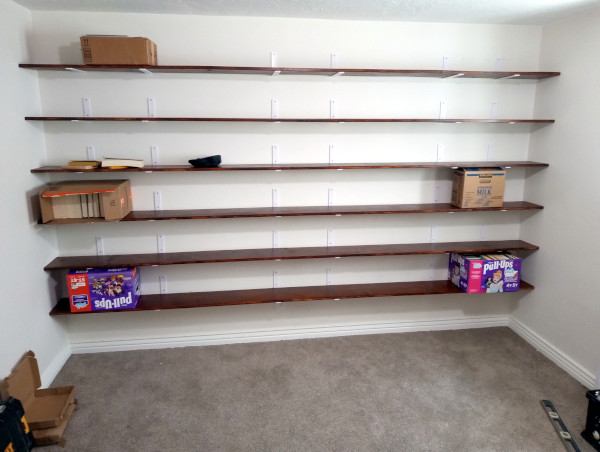
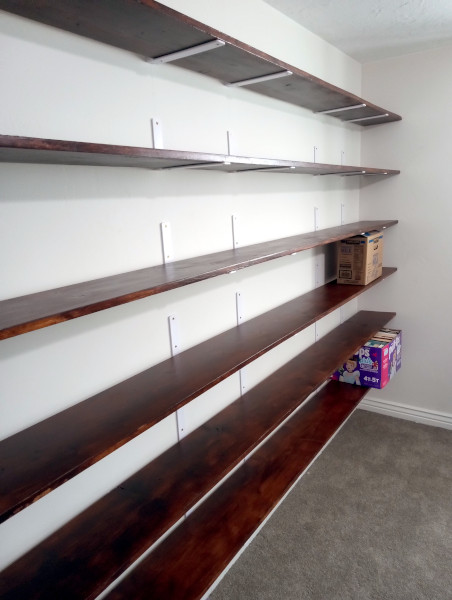
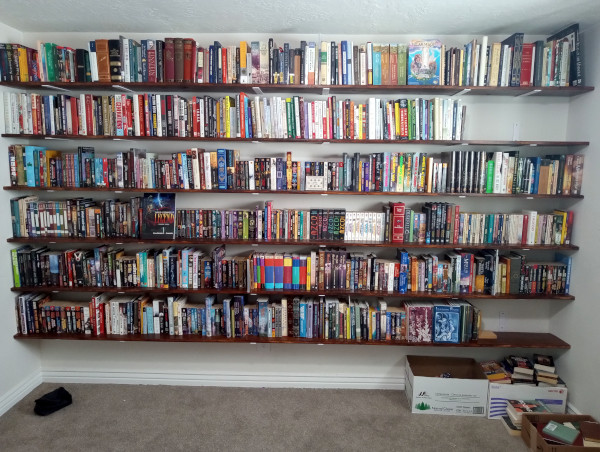
I hope you had a great 250th fourth of July! We had a bunch of family in town, so things were kind of crazy all last week. Then, on Monday and Tuesday, I buckled down and finally finished the ongoing home improvement project I’ve been working on for the last couple of months: installing new shelves in my basement office / writing den!

Those shelves are just common 10″x1″ pine board, bought at the local home depot. They each span 11’2″, which is the length of the wall. I sanded them down and stained them, then installed them all on shelving brackets that we bought on Amazon. Each bracket pair is rated for 100 lbs, so it may have been overkill to get three pair per shelf, but this way I don’t have to worry about the kids hurting themselves by doing something stupid like trying to climb up the shelves while I’m gone.

Total materials cost for the project was around $560. It would have been cheaper just to buy the BILLY shelves at Ikea, but from what I can tell from the recent online ratings, they’ve been using cheaper materials in order to keep the cost low, so nowadays those selves only have a lifespan of about a year. A new set of higher quality premade shelves would have been around $800 at Home Depot, so I figured it was better just to build them myself.

It feels so good to have all of our family’s books up and available to browse! Ever since we moved back into our Orem house, they’ve been sitting in boxes in the spare bedroom in the basement, taking up space. But with the way our family’s growing, we’ve been needing to get that de facto storage room set up as a girl’s bedroom. So the books needed to find a new home.

Next step: fix up the basement bathroom, and install a desk light in the spare bedroom, so that our oldest can move downstairs. I also want to get an easy chair, to turn this writing den into a reading nook. If we bring in a desk or an easel for the other side, we can use this room for homeschooling, too. It would be really convenient to be able to work on my writing while my daughter is in the other corner, working on schoolwork.

So yeah, things are taking shape very nicely. As far as the writing goes, I’m working hard on Lord of the Falconstar now, trying to get as far into it as I can before my wife goes back to full-time work. She goes back into the office next Monday, so I really need to buckle down and make as much headway as I can.

Crunching data and rethinking plans

So for the last week, I’ve been having some long reflections with ChatGPT (I say “reflection” instead of “discussion,” because generative AI is more like a sophisticated mirror than a mind) and crunching a bunch of the data that I’ve accumulated over the course of my career. It’s fascinating, because one of the things that generative AI is surprisingly good at is crunching large amounts of data and extracting interesting patterns from it. It’s less good at drawing useful conclusions, but that’s what God gave us humans a mind for.

One of the more interesting data points is that the ideal frequency with which to release new full-length novels is once every 3-6 months, ideally every 3-4 months. After 6 months without a novel release, sales tend to fall off, and after 9 months, they fall completely off of a cliff.

From this, I’ve decided to rework my release schedule, so that every January, May, and September, I have a new novel coming out. The goal is to have the next novel ready and up for preorder before the current one goes live. Between new novel releases, I plan to rerelease short stories, bundle and release box sets, or release new original short stories and novellas, with something coming out each month.

It’s an aggressive release schedule, but with the way I’ve incorporated AI into my writing process, I think I can manage it. It took me about 120 total writing man-hours to write Captive of the Falconstar, and with practice I can probably get that down lower. During the school year, while my wife is teaching or researching and I’m generally the one watching the kids, I can only get about an hour of work in each day, but I can do more like 2-3 hours in the summer, so that’s when I plan to catch up. That comes to about 400 man-hours of writing time in a given year, which is more than enough to write three 120 man-hour novels.

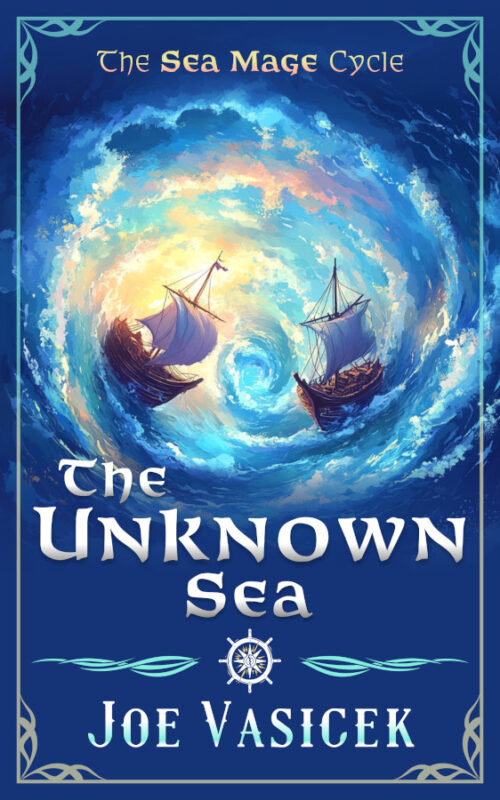
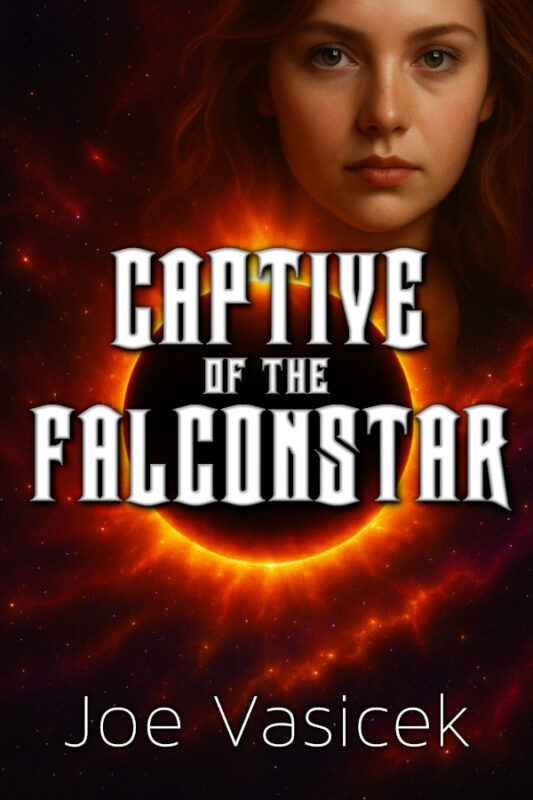
I’m going to try to give myself a bit of a buffer, though. After Captive of the Falconstar comes out in July, I plan to wait 6 months and publish The Unknown Sea in January 2027. The next release will be Lord of the Falconstar in May 2027, concluding the Falconstar Trilogy. After that, I plan to launch the Rise of the Falconstar Trilogy in September 2027 with The Soulbond and the Sling, following up with books 2 and 3 in January and May 2028.

My big summer project this year is The Unknown Sea, which I will probably finish sometime next month. After that, I’ll work on Lord of the Falconstar with a goal of finishing it well before the end of the year. Should be very doable. And since the AI draft of The Soulbond and the Sling is already complete, it shouldn’t take more than a few months to finish it. So by the time January 2027 rolls around, I may be more than halfway done with my September release for that year.

That’s the plan, anyway. I may want to experiment with crowdfunding some of these novels, especially The Soulbond and the Sling—which is another good reason to push it back to September 2027. But we’ll see how it goes.

Full steam ahead!

I’ve been making good progress on The Unknown Sea this week, pushing forward at a very good rate now that my wife is at home watching the kids. She’s got the next couple of months off for the summer, allowing me to write full-time, and I plan to take advantage of that as much as I can. This was the first week of that, and while I still feel like I’m ramping up to full speed, I did get quite a bit of writing done.

Right now, The Unknown Sea is at about 50% for the AI draft, 28% for the rough human draft, 22% for the revised human draft, and 11% for the final polished draft. I’m experimenting with pushing through all of those draft phases at once, obviously with different parts of the novel being at different stages. If everything proceeds according to my outline, the final draft will clock in at around sixteen chapters, 53 scenes, and between 65k to 70k words (or around 180 – 220 pages).

I probably won’t be able to finish it before the end of May, but I do think I can finish it by mid-June. It’s going to take a lot of work, but I’ve got the time now, so it’s mostly just a matter of buckling down and making it happen. It’s about the same length as Captive of the Falconstar, which took about 120 writing hours to finish, and I’ve already put in about 50 writing hours. To finish The Unknown Sea by May 15th, I need to average about 3.5 writing hours per day, which is going to be a bit tricky since 1) I still have a bunch of publishing tasks to work on, and 2) we have a family trip to Coeur D’Alene in the middle of that, but I think I can manage it.

I would really like to have it sufficiently finished so that I can start work on Lord of the Falconstar before Captive of the Falconstar releases in July. That way, I can estimate how much time I need to finish Lord of the Falconstar and have it up for preorder. But I may go ahead and put it up for preorder anyway, just with a long enough lead-time that I know I can have the book done before then.

What I’ll probably do is put The Unknown Sea up for preorder with a release date around October-November 2026, and Lord of the Falconstar up with a release date around January-February 2027. I’ve got a rough AI draft done for Lord of the Falconstar, but not much more than that, and I probably need to update some of the character cards and chapter prompts, which is also going to take time. So Lord of the Falconstar probably won’t come out until sometime in 2027, regardless.

Writing full-time over the summer

My parents were both high school teachers, and they told me that the three best things about being a teacher are: June, July, and August. My wife is a BYU professor, so she’s got a two month break instead of a three month break, but she can take it anytime over the summer, and she’s decided to start it next week. That way, she’ll be watching the kids from the end of BYU kindergarten to the week after Writers Cantina in July, giving me all that time to write full-time.

I am really looking forward to it! With luck, I can finish The Unknown Sea and push far enough into Lord of the Falconstar that I can put it up for preorder before Captive of the Falconstar is released. It’s going to take a lot of work, but I think I can do it. Captive took me a total of 120 hours to write, and I’m already about a third of the way through The Unknown Sea, so I can probably finish that by the first half of June. And then, I’ll go full ahead on Lord of the Falconstar to have that trilogy well and truly done by the end of the summer.

Looking forward, we have a wedding at the end of May, and a family trip up to Idaho in the first week of June. Coeur d’Alene is a solid 10 hour drive from Orem, Utah, which is one heck of a crazy haul, but we’ve done it before, though not with three kids. We’ll only be there for a weekend. Other than that, we’ll be at home for most of that time. So that’s the plan.

As for The Unknown Sea, it’s coming along very well, but I only have another half hour to work on it before it’s time to put the kids to bed, so I’d better get back to that now.

Back to writing fantasy

Now that I’ve finished Captive of the Falconstar, I’m back to writing fantasy again, this time The Unknown Sea from the Sea Mage Cycle. I was going to focus on The Soulbond and the Sling, but this book is much shorter, and I think I can have it up for preorder by the time Captive goes live. It’s also about a quarter of the way finished already, so finishing it will only take a little push.

What I really don’t want to do is spend six months working on a WIP that I won’t be able to release this year, or maybe even next year, only to have my sales fall off a cliff because I haven’t been publishing anything. Which means that there may never be a good time to work on The Soulbond and the Sling (or The People of the Last Harvest, for that matter), but if I can set up a few long-term preorders, that may give me the space I need. I’m also going to try making it a side project and working on it on the side, for those rare times when I get an extra hour or two.

There are two more science fiction books that I plan to write: Lord of the Falconstar and Return of the Starborn Son. Both of those will complete a trilogy (The Falconstar Trilogy and the Outworld Trilogy, respectively). But I plan to intersperse those projects with fantasy WIPs, so that I’ll alternate between fantasy and science fiction until those unfinished trilogies are all complete. And then, I’ll focus exclusively on writing fantasy.

The Unknown Sea shouldn’t take long to finish, though the AI draft is rougher than I remember it being. I suppose that means I’m getting better at this, since my older work now seems so much worse. All that really means is that the human draft will take longer, since I’ll fix it all up and make it good for the final draft. But I don’t think I will be finished with this WIP until at least the end of June, and probably the end of July.

My wife plans to fill out her 10 month contract on schedule, giving her two months off in the summer. That should give me July and most of August to write full-time. Perhaps that will be a good chance to work on The Soulbond and the Sling, or finish up Lord of the Falconstar quickly enough that I can put it on a long-term preorder and spend the next six months working on the Soulbound King books. We’ll see how it goes.

Finishing Up

I’ve passed the 50% mark of the rough human draft for Captive of the Falconstar, which means that I’ve got about 40k words left to go. Since I’ve been averaging between 2,000 and 2,500 words per hour, I only need about 20 writing hours to finish it.

I also have to finish the AI draft, which is somewhere around 80% done, but that shouldn’t be too difficult. Add maybe another 5 writing hours for that. Also, I plan to do a full human revision draft, and a final polished draft, which I will probably start this week. Those should each take between 16 – 20 writing hours.

So let’s see:

  • AI draft: 5 writing hours
  • Rough human draft: 20 writing hours
  • Revised human draft: 20 writing hours (conservatively)
  • Final polished draft: 20 writing hours (conservatively)

So all I really need is another 65 writing hours, and this WIP should be done and ready to move into the publishing queue.

Here’s the thing, though: I only get between 1-2 writing hours per day. I usually watch the kids while my wife is at work, and since we’re in March now there’s a lot of outdoor work that needs to get done, like pruning the apple trees and prepping the garden. So it’s going to be really hard to squeeze out any more writing hours than that. I do usually get more like 4-5 hours on Saturdays, though, while my wife watches the kids. But since we keep sabbath, I don’t write on Sundays.

So realistically, I can only get about 10 writing hours each week. Which means that I probably won’t finish this WIP until the second half of April. I was hoping to finish it by the end of this month—and if I had a solid week where I could write full-time, I probably could—but realistically, it’s probably going to take longer than I would like.

However, the good news is that it’s all going really smoothly. No writing blocks, no major story problems or hangups. Just a lot of putting in time and doing the work. And even with the chores and outdoor work, I do still get a good amount of writing time. My wife is really good about watching the kids in the evening, and it really helps to get out of the house to write.

So I am very confident that Captive of the Falconstar will be done by the end of April, enough that I will probably put it up for preorder in the next couple of weeks. As for the next book, I plan to work on it in the fall, but it probably shouldn’t take more than 3-4 months, even at my current pace.

Making Steady Progress

Now that we’re in a good daily routine again, I’ve been making steady progress in Captive of the Falconstar. I’m a little more than halfway done with the AI draft, and around 15% done with the human draft.

So far, there have been no major creative blocks, which is a good sign. The middle is always super messy, but I think I nailed the outline, because the AI draft has no major issues so far—and with a solid AI draft to guide the human writing, I’m consistently hitting 2500 WPH and higher.

In practice, that means that I should have a final polished draft of this book by the end of March. If I had more time to work on it each day, I’d have it done even sooner—perhaps even as soon as this month. But right now, all I can manage is about half an hour (if that) in the early morning, an hour in the evening, and sometimes as much as three or four hours on Saturday.

Not as much as I would like, but better than nothing. And without the way I use AI to generate a first draft, I probably wouldn’t be finished with this book until September or October, and it would be the only full-length novel I’d manage to publish all year. (Though realistically at that point, I’d probably have to go on indefinite hiatus and stop publishing altogether, until the kids grew up and left the house).

After Captive of the Falconstar is done, I plan to work on the human draft of The Soulbond and the Sling and the AI draft of The Soulbond and the Lady, until the first book is finished and ready to publish. But I won’t actually publish it until I have the first three books ready to go, since that way I’ll be able to rapid release the first trilogy.

Depending on how things go, I will probably put Captive of the Falconstar up for pre-order by the end of the month. I don’t usually do assetless pre-orders, but if I’m reasonably certain I can have the writing finished by the end of March, then I don’t see any reason not to give it a launch date and set things up to go. It will probably be available to read sometime in May or June.

I don’t know when I’ll have the third book of the trilogy finished, but if things go well with The Soulbound King series, there’s a chance it will be finished by the end of the year. I’ll probably finish writing The Unknown Sea before I move on to Lord of the Falconstar, just because I want to write and publish another Sea Mage Cycle book before the end of the year, but depending on how things go with Captive of the Falconstar, I might move the sequel up in the queue. Otherwise, it will probably come out sometime in early 2027.

Planning out the next year of writing

I’ve made some major changes to my writing process recently, mostly having to do with the accountability systems that measure my writing productivity. Instead of tracking daily word count, which I’ve done consistently for the better part of the last decade, I now track my average daily words per hour across all writing sessions.

What I found by tracking word count was that my writing and my family life were consistently coming into conflict, which wasn’t good for either. With three small children and a wife who no longer works from home, I’m currently in a season of life where I simply cannot dedicate as much time to writing.

So instead, I’m striving to do just enough writing each day to keep my writing skills sharp, so that when I do get the opportunity to dedicate a whole day or a whole weekend to writing, I can make the most of it. So instead of measuring the quantity of writing I do each day, I’m measuring how efficiently I can use my writing time, and striving to maximize that.

Over the holiday break, I also did quite a bit of thinking over all my current writing projects and how I should prioritize them in the coming year. Basically, for each WIP, I asked myself two questions: “how would I feel if this was the only book I wrote in 2026?” and “how would I feel if I never made any progress on this book for the rest of the year?” Based on that, I put my current novel WIPs in the following order:

  1. Captive of the Falconstar
  2. The Soulbond and the Sling
  3. The Unknown Sea
  4. Lord of the Falconstar

More than any other book I really want to finish Captive of the Falconstar this year. It’s science fiction, not fantasy, but it’s part of an unfinished trilogy that I’ve been committed to finishing for quite some time now. Even though I want to pivot to writing fantasy, I don’t want to leave a bunch of unfinished series as I do that. Also, it’s a really good book that I think that readers of the first book, Queen of the Falconstar, will find immensely satisfying. So I really want to finish and publish this book this year.

I don’t know exactly how long it will take me to finish it. Hopefully sometime around the spring, at which point I’ll put it up for a 2-3 month preorder. But I’m pretty overwhelmed with my other obligations right now, especially family, and we haven’t yet gotten into a good routine with my wife’s new job. So it might take a lot longer than that. But I am consistently working on it a little each day, and I expect it will be finished and published by the end of the year.

But even though I want to make progress on this series, I actually don’t want to lay everything aside to finish it. Which is why the next two books, in order of priority, are both fantasy. The Soulbond and the Sling is one that I really want to finish writing this year, even if I don’t end up publishing it in 2026. As I’ve said in previous posts, I don’t want to launch this new epic fantasy series until I have the first three books finished and ready to rapid release.

But I already have a complete human-revised AI draft of this book, so all I have to do now is go through and rewrite it in my own words. That’s going to take some time, simply because it’s such a massive book, but I want to get it done and finished and ready to publish, even if I end up holding off on that for the next couple of years.

Of course, while I continue to work on The Soulbond and the Sling, I will also continue to work on book 2, The Soulbond and the Lady. The rough AI draft of that book is already complete, but the final AI draft is going to take a lot of work, so it will probably take me as long to finish that as it takes to write and revise the final human draft of book 1. So I probably won’t finish The Soulbond and the Lady this year.

If I can finish a third book, I would like it to be The Unknown Sea. This would be the fifth installment in the Sea Mage Cycle, and so far, it’s been one of the funnest books to write. If you’ve enjoyed the other books in the series, I think you’re really going to enjoy this one, and I would really love to get it out there for everyone to read. Like all of the Sea Mage books, this one is relatively short, so finishing it shouldn’t be too difficult. It’s just a matter of making the time.

One thing you may notice is that I haven’t included any of the Christopher Columbus books in this lineup. After giving it some serious thought, I’ve decided to put that series on hold for the forseeable future. I just think it’s more important to pivot to pivot to writing fantasy, which means finishing all of the unfinished science fiction trilogies and writing new fantasy books to release in the coming years. 

So that’s my writing plan for 2026. I may also start a new WIP at some point, just because I can’t help myself—in fact, I rather expect it. But if and when I do, I’ll probably take it no farther than the rough AI draft before putting it on the back burner. In fact, it might be a good idea to put several such projects together, outlining and prewriting them just enough that I can pick them up and run with them when I’m ready to commit to such a project. That should scratch my creative itch just enough without taking too much time from the WIPs I’m committed to finishing.