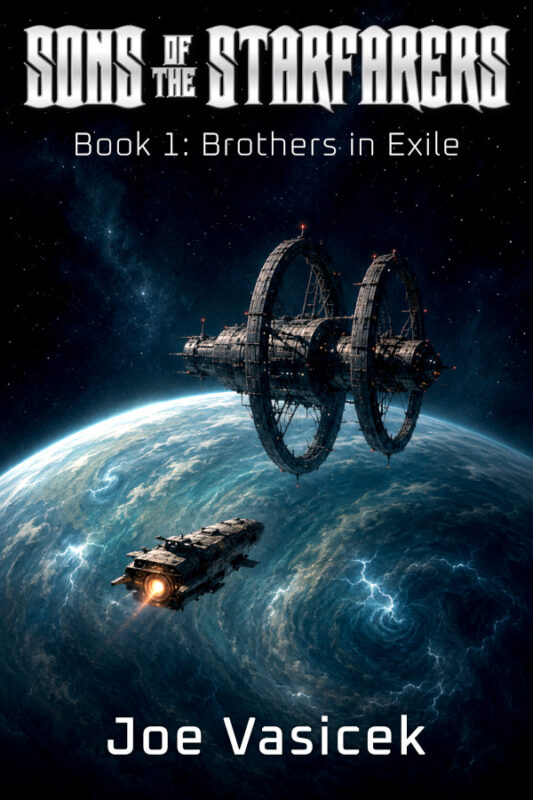
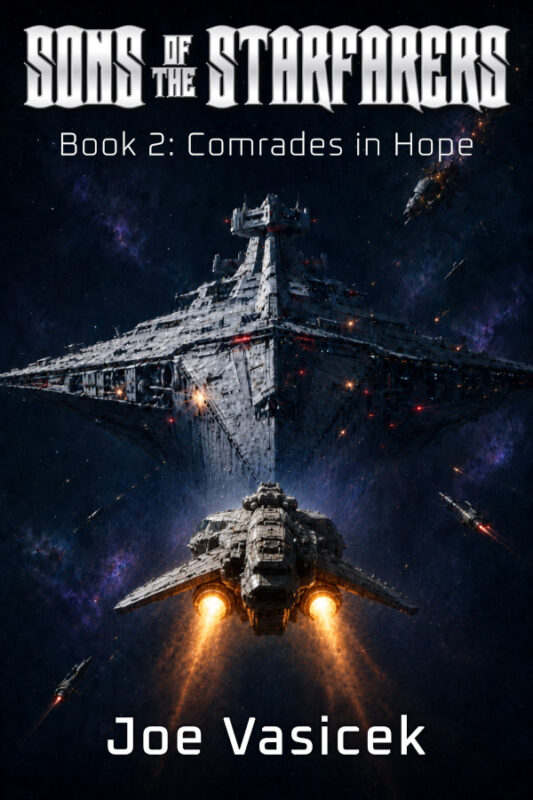
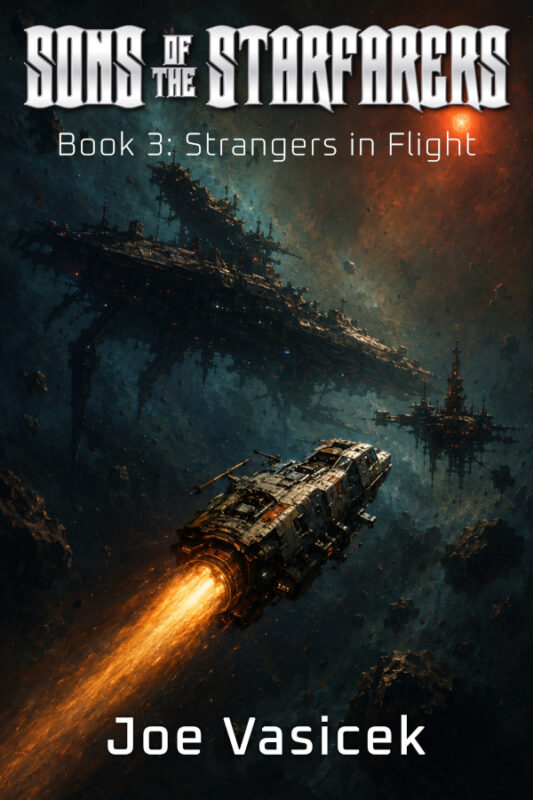
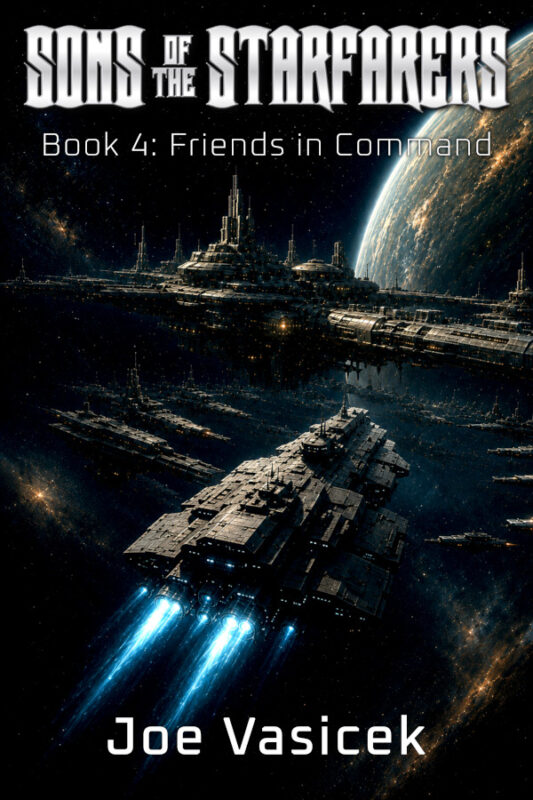
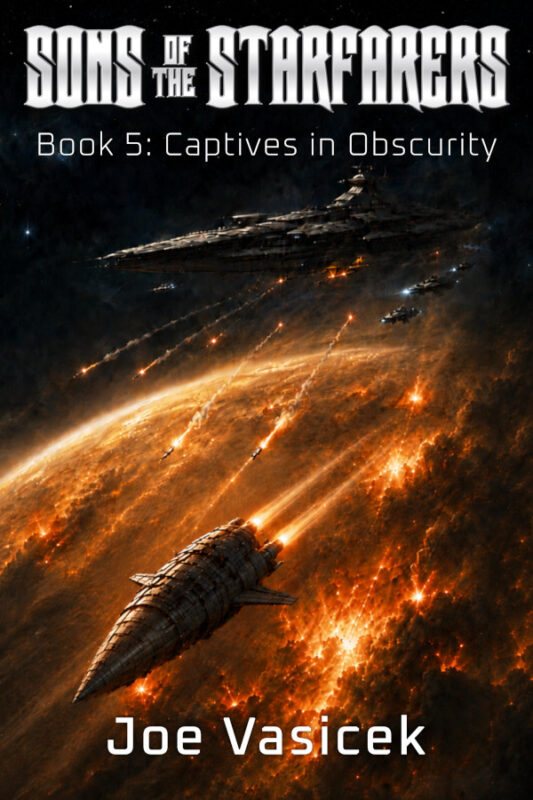
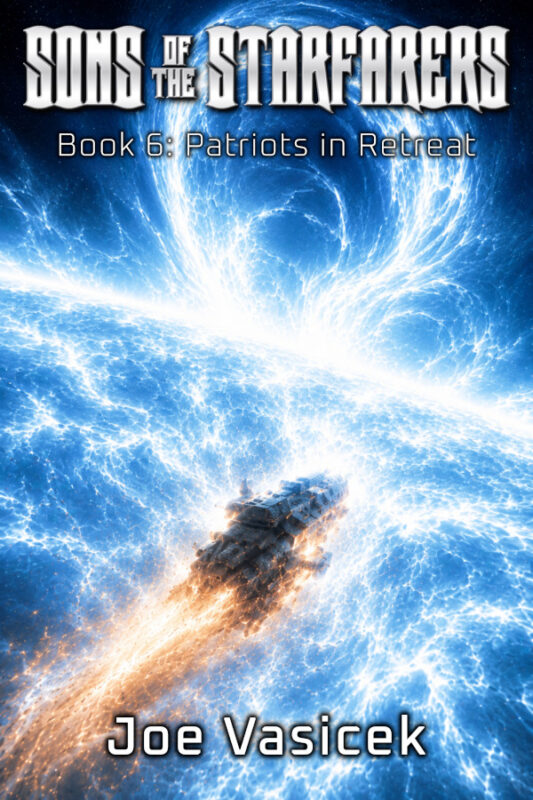
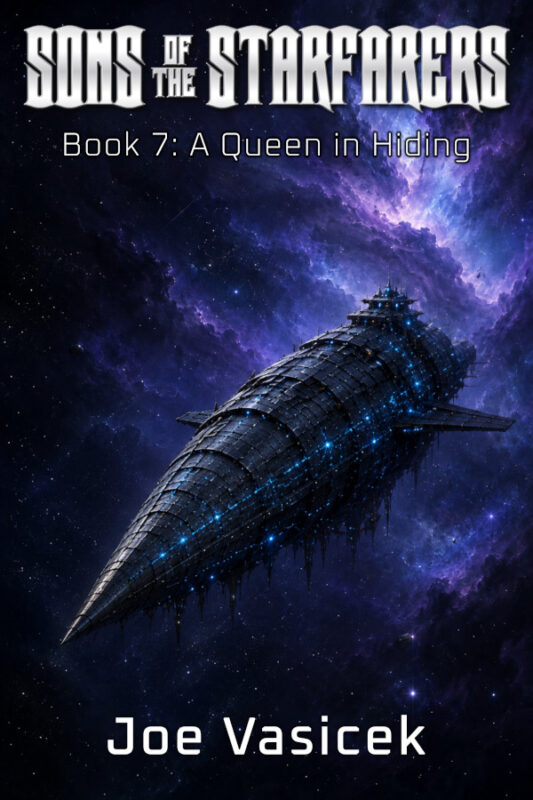
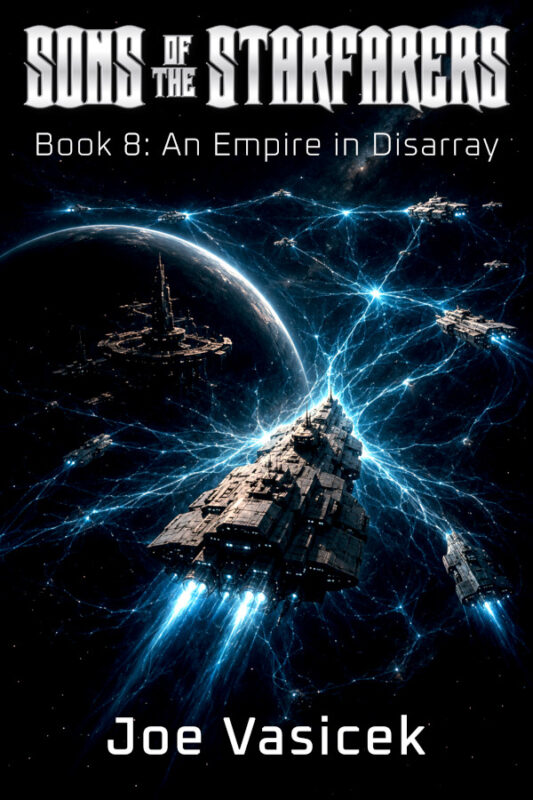
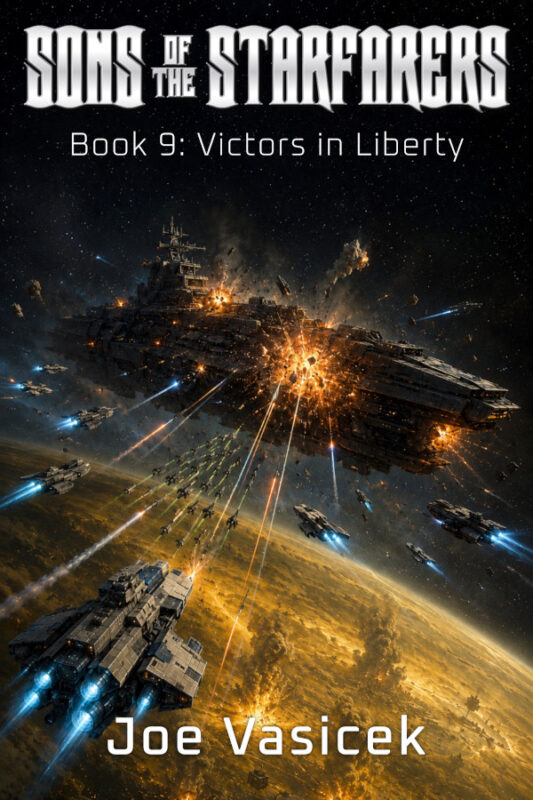
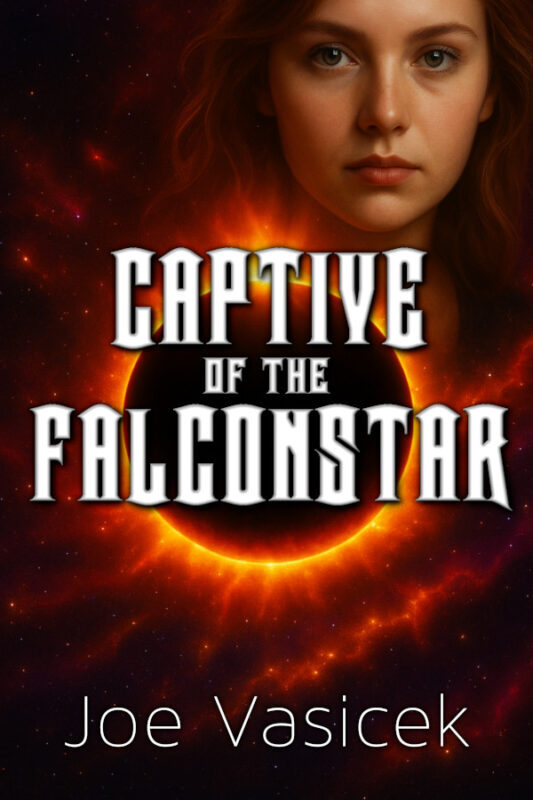
New Sons of the Starfarers Covers!

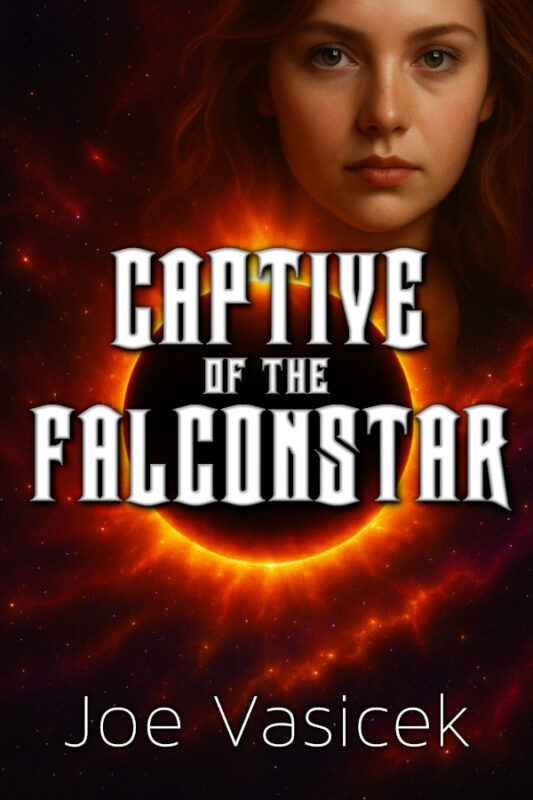
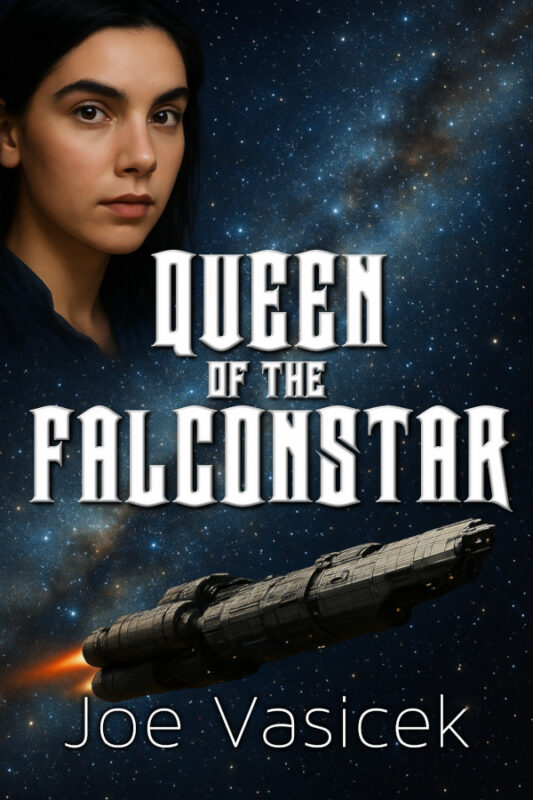
Ever since I got the pro version of ChatGPT (and/or the AWESOME Patron Toolbox over at Author Media), I’ve been sloooooowly going through my backlist, updating blurbs, covers, and metadata. One of my old series that really needs new covers is Sons of the Starfarers. Check out these new ones!

These will hopefully go up over the next week or so. Next up: the Genesis Earth Trilogy!

Author’s Note: Captive of the Falconstar

This is the author’s note I wrote for Captive of the Falconstar. To preorder the novel, click here.

As a young reader, I noticed an interesting pattern in the science fiction books I used to read. Whenever there were three books in a trilogy, the first one was usually a standalone of sorts, with a straightforward plot arc and a satisfying conclusion. But the second book in the trilogy either ended in a major cliffhanger, or else followed a tragic arc with a very unsatisfying conclusion that set things up for the third and final book in the trilogy, which wraps things up in a much more satisfying way. Over time, I internalized this basic rhythm, and still keep it in mind whenever I outline a new series arc.

With the Falconstar Trilogy, I had the idea for the first book long before I knew where the series itself was going. But I found it very difficult to write Queen of the Falconstar until I knew how the rest of the trilogy would end. For that reason, Queen of the Falconstar remained an unfinished draft on my hard drive for the better part of a decade, until I dusted it off in 2020 and tried to rewrite it as a novella. After running it through my writing group, I had a long conversation with my wife, in which I shared some of my story ideas for books 2 and 3. Her response was the catalyst that became Captive of the Falconstar: she basically said “Sonya is too much of a passive character. You should make her the villain/anti-hero of book 2, and give her a revenge plot.”

Suddenly, everything came together, and I knew exactly what I needed to do. I scrapped the novella version of Queen of the Falconstar and turned it into a novel, publishing it in 2021. I then set the Falconstar Trilogy aside to finish The Stars of Redemption (the third book in the Genesis Earth Trilogy) and Children of the Starry Sea. Basically, I had a lot of irons in the fire and wanted to finish those other WIPs before finishing what I’d started with Falconstar. Also, I wanted to see how Queen of the Falconstar did as a standalone, to judge whether or not to prioritize the next two books.

Then, in 2022, OpenAI released ChatGPT and everything began to change. Suddenly, generative AI was turning the writing world upside down. Two camps began to emerge: the first and most vocal was vehemently opposed to all things AI, but especially with using AI as a writing tool. From what I can tell, between a third to a half of all writers fall into that camp. The other half, however, quietly began to implement AI in their writing process in varying degrees. Some writers were lazy about it, leading to some hilarious mishaps when they copy-pasted the full AI response in their books without reading it first, including phrases like “here is the passage you requested, in the style of such-and-such author.” But others were more thoughtful about it, striving to find a balance between using AI as a tool and preserving their own authorial voice and vision.

It was a fascinating time to be a writer, especially one with several novels under my belt. Since I’d already written at least a million words without any AI, and had already developed my own personal voice, I didn’t see much harm in experimenting with these new AI writing tools to see what they could do. I very quickly found that the lazy approach was not the best way to “write,” as AI has, at best, a very bland voice and very little logical consistency over the course of a 300 page book. To really make it work, I found that I had to bring my own vision in the form of a solid outline, and to rewrite everything in my own words to make sure that my voice made it to the final version. But for all the work in-between, I found that AI was a very powerful tool.

There are basically three parts to writing a book: coming up with the story, translating that story idea into words on the page, and turning those words into good words. The part that I struggle the most with is putting the actual words on the page, because a story often changes in the course of writing it down, and when my focus is on putting words on the page, it’s very difficult for me to keep a broad view of the story. Suddenly, the words stop coming to me, because my subconscious mind recognizes that something in the story is broken, but because I’ve lost sight of the forest for the trees, I don’t know how to fix it. So I spend the next month (or two, or three) trying to write my way through the block, only to find that the whole book is hopelessly broken, at which point I decide to set the book aside and come back to it later, once I can approach it with fresh eyes. When I come back to it, the problem is often obvious enough that a quick rewrite can fix it, but by that point I’m several months (or even years) into the project, with very little to show for it. And that is when things work out well—I’ve got plenty of other books that I couldn’t fix, and ended up trunking.

But with AI, I can now translate my outline into a passable rough draft without losing sight of the overall story. By doing this, I can immediately identify all of the major issues with the story, and fix them before they turn into months and months of writer’s block. Of course, the AI draft is too terrible to publish on its own, but that’s no different than any other crappy first draft. So after tweaking the prompts, generating a few different versions of the book, and combining the best parts of each version into a version that’s as good as I can make it with the AI tools alone, I find that I’m ready to rewrite the whole thing in my own words. At that point, it doesn’t matter if I lose sight of the overall story, because all of the major story issues are fixed, and I can focus on the page without having to worry about falling into writer’s block.

In general, I think there are two approaches to using AI. The first is to use AI to do all the work, so that you can reap all of the reward. This isn’t always the wrong approach, but it does always produce “slop.” The other approach is to use AI to do the work that you really struggle with, so that you can refocus your energy on the work that you’re actually good at. Usually, this is the 20% of what you do that produces 80% of the results. Using this approach to AI, you can 5x your productivity without sacrificing quality or producing AI slop.

Imagine a world where instead of waiting a year or more to read the next book from your favorite author, you could get a new book every few months. A world in which your favorite author writes more than a hundred really good books over the course of his lifetime, rather than only one or two dozen. With the way AI is changing things, I’m very optimistic that we are entering this kind of a world. Yes, there will be a lot of slop too, but most of that is going to sink while the cream will rise to the top. And as for the fear that AI will completely replace human authors, I’m not too worried about that, because voice and vision are the two distinctly human elements that make the best books stand out from all the rest. We may get to the point where AI can write a good, generic fantasy novel, but it will never be able to write a Joe Vasicek novel. So if I can learn to use these AI writing tools without losing my voice or my vision for my books, the result is a world where I can write not just more books, but better books—enough to build an audience that will sustain a lifelong career.

So from 2023 through 2025, I focused all of my writing efforts on experimenting with these new AI writing tools, figuring out what worked and what didn’t work, and incorporated all of that into my new creative process. I wrote a lot of practice novels in that time, most of them in the Sea Mage Cycle, but I did experiment a lot with Captive of the Falconstar too. In 2024, I wrote out a detailed outline for the book, but my first attempt was not satisfactory, and I ended up trunking that AI draft and reworking the project from scratch. All through this time, the AI models themselves were rapidly changing, (as well as Sudowrite, the platform I use for most of my AI drafts,) so when I did pick up this WIP again, it made more sense to rewrite the prompts and generate a whole new version anyway.

In January 2026, I decided to buckle down and finish Captive of the Falconstar, even if it took the better part of the year. Thankfully, I managed to finish it in only four months, even though I was watching three small kids for most of that time while my wife was working full-time. (That’s another great thing about writing with these new AI tools: they can really help you to write through difficult life circumstances that would otherwise force you to put your writing on the back-burner for months, or even years.) Once it was done, I sent it off to my editor and put it up for preorder.

The content issues of Captive of the Falconstar did give me pause, since this is much more of an R-rated book than I usually write. In particular, I spent a lot of time agonizing over whether to fade to black instead of including the explicit sex scene where [SPOILER REDACTED]. But her realization of [SPOILER REDACTED] was important enough to her character development that I decided to keep it in. And whenever I paused for a gut check, I always got the impression that this was the book I was supposed to write, even with the explicit sexual content.

Zenoba’s bisexuality was also difficult to write, because of the danger that it would upset everybody and satisfy nobody: that LGBTQ readers would be outraged by the lack of positive affirmation, and that conservative readers would be disgusted by the inclusion of any LGBTQ content at all. But [SPOILER REDACTED] is so key to Zenoba’s character, and to [SPOILER REDACTED], that I couldn’t write her character honestly without including it. And again, whenever I paused for a gut check, I always felt impressed to go on. For all that, I can only suppose that there is a reader out there whom this story was meant to touch. Perhaps that reader is you.

When it comes to mature subjects like [SPOILER REDACTED], there’s a fine line between depicting the subject honestly and depicting it gratuitously. If you err too far on one side, you end up with a weak or an incomplete story, but if you err too far on the other, you veer into writing porn. I’ve done my best to thread that line, and to write my characters as true and as honestly as possible. Perhaps I could have done better, but I do believe that I’ve done the best that I can with my current level of skill.

My plan as of now is to finish another Sea Mage Cycle book and write the third and final book in the Falconstar Trilogy in time for a May 2027 release. I’m still not at a point where I can write a new book in less than 3-4 months, but I do think I can write them fast enough to publish 2-3 novels per year. So that’s the goal. Maybe when the kids are a little older, and I’m a little more practiced with these AI writing tools, I’ll be able to to do more than that. But either way, you won’t have to wait another five years before getting the conclusion to the Falconstar Trilogy. That much I can definitely promise you!

If you enjoyed this book, I would greatly appreciate it if you would post a rating or a review. It really does help to train the recommendation algorithms, so that other people with similar tastes can find these books. Or you can tell a friend about them—even in today’s interconnected world, there’s no substitute for an authentic human connection. If you want to follow my books and my writing, the best way to do that is to sign up for my email newsletter, which I send out about 1-2 times per month. Or you can follow my blog at One Thousand and One Parsecs, or email me at jvasicek.author@gmail.com if you want to get in touch.

That’s all for this one. Until next time, thanks for reading!

Joe

June 2026

HTTL

ChatGPT writes a sword and planet novel for the modern age

Last week, I posted the AI-generated synopsis for a trashy romantasy novel that hits all of the hottest current tropes. This week, I thought it would be fun to do something similar, but to pick a genre that has fallen out of favor in the last 50 years and see if we can’t update it for modern tastes.

So I asked ChatGPT to list some subgenres that were popular 50+ years ago but have fallen sharply out of favor in our current time, then list some of the tropes that define that genre, and combine those tropes with more popular tropes today. The subgenre we went with was sword and planet, and after going back and forth a few times, I think we came up with something decent, if not great.

(FYI, I went back and forth with the AI a lot more times with this one than with the trashy romantasy novel. As a result, it has a lot more of my own fingerprints on it, which you can probably tell if you read it closely enough. But I did rely heavily on the AI.)


Star-Crowned

Ava Mendoza is a brilliant but shy engineering graduate student who has never once seen herself as important, beautiful, or heroic. She prefers equations to people, and predictable routine to anything resembling danger. So when a late-night experiment catastrophically collapses into a quantum anomaly and a wormhole drags her out of her own world entirely, she has no idea she is about to become the center of another world’s prophecy.

She wakes in a burning red desert beneath a sun that flickers like a faulty light—sometimes blinding, sometimes dim, always unstable. Before she can orient herself, the sand erupts into a crystalline predator that hunts using refracted solar flares. Death seems certain until sky-clan warriors descend on insect-wing gliders and drag her to safety through a blur of heat and blade-light.

The moment they spot the battered silver watch on her wrist, everything changes. To Ava it’s a sentimental relic from her father; to the sky-clans it is the legendary “Clock of Worlds,” the unmistakable sign of their prophesied Star-Crowned Princess. She insists they’re mistaken, but the hope in their eyes is too hungry, too desperate. And their leader, Kade Thorne—scarred, disciplined, unexpectedly gentle—treats her with a respect she doesn’t know how to process.

Aelion is a world in collapse. Its red sun flares unpredictably, unleashing radiation storms capable of wiping out whole regions. Long ago, a lost civilization built the Aureole Shield, a planet-spanning defense lattice meant to regulate the sun’s tantrums. But now the shield is failing, and only a tyrant thrives in the chaos.

High Imperator Veylor—ruthless, brilliant, and dying slowly from radiation poisoning—has convinced many that only he can save the world. He sees in Ava the perfect weapon: a beautiful, exotic woman whom the people already whisper about in half-remembered prophecy. If he enslaves her, he doesn’t just possess her; he possesses their hope, their fear, their future. It’s not her power he wants. It’s her image. Her symbolism. Her body as a banner of conquest.

Ava flees with Kade and a small fellowship—Syrin the guilt-stricken telepath, Pira the razor-tongued scout, and Talen the scholar-priest whose fascination with Earthborn oddities borders on worship. Their journey across Aelion is lush, terrifying, and breathtaking: crystal forests humming with ancient data, floating citadels trembling on failing grav-cores, ruins haunted by swarming nanites humming like ghosts of the old world.

And between dangers, Ava and Kade move closer. They share warmth on freezing nights; they exchange glances that linger too long; he corrects her sword stance with hands that hover at her hips longer than necessary; she teases him about his old-fashioned courtesy. When Veylor’s hunters ambush them and Kade draws a battered Colt Peacemaker revolver—an impossibly out-of-place Earth weapon—Ava realizes he’s been hiding a truth as wild as her own.

He came from Earth too. Born in 1887, swept through a wormhole in a lightning storm, stranded here decades before she was born. The admission ties them together in ways neither is ready to voice.

But Veylor’s net tightens. He spreads word that Ava is his destined bride, his divine right. The Aureole Shield’s core is sealed behind defenses only his personal slaves and prisoners may pass. No army can storm it. No warrior can break in. And no other path leads to saving the world.

Ava understands the truth with terrible clarity: if she wants to reach the shield, she must let Veylor take her.

It is the most frightening decision she has ever made, and the bravest. She and Kade plan her “capture” together. He hates it—nearly breaks when she touches his cheek in reassurance—but he promises he will come for her. Not as a hero rescuing a damsel, but as her partner fulfilling the dangerous, brilliant plan she created.

When Ava surrenders to Veylor’s forces, the tyrant is ecstatic. He displays her like a trophy. He mistakes her trembling for fear, not strategy. He believes she is broken. He believes he has won. And because he assumes she is powerless, he brings her into the holy of holies: the Aureole Shield’s control chamber, a throne of living metal and starlight older than memory.

He demands she activate the shield for him.
Instead, she rewires it beneath his nose.

Ava uses her engineering expertise—her intuition, her quick thinking, her Earthborn perspective—to sabotage his takeover, reroute the shield’s systems, and trigger a hard reset that locks him out permanently. When Veylor lunges at her in rage, Kade storms into the chamber, fighting the tyrant in a brutal, desperate duel while Ava works to bring the shield back online.

The Aureole Shield ignites in a cascade of radiance. Aelion’s sun stabilizes for the first time in centuries. Veylor dies screaming that only he deserved its power.

And then—unexpectedly—the energy surge tears open a new wormhole. A shimmering, perfect doorway home.

For the first time since the desert, Ava falters. Earth calls to her with familiar, safe monotony: her graduate program, her half-finished research, her tiny apartment filled with loneliness she once endured without question. Returning would be easy. Predictable. The life she knew.

But she is no longer the woman who left. Aelion has carved her into something new—braver, bolder, desired, seen. She wants Kade. She wants the sky-clans. She wants to live vividly, fiercely, unapologetically. She wants to be what she has become.

She turns away as the wormhole closes on its own.

In the days that follow, she embraces her destiny fully. Ava dons the ceremonial finery of the sky-clans—not as a costume, but as her true skin: elegant, powerful, sensual. She becomes the Star-Crowned Princess by choice, not prophecy. Kade bows to her not out of submission, but devotion. She takes his hand as an equal, radiant and unafraid.

The shy engineer is gone.
In her place stands the woman who saved a world—and claimed her own heart in the process.

Ava Star-Crowned, Princess of Aelion.
A warrior’s beloved.
A world’s hope.
A legend just beginning.


What do you think? Is it something you might want to read? I’m not gonna lie: there’s a part of me that’s tempted to write AI slop, and a novel like this is something I could happily run with.

Or maybe… what if I wrote a book of interesting novel prompts for generative AI, designed for someone to copy-paste into ChatGPT (or their AI model of choice) themselves and have the AI write the story for them? The AI could then adapt the story to the reader, based on their reactions and what they like about it. What do you think? Would you buy a book like that?

ChatGPT writes a trashy novel that fits all the current market trends

So just for fun, I asked ChatGPT to list the post popular tropes in science fiction and fantasy literature right now, pick the most popular subgenre, and write up a novel synopsis that mashes up all of those tropes.

To no one’s surprise, the subgenre it chose was romantasy, but it also threw in dragons, dark academia, and time magic. Here is the complete synopsis:


Here is a tighter, sharper, more compelling 1000-word synopsis that follows the same outline but sells the story harder—maximizing emotional hooks, character stakes, and the high-heat romantasy appeal. Spoilers intact.


The Hundredth Life of the Dragon-Bonded

Rina Ashvale has always been ordinary—poor, unnoticed, unimportant. But on the morning of the Day of Choosing, she wakes with the unshakable feeling that she’s lived this day before. And died in it. Images flash behind her eyes: burning skies, a dragon’s scream, a prince’s hand dripping with blood. None of it makes sense.

Everything changes when Sereth, the most ancient and aloof of all dragons, chooses her as his rider. The bond hits like a lightning strike: thousands of half-formed memories, shards of forgotten lives, and a sense of wrongness in the fabric of the world. Sereth refuses to explain, and Rina finds herself thrust into the elite dragon war-college—completely unprepared, utterly overwhelmed, and lodged in the same wing as the kingdom’s most dangerous cadet: Prince Kael Vorian, heir to their nation’s long-time enemy.

Their first interaction is a disaster. Kael—brilliant, beautiful, and infuriating—sees Rina as an unworthy upstart bonded to a dragon she doesn’t deserve. Rina sees him as an arrogant elite who’s never had to fight for anything real. But whenever they clash in the skies, sparks fly far beyond anger. Something in the dragon bond won’t let them ignore each other.

As Rina trains, she slowly forms a found family with three other misfit cadets—gentle Jory, fierce Thalia, and quick-tongued Marek. Life at the academy carries surprising warmth: late-night mess hall confessions, shared exhaustion after flight drills, stolen pastries in the city. For the first time in her life, Rina feels like she belongs.

But then the déjà vu returns—harder, sharper. She predicts an ambush drill seconds before it happens, saving Kael’s life in a maneuver she can’t explain. When she confronts Sereth, the dragon finally admits the truth:

The world is trapped in a time loop. Ninety-nine times, humanity has fallen to the Void. Ninety-nine times, reality has reset to the beginning of this academy term. Dragons remember. Humans do not.
Except Rina.

Her growing memories mean one thing: she may be the first human in a hundred loops capable of breaking the cycle.

But the moment Rina begins changing events—saving lives that used to be lost, altering training outcomes—the Void adapts. Darker monsters appear. Missions that were once safe become fatal. Jory loses his arm. Marek nearly dies. And Rina realizes a horrifying truth: every change she makes doesn’t erase suffering—it only shifts it onto someone else.

Through it all, Kael remains her fiercest rival and most dangerous ally. Their tension spikes during a magical mishap that amplifies emotion, throwing them into a breathless near-scene neither can forget. During the annual Festival of the First Flame, in the chaos of a Void creature attack, they end up pressed together in a narrow alley, clinging to each other with equal parts fear and longing. When they finally give in to the desire they’ve been denying—an explosive, passionate moment in the dragon stables—they can no longer pretend what’s between them is merely conflict.

But Rina’s growing memories deliver an unbearable blow: in one of the previous loops, Kael burned her village to the ground to slow the Void’s advance. He admits it. He regrets it. He would do it again if it meant saving the world.

Their fragile connection shatters.

As the loop destabilizes, the world begins to tear. Rina slips into the Twilight Reach, the dream-realm dragons inhabit between deaths. There she meets the Hollow King, a godlike Void entity who has been feeding on the loop for centuries. He offers her a seductive bargain: sever the dragon bonds and the loop will end forever—no more death, no more suffering. But it would also mean the extinction of dragons, the world’s only memory-keepers.

Rina refuses. She will not save the world by erasing its heart.

Meanwhile, Kael uncovers a devastating truth: his father, the emperor, is planning a military strike to seize the academy’s dragons, a move that could break the loop catastrophically and hand victory to the Void. Kael offers to kill his father to prevent it. Rina stops him. Instead, she proposes a desperate ritual to jump the timeline forward—getting ahead of the emperor’s plan.

The ritual fails spectacularly.

Time fractures.

The academy splits into two overlapping timelines—the unchanged past loop and the altered timeline Rina and Kael created. Students flicker in and out of existence. Some have duplicates. Others appear as ghosts of who they were meant to be.

Rina’s squad members are caught between versions of themselves. With Sereth’s help, Rina merges their memories, giving each friend the best parts of both lives—even if it costs Sereth more of his dwindling strength. Every memory he surrenders feeds the growing collapse of the loop.

Rina finally understands: dragons carry the burden of memory, but they cannot change it. That’s why the loop always resets. Only a human mind—someone capable of holding all ninety-nine lives at once—can force time forward for good.

She volunteers to carry the full weight of the loop. Kael refuses to let her do it alone.

Together, in the Twilight Reach, Rina and Kael confront the Hollow King. Sereth sacrifices himself to shatter the loop, unleashing all his stored timelines in one final blaze. The Hollow King retreats—but not before warning that breaking the cycle will unleash consequences no one can predict.

Rina and Kael awaken in a world that has never existed before: one without resets, without second chances, without dragons except for a few younglings who survived the collapse. The academy is in ruins. Their nations have fractured. Rina’s village is gone in every timeline. Kael is disowned. The world is raw and wounded—but real.

With their surviving squadmates, they build a small dragon-rider outpost beside a river. Half refuge, half academy, it becomes the first place Rina has ever chosen for herself. Kael stays with her—not as a prince, not as a rival, but as the man who shared a hundred lifetimes of pain and desire with her.

For the first time, dawn breaks on a future that isn’t written.

Standing together in the new light, Rina and Kael speak the vow that binds them:

“We will be the dragons who remember.”

The loop is broken.
The world is reborn.
And their love—forged across a hundred lives—has finally outrun time itself.


So what do you think? Does it sound like something you’d actually want to read? Like something that might even be better than most of the trashy, trendy novels out there, even if it’s total AI slop?

I have no intention of actually writing this book, so if you feel like writing (or generating) it, knock yourself out. Just send me a link if you actually publish it.

How I Would Vote Now: 1993 Hugo Awards (Best Novel)

The Nominees

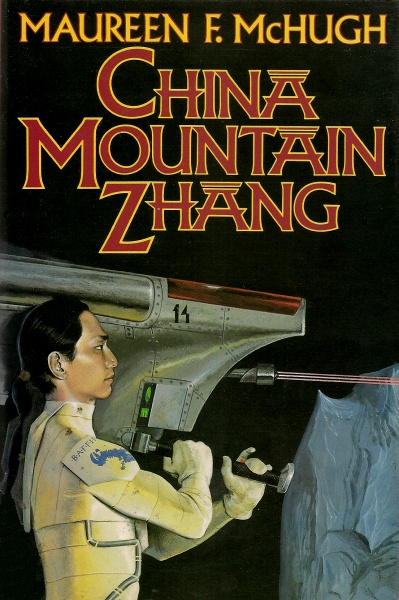
China Mountain Zhang by Maureen F. McHugh

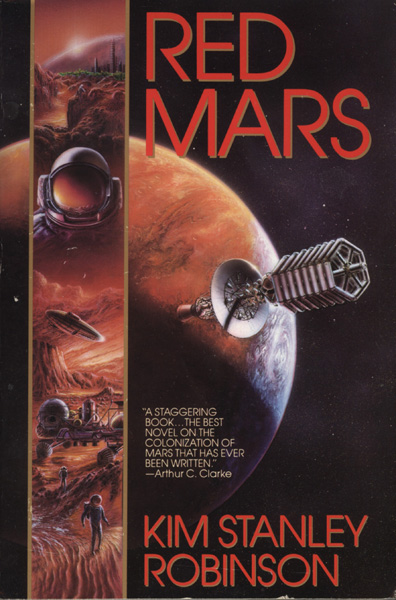
Red Mars by Kim Stanley Robinson

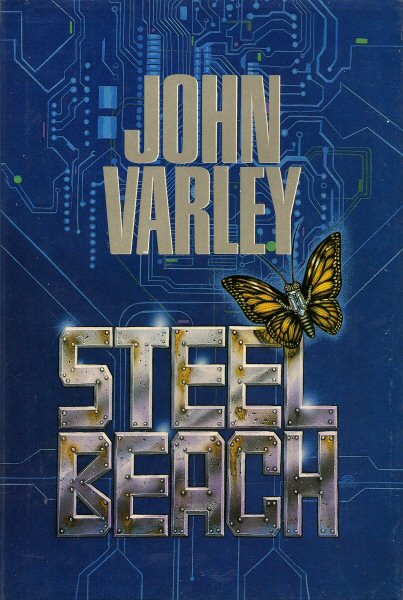
Steel Beach by John Varley

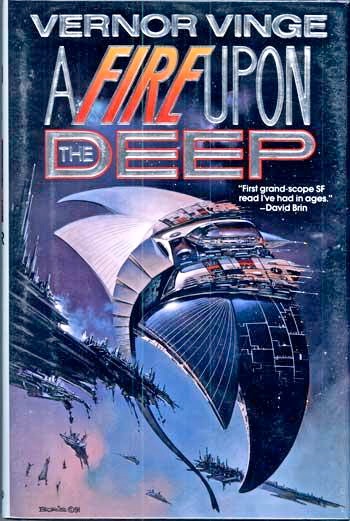
A Fire Upon the Deep by Vernor Vinge

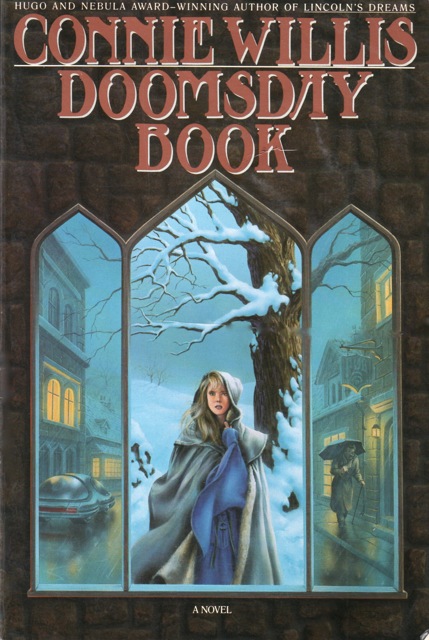
Doomsday Book by Connie Willis

The Actual Results

  1. A Fire Upon the Deep by Vernor Vinge
  2. Doomsday Book by Connie Willis
  3. Red Mars by Kim Stanley Robinson
  4. China Mountain Zhang by Maureen F. McHugh
  5. Steel Beach by John Varley

How I Would Vote Now

(abstain)

Explanation

I didn’t hate any of these books, but I didn’t love any of them either—which is fairly typical for me of 90s era Hugo Awards. Let’s go down the list.

Doomsday Book is often held up as Connie Willis’s best, but I thought it lost the plot a bit when the time travelers had to simultaneously face a pandemic in their own future time while also having to rescue the lost apprentice time traveler from the black death in medieval England. If you’re reeling from a pandemic, what the heck are you doing sending time travelers back as if it’s a normal day on the job? Also, Connie Willis really has no love for the medieval era, and it shows. Blackout and All Clear were much better, partially because of how much Connie Willis clearly loves WWII-era Britain.

If there’s one book in this list that I should try again, and probably will, it’s A Fire Upon the Deep by Vernor Vinge. It’s the kind of science fiction that’s right up my wheelhouse, and I’ve enjoyed Vernor Vinge before (Rainbows End is the best so far). But this book is so freaking huge, and I never latched on to any of the characters… oh, and the central conceit of the aliens, that the small collective packs form a hive mind that thinks and acts like an individual—that didn’t really work for me either time I attempted to read this book.

I screened Steel Beach and China Mountain Zhang through ChatGPT for objectionable content and decided to skip both of them. Here is what ChatGPT said about China Mountain Zhang that made me decide to skip it:

The story engages deeply with themes of intersectional identity, including race, sexual orientation, and societal roles. Zhang’s struggles as a gay man in a conformist society are a significant part of the narrative. The book also critiques authoritarianism and explores social dynamics through a progressive lens. While these themes are integral to the story and handled with subtlety, they align with a modern “woke” perspective.

And here’s what it said about Steel Beach that made me decide to skip it:

Language: Strong language is used throughout, reflecting the irreverent tone of the protagonist and the society depicted.

Gender and Identity: Steel Beach explores themes of gender fluidity and personal identity in a society where individuals can easily change their biological sex. This aspect of the world is presented as normalized rather than contentious.

As for Red Mars, I read this one way back (way way back) when I was a freshman in college. At the time, I was still working out what I believed politically, so most of KSR’s leftism went right over my head. However, there were a few sexually explicit scenes that weirded me out, especially the one where the colony team’s depressed psychiatrist discovers—and joins—the bizarre sex cult and their group orgies in the farm module. I still finished the book, but I declined to read the rest of the series.

What is it with crunchy leftist authors and bizarre, explicit sexual content? Why do they always seem to feel a need to fill their books with weird and pointless sex? There are so many books I’ve read for this series that started out strong, but ultimately devolved into sexual degeneracy that added nothing to the story. It’s almost like they felt a compelling need to add the degeneracy for its own sake. Maybe it’s a boomer thing? A “spirit of the age” possession of some sort? I honestly don’t know.

What if it’s all hallucination?

I’ve been thinking a lot recently about something my wife said about AI. She’s finishing up her PhD in computer science, and knows more about generative AI and computational linguistics than just about everyone I know IRL (and most people I follow on the internet, too). So when she speaks on the subject, I do my best to listen.

Ever since OpenAI and ChatGPT took the world by storm, she’s been telling me that she doesn’t think the hallucination problem (where LLMs make stuff up) will ever be solved. Indeed, she doesn’t think it’s a “problem” in a technical sense at all, because every response from a generative AI is a hallucination—and that’s kind of a point. These aren’t really thinking machines, they’re hallucinating machines, replicating patterns in human language and thought. What difference does it make if the answer is false or true?

We call it “artificial intelligence,” but that’s really a misnomer, because these machines have no “intelligence” at all—at least, not in the human sense. Instead, they are like mirrors of our own intelligence, parroting back things that sound like they involve real thought, when really it’s all just pattern replication. They aren’t trained to recognize truth, they’re trained to recognize patterns. So, in reality, everything an AI generates is a “hallucination.”

This is why she thinks that we will never fully solve the hallucination “problem.” Indeed, the whole effort is a bit like trying to turn a lion into a vegan. And until we can train an AI on absolute truth—a thing that humanity has never been able to agree upon, much less reduce to zeroes and ones—then all we will really be able to do is create better and better plumage for our stochastic parrots.

What are the implications of this? First of all, we can safely ignore the worst of the AI doom porn, because a machine that cannot fundamentally recognize truth from falsehood is probably not capable of taking over the world and exterminating or enslaving humanity, even if it does qualify as a “general” intelligence.

We can also lay aside the fear (or the pipe-dream) that AI will 100% replace humans in all or most or really any fields. Even if they can do 90% of the work, recognizing truth is still an essential part of just about everything we as humans do. We can give it jobs and tasks—perhaps even some genuinely complex tasks—but so long as these machines cannot fundamentally distinguish between truth and falsehood, we will still need a human to oversee them.

That doesn’t mean that most humans are safe from being replaced by AI, though. If an AI-augmented person can accomplish the work of 10x or 100x the number of other human workers, we’re still going to face a massive disruption in the labor market and society as a whole. The question, then, is one of ownership and distribution. Who owns the AI? How do we distribute the productivity gains from AI? These are some of the difficult problems we need to solve in the next few years.

But the real problem—and the scariest implication of all of this—is the question of truth itself. After all, if AI is fundamentally incapable of recognizing truth, and all AI output is hallucination on some level, then who determines what is true and what is not? Sam Altman? OpenAI? Congress? Some three-letter government agency?

I think this is going to be the defining question of the rising generation, which is growing up in an AI-native world. What is truth? How can we recognize it? How do we distinguish between what is true and what is false? Increasingly, we are going to find that these are questions that AI cannot answer. And in a world saturated by deep fakes, bots, and sock puppets, where the internet is dead and all the most powerful players are constantly fighting a 5th gen war with each other, truth will be the thing we are all starving for.

The tragedy of the millennial generation is that everything in our world conspired to starve us of the three things we needed most. More than anything else, we hungered for meaning, authenticity, and redemption—and for the most part, we never got it. You can blame social media, the boomers, capitalism, student loan debt, the Republicans, the Democrats—it really makes no difference. All of those things and more came together to hobble our generation and make it almost impossible for us to launch.

Will the same thing happen with the zoomers and gen-alpha over the question of truth? It appears that things are moving in that direction. In a world saturated with AI, truth becomes a scarce and valuable commodity.

So what do we do? First, I think it’s important to recognize that AI cannot and never will be an authority on truth. At best, it only mirrors our own thoughts and ideas back to us—and at worst, it feeds us the thoughts and ideas of those who seek to control us. But AI itself is neutral, just like a gun or a knife lying on a table is neutral. What matters is how it is used.

Beyond that, I don’t really know what to say. Only that this is something I need to think about a lot more. What are your thoughts?

What do you think of these covers?

I’ve been playing around some more with ChatGPT, working on cover art for the Falconstar Trilogy. The best way to do it, I’ve found, is to make the art with AI, but to do the typography myself.

Anyhow, here are the test covers. What do you think?

The one that I feel most ambivalent about is Queen of the Falconstar. I really like how Zlata turned out, and the Falconstar looks pretty cool too, but the background… let’s see if I can fix that:

Anyhow, what do you think?

Epic Fantasy vs. LitRPG: 20 more principles that set them apart from other genres

So building on yesterday’s blog post, after asking ChatGPT to contrast litRPG against epic fantasy, I asked the AI to come up with twenty more principles that show how litRPG and epic fantasy are more similar to each other, by contrasting them against other genres. In other words, I asked for another twenty principles that either 1) hold true for both litRPG and epic fantasy, but not other genres, or 2) do not hold true for litRPG or epic fantasy, but do hold true for other genres. This was what the AI came up with.

What do you think? Do you agree with the list, or do you think the AI doesn’t know what it’s talking about? I mean, of course the AI doesn’t know what it’s talking about—it’s a pattern-matching stochastic parrot incapable of actual thought—but does the list itself hold true, or not? I’m interested to hear what you think!


✅ Ten Principles That Work in Both Epic Fantasy and LitRPG (but not as well elsewhere)

1. The Long Form Is an Asset

  • Epic Fantasy: Readers expect doorstoppers; sprawling stories add gravitas.
  • LitRPG: Readers binge long series to follow progression.
  • Other genres: Overly long novels (romance, thrillers) often feel padded or indulgent.

2. Worldbuilding as a Core Pleasure

  • Epic Fantasy: Intricate maps, languages, and histories enrich immersion.
  • LitRPG: Detailed mechanics, systems, and economies are part of the appeal.
  • Other genres: Too much worldbuilding bogs down the story (e.g., in mystery or romance).

3. Reader Dedication Is Assumed

  • Epic Fantasy: Readers accept investment to reap the mythic payoff.
  • LitRPG: Readers accept grindy arcs to enjoy progression.
  • Other genres: Casual readers often want quick satisfaction.

4. Hero’s Journey as Central Skeleton

  • Epic Fantasy: Growth from obscurity to legend is the core arc.
  • LitRPG: Growth from level 1 to overpowered is the core arc.
  • Other genres: Often resist the monomyth (slice-of-life, literary realism, etc.).

5. Community/Ensemble Casts

  • Epic Fantasy: Multiple POVs enrich the tapestry.
  • LitRPG: Party dynamics (tank, healer, mage) reflect RPG roots.
  • Other genres: Large casts risk confusing readers who want intimacy.

6. Spectacle as Payoff

  • Epic Fantasy: Climactic battles or magical revelations awe readers.
  • LitRPG: Dungeon raids and boss fights provide thrill.
  • Other genres: Spectacle without intimacy or brevity (like in romance) falls flat.

7. Maps and Charts Enhance the Experience

  • Epic Fantasy: Maps show kingdoms, trade routes, and lost ruins.
  • LitRPG: Stat sheets, skill trees, and quest logs scratch the gamer itch.
  • Other genres: Appendices and diagrams often feel extraneous.

8. Bingeability

  • Epic Fantasy: Readers want to sink in for weeks.
  • LitRPG: Readers tear through serialized arcs like binge-gaming sessions.
  • Other genres: Shorter, self-contained experiences dominate (rom-coms, thrillers).

9. Immersion Requires Internal Consistency

  • Epic Fantasy: Magic systems, politics, and cultures must feel internally real.
  • LitRPG: Mechanics and progression must follow consistent rules.
  • Other genres: Small cheats or contrivances are forgiven more easily.

10. The Fantasy of Escape Into Another Life

  • Epic Fantasy: Readers escape into a mythic, larger-than-life destiny.
  • LitRPG: Readers escape into a game avatar, empowered and free.
  • Other genres: Escapism is more muted—characters often mirror real-world constraints.

❌ Ten Principles That Work in Other Genres But Not in Epic Fantasy or LitRPG

11. Economy of Length

  • Epic Fantasy: Truncated stories feel shallow.
  • LitRPG: Short books cut off progression.
  • Other genres: Brevity (novellas, short novels) often thrives in romance, literary fiction, thrillers.

12. Standalone Closure

  • Epic Fantasy: Readers expect series and arcs across volumes.
  • LitRPG: Readers expect sequels and continuous leveling.
  • Other genres: Standalone novels dominate many markets (romance, crime).

13. Minimal World Detail

  • Epic Fantasy: Sparse settings break immersion.
  • LitRPG: Thin systems or game mechanics disappoint.
  • Other genres: Often better to focus tightly on character or conflict.

14. Immediate, High-Speed Pacing

  • Epic Fantasy: Readers accept gradual build-up.
  • LitRPG: Readers accept grind loops before climax.
  • Other genres: Quick, relentless pacing (thrillers) is a selling point.

15. Subtlety Over Spectacle

  • Epic Fantasy: Readers want grandeur, not quiet minimalism.
  • LitRPG: Readers want flashy abilities, loot drops, boss fights.
  • Other genres: Subtle slice-of-life or understated literary fiction works well.

16. Ambiguous Endings

  • Epic Fantasy: Readers want resolution—wars won, empires reshaped.
  • LitRPG: Readers want progression arcs to complete.
  • Other genres: Literary realism thrives on ambiguity.

17. Everyday Banality

  • Epic Fantasy: Mundane routine (work, school, dishes) feels like filler.
  • LitRPG: Grinding without purpose or progress feels like padding.
  • Other genres: Slice-of-life, contemporary drama thrive on the ordinary.

18. Romance as the Core Engine

  • Epic Fantasy: Love enriches but rarely drives the whole tapestry.
  • LitRPG: Love plots are secondary to leveling and quests.
  • Other genres: Romance is often the primary driver.

19. Prose Minimalism

  • Epic Fantasy: Readers want at least some richness, tone, and weight.
  • LitRPG: Readers want clarity and detail in mechanics, not Hemingway sparsity.
  • Other genres: Minimalist prose shines in lit fic or thrillers.

20. Compressed Timelines

  • Epic Fantasy: Readers want generations, years, or at least a long journey.
  • LitRPG: Readers want long campaigns and layered arcs.
  • Other genres: Stories that span a weekend or a single evening work beautifully in mystery, romance, lit fic.

⚖️ Big Takeaway

  • Shared Strengths (1–10): Both genres embrace immersion, scope, detail, and reader investment. They reward readers who want to live in another world for a long time.
  • Shared Weaknesses (11–20): Neither does well with brevity, minimalism, ambiguity, or everyday mundanity. Those principles thrive in other fiction but undermine the immersive, long-game experience of epic fantasy and LitRPG.

Epic Fantasy vs. LitRPG: 20 principles that work in one but not the other

So I was doing some genre research using ChatGPT, comparing epic fantasy (which I write) to litRPG (which I do not write—at least, not yet). After going back and forth for a while, I had ChatGPT list a bunch of principles that set each subgenre apart from each other. In other words, each of these principles holds true only for the one subgenre and not for the other.

It’s an interesting list. But being AI-generated, I’m not sure how much I can trust it, so I’d be interested to get your feedback. How true do you think these principles holds? Is it a pretty solid list, or are any areas where the AI got it wrong?


✅ Works in Epic Fantasy but Not LitRPG

1. Slow, Majestic Pacing

  • Epic Fantasy: Readers savor patience, waiting hundreds of pages for payoffs.
  • LitRPG: Readers expect regular “level-ups” or stat reveals—slow burns feel like stalling.

2. World as a Living, Breathing Character

  • Epic Fantasy: Setting is alive, with cultures, histories, and myth shaping events.
  • LitRPG: Worlds are often coded, constructed systems; too much “world-agency” risks breaking the conceit of “game mechanics.”

3. Archetypal Myth and Destiny

  • Epic Fantasy: Readers love prophecy, ancient bloodlines, and cosmic fate.
  • LitRPG: Players expect agency and control; prophecy undercuts the appeal of player choice.

4. Elevated, Poetic Language

  • Epic Fantasy: Slightly archaic or grand prose enhances the mythic atmosphere.
  • LitRPG: Readers expect clear, modern, accessible prose—too much ornament feels like “lag.”

5. Moral and Philosophical Depth

  • Epic Fantasy: Readers enjoy wrestling with justice, faith, and power.
  • LitRPG: Too much moral philosophizing slows down what should feel like gameplay and strategy.

6. Earned Heroism Through Suffering

  • Epic Fantasy: Heroes rise through sacrifice, scars, and loss.
  • LitRPG: Heroes rise by optimizing builds and winning battles. Too much suffering without progression feels like poor game balance.

7. History as Weight

  • Epic Fantasy: Ancient wars, dynasties, ruins, and forgotten myths enrich immersion.
  • LitRPG: History matters less than mechanics; world “backstory” is often secondary to the system’s function.

8. Layered Political Intrigue

  • Epic Fantasy: Kingdoms, councils, conspiracies—slow, strategic plotting excites readers.
  • LitRPG: Readers may skip political detail to get back to quests, loot, or progression.

9. Villains as Ideologies

  • Epic Fantasy: Antagonists often embody philosophies or cosmic balances.
  • LitRPG: Readers want enemies to be challenges, bosses, or rival players—not treatises on ideology.

10. The Reader Must Feel Small

  • Epic Fantasy: The awe of mountains, empires, or gods dwarfs the individual.
  • LitRPG: Readers want to feel powerful, not humbled—progression fantasy is about growth and mastery.

✅ Works in LitRPG but Not Epic Fantasy

11. Constant Tangible Progress

  • LitRPG: Frequent “dings,” new skills, and stat boosts scratch the gamer itch.
  • Epic Fantasy: Constant visible gains feel artificial—growth should be slow, hard-won, and often invisible.

12. Game-Like Structure

  • LitRPG: Clear quests, dungeons, XP, and loot tables create satisfying loops.
  • Epic Fantasy: Too much structure breaks the illusion of a living world—life doesn’t hand out quests so neatly.

13. Crunchy Mechanics

  • LitRPG: Readers relish stat blocks, skill trees, and optimization discussions.
  • Epic Fantasy: Overly mechanical explanations kill immersion—magic should feel mysterious, not like a spreadsheet.

14. Frequent Combat Encounters

  • LitRPG: Battles are core gameplay; readers expect frequent fights.
  • Epic Fantasy: Endless combat risks exhausting readers who want battles to feel rare, costly, and decisive.

15. Player Agency Above All

  • LitRPG: The protagonist must feel like a player making choices.
  • Epic Fantasy: Fate, prophecy, or the “burden of destiny” often guide characters beyond their control.

16. Meta Awareness

  • LitRPG: Characters can reference game mechanics, genre tropes, or player logic.
  • Epic Fantasy: Meta jokes break immersion—characters can’t wink at the audience about being in a story.

17. Loot and Rewards as Story Fuel

  • LitRPG: New gear and loot drops are story progression.
  • Epic Fantasy: Magical swords and treasures matter, but they’re rare, symbolic, and usually secondary to inner growth.

18. Episodic, “Grindable” Arcs

  • LitRPG: Dungeon runs, quests, and side missions can be modular and satisfying.
  • Epic Fantasy: Too episodic undermines the long-arc gravitas; the story must feel like a single tapestry.

19. Power Fantasy at the Forefront

  • LitRPG: Readers want to imagine themselves growing invincible.
  • Epic Fantasy: Too much power fantasy feels hollow—readers want awe and cost, not invincibility.

20. Immersion Through Familiar Systems

  • LitRPG: RPG tropes are comforting—readers enjoy seeing familiar mechanics at play.
  • Epic Fantasy: Familiar mechanics feel derivative—immersion comes from originality, history, and myth.

⚖️ The Big Picture

  • Epic Fantasy: Offers immersion in a mythic, awe-inspiring legend, with patience, gravitas, and weight. It humbles and uplifts.
  • LitRPG: Offers immersion in a game you can read, with momentum, mechanics, and constant progression. It empowers and energizes.

They share world immersion as a value—but diverge in what kind of immersion the audience craves: awe vs. agency, myth vs. mechanics, destiny vs. progress.

How I Would Vote: 2025 Hugo Awards

The Nominees

The Tainted Cup by Robert Jackson Bennett

The Ministry of Time by Kaliane Bradley

A Sorceress Comes to Call by T. Kingfisher

Alien Clay by Adrian Tchaikovsky

Service Model by Adrian Tchaikovsky

Someone You Can Build a Nest In by John Wiswell

The Actual Results

TO BE DETERMINED

How I Would Vote Now

  1. No Award
  2. Service Model by Adrian Tchaikovsky

Explanation

As if yesterday’s post wasn’t controversial enough, I’ve decided to jump feet-first into this particular tempest (though thankfully, it appears to be a tempest in an ever-shrinking teacup). And I suppose the thing that makes this particular post so interesting is that I could actually cast this vote, if I had no qualms about giving the clowns who run the Hugo Awards any of my hard-earned money. But I do have qualms, so I won’t give them my money, which still makes this a hypothetical exercise, even though I’m posting this three weeks before the 2025 Hugos are awarded.

To be perfectly honest, I have not read any of these books all of the way through. I’ve read enough of two of them to DNF them, and one of them enough (including the epilogue) to know that I will eventually read the whole thing. And I screened all of them first with AI, which told me enough to know that three of them were not worth reading at all.

First, Someone You Can Build a Nest In. According to ChatGPT (and frankly, the back cover description itself), this book is chock full of body horror, trauma, abuse, and sexual depravity. It is also quite possibly the wokest book on the ballot, which means that it probably has the best chance of actually winning. Which also means that you couldn’t pay me enough money to read it. So much for that.

The Ministry of Time also appears to be woke, with anti-colonial and LGBTQ themes. However, the thing that really turned me off were all of the content issues that ChatGPT listed, such as frequent strong language, lots of F-bombs, and several erotic “open-door” sex scenes. So yeah, I’ll give a pass on that one too.

It’s much the same story for The Tainted Cup. A few woke elements, a subtle M/M romance (which I’m sure plays into the “All True Love is LGBTQ Love” trope that I cannot abide), and a lot of explicit profanity, with some prostitution to round it out. Not interested.

I forget why I DNFed A Sorceress Comes to Call. All I remember was that when I tried to read it, I felt repelled from it like a magnet. Since that has been my experience with basically everything else that T. Kingfisher has written, I didn’t feel compelled to try again.

Which brings us to the two books by Tchaikovsky. I really enjoyed his Children of Time, though I didn’t really get into the sequel (just didn’t feel compelled by any of the characters). He is a good writer, and specifically a good science fiction writer, though his scientific materialism strikes me as outdated.

Alien Clay didn’t appeal much to me, though—honestly, I found it difficult to believe that a government that would expend so many resources to transport their prisoners halfway across the galaxy wouldn’t also spend the tiny fractional cost to make sure they all got there alive. So right from the start, it felt like a melodramatic parody of all the left’s fears about “fascism.” And skipping to the end, it basically turns out the way Halo would have ended if the Flood had won. So I decided to DNF it, even though it wasn’t the worst book I’ve ever DNFed. And also, I don’t think that any one author should have more than one book on the ballot in any given year. So that’s why I’d put it under No Award.

Service Model, though, is pretty good. The best way I can describe it is Murderbot meets Kafka. It’s sort of an absurdist comedy in a post-apocalyptic world where the humans have (mostly) vanished, and the robots are malfunctioning in hilarious (and sometimes disturbing) ways. Not my favorite kind of book, and it probably could be improved by ruthlessly editing it to half the length, but I was enjoying it right up to the point where someone else put the library copy on hold, and I had to return it without renewing it. Skipping to the epilogue, I found nothing particularly objectionable, so I will pick it up again, and will likely finish it.

Which is more than I can say of most Hugo-nominated books in the last ten years.

[ETA 23 Feb 2026: I’ve decided to DNF Service Model after all, not because of anything objectionable that I read, but because I just couldn’t bring myself to pick it up again and finish it. It just wasn’t compelling enough for me to want to finish it more than I want to pick up something new. I could be persuaded otherwise if I heard someone really gush about it, but right now, I’m just not going to bother.]