It’s done!

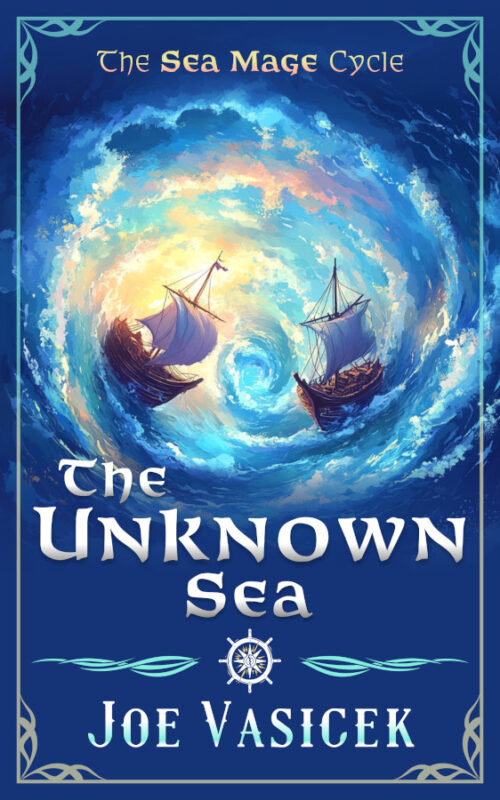
Last week, I finished writing The Unknown Sea, the sixth book that I’ve written so far in the Sea Mage Cycle. Here are the stats:

  • Total Chapters: 16
  • Total Scenes: 53
  • Total Words: 50,069
  • Total Process Words: 457,791
  • Total Writing Hours: 91.1
  • Total Writing Days: 71

This one went a lot faster than I thought it would, though it took nearly a year before I finally buckled down and did it. I had the initial idea for it way back in December 2024, and finished the outline in January 2025. But I put it aside until July, then worked on it off and on for the next three or four months, not really making much measurable progress. So it wasn’t until I buckled down in May and really sat down to finish it that I finally pounded it all out.

This is the sixth book I’ve written in the Sea Mage Cycle, but it’s the second book chronologically, taking place about ten years after the events of The Widow’s Child. As with all the Sea Mage Cycle books, this is a standalone. I will probably write at least another two books in the series, just so that I can round out another four book omnibus edition. It’s going to be a little while, though, as I really want to pivot towards the Soulbound King, releasing the first three books within a year of each other. Also, I need to finish my two open sci-fi trilogies: The Outworld Trilogy and the Falconstar Trilogy.

So my next big WIP is going to be Lord of the Falconstar, which I plan to release in May 2026. The outline and rough AI draft are already finished, so ten months should be sufficient to get that done, even with my wife going back to full-time work in a couple of weeks. We’ll have to start going to bed early, so that she can get more sleep, and I can wake up at 4AM to write. In the meantime, I plan to send The Unknown Sea off to my editor, and format and publish that as soon as he gets back to me with the edits.

By the way, The Unknown Sea is already up for preorder! You can get it here:

Buy from Amazon Kindle
Buy from Apple Books
Buy from Barnes and Noble Nook
Buy from Smashwords

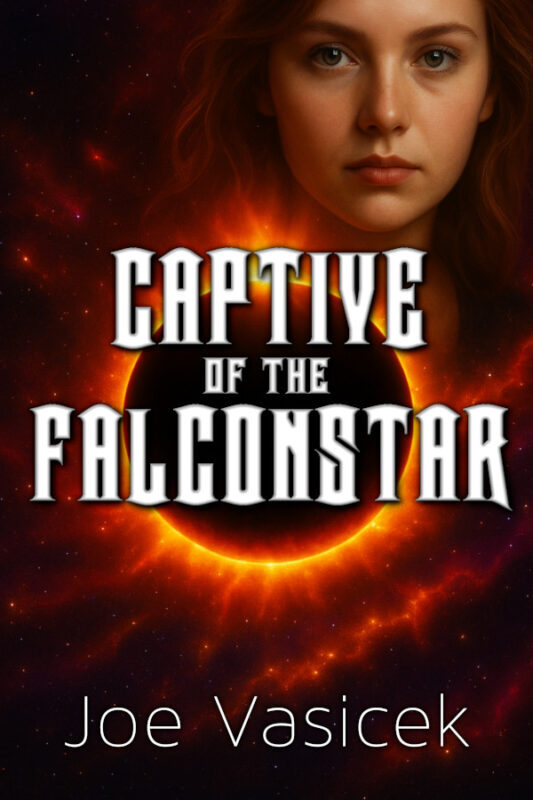
Author’s Note: Captive of the Falconstar

This is the author’s note I wrote for Captive of the Falconstar. To preorder the novel, click here.

As a young reader, I noticed an interesting pattern in the science fiction books I used to read. Whenever there were three books in a trilogy, the first one was usually a standalone of sorts, with a straightforward plot arc and a satisfying conclusion. But the second book in the trilogy either ended in a major cliffhanger, or else followed a tragic arc with a very unsatisfying conclusion that set things up for the third and final book in the trilogy, which wraps things up in a much more satisfying way. Over time, I internalized this basic rhythm, and still keep it in mind whenever I outline a new series arc.

With the Falconstar Trilogy, I had the idea for the first book long before I knew where the series itself was going. But I found it very difficult to write Queen of the Falconstar until I knew how the rest of the trilogy would end. For that reason, Queen of the Falconstar remained an unfinished draft on my hard drive for the better part of a decade, until I dusted it off in 2020 and tried to rewrite it as a novella. After running it through my writing group, I had a long conversation with my wife, in which I shared some of my story ideas for books 2 and 3. Her response was the catalyst that became Captive of the Falconstar: she basically said “Sonya is too much of a passive character. You should make her the villain/anti-hero of book 2, and give her a revenge plot.”

Suddenly, everything came together, and I knew exactly what I needed to do. I scrapped the novella version of Queen of the Falconstar and turned it into a novel, publishing it in 2021. I then set the Falconstar Trilogy aside to finish The Stars of Redemption (the third book in the Genesis Earth Trilogy) and Children of the Starry Sea. Basically, I had a lot of irons in the fire and wanted to finish those other WIPs before finishing what I’d started with Falconstar. Also, I wanted to see how Queen of the Falconstar did as a standalone, to judge whether or not to prioritize the next two books.

Then, in 2022, OpenAI released ChatGPT and everything began to change. Suddenly, generative AI was turning the writing world upside down. Two camps began to emerge: the first and most vocal was vehemently opposed to all things AI, but especially with using AI as a writing tool. From what I can tell, between a third to a half of all writers fall into that camp. The other half, however, quietly began to implement AI in their writing process in varying degrees. Some writers were lazy about it, leading to some hilarious mishaps when they copy-pasted the full AI response in their books without reading it first, including phrases like “here is the passage you requested, in the style of such-and-such author.” But others were more thoughtful about it, striving to find a balance between using AI as a tool and preserving their own authorial voice and vision.

It was a fascinating time to be a writer, especially one with several novels under my belt. Since I’d already written at least a million words without any AI, and had already developed my own personal voice, I didn’t see much harm in experimenting with these new AI writing tools to see what they could do. I very quickly found that the lazy approach was not the best way to “write,” as AI has, at best, a very bland voice and very little logical consistency over the course of a 300 page book. To really make it work, I found that I had to bring my own vision in the form of a solid outline, and to rewrite everything in my own words to make sure that my voice made it to the final version. But for all the work in-between, I found that AI was a very powerful tool.

There are basically three parts to writing a book: coming up with the story, translating that story idea into words on the page, and turning those words into good words. The part that I struggle the most with is putting the actual words on the page, because a story often changes in the course of writing it down, and when my focus is on putting words on the page, it’s very difficult for me to keep a broad view of the story. Suddenly, the words stop coming to me, because my subconscious mind recognizes that something in the story is broken, but because I’ve lost sight of the forest for the trees, I don’t know how to fix it. So I spend the next month (or two, or three) trying to write my way through the block, only to find that the whole book is hopelessly broken, at which point I decide to set the book aside and come back to it later, once I can approach it with fresh eyes. When I come back to it, the problem is often obvious enough that a quick rewrite can fix it, but by that point I’m several months (or even years) into the project, with very little to show for it. And that is when things work out well—I’ve got plenty of other books that I couldn’t fix, and ended up trunking.

But with AI, I can now translate my outline into a passable rough draft without losing sight of the overall story. By doing this, I can immediately identify all of the major issues with the story, and fix them before they turn into months and months of writer’s block. Of course, the AI draft is too terrible to publish on its own, but that’s no different than any other crappy first draft. So after tweaking the prompts, generating a few different versions of the book, and combining the best parts of each version into a version that’s as good as I can make it with the AI tools alone, I find that I’m ready to rewrite the whole thing in my own words. At that point, it doesn’t matter if I lose sight of the overall story, because all of the major story issues are fixed, and I can focus on the page without having to worry about falling into writer’s block.

In general, I think there are two approaches to using AI. The first is to use AI to do all the work, so that you can reap all of the reward. This isn’t always the wrong approach, but it does always produce “slop.” The other approach is to use AI to do the work that you really struggle with, so that you can refocus your energy on the work that you’re actually good at. Usually, this is the 20% of what you do that produces 80% of the results. Using this approach to AI, you can 5x your productivity without sacrificing quality or producing AI slop.

Imagine a world where instead of waiting a year or more to read the next book from your favorite author, you could get a new book every few months. A world in which your favorite author writes more than a hundred really good books over the course of his lifetime, rather than only one or two dozen. With the way AI is changing things, I’m very optimistic that we are entering this kind of a world. Yes, there will be a lot of slop too, but most of that is going to sink while the cream will rise to the top. And as for the fear that AI will completely replace human authors, I’m not too worried about that, because voice and vision are the two distinctly human elements that make the best books stand out from all the rest. We may get to the point where AI can write a good, generic fantasy novel, but it will never be able to write a Joe Vasicek novel. So if I can learn to use these AI writing tools without losing my voice or my vision for my books, the result is a world where I can write not just more books, but better books—enough to build an audience that will sustain a lifelong career.

So from 2023 through 2025, I focused all of my writing efforts on experimenting with these new AI writing tools, figuring out what worked and what didn’t work, and incorporated all of that into my new creative process. I wrote a lot of practice novels in that time, most of them in the Sea Mage Cycle, but I did experiment a lot with Captive of the Falconstar too. In 2024, I wrote out a detailed outline for the book, but my first attempt was not satisfactory, and I ended up trunking that AI draft and reworking the project from scratch. All through this time, the AI models themselves were rapidly changing, (as well as Sudowrite, the platform I use for most of my AI drafts,) so when I did pick up this WIP again, it made more sense to rewrite the prompts and generate a whole new version anyway.

In January 2026, I decided to buckle down and finish Captive of the Falconstar, even if it took the better part of the year. Thankfully, I managed to finish it in only four months, even though I was watching three small kids for most of that time while my wife was working full-time. (That’s another great thing about writing with these new AI tools: they can really help you to write through difficult life circumstances that would otherwise force you to put your writing on the back-burner for months, or even years.) Once it was done, I sent it off to my editor and put it up for preorder.

The content issues of Captive of the Falconstar did give me pause, since this is much more of an R-rated book than I usually write. In particular, I spent a lot of time agonizing over whether to fade to black instead of including the explicit sex scene where [SPOILER REDACTED]. But her realization of [SPOILER REDACTED] was important enough to her character development that I decided to keep it in. And whenever I paused for a gut check, I always got the impression that this was the book I was supposed to write, even with the explicit sexual content.

Zenoba’s bisexuality was also difficult to write, because of the danger that it would upset everybody and satisfy nobody: that LGBTQ readers would be outraged by the lack of positive affirmation, and that conservative readers would be disgusted by the inclusion of any LGBTQ content at all. But [SPOILER REDACTED] is so key to Zenoba’s character, and to [SPOILER REDACTED], that I couldn’t write her character honestly without including it. And again, whenever I paused for a gut check, I always felt impressed to go on. For all that, I can only suppose that there is a reader out there whom this story was meant to touch. Perhaps that reader is you.

When it comes to mature subjects like [SPOILER REDACTED], there’s a fine line between depicting the subject honestly and depicting it gratuitously. If you err too far on one side, you end up with a weak or an incomplete story, but if you err too far on the other, you veer into writing porn. I’ve done my best to thread that line, and to write my characters as true and as honestly as possible. Perhaps I could have done better, but I do believe that I’ve done the best that I can with my current level of skill.

My plan as of now is to finish another Sea Mage Cycle book and write the third and final book in the Falconstar Trilogy in time for a May 2027 release. I’m still not at a point where I can write a new book in less than 3-4 months, but I do think I can write them fast enough to publish 2-3 novels per year. So that’s the goal. Maybe when the kids are a little older, and I’m a little more practiced with these AI writing tools, I’ll be able to to do more than that. But either way, you won’t have to wait another five years before getting the conclusion to the Falconstar Trilogy. That much I can definitely promise you!

If you enjoyed this book, I would greatly appreciate it if you would post a rating or a review. It really does help to train the recommendation algorithms, so that other people with similar tastes can find these books. Or you can tell a friend about them—even in today’s interconnected world, there’s no substitute for an authentic human connection. If you want to follow my books and my writing, the best way to do that is to sign up for my email newsletter, which I send out about 1-2 times per month. Or you can follow my blog at One Thousand and One Parsecs, or email me at jvasicek.author@gmail.com if you want to get in touch.

That’s all for this one. Until next time, thanks for reading!

Joe

June 2026

HTTL

Plugging along

Just plugging along with my current WIP, The Unknown Sea. As of right now, I’m 28% done with the final polished draft, 32% done with the revised human draft, 46% done with the rough human draft, and 73% done with the final AI draft (the rough AI draft is already complete).

I’m cycling through all of these drafts at the same time, which is why each one is at a different stage. It’s an experiment to see if that’s a better way to write, as opposed to working on the one draft until it’s completely done, then reworking the whole book until the next draft is done, etc.

The important number is the 28% of the final polished draft, which marks the end of the writing stage. Once that’s done, I’ll send it off to my editor, accept/reject his edits, and then put it in the publishing queue. The preorder is already up at most ebookstores, but I still have to upload the final version by December, which shouldn’t be a problem as I expect to have a finished book by August or September at the latest.

So that’s what I’ve been up to. My wife’s birthday/anniversary is coming up, too—we were married on her birthday, so I’d better not forget it! But since both days are the same day, I don’t think I ever will. Then again, I’ve become a lot more forgetful the older I become. Half the toys our kids own, I have no idea where they came from or how they got here. Is that normal?

In any case, that’s what I’ve been up to. Back to writing!

Making good progress

It’s been a couple of weeks, so time for another quick writing update.

I’m happy to report that I’m making good progress on Captive of the Falconstar. Still just plugging away at it, refining the AI draft and steadily rewriting it to bring out my voice.

Right now, I’m about two thirds of the way done with the AI draft itself, and a quarter of the way through the human draft. If I really pushed, I could probably finish the AI draft by the first week of March, but I’m trying to spread it out in order to catch up with the human draft. Ideally, I would like to finish them both at about the same time. Right now, it’s looking like that’ll happen sometime in the end of March.

So for the next couple of weeks, I’m going to prioritize the human draft itself, and hopefully advance it up past the halfway mark. Which should actually be quite doable, even with watching the kids and only getting an hour or two each night to write.

One of the advantages of doing an AI draft first is that it makes it much easier to write when I’m tired or emotionally exhausted or otherwise just not feeling it. Instead of having to confront the blank page in such a state, I’ve already got a crappy first draft to fall back on for guidance. Sure, it’s clearly written by AI, but in some ways that actually spurs me on to write, since I can see what needs to be done to fix it.

Ironically, it’s almost like the AI is prompting me. Not exactly, since I put a lot of human input into the AI draft, from prewriting and prompt engineering down to revising the generated output into something that more closely fits my vision. Heck, I probably put more into my AI drafts than most AI slop writers (like the one recently featured in the NY Times) put into their finished, published AI-generated books. But it still makes for more efficient writing, since I’m spending less time working through writing blocks and more time just pushing it out.

So that’s what I’ve been up to lately. I’ve also got an idea for a new fantasy trilogy, but I’m going to keep that one close to my chest for the time being. After I’ve passed the 50% mark in the human draft of Captive of the Falconstar, hopefully sometime next week, I’ll start to put some work into that one, maybe even work out a rough AI draft of the first book.

What Brandon Sanderson gets wrong about AI and writing

Last week, Brandon Sanderson posted a video from a conference where he gave a talk titled “The Hidden Cost of AI Art.” In it, he argues that writers who use AI are not true artists, because the act of creating true art is something that changes the artist. This is true even if AI becomes good enough to write books that are technically better than human-written books. Therefore, aspiring authors should not use AI, because it’s not going to turn them into true artists. Journey before destination. You are the art.

Obviously, I disagree very strongly with Brandon on this point. For the past several years, I’ve been reworking my creative process from the ground up, in an effort to figure out how best to use AI to not only write faster, but to write better books. I’ve experimented with a lot of different things, some of which have worked, most of which haven’t. And I’ve published several AI-assisted books, many of which have a higher star rating than most of my human-written books. So I think it’s safe to say that I have some experience on this subject, at least as much as Brandon himself, if not more.

Brandon compares the rise of generative AI with the story of John Henry and the steam-powered rock drill, where John Henry beat the machine but died from overexertion. So he showed that man can still beat the machine, but the machine still went on to change the world.

But I don’t think that’s the right story when it comes to AI. It’s far too simplistic, pitting the AI against the artist. Instead, I think it’s better to look at how AI has changed the world of chess. For a long time, people thought that a computer would never be able to beat a human at chess. Then, in the 80s, an artificial intelligence dubbed “Deep Blue” beat Garry Kasparov at chess, proving that computers can beat even the best humans at the game. So now, all of our chess tournaments are played by AI, and humans don’t play chess at all. Right?

Of course not. Because here’s the thing: even though a strong AI can always beat a human at chess, a human who uses AI can consistently beat even the strongest AI chess engines. In fact, there are tournaments where teams of humans and AIs play against each other. They aren’t as popular as the human-only tournaments, since we prefer to watch humans play other humans, and the best human chess players prefer to play the game traditionally. But when they train, all of the top grandmasters rely on AI to hone their craft and sharpen their skills.

Chess is a great example of a field that has incorporated AI. And even though AI can play chess better than a human, AI chess players have not and never will replace human chess players. Because ultimately, asking whether humans or AI are better at chess is the wrong way of looking at it. AI is better at some things, and humans are better at other things. The best results happen when humans use AI as a tool, either in training or in actual play. And because of how they’ve incorporated AI, the game of chess is more popular now than ever.

Brandon spends a lot of time angsting about whether AI writing can be considered art. Perhaps when I’m also the #1 writer in my genre, and have amassed enough wealth through my book sales that I never have to work another day in my life, I can also spend my days philosophizing about what is and is not art. But right now, I prefer a more practical approach. I’m much less concerned about what art is than I am about what it does. And the best art, in my opinion, should point us to the good, the true, and the beautiful.

Can AI do that? Can it point us to the good, the true, and the beautiful? Yes, it can, just like a photograph or a video game can—both examples of counterpoints that Brandon brings up. But as with the game of chess, a human + AI can create better art than a pure AI left to its own devices. I suspect this will remain true, even if we reach the point where AI art surpasses pure human-made art. Because at the end of the day, AI is just a tool.

But what about Brandon’s point that “we are the art”? Isn’t it “cheating” to write a book with AI? Doesn’t that demean both the artist and the creative act?

It can, if all you do is ask ChatGPT to write you a fantasy story. Just like duct-taping a banana to a wall and calling it “art” is pretty demeaning (though you’ll still get plenty of armchair philosophers debating about whether or not it counts, highlighting again how useless the question is). But if you spend enough time with AI to really dig into what it can do, you’ll find that it’s no less “cheating” than pointing a camera and pushing a button.

One of the first AI-written fantasy stories I generated was a story about a half-orc. I wrote it using ChatGPT while my wife was in labor with our second child. We were both at the hospital, and I had a lot of down time before the action really began, so I used those few hours to write a 15k word novelette. It was fun, but the story itself was pretty generic, which is why I’ve never published it.

Basically, it read like an average D&D fanfic—which is exactly what every AI-generated fantasy story turns into if you don’t give it the proper constraints. If all you do is ask ChatGPT to tell you a story, it will give you a very average-feeling story. Every fantasy turns into a Tolkien clone or a D&D fanfic. Every science fiction turns into Star Trek. It may be fun, but it’s not very good. Just average.

My first AI novel was The Riches of Xulthar, and I wrote it quite differently. Instead of just running with whatever the AI gave me, I picked and chose what I wanted to keep, discarding the stuff that didn’t work very well. But I still didn’t constrain the AI very much, so it went off in some pretty wild directions, which made it a challenge to decide what was good. As a result, it went in some very different directions than I would have taken it, but the end result was something that I could still feel good about putting my name on. And of course, after generating the AI draft, I rewrote the whole book to make sure it was in my own words. That also helped to smooth out the story and make it my own.

Since writing The Riches of Xulthar, I’ve written (or attempted to write) some two dozen AI written novels and novellas. Most of them are unfinished. Some of them are spectacular failures. I’ve published another half-dozen of them, most in the Sea Mage Cycle.

It was while I was working on the latest Sea Mage Cycle book, Bloodfire Legacy, that I finally felt I was getting a handle on how to write something really great with AI. The key is constraints. AI does best when you give it constraints that are clear and specific. The more you constrain it, the more likely you are to get something that rises above the average and approaches something great.

But to do that, you have to have a very clear and specific idea of what you want your story to look like. Which means you have to have a solid outline (or at least some really solid prewriting), and a deep understanding of story structure.

I think the real reason Brandon is so opposed to AI writing is that it negates his competitive advantage—the thing that has made him the #1 fantasy writer. Without AI, the biggest bottleneck for new and established writers is putting words on a page. Brandon made a name for himself with his ability to write a lot of words relatively quickly. Where other fantasy writers like Martin and Rothfuss have utterly failed to finish what they start, Brandon finishes everything that he starts, and he starts more series than most other writers finish. This is why he’s known as Brandon Sanderson, and not just “the guy who finished Wheel of Time.”

But generative AI removes this bottleneck. Suddenly, putting words on the page is quite easy. They might not be good words, but they might be as good as Brandon Sanderson’s words. After all, his prose isn’t exactly the most brilliant of our time. Deep down, I think Brandon feels this, which is why he sees AI as such a threat.

Will writing with AI make you lose some of your writing skills? Probably. I suspect it’s much like how using AI to code will make you weaker at coding, at least on a line-by-line level. But coding with AI will make you a much better programming architect and designer, since it frees you up to focus on the higher-level stuff.

In a similar way, I expect that the new bottleneck for writing will have to do with the higher level stuff: things like story structure and archetypes. The writers who will stand out in an AI-dominated writing field will be the ones with a deep and intuitive understanding of story structure, who can use that understanding to get the AI to produce something truly great. Because if you understand story structure, you can write better constraints for the AI. Pair that with a good sense of taste, and you’ve got an artist who can make some really great stuff with AI.

This is why I think Brandon’s views on AI art are not only misguided, but actually toxic. Love it or hate it, AI is just a tool. Using it doesn’t make you any less of an artist, just like using a camera vs. using a paintbrush doesn’t make you any less of an artist.

How about a book on AI writing?

For the last two and a half years, I’ve been reworking my creative writing process to incorporate AI in a way that doesn’t diminish my voice or humanity while taking advantage of all of the ways that AI can make my writing faster and more efficient. I’ve got it down to a point where my books only take weeks or months to write, instead of months or years, and I’d really like to write a writing book where I can share all of that.

As with the other non-fiction that I’ve done, I’ll probably post it all here on the blog before combining it into a book. But there are a lot of different directions I could take this. Should I write this more for an amateur hobby/weekend writer, or an aspiring professional kind of like I was 15+ years ago? Should I focus more on how to preserve elements of humanity like authorial voice, creative vision, etc, or should I focus more on the AI side like prompt engineering and common AI-isms? Should I go into depth about philosophical and ethical concerns, or ignore that stuff altogether and focus on what I’ve found works for me?

What I need is to come up with a rough chapter outline. Once I’ve got that, I can turn this into a weekly blogging thing, until I’ve got enough posts for a book. And while I can run this brianstorming exercise through ChatGPT to come up with a good outline (and I probably will, at some point), I’d like to throw it out there and hear from some of you.

So what do you think? What’s the angle you’d really like to see me take with this?

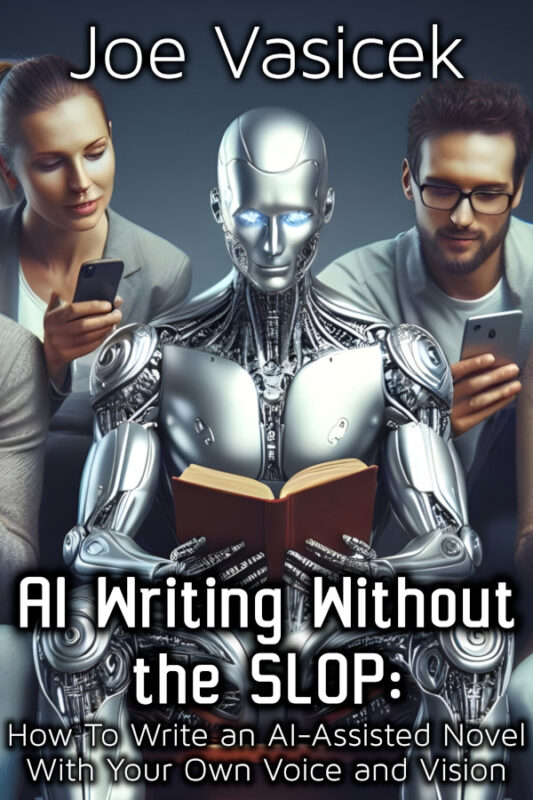
By the way, here’s a mock-up of the cover:

Third time’s the charm

We have a new baby! This one’s our third, and our second boy. The birth itself went quite smoothly, though he was having some minor breathing problems and had to spend a couple of hours in the NICU until they resolved. For that reason (and also because of some medication that made her shiver uncontrollably for nearly an hour), my wife said the immediate recovery from this birth was much more difficult than the other two. But he came out in one push, just like our other son. The staff wasn’t expecting that, and had to scramble to get another nurse in to help with everything.

While my wife and I were both in the hospital for the birth, my in-laws kept our other two kids overnight and watched them all day. But things got a little crazy when my father-in-law almost sawed his fingers off on a table saw, and had to go into the hospital for that. Then my mother-in-law came down with a cold, which quickly turned into walking pneumonia, so we took the kids back and all drove back home together after Mommy and baby were discharged from the hospital.

Right now, everyone in the family has a cold except for me and the baby. Hopefully it stays that way, though it is just a common cold, not RSV or anything worse. Still, we really don’t want the baby to get sick in his first week of life, which is why I’m watching him today. He’s currently sleeping on a pillow next to my writing computer.

Honestly, it’s been kind of nice—with my wife running around with the other two kids, I’m free to write and catch up on publishing tasks. The baby is super chill, and actually sleeps for four hours at a time, which ironically means that we’re sleeping better now than we were in the last few weeks of the pregnancy, since my wife had to get up almost every hour to empty her bladder. He also burps really well—so well, in fact, that sometimes we don’t realize that he’s already burped, and try forever to get another burp out of him only to give him the hiccups. But so far, he’s only spit up once (though he has peed on the changing pad table maybe half a dozen times).

Hopefully the cold runs its course in the next couple of days. And hopefully my in-laws recover from all the craziness soon, because they really would like to finally hold this new baby (and we would really like them to help watch our other kids). In the meantime, we’re just taking it a day at a time, doing our best to keep up on things without overstretching ourselves too much.

My current WIP is The Unknown Sea, and it’s coming along fairly well. I’m working on the AI draft simultaneously while humanizing it for the rough human draft, which is actually working out surprisingly well. AI writing and human writing work two different sets of mental muscles, so it’s kind of nice to switch off between the two. Keeps from burning out too much on any one thing. Also, the fact that I’m doing it all in the same WIP means that I don’t need to switch gears for a different book/series/genre. That switching can be tough.

It looks like The Unknown Sea is going to be a bit longer than my other Sea Mage Cycle books, though how much longer, I’m not yet sure. Still more fantasy adventure than epic fantasy. My hope is to finish the revised AI draft in the next four weeks, and the rough human draft another week or two after that, though with the new baby in the house, that is probably a wildly unrealistic goal. Still, he is a surprisingly mellow baby, so there is a chance.

Of course, the most important thing right now is to make sure the family is doing well, especially my wife. So that’s going to be the focus, until we can finally get settled into something of a new routine. Not sure how long that will take or what that will look like. But overall, we’re doing quite well.

Without AI, I would probably not be writing

I recently got another anti-AI one-star review that I want to pull apart, because it’s pertinent to what I want to say. I actually came up with the title for this post before I received the one-star review, so I’m not just fisking this one for the sake of fisking. With that said, though, there is definitely a lot to pull apart.

I was prepared to rate this as 2 stars. It is repetitive with no real character depth or development and a sincere lack of dynamic or engaging writing. 

Two stars… so magnanimous! In all seriousness, though, it’s worth pointing out that in spite of all the book’s flaws, she did read it all the way through. That’s important for later.

Then I read the “author” note at the end of the book that was defending their use of generative AI in their writing process…. not only that but also seemingly insulting other writers who are anti-AI claiming that readers dont seem to care about it.

You know what’s insulting to any author, whether or not they are “anti-AI”? Putting scare quotes around the word “author” when referring to them Though I suspect that she did that on purpose, fully intending to insult me, whereas I did not intentionally insult anyone. For the record, this is the passage from the author’s note that she claims is “insulting” to authors by saying that “readers dont [sic] seem to care about [AI writing]”:

Besides which, after sharing The Riches of Xulthar with lots of readers, I’ve found that most of the rage and vitriol against AI-assisted writing is on the writer side of things, not the reader side.

The other thing is that I was not trying to “defend” my pro-AI stance through the author’s note, just explaining my writing process and sharing the story behind the story like I do in the author’s notes I write in the back of all my books. That’s not me being “defensive,” that just me sharing my story.

But there is something profoundly narcissistic about the way this reader is framing her review. Because I stated something about readers that contradicts her anti-AI worldview, I must be intentionally “insulting” her (or the anti-AI authors she’s white knighting for, which amounts to the same thing). Because I wrote about how I used AI to help write the book, I must be “defending” myself against her anti-AI views. This kind of narcissism can only really come from someone who lives in an echo chamber and is not used to having their worldview challenged.

Well Joe, you are wrong. This book was lifeless and dull and the use of AI showed. Everything was one dimensinal and flat. Word choises were even static. We (readers) get it… FMC had auburn hair. There are other words besides auburn to describe it….

I’m not going to deny, there is some legitimate criticism here. Rescuer’s Reward was one of my earlier AI-assisted books, when I was still experimenting a lot and learning how to incorporate AI into my creative process while still preserving my voice and writing multi-“dimensinal” [sic] characters and stories. So it doesn’t surprise me all that much that I missed the mark with this particular reader for this particular book. Lesson learned. Thanks for the feedback and the useful data point.

With all of that said, though… I can’t help but notice that she read the whole book.

I have yet to hear a compelling AI argument in the reralm of artistic expression and this “book” just exemplified everything yet again. No heart. No depth. Not good.

This is the crux of the issue, and the reason I wanted to frame this post as a line-by-line response to this review. Is there “a compelling AI argument in the reralm [sic] of artistic expression”? Or is any author who uses AI committing an unforgivable transgression against their art?

Here’s the thing: most of the other authors I know gave up writing a long time ago. We all started out with bright-eyed dreams about telling great stories and creating great art, but the hard truth is that it’s almost impossible to make it as an author.

There are many reasons for this: people don’t read very much in today’s culture (I personally blame the public school system for that), and the publishing industry has always been brutally rapacious and exploitive of writers (just read The Untold Story of Books by Michael Castleman—it’s a really fantastic history of the written word).

But the writing itself is also very hard. There’s a reason why even many succesful writers are like this guy, single and living in what amounts to a glorified shack. Most of my writing friends quit when they got married and starting having kids. I sincerely hope that they’re just on a 20+ year hiatus, and plan to get back to writing again someday, because some of the stuff they wrote was really, really good (I’m looking at you, Nathan Major!) But sadly, that won’t make up for the stuff they would have written, but never did.

My wife and I just had our third child. Writing with small children is very difficult, especially when your wife has a full-time job. I love them all to death, though. If I had to choose between being a single writer, or putting my writing on hold for 20+ years and having to restart my whole writing career from zero, just to be able to raise a family, I wouldn’t hesitate for a moment to make that choice. But it would put a huge burden of guilt on my wife, because my writing was one of the key things that drew her to me back when we were dating. And while our marriage is probably strong enough to survive that, I can’t deny that it would be an incredible strain.

Without AI, I probably would be facing this choice right now. Even though I had managed to streamline my writing process in the last few years, I’ve never been an especially fast writer. Without AI, it took me about a year to write each novel—and that’s before all the demands on my time and energy that come with having small children.

But AI has enabled me to continue to pursue my career and my art, even through this period of life. Not only does this help me to be a better husband and father (which is ultimately the most important thing), but it also means that my readers don’t have to wonder about the things I would have written, but never did. I can write those books now. I can give those stories to the world.

I’m not talking about AI slop. I’m talking about incorporating AI into the creative process deeply enough that it enhances, rather than replaces, my human creativity. We don’t have to be afraid of AI. It makes so many things possible—including running a profitable indie author business while raising (and soon homeschooling) 3+ small children. But it takes a lot of practice to get to that point. And generative AI is still so new that I don’t think there’s anyone who’s truly mastered the art of AI-assisted writing.

My Sea Mage Cycle books are mostly for practice. They’re meant to be fun, light reading. If it gives my readers a satisfying respite from all the doom and gloom in the world these days, I consider that book a success. The experience of writing each of them has helped me to be a better AI-assisted writer. And while the earlier ones may read like AI slop, that won’t be the case for long.

Excerpt: The Unknown Sea, Chapter 1

I’m working on another Sea Mage Cycle book right now, alternating between the AI revisions (where I generate multiple iterations of each chapter using the same prompts, and combine the best parts for the final AI draft) and humanizing the AI draft to produce the rough human draft. So far, it’s working out really well. I do a little bit of work each day: maybe a chapter of the AI draft, or a scene of the human draft, but it’s steady progress and the kind of thing that I can probably keep up to some degree, even with the demands of a newborn baby, which is sure to throw things off in the coming weeks.

In any case, here is an excerpt from the first scene of the first chapter of The Unknown Sea. This is the rough human draft, so the writing is all mine and not AI-generated, though there may be some AI-isms because I used the AI draft as a guide. I’m going to write a post next week detailing my current AI-assisted writing process, so if any of that is confusing, check out my post there. In the meantime, enjoy!


The sea-soaked wood of the pier groaned under Enoch’s boots as he walked out onto the dock. He squinted, eyes stinging a little in the salty breeze as he peered out across the bustling harbor. Fat merchant caravels sat low in the water as they crawled into port, dockhands rushing to secure them. Elsewhere, sailors hauled heavy sacks of trade goods down to the docks, or rolled barrels of supplies up the narrow gangplanks for the ships that were preparing to depart. 

Enoch Ashenford took a deep breath. Few ports on the Azure Sea buzzed with the raw, desperate energy of the capital of the kingdom of Caravelia. Many a merchant prince had made his fortune here, and many a man with little to his name had rewritten his own story.

So why did he feel so thoroughly out of place?

He fished the letter of introduction from his waistcoat pocket. The elegant script had smudged a little at the corners from nervous handling, but the words on the parchment were still clear. Our son is of sound mind and steady hand, he read, taking encouragement from the words. He has a promising magical talent and will serve you well in the position of sea mage.

Of course, it wasn’t just the endorsement that had landed him the position. His father had had to pull some high-placed favors to get it. Not that Enoch wasn’t qualified, of course—as the only one in his family to be born with magical talent, he had worked hard to cultivate it with what meager resources the dwindling family wealth could acquire. But few young mages landed a berth quite so lucrative as a merchant caravel so early in their apprenticeship.

He tucked the letter away, hoping it would dutifully impress the captain. The morning air was thick with the stench of old fish and burning pitch, the unlovely aroma of commerce. Enoch drew another sharp breath and squared his shoulders before setting out to find the ship.

He pretended not to notice the stares and glances aimed his way. It was rare for a noble scion to set foot on these docks, let alone seek employment on a common merchant. His mother had insisted on dressing him well, in fine leather boots and a silk tunic, but these made him stand out almost as much as his pale, untanned skin and soft hands. He also had all his teeth, which was more than he could say of many of the men he passed.

It was frustrating, because if any of these gawkers looked closer, they would see the threadbare patches on his tunic and pants, the cracks and creases in the ageworn leather of his belt and boots. A noble son he might be, but the battered satchel slung over his shoulder held little of real value. 

He stopped to get his bearings. It seemed like the forest of masts and sails stretched almost to the horizon. Somewhere among them was the merchant ship that would be his ticket to wealth and glory—if he could only find the blasted thing.

“Make way,” a grizzled sailor shouted, carrying a large barrel on one shoulder. Enoch tried to get out of his way, but the man still nearly knocked him off his feet, swearing as he did so.

“Ouch!”

“Watch yourself, young lordling. This is no place for soft hands and slippered feet.”

Blood rushed to Enoch’s cheeks. “I’m not a ‘lordling,’” he muttered under his breath. “Just the seventh son of a penniless house.”

It was no use, of course. These common folk probably all thought that all nobles were rich. But Enoch’s noble birth had been more of a burden than a blessing. His older brothers had already divided up the Ashenford house’s few minor titles, barely managing to secure respectable positions and marriages for themselves. Even Carl, the second youngest in the family, had received a captain’s commission in the King’s Fleet. But by the time Enoch had come of age, the Ashenford house’s coffers had run as dry as a salt pan at high noon.

The manor still stood, of course. One couldn’t exactly pawn bricks and stone. But the paintings and tapestries had been sold, then the family silver, then most of the furniture. His mother wore the same gown to every court function, cleverly disguising the fact with slight alterations made by her own hands. As for his father, he spent most of his days in the family library, poring over the same old tomes—as if the secret to restoring the family’s fortune could be found in books alone.

No. Enoch had had enough of that dusty old manor, and he had no patience for the duties and pretenses of the court. He’d be damned before he gave up and turned around, even with all the snickering glances and gawking stares. He thought again of the letter of recommendation in his pocket, resisting the urge to take it out. If he could just find that blasted ship…

“You look a bit lost, lad,” a voice called out. “You wouldn’t happen to be young Master Ashenford, would you?”

Enoch turned to see a burly clean-shaven man in a leather apron, a crooked grin splitting his wind-chapped face. Sun and sea had tanned his skin to the color of old rope, which was almost as tough and leathery as the apron he wore. He swayed a little where he stood, and his shrewd eyes shone with the keenness of a man who had spent most of his life at sea.

“I might be,” Enoch hedged. “Who’s asking?”

“Marcus Reed, ship’s cook of the Waverunner. Captain sent me to fetch our new sea mage. That’d be you, I’d reckon?”

Enoch nodded, extending his hand. “That’s right. Pleased to meet you, Marcus.”

The man took it and gave him a single shake before gesturing toward the dock. Enoch quickly fell into step with his confident gait, grateful to have a guide to his new berth. 

“So,” Marcus asked, breaking the silence between them, “what brings a young nobleman to life at sea? Chasing adventure? Seeking your fortune?”

“A little of both,” Enoch admitted. “As the seventh son, it’s not like I’ve got much of an inheritance.”

“Ah,” said Marcus, chuckling dryly. “Well, the sea’s a great leveler, lad. Noble or commonfolk, it’s all the same when the storms hit.”

“Yes, sir.”

“Call me Marcus. We’re mates now, after all.”

“Right,” said Enoch, nodding. “And I guess you can call me Enoch. Like you said, the sea’s a great leveler.”

Marcus raised an eyebrow at him and smiled.

The Waverunner sat moored at one of the last piers. Enoch felt his breath catch as his eyes fell upon it. The sturdy single-masted caravel creaked a little as it swayed gently at the dock. Sixty feet of weathered oak, with a dark, waterlogged hull that had clearly seen many voyages. Despite her elegant curves, the salt and sun had clearly had their way with the wood.

“You there!” a commanding voice rang out from the upper deck. “The new mage?”

Enoch looked upward, meeting the gray eyes of a woman whose gaze held the relentless intensity of a hawk. She stood with confident poise, her graying hair pulled back into a tight braid, and her weather-beaten face held the sort of authority that needed no crown or title.

“Enoch Ashenford, Ma’am,” he answered, straightening his posture. “I’m to be your new sea mage.”

“Don’t just stand there, lad. Come let me get a look at you.”

He quickly climbed the narrow gangplank, ignoring how his stomach lurched. Once on board, he withdrew the letter of introduction and handed it to her.

“For you, Ma’am.”

Captain Maren Black plucked the letter from his hands and stuffed it into her waistcoat, barely giving it a glance. Instead, she looked him over from head to toe. Her eyes narrowed, making Enoch swallow.

“Hmm,” she muttered—a sound that could have meant anything. “Ever worked a ship before?”

“I’ve studied maritime magic extensively, ma’am. My family’s library—”

“That’s a no, then.” She turned away. “Marcus! Show the boy where to stow his gear. Thaddeus, check those lines again. They look slack.”

The pit in Enoch’s stomach fell—a pit that until now, he hadn’t realized was there. Like a dog with his tail between his legs, he quickly followed Marcus across the wooden deck and down into the hold.

“How large is the crew?” he asked the burly.

“Just five of us,” Marcus answered cheerily, ducking as they passed through the door. “Captain Black, First mate Thaddeus, Felix, yourself, and me. But what we lack in manpower, we’ll more than make up for in your magic. Right?”

“Right,” said Enoch, swallowing nervously. Just what had he gotten himself into? Seeing his discomfort, Marcus chuckled and clapped a hand on his shoulder.

“You’ll do fine, friend. Think of it this way: the fewer of us to crew the ship, the greater each man’s share of the profits.”

That was a good point, though it did little to quell Enoch’s growing anxiety. He also couldn’t help but notice how rough and calloused Marcus’s hands were to his own. With only five of them, he’d have to work hard to earn his keep, and not just with book learning and magic.

“This is where you’ll bunk,” Marcus announced, pointing to a cramped berth with a nod of his head. He leaned casually against the doorframe, folding his arms atop his leather apron. “This your first time at sea?”

Enoch’s cheeks burned. “Is it that obvious?”

“Don’t worry, lad. You’ll find your sea legs soon enough. The sea’s a harsh mistress, and an even harsher teacher.”

Enoch drew a sharp breath and nodded. A harsh mistress indeed, he told himself silently, but one I intend to master. As Marcus watched, he quickly unpacked his meager belongings, making space near the head of his bunk for the two most valuable pieces.

“Those look interesting,” Marcus remarked. “Family heirlooms?”

“Gifts from my parents,” Enoch explained. He unsheathed the dagger his father had given him and tilted it in the gleam of the candlelight. “The edge is inlaid with silver. It’s supposed to let it cut through magical shields and wards.”

Marcus raised an eyebrow. “And the amulet?”

He pulled out his mother’s amulet, fashioned from a spiral shell and hanging from a leather cord. “This one is called the Whispering Shell. It doesn’t look like much, but it’s enchanted with a powerful spell that helps the one who wears it to translate foreign speech.”

“So it lets you understand what the people around you are saying?”

“That, and it makes the bearer’s speech intelligible to all who hear. Like I said, it’s a powerful spell.”

Marcus whistled appreciatively. “Now that’s a rare piece of work. Must have cost a pretty penny.”

More than my family could afford, Enoch thought but didn’t say. His mother had pawned her grandmother’s emerald brooch to raise the funds, one of the last valuable pieces the family possessed. Instead of saying that, though, he simply nodded.

“My family wanted me to have every advantage.”

“Aye—and they’ll serve you well, I’d wager. Though not half as well as a sturdy pair of sea legs and a strong stomach.” Marcus grinned and slapped his back. “Though we’ll be giving you those in no time.”

“Thanks. I’ll keep that in mind.”

Marcus turned and left then, his footsteps creaking along the old, wooden floor of the deck. Enoch watched him for a moment, then carefully tucked the dagger and amulet away.

He thought of his mother, pawning a priceless family heirloom to buy him this chance. His father, struggling to maintain the fiction of their wealth while the walls grew bare around him. Seven sons, and the seventh was their last hope for something more than genteel poverty.

The thought hardened Enoch’s will until the pit in his stomach no longer seemed so terrible. He would not fail them. He could not afford to. He would stay on this ship and win his own fortune, restoring the family name and making his own way in this world. All of his doubts, all of his misgivings—it was time to throw those away. He was not just the overlooked son. It was time to become something more.

My spicy take on the ethics of AI art

There is nothing unethical about using generative AI to write or make art. Those who say otherwise either haven’t thought through their position, or they are lying for rhetorical effect. Or both.

If Andrew Tate wrote a book titled How To Enslave Your Woman For Fun and Profit, would he be within his rights to demand that no woman ever read that book? If you believe that AI is unethical because it was trained on writers’ and artists’ work without their consent, congratulations—that is exactly the position you have taken. You can’t pick up one end of the stick without also picking up the other.

Whether or not writers and artists were fairly compensated for the use of their work is a separate issue. Many of these AI companies obtained their training data by indescriminately scraping the internet, which means the used a lot of pirated work. But if using copyrighted material to train an AI system is fair use—and here in the US, the courts have ruled that it is—then all that they owe you is the cost of your book. So if your book is $2.99 on Kindle, that is what OpenAI owes you. Congratulations.

Does Brandon Sanderson owe Barbara Hambly royalties? Brandon Sanderson has sold something like $45 million in books, comics, and other media. Barbara Hambly struggles to pay her bills. Barbara Hambly wrote Dragonsbane, the young adult book that inspired Brandon Sanderson to write fantasy. Clearly, her work had a deep and lasting influence on him. So does he owe her?

If you believe that AI companies owe artists and writers more than simply the price of their own published work, this is a question that you must wrestle with. If it counts as “stealing” to train an AI on artists’ and writers’ work, then every artist and writer is also a thief, and owes royalties to the people who inspired them. Which is why the word “plagiarism” has a tight definition, and why our legal code recognizes fair use.

There is nothing unethical about using generative AI to write or make art. Almost everyone who says otherwise is either lying to themselves about that fact, or lying to you.

Why would someone lie about that? For the same reason people accuse you of being a racist, or a sexist, or a fascist, or a white supremacist, or a Christian nationalist… because using that term gives them power. They don’t actually want to make a reasoned argument. They just want to “win” the argument without ever having to make it in the first place. They use words that they know will get the reaction that they want, and they scream them as loudly as they can until they get it. That’s what the public discourse looks like in 2025.

To be fair, this is not just something that happens on the left. Plenty of people on the right will scream “woke” or “based” or “demonic” to cow people into accepting their point of view. These words do have meaning, and can be used to make a well-reasoned argument—just like “racist” and “fascist” have meaning. But most of the people who use these words are just wielding them like rhetorical clubs to bully their way around.

There is nothing unethical about using generative AI to write or make art. Most of the people who say otherwise are just using the word “ethical” to mean “things I don’t like.” They don’t believe in objective good or objective evil, and instead believe that things like truth and morality are relative. In other words, they think that good and evil change depending on who’s looking at it. This is why so many writers today can’t write a compelling villain (or a compelling hero, for that matter). They just don’t understand how good and evil work.

So why should you listen to them when they scream at you for using AI? You shouldn’t. They don’t know what they’re talking about. Or worse, they do, but they’re lying to you, because they want to compel you not to use AI in your art. Why? Because they’re afraid that if you do, you’ll create something better than what they can create. And on that point, they’re probably right.