Getting ready for the baby

Things are fairly quiet around here, though that’s going to change soon. The baby is nearly full term, and the doctors want to induce labor in just a few days, so that’s the plan. We’re just trying to get things ready for that.

Writing-wise, things are going very well. I recently finished the AI draft of The Soulbond and the Sling, and started work on The Unknown Sea again. My goal is to have the final draft ready to send to my editor by Thanksgiving, so that I can publish it in January. That’s going to be a tall order with the baby, though, so I may have to push the publication date back by a month or two.

Moving forward, I really want to publish a new novel at least every quarter. Some of those are going to be short, like the Sea Mage Cycle books, but eventually I hope to get up to epic fantasy length. And of course, I plan to finish my three unfinished trilogies in the next year or two. I’ve been taking the last couple of years to really figure out my AI-assisted writing process, and I think I’ve got that mostly down now, so it’s time to apply those lessons to these books and get them done.

One thing I’ve done recently was pull out all of my books from InAudio, formerly Findaway Voices. I was crunching the numbers from the last year, and I only made something like $12 during that twelve-month period, averaging something like $.04 per sale. Those numbers are skewed by all of the free audiobooks that get downloaded, but when I drilled into the reports, I found a bunch of places that were literally paying me only $.01 per sale. Literally just a penny. For an audiobook that a reader paid money for. Someone got paid in that transaction, and it sure as hell wasn’t me. Since InAudio doesn’t let you pick and choose which distributors you can send to—it’s literally all or nothing—I made the choice to just drop them. There’s no way I can sustain a career if I’m only getting pennies (if that much!) per sale.

I know that Audible has been in the news a lot recently, and for good reason—they really have been playing dirty, simply because they can get away with it. And while I don’t like the way they’re screwing authors over, I don’t think they’ve been screwing me nearly as bad as some of the places where InAudio distributes their books. For one thing, all of my audiobooks are AI narrated, so it’s not like I have a lot of production costs to make back. It’s literally just a value-add on top of the ebooks. For another thing, the least amount of royalties they’ve paid me is $.80 per book, which is more than what I get from just about every library service for audiobooks.

So for the time being, I’m going to keep my AI-narrated audiobooks up on Audible, even though I wish they would treat their authors better. But I’m not going to shell out the money for a human narrator at this time. It just doesn’t make sense, especially with the way that Audible squeezes us. With AI-narrated audiobooks, there really is no reason not to put them out, so long as they don’t drop the royalties any further. But it would take a hell of a long time to earn back an investment of several thousand dollars if all they’re paying me is $.80 per listen.

If you want to listen to my books on audio, the best way to do it is to click on the link at the top of the page and visit my online store. You also have the added bonus of owning the files, not just licensing them. And Bookfunnel is really good at delivering the audiobook to whatever app or device you prefer—or even opening it up in your browser, if you don’t have an audiobook app.

Soulbond and the Sling AI draft complete!

Last week, I finished the AI draft of The Soulbond and the Sling, the first book in my new epic fantasy series! Here are the stats:

  • 20 chapters (including prologue and epilogue)
  • 80 scenes
  • 136,294 words

So it’s a little short for an epic fantasy novel, but this is only the AI draft. As I rewrite it into the human draft, I will add more details and nuance that will hopefully flesh it out, bringing it closer to the 150k – 180k word range.

I started the AI draft in March, but I wasn’t working on it continuously all that time. I worked on it in about four separate bursts, each one lasting a few weeks. In total, it took 70 working days, or approximately 12 working weeks to write it.

The next stage is the human draft, where I rewrite the whole thing from scratch to make sure it’s entirely in my own words. I’ll keep the AI draft on-screen as a reference, and may use some turns of phrase that I like, but I’m not going to copy-paste from it. This way, the resulting work will be entirely my own.

I don’t know how long it will take to finish the rough human draft, but I expect it will take longer than the AI draft, perhaps even 2x or 3x as long. Then again, if the AI draft is clean enough, it might even take less time than that. I’ve been getting pretty good at these AI drafts, and it’s already at least partially in my own voice, given how my personal taste guided which parts of which AI generated iterations I decided to keep. I also did a revision pass with no AI whatsoever, mostly just to smooth out inconsistencies.

But the AI draft is complete! This is the longest book I have ever written with AI, and one of the longest ones I have written in general. I hope it is the first of many more to come!

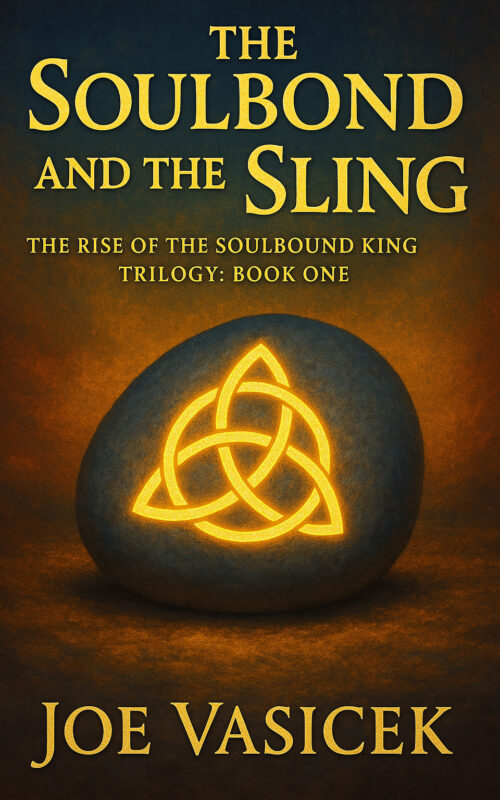
(And also, I really need to get a better book cover!)

The Soulbond and the Sling: Prologue

This is the prologue of my epic fantasy novel, The Soulbond and the Sling. It’s a fantasy retelling of the story of David and Goliath, in a world where magical powers can only be unlocked through marriage. I used AI to write the rough draft, but everything here has been rewritten in my own words. I will probably revise it a couple more times before the book is published, but this is close enough that I think it’s worth posting. Enjoy!


Madoc leaned against the rough-hewn timber of the palisade, his breath forming ghost-like wisps in the cold night air. Another uneventful night on the eastern borderlands—though of course, almost anything could be lurking in the darkness below. He took a deep breath, fighting sleep, and began to pace, the wooden floorboards creaking beneath his weight.

For nearly six years, he’d been stationed at this frontier outpost that guarded the high road between the kingdoms of Zyonna and Edumar. In that time, he’d seen a distinct drop in the number of merchants who frequented the roads by day. And by night, the road was so empty, they could have been stationed in the wilderness. Beyond the palisade walls, the chill wind swept down from the rugged heights of Zyonna’s northern plateau, carrying the crisp, earthy scent of highland heather with its promise of the coming spring.

He paused his pacing to peer into the darkness. Tonight, the stars seemed to blaze more brilliantly than usual, though the gently rolling contours of the land were barely visible against the moonless sky. The trees had been cleared for several hundred yards, but the lands beyond were thickly forested. At this time of year, rain and sleet were all too common, so the star-strewn sky was a welcome relief, though it only seemed to multiply the shadows below.

He slowly made his way toward a cluster of soldiers huddled around a small brazier, their cloaks wrapped tightly against the chill late-winter breeze. Their words carried easily to his ears.

“My cousin trades with the rivermen from Edumar,” said Ferris, a stocky young bowman with a thick red beard. “He says half of the villages he used to frequent are empty now. It’s like that throughout the whole kingdom.”

“The Fellspawn, no doubt,” grunted Pete, a wiry veteran with a patch over one eye. “It’s been getting worse on the other side of the border for years. Nothing for us to worry about, though. Our king isn’t a wicked soulbond mage like Gardomir.”

“Nothing to worry about?” Ferris retorted, his eyebrows knitting in disbelief. “The Fellspawn knows no borders. They may spawn out there in Edumar, but they’ll come out here right as—”

“They’ll do no such thing, so long as our mages keep the corruption at bay. It’s all just a part of the natural cycle. We might get an occasional direwolf or two, but you don’t need magic to deal with those.” He spat over the edge of the stockade for emphasis.

Ferris shook his head. “My cousin says there’s nothing natural about the Fellspawn out there in Edumar. The abominations he’s heard about don’t just pop up on their own. They’re being summoned by something—or someone.” He glanced around the circle, looking for support.

“Your cousin says a lot of things,” the one-eyed veteran grunted.

Madoc paused, curious to see how his men would react. Few of them were greenhorns like Ferris, though tensions had been gradually rising in the fort these last few months. But whether that was due to mere cabin fever or the rumors from the other side of the border was difficult to gauge. He turned to the side, facing the wall, and let the men’s voices carry.

“I don’t know, Pete,” said Tom, another old-timer who’d been stationed here longer than Madoc. “They call King Gardomire the Many-Bonded now. They say he’s taken five soulbound concubines. If anything can stir up the Fellspawn, it’s that.”

“Trader’s tales,” Pete scoffed. “Next they’ll be saying King Gardomire breathes fire and has horns.”

“No, it’s true,” Tom insisted. “He really has bonded five slave women to his will, raping them for all the magic that they can give him. It’s made him more powerful than any of our soulbound mages. But that isn’t all. They say he’s taken up with dark unnatural dark magics too—wielding the Fellspawn himself, even.”

“Like hell it has,” spat Pete. “Kings forge alliances with other kings, not with the forces of nature. You can’t trust everything that you hear.”

“But what if there’s some truth to the rumors?” Ferris chimed in, his voice tinged with concern. “They can’t all be wrong.”

“Aye,” said Tom. “The lad has a point. King Gardomir’s always been a power-mad tyrant, but lately, the stories out of Edumar have been getting downright grim.”

Madoc had heard enough. He pushed off from the rough-hewn timbers, stepping with deliberate heaviness as he walked toward his men. The quiet murmur of conversation ceased as the floorboards creaked beneath his thick leather boots.

“Enough with the ghost stories, lads. Speculating without facts is as pointless as trying to shoe a fish. Are we soldiers, or idle gossips at market day?”

Pet grunted in appreciation, though Ferris and Tom straightened uncomfortably. 

“Sorry, sir,” Tom muttered. “Just trying to pass the night.”

Madoc smiled and clapped him on the shoulder. “Just another boring night on the border, eh? That’s how it always is. We tell ourselves stories like wide-eyed children just to pass the time, and the next you know, the stories spread and gain a life of their own.”

“But what if there really is something more out there, sir?” said Ferris, the flickering light of the brazier reflected in his eyes, “More than the usual border reivers, I mean.”

Madoc turned and looked the young man squarely in the eye, though he kept his posture relaxed. “Have any of us seen a creature of the Fellspawn that was more than a match for our spears?”

The men shook their heads. Madoc pointed to the shrouded treeline below.

“Have any of you seen King Gardomir in those shadows, sporting horns and breathing fire?”

Old Pete snorted.

“Whatever’s happening in Edumar,” Madoc continued, “it doesn’t change our duty here. We keep watch, we stay alert, and we don’t let imagined horrors distract us from the real ones. Besides,” he added, gesturing behind them, “we’ve got the orb.”

The men all glanced down to the courtyard of the fort, where a crystalline sphere sat atop a sturdy stone pedestal. Its smooth, dull surface reflected the starry sky, without any hint of the enchantment that lay upon it. If anyone—or any thing, for that matter—approached the outpost with violent intent, the orb would glow a fierce orange, warning the men as surely as a roaring fire. Enchanted orbs like this one had been placed strategically along the length of the eastern frontier, aiding the men of the guard in their watch.

Madoc clapped Ferris’s shoulder. “See, lad? Whatever may lurk in Edumar is no threat to us tonight. Now, keep your eyes open and try not to freeze your arses off.”

The older men chuckled appreciatively, bringing a hint of pink to their cheeks. Even Ferris smiled. At the sight, Madoc felt the knot in his chest ease a little. It wasn’t that he discounted the rumors entirely, but spreading them would serve no one. They all knew their duty. Twenty men on the edge of the kingdom, serving as Zyonna’s first line of defense. The last thing they needed was to start jumping at shadows.

Madoc left them and walked to his preferred spot in the northwest corner of the stockade, where he could watch both the eastern approach from Edumar and the high road back to Caer Zyonna. From here, the distant hills looked a little like sleeping giants, their silhouettes barely visible against the starry sky. He settled in for another quiet night, where the occasional wandering deer would be the only break in the boredom, beside the nightly changing of the watch. His mind began to wander, planning out patrol routes and mess hall duties for the coming week.

In truth, the lack of border activity troubled him more than any rumor about King Gardomir or the Fellspawn. When he had first been posted here, the high road had seen a steady flow of merchant traffic between the two kingdoms, stretching almost from dawn to dusk. Now, even in broad daylight, it was rare to see anyone on the road. The thought made Madoc frown. Smugglers and reivers, he could deal with, but the relative silence was unnatural for these parts. After all, the crown hadn’t posted him on the wilderness. So why did it feel increasingly like they had?

The hour passed slowly. At the end of it, a new group of sentries came up to replace the men who had clustered around the brazier. They made the rounds slowly, checking to make sure all was quiet beyond the rough-hewn palisade. Madoc grunted a little and rose to check in with them, grateful for the distraction from his thoughts.

“How’s it look, Lodan?” he asked as he approached the two men on the southern wall.

“Calm as a spring meadow,” Lodan answered with his northern accent.

“Aye,” said Adam, his companion. “If it weren’t for that persistent northerly wind, it might even be pleasant out here.”

Madoc narrowed his eyes, peering eastward where the shadow outline of Edumar’s rolling hills brooded against the sky. “Aye,” he agreed. “Make sure to stay warm, lads. We need your arms and legs as much as we need your eyes.”

“Wait,” said Lodan, frowning as he lowered his voice. “Listen—what was that?”

The sound was so low that Madoc initially took it for the wind. It was a low, rhythmic thumping, coming from the east. Like footfalls, but spaced too far apart to belong to any man or horse.

“Thunder?” Adam asked.

“Too low for thunder,” Lodan answered, though his voice was tight and uncertain.

Madoc stiffened as he strained to listen. There it was again—a low, reverberating thud that he felt in his chest as much as he heard with his ears. He quickly scanned the horizon, but no rainclouds marred the sky in any direction. The stars shone undisturbed.

He glanced down into the courtyard below and felt his stomach clench. The orb had picked up a faint orange glow, like the last embers of a dying fire. The sight sent a chill snaking down his spine. Sinister shadows danced across the grass, cast by the glowing orb.

“Sound a quiet alert,” Madoc ordered. “All men to their positions. No horns, no shouting.”

Lodan and Adam nodded and moved quickly, hurrying down the ladder with silent feet. They entered the barracks and quickly began to wake the sleeping men, who soon began to emerge. There were only twenty of them, but they woke quickly, scrambling up the wall with their armor half-fastened and their weapons in hand. Within a few minutes, the once-sleepy outpost was transformed, every man in position along the eastern wall.

All the while, Madoc peered into the darkness where the highland meadows gave way to scattered copses of pine and birch. He had an unsettling feeling that something dangerous lurked unseen in those woods, just beyond their sight. Should he send out a scouting party? No—best to keep his men concentrated and wait. The night was too dark to risk sending them out by twos and threes.

Besides, he sensed that whatever was out there was coming straight for them.

“Form up,” he called softly to the archers gathered along the wall. “Nock arrows but hold until my command.”

The men silently obeyed, holding their bows and nocking their arrows in near total silence. There were no torches or light to see by—they had been careful not to show any sign that the fort had been awakened. All of the countless drills had prepared them well for this moment, though Madoc didn’t miss the nervous glances that some of them exchanged. Down in the courtyard behind them, the warning orb began to brighten.

“Do you see anything, sir?” Tom asked, squinting into the night.

Madoc was about to answer when a massive figure suddenly detached itself from the trees. It stood nearly twice the height of a man, with a great, hulking body twisted monstrously by thick, corded muscle. Two curved horns jutted unnaturally from its skull, gleaming like obsidian blades. And its eyes—God, its eyes—glowed with a faint amber light that seemed to pierce Madoc’s very soul.

“Sweet mercy,” whispered one of the archers. “What is that thing?”

The warning orb now blazed like a captured sunset, bathing the entire courtyard in a deep orange light. Madoc’s throat felt suddenly tight.

“Draw!” he heard himself issue the order. “Loose!”

Arrows whistled through the chill night air, shattering the silence. The volley was tight and well-aimed, every arrow flying true. Madoc held his breath.

The volley struck the beast with enough power to drop a line of charging war-horses. But to Madoc’s dismay, most of the shafts bounced harmlessly off of the creature’s hide. Those few that did stick seemed to have no effect, for the beast began to advance toward the fort, its relentless strides devouring the earth beneath it with alarming speed.

“Again!” Madoc yelled. “Draw and loose!”

The archers quickly nocked new arrows and loosed them at the approaching beast. The second volley was a little most scattered than the first, but still flew true—to much the same result. Almost all of their shafts glanced off of the beast’s hide. Those few that stuck seemed merely to anger the colossal intruder.

It surged toward the fort with ferocious speed, lowering its massive horns. “Brace for impact!” Madoc barely managed to yell before the creature slammed into the wooden palisade.

As a young man decades ago, Madoc had fought in the war with Edumar. During one of the sieges in the course of the campaign, he had seen an iron-tipped battering ram reduce the wooden gates of a walled town to kindling. But even that was not enough to prepare him for what he now saw.

The beast’s impact shattered the wall almost totally. Logs as thick as a man’s waist burst inward, splintering into fragments. The adjoining watchtower crumpled in on itself like parchment crushed in a fist. Men screamed, some of them thrown clear by the impact, others caught in the collapsing structure.

Madoc struck the hard-packed earth of the courtyard, driving the air from his lungs. Pain lanced through his shoulder, but his training took over and he quickly rolled, somewhat softening the blow. As soon as he came to a stop, he staggered to his feet.

All around him was chaos. Men ran in every direction, some trying to form a defensive line, others fleeing toward the stables. The monstrous intruder stood amid the wreckage of what had once been the palisade. The bright orange light of the warning orb lit it in terrible detail, like a nightmare given flesh. As it gazed upon the chaos it had spread, its amber eyes held no animal confusion—only calculated, intelligent malice.

“Hold your ground!” Madoc yelled, just as the creature let out a thunderous roar. Men cried out and staggered, and Madoc felt his own ears ring.

The beast stepped fully into the courtyard, its massive head swiveling as it surveyed the panicked humans scattering before its approach. Then its eyes fixed on the glowing orb, which now pulsed with such intensity that it cast the whole outpost in a hellish orange light.

“Rally to me!” Madoc shouted, drawing his sword. The blade felt pitifully inadequate against such a monstrosity, but he raised it nonetheless.

A handful of his most battle-hardened veterans quickly formed a desperate line beside him. Madoc yelled, and they charged at the Fellspawn monster with their swords and spears. Two brave spearmen managed to penetrate the beast’s hide, eliciting a roar of rage. A massive clawed hand swept out, raking the first spearman across the chest and all but disemboweling him. The second man barely had time for a massive step before those gnarled fingers closed around his torso, crushing armor, flesh, and bone with sickening ease.

Madoc swung and slashed at the beast’s leg in an effort to hamstring it. His sword bit into that gray, leathery flesh, to little effect, barely penetrating more than an inch. The creature didn’t even look down.

Instead, it stepped up to the warning orb and wrapped its massive hand around the glowing crystal. The orange light intensified, bleeding through its fingers like rays of dying sunlight. Then it squeezed, and the orb shattered with a sound like glass grinding against stone.

Madoc gasped in shock and horror. The outpost was thrown into sudden darkness, the monster reduced to a looming, shadowy mass. His men fell back in confusion, stumbling over their fallen comrades. From the stables, Madoc heard the panicked whinnying of the horses in their pens.

The beast heard them too. It turned with surprising swiftness, its amber eyes fixating on the door to the stables, where the outpost’s horses stamped and kicked in terror.

“No,” Madoc breathed.

With casual ease, the creature tore off the thatch roof and reached inside. A horrible human scream filled the night as the stable hand met his hand. Then the beast reached a little farther, and pulled out a chestnut gelding in its massive hands. Still alive, the panicked horse thrashed frantically as the creature wrung it like a rag. The animal split in two, splattering the courtyard with blood and steaming entrails.

The last of the men who still held their ground now broke down and ran. Even Madoc fell back, barely keeping a grip on his sword. He felt his gorge rise but quickly forced it down.

“To me!” he bellowed in desperation. “For Zyonna!”

But no one rallied to his call. Their spirits shattered, their courage spent, men scrambled for the rear gate or sought to hide in the barracks and the blacksmith’s shop. And far too many of them now lay motionless on the blood-soaked earth. 

The creature tore methodically through the dead horse, quickly consuming the remains of the once magnificent beast. A few brave souls took potshots at it with their bows, to little effect. It devoured most of the horse’s front half before dropping the remaining carcass and straightening to its full height. Blood dripped from its jaws as it turned to face Madoc with those terrible amber eyes.

Madoc’s gut fell, and for a brief, heart-stopping moment, he thought it would come for him. But then, a sound emerged from deep within its throat—a rhythmic, guttural cry of satisfaction.

“Gol-guh. Gol-guh.”

With casual indifference toward the survivors of the attack, the creature pivoted on its heel and ambled back through the collapsed eastern wall. Its steps were unhurried, making clear that it was leaving on its own terms, and no one else’s. Once outside, it veered away from the dense forest from which it had emerged, heading westward instead. 

Toward the high road. Toward Zyonna.

An awful silence fell over the ruined outpost, broken only by the moans of the wounded and dying, and the crackle of flames where a brazier had spilled and caught on splintered wood. Madoc stood frozen for several heartbeats, struggling to process all that he had just witnessed. The attack had barely lasted longer than a few minutes, but it felt as if half a lifetime had passed.

Then his training quickly asserted itself. He blinked and turned to his men.

“Check for survivors!” he ordered. “Get the wounded out where we can treat them. And someone put out that fire before it spreads!”

Gradually, men staggered back into the courtyard, some emerging from the places they’d hid, others dragging themselves up from where they’d been thrown. Those who were whole moved quickly to carry out their commander’s orders. Soon, they were laying out the wounded on the hard-packed earth.

Madoc made a quick assessment of their losses. Five men dead, including the stable hand. Eight wounded, two critically. Half their horses slain or fled out into the night. The eastern wall was destroyed beyond repair, meaning they’d likely have to abandon the outpost. And the warning orb—their most valuable asset by far—reduced to little more than glittering shards.

He turned and stared in the direction the creature had vanished. Not toward Edumar, he realized with a chill. It was heading west, deeper into Zyonnan lands.

“Ferris!” he called, spotting the stocky highlander. “Can you ride?”

“Yes, sir,” the young man answered. “What would you have me do?”

“Take the fastest horse you can find and ride for Caer Zyonna. That… thing… is headed straight toward our country’s heartland. Every settlement between here and the Western Marches is in danger.”

“Sir,” said Ferris, his face paling in the dim starlight. “What was that thing?”

“I don’t know. But the kingdom must be warned. Tell them…” Madoc struggled to articulate the horror they’d just witnessed. The creature was obviously Fellspawn, though it hadn’t behaved like one. Instead of making a frenzied and indiscriminate attack like any other wild beast, it had shown purpose. Intelligence. As if it had not been merely spawned, but sent.

“Sir?”

He narrowed his eyes, suddenly remembering the beast’s final call. “Tell them the Golga has come.”

Ferris nodded grimly, mounted the nearest horse, and galloped westward down the road toward the kingdom’s distant capital.
Fisking 1-star reviews bashing AI

They say that authors should never respond to one-star reviews. That’s generally good advice, and for most of my career, I’ve studiously kept it. However, I’ve recently begun to get a new kind of one-star review that baffles me—reviews that essentially say: “the book was good, but it was written with AI so I hate it.”

Here’s an example:

This book is written with AI. Incredibly disappointing as a reader to give a book/author a chance and then to get to the end of the book only for the “author” to then announce the AI card. If I could give zero stars, I would for this alone. I also didn’t appreciate that this use of AI was not announced until the ending Author’s Note. If “authors” are going to cut corners and put their name to computer-generated mush, they should be willing to put that information on the front cover. The book struggled to find its pace, and some parts read as though they were written for a child’s short story competition while others felt as though the writer was snorting crushed up DVDs of Pirates of the Caribbean as they wrote.

Let’s break it down:

This book is written with AI. Incredibly disappointing as a reader to give a book/author a chance and then to get to the end of the book only for the “author” to then announce the AI card.

Yes… but I can’t help but notice that you got to the end of it. In other words, you finished the book. Also, from the way you tell it, it seems that you didn’t realize the book was written with AI until you got to the very end. So based on your own behavior, it doesn’t seem that quality was the issue.

I also didn’t appreciate that this use of AI was not announced until the ending Author’s Note. If “authors” are going to cut corners and put their name to computer-generated mush, they should be willing to put that information on the front cover.

Okay… but if my book was just “computer-generated mush,” why did you finish it? And why were you surprised when you learned that it was written with AI-assistance?

I can understand the objection to books that were written solely with AI, with little to no human input. But that’s not how I write my AI-assisted books. Instead, I outline them thoroughly beforehand, write and refine a series of meticulously detailed prompts (usually using Sudowrite), and generate multiple drafts, combining the best parts of them to make a passable AI draft. And then I rewrite the whole thing in my own words, using the AI draft as a loose guide with no copy-pasting.

Why would I go through so much trouble? Because of how the AI drafting stage gives me a bird’s eye view of the book, allowing me to identify and fix major story issues before they metastasize and give me writer’s block. Before AI, that’s where 80% of my writer’s block came from, and it often derailed my projects for months, so that it took me well over a year to write a full-length novel. But with AI, I’m no longer so focused on the page that I lose sight of the forest for the trees. So even though generating and revising a solid AI draft adds a couple more steps to the process, it’s worth it for the time and trouble that it saves.

That’s the way I use generative AI in my writing process. But there are many other ways—and I hate to break it to you, but most authors use AI in one way or another. If an author uses Grammarly to fix their spelling and grammar, should they disclose that on the cover? If they use MS Word? What if they used a chatbot to brainstorm story ideas, but went on to write it entirely themselves? Should that also be disclosed?

The book struggled to find its pace, and some parts read as though they were written for a child’s short story competition while others felt as though the writer was snorting crushed up DVDs of Pirates of the Caribbean as they wrote.

Yes… but again, I can’t help but notice that you finished the book. And after you finished it, you were surprised to learn that it was written with AI. So with all due respect, I’m going to call BS on your objections here. I think you only decided you hated the book after you learned it was written with AI, and you came up with these objections after the fact. Whatever.

I think a lot of the people who object to AI are really just scared and angry. They claim to have principled, ethical objections to the technology, but few of them follow through to implement that principled stance into every area of their lives. After all, if you use Grammarly, Google Docs, or MS Word, you are using generative AI just as surely as I am using ChatGPT and Sudowrite. For most people, the ethical objections are just a smokescreen for their general fear of change. They’re fine with embracing the convenience the technology offers them in their own personal lives, but they insist that everyone else—including me—live according to their principles, no matter how inconvenient or difficult it may be.

As an example of that, check out this one-star review:

The arts! Whether visual, performance, or literary—my haloed experience has been the act of creating and sharing a connection to the profound or sublime. Why, then, would any artist—musician, dancer, sculptor, painter, or author—offload (abdicate) the act of creation to AI? Process versus product. Mr. Vasicek included an afterword for this volume, describing his workflow and the efficiency of collaboration with AI: a 6,624-word day! another volume completed! Mr. Vasicek obviously owns the skills to weave rich character development and scenes. Perhaps Mr. Vasicek’s AI collaboration explains why these characters, the plot, the narrative—and subsequently, the entire story— are so flat and undeveloped. Although his lead male shows some undeveloped promise, the mother’s too-oft used “dear” and “my love,” and the daughter’s clutching at her mother’s apron are cringe-inducing. Perhaps Mr. Vasicek might eschew AI-assisted writing, seeking a future of quality over quantity.

Let’s break it down:

The arts! Whether visual, performance, or literary—my haloed experience has been the act of creating and sharing a connection to the profound or sublime. Why, then, would any artist—musician, dancer, sculptor, painter, or author—offload (abdicate) the act of creation to AI?

Because for some of us, writing is more than a “haloed experience”—it’s an actual job. It’s what we do for a living. And if you want to do your best work, you need to use the best tools. We used to build houses with plaster and lath and wrought-iron nails, using hand tools and locally-sourced lumber. But today, you’d be a fool not to use power tools and materials sourced from a building supply store, or your local Home Depot. If that makes your building experience less profound or sublime, so be it.

Process versus product. Mr. Vasicek included an afterword for this volume, describing his workflow and the efficiency of collaboration with AI: a 6,624-word day! another volume completed!

I’m not gonna lie: there is a certain degree of tension between art-as-product and art-for-art’s-sake. But the two are not mutually exclusive. A house can still be a beautiful work of art, without taking as long as a cathedral to build it. Likewise, a book can still be a beautiful work of art, without taking as long as Tolkien’s Lord of the Rings.

Again, you’re trying to pidgeon-hole me into your “haloed” idea of what a “true artist” should be. Which would make it absolutely impossible for me to make a living at this craft. If all of us writers followed that path, there are a lot of wonderful books that would never get written. And I doubt that the overall quality of the books that do get written would rise.

Mr. Vasicek obviously owns the skills to weave rich character development and scenes.

Now we get to the interesting part. I checked this reviewer’s history, and this was the only review they’ve written for any of my books. Therefore, I can only assume that this is the only book of mine that they’ve read. But if that’s the case, how do they know that I have “the skills to weave rich character development and scenes”? If the book I wrote with AI was pure trash, why would they say that I obviously have some skill?

Once again, we’ve got a case of “I enjoyed this book, but it’s written with AI so I hate it.” In other words, it’s not the book itself that you hate, so much as the way I wrote it. You object to the idea of authors using AI, not to what they actually write with AI.

Perhaps Mr. Vasicek’s AI collaboration explains why these characters, the plot, the narrative—and subsequently, the entire story— are so flat and undeveloped. Although his lead male shows some undeveloped promise, the mother’s too-oft used “dear” and “my love,” and the daughter’s clutching at her mother’s apron are cringe-inducing.

Finally, some specific and legitimate criticism. And while I do think there’s a degree of retroactively looking for faults after enjoying the book, I’m totally willing to own that these criticisms are valid. This particular book (The Widow’s Child) was one of my first AI-assisted books, and I was still learning to use these AI tools as I was writing it. I did the best I could at the time, but if I were to write it today, I could probably do a lot better, smoothing out the annoying AI-isms that you’ve pointed out here.

But the book is currently sitting at 4.4 stars on Amazon (4.1 on Goodreads). And the other readers do not share your objections. Here is another review, pulled from the same book:

Since waiting a year or more to read the next book in a sequel is hard on my stress levels, I’m liking this AI. It means talented authors like Joe Vasicek can churn out an outline faster. Then he can bring in his talented ideas, such as the content of this heart-stopping adventure of The Widow’s Child, to fill out the nitty gritty in record time.

Clearly, it’s not the case that all (or even most) readers feel the same way about AI as you do.

Perhaps Mr. Vasicek might eschew AI-assisted writing, seeking a future of quality over quantity.

Why can’t we have both? Why can’t we have quantity with quality? Why can’t AI make us more creative, instead of replacing our human creativity?

This is all giving me flashbacks to the big debate between tradition vs. indie publishing, back in the early 2010s. Back then, the debate was between purists who said that indie publishing would destroy literature by flooding the market with crappy books. Indies argued that removing the industry middlemen would create a more dynamic market that would give readers more choices and allow more writers to make a living. Both were right to some degree, and both were also wrong about some things. In the end, we reached a middle ground where “hybrid publishing” became the norm.

The same kind of debate is happening right now between human-only purists and AI-assisted writers. The biggest difference is dead internet theory. In the early 2010s, the ratio of bots to humans on the internet was still low enough to allow for a lively debate. Today, there’s so much bot-driven outrage on the internet that most of us are just quietly doing our own thing and avoiding the debate.

That same bot- and algorithm-driven outrage is driving a lot of peole to be irrationally angry or afraid of AI. With that said, I can understand why so many people are upset. And I do think there are a lot of valid criticisms about this new technology, including its environmental impact, copyright considerations, how the models were trained, and the societal impact it’s already starting to have. But if we don’t have an honest and good-faith debate about these issues, we can’t solve any of them. And we can’t have a good-faith debate if one side is coming at it from a place of irrational anger or fear.

In any case, I find it super annoying when readers who clearly found some value or enjoyment in my books turn around and give it a one-star review merely because they don’t like how I used AI. And at the risk of going viral and soliciting more one-star anti-AI reviews, I think its worth voicing my views on the subject and opening that debate. So what are your thoughts on the subject? How do you feel about using AI as a tool to help write books? Can we have quantity with quality? Can AI help us to be more creative, not just more productive? What has been your experience?

Fantasy from A to Z: U is for Unicorns

If you were expecting a post on unicorns or other mythical beasts, I hate to disappoint you again, but that’s not what this is going to be. Instead, I want to write a bit about that most mythical of all human creatures: the full-time fiction writer.

Okay, perhaps we’re not that mythical. After all, Brandon Sanderson estimates that of all his students over the years, perhaps as many as 10% of the ones who set out to become full-time writers actually make that dream into a reality. I sometimes wonder: would Brandon count me as one of those 10%? Should he? The answer to that is… complicated. 

One of the first questions I get whenever I tell people that I’m a writer is “oh, wow—how is that working out for you?” Which is really a roundabout way of asking how much money I make, and whether I’ve been able to turn it into a full-time career. I am not (yet) a major bestselling author, and the closest thing I’ve had to a breakout thus far has been my (now unpublished) Star Wanderers novella series, which managed (mostly by accident) to hit the algorithms correctly back when a permafree first-in-series with lots of direct sequels was the best path to success. Then the publishing landscape changed, the algorithms shifted to favor pay-to-play advertising, and my books got left behind.

I will admit that if it weren’t for my wife’s income, I wouldn’t be able to pursue writing full-time. As a family, we’re following a path very similar to my Scandinavian ancestors, where the wife tends the farm while the husband goes off a-viking. In other words, my wife has the stable, traditional career that provides our family with some degree of security, while I have the more risky career that has the potential to catapult us into transformative levels of wealth and prosperity. We’re doing just fine, but it does sometimes feel like my Viking ship has yet to land ashore.

Because here’s the thing: something like 90% of the money in book publishing (after the booksellers and publishers and other middlemen take their often-exorbitant cuts) goes to less than 1% of the writers who actually make any money (and something like 30% of kindle books never sell a single copy). 

For every Brandon Sanderson, there are thousands—perhaps hundreds of thousands—of published authors who write on nights and weekends while holding down a day job to pay the bills. My writing contributes enough to the family budget to justify pursuing it, but if I were still single, I would need at least a part-time job.

Indie publishing has created a lot of opportunity for authors to make a career out of their writing, and there are many successful indies who are making a decent living at it. At the same time, indie publishing has also massively exploded the number of books that are published, so the proportion of full-time to still-aspiring authors is probably about the same (and may have actually tilted the other way). 

In recent years, it has very much turned into a zero-sum pay-to-play game, especially with advertising. From what I can tell, most authors lose money on advertising, and most of those who are making money are spending upwards of $10,000 each month to make $11,000. The elite few who learn how to successfully game the algorithms to blow up their books often put their writing on the backburner to launch their own companies or provide publishing services, leveraging their expertise to make a lot more than they otherwise would.

The algorithms are changing books in some very strange ways. If J.R.R. Tolkien or Roger Zelazny or Robert E. Howard were writing today, would they be able to make it in today’s publishing environment? 

Howard’s Conan stories would either have to be a lot sexier, or else would have to include the sort of tables and character stats you find in LitRPG. His covers would also be a lot more anime, and show a ridiculous amount of cleavage (which he actually might not have had a problem with, judging from some of the old Weird Tales covers). 

Zelazny’s Chronicles of Amber would all be far too short to make it in Kindle Unlimited—to make it in that game, you have to have super long books that max out on page reads, in order to maximize advertising ROI so that you can outbid your competitors. And if you aren’t winning the pay-to-play advertising game, your KU books will sink like rocks. Also, Zelazny took way too much time between books. Gotta work on that rapid release strategy, Roger.

As for Tolkien… hoo boy, there’s an author who did everything wrong. Decades and decades spent polishing his magnum opus, with a short prequel novel that falls squarely in the children’s category (totally different genre) as the only other fantasy book published in his lifetime. I suppose he could have serialized Lord of the Rings, except nothing really happened in episode 1: A Long-Expected Party. Certainly not anything that would adequately foreshadow all the dark and epic battles to come. Perhaps if he followed a first-in-series permafree strategy, and just gave away Fellowship of the Ring for free… and then made The Hobbit his reader magnet for signing up for his email list… maybe that could have worked? After all, there’s always BookBub…

I jest, of course. Each of these authors’ books became classics, not because of their marketing strategy, but because they hit the cultural zeitgeist in exactly the right way. But is it possible for an author to do that today without also getting a boost from the algorithms? Or do the algorithms have more power to shape our culture than anything else? Those are disturbing questions, and I honestly do not know the answer.

And then there’s the question of AI, which is massively disrupting all of the creative fields. In the interest of full disclosure, I am actually quite sanguine about generative AI, and have already been working to incorporate it into my creative process. I’m not a fan of AI slop, but I don’t feel particularly threatened by it. I decided a long time ago that if AI ever became good enough to write an entertaining book, it still would never be able to write a Joe Vasicek book. That’s insulated me from most of the doom porn out there.

Right now, there is a HUGE fight happening between authors like me who are embracing AI, and authors who treat it all as anathema, and have vowed to never use any sort of AI in any of their books (except Grammarly, of course, because… reasons. And Microsoft Word. And…) Frankly, it reminds me of the big debate between indie and traditionally published authors, back before self-publishing had lost its stigma. The biggest difference is that the level of online outrage has been ramped up to 11, mostly as a result of the social media algorithms (which weren’t as robust or as powerful back in the early 2010s). I suspect that we will ultimately settle on a “hybrid” approach, much like we did with publishing, but the sheer level of vitriol has made me wonder about that. 

On the reader end of things, though, it seems like most readers don’t really care if a book was written with or without AI assistance, so long as it’s actually a good book. Which means that there is a real opportunity for authors who 1) know how to tell great stories, 2) have already found and honed their voice, and 3) know how to strike the right balance between the AI and the human elements. 

Which describes my own position almost perfectly. Over the last fifteen years, I’ve read, written, and published enough books that I have a pretty good handle on what makes a great story. I’ve also honed my voice well enough that I can write in it quite comfortably. And as for the balance between AI and human writing, I’ve been working hard on that since ChatGPT burst onto the scene in 2022. Half a dozen books and about a million words later, I’ve learned quite a lot about how to best strike that balance.

Will AI replace authors entirely, making this particular unicorn extinct? I don’t think so. But AI may radically change our concept of what “books,” or “writers,” or “writing” really are. A long time ago, I realized that even if AI became good enough to write a decent book, it would never be able to write a Joe Vasicek book. Only I can do that. Whether or not that’s worth something is up to the readers to decide.

The dangers of relying too much on AI

I saw this really interesting video last week, and it made me think: am I relying too much on AI?

In my personal life, this probably isn’t an issue. I do occasionally ask ChatGPT to make me a recipe, or to advise me on a particular topic, but I always do a gut check and assume that it’s hallucinating if it doesn’t pass. If it gives me something that I can quickly and easily verify, I always do that… and half of the time, it turns out to be a hallucination to some degree. So yeah, I don’t rely on it nearly as much in my personal life as some of the characters in this video.

What about blogging? Don’t be too scandalized, but with my new blogging schedule, I have experimented a bit with using ChatGPT to write some of these blog posts. It’s not like I’ve been copy-pasting everything straight from the chatbot, but I have relied on it a little more heavily than I do in my own writing.

After trying that a couple of times, though, I decided to cut that out and write all of these blog posts by hand. Why? Because I felt like it was creating too much distance between myself and the people who read this blog, and the purpose for writing this blog is to foster a human connection. So it kind of defeats the purpose to rely on a chatbot to generate most of the content I post here. For that reason, I plan to keep writing all these blog posts entirely myself, with only minimal AI input.

So what about my fiction? This is where things get a little tricky. While I totally agree that simply copy-pasting from AI is a piss-poor way to write a book, I do think that AI can be a very useful tool in writing and crafting a novel, provided that you understand the limitations of the AI and don’t rely on it too much. But how much is too much? That is the question.

The biggest way that AI has helped to enhance my own writing is in giving me a birdseye view of the story as I generate a “crappy first draft.” This birdseye view allows me to see and fix major story issues before they metastatize and give me writer’s block, which is what tends to happen if I write these drafts out entirely by hand. When I’m focused on the page, I tend to lose sight of the forest for the trees, so I don’t notice that there’s a problem with the story until I’m several chapters in and find that I just can’t write.

This has happened with basically every project that I write on my own, and is the main reason why it took me anywhere from six to eighteen months (or longer) to write even a short novel, before I started using AI. However, since I began incorporating AI into my writing process, this problem has basically gone away, and I no longer experience this form of writer’s block at all.

However, while I do rely on AI to help me to craft my “crappy first draft,” that isn’t the draft that I publish. Once the AI draft is as good as I can make it, I will then go through scene-by-scene and rewrite the entire book in my own words. The purpose for this step is to make sure that I’m telling the story in my own words, and to make the story my own. I will still have the AI draft open on another screen, and refer to it as I write out the story, but I don’t do any copy-pasting. It’s all written out by hand.

Is this enough, though? Or do I need to add more steps to make sure that I’m not relying too much on AI, and thus losing my own voice? Recently, I’ve been spending a lot more time on the AI draft, generating multiple iterations and combining the best parts to (hopefully) boost the quality. I’ve also been doing a revision pass over the AI draft, tweaking it to smooth over some common AI-isms and (hopefully) adding a bit of my own voice before I move on to the human draft and rewrite the whole thing to make sure it’s all in my voice.

But while this might be enough to keep the book in my own words, is this enough to keep my own writing skills from atrophying? Or do I need to occasionally pick up a WIP that is 100% human writing, with no AI at all, just to make sure I don’t lose these writing skills? That is the question that I’m currently pondering. Perhaps this is the sort of thing that short stories could serve really well to help with. Perhaps I should go back to writing short stories again, just as a way to keep my writing skills sharp.

If I were starting out right now as a new writer, I would definitely avoid writing with AI until I’d written enough to find my own voice. And I would also make sure to write at least one novel 100% without AI-assistance, just for the experience, and to prove to myself that I could do it. Otherwise, I think there would be a very real danger in becoming over-reliant on AI to write my books, and thus risk losing my own unique voice, so that none of the books that I write ever truly become my own.

Anyhow, those are some of my current thoughts on the subject. What do you think of this problem?

Anti-AI is the new virtue signaling

According to Merriam-Webster, “virtue signaling” is:

the act or practice of conspicuously displaying one’s awareness of and attentiveness to political issues, matters of social and racial justice, etc., especially instead of taking effective action.

Because it is much easier to signal your virtue than it is to actually be virtuous, the people who virtue signal the loudest also tend to be the ones who have something they’re trying to cover up. This hypocrisy is a big part of what makes virtue signaling so obnoxious.

Time for me to spill a little tea. A couple of years ago, after I wrote “Christopher Columbus: Wildcatter,” I got an acceptance from the editor of Interzone. It wasn’t formalized yet, but he expressed over email that he was interested in purchasing the publishing rights for that story, the sequel, and possibly others after. It got far enough along that we were going back and forth on editorial details, our vision for the stories, etc.

Then the time came for him to send me a contract. Aaand… he ghosted me. Flat out ghosted me. A month went by without any correspondence at all. I didn’t want to seem too forward, but I also was starting to get a little concerned. So I sent out a brief follow-up email, asking about the contract… and I got a response that read like something copy-pasted from a form rejection.

Now, as far as literary transgressions go, that’s kind of tame. It’s not like the editor owed me money and refused to pay. And as far as I know, Interzone is prompt with all of their payments and pays all of their authors in full. After all, everyone deserves the benefit of the doubt.

But that sort of unprofessionalism really wasn’t cool, either. In fact, it was enough that I stopped sending Interzone any submissions. After all, if the editor saw nothing wrong with yanking my chain around before he published me, that’s kind of a yellow flag. Not to mention that it left a very sour taste in my mouth.

So when I saw this story from Jon Del Arroz, with the editor of Interzone accusing Asimov’s of using AI art, and using that as a pretext to blacklist all of their authors, I immediately recognized that sort of behavior for what it is: virtue signaling. Which made me wonder: how much of the anti-AI vitriol that’s ubiquitous in online writing communities these days really just a new form of virtue signaling?

Think about it. It explains so much about the insane anti-AI faux controversies that have been blowing up around 2025 WorldCon. For more than a decade now, the people chasing the Hugo Award have been among the worst offenders of gratuitous virtue signaling (especially Scalzi). It also explains why so much of the anti-AI content on YouTube is less about presenting well-reasoned arguments, and more about sighing dramatically or making snide, sarcastic remarks. Virtue signaling always appeals to pathos before it appeals to reason.

I expect this phenomenon is going to get a lot worse in the next few years, at least until AI-assisted art and writing become normalized (which is going to happen eventually, it’s just a matter of time and degree). So the next time you see someone publicly posting about how horrible it is for creatives to use AI, take a good, hard look at the person leveling the accusations. Chances are, they’re just virtue signaling.

Thoughts on Sudowrite’s new Muse 1.5 model

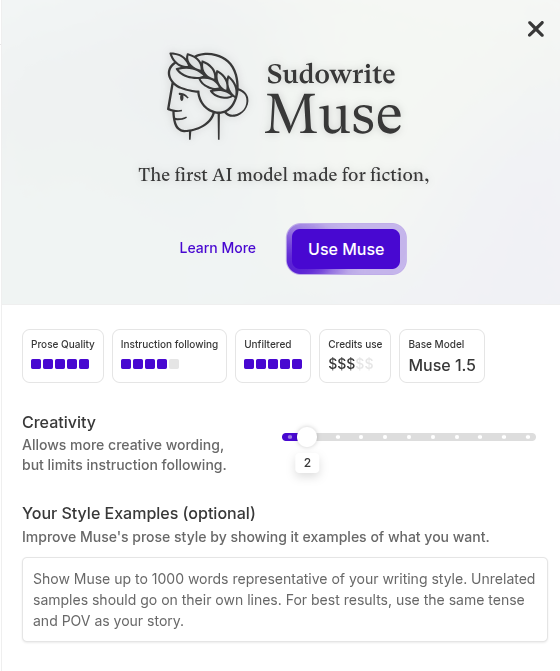
Sudowrite just released their new, updated version of Muse, their in-house generative AI model that’s optimized for writing fiction. It’s very similar to Muse 1.0, where you select a “creativity” setting from 1 to 11, optionally add some prose for it to work from, and then let it go. To allow their subscribers to experiment with it, they made it free to use today—but honestly, it doesn’t use a ton of credits anyway, so unless you’re on the cheapest plan (or generating a +1M word tome) it’s not going to break the bank.

I happened to be working on the rough AI draft of Captive of the Falconstar, so I decided to try it out. I wasn’t too impressed with the earlier version of muse, since I found that it didn’t have much internal consistency and felt a bit like it had just thrown my whole story bible into a blender. But perhaps the main problem was that I was setting the creativity too high. With Muse 1.5, I still ran into those problems on the higher range, but when I set creativity down to 1 or 2, it actually was fairly coherent (though the dialogue was still a bit like “let’s throw these characters in a blender and see what happens!”)

I think it might be that the way I’m writing my scene beats works better for the more reliable version of Muse. I tend to write very detailed scene beats, running in the 200 to 500 word range. I suspect that Muse would work much better if I were “discovery writing” my AI draft, instead of outlining it rigorously and generating multiple iterations of each chapter to pick out the best parts of each one. When you crank up things on the creative end, it can get pretty wild, especially on the 11 setting.

But while the internal consistency of the writing isn’t nearly as good with Muse as it is with Claude, the prose is definitely better. So what I’m probably going to do in the future is generate the first iteration of each chapter in Claude 4 Sonnet (or Opus, if I have enough credits for it—Opus is a monster of a credit spender, but the results are quite excellent! I really hope Sudowrite builds a “delux” model based on Claude 4 Opus.) After that, I’ll generate a couple of other iterations using Muse, then go through it line by line to copy-paste the best parts of the Muse iterations into the master version.

It’s a lot more work, but I think this way I can get the best aspects of both models, and produce a really clean AI draft. And the cleaner the AI draft is, the faster and easier it is to write the human draft—and likely with better results too.

Fantasy from A to Z: C is for Conan

Before there was J.R.R. Tolkien, there was Robert E. Howard. And before there was Middle Earth, there was Conan the Barbarian and the Hyborian Age.

Robert E. Howard had an amazingly prolific writing career, cut tragically short by his suicide. When I think of all the books and stories we could have had if Howard had not shot himself in grief after the death of his mother, it fills me with a profound sense of loss (and makes me want to rewatch the excellent biopic about him—or more accurately, his girlfriend—The Whole Wide World). I love Howard’s fantasy stories—not just the ones about Conan and his adventures, but the ones about Bran Mak Morn, Kull of Atlantis, Solomon Kane… honestly, he wrote so many stories that I have yet to exhaust them all. 

But my favorite are the stories about Conan the Barbarian, who is undoubtedly his most famous literary creation. Over the course of the last century, Conan the Barbarian has taken on a life of his own, with dozens of writers taking a stab at writing stories in the Cimmerian’s world. My favorite of these is probably John Maddox Roberts, though I have a soft spot for L. Sprague de Camp. Harry Turtledove also wrote an excellent Conan novel, Conan of Venarium. 

In a lot of ways, Robert E. Howard’s Conan stories set the standard for modern fantasy—or at least for the sword & sorcery strain for it. Tolkien later established the epic fantasy strain, and you can make a solid argument that every other successful fantasy book is derivative of one or the other (or both). Where the epic fantasy strain tends run super long, with novels in the 200k word to 400k word range, the sword & sorcery strain tends to run much shorter, with many of the original Conan stories clocking in at under 10k words. In fact, from what I’ve gathered, until Lord of the Rings became popular in the 60s and 70s, most readers thought that the natural length of a fantasy story was under 10k words.

For the Conan stories, that’s probably true—or at least, under 40k words, since many of Howard’s original novellas are quite good. My favorite of his is probably either “The Tower of the Elephant” (perhaps the most classic Conan story) or “The Black Stranger,” which had a very interesting Mexican standoff between three stranded pirate captains that Conan totally blows up. I also really enjoyed “Iron Shadows in the Moon,” mostly because the female love interest gets an interesting and satisfying character arc. The crucifixion scene from “A Witch Shall Be Born” was really great, too, and of course, the brutal savagery of “Red Nails” made a really big impact—though since that was the last Conan story Howard wrote before he shot himself, it has a very dark edge to it.

Howard only wrote one Conan novel, and to tell the truth, I wasn’t particularly impressed by it—it just felt like a generic Conan story, padded with a bunch of filler to increase the length. But I did really love Conan the Marauder by John Maddox Roberts, where Conan rises through the ranks of a horde of nomadic tribesmen, starting as their slave and eventually becoming the right-hand man of the Hyborian age’s Genghis Khan. The two major villains of that book had exceptionally satisfying deaths, and the writing was almost as pulpy and glorious as Howard’s writing itself.

After you’ve read all the original Conan stories, you really should watch The Whole Wide World. It’s a wonderful film about the only woman Howard ever loved, his on-again off-again girlfriend Novalyne Price, and their turbulent relationship. As a writer, I really appreciated the glimpse that the movie gives into the life of the author himself—and on how some of his eccentricities as a writer mirror my own. Thankfully, though, my family life has been much more stable. I don’t blame Novalyne Price for rejecting Howard, but I am very thankful for my own wife and children. My own writing changed dramatically when I became a husband and father. I can only imagine what wonderful stories we would have had if Robert E. Howard’s life had taken a similar path.

The book I’ve written that comes closest to matching the mood, theme, and action of a typical Conan story is probably The Riches of Xulthar. It isn’t nearly as good as the original Conan stories, but I do think it compares favorably against some of the later knock-offs. The idea for it came when I was playing around with ChatGPT and asked it to write me a fantasy adventure story in the style of Robert E. Howard. Things took off from there. Riches of Xulthar was my first AI-assisted novel, though after using AI to generate the rough draft, I rewrote the whole book to put it in my own words, which is the process I use for all of my AI-assisted books. If you’re interested, you can do a side-by-side comparison between the AI draft and the human draft on my blog. 

Thoughts on the Worldcon 2025 AI “scandal”

I’ll just come out and say it: I predict that the world’s last Worldcon will happen before 2034, and that after that, the convention (and possibly the Hugo Awards themselves) will be permanently disbanded. That’s what I think will be the ultimate consequence of the latest “scandal” regarding Seattle Worldcon’s use of ChatGPT, and the anti-AI madness currently sweeping the science fiction community on Bluesky.

If you haven’t been following the “scandal,” you ought to check out Jon Del Arroz’s coverage of it. He’s definitely partisan when it comes to politics and fandom, but he’s neutral on the subject of AI, or as neutral as you’re going to find, especially in writerly circles.

But here’s the TL;DW: the people organizing Worldcon 2025 in Seattle decided to use ChatGPT to help them decide which authors and panelists to put on which panels. This triggered a bunch of authors and panelists who are opposed to generative AI, simply on principle. Some of these authors—including Jeff VanderMeer, who is up for a Hugo award—have bowed out, while others have called for resignations and apologies. Many of the volunteer staff have also stepped down, exacerbating the staffing shortage—which is why the convention relied on ChatGPT in the first place. And apparently over on Bluesky, the scandal is taking on a life of its own, with everyone working themselves up to a massive frenzy over the subject.

My own opinion of the “scandal” is this: it isn’t a freaking scandal! Whatever your opinion on AI-assisted writing, using ChatGPT as an aid to research panelists is totally above-board and a legitimate use of AI. To disagree with that is to say that there is no ethical use-case for generative AI whatsoever, which is hypocritical and absurd—unless, of course, you’re still writing your books on a manual typewriter and submitting them to your publisher via the US postal service. Or using WordStar, if your name is G.R.R. Martin and you’re the last person on earth who “writes” with that defunct software (putting “writes” in quotation marks, since we all know by now that Martin isn’t actually writing anything).

But it isn’t the “scandal” itself that interests me, so much as what the fallout will likely be. Ever since the Sad Puppies debacle in 2015 (and arguably long before that), Worldcon has been dominated by the wokest fringe of SF&F fandom, and it’s been an open secret that the Hugo awards themselves are controlled by the publishers, largely for marketing purposes.

So at this point, the only things really keeping the whole Worldcon/Hugo charade going are 1) woke authors who use the convention to manufacture clout for their failing careers, because they wouldn’t otherwise have a platform, and 2) woke publishers who use the awards to manufacture clout for their poorly-selling books, because they don’t actually know how to market books effectively (at least, not to readers—libraries are a whole other subejct deserving of its own discussion, because there is a genuine scandal there). Once those two things dry up, and all of the ruin has been exhausted from these institutions (ie Worldcon and the Hugos), I really do think they will collapse and go away.

That’s what I find so fascinating about this scandal: it is so utterly toxic and absurd on its face that it’s going to do permanent damage to Worldcon and the Hugos. The writers of the rising generation who will one day dominate the field are all playing around with these AI tools right now, and doing really interesting things with them. Meanwhile, most of the authors who are screaming about AI on Bluesky right now will either be dead or irrelevant (or both) in the next 20 years. And yes, Mike Glyer, you can quote me on that.

Seriously, though: if the Worldcon community is so vociferiously opposed to a legitimate use-case of ChatGPT—namely, to alleviate the already overwhelming burdens being carried by the volunteer staff—AND they continue to be absolutely toxic about it online… who in their right mind would want to be a part of that community? And since the only thing keeping the whole charade going is its ability to manufacture clout, that’s why I think its years are numbered—and likely in the single digits.

On the plus side, if/when the Hugos finally die, I won’t have to read any more crappy woke books to be able to say I’ve read (or DNFed) every Hugo award-winning novel.