The dangers of relying too much on AI

I saw this really interesting video last week, and it made me think: am I relying too much on AI?

In my personal life, this probably isn’t an issue. I do occasionally ask ChatGPT to make me a recipe, or to advise me on a particular topic, but I always do a gut check and assume that it’s hallucinating if it doesn’t pass. If it gives me something that I can quickly and easily verify, I always do that… and half of the time, it turns out to be a hallucination to some degree. So yeah, I don’t rely on it nearly as much in my personal life as some of the characters in this video.

What about blogging? Don’t be too scandalized, but with my new blogging schedule, I have experimented a bit with using ChatGPT to write some of these blog posts. It’s not like I’ve been copy-pasting everything straight from the chatbot, but I have relied on it a little more heavily than I do in my own writing.

After trying that a couple of times, though, I decided to cut that out and write all of these blog posts by hand. Why? Because I felt like it was creating too much distance between myself and the people who read this blog, and the purpose for writing this blog is to foster a human connection. So it kind of defeats the purpose to rely on a chatbot to generate most of the content I post here. For that reason, I plan to keep writing all these blog posts entirely myself, with only minimal AI input.

So what about my fiction? This is where things get a little tricky. While I totally agree that simply copy-pasting from AI is a piss-poor way to write a book, I do think that AI can be a very useful tool in writing and crafting a novel, provided that you understand the limitations of the AI and don’t rely on it too much. But how much is too much? That is the question.

The biggest way that AI has helped to enhance my own writing is in giving me a birdseye view of the story as I generate a “crappy first draft.” This birdseye view allows me to see and fix major story issues before they metastatize and give me writer’s block, which is what tends to happen if I write these drafts out entirely by hand. When I’m focused on the page, I tend to lose sight of the forest for the trees, so I don’t notice that there’s a problem with the story until I’m several chapters in and find that I just can’t write.

This has happened with basically every project that I write on my own, and is the main reason why it took me anywhere from six to eighteen months (or longer) to write even a short novel, before I started using AI. However, since I began incorporating AI into my writing process, this problem has basically gone away, and I no longer experience this form of writer’s block at all.

However, while I do rely on AI to help me to craft my “crappy first draft,” that isn’t the draft that I publish. Once the AI draft is as good as I can make it, I will then go through scene-by-scene and rewrite the entire book in my own words. The purpose for this step is to make sure that I’m telling the story in my own words, and to make the story my own. I will still have the AI draft open on another screen, and refer to it as I write out the story, but I don’t do any copy-pasting. It’s all written out by hand.

Is this enough, though? Or do I need to add more steps to make sure that I’m not relying too much on AI, and thus losing my own voice? Recently, I’ve been spending a lot more time on the AI draft, generating multiple iterations and combining the best parts to (hopefully) boost the quality. I’ve also been doing a revision pass over the AI draft, tweaking it to smooth over some common AI-isms and (hopefully) adding a bit of my own voice before I move on to the human draft and rewrite the whole thing to make sure it’s all in my voice.

But while this might be enough to keep the book in my own words, is this enough to keep my own writing skills from atrophying? Or do I need to occasionally pick up a WIP that is 100% human writing, with no AI at all, just to make sure I don’t lose these writing skills? That is the question that I’m currently pondering. Perhaps this is the sort of thing that short stories could serve really well to help with. Perhaps I should go back to writing short stories again, just as a way to keep my writing skills sharp.

If I were starting out right now as a new writer, I would definitely avoid writing with AI until I’d written enough to find my own voice. And I would also make sure to write at least one novel 100% without AI-assistance, just for the experience, and to prove to myself that I could do it. Otherwise, I think there would be a very real danger in becoming over-reliant on AI to write my books, and thus risk losing my own unique voice, so that none of the books that I write ever truly become my own.

Anyhow, those are some of my current thoughts on the subject. What do you think of this problem?

How Not To Write An AI-Assisted Novel

The worst way to write a novel with generative AI is to make the AI do all the work.

In fact, thinking of it in terms of “how much of the work can I get the AI to do?” is pretty much guaranteed to give you a really crappy book by the end of it. The AI’s job isn’t to “do the work,” any more than a power tool’s job is to build a house. You do the work. AI is just a tool to multiply your efforts.

But let’s take a step back. Who am I to talk about all of this? My name is Joe Vasicek, and I’m an indie author who’s been writing and publishing regularly since 2011. At this point, I have several dozen novels under my belt, including about half a dozen AI-assisted novels, the first of which is published under my Joe Vasicek pen here on this blog. Also, my wife is a PhD student and research assistant who works with generative AI and large language models. Her thesis is on using generative AI to create interactive cross references for any body of text, customized to the user. We talk a lot about generative AI and share what we’ve learned, so we’re both fairly knowledgeable on the subject.

At this point, it’s still very much the wild west of writing with AI-assistance. The technology is new enough that there really are no experts on the subject, though I expect that that will change rapidly over the next few years. And while I can’t (yet) say that I’ve made gazillions of $$$$ from my AI writing methods, I can say that I’m one of the first professional writers to develop a method for writing with AI-assistance.

And that’s not a boast. Whenever I get together with other writers, I wish there were more of them (really, any of them) that I could talk with about this stuff. There are some online communities that come at it more from the AI side than the professional writing side, and I probably ought to spend more time in those, because it’s probably only a matter of time before one of them has a runaway bestseller and shakes up the publishing industry in the same way that Amanda Hocking shook things up when the indie publishing revolution was just getting underway.

Maybe that someone will be you. Who knows? We’re still very much in the wild west of AI writing, and probably will be for a while.

It’s that very loneliness that makes me want to blog about AI-assisted writing—that, and the fact that I’m still trying to figure it out for myself, so I would love to hear what’s working for other writers. But one thing that I’ve learned from my own experience is that the worst way to write an AI-assisted novel is to dump all the work on the AI and expect anything good to come out.

The main reason for this is that LLMs and generative AI do not think—at least, not in any meaningful way that’s similar to the way you and I think. Instead, these models analyze human language for patterns, and replicate those patterns according to the parameters and instructions give by the user. It’s much closer to how your phone is able to predict your next word when you go to write a text, except that instead of writing the next word, ChatGPT or Sudowrite or whatever LLM you happen to be using is instead predicting the next 5-10 paragraphs.

So really, it’s not very useful to think of an AI as being able to “write” anything. Instead, it’s much more useful to think of it as “simulating” the thing that you’ve told it to write, or producing a simulation of the kind of work that a human would produce, given your parameters and instructions. The AI isn’t “doing the work” for you, it’s merely simulating the end product of that work. You still have to make it your own.

And how do you make it your own? Personally, I’ve found that the best way to do that is to open up a new document on my second monitor and type it all out by hand, occasionally referring to the AI-generated text when I don’t know what to write next, but largely trusting in myself to create the real, non-simulated draft. No copy-pasting! The mental exercise of writing it all out, word for word, stimulates something in the creative mind, and in most cases I end up writing something completely different, using the simulated version of the novel merely as a stepping stone.

So why do I go through all the trouble of generating a whole novel, when I’m probably going to throw out most of that text anyway? That’s a very good question—so good, in fact, that it needs to be the subject of its own post.

Cooking adventures and an awesome webcomic

So I have a bunch of ideas for blog posts I’d like to write, and I’ll probably get around to them eventually, but I thought I’d drop a line now just to let you all know what I’ve been up to.  It’s been a pretty good week, with some decent progress on the current WIP (Lifewalker) and some other random stuff that may be of some interest.

First, Lifewalker.  It’s coming along quite well.  I’m averaging around 2k words a day, so more of a leisurely pace than a white-hot creative heat, but not too bad.  It’s kind of turned into a post-apocalyptic Western, mostly because I can’t write about southern Utah without the landscape taking over.  This video should give you an idea why:

At the same time, the character’s voice really seems to be taking shape in a way that I like.  He’s kind of drifting right now, but the way he writes about it is very much like an old man reminiscing on the course of his life, lingering on the regrets as well as the triumphs, with some rather wistful commentary on each.  This is really a character that I can just pick up and run with–the story is practically writing itself.

It’s not just the voice, either.  Random stuff is just finding it in–powerful stuff that makes the story awesome.  For example, just in the last chapter, the characters were holding a meeting to see what they should do to rescue some of their friends who had been kidnapped.  Out of nowhere, one of them pulls out a skull from a human baby, with beads and feathers dangling from it like some sort of totem.  He brought it out to show that the people who’d attacked them were not just normal bandits, but cannibals from the Nevadan wastelands, which put them in a whole new category of badassery.  Stuff like that comes out of nowhere every time I write, and it’s awesome.

I’ve had a lot of time to write, though I don’t feel I’ve been using it all productively.  Still, I’m on track to finish this thing by the end of the month, which will be extremely gratifying.

In the meantime, I’ve been experimenting a lot with cooking and gardening.  Just planted some tomatoes in 3-gallon ice cream buckets (with dirt instead of ice cream, of course), and those are growing nicely.  It’s fun to have something to water in the morning, and when they start to yield fruit, I’m sure it will be awesome as well.

But I’ve also been experimenting with the old Egyptian kushari recipe I picked up after the 2008 study abroad.  It always seemed to be missing that one thing that would make the other ingredients come together and achieve that delicious synergy.  Well, I think I’ve found it: chickpeas and cumin, with maybe a touch of vinegar.  It might not be 100% authentic, but when I cooked it this time with that stuff, it tasted heavenly.

So this weekend, I’m going to try to perfect the recipe, something I’ve been wanting to do for years.  I’ll try cooking the rice in chicken broth, and adding more onions and garlic with maybe a little tomato.  Also, coriander–I know that coriander and cilantro are basically the same plant, but I think the coriander will go with this better than cilantro.  Also, it helps to fry it with a little oil after taking it out of the refrigerator, rather than sticking it in the microwave.  I haven’t had a microwave for over a year, and I think I actually prefer cooking without it.

Speaking of food, my roommate’s sister’s roommates dropped off a bag full of crap from their kitchen, since they’re moving out for the summer.  We’ve been having an interesting time combing through it–found some pretty good stuff, actually.  One of the more useful things is a bag full of buckwheat, which is AWESOME because kasha was one of my favorite dishes in Georgia.  Kasha and lobio–delicious!

So yeah, I’ve had food on my mind a lot this week.  If things work out, maybe I’ll post a recipe or two.  Kushari is delicious, cheap, filling, and healthy–a winning combination if ever there was one.  Kasha is pretty simple, but that’s what makes it so great–a simple, hearty food that leaves you feeling warm and whole.

Besides cooking exotic foods, I’ve also been reading a lot of Freefall.  I discovered it just last week, and I have to say, it is awesome.  One of the better webcomics I think I’ve ever read.  Like Schlock Mercenary, it’s a space opera comedy romp, but where Schlock kind of turned dark in recent years (which I’m not complaining about, don’t get me wrong), Freefall has still stuck to its happy-go-lucky roots.  And just like Schlock Mercenary, the humor is not only entertaining, but often wonderfully insightful.

Florence_AmbroseBut by far, the best part of the story is how compelling the characters are.  My favorite is Florence Ambrose, an artificially bred Bowman’s Wolf who is kind of a human-wolf hybrid.  She’s one of only 14 members of her species, and the corporation that created her considers her more as property than an individual. She’s got all these biologically programmed safeguards that force her to obey direct human orders, no matter how ludicrous–but the only way for her species to survive is to convince the corporation that Bowman Wolves are profitable, so that they’ll make more (the whole 50-500 rule and all that).

Somehow, she becomes the engineer of the Savage Chicken, a down-and-out starship captained by the infamous Sam Starfall.  Sam is basically a lazy, larcenous alien squid who wants nothing more than to steal everyone’s wallet and become famous doing it.  At first, it seems like a horrible combination–Florence is basically a good, honest person, who wants to do good work and please everyone.  But as the story goes on, the two develop quite a rapport, and start to rub off on each other.

Florence helps Sam to clean up and get his act together, and Sam helps Florence to learn ways to get around her difficult situation vis-a-vis her safeguards and lack of free will.  More importantly, Sam helps her to stop feeling guilty long enough to recognize that doing the right thing sometimes means breaking (or at least twisting) the law.

As if that weren’t enough, there’s the whole cross-species romance angle between Florence and the biologist who rescues her back in one of the earlier subplots.  As you might expect, it gets really lonely being the only Bowman’s Wolf on the planet–especially when the other 13 are frozen in cryo, on their way to a world several light-years away.  Florence knows that she needs to do what she can to propagate the species, but she’s also got some emotional needs that demand to be satisfied now.  Winston is kind of similar, a lonely parasitic biologist on a frontier terraforming project with only 40,000 humans and a 40-60 male-female ratio.  Except for the whole cross-species issue, they make a really good couple.  I’m riveted to find out what happens next!

So yeah, if I had to sum it up: good, honest, likeable person + insecure future + social limbo + unsatisfied emotional needs = really compelling story.  Plus, she’s half wolf–how cool is that?  What I would give for her incredible sense of smell…

In any case, it’s getting late, and even though tomorrow is Saturday, there’s a bunch of stuff I want to do tomorrow so I’d better cut this short for now.  See you later!

Slow, but still making progress

Sorry for neglecting the blog this week.  I took a temp job to earn some cash, and that’s been sucking up most of my time lately.  Fortunately, it should be over sometime next week.

In the meantime, I found a place to live for the next few months.  I’m in the basement of an old house, rooming with a former classmate from Brandon Sanderson’s English 318 class.  So far, it’s actually been pretty awesome.  The rent is dirt cheap and you get what you pay for, but there aren’t any rats and the heater works fine.  It should be a good place to spend the winter.

Progress on Stars of Blood and Glory has slowed down somewhat, mostly due to the temp work, but it’s still coming along steadily.  If all goes well, I’ll have it polished and sent out to my editor by the end of next week, which leaves only the cover art to figure out.  I’m going all out for this one, just like I did with Desert Stars and Bringing Stella Home.

Also, I just (re)started Lifewalker, a post-apocalyptic novel previously titled The Chronicles of Lifewalker.  I know, I should be putting more time into getting Stars of Blood and Glory ready for publication, but this project has been begging to be written since 2011.  I wrote a first chapter two years ago, but the narrative voice wasn’t working too well.  Basically, I was trying too hard to imitate 19th century prose without having read enough to know how to do it well.  Instead, I decided to toss all that stuff out and write the dang story without being overly restrictive.  I think it’s going to turn out well.

Blah blah blah oh did I mention that I checked out a couple of David Gemmell books from the Provo Library?  Well, I did.  They are the last two books in the Drenai series that I haven’t read, and I am soooo excited to sink my teeth into them.  Just started The First Chronicles of Druss the Legend last night, and it is AMAZING.  Expect to see a review here soon.

Speaking of which, I should probably reread Wool and review it sometime.  Hugh Howey really took the publishing world by storm last year, and he’s doing some truly amazing things for indie writers.  His books are great, too–definitely worth picking one up.

That’s just about all right now.  I’ll probably put in another hour of writing/revising, then turn in for the night.  Later!

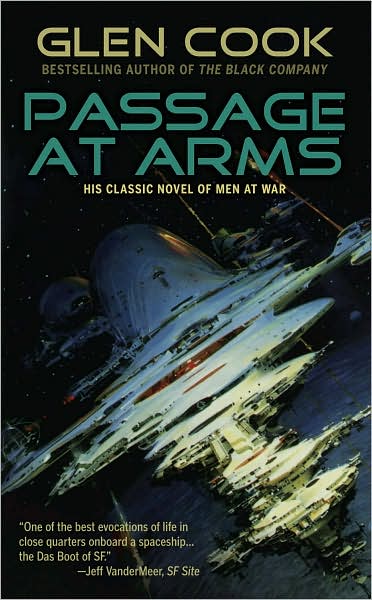
Passage at Arms by Glen Cook

Humanity is losing a long, bloody war of attrition against an alien race.  Our only military advantage lies in the climbers–small, guerrilla style gunboats that can cross into a higher dimensional plane.  Under the right conditions, this technology enables the ships to pass through space undetected.

As the war reaches a critical juncture, one former soldier, now a journalist, joins with the crew of a climber to get the inside story.  What he finds is a far cry from the brave, clean-shaven heroes portrayed by the official war propoganda; the climbers are a gritty, dirty-minded lot of soldiers, cursing the higher ups and living from leave to debaucherous leave.

When worst comes to worst, however, and crap hits the fan, everyone’s true colors come out.  When that happens, who will hold together, and who will fall apart?

I enjoyed this book a lot.  Parts of it were a little raunchy, but never too much for my taste, though your mileage may vary.  Glen Cook leans more towards flowery writing than pure storytelling, and while I had a few minor qualms with his writing style, the book was quite compelling.

Glen Cook really excels at character voice and viewpoint.  Even though the book was military sci-fi set almost entirely in space, it had a very distinct, almost noire feel to it.  Everything that happened was heavily filtered through the main character’s point of view, which made the narrative feel very intimate and personal.  When Charlie dances the foxtrot, you feel like you’re right there in the thick of it.

My favorite thing about this book, however, is the level of scientific realism in the combat systems.  Obviously, things like hyperspace and trans-dimensional drives are entirely speculative, but the orbital dynamics of the planetary siege and visual effects of the nightly bombardment gripped me from the first page.  It didn’t feel pulpy or cartoonish at all–in fact, it felt disturbingly reminiscent of news footage from the ’91 Gulf War, which haunted me for a while as a kid.  This isn’t your typical humans vs. aliens sf adventure novel–it’s like a firsthand account from someone who was there.

My biggest issue with the book was more stylistic than anything else; Cook tends to rely on one-sentence paragraphs to add extra punch–which can be effective, when done sparsely.  However, every page would have at least two or three of them, often occurring one after another.  For me personally, that was a bit too much, but obviously it didn’t keep me from finishing the book, or enjoying it.

So yeah, if you like your science fiction with a heavy dose of gritty realism, you’ll probably like this book.  Even if you don’t, it’s worth checking it out for the orbital dynamics and other interesting details.  Even though it probably isn’t perfect, it feels a lot more accurate than most of the other books out there.

Pulling along

Just a quick post, because it’s 3:30 am and I’ve got a TON of stuff to do tomorrow, such as:

1) cleaning checks
2) replace the air filter in my car
3) go running with my bro in law
4) finish Genesis Earth 5.0
5) band practice
6) watch Inception with a bunch of friends at the dollar theater

Yeah, tons of stuff.  So anyways…

I’m amazed at how quickly I’m pulling through Genesis Earth.  Yesterday I revised through 11.7k words, and today I did about 14.1k.

At this point, most of the work is sentence and paragraph level, and has more to do with voice and rhythm than actual story.  There were a few science issues, mostly having to do with distances and velocities, but thanks to Logan I think I’ve caught most of those.  Thanks so much!

I’m also finding out that this story is much better than I used to think it was.  With all the form rejections I’ve been getting for it, I wondered for a while whether I should put it back in the trunk and let it quietly die.  Now, however, I can see that it has a lot more promise than I’d previously thought.  Even if it isn’t published as my first novel, I really do believe that this story deserves a home.

At the same time, though, I’ve noticed some major differences between my writing in this piece and my writing in the stuff I’ve written more recently.  I’m not sure exactly how to put it, but I think it has something to do with voice.  I don’t want to say that Genesis Earth is more choppy, but it does seem a lot more…matter of fact, if that makes sense.  There are also a lot more rhetorical questions, but I think that’s an artifact of the 1st person perspective.

But even if the voice in this piece is different from my voice now, it’s different in a good way.  It feels more…YA?  I’m not exactly sure, but it seems to work.  The sequels, if/when I write them, will probably be in 3rd person (ala Spin and Axis by Robert Charles Wilson), and that’s going to create a much different feel than this book.

It worked for Axis, though, so I think I can pull it off–that is, if/when Genesis Earth gets picked up by a publisher.  I don’t want to write the other two books in this trilogy until I know the first one is sold.

In unrelated news, I had a job interview today.  It was with a wilderness therapy company, the same that wait listed me for the January training.  I really hope I get in–more than anything at this point in my life, I feel that I need to gain some major life experience.  Probably the biggest stumper question was “what three words would you use to describe yourself in your last job, and what three words would your supervisor use to describe you?” A difficult question, particularly when all your recent jobs have been temp jobs.  I think I did alright, though–now, we just need to wait and see.

In other unrelated news, I threw an awesome movie night tonight.  We watched Scott Pilgrim vs. The World, and maybe fifteen people showed up–most of them from Quark, but a couple of friends from some other places too.  Man, that Scott Pilgrim movie is epic. So hilarious, so entertaining, and at the same time, so true.  And then, we went to Dairy Queen and hung out until midnight hanging out.  It was great.

In still other unrelated news, I recently ordered the anime series Planetes on DVD.  It was at a good price, and I knew I’d buy it eventually, so I allowed myself to splurge.  I am so happy I did, because the science fiction elements are done surprisingly well.  All the little details, from the zero gravity handholds in the walls to the way the stations spin, are surprisingly true to real life, and the show’s vision of 2075 is not beyond the realm of our own possible future.  In other words, Planetes is quite possibly the best rocketpunk anime show out there, and a great source for inspiration.

Well, that’s enough for now.  Tomorrow, I will finish this novel and send it out to the agent who requested it.  In the meantime, though, it’s 4:00 am and I must sleep.

Genesis Earth 3.0 is finished!

That’s right!  Here are the stats:

ms pages: 269
words: 74,687
file size: 525 KB
chapters: 16, prologue & epilogue
start date: 8 July 2009
end date: 25 July 2009

Wordle: Genesis Earth 3.0

Wow, I finished this rewrite in seventeen days. Seventeen days! Hard to believe it’s only been that long. I hope the quality of this work went up in that time. I still feel like I need to run through and proofread it, make sure that the language flows well and the dialogue isn’t stilted.

In the process of writing this draft, I added or deleted 37,159 words from the previous draft. Going by the wordcount of the previous draft, 51.98% of the text changed.

Now I need to start submitting this book. It’s going to be kind of hard–I’m not sure whether it’s YA or not. On the one hand, the main characters are older teenagers and experience a lot of personal growth over the course of the novel. On the other hand, the (pseudo)science is a little dense, and the prose isn’t…well, it doesn’t read like most of the YA that I’ve read.

Well, I guess the only thing to do is shop it around and see who picks it up. In the meantime, I’m going to put everything I have into finishing Bringing Stella Home. The 2.0 draft of that novel is going to be AWESOME!

Heaven’s library

2,943 words today, even though today was the first day of Writing and Illustrating for Young Readers.  I’ve reached the major climax of the book–the moment I’ve been replaying over and over in my head.  Perhaps this novel is not as bad as I’d thought–perhaps I can pull this off.  The current incarnation is terrible, but I can see in my mind how good it can be in its second or third incarnation.  Inshallah, I’ll pull it off.

Today was the first day of BYU’s writing conference, and it was great!  The speaker in the last workshop I attended, Dandi Mackall, was exceptional.  I don’t have my notes with me and the BYU library closes in twenty minutes, so I’ll recap the best part of her presentation, the story she told in the last five minutes.

She said that once she had a dream where she died and went to heaven (thank goodness!).  When she got there, the angel who greeted her offered to show her around, and asked what she wanted to see first.  Her answer?  The library, of course!

In heaven’s library, she found shelves stretching as far as she could see, full of the very best books.  She picked out a few and recognized some of her favorites, the ones that had impacted and changed her life.

After a while, though, she started to get a little disappointed: all of the books in heaven’s library were books we already had down on Earth.  Why was that?  Didn’t heaven have anything new–anything we hadn’t already seen down below?

“But all these books were here first,” said the angel.

Still, she couldn’t accept that as an answer, so the angel took her down a long, winding, narrow corridor.  The deeper she went, the narrower and dustier it became, until she started to feel uneasily.  This part of the library was dark and dirty.  It was clear that hardly anybody every came down here

Finally, the angel led her to a door covered in cobwebs.  He brushed them aside and opened the door, leading her inside.  Here was a room many times larger than the first, with old, dusty bookshelves stretching higher than she could see.

She picked out a book and started reading through it.  It was one she’d never heard of, but it grabbed her.  She could tell that it was really good.  She picked up another one, and realized that it was just the kind of book that one of her friends would have loved to read.  She picked up another one, and realized that this one could have helped out another friend when she’d gone through a terrible life crisis.

All of this made her angry. “Why didn’t we have these books?” she asked the angel. “They are just as good as the ones in the other room.  Why didn’t they make it down?”

“These are all the books that remain unwritten,” said the angel. “Each one of these is a book that a writer, somewhere below, has in them but fails to write down.

“This one is by a writer who just won’t let anyone touch her writing and give her the criticism she needs to improve her craft.  This one is by a writer who doesn’t have the discipline to write consistently and finish what he starts.  This one is by a writer who doubts her story and doesn’t think she can ever get it to work.”

At this, she nodded and let the angel lead her back out to the main room.  As she left, she saw one final book near the door.  It had her name on it.

What a great, encouraging story.  I didn’t do nearly as good a job retelling it as Dandi did the first time, but it had a tremendous impact on me. I hope sharing it with you, it does something of the same. 

For some reason I don’t understand, fate, God, or genetics (or some malicious combination of the three) conspired to turn me into a writer.  I don’t write for fame or fortune; I write because I can’t not write.  Sometimes, I wonder if I’m making a mistake trying to turn this into a career, into something that will feed myself and my future family.  Looking at the millions of other floundering writers like myself, it’s easy to feel anxious.  After all, only a tiny fraction of us will ever get published, let alone make a professional career out of this.  Do I even have a fighting chance?

But then I hear a story like this one and I remember why it is that I write.  Not for fame, fortune, publication, personal gratification, or even just because I can’t not do it.  It’s because storytelling itself is important.  It helps us connect with the world around us, to see its beauty and wonder.  It helps us to appreciate ourselves and understand others.  It stimulates our imaginations and, by so doing, helps us to life our eyes from the ground and see the divine  potential that is all around us.  It helps us to grow through vicarious experience–it helps us to live and to love.  

Writing, at its best, is a sacred act, an important act, and if by grace we have been touched by inspiration and given a story to write, we should consider it noble and honorable to bring that story incarnate into the world, to touch the lives of others and lead them to what is good and true.