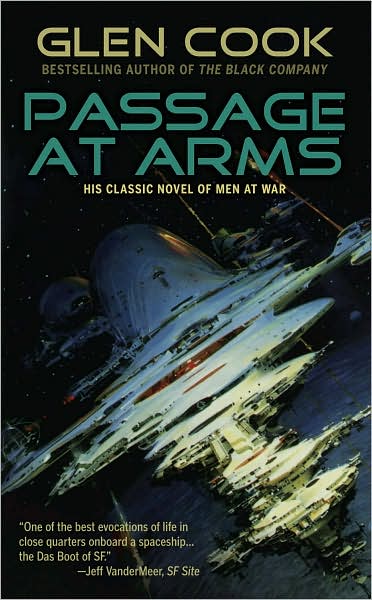
Passage at Arms by Glen Cook

Humanity is losing a long, bloody war of attrition against an alien race.  Our only military advantage lies in the climbers–small, guerrilla style gunboats that can cross into a higher dimensional plane.  Under the right conditions, this technology enables the ships to pass through space undetected.

As the war reaches a critical juncture, one former soldier, now a journalist, joins with the crew of a climber to get the inside story.  What he finds is a far cry from the brave, clean-shaven heroes portrayed by the official war propoganda; the climbers are a gritty, dirty-minded lot of soldiers, cursing the higher ups and living from leave to debaucherous leave.

When worst comes to worst, however, and crap hits the fan, everyone’s true colors come out.  When that happens, who will hold together, and who will fall apart?

I enjoyed this book a lot.  Parts of it were a little raunchy, but never too much for my taste, though your mileage may vary.  Glen Cook leans more towards flowery writing than pure storytelling, and while I had a few minor qualms with his writing style, the book was quite compelling.

Glen Cook really excels at character voice and viewpoint.  Even though the book was military sci-fi set almost entirely in space, it had a very distinct, almost noire feel to it.  Everything that happened was heavily filtered through the main character’s point of view, which made the narrative feel very intimate and personal.  When Charlie dances the foxtrot, you feel like you’re right there in the thick of it.

My favorite thing about this book, however, is the level of scientific realism in the combat systems.  Obviously, things like hyperspace and trans-dimensional drives are entirely speculative, but the orbital dynamics of the planetary siege and visual effects of the nightly bombardment gripped me from the first page.  It didn’t feel pulpy or cartoonish at all–in fact, it felt disturbingly reminiscent of news footage from the ’91 Gulf War, which haunted me for a while as a kid.  This isn’t your typical humans vs. aliens sf adventure novel–it’s like a firsthand account from someone who was there.

My biggest issue with the book was more stylistic than anything else; Cook tends to rely on one-sentence paragraphs to add extra punch–which can be effective, when done sparsely.  However, every page would have at least two or three of them, often occurring one after another.  For me personally, that was a bit too much, but obviously it didn’t keep me from finishing the book, or enjoying it.

So yeah, if you like your science fiction with a heavy dose of gritty realism, you’ll probably like this book.  Even if you don’t, it’s worth checking it out for the orbital dynamics and other interesting details.  Even though it probably isn’t perfect, it feels a lot more accurate than most of the other books out there.

Pulling along

Just a quick post, because it’s 3:30 am and I’ve got a TON of stuff to do tomorrow, such as:

1) cleaning checks
2) replace the air filter in my car
3) go running with my bro in law
4) finish Genesis Earth 5.0
5) band practice
6) watch Inception with a bunch of friends at the dollar theater

Yeah, tons of stuff.  So anyways…

I’m amazed at how quickly I’m pulling through Genesis Earth.  Yesterday I revised through 11.7k words, and today I did about 14.1k.

At this point, most of the work is sentence and paragraph level, and has more to do with voice and rhythm than actual story.  There were a few science issues, mostly having to do with distances and velocities, but thanks to Logan I think I’ve caught most of those.  Thanks so much!

I’m also finding out that this story is much better than I used to think it was.  With all the form rejections I’ve been getting for it, I wondered for a while whether I should put it back in the trunk and let it quietly die.  Now, however, I can see that it has a lot more promise than I’d previously thought.  Even if it isn’t published as my first novel, I really do believe that this story deserves a home.

At the same time, though, I’ve noticed some major differences between my writing in this piece and my writing in the stuff I’ve written more recently.  I’m not sure exactly how to put it, but I think it has something to do with voice.  I don’t want to say that Genesis Earth is more choppy, but it does seem a lot more…matter of fact, if that makes sense.  There are also a lot more rhetorical questions, but I think that’s an artifact of the 1st person perspective.

But even if the voice in this piece is different from my voice now, it’s different in a good way.  It feels more…YA?  I’m not exactly sure, but it seems to work.  The sequels, if/when I write them, will probably be in 3rd person (ala Spin and Axis by Robert Charles Wilson), and that’s going to create a much different feel than this book.

It worked for Axis, though, so I think I can pull it off–that is, if/when Genesis Earth gets picked up by a publisher.  I don’t want to write the other two books in this trilogy until I know the first one is sold.

In unrelated news, I had a job interview today.  It was with a wilderness therapy company, the same that wait listed me for the January training.  I really hope I get in–more than anything at this point in my life, I feel that I need to gain some major life experience.  Probably the biggest stumper question was “what three words would you use to describe yourself in your last job, and what three words would your supervisor use to describe you?” A difficult question, particularly when all your recent jobs have been temp jobs.  I think I did alright, though–now, we just need to wait and see.

In other unrelated news, I threw an awesome movie night tonight.  We watched Scott Pilgrim vs. The World, and maybe fifteen people showed up–most of them from Quark, but a couple of friends from some other places too.  Man, that Scott Pilgrim movie is epic. So hilarious, so entertaining, and at the same time, so true.  And then, we went to Dairy Queen and hung out until midnight hanging out.  It was great.

In still other unrelated news, I recently ordered the anime series Planetes on DVD.  It was at a good price, and I knew I’d buy it eventually, so I allowed myself to splurge.  I am so happy I did, because the science fiction elements are done surprisingly well.  All the little details, from the zero gravity handholds in the walls to the way the stations spin, are surprisingly true to real life, and the show’s vision of 2075 is not beyond the realm of our own possible future.  In other words, Planetes is quite possibly the best rocketpunk anime show out there, and a great source for inspiration.

Well, that’s enough for now.  Tomorrow, I will finish this novel and send it out to the agent who requested it.  In the meantime, though, it’s 4:00 am and I must sleep.

The Madness Season by C. S. Friedman

In the 21st century, Earth was conquered by an alien collective consciousness known as the Tyr.  Now, five hundred years later, humankind has been scattered across the Tyr-occupied worlds as slaves.  It is a dark and uncertain existence, under the rule of masters who do not care whether their charges live or die.

For the last five hundred years, Daetrin has been a survivor.  An anomaly among humans–a man with the power to live indefinitely–Daetrin is used to keeping his true nature hidden.  But when the Tyr learn of his strange abilities and take him away for further study, he finds himself on the run, out in the open.

In order to survive, however, he must face his greatest fear–the fear that he isn’t entirely human.

This book was interesting.  C. S. Friedman’s prose is quite good, and her main character has a very unique and engaging voice.  For some reason, she wrote all of Daetrin’s stuff in first person, while the other characters in third person.  I think that the main reason for this was to preserve the sense of surprise and horror when he made certain discoveries while at the same time revealing certain critical aspects of her world that the reader absolutely needed to know in order for the story to make sense.  It didn’t bother me–in fact, I think she did it quite well–but it might not work for you.

In terms of story, this book was interesting but a little confusing.  It lagged at times, especially towards the beginning, and towards the end so many things came together at once that it was difficult for me to keep track of them.  I’m not entirely sure why that was, but I think it’s related to the fact that I never felt a very clear sense of progression.  Plotwise, things happened, but I didn’t see how one led necessarily to the next, or where things were going overall.

That said, the ending was satisfying, and I enjoyed reading this book.  You don’t realize it until the end, but the whole book is basically Friedman’s sf take on a certain type of well known, very popular mythical monster.  I won’t spoil the book by telling you which one, but when I saw it, it made me smile.

In terms of science fiction, there are a lot of old tropes with very few new ideas, except for the shapeshifting alien species known as the Marra.  Their culture was interesting, and I thought Friedman did a very good job conveying both the familiarity and the alien-ness of that species.  The Tyr weren’t quite as interesting, because they were basically just the Borg with scales and spikes, but the Hraas and the Tekk (who are a type of human) were also well done.

This is definitely the kind of book you’d want to sit down and read, rather than take everywhere with you and read whenever you get a spare moment.  Without sitting down and dedicating some time to it, it’s very difficult to really get into the story or feel immersed in the world.  I made that mistake, and it took me nearly a month to finish it.  That said, it was a good book; I’ll definitely be reading some Friedman again.

13,837 words in a day?

Yeah, that’s right.  Believe it or not, I barreled through about 13,837 words today.  That’s thirteen THOUSAND, not thirteen hundred.

Now, only about a thousand of that was new stuff  that I was writing.  Most of the rest of it was rearranging scenes that I’d already written, touching them up only a tiny bit.  I did merge a couple of scenes, delete or tone down some stuff, etc.

So really, about 90% of my work today was just revision, and not even really hardcore revision at that.  I’m still treating this version of my story as a rough draft; I’m not taking the time to polish things up and fix the known minor problems.  Really, I’m just running through what I’ve already written to make sure I have what I need to get past the roadblock I hit back in April.

The biggest thing I’m doing right now is rearranging scenes into entirely new chapter arrangements.  This seems to be a problem everytime I write a story with multiple viewpoints: I never seem to get the prelude-rising-falling-resolution-cliffhanger action that good chapters have.  I write scenes as they come to me, in a progression that seems natural at the time, but once I take a step back, I find that things work better on the macro-level if I complete rearrange which scenes come where in the narrative.

Part of that is that sometimes I just need to write a few paragraphs (or even a few scenes) just for me to figure out what’s going on, plotwise or settingwise.  What I’m finding with Bringing Stella Home is that I’m taking scenes from James and Danica’s viewpoints and moving them up a chapter or two, cutting out the filler in the middle.

I’ve got a long way to go before I master the art of good chapter structure.  Or perhaps it’s something that I do better when I’m revising, not drafting.  After all, I think I’m more of a discovery writer than a firm outliner.  Perhaps I write in a sort of puzzled up everywhere kind of way, and then do best when I don’t put all the pieces together until after I’ve vomited them all on the page.

I am getting more excited about this story, though.  Taking a step back and looking at things from a more global perspective has really re-energized me.  I can see the major turning points, and that helps me to build up for them much better.

I’m only worried that the “midpoint” is going to be somewhere around the 3/5ths mark, not the halfway mark as it should be.  One of my goals with this book is to see if I can hold to the three act structure and whether that makes my story any stronger.  But, according to the website, the midpoint occurs “approximately” at the halfway point, so I guess I can fudge it.

Also, the midpoint is supposed to be where the main character hits rock bottom.  Hee hee hee…oh, he will.  He will.  Bwahahahaha!!!

In the meantime, you owe it to yourself to listen to this:

Downbelow Station by C. J. Cherryh

“The stars, like all man’s other ventures, were an obvious impracticality, as rash and improbable an ambition as the first venture of man onto Earth’s own great oceans, or into the air, or into space.” Thus begins Downbelow Station, an epic tale of man’s future beyond Earth.

The outer colonies of Earth have rebelled and are fighting a long, ferocious war against the Earth colony. Mazian’s fleet, the main battle fleet aligned with Earth, has been out of contact with their superiors for so long that Earth company no longer controls them. As they fight their losing war against the Union of outer stations, they leave wreckage and destruction in their wake, determined not to give Union forces anything that could be used against them. One by one, the stations that serve as stepping stones to the Beyond fall into destruction in this terrible, senseless war of attrition.

Pell is the last major station before Earth, the nexus point between the two warring sides. It is also the only station orbiting a marginally habitable world with sentient life–the peaceful and primitive Hisa, who worship the sun and dream of traveling one day to the stars. The Konstantin family is determined to do everything they can to maintain Pell’s neutrality, but with the war coming closer and floods of refugees bringing crime and disorder, that proves increasingly difficult. It is made even more difficult by power players within the station who, unbeknown to Mazian or the Konstantins, are seeking to strike a deal with Union.

This story won the 1982 Hugo award. Since I like to write science fiction, specifically epic space opera much like this, I was very interested in reading this book and seeing what Cherryh’s vision of the far future looked like.

Her worldbuilding in this book is really, really cool. In the first chapter, she outlines how human history takes mankind to the stars–through commercial means and business interests, not government expansion. Each station serves as a jumping off point for the next expedition to the next star system, with independent merchanters hauling the profits back to Earth and conducting trade between the stations. As humanity expands, however, communication between Earth and the Beyond becomes more and more difficult, and when the Earth company tries to impose taxes on the outer stations, they rebel and form the Union.

Stationers and merchanters have distinct cultures, with the stationers feeling much more rooted to one place, trusting more in bureaucracy, and feeling more of an allegiance with Earth and the company. Merchanters, on the other hand, are much more nomadic and independent, putting more credence to family names than port of origin, and tend to have single-parent families (to keep the population from becoming inbred, merchanter women remain single, obtaining their children through short-lived relationships whenever they come into port). Two of the main characters (Damon and Elene) are a stationer-merchanter couple, and the cultural differences really come out in the way they interact with each other.

At the same time, it’s a story of first contact and what happens after first contact. The Hisa are a distinct race of sentient beings, creatures who don’t understand the ways of the humans, especially war. Their presence adds a degree of tension, especially when you consider how disastrous the war could be on Human-Hisa relations. The Hisa, however, are very clever, and the humans come to realize that they have a lot to learn from this peaceful race of furry little creatures. One of the viewpoint characters is a Hisa, and it’s really interesting to look at the station, the world, and the humans from this alien perspective. Cherryh did a good job creating a believable, complex alien race.

Overall, this story is more about grand ideas and concepts than it is about individual characters, so while Cherryh did a fair job with her characterization, her point of view was always a bit distant and I never felt extremely close to any of her characters (except perhaps Mallory–more on that later). That made it a bit hard to read the story as I got deeper and deeper into the story. There was a lot of setup before the action really started to break, and because I wasn’t very close to the characters, I didn’t feel as engaged by the story.

The action, too, was very difficult to visualize. I never really understood how faster-than-light travel worked in this book, and because all of the space battles happened partially inside warpspace, I never knew what was going on. That was a little frustrating, and kept me from really understanding or getting the tension. The gunfights and hand to hand combat was good, but it was almost always chaotic mobs against lines of armed police and/or soldiers, and never really described all that concretely. Cherryh didn’t really describe what the soldiers were wearing, what they looked like, what their guns were like, what the mobs looked like, sounded like, etc. Distant viewpoint, more conceptual than immediate.

The political situation, however, was very interesting and complex. There were a lot of different players, each with their own distinct goals and interests. There is the Company, whose chief spokesman in the beyond is Ayres, a diplomat whose delegation essentially becomes prisoner to the Union; the Union, lead by Admiral Azov, a shrewd, effective military commander; there’s Pell, led by the Konstantin family (Damon, Emilio, Angelo); but then within these three main parties there are all sorts of other divisions, such as Mazian’s fleet (and within Mazian’s fleet there is another division, with Mallory and her ship as a sort of loose cannon), the merchanters, the Lucas company (Konstantin’s main rivals within Pell), the refugees of Pell (known as “Q,” for quarantine), etc etc.

With some of these groups, you know clearly who is good and who is evil. With others, however, you’re not so sure. Mallory was a fascinating character to me–fascinating because even though I hated what she was doing to everyone else, I really admired the way she ran her ship, the way she respected and took care of her troops, and the way she was always on top of things. She earned my respect, despite that I spent a good portion of the book hating her, and of all the characters, she was the one I felt closest to. She always did what needed to be done, even if it meant getting her hands bloody, and though she was a bit arrogant, she made up for it by being an excellent, top-rate leader. She was by far the most interesting character, the wild card, and Cherryh played her very well.

Cherryh’s writing is very dense and abstract; this book took me a lot longer than I thought it would. It’s not for everyone, and I wouldn’t be surprised if ended up quitting midway through. I almost did that, but I forced myself to read through it until the plot really took off. Cherryh’s vision of the future, however, is really fascinating, something complex, futuristic, and yet very believable, from the way she connects everything together. A fascinating world, and a vision that is, for all the war and horror, satisfyingly hopeful in the end.
…and they all lived evily ever after.

Today we had a quark writing group party, and it was lots of fun! We all went up to drek‘s new house, up in Draper, and read some of our really old, really bad first attempts at writing stories. Good times!

Drek, Nick, lexish, slipperyjim, jakeson, gamila, aneeka, and one of my friends from the FLSR writing group all came up. Jakeson and his crew got lost on the way, but we had a good time hanging out, chatting, eating the pita bread and hummous that I’d cooked (I figured everyone else would bring sugar-heavy treats, so I cooked something a little more on the healthy side–still delicious, as evidenced by how much everyone ate!), and talking about how we’d gotten started writing.

I think a lot of us had similar stories–while we all wrote for different reasons, we all tried to do something big in high school, something that marked a turning point of some sort. The other common thread that ran through our stories was…how laughably bad they were! There were gradations, of course (Nick’s story that started with the word “Gandalf” and only got worse was pretty ridiculously crazy), but all of our stuff was pretty bad.

It can be both fun and painful to look back on past stuff, especially the stuff you wrote back in high school. It’s like, all the painful awkwardness of high school is not limited to your social life, it seeps into your writing as well, especially if that’s when you first try out your hand at the craft. So many cliches, so much bad grammar, so many viewpoint errors and info dumps…ARGH!!!

Of course, that is precisely what made it so entertaining. The awkward, emo, immature teenage grasp of the universe, combined with dozens of stale cliches and atrocious grammar–brilliant! I’m glad we were all at a point where we could look back on this stuff and laugh. It can do you good to air out your closet and let go of some of the old stuff you are sure would destroy you if you ever let it saw the light of day.

My first writing attempt was a novel that has since been entirely lost. I printed up a hard copy, once a long time ago, but I’ve lost that one and really have no desire to try and dreg it up. Of course, all the digital copies haven’t survived. My second novel attempt, however, I have in both digital and hard copy. That’s the one that I dipped back into for this writing party.

I actually sent out a copy of this to my aunt in Washington DC, who is/was an editor for a magazine. She read about the first twenty or thirty pages and sent me this letter, which I will use to finish off this post. The only places I’ve used ellipses are when my aunt described problems specific to certain passages and quoted them.

October 14, 1999

Dear onelowerlight [name, obviously, has been changed 😛 ]

The manuscript your mom sent home with Evan has proven to be an interesting read in many ways. It is wonderful to see people take an interest in writing. This pastime has given me many hours of satisfaction. I find that the joy is in the journey and that the process is as important to me as the finished job. However, it is always satisfying to have a finished product that I feel good about.

What it looks like you have is a wonderful outline for a novel. Your language is colorful and descriptive. The battle scene held my interest and made me want to know what was going to happen next. My intent was to read the manuscript from beginning to end purely for the joy of reading it. The urge to edit, an urge that often gets in my way as I write a first draft, got in my way as I read. Hence I was not able to follow through. I have written on some of the pages. What follows are a few other observations.

A really good writer named John Gardner said that a piece of fiction opens up a dream to the reader. Anything that causes the reader to become aware of the author or that jolts him out of the fictive dream does not belong. It is always helpful to let a manuscript cool for several days and then begin to read it. This will help you be more objective. Sometimes the things that seem marvelous turn out to be less enchanting than one thought during the rapture of creation.

Titles are difficult. Would anyone have read Catch 22 by another name? Some people don’t think so. It has been postulated that the reason the story about The Man Who Went Up A Hill And Came Down A Mountain didn’t do better as a movie–and presumable a book–was because of the length of the title. For many authors the title is the last thing to be written.

Your first two or three pages contain a good deal of “throat clearing.” An opening needs to grab the reader so he will continue. There needs to be a problem, action and change. It should be action that is vital to the story. Someone is going on a trip. Someone is going into battle. someone is getting married. Someone is being born. Unless you want to write erotic literature it would be better not to start with conception. Work the background in later. In The Gospel of John the first few verses talk about the Word. Immediately the Word is identified with the Son of God and the story of his baptism. The problem of establishing himself as a teacher is presented. In episode IV of Star Wars the force is not explained to us at the beginning, rather we see what it can do. It isn’t until Solo talks about fools who believe in an ancient religion that we begin to have some idea th at the force is more than magic. The characters give all this information to us.

Point of view is the perspective that the story is told from. T he most difficult and therefore least used these days is the omniscient narrator. A good rule of thumb is to see the story through the eyes of the person with the problem. Many authors write in first person. One can also use second or third person. Third person is similar to first person except the pronoun I isn’t used as much. (Actually it is more complicated than that, but that will suffice for now.) Sometimes a narrator who doesn’t see into anyone’s mind tells a story. Most fiction that looks like omniscient narrator is actually being told from the point of view of one of the characters. The narrator can then see into the mind of one person and all the other action is viewed through his eyes. Sometimes a novel will contain oone person’s point of view in one chapter and that of another character in another. This seems to work. It is confusing when shifts occur without warning.

Psychic distance has to do with how close you want your reader to be to the story. Stephen King wants to inspire terror. He gets his readers as close as he can. You hear breathing, feel sweat, hearts race. Jane Austin keeps her readers at a great distance. You see the lights, you hear the conversation, it is all very proper–no sweat, no breathing, no racing hearts. Just as with the point of view, the important thing is that the narrative remains consistent. It must not switch in the middle of a sentence, paragraph, or chapter.

Write in active voice as much as possible. Your English teacher will tell you all about this. Be aware that verbs ending in “ing” do not help your story. (Running up the hill after Jill and tripping over a rock Jack stumbled.) This slows the action of the story down but when used sparingly can add emphasis. The following construction works better (Jack ran up the hill after Jill. He tripped over a rock and stumbled. “D___!” he grumbled. Jill took water from her bucket and soap from her pocket and washed his mouth out.)…

…You have many long sentences. Your writing will be tighter and stronger with shorter sentences and fewer prepositional phrases…

…There are lots of ways to deal with dialogue. You can put the dialogue first and description second…you can put the dialogue at the end…you can break it up the way you have in your manuscript or you can put description on either sie of it…Like every other element of your story, you don’t want it to call attention to itself.

I believe you changed fonts to show a change in viewpoint or in who is speaking. For me this is very distracting. There are other good ways that work. Also it is easier for me to read when it is double-spaced.

Two books that I have found most helpful are John Gardner’s The Art of Fiction. It is out in paperback. John Gardner also wrote a wonderful fantasy called Grendal. It is not very long. It is told from the point of view of the monster. The other book is The Elements of Style by Strunk and White.

Thank you for sharing your manuscript with me. It takes great courage to share one’s work. I admire you for starting out early. Remember free advice is worth what you pay for and don’t let anybody discourage you. You learn to write by writinig. You have a good start.

Your’s truly,

Aunt Yvonne

Progress!

I’m sludging through the middle of Bringing Estella Home.  I’ve heard people call this the “blue collar work” of writing, all the parts between the beginning chapters and climactic ending chapters.  I believe it.

In particular, I was having some difficulty with chapter 7 last week.  I have, basically, three separate plot threads tied up in four viewpoints.  Sometimes, it can be frustrating to give them all equal time while putting the scenes together in such a way that they contrast and build off of each other.  In particular, it’s difficult to get the chapters right.

I’ve heard that each chapter is supposed to be its own distinct sub-story, with its rising action, a mini-climax, and a falling action of some kind.  I’m fairly confident that I can do this intuitively over one or two viewpoints, but over four viewpoints, with three different plot lines?  It’s tough.  Last time I tried was with my first novel, and when I went back for the rewrite I had to reorder several of the chapters, especially the first three ones.

The way I’m doing it for Bringing Estella Home is picking one of the plot lines to be the main subject, if you will, of the chapter.  I build on the other plot lines as well, but the big climax, the big reveal, comes in the plot line that I’ve designated for that chapter.  Typically, I’ll start each chapter with a viewpoint from the plot line that is central to the rising and falling action of that chapter–or, if I don’t start it with the viewpoint, I start it with the characters talking about the idea that is central to the climax of the chapter.

Originally, I thought that the climax / central aspect of chapter 7 would be the brainwashing / mind-altering procedures that Ben undergoes in becoming a soldier for the Hameji.  I started with James discussing the Hameji with the other mercenaries on the ship and talking about various legends they’ve heard of mind-altering drugs that give the Hameji special powers.  The next scene was Ben forced to take some of those drugs.

However, I really hadn’t figured out Ben’s part of the story at this point.  I knew he’d take the drug, and I knew how it would change him, but I didn’t know what happened next.  As a result, the rest of the chapter just felt like a chore, one that I accomplished over several late nights (probably to the detriment of the quality of the writing :P)

It wasn’t working.  The chapter just didn’t feel like it held together.

Then, I had a genius idea–why not make the last scene of chapter 6 the first scene of chapter 7?  The viewpoint was from Estella, meeting the jealous head wife of the Hameji overlord.  That scene set up the conflict for the next two chapters of Estella’s story–in retrospect, why didn’t I make it an opening scene for that reason alone?

I don’t know.  But it worked out wonderfully well!  Once I shifted the central focus of the story to Estella, EVERYTHING fell into place!  Her conflict at this point really was a lot more interesting than anything else in the chapter.

So now, with chapter 7 under my belt, I am WAY excited for chapter 8!  While I was walking back from school one day, I figured out exactly what needs to happen next in his story, and it is amazing!  Brutal, violent, and torturous, but it is amazing!  And this is the perfect chapter to insert James’s philosophical discussion with Danica, the one that I wrote down nearly a month ago just because I had to get it out!  I’m excited.  Maybe I’ll even finish it before Saturday.

Anyways, it is 2:30 am, and I am way tired.  Time to get some sleep.  Thank goodness my first class doesn’t start until noon! 🙂

update on the novel

Ughh…….

Alright, in the tradition of last year when I would write until 2am every night and then blog on it before going to bed, here is another update on how Bringing Estella Home is going right now.

It’s getting tougher.  I’m right in the middle of it right now, in chapter 7, and I’m not sure whose viewpoint I should do next or how I should be organizing these chapters.  I’ve got four viewpoints, but really there are three separate subplots going on, and I need to give them each equal time while structuring them so that the tension builds from one to the other.  When you don’t know what your chapter is doing in relation to the novel as a whole, it’s difficult.

My readers in English 318 tell me that one of the most interesting things in this story is the culture of the antagonists, the Hameji, and that’s really good because I want it to be interesting.  I’ve created a sort of ruthless, cold-hearted, irrationally violent barbarian culture, and over the course of the rest of the novel I’m going to show exactly WHY they are so violent, what drove them to it, etc.  Sound familiar?  It’s my Mongols in space idea, and it’s coming along very well…

…except that I didn’t have Ben’s part figured out very well.  He’s the one who gets brainwashed and turned into one of their soldiers, given a drug that melds his emotional being with that of a collective–kind of like the borg, but only with feelings and emotions, not with thoughts.  It will be interesting to play with that idea, but this chapter, which was originally supposed to focus more on his experience with that transition, just…didn’t work out as well.  Not a lot of screen time for him, for some odd reason.

So I did a little bit of thinking as I was walking home today.  I thought to myself, “if I were a Hameji commander, how would I train these guys?” And it worked out very well!  I think I know what I need to do now, what Ben’s story is going to be for the next couple of chapters.  That’s very good.

Man, going for a walk can really help you sort things out and figure out what happens next.  Even though I have an mp3 player, I rarely listen to it as I’m walking to and from campus.  Many times I have my best ideas while making the commute.  If/when I become a professional novelist, I’m going to have to set aside time each day for long walks.

Finally, I’m a little worried that I’m falling behind on my deadline.  I wanted to finish this thing by the final exam day, sometime in April, but now that I’m sludging through the middle, I wonder if it might take longer.  I have the climaxes figured out very well, but I’m still a long ways away from them.  I might not finish this novel until the end of May, especially since I’ll have to do some major revisions of the first three chapters to hand it in for the English 318 final.  That won’t give me a lot of time to revise my novels for World Fantasy 2009…

Bah.  There is so much to think about.  Rather than deal with it now, I’m going to go to bed.