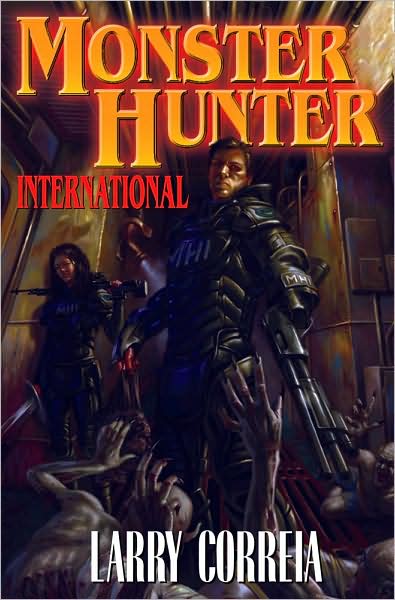
 Owen Zastava Pitt wants nothing more than to be a mild-mannered accountant with a comfortable, boring life. Unfortunately, fate has other plans. His father–a retired green beret–brought him up to be a killing machine, with or without a firearm. To pay for college, Owen worked alternately as a bouncer and a highly illegal cage fighter. But all that’s behind him now; he has a respectable job–one where he isn’t required to kill things for a living.
When his boss turns out to be a werewolf, however, and Owen single-handedly kills him, all of that changes. A guy shows up at the hospital with a business card for a company called “Monster Hunter International,” and promises to help him make a lot of money killing things for a living. It turns out that vampires, wights, werewolves, and evil tentacled monsters are real, and the business of monster hunting is quite lucrative.
At first, Owen is hesitant. But when an old Jewish man starts showing up in his dreams, telling him about an ancient, evil plot to subjugate the world, he realizes that he has little choice in the matter. Fate has given him a calling–or, as the old man likes to say, the “short end of stick.”
If you’re a gun fanatic or a B-movie connoisseur, you’ll love this book. It’s basically Men in Black meets Van Helsing, with enough firearms and weapons to make Rambo look tame. Hundreds of mindless zombie wights? Bring out your automatic 12 gauge shotgun. Giant flying gargoyles the size of semi-trucks? Hope you brought enough RPGs and grenade launchers to go around. Hordes of undead swarming across Alabama? Better arm the 5-kiloton tactical nukes.
The story was quite entertaining, with enough comedic and romantic subplots to keep things interesting. The battle between good and evil was pretty clear cut and unambiguous, with evil being measured by how many tentacles a thing has, but some of the monsters (such as the vampires) were much more complex. When you have to decapitate your buddies after they die, to make sure they don’t come back as something that will kill you, that makes things interesting.
I felt that the second half of the novel lagged a little, especially with the number of false endings. However, the ending itself was quite satisfying, with an interesting twist that caught me a little by surprise. The quality of Correia’s writing was a little weak in places, but the story was more about killing the bad guys than crafting beautiful prose. In any case, I don’t think his intended audience will mind.
Overall, it was an entertaining, surprisingly fast read. It’s not the type of thing I usually read, but I enjoyed it. If you’re looking for deep, meaningful literature that changes the way you view the world, or a clean, wholesome read that’s free of excessive language or violence (Gamila, I’m talking to you), this book probably isn’t for you, but if you’re looking for an entertaining story about undead monsters where the good guys aren’t pussy-footing idiots, you’ll probably enjoy this book. If you own more than one firearm, it’s a must-read.
 In the 21st century, Earth was conquered by an alien collective consciousness known as the Tyr. Now, five hundred years later, humankind has been scattered across the Tyr-occupied worlds as slaves. It is a dark and uncertain existence, under the rule of masters who do not care whether their charges live or die.