WIP Excerpt: The Road to New Jerusalem, Chapter 1

[Author’s Note: This is an AI-assisted rough draft, so it’s still got a lot of issues that are going to be worked out before the final draft. The genre is post-apocalyptic / end-times fiction, and I plan to publish this novel under my pen name J.M. Wight.]

The late spring air was dry and pleasant, the afternoon sun not quite hot enough to justify turning on the precious air conditioning that drew so much power from the house batteries. Jacob Wilcox knelt among the tidy rows of vegetables in their front yard garden, his calloused hands stained with dirt. Nearby, his wife Emily dug through the soil, carefully plucking out the pesky weeds that had sprung up among the tomatoes they’d recently planted. Their two year-old daughter giggled nearby, chasing a butterfly through the overgrown grass on the other side of the sidewalk.

“Look, Mommy!” Lily squealed as she scampered after the delicate creature, which evaded her grasping fingers with ease.

“Careful, sweetheart,” Emily called out, smiling at their daughter’s innocent delight. Her eyes met Jacob’s, and he nodded, wiping his brow with the back of his hand.

“We’ll need to expand the potato patch soon,” he said, his blue eyes scanning the yard critically. “With food shortages getting worse, we can’t afford to waste any space.”

Emily nodded, her braid swinging as she bent to pat soil around a tomato plant. “I was thinking we could tear out those old rose bushes by the fence. They’re not practical anymore.”

A flicker of sadness passed over Jacob’s face. Those roses had been Emily’s pride and joy, before… well, before everything changed. As with most of the people still living on their street, their front yard had been converted almost completely from lawn to garden space. Jacobe had even extended the garden to the neighboring house, which had been unoccupied ever since the elderly couple that used to live there had passed away. Though technically they didn’t own it, Provo city gave them a break on their property taxes to maintain it, and the yard space was useful for feeding their growing family. Besides, it kept their street from looking as ugly as some of the others in the city, where totally abandoned houses stood in broken disrepair, their yards covered in weeds and overgrown saplings.

“It’s hard to believe this used to be such a lively neighborhood,” Emily murmured, following Jacob’s gaze. “Now it feels…empty.”

Jacob nodded, his brow furrowing. “The population crash has taken its toll, that’s for sure. But at least we have this.” He gestured to the garden, the rich soil yielding the fruits of their labor. “With the supply chains collapsing, we’re blessed to have this extra space to grow our own food.”

Emily smiled faintly, wiping a strand of hair from her face. “I’m grateful for that, Jacob. It’s one less thing we have to worry about.” Her expression darkened slightly. “Though I can’t help but wonder what else the future might hold.”

Jacob reached over, giving her hand a gentle squeeze. “Have faith, my love. The Lord is watching over us, even in these uncertain times.” 

Emily nodded, some of the tension leaving her shoulders. “You’re right.” She squeezed his hand back, then returned her attention to the garden, her movements calmer, more assured.

Jacob glanced from Lily to the craggy mountains that towered only a few miles from their house. The mountains were one of the few things that hadn’t changed, though the paint on the Y above Brigham Young University had almost completely worn off. The faint scent of sagebrush carried on the breeze, mingling with the earthy smell of the freshly tilled soil. It wasn’t difficult to imagine what the pioneers must have felt when they’d planted their first crops in the soil not far from here. Jacob couldn’t help but feel his kinship with them as he turned to regard their own small garden.

The jingle of an approaching bicycle bell suddenly caught their attention. They turned to see Brother Hansen, the stake executive secretary, pedaling up the cracked sidewalk. 

“Brother and Sister Wilcox,” he called out, smiling wanly as he stopped his bike in front of their yard. “I hope I’m not interrupting.”

“Not at all,” Jacob replied, setting down his shovel. “What can we do for you?”

Brother Thompson’s eyes darted between them. “President Thornton would like to meet with you both this evening at the Stake Center. Seven o’clock, if that’s convenient.”

Jacob felt Emily stiffen beside him as she drew a sharp breath. He squeezed her hand for support.

“Did he say what it’s regarding?” Jacob asked. There were only a small handful of possibilities.

Brother Hansen shook his head. “No, he didn’t provide me with any details.”

Emily glanced quickly at Jacob, as if gauging his reaction. “Jacob…”

“Can we make it?” he asked her softly.

She bit her lip and nodded. He turned to Brother Hansen again.

“Of course. We’ll be there.”

With a nod and a smile, Brother Hansen remounted his bicycle. “Thank you, Brother and Sister Wilcox. We’ll see you there.” 

They watched in silence as he rode away, hardly daring to speak until he turned the corner and passed out of sight. Jacob turned to his wife, searching her face, which had suddenly gone pale, her green eyes wide with apprehension.

“What did Brother Hansen want, Daddy?” Lily asked in her innocent voice. 

Jacob let go of Emily’s hand and knelt down to give his daughter a reassuring smile.

“Mommy and Daddy have a meeting with President Thornton tonight, after you go to bed. But don’t worry, I’m sure Grandma can babysit you while we’re gone.”

Emily bit her lip. “Do you think President Thornton is going to…” Her voice trailed off, leaving her thought unspoken.

Jacob took a long breath. “I don’t know,” he admitted, the words feeling heavy on his tongue. “But we have that extra house… it makes sense that they might call us to live the Principle.”

The Principle. Yet another thing that they now had in common with the early pioneers. Had it been as difficult a thing for them to live as it was for the saints now? Until President Soares had announced the resumption of the practice, nearly everyone in the church had thought of plural marriage as a historical anomaly—something that the Lord had required only of the early saints, for reasons that were unique to their time and circumstances. But now, it was clear that the true anomaly was the century and a half in which the practice of plural marriage had been suspended.

“It could be about anything,” Jacob said softly, trying to reassure her. But his own heart was racing. A summons from the Stake President was rarely a casual matter these days.

Emily shook her head. “Why else would he want to see us both? We’re not rich, but we’re better off than most. We have the extra house next door…”

“Which we’re using for more garden space,” Jacob interjected. “Emily, please. Whatever happens, we’ll face it together. Our faith will see us through.”

Emily bit her lip, clearly unconvinced. Jacob longed to pull her close, to chase away her fears. But he knew that right now, his certainty would only push her further away.

“Mommy,” Lily asked, her big blue eyes filled with worry. “Why do you look so sad?”

Emily forced a smile and scooped Lily up into her arms. “I’m fine, dear. Just some adult stuff to deal with. How about we go inside and make some lemonade together?”

Lily nodded enthusiastically, her thoughts now consumed by the promise of a sweet treat. Jacob watched them go, his heart heavy. He lingered a moment longer, surveying the fruits of their labor—the garden, the houses, the comfortable life they’d built. How fragile it all now seemed.


Jacob adjusted his tie in the mirror, carefully smoothing out the silk fabric until it lay perfectly against his threadbare white shirt. Behind him, Emily sat on the edge of their bed, quietly brushing out her long chestnut hair. The weight of their impending meeting with the stake president hung between them like a thick fog. Even so, neither of them said anything until a knock at the front door broke the silence.

“That’ll be your mother,” said Emily, rising at once to her feet. “I’ll go check on Lily one more time and be down in a few minutes.”

Jacob nodded, watching her slip out of the room before he made his way downstairs. Sure enough, his mother Eleanor was waiting on the porch, a gentle smile on her face.

“Good evening, Jacob. I hope I’m not making you late.”

“Not at all, Mom,” he said, stepping aside to let her enter. “We’ve already put Lily to bed. Thanks for watching her while we’re gone.”

Eleanor paused, studying his face with her keen blue eyes. “Is everything alright, Jake? You seem troubled.”

Jacob sighed and ran a hand through his hair. “It’s just this meeting with President Thornton. I can’t help but wonder if he’s going to ask Emily and me to… you know…”

“To enter into plural marriage?”

He nodded, his shoulders sagging. “To be honest, I don’t know how Emily would take that. She’s struggled with the Principle ever since President Soares announced it. I’m not sure her testimony is strong enough for something like that.”

“Have you talked with her about it?” Eleanor asked gently.

“Not really,” Jacob admitted, looking down at his shoes. “I don’t want to push her. She’s been through so much already, with her mother leaving the church and all. I don’t know how to bring it up without making things worse.”

Eleanor’s gentle gaze lingered on her son, her brow furrowed in concern. “Oh, Jacob. I know your love for Emily is strong and you only want to protect her. But a good husband must also be able to have difficult conversations. You cannot keep avoiding this forever.”

Jacob let out a heavy sigh, feeling the weight of his mother’s words. How could he explain to Emily that while he didn’t necessarily agree with the concept of plural marriage, he had faith in the church and its leaders? That they were being guided by a higher power, even if it was hard to comprehend at times? His mind was filled with conflicting emotions, but he knew deep down that Eleanor was right. They couldn’t keep brushing this issue aside.

Emily’s soft footsteps on the worn wooden stairs drew Jacob’s attention. He looked up to see her descending, her chestnut braid swaying gently with each step. A smile tugged at his lips, momentarily easing the tension that had built in his chest.

“Hey there,” Jacob said softly, meeting Emily at the bottom of the stairs. He leaned in and placed a gentle kiss on her cheek. “Lily go down okay?”

Emily nodded, her hazel-green eyes meeting his. “She did. She asked for an extra story tonight.”

Eleanor stood from her seat, smoothing her skirt. “Well, I’ll be here if she needs anything. You two go on now, don’t want to keep President Thornton waiting.”

“Of course.” Jacob guided Emily towards the door with a light touch on her lower back. “Thanks again for watching Lily, Ma. We shouldn’t be more than a couple hours.”

“Take all the time you need,” Eleanor said, embracing each of them in turn. “I’ll be here when you get back.”

They walked in silence for a moment, the fading sunlight casting long shadows across their path. The once-vibrant neighborhood had a haunting, abandoned feel, with overgrown yards and darkened windows hinting at the collapse that had transformed their community. Given everything that had happened in the last few years, it truly was a blessing that they lived in a town where it was safe to walk five blocks after dark. Then again, things had never gotten as bad in Utah as they had in most of the rest of the country.

“Could you have ever imagined our town looking like this?” he whispered, struggling to find the right words.

“So much has changed,” Emily said, her voice trembling as she squeezed his hand tighter. “And who knows what else could change, depending on what President Thornton has to say.”

Jacob’s chest tightened, and he squeezed his wife’s hand in a way that he hoped was reassuring. Five years had passed since the church had issued Official Declaration 3, with the unanimous support of the First Presidency and the Quorum of the Twelve. Jacob had been on his mission at the time, and like everyone else in the church, Jacob had struggled with it, but he felt he’d gained a testimony of it—or at least, as much of a testimony as one could gain without actually practicing the Principle. But with Emily, he wasn’t so sure.

“It’ll be alright, Em,” he murmured, his voice low and soothing. “And even if it is, we’ll… we’ll figure it out. The Lord wouldn’t ask anything of us that we can’t handle.”

Emily nodded, her gaze fixed on the familiar path leading to the stake center. “I know, Jacob. I just…” She paused, worrying her lip between her teeth. “What if President Thornton does want us to consider plural marriage? I don’t know if I can do it, Jacob. The thought of sharing you with someone else…”

Jacob squeezed her hand, wishing he knew the right words to comfort her. “Let’s not get ahead of ourselves,” he said gently. “We don’t know for sure what this meeting is about.”

Emily leaned into his touch. “I know the church teaches that plural marriage is a righteous principle,” Emily whispered, her gaze fixed on the pavement. “But I’m not sure I’m strong enough to live it. Does that make me faithless?”

Jacob stopped walking, turning to face her. “Of course not,” he said firmly, cupping her cheek. “Having questions doesn’t mean you lack faith, Emily. It just means you’re human.”

Emily managed a small smile, drawing strength from Jacob’s reassuring touch. “I’ll try to be strong. For you, and for Lily.” She sighed, her shoulders sagging. “I just wish I had your unwavering faith.”

“Your faith is strong, Emily,” Jacob insisted, his tone earnest. “You’ve never wavered in your love for the Lord, even when times have been difficult.” He brushed a stray lock of hair behind her ear. “As long as we have each other, and the Lord on our side, we can handle anything. Right?”

“Right,” she murmured, though he could still hear the uncertainty in her voice.


“Brother and Sister Wilcox,” said Brother Hansen, setting aside the three-ring binder splayed across his lap as he rose to greet them. His smile was warm, but did little to ease the tension Jacob felt as he and Emily stepped into the foyer of the stake center.

“Is President Thornton seeing someone right now?” Jacob asked as he shook Brother Hansen’s hand.

The stake executive secretary laughed. “No, for once we aren’t running behind. I also left the next interview slot open, in case the president wants some extra time with you.”

Jacob could practically hear his wife’s nervous swallow. Uncertainty coiled in the pit of his stomach, but he forced it down. He had to be strong enough for both of them.

Brother Hansen quickly ushered them down the hall to the stake offices behind the chapel. The lights on the other side of the building were off, making the empty hallway beyond feel like a long, dark tunnel. President Thornton was waiting at the last door before the darkness, his smiling face partially shadowed.

“Jacob and Emily,” he welcomed them warmly. “It’s good to see you both. Please, come inside.”

President Thornton was an older man, with gray hair and a navy blue suit and a white shirt, both of them slightly wrinkled. His tie was red and navy blue, with a simple chevron design. His smile was warm and friendly, though his eyes were solemn. Jacob felt his wife stiffen involuntarily as he pulled back the large conference chair for her.

“Thank you for coming on such short notice,” President Thornton said as he took his own seat at the head of the large conference table. “I know this has been a difficult time for many of us, with all the changes our church has recently experienced.”

Jacob took the chair beside his wife and squeezed her hand, acutely aware of Emily’s tension. He cleared his throat. “We’re happy to serve in any way we can, President.”

There was a moment of silence, heavy with anticipation. President Thornton leaned forward, his hands clasped in front of him. He met each of their eyes.

“Brother and Sister Wilcox, I have prayed earnestly about your family and the role the Lord would have you play in the unfolding events of these latter days.”

This is it, Jacob thought, bracing himself. He felt an awful knot form in his stomach.

“In the last general conference,” President Thornton continued, “President Soares announced that the time has come to build up Zion in the land of Missouri.” He paused, his gaze sweeping between the two of them. “Brother and Sister Wilcox, the Lord has called you to go to Missouri and help build the New Jerusalem.”

The words hung in the air for a moment. Jacob blinked, surprise washing over him. He turned to Emily, searching her face for a reaction. Her eyes were wide, a mix of relief and uncertainty evident in her expression.

“You… aren’t calling us to practice plural marriage?” he asked.

President Thornton smiled. “No, Brother and Sister Wilcox. I have not brought you here to call you to practice the Principle at this time. Rather, it is the Lord’s will that you should take your family to the New Jerusalem.” 

Jacob felt the breath leave his lungs in a rush, the knot in his stomach unraveling. They were not being called to practice plural marriage. He was not being asked to take a second wife at this time. But as he glanced at Emily, he saw a different emotion flickering across her face – one tinged with uncertainty and apprehension.

“The New Jerusalem?” Emily’s voice was soft, tinged with a hint of wonder and trepidation. “But…what about our life here? Our home, our family?” She reached for Jacob’s hand, her fingers trembling slightly.

President Thornton nodded sympathetically. “I know this is a lot to take in. The call to build Zion is not one to be taken lightly.” He clasped his hands on the table, his gaze earnest. “But the Lord has spoken, and we must heed His call. The Lord has chosen your family, along with several others from our stake, to join the first wave of settlers. You, Jacob and Emily, are called to help built up Zion there—to be part of the vanguard of saints heeding this prophetic mandate.”

Jacob’s mind was suddenly in turmoil, torn between excitement and the fear of leaving behind everything he knew. Moving to Missouri would mean starting over, leaving behind the comfortable life they had built. Yet it was also a chance to take part in fulfilling the prophecies about building the city of Zion in the last days, a duty that thrilled him to his core. 

“What exactly will this calling entail, President Thornton?” he asked.

“I know it will be difficult to leave your homes behind,” President Thornton said solemnly. “But you won’t be alone in the journey. Your father, Thomas, has been called to lead the caravan, along with both of his wives.”

Jacob blinked in surprise. “He’s already accepted the call?”

“Yes,” said President Thornton, smiling. “I extended it to him just an hour ago.”

“When do we leave?” Emily asked.

President Thornton turned to regard her kindly. “Not until everything has been put in order. The prophet’s counsel on this matter is clear: we are not to go up in haste, or to run faster than we have strength. You will have all the time you need to make the necessary preparations.”

But not to sell their house, Jacob knew. No matter how much time they took, he doubted they’d ever find a buyer. The population collapse had completely destroyed the real estate market, even here in the free state of Utah.

“I know it will be a difficult sacrifice,” President Thornton said, as if reading his thoughts. “But I testify that your family will be blessed as you answer the prophet’s call.”

Jacob nodded and glanced at his wife, squeezing her hand. “We know, President Thornton. We’ll go.”

The stake president smiled. “Thank you, Brother and Sister Wilcox. Do you have any questions?”

Before Jacob could speak, Emily’s soft voice cut through the silence. “I know you haven’t called us to live the Principle at this time, but if… if we’re asked to live that law upon arriving, how are we to…” Her voice trailed off, leaving the question unspoken.

President Thornton nodded kindly. “The prophet Joseph Smith taught us that a religion that does not demand the sacrifice of all things does not have the power to produce faith unto salvation. The Lord’s timing is His own, and I cannot tell you everything that He will require of you. But I promise that He will guide and uphold you as you put your trust in Him.”

The tension in the room eased somewhat, though Jacob could sense that Emily wasn’t totally satisfied with the stake president’s answer. It would not be easy to leave everything behind.

“We will do all that the Lord requires of us,” he said firmly.

“Thank you, my dear brother,” President Thornton answered. “Now, I suggest you go home and start making preparations for your journey.”

He rose to his feet, signaling the end of their interview. 


Jacob leaned against the heavy black door of the stake center, holding it for his wife as they stepped out into the crisp evening air. The last traces of twilight were just visible on the horizon, and hundreds of stars were already visible in the dark, cloudless sky, multiplying by the minute above the sparsely lit city. 

Emily was the first to break the heavy silence as they walked hand in hand down the darkened neighborhood street. “At least we weren’t called to practice plural marriage,” she offered.

“Yeah,” said Jacob, glancing at her sideways. Wasn’t he the one who was supposed to say that? He squeezed her hand reassuringly, but she still felt tense and nervous. What was she worried about?

“So,” he said, “the New Jerusalem.”

“Yes,” she answered, her voice barely louder than a whisper. Her steps were slow and hesitant, and not just from the darkness or the cracked and broken sidewalk.

“Hey,” said Jacob, putting an arm around her as they walked. “Is everything okay?”

But as they walked down the street back toward their house, Emily’s steps were slow and hesitant, suggesting that she was still troubled. Jacob longed to wrap his arms around her and comfort her, to tell her that everything would be alright, but the words caught in his throat like a lump of coal. Despite the peacefulness of the night, a storm brewed within them both, uncertain and fearful of what their new calling would bring.

Emily was the first to speak, breaking the stillness. “Missouri,” she said doubtfully. “The New Jerusalem. It all sounds so extravagant. But what about our lives here? Our home, our friends?” She looked at him with a pleading expression. “How can we just up and leave everything behind?”

Jacob’s heart sank. He had no easy answers, only the unwavering belief that they must follow the prophet’s guidance, even if it felt like an impossible path to follow.

“The Lord will bless us, Emily,” Jacob said, trying to convince himself as much as her. “It won’t be easy, but the Lord will provide for us, just as He has for His people throughout history.”

Emily’s grip on Jacob’s hand tightened, her fingers trembling slightly. “I want to believe that, Jacob. I really do. But…” She trailed off, her gaze fixed on the cracked sidewalk beneath their feet.

Jacob’s stomach churned with a mixture of empathy and frustration. He knew Emily’s faith wasn’t as unwavering as his own, but he desperately wanted her to feel the same peace he did about their calling. He searched for the right words, praying silently for guidance.

“Remember when we first got married?” he asked softly. “How scared we were about starting our life together, especially with the world falling apart around us?”

Emily nodded, a faint smile ghosting across her lips. “How could I forget? We were so young, so naive.”

Jacob pressed on, encouraged by her response. “But we made it through, didn’t we? We built a life together, despite everything. The Lord blessed us then, and He’ll bless us now.”

As he spoke, Jacob’s gaze drifted upward, taking in the vast expanse of stars above them. The night sky seemed to pulse with an otherworldly energy, as if the very heavens were affirming his words. A cool breeze rustled through the nearby trees, carrying with it the faint scent of pine and distant rain.

But when Jacob looked back at Emily, his heart sank. Instead of comfort, he saw a shadow pass over her face, her eyes growing distant and troubled. The smile that had briefly graced her lips had vanished, replaced by a tightness that made his chest ache.

“Emily?” he asked, his voice barely above a whisper. “What’s wrong?”

She shook her head, her hair catching the dim light of a nearby streetlamp. “Never mind, Jacob. I’ll be alright.”

The rest of their journey was filled with heavy silence. As they neared their modest home, Jacob couldn’t help but catch a glimpse of his own reflection in the darkened windows. The man staring back at him looked lost and uncertain – a stark contrast to the confident, strong leader he knew he was supposed to be. He felt grateful for the opportunity to help build the New Jerusalem, to be chosen among those preparing for Christ’s return. But as he thought about the daunting task ahead, doubts and insecurities crept in, making him question if he was truly worthy of such an important role.
WIP Excerpt: The End of Elysium, Chapter 1

I am really excited about this WIP. Ever since I wrote the short story “The End of Elysium,” I thought it would make a good novel—and now, with the help of AI, I’m able to make that a reality while juggling all of my other writing projects!

What follows is the AI-assisted draft of the first chapter of this novel. To get it to this point, I generated multiple iterations of the first chapter, combined the best parts, and used some AI revision tools to smooth over some of the rough edges. The next phase is the rough human draft, where I rewrite the whole thing in my own words (no copy-pasting). After that, I’ll make a thorough revision pass, and if there aren’t any story problems I’ll make a final polishing pass where I cut the word count by at least 10%. At that point, it’s ready to publish.

It might seem like this is a whole lot of extra work compared to writing without AI-assistance. However, I’ve found that using AI to write the “crappy first draft” actually helps out a ton to work out the major story issues that tend to cause writer’s block later in the project, thus saving potentially months of work. In fact, by using AI, I’ve been able to cut down my typical novel writing time from several years to just two or three months, thus making it possible to juggle multiple projects at once—and hopefully, once the production pipeline fills out and all these projects start to come to fruition, publish a novel-length work every other month or so.

But enough about the writing process. Here is the excerpt from the AI-assisted draft of this novel!


Abbey

Abbey woke up with a start, her heart throbbing rapidly and her breath coming in short, quick gasps. In her mind’s eye, she could still see the ancient lost city, with its crystalline spires shining in light of the morning sun. Gehenna, they called it—the last remaining citadel of the old world. Legend held that its streets were paved with gold and lined with technological marvels beyond imagining.

The dream was always the same. Abbey saw herself wandering the fabled metropolis, basking in its wonders: fountains of pure water with towering monuments of bronze, sleek crystalline structures reaching upward to the heavens. Though the city was conspicuously empty, it was largely still intact, as if only a few days had passed since its inhabitants had left—not the centuries of abandonment that had worn the outside world into ruin. Deep in her bones, she knew that the secrets that lay hidden here would usher in a golden age for the survivors of humanity. In her dream, those secrets called out to her, as if yearning to be unearthed. If only she could find them!

She squeezed her eyes tightly shut, trying desperately to hold onto the last fragmentary images of her dream. If only she could reach out and grasp it—make it tangible and real. She lay completely still, afraid that even the slightest movement might cause her to lose the last wisps of her beautiful vision.

“Gehenna,” she whispered, savoring the word.

She lay still for several moments, willing the dream of the lost city to come back into focus. But already the images had faded from her mind, dissipating like morning fog before the harsh, bright light of day.

Abbey sighed and sat up in bed, the threadbare blanket falling away. Pale light filtered through the cracks in the metal walls of her small dwelling. She stretched, working out the kinks from sleeping on the hard pallet, and swung her feet to the floor.

“One day,” she murmured, her mind wandering back to the lost city that had captured her imagination since childhood. “One day I’ll find you.”

Abbey moved through her tiny space, every action honed by years of routine. She splashed water on her face from a chipped basin, tied back her unruly hair, and walked over to the window on bare feet. With a swift motion, she opened the shutters and was greeted by a flood of warm sunlight pouring into the room. The fresh morning air filled her lungs as she leaned out, taking in the sights and sounds of nature awakening around her humble dwelling. In the distance, birds chirped and leaves rustled in the wind.

Filled with renewed determination, Abbey turned from the window and began gathering her gear – a tattered backpack, her trusty climbing axes, a coil of sturdy rope, ration packs, and her canteen. She paused at her workbench, fingers trailing over the map she’d laid out and the assortment of scavenged tech she’d collected. Each time she ventured out, she pushed a little further, mapped a little more of the collapsed highways and crumbling buildings. Patience and persistence would lead her to Gehenna eventually. It had to. Finding the lost city was more than a dream – it was her destiny.

As she tied her boots, Abbey couldn’t shake off the constant criticism from her fellow Valley Folk. They all seemed to have the same message: “Why do you keep chasing this impossible dream? It’s time to settle down and focus on the things that really matter.” But Abbey refused to listen. She knew she was onto something big, something that could change everything.

As Abbey stepped outside, the vibrant colors of the Valley greeted her, a vibrant tapestry of greens and golds. The morning sun bathed the landscape in a warm, golden glow, casting long shadows across the dewy grass. Birds trilled their melodic songs from the treetops, their voices intermingling with the gentle rustling of leaves in the breeze. The familiar sights and sounds of her home never failed to stir something within her – a mix of comfort and restlessness.

Abbey inhaled deeply, letting the fresh air fill her lungs and invigorate her senses. Despite the beauty surrounding her, her mind remained fixated on the legendary city that haunted her dreams. She set off down the well-worn path, her boots crunching against the gravel as she made her way towards the heart of the Valley.

She followed the familiar path that snaked through the village, her heavy boots leaving deep imprints in the damp earth. The sounds of daily life reverberated around her – the clanging and whirring of machinery from the machinist’s workshop, the bleats and snorts of livestock being led to pasture by farmers. Some tended to their gardens, coaxing vibrant vegetables from the rich earth, while others worked on their humble cottages. They greeted her with warm smiles and friendly waves, which she returned, her vibrant energy lifting their spirits.

“Good morning, Abbey!” called out the baker, waving from the doorway of his shop. “Off on another adventure today?”

Abbey grinned, her eyes sparkling with excitement. “You know me, Arlo. I can’t resist the call of the unknown.”

The baker chuckled, shaking his head with a mixture of amusement and admiration. “Well, be careful out there. And don’t forget to stop by for a fresh loaf when you get back. I’m trying out a new recipe today.”

“Wouldn’t miss it for the world,” Abbey promised, already looking forward to the taste of Arlo’s latest creation.

As Abbey continued down the winding path, her eyes caught sight of Old Mara, the village’s wise elder, tending to her beloved herb garden. The sweet aroma of thyme and rosemary filled the air as Mara’s skilled hands danced gracefully among the vibrant green plants.

“Good morning, Mara!” Abbey called out, her voice bright with enthusiasm. “How are your herbs coming along?”

Mara straightened, her kind eyes crinkling at the corners as she smiled. “Ah, young Abbey. They’re thriving, thanks to this blessed weather. Off on another of your expeditions, I see?”

Abbey nodded. “You know me, always looking for something new to discover.”

Mara’s gnarled hands shook as she spoke, her voice thick with concern. “Just be careful out there, child. The Wastes are no place for a young woman like you.”

Abbey couldn’t help but bristle at the insinuation that she was too fragile for the dangers of the outside world. Still, she bit her lip, knowing that Mara only wanted to protect her.

“I know, I’ll be careful. I promise.”

Mara reached out and patted Abbey’s arm, her gaze softening. “We only want what’s best for you, dear. This valley, our people – this is where you belong.”

Abbey forced a smile. “I know, Mara. But there is so much more out there than just our simple way of life.”

As she made her way down the winding path towards Gehenna, Abbey’s mind raced with conflicting thoughts and emotions. She loved her home and its people, but she couldn’t shake the feeling that there was something more waiting for her beyond the familiar fields and forests of their valley.

The sound of laughter drew her attention, and she spotted a group of children playing near the stream. Their carefree joy brought a smile to her face, even as it reminded her of how different she felt from most of the Valley Folk.

“Abbey! Abbey!” One of the younger girls, Lily, came running up to her. “Did you find any treasures yesterday?”

Abbey knelt down, reaching into her pocket. “As a matter of fact, I did.” She pulled out a small, shiny object – a gear from some long-forgotten machine. “What do you think this might be from?”

Lily’s eyes widened with wonder. “A magic spinning wheel? Or maybe a star-catcher?”

Chuckling, Abbey ruffled the girl’s hair. “Could be. The world before the Catastrophe was full of marvels. Who knows what we might discover next?”

She continued on her way, exchanging pleasantries with others who crossed her path. Their well-meaning warnings and gentle admonishments did little to dissuade her. If anything, they only fueled her resolve to uncover the truth behind the legends.

Finally, Abbey arrived at the hangar, a large, repurposed barn that housed the Valley’s few precious vehicles. The massive structure loomed before her, its corrugated metal walls patched with sections of colorful fabric. Solar panels glinted atop the structure, harnessing the sun’s energy to power the fleet of vehicles within. The air hummed with the sound of machinery and the sharp scent of oil and grease.

The hangar doors were already open, revealing the cavernous interior filled with an assortment of vehicles – relics from the world before, lovingly maintained and modified by the village’s skilled mechanics. Sunlight streamed through the high windows, catching motes of dust that danced in the air.

“Finian!” Abbey called out, her voice echoing in the vast space. “Are you in here?”

A clatter of tools and a muffled curse answered her. From beneath one of the larger rovers, a pair of legs clad in oil-stained coveralls emerged, followed by the rest of Finian as he pushed himself out and looked up at her.

“Well, if it isn’t our intrepid explorer! Come to borrow one of my babies again?”

Abbey laughed, her eyes sparkling. “You know me too well, Finian. I’m hoping to push further into the eastern sector today.”

Finian wiped his hands on a rag as he stood, his expression a mixture of admiration and concern. “The eastern sector? That’s mighty ambitious, even for you. You sure you’re up for it?”

Abbey nodded, her expression set. “I have to be. I had another dream about Gehenna last night. It felt so real, Fin.”

He sighed, running a hand through his salt-and-pepper hair. “Well, I can’t stop you. But at least let me give you our sturdiest rover.” He gestured to a rugged vehicle nearby, its frame reinforced with scavenged metal and its oversized tires caked with dried mud. “Old Bessie here has never let anyone down.”

As Abbey began loading her gear into the rover, Finian busied himself with last-minute checks. He topped off the fuel cells, tested the solar backup system, and calibrated the navigation array. While he worked, Abbey loaded her gear into the back and settled into the driver’s seat. The familiar scent of oil and leather filled her nostrils, mixing with the crisp morning air that drifted through the open hangar doors. She took a deep breath, savoring the moment before the journey began.

“Remember,” Finian said, leaning through the window, “if you run into any trouble out there, just hit the emergency beacon. We’ll come running.”

Abbey nodded, her throat tight with a mixture of excitement and apprehension. “I will. Thanks, Finian. For everything.”

As she started the engine, the rover rumbled to life beneath her. The deep, mechanical growl reverberated through her body, setting her nerves alight with anticipation. She eased the vehicle out of the hangar, waving goodbye to Finian.

Abbey guided the rover through the narrow mountain pass, the towering peaks casting long shadows across the rocky terrain. As she emerged on the other side, the stark contrast between the lush valley and the barren wasteland struck her once again. Abbey clenched the steering wheel, her focus fixed on navigating through the treacherous terrain.

She brought the vehicle to a halt at the edge of the desolation. Where the Valley teemed with life, the Wastes were a barren and desolate wasteland. The once verdant land now lay barren, its earth cracked and dry underfoot. The landscape was punctuated by sharp rock formations that seemed to reach for the sky, while eerie silhouettes of giant fungi loomed in the distance like alien monuments. A sickly yellow haze hung in the air, obscuring the horizon and casting an otherworldly glow upon everything in its path. She inhaled deeply, savoring the last breath of clean air before donning her protective mask to brave the toxic atmosphere ahead.

“Gehenna,” Abbey murmured, her eyes scanning the horizon. 

Abbey’s heart ached as she contemplated the magnitude of the destruction. The Catastrophe had ravaged the world, leaving only ruin in its wake. Yet, even amidst the devastation, she couldn’t help but feel a flicker of hope. Could Gehenna be hidden beneath one of those distant rock formations? Or perhaps it was concealed by some ancient technology, invisible to the naked eye?

She closed her eyes, picturing the shining towers and gleaming streets of the legendary city. It was a vision that had haunted her dreams since childhood, a promise of a better life waiting just beyond the veil of the unknown. And though the Wastes seemed to mock her with their unyielding emptiness, Abbey refused to let go of that promise.

With a deep breath, she steered the rover forward, venturing once more into the desolation. “I know you’re out there somewhere,” she said aloud. “And someday, I’ll find you.”

Hopefully, someday soon.

Ranger

Ethan “Ranger” Carter paused before the entrance to Gehenna’s main simulation chamber. All around him, the underground corridors stretched like a labyrinth, their corroded metal walls and deteriorated conduit and pipes dimly illuminated by the flickering overhead lights. The air was tangy with the smell of old copper and rusted metal, with a hint of stale human sweat. The constant hum of machinery filled the space, a monotonous drone that seemed to vibrate through Ranger’s bones.

MONK: Offers total forgiveness. Able to see through deception, especially self-deception. Invites, but never forces.

He glanced down at his calloused and scarred hands, reminders of the endless hours he spent maintaining the failing systems of the vault. How much longer could they survive down here, cut off from the world above? The thought weighed heavily on his mind, especially with Old Man Mercer, Gehenna’s aging Watchman, lying on the brink of death.

“Another day in paradise,” Ranger muttered. With a tired sigh, he entered the dimly lit simulation chamber and prepared to jack into the simulation. The windowless room was illuminated only by the sickly green glow of ancient computer screens, casting an eerie pallor. He walked towards the nearest one, its surface marred with cracks and pits. 

His body sank into the worn leather chair, and he reached for the neural interface cable – a cold metal snake that connected him to the virtual world. As he closed his eyes, he couldn’t help but feel a sense of confinement and unease creeping up on him, despite his years of using the technology.

The world shifted, the transition as jarring as always, and Ranger found himself standing in a lush garden. Gone were the oppressive confines of Gehenna, replaced by a shimmering cityscape that defied the laws of physics. Impossibly tall spires of crystal and light stretched towards an endless azure sky, while lush gardens floated serenely between them. The air was suffused with a gentle, golden light, and the faint sound of birdsong drifted on the breeze. Elysium stretched out before him, a paradise of verdant green and shimmering light.

Yet even in this seemingly perfect virtual Eden, signs of decay were beginning to show. The leaves on the trees flickered and shimmered, their edges blurring into pixelated static as if struggling to hold onto their form. The gentle breeze that once carried a sweet fragrance now also brought a faint undertone of discord, a reminder that this simulation was not eternal. The vibrant colors of the world seemed slightly muted, like a painting fading over time. It was a small crack in the facade, but one that could not be ignored.

Amidst the vibrant and lush garden, stood Jonas Mercer, a towering figure who had been his mentor and guide for countless years. His face, etched with lines of wisdom and experience, seemed to mirror the intricacies of the flowers and foliage surrounding him. Even in this simulated reality, his appearance remained true to that of the real world. The sun’s rays danced across his face, illuminating his piercing gaze.

“Ranger, my boy,” Jonas called, his voice carrying a weariness that seemed out of place in this paradise. “Come, sit with me one last time.”

As Ranger approached, he noticed how the old man’s form flickered intermittently, a stark reminder of his failing physical body in the real world. Even in this virtual world, death was making its presence known.

“Jonas,” he said softly, taking a seat beside his mentor. “How are you feeling?”

Jonas chuckled, the sound distorting slightly as his image wavered. “As well as can be expected, given the circumstances.” His eyes, despite their digital nature, held a profound sadness as he gazed across the simulated cityscape. “Pretty as a picture, isn’t it? Hard to believe it’s all just data and illusions.”

Ranger nodded, his gaze drawn to the shimmering imperfections in Jonas’ form. “It’s a marvel, to be sure. But sometimes I wonder…”

“If it’s all worth it?” Jonas finished, his eyes piercing. “If we’re just delaying the inevitable, hiding away in our little virtual paradise while the world above lies in ruins?”

Ranger shifted uncomfortably, the old man’s words striking a chord deep within him. “I just can’t help feeling like we’re meant for something more, like there’s a greater purpose out there waiting for us.”

Jonas sighed, his image flickering briefly as a wave of pain washed over his physical form. “I’ve been the Watchman for longer than I care to remember, Ranger. I’ve seen the records, heard the stories passed down from those who came before. Our ancestors, they were the lucky ones, if you can call it that. They survived the Catastrophe, made it to Gehenna before the world above turned to ash and dust.”

He paused, his gaze growing distant. “They built this place to be a sanctuary, a haven where humanity could ride out the storm. But they always believed that someday, we’d find our way back to the surface, that we’d discover the Promised Land and start anew.”

Ranger leaned forward, his heart quickening at the mention of that fabled place. “Do you think it’s really out there, Jonas? The Promised Land?”

The old man shrugged, a gesture of weary resignation. “I wish I knew, Ranger. I’ve spent my whole life searching for it, and now I fear my time is drawing to a close. The systems that sustain me are failing, both here and in Gehenna.”

Ranger felt a chill run through him at the words. He had always known that this day would come, but to hear Jonas speak of it so plainly was still a shock.

“What can I do?” he asked, his voice rough with emotion.

Jonas leaned forward, his eyes intent. “You must listen carefully, Ranger. Our people cannot remain here forever. Elysium was never meant to be a permanent solution.” The old man’s image flickered violently, and for a moment, Ranger feared he’d lost him. But Jonas’s voice returned, weaker now. “There’s a world beyond these walls, beyond even the Wastes. A Promised Land.”

Ranger’s chest tightened. “The Promised Land,” he murmured. “But how can we be sure it even exists?”

Jonas’s form stabilized momentarily, his gaze locking onto Ranger’s. “We must have faith, my boy. Faith in the resilience of our world, and in our own ability to reclaim it. The dream of the Promised Land, it’s what keeps us going, what gives us hope in the face of all this darkness. Promise me, Ranger, that you won’t give up on that dream. That you’ll do everything in your power to lead our people to the Promised Land.”

Ranger swallowed hard, the weight of that responsibility settling heavy on his shoulders. He knew, deep in his bones, that he could never turn his back on his people, on the duty that had been entrusted to him. But at the same time, he couldn’t shake the feeling that the path ahead would be a lonely one, that the search for the Promised Land might well be the task of a lifetime.

“I promise, Jonas,” he said, his voice thin but resolute. “I’ll keep searching, keep hoping, for as long as it takes. I will do everything I can to find the Promised Land, no matter the sacrifice.”

The old man smiled, a flicker of pride and relief crossing his face as he reached out to clasp Ranger’s hand in his own. But even as he did so, his image began to waver and distort, the simulation struggling to maintain his fading consciousness. 

“Go now, Ranger,” he said, his voice growing fainter with each word. “Gehenna is in your hands now. You are… the Watchman.” 

His image flickered one last time, then vanished entirely, dissolving into a cascade of shimmering pixels that glittered briefly in the golden light before fading away to nothingness. 

Ranger stood there for a long moment, his gaze fixed on the spot where Jonas had been. The virtual paradise hummed with a gentle, soothing energy, the air filled with the soft chirping of birds and the distant laughter of children at play. It was a world without pain, without suffering, a haven for the last remnants of humanity.

Yet, even as the virtual paradise shimmered around him, a sudden weight settled on his shoulders. He had always been different from the others, had always felt like an outsider among his own people. While they were content to live out their days in the virtual paradise of Elysium, he had always longed for something more, something real. 

He thought of the Promised Land, the mythical place that Jonas and the other elders spoke of with such reverence. A place where the earth was healed, where humanity could start anew without the need for virtual realities and underground bunkers. It was a beautiful dream, but was it even real? It seemed so distant, so unattainable. And now, with the fate of his people resting on his shoulders, he felt more alone than ever.

“System, end simulation,” he commanded, his voice echoing in the emptiness.

The vibrant colors of Elysium began to fade to gray, signaling the end of the session. Ranger closed his eyes, and when he opened them again, he found himself back in the cold, sterile confines of Gehenna. He blinked rapidly, adjusting to the dim, flickering light of the simulation chamber.

Beside him, on the adjacent couch, lay Jonas’s body. Ranger’s heart clenched at the sight. In death, the old man looked small, fragile – nothing like the towering figure of wisdom and strength he’d been in life.

“I’m sorry, old friend,” Ranger murmured, his voice rough with emotion. “I hope you’ve found your own Promised Land.”

With gentle reverence, Ranger reached out, gently closing Jonas’s eyes before he disconnected the neural interface from Jonas’s temples. He slid his arms beneath the frail body, lifting it with care. The weight was surprisingly light, as if Jonas had already begun to fade away.

As he carried Jonas through the winding corridors of Gehenna, Ranger’s mind wandered to the world he had just left behind. Elysium, with its lush landscapes and endless possibilities, was a stark contrast to the grim reality of the bunker. The walls here were cold and lifeless, the air stale and recycled. It was a world of necessity, of survival, far removed from the idyllic paradise of the simulation.

He finally arrived at the incinerator room, the heat hitting him like a physical force. The small, tight space was filled with towering banks of machinery and intricate piping, creating a labyrinth of metal and wires. In the center rose the monstrous incinerator, its massive cylindrical form radiating a dull, ominous red glow that seemed to pulse with anger.

Gently, Ranger laid Jonas’s body on the conveyor belt. He paused for a moment, his hand resting on the old man’s shoulder, his eyes stinging with unshed tears. Jonas had been more than just his mentor; he had been a father figure, a guiding light, and a personal friend.

“Goodbye, old friend,” he whispered, a single tear tracing a path down his cheek. “May you find peace in whatever lies beyond.”

With a heavy heart, Ranger activated the conveyor belt and stepped back, watching as it slowly carried Jonas’s body into the heart of the incinerator. The flames engulfed the corpse, consuming it in a matter of moments. Ranger stood motionless, his eyes fixed on the fire, as if trying to burn the image into his memory. It was a sorrowful sight, a final send-off for his friend and mentor.

As he watched, Ranger couldn’t help but think of Elysium. It was a world without pain, without suffering, a world where anything was possible.

But it was also a world that wasn’t real.

In Elysium, there was no death, no loss, no grief. But here, in the harsh reality of Gehenna, those things were all too common. The concrete walls and metal surfaces seemed to mock him, reminding him of the cold, unforgiving nature of the world he lived in.

Ranger stood there for a long time, watching as the flames danced and flickered, reducing Jonas’s body to ashes. He thought of the promise he had made, of the mission that lay ahead of him.

“I don’t know if I can do this alone,” he confessed to the silent form. “But I’ll try. For you, for all of us. I’ll find the Promised Land.”

Lyra

Lyra Bellamy carefully adjusted her council robes as she entered the grand chamber of the Council, Elysium’s governing body. Ornate marble pillars stretched upward toward a ceiling that opened to a sky of endless blue, with flawless diamond statues depicting the founders in all of their glory. A large stone table sat in the center of the palatial chamber, shaped in a perfect circle. Beverages had been set at each place, according to the personal tastes of each council member (Lyra’s was a chamomile herbal tea). The virtual space shimmered with ethereal light that cast a gentle glow on the faces of those gathered. 

As she took her seat, Lyra’s gaze swept over her fellow Council members. Gideon Gray’s imposing figure dominated one end of the table, his dark eyes shining intelligently amidst his salt-and-pepper beard. Though all on the Council had an equal voice, with none ranked higher than another, his voice had lately come to dominate many of their proceedings. Iris Blackwood, one of his allies and another outspoken voice, took her place on Lyra’s left, her bearing regal and composed. On Lyra’s right, Nina Evergreen had already settled in, her hazel eyes bright with curiosity. 

“Good morning,” said Nina with a friendly nod. Lyra returned her greeting with a smile and took a sip of her chamomile tea. All around the table, the other Council members took their seats, their colorful robes shimmering in the soft, crystalline light.

Gideon Gray, his dark hair immaculately styled and his eyes gleaming with fervor, leaned forward in his seat. “The passing of the old Watchman is a great loss to our community,” he said, his voice dripping with reverence. “But it also presents an opportunity for us to reaffirm our commitment to Elysium.”

Iris nodded in agreement, her steel-gray eyes fixed on Lyra. “I agree,” she said. “The preservation of our way of life must be our top priority. We must ensure that the new Watchman understands the importance of maintaining the stability and harmony of our world.”

Lyra felt a flicker of unease in her chest. She knew that Gideon and Iris were staunch preservationists, believing that Elysium was the pinnacle of human achievement and should be protected at all costs. But she also knew that there were those on the council who still clung to the old ways, who believed that Elysium was meant to be a temporary haven until the Earth healed and they could find the Promised Land.

“I agree that we must support the new Watchman,” Lyra said, her voice soft but firm. “But let us first take a moment to remember Jonas and all he did for our community.”

As the council members bowed their heads in a moment of silence, Lyra’s thoughts drifted. She had always been content with her life in Elysium, with the predictability and comfort it offered. But now, faced with the challenges ahead, she knew that she would need to tread carefully, to find a way to bridge the gap between the opposing viewpoints threatening to tear the council apart.

When they raised their heads, Lyra spoke again, her tone gentle yet firm. “Now, let us discuss how we move forward, always keeping in mind the harmony and well-being of all in Elysium.”

Nina Evergreen, her golden hair cascading down her back, leaned forward with a thoughtful expression. “Perhaps we should consider the possibility that the Promised Land is not a physical place, but a state of being,” she said, her hazel eyes shining with curiosity. “Maybe the true purpose of Elysium is to help us achieve inner peace and harmony, rather than to serve as a temporary shelter.”

Lyra felt a surge of gratitude towards Nina. She had always admired the young woman’s open-mindedness and willingness to consider new ideas. But she also knew that such views were not always welcomed by the more conservative members of the council.

Gideon Gray’s piercing gaze swept across the council chamber, his virtual avatar radiating an aura of unwavering conviction. “Elysium is not just a temporary shelter,” he declared, his voice ringing with conviction. “It is a testament to the ingenuity and resilience of our ancestors, who built this paradise in the face of unimaginable adversity. To abandon it in pursuit of some mythical ‘Promised Land’ would be to dishonor their memory and sacrifice.”

Iris Blackwood nodded in agreement, her steel-gray eyes flashing with resolve. “We have a duty to preserve this world for future generations,” she said, her words measured and precise. “Elysium represents the pinnacle of human achievement, a shining beacon of hope in a world that has been ravaged by catastrophe. Why risk everything for an uncertain future beyond these walls?”

The air in the council chamber seemed to thicken with tension. Lyra’s gaze swept across the faces of those present, noting the mix of agreement and skepticism.

Councilwoman Vera, her brow furrowed, spoke up. “But wasn’t Elysium always meant to be temporary? A sanctuary until the Earth healed?”

“That was before we understood the true potential of what we’ve created here,” Gideon countered, his eyes flashing. “Why risk everything for a world that may no longer exist as we remember it?”

“Our ancestors’ vision was to reclaim our home,” another council member interjected. “To carry on the legacy of humanity in the physical world. Are we to abandon that dream simply because it is difficult or uncertain?”

Gideon’s avatar flickered momentarily, betraying his rising anger. “And what if Earth never heals? Would you have us trade paradise for a wasteland?”

Lyra listened to the debate, her heart torn between the two sides. She could understand the preservationists’ desire to protect what they had created, to maintain the stability and comfort of life in their virtual haven. Yet Jonas had always been a staunch believer in the idea that they were destined for something greater than the confines of Elysium. 

She raised her hand, and the room fell silent, all eyes turning to Lyra. The virtual environment shimmered slightly, a reminder of the artificial nature of their world.

“My friends,” she began, her voice soft but steady, “I know that this is a difficult decision, one that will shape the future of our people for generations to come. But let us remember that we are all part of the same community, united in our desire to do what is best for our people.” She met the eyes of each council member in turn, her gaze warm but firm.

Gideon leaned forward, his brow furrowed. “Lyra, surely you can see that Elysium is our home, our sanctuary. To abandon it would be to turn our backs on everything our ancestors built.”

Iris nodded in agreement, her silver hair glinting in the soft light of the council chamber. “We have a responsibility to preserve what we have created, to ensure that future generations can continue to thrive in this paradise.”

“Perhaps,” Lyra ventured, “there’s a way to honor both our past and our future. To preserve Elysium while still exploring the possibility of a world beyond.”

Gideon nodded approvingly. “A wise suggestion, Councilwoman Bellamy. We should not rush into decisions that could jeopardize everything we’ve built.”

Lyra offered a small smile, even as her thoughts continued to churn. “Thank you, Gideon. I believe we all need time to reflect on what’s been said here today.”

The council members murmured among themselves, the tension in the room dissipating. Lyra exhaled slowly, relieved to have steered the discussion away from conflict. Yet as the meeting adjourned, she couldn’t shake the feeling that they were standing at a crossroads, unsure of which path to take.

Operation SB #4: The Curse of the Lifewalker

Title: The Curse of the Lifewalker
Genre: Post-Apocalyptic
Word Count: 4,340
Time: 1 day (sort of)

So after “L’enfer, c’est la solitude,” I was kind of in a short story mood for a couple of days and decided to bang out another one. This one is actually an adaptation from my novel Lifewalker, a post-apocalyptic tale where a global pandemic kills everyone older than 25. The story takes place several hundred years after the apocalypse, where a society of children and teenage adults has evolved to fill the void left over by the collapse. It’s told from the point of view of a “lifewalker,” someone who is naturally immune and lives out a normal lifespan. Normal to us, at least–not to anyone else in the new society.

It actually wasn’t that hard to adapt the first chapter to a short story. It very much has its own narrative structure, with a beginning, middle and end. Obviously, it finishes on a rather open-ended note, but I think I was able to turn it around and focus on the premise: “when all the world is afflicted by the plague, sometimes the greater curse is to be whole.” Touched up the first couple of pages quite a bit, setting the stage for a short story and not a full novel, then went over the rest of it with a light pass and wrote a summation paragraph at the end to wrap things up.

Obviously, it took me more than one day to write the bulk of the chapter–in fact, I think it’s been through a couple of drafts now. But the adaptation to short story form went fairly well, and I’m quite pleased with the result.

Since I’ve already got stories at the top three markets (Writers of the Future, Asimov’s, Analog) and Clarkesworld is on cool-down, I sent the story to the next magazine on the list, Fantasy & Science Fiction. They only take snail mail, though, so I had to print out the story, print out a cover letter, take it to the post office, buy a letter envelope, stamp, manila envelope, fill out the SASE, etc etc. It was like a blast from the 00s or something.

Anyway, as I was walking over to the post office, I had this AWESOME epiphany in which the end of the novel came to me. It’s SO MUCH BETTER than what I’d originally had in mind, and actually got me excited to work on Lifewalker again. I probably won’t pick it up until I’ve finished the first three Sons of the Starfarers books, but now I have an awesome, amazing ending to work toward.

All I have to do is write it. 😛

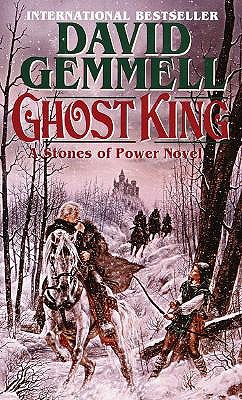
Ghost King by David Gemmell

Ghost KingAnother review of a David Gemmell book?  Yes, because I’m just that much of a fanboy.

With the Drenai series finished, I decided to sink my teeth into the Stones of Power series.  This series confuses me, because I’ve read The Jerusalem Man, which was retroactively put in as book three, but that’s a post-apocalyptic tale of the gunslinger Jon Shannow, but the series actually starts in Arthurian England.  As soon as I got a couple chapters into the first book, though, I began to see the connection.

Ghost King is an alternate history tale of King Arthur (Uther, in the book), and how he rises to become the Blood King of Britannia.  His grandfather, Culain, takes him into the mountains after the Brigantes assassinate his father, and there trains him to become a leader and a warrior.

Culain, of course, is one of the immortal Atlantians, just like his friend Maedhlyn (Merlin).  After the fall of Atlantis, they have wandered the Earth as gods, using the powers of the Sipstrassi stones to accomplish wonders.  Worshipped in turn by the Greeks, the Romans, the Hittites, and the Babylonians, Culain has tired of immortality and now wants to live out a mortal life.  But his jilted lover, the Ghost Queen, wants revenge on him for leaving her.  She was the one who killed Uther’s grandmother and mother, and who now wants to kill him and rule all of Brittania.  But her son Gilgamesh has corrupted her, so that in a parallel universe she must kill twenty pregnant woman every month just to replenish the magic of her Sipstrassi …

Okay, I might as well give up trying to explain the plot, because it only gets crazier.  Somewhere in this parallel dimension, a lost Roman legion has been wandering for hundreds of years, consigned to the void by Culain.  Also, Gain Avur (Guenevere) is in there too, as well as the Lance Lord (Lancelot), though he doesn’t come in until the epilogue.  There are also demons and vampyres, all sorts of battles, and lots of other crazy stuff.  It’s pretty freaking dang awesome.

I really enjoyed Uther’s transformation from the weak, bookish boy to the warrior king, as well as the budding of his relationship with Gain Avur (what can I say, I’m a sucker for romance).  My favorite character, though, was Prasamaccus, a crippled Brigante peasant who becomes one of Uther’s close advisors.  He’s basically a regular guy who gets sucked up into the whole adventure, but he’s level-headed and practical enough that he manages pretty well.  He’s also just a good person, which was quite refreshing in a world full of death and drama.

At one point, after rescuing Uther, he’s a guest in Uther’s chief general’s villa.  The general gives him a servant girl for the night, since in this world most men think nothing of bedding a slave.  Prasamaccus is a peasant, though, and he’s kind of shy.  The girl was actually captured in a raid in Germany, where she was raped, and this is her first time bedding someone since those traumati not the monster she’s afraid that he’ll be–they actually share a really tender moment of intimacy that heals much of her trauma and introduces him to the love of his life.c events.  She’s absolutely terrified, but so is Prasamaccus–he’s a cripple, and assumes that women just don’t want him.  He spends the night with the girl but doesn’t force her to sleep with him, and when she realizes how gentle he is–that she holds the power, and that he’s not the monster she’s afraid that he’ll be–they actually share a really tender moment of intimacy that heals much of her trauma and introduces him to the love of his life.

It’s poignant, story-rich moments like that that make me such a David Gemmell fanboy.  Usually they happen in the midst of war, between battle-hardened friends who are forced by circumstance to do something heroic, but they also happen in the quiet moments between characters who carry other scars.  That whole thing in the previous paragraph only happened in three pages or so, but it was still so incredibly powerful and moving.  Every moment of a David Gemmell book is like that, sometimes from the very first paragraph.  It’s awesome.

As far as David Gemmell books go, I’d put this one in about the middle of the pack.  It’s not quite as powerful as Legend or Wolf in Shadow, but it doesn’t meander as much as White Wolf or have such an anti-climactic ending as Ironhand’s Daughter (which was probably split by the publisher–more on that when I review The Hawk Eternal).  The characters aren’t quite as memorable as Druss, Skilgannon, or Waylander, but they are pretty awesome nonetheless.  I’d rate this book a 3 compared to Gemmell’s other books, but a 4.5 out of fantasy overall.  Definitely worth a read.

Cooking adventures and an awesome webcomic

So I have a bunch of ideas for blog posts I’d like to write, and I’ll probably get around to them eventually, but I thought I’d drop a line now just to let you all know what I’ve been up to.  It’s been a pretty good week, with some decent progress on the current WIP (Lifewalker) and some other random stuff that may be of some interest.

First, Lifewalker.  It’s coming along quite well.  I’m averaging around 2k words a day, so more of a leisurely pace than a white-hot creative heat, but not too bad.  It’s kind of turned into a post-apocalyptic Western, mostly because I can’t write about southern Utah without the landscape taking over.  This video should give you an idea why:

At the same time, the character’s voice really seems to be taking shape in a way that I like.  He’s kind of drifting right now, but the way he writes about it is very much like an old man reminiscing on the course of his life, lingering on the regrets as well as the triumphs, with some rather wistful commentary on each.  This is really a character that I can just pick up and run with–the story is practically writing itself.

It’s not just the voice, either.  Random stuff is just finding it in–powerful stuff that makes the story awesome.  For example, just in the last chapter, the characters were holding a meeting to see what they should do to rescue some of their friends who had been kidnapped.  Out of nowhere, one of them pulls out a skull from a human baby, with beads and feathers dangling from it like some sort of totem.  He brought it out to show that the people who’d attacked them were not just normal bandits, but cannibals from the Nevadan wastelands, which put them in a whole new category of badassery.  Stuff like that comes out of nowhere every time I write, and it’s awesome.

I’ve had a lot of time to write, though I don’t feel I’ve been using it all productively.  Still, I’m on track to finish this thing by the end of the month, which will be extremely gratifying.

In the meantime, I’ve been experimenting a lot with cooking and gardening.  Just planted some tomatoes in 3-gallon ice cream buckets (with dirt instead of ice cream, of course), and those are growing nicely.  It’s fun to have something to water in the morning, and when they start to yield fruit, I’m sure it will be awesome as well.

But I’ve also been experimenting with the old Egyptian kushari recipe I picked up after the 2008 study abroad.  It always seemed to be missing that one thing that would make the other ingredients come together and achieve that delicious synergy.  Well, I think I’ve found it: chickpeas and cumin, with maybe a touch of vinegar.  It might not be 100% authentic, but when I cooked it this time with that stuff, it tasted heavenly.

So this weekend, I’m going to try to perfect the recipe, something I’ve been wanting to do for years.  I’ll try cooking the rice in chicken broth, and adding more onions and garlic with maybe a little tomato.  Also, coriander–I know that coriander and cilantro are basically the same plant, but I think the coriander will go with this better than cilantro.  Also, it helps to fry it with a little oil after taking it out of the refrigerator, rather than sticking it in the microwave.  I haven’t had a microwave for over a year, and I think I actually prefer cooking without it.

Speaking of food, my roommate’s sister’s roommates dropped off a bag full of crap from their kitchen, since they’re moving out for the summer.  We’ve been having an interesting time combing through it–found some pretty good stuff, actually.  One of the more useful things is a bag full of buckwheat, which is AWESOME because kasha was one of my favorite dishes in Georgia.  Kasha and lobio–delicious!

So yeah, I’ve had food on my mind a lot this week.  If things work out, maybe I’ll post a recipe or two.  Kushari is delicious, cheap, filling, and healthy–a winning combination if ever there was one.  Kasha is pretty simple, but that’s what makes it so great–a simple, hearty food that leaves you feeling warm and whole.

Besides cooking exotic foods, I’ve also been reading a lot of Freefall.  I discovered it just last week, and I have to say, it is awesome.  One of the better webcomics I think I’ve ever read.  Like Schlock Mercenary, it’s a space opera comedy romp, but where Schlock kind of turned dark in recent years (which I’m not complaining about, don’t get me wrong), Freefall has still stuck to its happy-go-lucky roots.  And just like Schlock Mercenary, the humor is not only entertaining, but often wonderfully insightful.

Florence_AmbroseBut by far, the best part of the story is how compelling the characters are.  My favorite is Florence Ambrose, an artificially bred Bowman’s Wolf who is kind of a human-wolf hybrid.  She’s one of only 14 members of her species, and the corporation that created her considers her more as property than an individual. She’s got all these biologically programmed safeguards that force her to obey direct human orders, no matter how ludicrous–but the only way for her species to survive is to convince the corporation that Bowman Wolves are profitable, so that they’ll make more (the whole 50-500 rule and all that).

Somehow, she becomes the engineer of the Savage Chicken, a down-and-out starship captained by the infamous Sam Starfall.  Sam is basically a lazy, larcenous alien squid who wants nothing more than to steal everyone’s wallet and become famous doing it.  At first, it seems like a horrible combination–Florence is basically a good, honest person, who wants to do good work and please everyone.  But as the story goes on, the two develop quite a rapport, and start to rub off on each other.

Florence helps Sam to clean up and get his act together, and Sam helps Florence to learn ways to get around her difficult situation vis-a-vis her safeguards and lack of free will.  More importantly, Sam helps her to stop feeling guilty long enough to recognize that doing the right thing sometimes means breaking (or at least twisting) the law.

As if that weren’t enough, there’s the whole cross-species romance angle between Florence and the biologist who rescues her back in one of the earlier subplots.  As you might expect, it gets really lonely being the only Bowman’s Wolf on the planet–especially when the other 13 are frozen in cryo, on their way to a world several light-years away.  Florence knows that she needs to do what she can to propagate the species, but she’s also got some emotional needs that demand to be satisfied now.  Winston is kind of similar, a lonely parasitic biologist on a frontier terraforming project with only 40,000 humans and a 40-60 male-female ratio.  Except for the whole cross-species issue, they make a really good couple.  I’m riveted to find out what happens next!

So yeah, if I had to sum it up: good, honest, likeable person + insecure future + social limbo + unsatisfied emotional needs = really compelling story.  Plus, she’s half wolf–how cool is that?  What I would give for her incredible sense of smell…

In any case, it’s getting late, and even though tomorrow is Saturday, there’s a bunch of stuff I want to do tomorrow so I’d better cut this short for now.  See you later!

Trope Tuesday: After the End

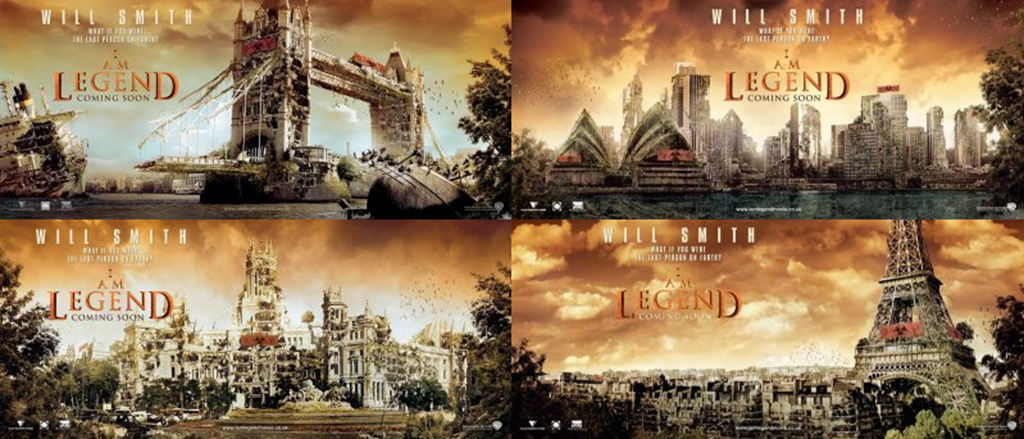
i am legend2It’s the end of the world as we know it … so why do we feel fine?

On the apocalyptic scale of world destruction, when the thing that wipes out civilization doesn’t quite kill everyone, we’re left with an After the End type setting.  Depending on where the writers fall on the sliding scale of idealism vs. cynicism, this may range from a futuristic Arcadia to a crapsack post- hell on Earth.

Whatever the case, expect to see lots of modern ruins and schizo tech mashups (horse-driven cars?  Wood-wheeled bicycles?).  If anarchism reigns, expect to see lots of punks roaming the wastelands in muscle cars and motorcycles.  If Ragnarok Proofing is in effect and the ruins of civilization haven’t quite decayed yet, expect some variation of a scavenger world.  And if someone from our modern era finds himself lost in this bizarre post-apocalyptic future, expect him to find some sort of constant to reinforce that he’s not in Kansas anymore.

Unlike dystopian settings, where society evolves (or is deliberately turned) into a horrible, hellish place, a post-apocalyptic setting represents a reboot of civilization itself, where one society has passed away and a new one is slowly picking itself up from the ashes.  It has the potential to be a lot more hopeful, and to give the reader a lot more wish fulfillment.  After all, who wouldn’t want to be one of the lucky survivors tasked with rebuilding civilization?  Sure there may be zombies or nuclear nasties wandering about, but on the plus side, you don’t have to worry about your bills or your deadbeat job anymore.

Douglas Rushkoff has some interesting ideas about why this type of story is becoming more and more popular nowadays.  In his new book Present Shock which he’s been promoting recently, he argues that many of us are so overwhelmed by a world where everything happens now that we wish we could end it all and start over.  When we live in an ever-changing present without a coherent narrative to reference our past or our future, we long for something to restore that sense that we’re part of a larger story, even if that story is racing towards a horrible, tragic end.

But every ending is a new beginning, and that’s what lies at the very core of this trope.  When our world passes away, what will the new world look like that takes its place?  Will we learn from our mistakes, or are we doomed to repeat our worst atrocities?  Will we eat each other like dogs, or will we tap into some deeper part of human nature where mercy and compassion lie?

This is all on my mind right now, because I’m writing a post-apocalyptic novel (with the working title Lifewalker) that takes place in Utah 200 years after the end.  Humanity was hit by a plague that kills everyone over the age of 25, so that the only people left are orphans, teenage adults, and their babies.  It’s fascinating to wonder what from our era would fall apart and what would remain, or what would be preserved and how the new society will take shape.

But it’s not the apocalypse itself that I’m interested in, so much as what happens after things stabilize.  The main character is one of the few people who’s immune to the plague, so naturally he feels like a complete outcast.  He’s walking the Earth, riding down the ruins of I-15 with a copy of Brandon Sanderson’s Mistborn in his saddlebag.  And the people he meets … well, let’s just say I wasn’t very kind to Las Vegas.

I think that’s another part of the appeal of this trope: it takes our own world and twists it into something fantastic, so that instead of having to wrap our minds around a whole new set of history and physics, we can build on the familiar in wild and interesting ways.  A Canticle for Leibowitz did this very well, with another post-apocalyptic tale set in Utah.  However, the most famous popular example is probably the movie I Am Legend.  I love those long panoramic shots with Will Smith hunting deer in Times Square, or hitting golf balls off the wing of a fighter jet.  Stuff like that really sparks the imagination because it combines something familiar with something wild and different.

Believe it or not, this trope has actually happened in real life.  After the bubonic plague swept across Europe, whole cities were depopulated, with as much as 60% casualties in some places.  When the Pilgrims settled at Plymouth, they were actually building over the ruins of a large Indian settlement that had been wiped out by smallpox just a few years before.  And using DNA evidence, scientists now believe that all of modern humanity is descended from a small group of just 50 females who survived a global volcanic eruption some 70,000 years ago.

So yeah, this is definitely a trope I like playing with.  I’m on track to finish Lifewalker by the end of May, so you can definitely expect to hear more about it in the weeks and months to come.

Also, for those of you looking for resources to help you visualize what the world will look like after the end of human civilization, here are a couple of excellent resources I’ve found.  First, check out The World Without Us, an excellent book written by an environmentalist that poses a basic thought experiment: what would happen if all humans everywhere magically vanished, and all that was left was the stuff that we’ve built?  What, if anything, would remain? (spoilers: not much) If you want to explore that idea but you don’t want to read the whole book, check out this wiki on Life After People, a series of History Channel documentaries that basically posed the same question.  The answers may surprise you.

Post A to Z update

So, the A to Z challenge is over, and it’s back to things as usual.  I hope you guys enjoyed it–I’ll probably compile the posts at some point, update them to add some more examples and references, and put it out as a $2.99 ebook.  When I get around to it, that is.  If that’s something that interests any of you, let me know and I’ll get it up sooner.

As far as writing goes, I just went back to work on Lifewalker yesterday, and the story is coming along swimmingly.  This is the post-apocalyptic story about a guy wandering down the ruins of I-15 with a copy of Brandon Sanderson’s Mistborn.  I checked with Peter and Brandon about that, and they said it’s okay.  In fact, they think it’s hilarious.  And it is, I suppose, though the book takes itself fairly seriously.

Just to give you an idea what I’m talking about, here’s an excerpt:

The first night, I stayed in a small village known as Sannakin. The people there were surprisingly friendly, though they assured me that they would have been more cautious if I had come from the south.

“What’s south of here?” I asked the village patriarch over dinner.

He shrugged. “Don’t know—never been that way. Get a lot of tinkers, though, and a merchant ever now and again. There’s people out there, that’s for sure—but it’s a wild and a dangerous country.”

I paid them for their hospitality by reading from Mistborn: The Final Empire. The story confused many of them, especially those who had never seen the ruins of a city. I explained to them that the forefathers used to live in great communes of thousands, or even tens of thousands of people. This sparked a vigorous discussion over how such a large community could possibly provide enough food for itself, and how it would handle the waste. Some people asked me if in the days before the Blight, ash covered the sky as it did in my book. I answered that it probably had, though doubtless the author had exaggerated it somewhat for the purposes of the story. This led to an even more vigorous discussion about the merits of fantasy stories in general, with most of the villagers forming a decidedly negative opinion of the genre. I strongly disagreed, of course, but held my tongue so as not to offend my hosts.

Today, I wrote a passage where the main character had to mediate an argument between two scholars over who was the primary god in the forefather’s pantheon: Batman or Superman.  In a few chapters, he’ll rescue a girl from a band of bloodthirsty cannibal slavers infesting in the ruins of Las Vegas.

As you can tell, this book is a lot of fun. 🙂

As for the publishing side of things, I’m working with an illustrator to get the cover ready for the first Star Wanderers omnibus.  It’s going to be for Parts I through IV, but don’t worry–if you’ve already bought the parts individually, there won’t be any new content except the author’s note.  I’ll either publish that here or send my newspaper subscribers a link for where they can read it.

I’m not sure if anyone really reads the author’s notes at the ends of my books, but I enjoy telling the story behind the story, so I’ll keep doing them.  Besides, I figure some of you have read them, since you’re signing up for my email newsletter and sending me an occasional fan emails.  I really enjoy those, by the way, so thanks for sending them!

That’s just about it for things over here.  In unrelated news, I recently discovered an excellent sci-fi webcomic.  It’s called Freefall, and the archives stretch waaaaay back to 1998 (!!!).  So yeah, I’m going to be busy for a while.

But don’t worry, I’ll still find make time for writing.  I’m doing about 2k words per day right now, so at that rate, the first draft of Lifewalker should be finished before the end of May.

Aaand my roommate wants to sleep, so I’d better get off the computer now.  Later!

Productivity? Yeah, about that…

So, for the past week, I’ve kind of been between projects.  I finished the revisions for Stars of Blood and Glory last Saturday, after a week or two of light revisions, but since then it’s been a bit of a struggle. I’m still working on Star Wanderers: Benefactor, and progress on Lifewalker had been coming along, but haven’t managed to really immerse myself in either those stories yet.  As a result, I don’t really have much to show for this past week, other than a scene or two in Benefactor and a new first chapter for Lifewalker.

One of the problems, I think, is that I haven’t really been able to turn off my internal editor.  Even with my blog posts, I’m constantly going back and rewriting the previous sentence.  This sucks, because it slows down the writing, makes the process tedious and painful, and doesn’t necessarily improve the quality of my writing either (at least, not beyond a certain degree).

What I really need to do is run with a project until I hit my stride, and then do all I can just to keep a steady pace.  So that’s what I’m going to do with Lifewalker this next week: force myself to write without really caring too much about whether the stuff on the page is pretty good.  Because usually, when I don’t angst about it too much, it actually turns out pretty well.  Sure, I might write myself into a hole I can’t get out of (at least, not without breaking the story), but if that’s the case I can always toss out a couple of chapters and redo things.

So far, Lifewalker has surprised me quite a bit.  I have a general direction I want the story to go, and a vague idea of where the main character is going to go up, but when it comes to a particular scene, things will pop up out of nowhere that takes the story in all sorts of interesting directions.

For example, my main character is currently wandering a post-apocalyptic Utah with just a handful of possessions.  One of them is a copy of Brandon Sanderson’s Mistborn: The Final Empire.  At one point, he spends a night among the people living in the ruins of Santaquin (“Sannakin”).  Out of nowhere, I decided to have him read them a chapter or two from the novel, which of course confuses the heck out of them.  So then they start asking him questions, like whether the world before the apocalypse was covered in ash like in the novel, which leads them to all sorts of wild and ridiculous speculations.  The aside only lasts a couple of paragraphs, but it takes things in a whole direction that I hadn’t planned it to–one that really fleshes out the world.

This is my first time writing post-apocalyptic fiction, and while it seems a bit daunting, when I actually sit down and focus on putting out new words, wild and interesting things happen.  The research is a bit daunting, but the story takes place two hundred years after the apocalypse event, so there’s actually a fair amount of leeway.  As long as I’ve got Google Earth running in the background, with ready access to Wikipedia when I need it, I should be all right.

As for Benefactor, don’t worry, that one’s coming along as well.  When I’ve had too much of the post-apocalyptic world, it’s actually quite refreshing to come back to the familiar universe of the Star Wanderers series.  Bouncing between the two stories should be a good way to avoid burnout–though at my current pace, that’s the least of my worries.

Next week is going to be fairly eventful.  I’ve got a job on Monday that will take up most of the day, and LTUE will keep me occupied all Thursday, Friday, and Saturday.  Still, I should be able to get in at least a chapter or two in both stories.  We’ll see how it goes.

That’s about all for now.  It’s getting late, so I’d better turn in.  Night!

Slow, but still making progress

Sorry for neglecting the blog this week.  I took a temp job to earn some cash, and that’s been sucking up most of my time lately.  Fortunately, it should be over sometime next week.

In the meantime, I found a place to live for the next few months.  I’m in the basement of an old house, rooming with a former classmate from Brandon Sanderson’s English 318 class.  So far, it’s actually been pretty awesome.  The rent is dirt cheap and you get what you pay for, but there aren’t any rats and the heater works fine.  It should be a good place to spend the winter.

Progress on Stars of Blood and Glory has slowed down somewhat, mostly due to the temp work, but it’s still coming along steadily.  If all goes well, I’ll have it polished and sent out to my editor by the end of next week, which leaves only the cover art to figure out.  I’m going all out for this one, just like I did with Desert Stars and Bringing Stella Home.

Also, I just (re)started Lifewalker, a post-apocalyptic novel previously titled The Chronicles of Lifewalker.  I know, I should be putting more time into getting Stars of Blood and Glory ready for publication, but this project has been begging to be written since 2011.  I wrote a first chapter two years ago, but the narrative voice wasn’t working too well.  Basically, I was trying too hard to imitate 19th century prose without having read enough to know how to do it well.  Instead, I decided to toss all that stuff out and write the dang story without being overly restrictive.  I think it’s going to turn out well.

Blah blah blah oh did I mention that I checked out a couple of David Gemmell books from the Provo Library?  Well, I did.  They are the last two books in the Drenai series that I haven’t read, and I am soooo excited to sink my teeth into them.  Just started The First Chronicles of Druss the Legend last night, and it is AMAZING.  Expect to see a review here soon.

Speaking of which, I should probably reread Wool and review it sometime.  Hugh Howey really took the publishing world by storm last year, and he’s doing some truly amazing things for indie writers.  His books are great, too–definitely worth picking one up.

That’s just about all right now.  I’ll probably put in another hour of writing/revising, then turn in for the night.  Later!

Yesterday’s Gone: Episode One by Sean Platt & David Wright

Imagine you wake up tomorrow, and find out that everyone around you has vanished.  Well…not everyone.  But the ones who are still around claim to see strange things that you can’t see.  And then, you get an eerie feeling of a presence…something dangerous, something coming at you right now.  And then, things get really weird…

Yesterday’s Gone is a post-apocalyptic serial thriller: basically,  a novel divided into six parts or “episodes,” the first of which is free.  Since I’m interested in doing something similar with my next project, I decided to check it out.

From the very start, I was hooked.  The conflict was intriguing, the pace was fast and gripping, and the characters were interesting, with reactions that were spot on.  I wasn’t intending to finish the whole thing in one sitting, but once I’d started, there was no way I could put it down.

A couple of things jolted me out of the story, though.  The first was the sheer immensity of the cast of characters.  Literally, the first half of the episode was just introducing new ones, and none of them got more than two viewpoint scenes in the whole ebook.  I was on board for the first three or four of them, but around number six or seven, I just wanted to skip them and get back to the first guy.

Two of the later characters were just painful to read–not only did I not care about them, I vehemently hated who they were and wanted them to die or get out of the way so I didn’t have to read their viewpoints anymore.  The first was an eight year-old boy who had some mystical connection with animals…I just couldn’t sympathize with him at all.  The other one was a serial rapist and/or murderer who saw the apocalypse as just an opportunity to run around raping and killing the other survivors.  I skipped his scenes, but then had to go back because there were some clues hidden there and I didn’t want to miss them…ugh.

The other thing that really bothered me was the very last scene in the episode, where the authors made the mistake of showing the monster.  I won’t spoil it for you, but the image on the page clashed so strongly with the image in my mind, it deflated almost all the tension for me.  What was supposed to be a cliffhanger instead turned out to be a big “huh?”

Your mileage may vary, however, so if you’re into post-apocalyptic fiction, I think it’s definitely worth checking out.  Just like the happy pills in the empty lot behind the school, the first one is free: you can pick it up on Amazon or Smashwords.  And in spite of its problems, there was a lot in this story that I really liked.  Maybe you’ll enjoy it more than I did.

In terms of the serial format, I think it worked very well, except for those two problems: too many characters to keep track of, and an ending that booted me out of the story.  Otherwise, I think it’s a great way to publish, and I’ll probably experiment with something similar in the future.