Story Notebook #6

Alright, it’s time to go through another story notebook.  This one covers the spring and summer of 2010, right after I graduated.  It was a weird transitional period in my life, when I didn’t really know what I was doing or where I was going, but I was determined to keep on writing anyway.

I filled three pocket notebooks with story ideas in 2010, and last time I mistakenly thought I’d covered one that went from graduation through the end of the year.  While putting my records in order before going abroad, I found that this one actually came a little earlier.

Lots and lots of story ideas…2010 was definitely a good year for that.  So anyhow, here we go:

A planet settled by people with aircars: there will be no asphalt roads, only packed earth.

An interesting consequence of futuristic technology; too often, stories come up with something flashy without really thinking through all of the implications.  Can you imagine a world without asphalt?  If you can, then please take me there!

A task-oriented woman who thinks men are fickle because they’re always trying to come across as macho, trying to save face, etc.

This makes me think of something I heard somewhere about gender roles and politicians.  If I remember it correctly, most men go into politics for the fame, power, and glory, while most women go into politics because something in their community is broken and they feel it’s their duty to fix it.  Not sure if that’s true or not, but this story idea made me think of that for some reason.

Humanity has been domesticated by a super-intelligent alien race and bred into several different breeds with wildly varying physical characteristics.

In other words, a post-human universe where humans have been bred as pets, like dogs.  Can you imagine a world where the physical differences between humans of different races are as great as this:

Can these two even physically reproduce?

A fantasy where the traveling hero is actually the bad guy.

I think Girl Genius already beat me to that, though Othar is more of an annoyance than a genuine villain.

An interstellar Sir Richard Burton.

Now that would be an interesting series.  Sir Richard Burton was a British adventurer who went to the Middle East before doing that was cool.  He made the first English translation of the 1001 Arabian Nights (as well as the Kama Sutra, apparently), and was one of the first European explorer to sneak into Mecca–certainly the first non-Muslim explorer.  I hear he was quite a character.

A planet on a highly eccentric orbit where habitability is sustained by large glowstones that absorb high amounts of energy and emit heat slowly.

Ooh, I’d forgotten about this one.  I’ll have to use it sometime–maybe in a science fiction / fantasy mashup.  You know, with dragons and stuff.

A werewolf who is tame around just one person.

I’m pretty sure this one has been done, and I’m also pretty sure I’m not interested in reading it.  Sorry, Twilight fans–or maybe you’re welcome?

A landscape more vertical than horizontal, where the architecture reflects this (like the old Knight building).

The Knight building was a multi-split-level administration building at BYU where Leading Edge used to meet.  Lots of stairs, entrances on just about every level–it was a weird building (but not quite as weird as the JKB).  But yeah, a vertical landscape would be cool–though I guess that’s pretty common in cyberpunk, with all those cities.

An alien species that communicates only by touch.

“What the–augh!  Get it off of me!” Thus begins humanity’s first interstellar war.

Purgatory for fictional characters, where all the plot hole stories go.

I’m pretty sure that was a South Park episode.

A religious order that believes that developing math skills is the key to self and enlightenment, becuase math is the only science that is completely a priori.

Heh, I’ll bet my Dad would like that story.  It might be the first one of mine that he actually buys.

A man frames himself to go to prison so that he can go to law school / have time to write.

When you’re unemployed and struggling to make ends meet, some otherwise unsavory options begin to look pretty attractive…

What if humanity had a blight like the American Chestnut, where everyone over the age of 20 dies of a horrible disease?

I actually started writing that one.  Finished the first chapter, kind of in a pseudo-Victorian first person style, like Robinson Crusoe.  I have no idea when I’ll finish it, but the universe is really, really fascinating.

A world where novelists / storytellers convey their tales telepathically without translation into words.

And then SOPA gets passed, and all of us creative types are screwed.

What if the mountains were sentient? What would they think of the human race?

“Dang it!  Not another cavity!”

Land of the sleeping rainbows

I think this is actually a real place in southern Utah; I just thought it would make a cool story prompt.

What if the Amish really are 18th century people, guarding a natural time portal in central Pennsylvania?

That would be a fun one to research. “Hello, I’m writing a time travel novel…can I join your village for a year?”

Marital therapy that involves swapping bodies.

I’m pretty sure Disney did something like that in the 60s.  With the way the country has changed, I’m sure it would be much different if someone did it again today.

And that just about does it for this notebook.  As always, feel free to use any of these ideas in your own work.  It isn’t “stealing” if it hasn’t actually been written yet (unless congress passes a revamped version of SOPA that…hmm, that gives me an idea…).

Thanks guys!  See you around!
The Jerusalem Man by David Gemmell

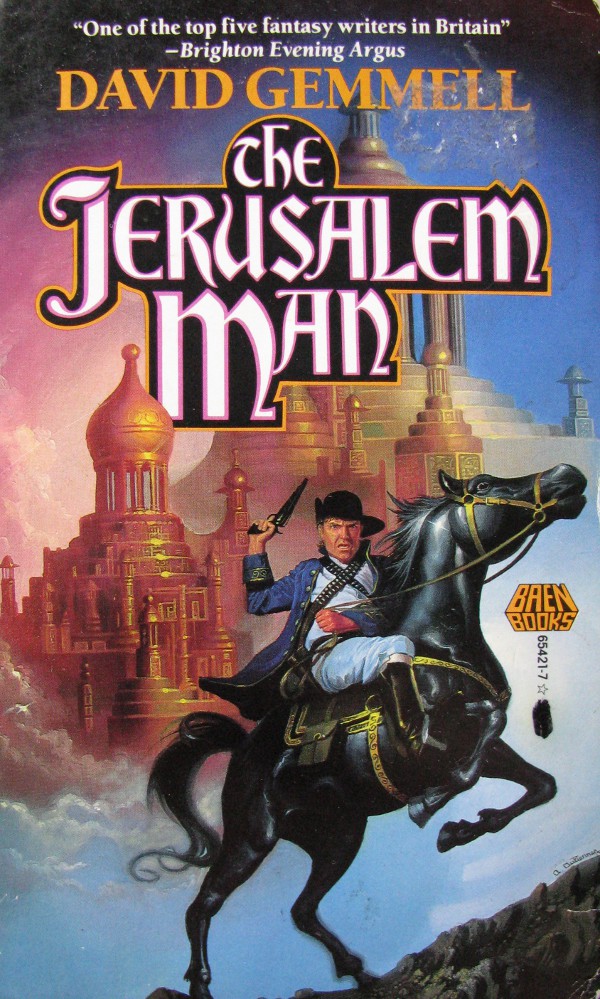
The old world is dead, destroyed by nuclear fire.  The old ways are long forgotten–except by one man in search of the Holy City.  He wanders the Earth with two guns and a Bible, leaving a trail of death and ancient prophecy in his wake.  Brigands fear him, honest men pity him, and the Hellborn hunt him.  He is John Shannow–the Jerusalem man.

This is some vintage David Gemmell.  In fact, I think this particular edition has been reprinted as Wolf in Shadow, and can no longer be found except in used bookstores and book trading sites.  Regardless, the book is awesome, right on par with Gemmell’s other work.

David Gemmell has the uncanny ability to suck you in almost as soon as you open the book, making you emotionally invested in the characters and conflicts to the point where you can’t stop thinking about it.  My favorite part of this book was in the first few chapters, when John Shannow found a frontier woman and briefly settled down.  It only lasted a handful of pages, but it was so powerful and moving that I felt compelled to read almost nonstop until I’d finished the book.

The later half gets a little outlandish, with magic stones, the lost city of Atlantis, and a Satanic cult bent on world domination.  It was a fun adventure, but not as compelling for me as the personal story of John Shannow.  In fact, it seems as if Gemmell unconsciously fell back on all the old tropes of the Drenai series, turning his post-apocalyptic western into a sword and sorcery romp, like Waylander with guns.  It wasn’t bad, but at times it did feel a little over the top.

This might have to do with my own personal tastes, however.  I tend to enjoy stories that have more to do with the personal lives and intimate struggles of the characters than grand quests to save the world.  I don’t know if it’s always been like that, or if it’s just something that’s changed as I’ve gotten older.

Regardless, The Jerusalem Man was a great book, and I thoroughly enjoyed it.  If you’re a fan of fantasy-western mashups, or post-apocalyptic fantasy in general, then this is a must-read.  And even if that’s not your usual fare, if you’re drawn to loner heroes who don’t pull any punches, you’ll almost certainly love this book.

Back in Mass

Mass = Massachusetts = “back east,” for all you unwashed Utahans!

My sister’s wedding is this weekend, so I’m back at my parents’ place helping them get everything set up.  It’s going to be a busy day tomorrow, but I’ve got my netbook and will probably get a couple good hours of writing in.

I managed to write a bit on the plane today, but not as much as I was hoping.  My goal is still to finish Into the Nebulous Deep 1.1 by May 14th; I’ve got about 15k-20k left to go, and since I’m taking the next few weeks off to work on writing projects, I shouldn’t have any problems meeting that deadline.

Yesterday, I took the unedited manuscript of Genesis Earth and formatted it nice and pretty so my friend Laura could read it on her Kindle, and…man, it looks like a real book!  There’s something about seeing your work in the actual form that people are going to read it in that is just…well, for lack of a better word, magical.  It’s definitely motivated me to get GE up quickly, as well as Journey to Jordan.  More on that in the next few days and weeks to come.

It’s getting late out here and I’d better get some sleep, but before I do, I want to put a plug in for my new favorite webcomic, The Zombie Hunters.  Ross Wolfe, Quark’s renowned zombie expert, introduced me to the comic a couple months ago, and I have been totally hooked ever since.

The comic is set in our world after the zombie apocalypse, where a band of five thousand survivors struggles to rebuild civilization on an island that was previously the site of a major research campus.  The zombie plague has a dormant phase, where the infected can live normal lives, but turn into zombies when they die.

The infected live in segregated barracks as second class citizens, but teams of them regularly venture out into the wastelands to salvage supplies from the zombie-infested ruins.  The comic basically centers around one of these teams of zombie hunters; their struggles and challenges, their relationships with each other, and their hopes and dreams for the future.

The storytelling is fantastic, the characters are engaging and real, the post-apocalyptic setting dark, gritty, and yet totally immersive and frighteningly believable–man, it’s just awesome.  And the longer it runs, the better it gets!  I can’t wait to find out how Charlie the half-life fits in with his ability to communicate with the zombies, or to get the full backstory with Jenny and Milo.  And I love the banter between Jenny and Sammie, her alcoholic sociopath best friend.

Right now, though, the main storyline is on hold while the author works through some business problems, but the short story is absolutely fantastic.  I love her fantastic use of point of view–how she gets into the little boy’s head and shows the apocalypse unfold from his perspective.  And the kid’s grisly end…man, zombies are even freakier when you never see their faces!  I wouldn’t be surprised if I have nightmares tonight about it–I have in the past.  Crazy awesome zombie nightmares, heh.

As a side note, may I point out what may quite possibly be the perfect weapon for the zombie apocalypse, the AA-12 shotgun.  All it needs is a bayonet and like a bajillion clips of ammo.  A must-have for any zombie contingency plan.

But yeah, let me just say I am in awe of The Zombie Hunters.  Awesome, awesome story–every time it updates, I get immersed again in the post-apocalyptic world, and it is amazing.  If I ever end up writing a zombie apocalypse story (which will probably involve starships and space travel in some fashion), I would be tickled if it’s even half as good as this excellent webcomic.

Just another update

A few updates, in case you’re interested in what’s going on with me:

I’m getting ready to post a new story to Amazon.  This is going to be the one that won first place in the 2009 Mayhew short story contest at BYU.  It’s also an excerpt for Genesis Earth, which is currently in the quarter finals for the 2011 Amazon Breakthrough Novel Award.  More news on that as it comes out.

Into the Nebulous Deep is coming along.  Surprisingly, the rough draft follows a very tight, coherent plot structure.  At this stage, every other novel I’ve written is usually all over the place.  This one looks like it’s going to be twenty chapters, with four parts of five chapters each.

Right now, I’m in the middle of chapter 13.  I was hoping to finish it this week, but my sister was in town this weekend, so I spent most of my time with her instead.  Not that that’s a problem; I can probably catch up tomorrow.  I’m hoping to finish part III before the end of next week.

It’s going to be tough, though, because I’m starting a new temp job on Monday.  It’s 40 hours per week at $9, which is pretty sweet, especially since my tax return is basically going to cover all my expenses this month.  Hooray for cheap Utah summers!  The full time work is going to be tough on the writing, though.

Which brings me to my last update: the guys at Pioneer Book called me back today and set up a job interview on Tuesday!  Hooray!  I’m totally stoked–this bookstore job would be awesome.  I might even postpone my TEFL plans for a while if I get the job.  It probably won’t be full time or pay much more than minimum wage, but dude, it’s a bookstore. Plus, part time work is perfect for writing.  As long as I have enough to get by, I’ll be happy.

And to close, let me leave you with this awesome trailer my brother in law shared with me.  I haven’t seen this movie, but it looks absolutely freaking awesome–like the kind of film my old roommate Steve Dethloff would make.

Man, Steve and I would make an awesome duo in a post-apocalyptic world. I should move to Dallas just so we can be ready to team up when it happens. If they made a movie of our exploits together, it would totally be just like this. Lost Vegas…

Steve, if you’re reading this, I want you to know that there’s no one I’d rather be killing zombies with than you.

Q1 report, 2011

So in terms of writing, this was a pretty decent quarter.  Nothing too prolific, but definitely making progress on my writing goals for 2011, which include:

1) finish at least two polished novels,
2) finish at least three new rough drafts,
3) start at least four major new projects.

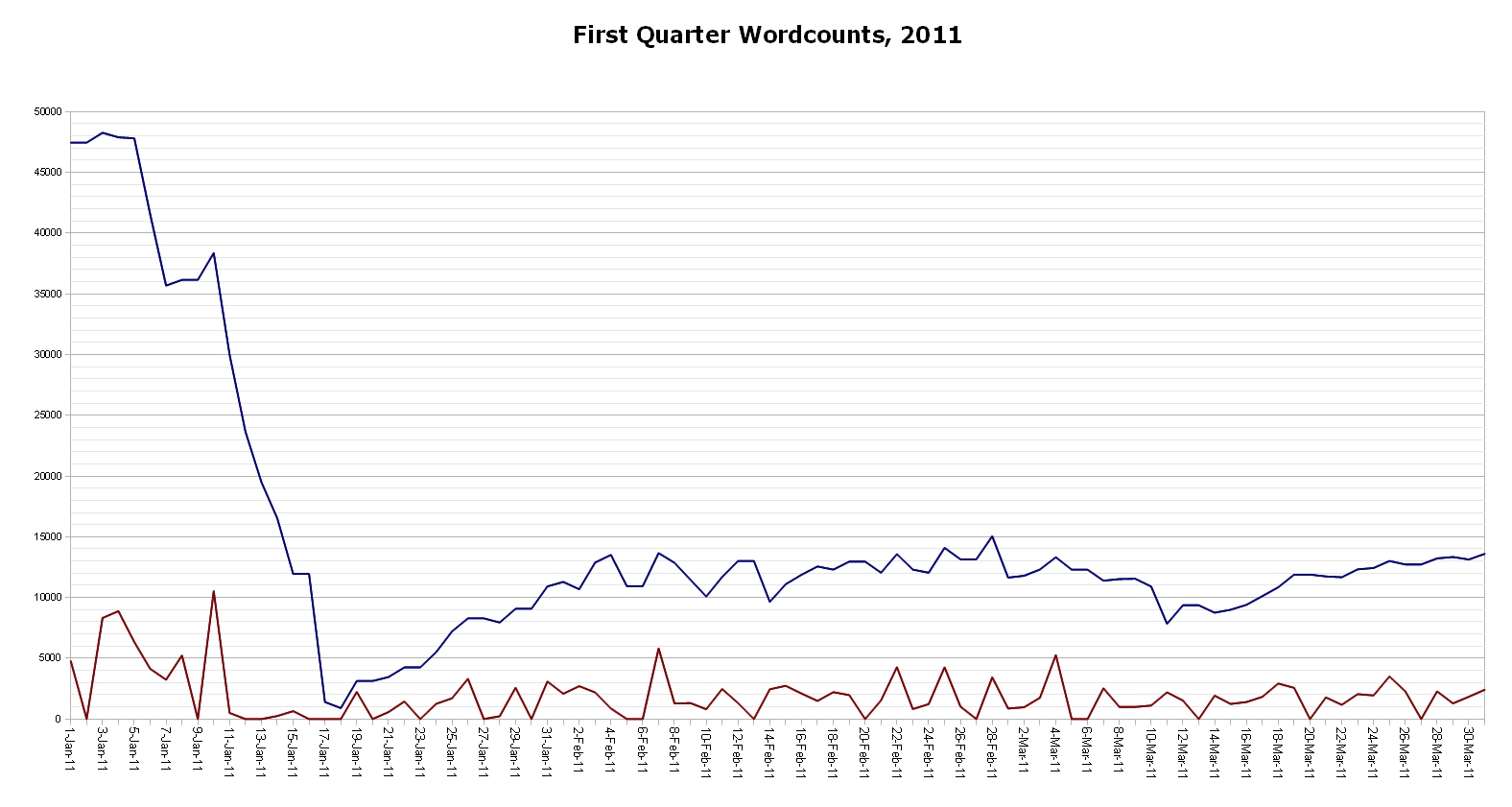
The spike in the graph from the beginning of the month is from the final revision of Bringing Stella Home, which was pretty much just a final polish.  After that was finished, I had a little difficulty picking up the next project, but once I did, I was able to be pretty consistent.

In mid-January, I picked up Worlds Away from Home and worked on that until the beginning of March.  This was a pretty huge overhaul, especially for the end, but it still needs a lot of work.  Basically, this draft was just to get it to the point where I could send it out to my first readers without being eternally ashamed.

After finishing WAFH 2.1 in the beginning of March, I launched right back into the sequel for BSH, Into the Nebulous Deep.  I figured it would be good to have the sequel in hand, in case I decided to go indie with BSH, as well as to practice writing sequels.

All throughout March, the writing was surprisingly steady, but recently things have kind of gone off kilter.  Maybe it’s all the increased distractions (job interviews, EPIK application, the TEFL course, other random crap), or maybe it’s just that I’ve become less disciplined, but I don’t feel like I’ve been writing very consistently in the last little while.  And the graph doesn’t really show that, because I recently started a few other projects which have sort of taken the place of ITND.

The first of these is currently untitled, but it takes place in a post-apocalyptic version of our world which I’ve code named “The Blight.” I don’t want to say much about it, but it’s REALLY REALLY REALLY cool…trust me.  Think lone man, wandering the ruins of civilization two hundred years after its fall, trying to make a life for himself when everyone else around him dies at a ridiculously early age because of this blight that has swept across all of humanity.

I’m having a TON of fun building this world, and the story is practically writing itself.  In the interest of finishing what I start, though, I’m going to sideline it until ITND is completely finished (which should be by the end of April, inshallah…).

The other project is a novella version of BSH, basically taking just Stella’s viewpoints and telling the story of her capture and eventual ascension to the Hameji throne.  This project shouldn’t be too hard–basically, I’m just frankensteining it from BSH, with a few tweaks.  My main reason for writing it is to have a novella-length work that I can release as an ebook, possibly to generate interest in Bringing Stella Home.

Speaking of which, in March I released a couple of short stories as ebooks on Amazon.  It’s a little early to gauge how well they’re doing, but I’m learning a lot from the experience, and the sales are gradually trickling in.  Once I release a few more works and start promoting them, I expect the sales will grow.

So in the last three months, I’ve finished one polished novel (Bringing Stella Home), started two new projects (Sholpan and untitled (the blight)), and made progress on polishing Worlds Away from Home. I wrote / revised through 170k words, about 30k to 50k of which were all new material.  I also ventured into indie publishing and released two short stories on Amazon, which are earning me a buck or two each week.

Overall, it hasn’t been as prolific as other quarters, but it’s not been too bad either.  Now to finish ITND and make some progress on that freaking nashostomo…

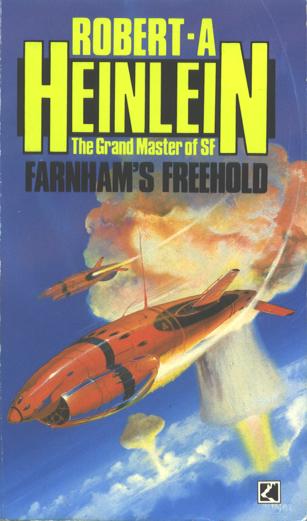
Farnham’s Freehold by Robert Heinlein

Bomb warning.  Third bomb warning.  This is not a drill.  Take shelter at once.  Any shelter.  You are going to be atom-bombed in the next few minutes.  So get the lead out, you stupid fools, and quit listening to this chatter!  TAKE SHELTER!

Thus begins the wild and crazy story of Hugh Farnham, a middle aged suburban American, with his alcoholic wife Grace, his law student son Duke and daughter Karen, their black house servant Joseph, Karen’s sorority sister Barbara, and the cat Mr.-Livingston-I-Presume.  When the Russians nuke the peaceful town of Mountain Springs into oblivion, only the uncanny foresight and resourcefulness of Hugh keeps them alive.  When they open their bomb shelter and climb outside, however, they find themselves in a world that defies anything they could ever imagine.

This book was incredible. I finished it at 4:00 am on a Sunday night, and honestly I wouldn’t have it any other way.  The characters are memorable and engaging, the plot face-paced and thrilling, the world fantastically imaginative, and the story both entertaining and thought provoking.  Wow.

Heinlein is an unparalleled storyteller, and I think he does it by creating worlds that are innately fascinating and imaginable and populating them with characters who act like real people, with the full range of reactions and motivations that real people have.

Consider the basic premise: who hasn’t wondered what World War III would be like?  No one who grew up during the Cold War, certainly.  And as for surviving and colonizing an uncivilized wilderness, people of all ages have been enthralled with that idea since Robinson Carusoe and The Swiss Family Robinson.  Heinlein capitalizes on this urge by telling us a story that we love to tell ourselves.

But the thing that really drew me in was the characters.

I’ll confess, when I got to the part where they open the bomb shelter and find themselves in a pristine, virgin wilderness instead of a blasted city, I threw the book across the room.  Up to that point, everything about the nuclear attack had been so realistic that the cross-dimensional time travel element totally threw me out.

However, even after I put the book down, I couldn’t stop thinking about Hugh Farnham.  The down to earth, no nonsense resourceful man who took the Boy Scout motto “Be Prepared” to a whole new level–who had the chutzpah to draw a gun on his own son when his rebellious behavior threatened to unravel the group–his undying attitude of “never surrender”–I just couldn’t stop thinking about him.  So I picked the book back up and finished it, and am I ever glad I did!

But it wasn’t just Hugh Farnham.  Grace, with her debilitating alcoholism and irrational outbursts, was a character I really loved to hate EVEN THOUGH she reminded me of people in my own family.  Joe, the longsuffering polite servant who changes so frighteningly with the reversal of fortune in the second half of the book; Duke, whose dysfunctional relationship with his father leads to so many problems; Barbara, the 60s era divorcee who goes from outsider to one of the closest members of the group–man, there were some memorable characters.  And NONE of them were caricatures; all of them had strengths and weaknesses, and while some fell prey to their flaws, others rose above them and triumphed magnificently.

I suppose that Farnham’s Freehold is a good example of pulp science fiction at its best: an imminently entertaining story that is also meaningful and thought provoking.  If so, then this is definitely the kind of stuff I want to write.  The descriptions may be sparse and the prose rather unremarkable–but man, the story…what a wild and crazy ride!

The technological singularity: a thing of the past?

One of the latest trends in science fiction is the concept of the technological singularity — the point in history at which technological advances occur so rapidly that we can no longer learn the new stuff fast enough to keep up with it.

I hear a lot of people talk about this at cons, and I’ve read/listened to quite a few stories about this concept.  Basically, these stories posit a world where science has become a new magic, and our world has been transformed beyond all intelligible recognition.

However, a recent post on the excellent Rocketpunk Manifesto blog made me wonder if we’ve already passed the point of singularity in our own society.  The post basically asserted that the period 1880 to 1930 saw so many sweeping technological advances that the world in 1930 would have been unrecognizable to a person from 1880, whereas our current society would still be intelligible to a person from 1930.

This made me wonder: how far into the singularity have we already come?  How much of our technological infrastructure has become so advanced that the common man lacks the capacity to comprehend it?

Think about it.  Fish around in your pockets and pull out your phone.  Do you understand how it works well enough to take it apart and put it together again?  To rebuild the device from parts?  Do you own the tools and machinery to construct the parts from which it is made?

How about the building in which you currently find yourself?  Do you possess the knowledge to build a comparable structure that performs the same functions?  That keeps you sheltered and provides the same light, heat, electricity, and internet connection that you now enjoy?

There was a time, not too long ago, when people would move out to the wilderness and homestead land by building their own homes from available natural resources.  If you needed to build your own house, as so many people used to do, could you do it?

How about your means of transportation?  If necessary, could you take apart your car and rebuild it again from the ground up?  Could you perform basic maintenance on it if you needed to?  How many of us can change our own oil–and how many of us are dependent on others for such a simple service?

Or what about the things we take most for granted–our understanding of the way the universe works.  Do you really understand the principles of physics?  Do you comprehend how electricity or magnetism really works, or are you still thinking in overly-simplified terms like electrons flowing through a circuit like water?  Even the most intelligent physicists can’t reconcile electromagnetism with Newtonian physics, so what makes you think you know so much?

How much of what we think we know is really just an illusion, meant to keep us pacified and docile?  To give us a false sense of security–that someone is in control, so we can rest easy?  Does anyone REALLY understand 100% how the economy works?  Do any of us know who or what is really in charge anymore?  Have we unwittingly handed over the reigns of control to some digital algorithm so basic to our newly networked way of life to be practically invisible?

Looking at how few of us are truly self-sufficient, and how much power we’ve ceded to forces beyond our control, our modern society seems so delicate and fragile.  Can anyone REALLY say that our society is not in danger of falling apart?  That our way of life is not an unnatural and unsustainable aberration?

Anyhow, those were some of my initial thoughts.  The more I compare the science fiction of the past with the reality of the present, the more predictions I see coming true in the most unexpected of ways.  The singularity may have less to do with uplinked consciousnesses and more to do with Google’s SEO algorithms than we are comfortable admitting.  And realistically, the light bulb may prove to be more revolutionary than anything Apple has ever or will ever produce.

A Canticle for Leibowitz by Walter M. Miller, Jr.

It was said that God, in order to test mankind which had become swelled with pride as in the time of Noah, had commanded the wise men of that age, among them the Blessed Leibowitz, to devise great engines of war such as had never before been upon the Earth, weapons of such might that they contained the very fires of Hell, and that God had suffered these Magi to place the weapons in the hands of princes, and to say to each prince: ‘Only because thine enemies have such a thing have we devised this for thee, in order that they may know that thou hast it also, and fear to strike.’

But the princes, putting the words of their wise men to naught, thought each to himself: ‘If I but strike quickly enough, and in secret, I shall destroy those others in their sleep, and there shall be none to fight back; the earth shall be mine.’

Such was the folly of princes, and there followed the Flame Deluge…

In the new dark ages of man following the nuclear apocalypse, an order of Catholic monks preserves the last vestiges of civilization: a shopping list, an electrical diagram, and other assorted scraps of a long-dead world.  As mankind rises from the dust, inevitable tensions arise between the church and the world, between Jerusalem and Babylon, Christ and Lucifer.

This book is epic.  Epic. I can’t begin to describe how incredible it is.  Virtually every page, especially towards the end, is packed with meaning.  A cautionary tale of the folly of man in this fallen world, this story held me captivated right up to the chilling final chapter.  Bravo.

As I understand it, Walter M. Miller Jr. wrote this book in the late 50s / early 60s, during the height of the Cold War.  Science fiction at that time was both sweepingly visionary and frighteningly pessimistic about the future of mankind, and this book successfully captures both extremes.  Like Asimov’s Foundation series, it reads more like a collection of elongated short stories, but Miller’s characterization and attention to detail is superior, in my opinion, to Asimov’s.

The most fascinating aspect about this book is the way that Miller hearkens to the past to give us a vision of our future.  Many of his ideas are straight out of Augustine and Aquinas–indeed, in several places, the story feels like it’s set in 3rd or 4th century Europe, which only adds to the delicious irony.

Yet, while this book has a strong Catholic feel, I never felt alienated or excluded from its intended audience.  Maybe it’s because my Mormon heritage is more compatible with Catholicism than other religious beliefs, but I don’t think it’s just that; the issues in this book are human issues, not just religious issues, and by focusing on that fact, Miller makes the story much more universal.

Even with all the deep, philosophical elements, this story is wonderfully entertaining.  Irony abounds, especially in the first section, in which a young novice takes a simple electrical diagram from the pre-deluge world and, completely unaware of its significance (or lack thereof), spends the rest of his life making a beautiful illuminated manuscript of it.  Even though the sections were  short, I quickly fell in love with the characters in each one, and connected with them almost instantly.

The final scene, in particular, was incredibly touching.  I won’t spoil it for you, but let me just say, if you are or ever have considered taking your own life, read this book, just for the final scene.   The degree to which the last abbot clings to life, even in the face of so many good reasons to give up, is just incredible.  And the final scene, in which…I won’t ruin it for you.  Just read it!

A Canticle for Leibowitz is one of the most powerful, meaningful books I have read in my life.  It is more than a good read, more than epic.  I class it as one of the best works of fiction this genre has ever produced.  If you have ever wondered about the destiny of mankind, or the proper relationship between the secular and the spiritual in our modern age–read this book!

Spin by Robert Charles Wilson

What would you do if you knew that the world was going to end in the next thirty years? That one day, before the end of your natural lifespan, the oceans will boil and the forests burst into flames, and life on this planet will come to an end? That you, your children, and even humanity itself have no future–that everything will end with you?
When the mysterious beings known as the Hypotheticals encase Earth in a temporal warp field that causes years to pass outside for every second on Earth, that is the uncomfortable question that all of mankind must confront. In five billion years–less than forty years on Earth–the sun will burn up its hydrogen and expand into a red giant star. When that happens, the sun will swallow the Earth and every living thing will die.

Some people turn to religion for answers.  Some turn to Science.  Some put off the question, living their lives as if the end will not come.  But as the years pass and the unavoidable apocalypse looms nearer, humanity begins to spiral out of control, and civilization itself looms on the verge of collapse.

The year the stars fell from the sky, thirteen year old Tyler Dupree discovers that he is in love with his best friend (Jason Lawton)’s sister, Diane.  The dynamics of the friendship between the three, however, make it impossible for Tyler to express his true feelings–and, in any case, Diane doesn’t seem interested in being anything more than a friend.

When the Spin hits, all three of them find themselves on radically different and sometimes conflicting paths.  Diane turns to evangelical Christianity and the frenzied religious outporing the Spin inspires.  Through his father, Jason rises to become one of the most influential scientists and directors in the Perihelion Foundation, the premier aerospace agency and Spin-related policy forming body in the US.  

Tyler, however, pursues the same middle class life he probably would have followed anyway–medical school, followed by a career as a doctor.  Still, his undiminished feelings for Diane and his frienship with Jason draw him into the center of the Spin hysteria and behind the scenes in the circuitous Spin-era politics.

Diane, now married to a fervent believer in a free love fundamentalist cult, comes to rely on Tyler as her only link to the outside world.  Meanwhile, Jason Lawton pursues perhaps the most grandiose and ambitious project mankind has ever attempted; the terraformation of Mars. 

With the temporal distortion of the Spin, millions of years of evolution turn Mars into a verdant green world in only one Earth year.  When Jason launches the first manned mission to the planet, barely a week passes before the the first Martian-born human returns to mankinds ancestral home–a descendant of a civilization millenia older than our own.  This small, dark-skinned, wrinkled man comes with a tantalizing message that may prove the key to finally understanding the Hypotheticals and the Spin itself.

But all of this may be too late, because the Spin membrane is finally beginning to show distressing signs of failure, and the sun has already grown hot enough to boil the oceans and scorch the planet.

I loved this book.  Honestly, I have to say it is one of the best science fiction books I have ever read.  Better even than Ender’s Game, better even than Foundation or any of the other classics.  No other book that I’ve read has done everything that I believe a good science fiction book should do.  I would highly recommend this book to anyone and everyone.

Like Clarke and a lot of the older classics in the science fiction tradition, Spin addresses some of the grand questions with which science and humanity have always wrestled.  What is the ultimate end of mankind?  The ultimate end of evolution?  Are we unique in this universe?  What is our place in the cosmos?  What is transcendence, and can we as a mortal species achieve it?

Unlike much of the older works, however, Spin addresses these questions through solid, developed, rich characters and a human drama that is as engaging as anything in any other genre.  When I read this book, I felt connected with these characters.  I genuinely cared about them.  They were real, distinct people who changed and grew based on their choices and experiences.  Furthermore, their struggles and conflicts echoed my own.  It felt true.  Tyler’s unrequited love was not only utterly believable, it kept me just as engaged as the grand ideas and the science fiction elements.

As science fiction, the ideas in this book were some of the most original and eye-popping ideas I’ve ever seen.  There was definitely a sense of wonder, as thick and beautiful as Clarke or Heinlein or Asimov.  The thing that made these ideas so great, however, was the eminent believability that accompanied them.  Robert Charles Wilson thought out the implications of everything, and showed them through concrete, human details.  His Martian landscapes were as real and believable as his picture of the New England countryside.  I not only felt that I was there, I felt that I was in this world, where the end-of-everything panic had set in, causing all sorts of bizarre, almost post-apocalyptic (pre-apocalyptic?) social changes.  It was truly fascinating.

But it wasn’t just the storytelling that engaged me: Robert Charles Wilson’s prose is among some of the best that I’ve ever read.  Reading this book really was like eating cheesecake.  The writing not only flowed, it shined, yet in a way that illuminated the meaning behind the words rather than drawing attention to the words themselves.  Wilson’s metaphors were not only rich and beautiful, they expressed the meaning behind the text so clearly that in each case, I don’t think he could have gotten across that particular impression, that feeling, in any other way.  Everything was calculated, and I would read pages and pages of text without even realizing how far I’d come.  Incredible.

I did have one issue with my first readthrough, back in July of last year: the Martian civilization, while grand, didn’t feel grand enough.  I mean, in 0nly four thousand years of history, look how far we’ve come here on Earth–all of our religions, all of our science, all of our discoveries and everything else.  We can hardly even remember what it was like, four thousand years ago–yet in Spin, the Martians know all about the reasons why Earth spawned their civilization, all of the questions that the Earthers have been asking about the Hypotheticals, etc.  I almost think that the Martians would have a more mystical view of Earth; that their understanding of us would be steeped in legend, and that they would have forgotten who we really are.

In my second readthrough, however, this was less of an issue to me.  Wilson really does make the Martians seem alien, a separate, distinct culture with a long, rich tradition.  His Martian citizen is very distinct from any of the Earthers, and notices some very small things that we always take for granted.  So, even though there could be more of a feeling of grandeur, Wilson already paints a very believable, very grand view of the Martian civilization he invents.

I am not exaggerating one bit when I say that this is probably the best science fiction book I have ever read.  I would recommend it above and beyond anything else I’ve reviewed here on this website.  If you haven’t already, pick up this book and read it.

Sabriel by Garth Nix

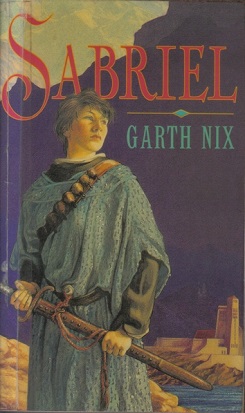
Sabriel doesn’t know it, but her father is more than just a powerful necromancer; he is a key in the political intrigue of the Old Kingdom–the land beyond the wall. When he interrupts her class at Wyverly college by sending a hand–an enslaved spirit–from beyond the fourth gate of Death to drop off his sword and magic bells, Sabriel knows that something is wrong.

Something is holding her father hostage in Death, and Sabriel is determined to find him and rescue him. When she crosses over the wall, however, into the world of magic, both free and charter, she discovers just how little she knows about the history of the world, and the conflict in which her father was intimately involved. On this side of the wall, the world nearly ended two hundred years ago, and something that should have passed beyond the ninth gate of Death has come back to finish what it started and claim the world as its own…

I read this book for English 318 this year; we discussed it in class a couple of weeks ago. I ended up reading the book in about 48 hours, and as far as required reading goes, it wasn’t bad. Not bad at all. In fact, I really enjoyed it.

Garth Nix creates a fascinating world in this book, with magic that feels wondrous and otherworldly and places that feel fantastic. His conception of Death as a river with nine gates–nine waterfalls–is extremely fascinating, and the use of the bells to cast spells is really well done. The first hundred pages of this book felt a little bit like the beginning of The Dark Is Rising: it felt really dark and spooky, like being lost in the woods and knowing that something ancient and dangerous was out there with you.

The characters were also interesting and likeable. Sabriel is a necromancer who, in some ways, is afraid of facing death–the fact that everyone has to go at sometime. This is a YA book, so she was basically a young adult thrown in way over her head, tossed back and forth from crisis to crisis. At the same time, she takes charge often enough that she is definitely not just a weak character, driven passively from place to place. When the love interest enters the story, she’s basically the “prince” that rescues him from the “dragon,” repeatedly.

The biggest issue I had with this book was its predictability. It seemed that I could see every plot development and big reveal at least fifty pages before it happened. That said, the main thing driving me through the book wasn’t the plot–it was the setting and the characters. Sabriel has to learn some difficult lessons in order to succeed, and the magic she uses is just really freaking cool. Charter symbols, free magic, the five great seals of the charter, the nine gates of Death and the voices of the bells–cool stuff. That was enough to keep me interested, despite the relatively straightforward and unsurprising plot.

Overall, this was definitely a good fantasy. Garth Nix does a great job creating a sense of wonder, and his characters were interesting too. If you like fantasy and haven’t yet heard of this one, I’d definitely recommend it.