Humility and Leadership in The Sword Keeper

What makes someone worthy to lead: strength, status, skill, or something deeper? The Sword Keeper is a chosen-one fantasy about a tavern girl who is handed a legendary sword, a dangerous prophecy, and a responsibility she never asked to carry. At the heart of the story is the idea that true leadership begins not with power, but with humility.

Where the Idea Came From

The first spark for The Sword Keeper came when I was taking Brandon Sanderson’s writing class at BYU, around the time he had just published Warbreaker. I loved the idea of a sentient sword as one of the characters, but the story truly came alive later, after I moved to the Republic of Georgia to teach English. The mountains, villages, dances, family names, food, roads, and little backcountry details of the book all grew out of my time there, especially in Kutaisi and the mountain village of Rokhi.

How Humility and Leadership Shape the Story

Tamuna is not the obvious person to bear Imeris. She is not a warrior, a noble, a trained monk, or a commander. She is a tavern girl from a mountain village, more familiar with chores, travelers, and local gossip than with swords, strategy, or war. That is exactly what makes the theme work. The sword does not choose the strongest person in the room. It chooses someone who can learn, listen, care, and carry power without treating it as a prize.

Alex is the clearest contrast. He has the training, discipline, courage, and martial skill that Tamuna lacks. He once hoped the sword would choose him, and part of him still believes he would have been the better bearer. But his struggle shows why humility matters. He has to learn that service is not failure, and that leadership is not always given to the person who looks most qualified. By the end, he recognizes Tamuna as the true sword bearer because she treats command as a sacred burden rather than a personal honor.

This theme also shapes Tamuna’s growth. She does not become a leader by pretending she is fearless or invincible. She becomes a leader by accepting responsibility, listening to counsel, protecting her friends, and slowly learning how to make decisions that affect more lives than her own. When she realizes that leadership means deciding life and death for those who follow her, Alex tells her that the fact she treats that responsibility seriously is probably why Imeris chose her.

What Humility and Leadership Say About Us

Most of us are tempted to think leadership belongs to the confident, the talented, the powerful, or the people who seem born for greatness. But real leadership often begins with the person who understands the weight of responsibility. Humility does not mean weakness. It means knowing that other people’s lives matter, that power can corrupt, and that courage is only noble when it serves something beyond itself. That is why Tamuna’s journey matters: she is not chosen because she wants glory, but because she can learn to serve.

Why This Theme Matters to Me

I care about this theme because I know what it feels like to be unprepared for the road ahead. When I first began working on this story, I was trying to launch a writing career during a difficult season, with discouraging book sales and few good prospects outside dead-end jobs. Moving to Georgia became one of those unexpected life turns that gave me more than I knew I needed. In a way, Tamuna’s story grew out of that same feeling: being called into something larger than yourself, not because you feel ready, but because the road has opened and you have to decide whether to take the next step.

Where to Get the Book

Related Posts and Pages

Explore the series index for The Twelfth Sword Trilogy.

Return to the book page for The Sword Keeper.

Is The Sword Keeper for You?

The Sword Keeper is a coming-of-age epic fantasy about a village tavern girl chosen by an ancient sentient sword to stand against a rising empire of corrupted blades, dark mages, and enslaving powers. It delivers a classic quest-fantasy experience with mountain passes, warrior monks, sword training, prophecy, friendship, danger, and a young heroine slowly learning that wisdom matters as much as strength.

What Kind of Reader Will Love The Sword Keeper?

If you love…

  • classic epic fantasy quests with ancient prophecies, enchanted swords, lost orders, and rising dark empires
  • young heroines who start ordinary, frightened, and untrained, then grow into courage and command
  • sentient magical weapons with personality, memory, moral purpose, and ancient secrets
  • friendship-driven fantasy where loyalty, sacrifice, and trust matter as much as battle skill
  • mountain settings, old fortresses, warrior cultures, road journeys, and a sense of mythic history

…then The Sword Keeper is probably your kind of story.

What You’ll Find Inside

Tamuna Leladze is a curious tavern girl from the mountain kingdom of Kutaisa whose life changes when she touches Imeris, the twelfth and final enchanted sword of an ancient order. Suddenly bonded to a blade that can speak into her mind, share the memories of past bearers, and train her for a war she never asked for, Tamuna is forced to flee her home with Nika, her loyal childhood friend, and Alex, a proud warrior monk who resents that the sword chose her instead of him. The story is adventurous, earnest, and emotionally sincere, with fast-moving escapes, training sequences, strategic lessons, battlefield danger, and a hopeful but serious tone.

What Makes The Sword Keeper Different

Readers who enjoy the chosen-one structure of classic fantasy will find familiar pleasures here: a humble protagonist, a sacred weapon, a broken order, and a shadowy enemy moving across the map. But The Sword Keeper stands apart by making the sword itself one of the central characters, not just a magical object or symbol of power. Imeris is teacher, mentor, conscience, strategist, and ancient witness, while Tamuna’s growth depends less on becoming physically unstoppable and more on learning judgment, courage, leadership, and self-command. The setting also draws heavily from the Caucasus and the Republic of Georgia, giving the mountain villages, dances, names, roads, food, and landscapes a flavor that feels distinct from more familiar medieval-Western fantasy worlds.

What You Won’t Find

This is not grimdark fantasy, and it is not a cynical deconstruction of the chosen-one story. Readers looking for morally gray nihilism, graphic sensuality, or a story where everyone is corrupt may not find what they are looking for here. The violence and danger are real, but the heart of the book is earnest, heroic, and fundamentally hopeful.

Why I Think You Might Love It

I wrote The Sword Keeper out of my love for stories where ordinary people are called to become more than they ever imagined. Much of the world building grew out of my time teaching English in the Republic of Georgia: the city of Kutaisa, the mountain pass, the dancing, the family names, the backcountry details, and even small moments like Nika caring for the weakest chick in a brood all came from things I saw or experienced firsthand. I think that gives the story a lived-in texture beneath the fantasy adventure—a sense that Tamuna’s world is not just a backdrop, but a place worth saving.

Where to Get the Book

Related Posts and Pages

Explore the series index for The Twelfth Sword Trilogy.

Return to the book page for The Sword Keeper.

Curiosity is…

Curiosity is one of the defining traits of all great people. It is the driving force behind every dreamer, and the imperative behind all those who seek to improve the lives of their fellow men.

The Sword Keeper by Joe Vasicek

Going full-tilt on The Soulbound King

I’ve decided to put The Road to New Jerusalem on the back burner and focus instead on my epic fantasy series, The Rise of the Soulbound King Trilogy. If I push, I think I can finish the AI draft of book 1 in the next two weeks. I’ve also nearly finished the outline for book 2, and will probably have a rough AI draft for that one by the end of September.

I would really like to publish this series in 2026, but I don’t want to launch it until I’m ready to rapid release the first three books. And since these books are all epic fantasy, it’s going to take a lot of time and effort to write them. Without AI, it would probably take me something like two or three years for each book. I’m not a very fast writer, and I tend to get stuck in the middle, even when I have a solid outline. With AI, I think I can shorten that to 6-8 months.

These books are probably going to range between 150k and 200k words, so not super long for epic fantasy (for comparison, Mistborn: The Final Empire is about 214k words, and The Way of Kings is about 384k words). That’s much longer than most genre books, though, including most of the books I’ve written until now. And writing difficulty doesn’t scale linearly with book length; it scales logarithmically. So while it may take only 1-2 months to write a Sea Mage Cycle book, those are only about 1/3rd the length of a Soulbound King book.

My long-term goal, though, is to pivot to epic fantasy, to the point where that’s mostly what I write. And if you read my science fiction novels, you’ll find that they’re much more like epic fantasy, with multiple viewpoints, grand galactic empires, wars and political machinations, and a universe that has its own character arc. So while this may superficially seem like a huge pivot, it’s actually not.

There are three science fiction books that I need to write before I can pivot entirely to writing fantasy: Captive of the Falconstar, Lord of the Falconstar, and The Return of the Starborn Son. Those are the only outstanding science fiction series that need finishing (and I will finish them, I promise—I’m not going to pull a GRRM). I also need to finish the Twelfth Sword Trilogy, the epic fantasy series I started in the 2010s while I was still mostly writing science fiction.

Realistically, the only ones of those books that are going to be finished between now and the end of next year are the Falconstar books, since I need to juggle all of these with the Soulbound King epic fantasy books that I’m also writing. But I think I can finish the Falconstar books, and also write and publish a Sea Mage Cycle book or two within the next year. I’ve found that it often helps to take week-long breaks to work on other projects, which allows me to approach a larger and more challenging WIP like The Soulbond and the Sling with new eyes. So I will probably alternate between working on the Soulbound King books and working on Falconstar and Sea Mage Cycle for the forseeable future.

But my goal for the next two weeks is to go full steam ahead on The Soulbond and the Sling, until it is finished. And with luck, I will also have a few excerpts to share with you soon!

Fantasy from A to Z: I is for Immortality

Immortality is one of those fantasy tropes that shows up everywhere once you start looking for it. Vampires, elves, gods, liches, ancient dragons hoarding gold through the centuries—we’re fascinated by the idea of beings that can’t die. Sometimes they’re terrifying, sometimes noble, sometimes weary and wise. But always, they strike a chord.

Why? Because they brush up against one of our deepest human anxieties: death.

Death is one of those universal aspects of the human experience. Everybody dies. And compared to the lifespan of things like mountains, or forests, or stars, the human lifespan is remarkably short and fleeting. Some of us live a long and a full life, and are ready to go when the time comes, but many of us are not. Tragedy can strike us at any time. No one knows when the reaper will come for them.

This is why, in fantasy fiction, immortality often comes wrapped in awe and mystery. It’s a mark of otherworldliness, a symbol of something beyond the ordinary cycles of birth and death. Sometimes it’s a gift. Sometimes it’s a curse. Often, it’s a little bit of both.

Personally, my favorite fantasy author who captured this complexity is J.R.R. Tolkien. His elves are perhaps the most iconic immortal race in all of fantasy. They don’t age or grow frail. They don’t die of disease. They are not eternal in the divine sense, but their lives are bound to the life of the world. When they are slain, their spirits travel to the Halls of Mandos, where they can eventually be re-embodied. But they are still bound to the world. They don’t pass beyond it. They don’t get to move on.

That’s the heart of their tragedy.

Elves in Tolkien’s legendarium aren’t happy fairytale creatures dancing in the moonlight. They are ancient beings with long memories, deep sorrows, and wounds that don’t always heal. They remember battles and betrayals that happened millennia ago. They carry the weight of history like a cloak that can never be removed. And for all their beauty and wisdom, they are fading. Slowly, subtly, inevitably. Their time is passing, and they know it.

In contrast, humans are mortal and thus are not subject to this curse. As Tolkien writes in The Silmarillion:

“And the Doom of Men, that they should depart, was at first a gift of Ilúvatar. It became a grief to them only because coming under the shadow of Morgoth it seemed to them that they were surrounded by a great darkness, of which they grew afraid.”

That’s a remarkable insight. Mortality, which we so often view as a curse, was originally a gift. The elves envy us not because we die, but because we get to leave. To move beyond the world. To have an end.

And yet, we don’t often treat it like a gift. In fact, we go to absurd lengths to avoid it.

You don’t have to look far to see that our obsession with immortality isn’t limited to fantasy stories. In Silicon Valley and other corners of the tech world, there’s a growing movement of wealthy futurists who are pouring money into the dream of defeating death. Some want to reverse aging at the cellular level. Some are working on brain-uploading technology, convinced they can digitize the human soul. Others are experimenting with biological “enhancements,” anti-aging therapies, or even transfusions from younger people in an effort to extend their lifespans.

This hunger for immortality is as old as the Epic of Gilgamesh, but today it wears a lab coat and calls itself “biohacking.” The names have changed, but the impulse remains the same. We want to stay. To cling to life. To hold onto what we have, no matter the cost.

But is that really such a noble goal?

Fantasy offers us a counterpoint. Again and again, stories show that immortality comes at a price. Vampires lose their humanity. Liches surrender their souls. Gods become detached from the world of mortals. Even the elves, for all their grace, are caught in a long decline.

Immortality often brings with it a kind of existential exhaustion. Without death, there is no closure. Without loss, there is no growth. Without time running out, nothing truly matters.

Mortality, by contrast, sharpens everything. Because we are mortal, our choices matter. Because time is a scarce resource—indeed, perhaps the only resource in our world that is truly scarce—our relationships carry weight. Because we will one day die, every act of love, courage, sacrifice, or faith becomes immeasurably precious.

And that’s something that fantasy, at its best, understands better than any philosophical treatise or TED Talk ever could. Again, Tolkien writes:

“But the sons of Men die indeed, and leave the world; wherefore they are called the Guests, or the Strangers. Death is their fate, the gift of Ilúvatar, which as Time wears even the Powers shall envy.”

The elves call us guests. Strangers. Not because we are lesser, but because we do not belong to the world in the same way they do. We are pilgrims passing through this world—strangers in a strange land. Our road leads elsewhere, and that elsewhere—whatever lies beyond the circles of the world—is part of the hope that makes us human.

In my own fantasy, I like to play with this idea. My characters all live in the Mortal Realm, but there is an Immortal Realm that lies beyond the bounds of their current existence, and the veil that separates the two can sometimes grow quite thin. In The Sword Keeper, there is a Void between the two realms that Tamuna must cross in order to confront the evil that afflicts her world, and to find the lost spirit of her father. In Bloodfire Legacy, when Lord Arion is assassinated in the first chapter, he temporarily gives up the indescribable glory of the Immortal Realm in order to linger as a ghost and help guide his orphaned daughter. 

All of these characters are bound, in time, to pass from this Mortal Realm, but that isn’t a curse—it’s a gift. There is far more to this life than the bounds of our material existence. There are more things in heaven and in earth than we can comprehend with our mortal understanding.

In the end, fantasy doesn’t just explore our fear of death. It teaches us how to find meaning in the brief time we’re given. So the next time you read about some deathless sorcerer or ageless elf queen, remember: you have something they never will. An ending, and a beginning. A home beyond this world. A story that can reach its conclusion.

Fantasy from A to Z: H is for Heroes

When David Gemmell, my favorite fantasy author, broke into the field in the 1980s, his books were considered to be part of the “heroic fantasy” subgenre. If the two major divisions of fantasy were epic fantasy (sometimes also known as “high fantasy”) and sword & sorcery (sometimes known as “low fantasy”), heroic fantasy was very much in the sword & sorcery vein. Then the stars of George R.R. Martin and Joe Abercrombie began to rise, and heroic fantasy gave way to what we now know as “grimdark.” 

On a superficial level, both grimdark and heroic fantasy appear to have much in common. Both subgenres tend to feature morally gray characters, worlds that are dark and brutal, and a great deal of graphic violence. George R.R. Martin is famous for killing off his characters, and David Gemmell likewise tends to kill off about half of his starting characters in every book. 

But if you spend enough time with both subgenres to get past the superficialities, you’ll see that they are totally different—and in some key ways, diametrically opposed. Not all grimdark descends into total nihilism, but much of it unfortunately does. But heroic fantasy is defined by the fact that it is not utterly nihilistic. Which isn’t to say that all heroes are noble and bright—gray morality is still very much a trope of the subgenre—but the very fact that heroes exist is enough to keep heroic fantasy from delving too deep into nihilism.

This is why I love practically everything that David Gemmell has written, but I couldn’t get past the first book in George R.R. Martin’s Song of Ice and Fire. I acknowledge that Martin is a brilliant and gifted writer. There were parts of A Game of Thrones where I felt more immersed in Martin’s fantasy world than in almost any other book I’d read. But by the end of the book, I hated all of the characters and was rooting for Danaerys to come with her dragons and burn them all to cinders (which was apparently the plan all along, if season 8 of the show followed Martin’s outline).

The thing is, George R.R. Martin is obsessed with the idea of victimhood. All of the characters in A Song of Ice and Fire are either victims or victimizers, or both. That is, apparently, the most interesting aspect that Martin finds about them. Which explains why his series did so well in the 00s and the 10s, when intersectionality was on the rise and critical theory came to dominate so many aspects of our culture. In any other time, Martin’s obsession with victimhood would not have gained such a following—which explains why it took him nearly five decades to hit his big break.

But where Martin is obsessed with victimhood, Gemmell was obsessed with heroism. He had a penchant for taking the most despicable and morally bankrupt characters, putting them in circumstances that demanded something more of them, and showing them rise to the occasion, making a heel-face turn and becoming the hero that the story demanded. It’s so immensely satisfying for me, every single time. Even the villains will sometimes turn into heroes by the end—though when they don’t, you can always expect them to have creative and satisfying deaths. No “creative subversion” of reader expectations there!

For Gemmell, there’s nothing very complicated about being a hero. There’s no list of defining characteristics or attributes. There’s also nothing particularly complex that a character has to do. For Gemmell, a hero is simply a person who does something heroic. Nothing more, and nothing less.

At this point, I’d usually give examples, but since all of them are spoilers, all I can say is go and read David Gemmell’s books! Some of the best heel-face turns are in Winter Warriors and Hero in the Shadows. I also really loved the protagonist’s redemption in The Swords of Night and Day. And of course, if you really want a great example of an unlikely hero, read Morningstar. That’s basically the whole plot of the book.

Like Gemmell, I prefer to write stories with heroes rather than anti-heroes. My Sea Mage Cycle books are generally more light on violence than a typical Gemmell book, but in The Widow’s Child and The Winds of Desolation, I put the main characters into some tough circumstances that forced them to step up and play the part. Same with The Sword Keeper, my first fantasy novel. And of course, with the Soulbond King books that I’m currently writing, where the main character is patterned after King David, there will be lots of opportunities for him to do heroic things, even if he is a more complicated character.

Heroes are so important to me that I honestly cannot read any fantasy book that doesn’t have one. When I look back on all of the big-name fantasy books that I’ve DNFed, that honestly is the major defining factor. Fortunately, the fantasy genre is full of excellent heroes—and with the way trends are shifting, I think we are going to see a lot more of them soon.

Rethinking some things

So I had an extremely vivid dream last Friday night where I got cancer and learned that I had only a month to live. Among other things, I found myself asking: “What am I going to do about my writing career? Who is going to finish all these books? Are they going to fade into obscurity, or will someone promote them so that my family will benefit from them after I’m gone?”

The whole thing made me feel like the race was suddenly over, and I hadn’t finished it, but had to hand off the baton to someone else who would. So instead of spending that final month of my life writing, I would have to spend it outlining things in such a way that the person who carried it all after me would be able to do it right.

(And then, hilariously, when I told my friend and cowriter Scott Bascom that I had terminal cancer, his response was: “So what? Get back to writing.” And when I told him IRL about that dream, his reaction was: “Well, was I wrong?”)

Obviously, it was an incredibly sobering and emotional dream, for reasons that had nothing to do with my writing. But it also got me to thinking about some things I’ve taken for granted about my writing process, and how I ought to change them or at least experiment with other ways of doing things.

For example, for the last fifteen years—really, since I started writing professionally—I’ve just sort of assumed that I would 1. work on one novel WIP at a time, and 2. write that novel sequentially from start to finish, rather than hopping around.

In the early years, I experimented with doing things differently and decided that I just wasn’t wired that way. But that was also when I thought I was a 100% discovery writer and didn’t have any sort of outlining process. Basically, I tried to keep the whole novel in my head, a nearly impossible task even for a veteran writer.

Now, I have a much more rigorous outlining process that divides each novel WIP into chapters and scenes, so that instead of trying to keep an entire novel in my head, I can eat the elephant one small bite at a time. So I’ve actually got the infrastructure in place right now to experiment with those things, in a way that I didn’t before.

Another thing that I’ve always taken for granted is that in order to be a working professional, I need to set strict deadlines for each project and schedule those deadlines at least a year in advance. Never mind that I have never kept an original deadline that I’ve made for a project, or kept to those schedules. Instead of finding a better way, however, those deadlines and schedules always just keep getting pushed back.

I’ve also been trying to find a way to write a novel all the way through from start to finish, without getting stuck in the middle and feeling like I need to put it aside for a while (on the “back burner,” as I used to say). In fact, that was one of the main reasons why I developed my outlining process in the first place. But even with a well-developed outline that still has some flexibility to adapt to a changing story, I still can’t write a novel straight through without having to take a break.

Another thing I’ve always failed at is hitting my daily word count goals consistently. Instead, I typically write in starts and fits, especially when I’m in the messy middle of whatever novel WIP I’m working on at the moment. However, I did have some success with those nanowrimo challenges where I worked on short stories—in other words, where I hopped from project to project.

Also, until this year, I could never manage to read very consistently. I’d go through phases where I’d read a lot, followed by long reading droughts where I’d read almost nothing. But then, I discovered some reading hacks that completely changed everything, and now I’m reading between one and two dozen books a month (most of them just the first and last chapters, but about 6-10 of them all the way through).

One of those reading hacks was—wait for it—reading more than a dozen books simultaneously and hopping from book to book. And the thing that made that possible was my reading log, which provides some structure and helps me to see how much I need to read from each book to not just totally drop the ball.

So why don’t I try something similar with my writing? What if, instead of working on one novel WIP at a time, I used these outlines to break them all up into scenes and just skipped around, writing whatever stands out as the most interesting thing to write at the moment? The outlines will help to keep it all straight, so I don’t have to keep an entire novel in my head. And when I inevitably get stuck with one WIP, I don’t have to lay it aside for months on end—instead, I can jump to something else, since I’m already jumping around in the first place.

It sounds kind of crazy, but I’ve found that my ADHD brain actually works better that way, at least when it comes to reading. So why not writing as well? It’s worth a shot, at least. And maybe one of the upsides will be that I won’t have to angst so much about those deadlines. If the focus is on hitting daily word count instead of staying on deadline for my current WIP, then solving the first problem will ultimately solve the second one, once I hit my stride.

So that’s what I’m going to experiment with: hopping from project to project, with a goal of hitting my daily word count goal rather than advancing a single project to an arbitrary deadline.

In order to do that, I need to make some outlines. Here are all of my unfinished novel(ish) WIPs that I haven’t trunked yet:

  • The Sword Bearer (Twelfth Sword Trilogy #2)
  • The Sword Mistress (Twelfth Sword Trilogy #3)
  • Captive of the Falconstar (Falconstar Trilogy #2)
  • Lord of the Faconstar (Falconstar Trilogy #3)
  • Children of the Starry Sea (Outworld Trilogy #2)
  • Untitled (Outworld Trilogy #3)
  • A Brotherhood of Swords (First Sword Trilogy #1)
  • Untitled (First Sword Trilogy #2)
  • Untitled (First Sword Trilogy #3)
  • The Lifewalker Chronicles (standalone)
  • Starship Lachoneus (standalone, may be a collection)
  • The Justice of Zedekiah Wight (collection)
  • The Mercy of Zedekiah Wight (collection)
  • Christopher Columbus, Interstellar Explorer (collection)

Of those, only Children of the Starry Sea and Captive of the Falconstar are fully outlined. So I’ve got a lot of work to do.

Instead of taking time off to outline all of these, however, I’m going to prioritize hitting word count, and work on the outlines on the side, in my voluminous spare time </sarc>. It’ll probably take a while, but I’ll eventually get it done—and that will provide some extra motivation to hit word count each day.

Also, I plan to outline all of them, even the book 3s where book 2 still hasn’t been written. The reason for that is so that I’ll have something to hand off to another writer, in case that crazy dream comes true. I don’t think that it will, but I’m gonna go sometime, so it’s better to get into the habit of doing that now. Besides, it may be helpful to skip ahead to the next book and write a few scenes: give me something to write toward.

TL;DR: I’m going to be doing a lot of experimentation in the next couple of months, skipping around in all of my WIPs instead of focusing on one at a time. It’s going to be crazy, but hopefully in a productive way. And a fun way too.

Spring Shorts 2022 #4: The Freedom of Second Chances

I’m really happy with how this short story turned out. It pushes the edge in a lot of interesting ways, with the main character having to choose between duty and honor and doing what is right, and a forced abortion situation that puts the lie to the “women’s right to choose” insanity. It will probably get me blacklisted at a few more magazines, but at this point I really don’t care.

Once again, I used the Mythulu cards to come up with this story. Here are the ones I used:

  • CLONE: Many available forms, including: duplicate, twin, rebirth, alternative life path manifested, time traveler overlap, actor, understudy, etc. Can even mean a second chance or a relapse.
  • ABANDONED: Indicates a severe problem in the environment that prior ihabitants were unable to solve. Draw +1 Habitat.
    • COASTAL: Peaceful threshold where the ocean meets land. Known for caves, karsts, and dunes. Represents unsolvable relationship problems.
  • ERODED: Extensive, exponential deterioration of a foundation due to long-neglected defense.
  • MARRIAGE OF HONOR: A permanent relationship initiated to help someone else avoid shame or discredit.
  • TATTOO: Marked to identify, warn, or remember.
  • GUILTY: Responsible for the worst thing that has happened recently to everyone around them.
  • BODYGUARD: Primary purpose is to protect something else, at any cost.
  • VELVET: Labor-intensive weave of fabric that mimics the soft fur on a young buck’s antlers. Worn to inspire reverence or respect.
  • BLOOD: Represents the energy invested to keep something alive. The only element which affects the soul beyond mortality. Can taint or purify.
  • SLIPPERY: Wants freedom and is hard to hold onto. Often enjoys the chase.
  • BUREAUCRAT: Keeps others in bondage with words. Diverts enemies toward illusions to exhaust them into giving up.
  • CATALYST: Initiates or accelerates a chemical reaction without itself being affected. Gifted at getting things moving.
  • NECRO: Things that were once living, but no longer are. Draw again to decide what died. Draw +1 Habitat or Element.
    • PET: Healthy codependence with a clear heirarchy, usually between members of different species.
  • TORN: Forcibly separated parts, which often continue to exist separately. Indicates a lost privilege or reduction in status. Symbol of anger.
  • SIGIL: Symbols that have power to force or bind. Used in communities to rally groups together.

I’m going to keep going through until I’ve used all of the Mythulu cards in a story at least once. So far, they’ve proven to be an interesting way to not only generate story ideas, but to send my stories off in different and interesting directions. It usually takes me a little while (or sometimes a couple of different draws) to figure out how to fit everything into a coherent story, but I’m getting the hang of it, and the process is actually pretty fun.

As for the spring shorts challenge, it’s Memorial Day today, which means that the challenge is basically over. I only ended up writing four stories, which is a lot less than what I’d hoped to write, but I think these will turn out really well after I rework them a bit, so I’m counting it as a partial success.

For June, I plan to write two more short stories in order to fill up the buffer. My writing group meets once a month, so with two more stories to critique in June, that will give me a buffer of six months by the time July rolls around. I also plan to fix up all four of these spring shorts stories and put them on submission for the next few months, before I publish them as free singles.

I will try to do a new short story each month, in order to keep the buffer at six months, but I may do another short story nanowrimo this year if it turns out that I need more. As far as other WIPs are concerned, though, after I write these next two stories in June, I’m going to go back to novels. My plan right now is to write the first three chapters of The Sword Bearer and Captive of the Falconstar by the fourth of July, then decide whether to go on with one of those or to keep working on Children of the Starry Sea.

Good things are happening!

It’s been a while since I posted a general update here on the blog, and while I’ve been sharing regular updates to my mailing list, enough has been happening that I suppose I should let all the rest of you know what’s going on.

First, I decided to pull out a bunch of investment money and put it into my writing, in order to go full-time for the next few months (and hopefully for the forseeable future). I shared more about this on my newsletter. Basically, I rewrote my business plan and decided that my best way forward is to go all-in for the next few months, writing more books and growing my business. I have a plan, and if it works, I’ll be able to go full-time indefinitely.

Second—and this may seem to contradict the first—I got a job at the local used bookstore, Pioneer Book! I’ve been going to this bookstore for years, befriending the manager and several employees, and several months ago (before I decided to reinvest in my writing business) I dropped off a resume in the hopes of getting a job there. When I got the call, I wasn’t going to turn it down.

It’s a part-time, 20 hours per week job that fits in perfectly with my writing. It’s also a job where I get to work with books, and be around bookish people, so I’m sure there will be lots of opportunities to learn interesting things that will help as I build my own writing and publishing career. Basically, it’s the perfect day job for a writer, and I’ve really been enjoying it so far.

Writing-wise, I just finished Gunslinger to Earth, the third book in the Gunslingers trilogy, and I’m finishing up the revisions to send it to my editor hopefully in the next few weeks. My next WIP is Edenfall, and I’m hard at work on it now. The goal is to finish it by March, and publish it over the summer.

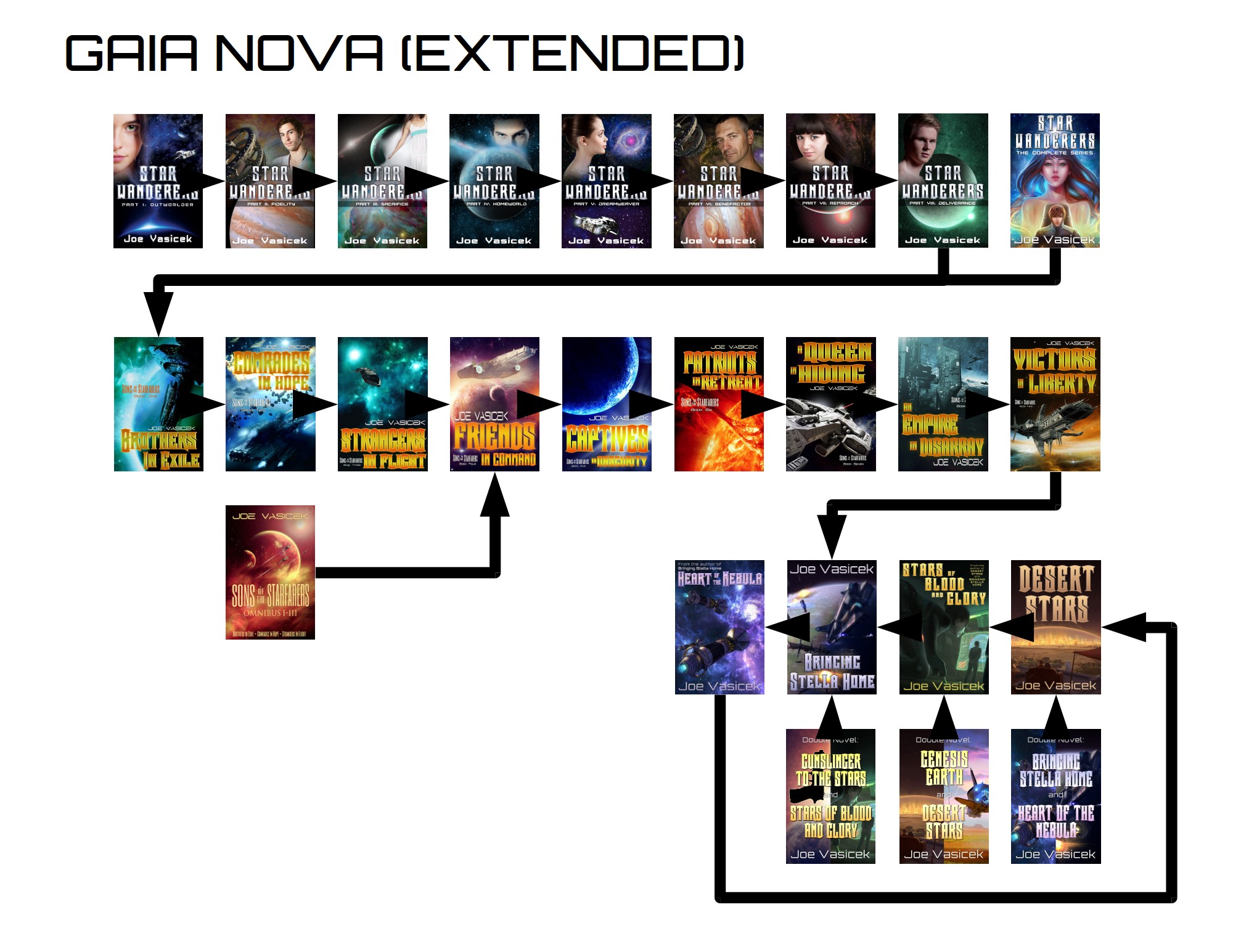
Publishing-wise, I’ve revamped the backmatter in my books again, with a new map for how everything connects to everything else. The biggest change is in my short stories, which aren’t mapped out here, but basically I’m going to focus on putting them into bundles, and have the singles point there. Eventually, I want to have only one or two singles for every bundle, with five to six stories per bundle. I have enough stories written to fill out four bundles, but a bunch of them are still out on submission, so it could take a while.

I’ve also been doing a lot more to build my email list, not just through Prolific Works but also through Bookfunnel, Story Origin, and MyBookCave. There is a method to the madness, and all of this fits into the wider plan. I’ve also updated the pricing on some of my books, and experimenting with AMS ads, though there’s not much to report on that front at the moment.

In short, I’ve been pretty busy. Most of my time and effort is going toward writing. I’ve got a very aggressive writing schedule for the next year, and hope to finish all of my trilogies before 2020, including the Genesis Earth trilogy and the Twelfth Sword trilogy. The way I have it planned out, if I can average 1600 words a day, I’ll be able to do that no problem.

As far as my personal life is concerned, I’ve been dating a really fantastic girl for the last few months and things are going very, very well. I’m not sure how much of that I should share, but you’ll probably hear more about it in the future, if not here on the blog, then definitely in my author’s notes and newsletter.

As of right now, 2019 is looking to be a fantastic year! I’m really looking forward to seeing what the rest of the year will bring, and I expect I’ll have lots of good things to share with you in the future. Take care, and thanks for reading!

My New Writing Process (or why I don’t believe in pantsing anymore)

For the longest time, I thought I was a “discovery writer.” That is to say, I believed there were two kinds of writers—pantsers vs. plotters—and that I was very much a pantser. It was what I was comfortable with. It was what I defaulted to when I sat down to write. It was the style of writing that for me, produced the best books.

Or so I thought.

Ten years later, I come to a realization: my writing process needs work. In order to keep writing at a professional level, I need to produce more books, and to do that, I need to write cleaner first drafts. Discovery writing was great for short stories or novellas, but my novels always seemed to hit a block somewhere in the messy middle. If I want to put out a new book each month, that’s not something I can afford.

Around this time, I read The Seven Habits of Highly Effective People. The second habit, “begin with the end in mind,” challenged everything I thought I knew about writing. According to Stephen Covey, everything is created twice: first in the mind, then in reality. To achieve maximum effectiveness in your work, make sure you have a clear plan.

“But wait!” I said. “I’m a pantser—a discovery writer. I don’t do outlines. That’s for plotters.”

And then I thought about it.

What if the whole “pantser vs. plotter” dichotomy is wrong? What if you have to master both skills to really be a masterful writer? Sure, there are plenty of successful writers who never do, but would they be more effective if they did?

What if it’s a bit like talent? People believe that you need talent to be successful, when in reality, talent is just a starting point. A writer who works hard to improve their craft will always overtake a talented writer who doesn’t. And yet, this myth of talent persists, mainly because people can’t see (or don’t want to see) all the hard work that goes alongside it.

This is the conclusion I’ve come to: that when it comes to professional writing, there are no “pantsers” or “plotters.” There are only different forms of outlining. It may be as simple as a one-paragraph sketch, or it may be as complex as a two-hundred page story bible. There are as many outlining methods as there are writers, and many writers tweak their methods with each book in an effort to improve their process.

“Discovery writing” was what came easy to me, but to achieve my full potential, I had to embrace the stuff that was hard. And that meant learning to make an effective outline.

The Old Writing Process

Here’s how I used to write a book:

I’d get a bunch of ideas and do nothing with them. Nothing at all. I told myself I was just letting them stew in the back of my mind, but really it was just an excuse to not do any outlining.

Eventually, the muse would hit me over the head, and an idea would become so compelling that I couldn’t not write about it. At this point, I’d come up with an opening scene and a premise for the rest of the book. I’d also have a vague idea of how the story was going to end, but I wouldn’t pursue it at all, for fear that too much planning would “ruin” it.

All of the other ideas would start to come together, but without an outline to show how they were all connected, I would lose sight of it almost immediately. After writing the first couple of chapters, I soon found myself in the thick of the forest, with only the vaguest idea of where I was going. Soon, I’d lose sight of the forest for the trees. I’d hit a block and try to push my way through, only to find that I was lost.

At this point, I’d set the unfinished WIP aside for a few months, to approach it with “fresh eyes.” It was basically a failed draft. When I felt ready to pick it up again, I would start all over from the beginning, recycling all the stuff that seemed to work and cutting out the stuff that didn’t.

If things went well, I’d push through that block and write the next few chapters… until I came to another block, and had to set it aside again.

If things did not go well, I’d hit the same block only to find that I couldn’t push through it. Something was broken that was fundamental to the story itself. If I was lucky, I’d catch onto that fact soon enough not to lose too much writing time. But more often than not, I’d spent weeks and months agonizing over it, and beating myself up for being a horrible writer.

This would go on for years. My pile of unfinished WIPs grew increasingly larger as I bounced from one failed draft to the next. Usually on the third or fourth attempt, though, I’d push all the way to the ending—not quite the ending I first had in mind, but one that still worked. Kind of sort of.

Then came the revisions.

I’d set the book aside again, usually for a few months. When I was confident I could approach it with “fresh eyes,” I’d pick it up again, only to realize that it suuuuuucked. A little bit angry with myself for writing such a crappy book, I’d go at it with an axe. Characters, subplots, and chapters would all get cut out.

After mauling my WIP to pieces, I’d stitch it back together, usually with the scenes in different order. Then I’d set it aside for a few months again. Rinse and repeat.

Eventually, it would reach a point where it didn’t suck. The ideas would finally come together in some approximation of the way I’d originally envisioned—or would have envisioned, if I’d made the effort beforehand to do so. I’d send it out to my beleagured beta readers (some of whom I’d dragged through multiple drafts), make a few final tweaks, and then start the publication process.

By now, several months would have passed since I’d published anything. If I was lucky, I’d get a couple dozen preorders and sell a few dozen more in the first month. If not, I’d release it to a chorus of crickets.

The New Writing Process

Anything worth creating is worth creating twice.

The first creation starts with a rough outline of the plot. According to Dramatica theory, a complete plot has four throughlines:

  • The Objective Throughline is the basic overview; the general’s view. It’s what you tell people when they ask “what’s your story about?”
  • The Main Character Throughline is the story as experienced by the primary character through whom the readers insert themselves into the story—basically, the character that all the kids fight to be. “I’m Belle!” No, I’m Belle!” “No, you can be Gaston.” “But I don’t want to be Gaston!”
  • The Impact Character Throughline is the story as experienced by the foil or counterpoint to the main character, who creates most of the tension that drives the story forward. “Fine, then, you can be the Beast.” “Okay, but next time, I get to be Belle!”
  • The Relationship Throughline is like the objective throughline, but focused on just the relationship between the main character and the impact character. As both characters change and grow, the best way to show that is often through the changes in their relationship.

Once I’ve figured out the throughlines, I match them up in a spreadsheet to form chapters. Each chapter breaks down into three or more scenes, which serve to advance the throughlines. The scenes also work together to create a beginning, middle, and end for each chapter.

At this point, with the main plot of the book fully outlined, I start to add subplots. These can be romantic, tragic, or just an opportunity for one of the minor characters to shine. I may also add a background storyline with stuff going on behind the scenes that never makes the page, just to keep track of what’s going on.

Where the plot points for the throughlines correspond to whole chapters, the plot points for the subplots correspond to the scene level. A subplot may start or end in the middle of the book, or lay dormant for several chapters. I try to make each scene do double-duty, but add new ones as necessary.

For each of the major characters, I also write up a character sheet. This lists all of the specific details that tend to get mixed up in a rough draft, like hair color, eye color, height, weight, etc. It also gives me a chance to do a deep dive into who this character is and what makes them tick. Besides things like religion, education, occupation level, etc, I also include things like family relations, backstory, strengths and weaknesses, handicaps, etc.

Beyond that, I may draw up a sheet for conflict alignments, or to list all the story tropes that I want to include in the story. It really depends on the book.

Lately, I’ve been experimenting with a process for revising my WIP as I’m drafting it. I keep a sheet for revision notes and color each scene and plot point for which draft phase it’s currently in: red for first draft, yellow for first revision pass, green for second revision pass, and black for final draft.

After fixing all the major issues, usually on the first or second pass, I set a goal to cut 10% of the words in the scene. Usually I end up cutting closer to 20%. This improves the quality of the writing and helps to make it much tighter.

I’m still experimenting a lot with my outlining techniques, trying out new things and refining the things I’ve previously tried. A year from now, I’m sure it will look much different. But the two major parts that do work quite well are the plot outline and the character sheets. Everything else builds on top of that.

And the really cool part is that it actually works. From June to August, I started a full-time job, moved twice, and experienced a family emergency, and I still managed to finish a novel through all of that, largely thanks to this outline. No writing blocks. No failed drafts. Just 600 words a day, no matter what else was going on, and by the end of it, I had a publishable novel.

I think this book will help me to write longer books, too. That’s what I’m working on next. If all goes according to plan, Queen of the Falconstar will be my longest book yet—not by very much, but still a good 10k words longer than Bringing Stella Home, which is currently my longest book. The things I’m learning now will help me to write more epic fantasy, like the next two books in the Twelfth Sword Trilogy. That’s the goal at least.

If there’s nothing else I’d like you to take from this post, it’s this: don’t be afraid to try new things. Don’t put yourself into a corner by saying things like “I’m a discover writer,” or “I’m not really an outliner.” Try it! You learn a lot more from your failures than you do from you successes.