Belief in the lie is the life of the lie.
Ursula K. Le Guin, Powers.
Tag: Ursula K. Le Guin
“The god Luck is deaf in one ear…”
The god Luck is deaf in one ear, they say, the ear we pray to; he can’t hear our prayers. What he hears, what he listens to, nobody knows. Denios the poet said he hears the wheels of the stars’ great chariots turning on the roads of heaven.
Ursula K. Le Guin, Powers
An interesting personal discovery
I just made a very interesting personal discovery, gleaned from the data on my reading of the Hugo and Nebula winning books. Of the 110 novels that have won either award, I have now read all but 16 of them, which is enough data to get some reprentative results.
One of the best predictors that I will DNF a book is whether the author is a childless woman. Of the 18 books written by childless women, I have DNFed all but three of them (Downbelow Station by C.J. Cherryh, which I read years ago and would probably DNF today, and Network Effect by Martha Wells, which is a genuinely entertaining read, and Jonathan Strange & Mr. Norell by Susanna Clarke, which I haven’t read yet). For childless men, it’s a little bit more of a crapshoot: of the 31 books written by childless men, I’ve DNFed 16 of them and read 11, but only 6 of those are books I thought were worth owning.
Conversely, one of the best predictors that I will enjoy a book is whether the author is a mother. Of the 20 books written by mothers, I have DNFed only 6 of them and read 8, all of which I think are worth owning. Of the six remaining books that I haven’t read yet, I will almost certainly finish four of them, and may finish all six. The only book by an author I haven’t already read and enjoyed is The Speed of Dark by Elizabeth Moon, which I am currently reading and will probably finish next week.
For fathers, it’s more of a mixed bag. Of the 40 books written by fathers, I have DNFed 19 of them and read 16 (12 of which I think are worth owning). Of the five that I haven’t read yet, I’ll probably DNF at least one or two, so it’s safe to assume that there’s only a 50/50 chance I’ll enjoy a book if it’s written by a father, a little better than if it’s written by a childless man but not by much.
So there’s something about female authors that makes me much more likely to enjoy their books if they’ve decided to have children, and much less likely to enjoy them if they haven’t.
But I have to couch this discovery by saying “one of the best,” because so far, the best predictor that I will DNF a book is whether it won a Nebula without also winning a Hugo. Of the 31 books that have only won the Nebula, I have DNFed a whopping 23 and finished only 3 of them, none of which I thought was worth owning. Of the remaining five, however, I will probably finish at least another three of them, and all are books that I will probably decide are worth owning (Falling Free by Lois McMaster Bujold, The Speed of Dark by Elizabeth Moon, and Powers by Ursula K. Le Guin—all of them written by mothers). If that is the case, then the child-rearing status of the author (provided that she’s a woman) will indeed be the best predictor as to whether I’ll enjoy the book.
As for the decade in which the book came out, I’m slightly more likely to enjoy it if it was written between the mid-40s (counting retro-Hugos) and the mid-60s. From the mid-60s through the 70s, I thought almost all of the award-winning books were terrible (the only exceptions were Dune by Frank Herbert, which is more a creation of the early 60s, and The Left Hand of Darkness and The Dispossessed by Ursula K. Le Guin).
I haven’t yet read all of the books that came out in the 80s and 90s, but it generally looks like a 50/50 split, slightly favoring books from the mid-80s and disfavoring books from the late 90s. For the 00s, there isn’t enough data right now to say one way or the other. It’s the one decade left where most of the Hugo and Nebula award-winning books are still on my TBR.
But starting in 2010, the books all seem to become terrible again. The only exceptions are Blackout and All Clear by Connie Willis (whose heyday for the awards was really more in the 80s and 90s), The Three-Body Problem by Cixin Liu (a Chinese author who isn’t caught up in all of the culture war baggage here in the West), and The Network Effect by Martha Wells, which once again seems to be the exception that proves the rule.
Reading Resolution Update: April
My 2022 reading resolution: Read or DNF every novel that has won a Hugo or a Nebula award, and acquire all the good ones.
In 2007, when I was a sophomore in college, I went up to Salt Lake City with some friends and was browsing the awesome (and fairly run down, even at the time) used bookstore near the Gallivan Plaza TRAX stop, which has since changed names and moved to another location. It was a really awesome used bookstore, and I determined to buy a SF novel while I was there, since I was really getting back into SF after my mission. I saw a massive 600+ page trade paperback edition of Cyteen by C.J. Cherryh, and since I was reading Downbelow Station at the time, I decided to get that one.
For the next fifteen years, I lugged that book everywhere, through more than a dozen moves (though for the biggest move, where I made the pioneer trek in the wrong direction and repented 8 months later, I boxed it up with my other books and left it in a friend’s basement). In all that time, I never actually read it—or even opened it up, really—but it was always there, somewhere in the middle of my dismally long TBR list.
It wasn’t that I didn’t want to read it: I just didn’t have (or make) the time. Downbelow Station had been an okay read, if not spectacular, but I had really enjoyed some of C.J. Cherryh’s shorter books, like Merchanter’s Luck and Voyager in Night. Also, space opera books about sprawling galactic empires were right up my wheelhouse, so it didn’t seem odd for me to own such a book that I hadn’t yet read. In fact, most of the books that I owned throughout this time were books that I wanted to read but hadn’t gotten around to yet. If I have a superpower, it’s an uncanny ability to acquire books no matter where I am. Unfortunately, I’m not as good at reading them.
Fast forward to 2022. I’ve gotten married, had a daughter, launched my own writing career, and become a homeowner—and I’m still lugging this massive 600+ page trade paperback book that I’ve never read. But I’ve just set a resolution to read (or DNF) every Hugo and Nebula award-winning novel, and Cyteen is on the list. So around the middle of March, I finally open it up and start reading it.
After about a month, I decided to DNF it.
It’s not that it was terrible. Perhaps you enjoyed it, and that’s fine. I just found it to be too drawn out and confusing. I think C.J. Cherryh does better when she’s focusing on just a few characters, rather than trying to give the grand sweep of galactic civilization or whatever. I didn’t finish Foreigner for similar reasons. Maybe someday I’ll return to that one and Cyteen, but for now, I’m counting it as a DNF.
But the thing is, I was hauling around this massive book for most of my adult life. When I bought it in 2007, I figured that since it had won a Hugo, it had to be good. Perhaps, if I’d read it back then, I would have been more patient with it and slogged through to the end. Perhaps I would have decided it was just as good as Downbelow Station. Or perhaps, if I read Downbelow Station today, I would end up DNFing it as well.
The point is, I wish I’d been a lot more discerning about my reading when I was younger, and not just acquired books that I hoped to read “someday”… because books (at least the paper ones) are heavy and take up a lot of space. And a lot of them really aren’t worth reading. Of course, you’ve got to read a few stinkers to figure out what you really like, so it isn’t always a waste… but libraries exist for a reason.
So what this experience really tells me is that Mrs. Vasicek and I are doing the right thing by taking our family to our local library once a week. Also, it tells me that the second part of my resolution—to actually acquire all of the books that I think were worth reading—is just as important as actually reading them. Because, if the ultimate goal is to “seek… out of the best books words of wisdom,” then it’s not enough to just make a list: you actually have to read the damned things, and keep your own personal library in order to revisit those words and share them with others. Because ultimately, you have to discover which books are the “best books” on your own, and your best books list isn’t going to be the same as anyone else’s best books list. Which means that you can’t rely on anyone else’s list. You can use it as a starting point to make your own list, but that’s all you should use it for.
So now I want to go through all of the books I’ve acquired over the years and figure out which ones I ought to get rid of, because Cyteen certainly wasn’t the only one. In fact, most of the books in our family library are books that I haven’t (yet) read. By my count, there are just under 150 of them, totalling about 55k words. Even at a rate of 100 words or two hours of reading each day, that’s still going to take almost two years… and that’s not counting all the library books that we’re sure to check out in the meantime.
Oh well. I suppose this is more of a process than anything else. Journey before destination, and all that. And I’m sure I’ll have fun in the process, since despite the fact that I DNF far more books than I actually read, I do genuinely enjoy reading.
In any case, here are all of the Hugo and Nebula award-winning books that I read (or DNFed) in the month of April:
Books that I read and plan to or have already acquired:
- Rainbows End by Vernor Vinge (2007 Hugo)
- Blackout by Connie Willis (2011 Hugo and Nebula) (audio)
Books that I read and do not plan to acquire:
- Blackout by Connie Willis (2011 Hugo and Nebula) (print)
Books that I did not finish:
- A Time of Changes by Robert Silverberg (1972 Nebula)
- The Gods Themselves by Isaac Asimov (1973 Hugo and Nebula)
- The Fountains of Paradise by Arthur C. Clarke (1980 Hugo and Nebula)
- The Claw of the Conciliator by Gene Wolfe (1982 Nebula)
- Cyteen by C.J. Cherryh (1989 Hugo)
- Tehanu by Ursula K. Le Guin (1991 Nebula)
- The Diamond Age by Neal Stephenson (1996 Hugo)
- The Moon and the Sun by Vonda N. McIntyre (1998 Nebula)
- Parable of the Talents by Octavia E. Butler (2000 Nebula)
- 2312 by Kim Stanley Robinson (2013 Nebula)
- Beyond This Horizon by Robert A. Heinlein (1943 Retro Hugo, awarded in 2018)
- The Nemesis from Terra by Leigh Brackett (1945 Retro Hugo, awarded in 2020)
Total books remaining: 26 out of 110 (currently reading 12 and listening to 3).
Reading Resolution Update: Before 2022
My 2022 Reading Resolution: Read or DNF every novel that has won a Hugo or a Nebula award, and acquire all the good ones.
I was going to keep track of my reading resolution this year by mentioning each book and what I liked or didn’t like about it, why I DNFed it if I did, etc… and then I thought about it a little more and realized that that’s a terrible idea. Perhaps if I weren’t an author myself, I could risk bringing down the wrath of the internet by broadcasting everything that I really think about these books, but that’s still a really stupid thing to do—not to mention, a great way to burn a bunch of bridges that, as a writer, I really shouldn’t burn.
Instead, I’m going to post a monthly update where I list all of the books that I read and want to acquire, all the books that I read and probably won’t acquire, and all of the books that I DNFed, without any book-specific commentary. I do think that having some public accountability will help me to keep this resolution, and I do intend to keep it. But because I anticipate DNFing a lot of books that have very, um, merciless fans, this seems like a better way to do it.
So here is how things stood on the morning of January 1st, 2022:
Books that I read and want to / have already acquired:
- Double Star by Robert A. Heinlein (1956 Hugo)
- Starship Troopers by Robert A. Heinlein (1960 Hugo)
- A Canticle for Leibowitz by Walter M. Miller Jr. (1961 Hugo)
- The Man in the High Castle by Phillip K. Dick (1963 Hugo)
- Dune by Frank Herbert (1966 Hugo and Nebula)
- The Left Hand of Darkness by Ursula K. Le Guin (1970 Hugo and Nebula)
- The Dispossessed by Ursula K. Le Guin (1975 Hugo and Nebula)
- Downbelow Station by C.J. Cherryh (1982 Hugo)
- Neuromancer by William Gibson (1985 Hugo and Nebula)
- Ender’s Game by Orson Scott Card (1986 Hugo and Nebula)
- Speaker for the Dead by Orson Scott Card (1987 Hugo and Nebula)
- Barrayar by Lois McMaster Bujold (1992 Hugo)
- Mirror Dance by Lois McMaster Bujold (1995 Hugo)
- The Mule (included in Foundation and Empire) by Isaac Asimov (1946 Retro Hugo, awarded in 1996)
- Harry Potter and the Goblet of Fire by J.K. Rowling (2001 Hugo)
- Farmer in the Sky by Robert A. Heinlein (1951 Retro Hugo, awarded in 2001)
- Fahrenheit 451 by Ray Bradbury (1954 Retro Hugo, awarded in 2004)
- Spin by Robert Charles Wilson (2006 Hugo)
- The Sword in the Stone by T.H. White (1939 Retro Hugo, awarded in 2014)
- Network Effect by Martha Wells (2021 Hugo and Nebula)
Books that I read and don’t plan to acquire:
- The Demolished Man by Alfred Bester (1952 Hugo)
- The Forever War by Joe Haldeman (1975 Hugo and Nebula)
- Gateway by Frederik Pohl (1977 Hugo and Nebula)
- Red Mars by Kim Stanley Robinson (1993 Nebula)
- American Gods by Neil Gaiman (2001 Hugo)
Books that I did not finish:
- The Moon is a Harsh Mistress by Robert A. Heinlein (1966 Hugo)
- Flowers for Algernon by Daniel Keyes (1966 Nebula)
- Lord of Light by Roger Zelazny (1967 Hugo)
- Ringworld by Larry Niven (1970 Hugo and Nebula)
- Rendezvous with Rama by Arthur C. Clarke (1973 Hugo and Nebula)
- Green Mars by Kim Stanley Robinson (1993 Hugo)
- Blue Mars by Kim Stanley Robinson (1996 Hugo)
- Forever Peace by Joe Haldeman (1997 Hugo, 1998 Nebula)
- The Fifth Season by N.K. Jemisin (2015 Hugo)
- The Obelisk Gate by N.K. Jemisin (2016 Hugo)
- The Stone Sky by N.K. Jemisin (2017 Hugo and Nebula)
#GiveThanks Day Three
(30) My wife posted today that she’s grateful for Tillamook Mudslide ice cream. So am I!
(31) I’m grateful for the original Star Wars series for cultivating within me a deep and lifelong love for science fiction.
(32) I’m grateful for Michael Ende and his magnificent book The Neverending Story, which remains my favorite novel of all time, and showed me as a child just how powerful and moving a book can be.
(33) I’m grateful for Madeline L’Engle and A Wrinkle in Time for helping me to realize that one day, I would be a writer.
(34) I’m grateful for Ursula K. Le Guin and her masterful book The Dispossessed for showing me how the written word can make you feel you understand a fictional character from a completely alien culture better than you understand yourself.
(35) I’m grateful for Orson Scott Card and Ender’s Game for keeping me up until 4am and giving me one of the most incredible reading experiences of my life.
(36) I’m grateful for David Gemmell and his Drenai Series for moving me to tears with the inspiring heroism of his characters.
(37) I’m grateful for my childhood teachers who encouraged me to read and instilled in me a love of reading.
(38) I’m grateful for Terry Pratchett and his wonderfully entertaining Discworld books, which definitely helped me to become a funnier person.
(39) I’m grateful for Paperback Swap, which has been a wonderful tool for swapping books and building my personal library.
(40) I’m grateful for all of the wonderful books I have yet to discover.
(41) I’m grateful for Goodreads for helping me to organize and keep track of the books that I read, and to set reading goals.
(42) I’m grateful for the ability that I have to blog about my writing and my reading, something that didn’t really exist until just a couple of decades ago.
(43) I’m grateful for NaNoWriMo and the encouragement that it gives all of us to write things we didn’t think that we could.
(44) I’m grateful for Brandon Sanderson, his wonderful books, the positive influence that he is on the fantasy genre, and for the class he taught at BYU that both I and my wife were privileged to be able to take (though we didn’t know each other at the time).
2020-02-20 Newsletter Author’s Note: Thoughts on the History and Future of Science Fiction (Part 1)
This author’s note originally appeared in the February 20th edition of my newsletter. To sign up for my author newsletter, click here.
One of the projects I hope to get to someday is to make a podcast on the history of science fiction. I’m a huge fan of podcasts, and subscribe to almost 100 of them, and some of my favorites are history podcasts like Hardcore History, History of Rome, Revolutions, The Cold War: What We Saw, etc. At this point in my life, I don’t think it’s the right time to get into podcasting, but at some point in the next few years I’d really like to try my hand at it.
I have thought a lot about what this History of Science Fiction podcast would look like, though, and it’s led to some interesting thoughts about the future direction of the genre. Let me explain.
Modern science fiction began with Mary Shelley’s Frankenstein, which laid the groundwork for just about everything else. Authors like Jules Verne and H.G. Wells picked up the torch, launching “scientific romance” as its own literary genre. Many of the conventions and tropes of science fiction were set during this era, which lasted from the 1820s through the early 1900s.
The next major era of science fiction was the era of the pulps, which experienced its heyday in the 1920s and 30s. The publishing innovations that had made the penny dreadfuls possible only a generation earlier now led to a proliferation of novels and short story magazines, opening up all sorts of opportunities for new writers.
This was the era of bug-eyed aliens and scantily-clothed damsels in distress, as frequently displayed in the cover art. Science fiction, mystery, western, adventure, and true crime stories were all mashed up together. Major names from this era include Edgar Rice Burroughs and Hugo Gernsback, who coined the term “scientifiction” to distinguish the stories that would later be called under the name “science fiction.”
The pulps laid the groundwork for the golden age, which lasted through the 40s and 50s. It was greatly influenced by John Campbell’s tenure as editor of Astounding Science Fiction, and the authors that he mentored. This was when science fiction really came into its own. Major authors from this era include Isaac Asimov, Robert A. Heinlein, Arthur C. Clarke, George Orwell, and Ray Bradbury.
The next major era was the New Wave, when authors like Ursula K. Le Guin, Michael Moorcock, Frank Herbert, and Phillip K. Dick broke out of the conventions established by Campbell and other golden age figures, experimenting with new styles and creating new tropes. This was when we began to distinguish between “hard” science fiction that revolved around the hard sciences like physics and math, and “soft” science fiction that revolved instead around things like political science and social studies. The political radicalism of the 60s and 70s also influenced the science fiction of this era.
At this point, most histories of science fiction point to an era called “cyberpunk” or “the digital age,” which emerged in the 80s and defines the period that we’re currently living through. However, I don’t think this is correct. Instead, I think that literary science fiction went through a dark age from the mid-80s to the late 00s, and only recently began to emerge from it. Let me explain.
In film, TV, and video games, the 80s and 90s were a golden age. For books, however, it was exactly the opposite. The rise of the big box stores like Borders and Barnes & Noble drove independent booksellers out of business, which caused many local distribution companies to collapse. This, in turn, led to a period of mergers and consolidation within the publishing industry, giving rise to the “big six”: Hachette, HarperCollins, Macmillan, Penguin, Random House, and Simon & Schuster.
At the same time, the rise of the internet led to a massive and precipitous decline across newspapers and periodicals, including traditional short story magazines such as Analog and Asimov’s. Most of the science fiction magazines folded, unable to adapt their business models to the changing world. This would later change as podcasting and crowdfunding, but before those innovations would later revolutionize the industry, many considered short stories to be dead.
The effect of all of this was that literary science fiction entered a period of managed (and sometimes catastrophic) decline. As the publishing houses merged and consolidated, their offices all moved to New York City in order to pool talent and resources into one geographic center. However, this also led to problems like groupthink as publishing fell in an echo chamber.
Science fiction began to balkanize. The proliferation of cyberpunk, steampunk, deiselpunk, biopunk, and all the other _____punk subgenres is emblematic of this. Furthermore, as all of the major editors became caught up in the echo chambers of progressive, blue-state politics, they increasingly overlooked red state authors from “flyover country.” Baen, whose offices are in North Carolina, has never suffered from this, but Tor and the other New York publishers really have.
I think Orson Scott Card really bookends this period. In the 80s, he was the first author to win the Hugo and the Nebula in the same year. In the 00s, he was all but excommunicated from the canon for his allegedly homophobic views. Science fiction had transformed from the big tent genre of the 50s, 60s, and 70s to something so balkanized, elitist, and radical that “wrongthink” had unironically become a crime in the very genre that had invented the term.
And then indie publishing happened.
This author’s note is getting long, and there are other things (including writing) that I have to do today, so I’ll have to end on that note. I’ll follow up in my next newsletter with my thoughts on current trends in the science fiction genre, and where we’re heading from here. I think the 20s will see some massive creative destruction, but ultimately I’m hopeful that the best is yet to come. The dark age is over, and there’s never been a better time to be a reader—or a writer!
Plans for My Personal Home Library

If everyone has a weird or quirky super power, mine is the ability to acquire books. Even when I was living out of a suitcase in a remote Caucasian village, or traipsing across the Middle East, I was constantly acquiring books.
With my marriage to Future Mrs. Vasicek coming up, I’ve decided to put this super power to use. Instead of acquiring books randomly, I’m approaching the task of building a personal library with goals and a plan. Part of that plan is to inventory all of the books that I own, with lists of books / ebooks / audiobooks that I want to acquire. Part of it is to find a place in my home where I can shelve them all, instead of keeping them in boxes or the closet. And another part is categorizing all of the books, with goals for each category.
Requirements
After putting some thought into it, here are my basic requirements:
- The entire library must fit in a single room / device / server.
- The only books that I’ll keep are ones that:
- I want to read again,
- I want to talk about with others, or
- I want to share with my family.
- Ebooks and audiobooks must be DRM-free and device agnostic.
A while ago, I did a blog post on the pros and cons between print books, ebooks, and audiobooks. That seems to be a pretty good set of criteria for determining which formats to collect my books in, or whether to collect a particular book in multiple formats.
Ideally, I want to set up my personal library in a shared space in my home, where I can host guests. Future Mrs. Vasicek and I are going to get a set of scriptures, kind of like the tradition of a family bible, and I want this to be the centerpiece of my personal library. Eventually, I also want to get a dedicated ereader (or set of ereaders) that lives in the library, as well as a portable hard drive for all of the audiobooks. I don’t want any of it to depend on the cloud.
Categories
So far, I’ve got eight categories, though I’m sure this will expand. They are:
- Science fiction & fantasy
- Other fiction
- LDS non-fiction
- Self-improvement
- Writing & publishing
- Arabic language
- History & current events
- Other non-fiction
I have a lot more fiction books than non-fiction (go figure). For now, I’m using Goodreads as a library inventory system, though I may want to find something better in the future. If you check out my Goodreads profile, you can probably see all of them.
I’m working to come up with goals and plans for each category. Here’s what I have so far:
Science Fiction & Fantasy
My main goal here is to collect the complete works of David Gemmell. He is my favorite fantasy writer of all time, and I’ve read all of the Drenai series and most of the Stones of Power and the Rigante series as well. I’m holding off on the Troy books, mostly because I want to savor them. He’s also got a few standalones and duologies, most of which I’ve read.
Other series that I want to collect in print are:
- Louis McMaster Bujold’s Vorkosigan series
- All of Heinlein’s juveniles
- The Barsoom series by Edgar Rice Burroughs (Princess of Mars, etc)
- Ursula K. Le Guin’s Hainish cycle
- All of the books by my writer friends
There are also a bazillion trilogies that I either own or want to collect, but it’s not worth listing them all here. I’m sure this is going to be a very dynamic part of my personal library.
Other Fiction
My main goal for this section right now is to collect all of the Sackett books by Louis L’Amour. There are only two left, both of which I’ve requested on Paperback Swap. Now I get to read them all, without any interruption!
I also plan to focus on collecting Jeff Shaara, especially the Civil War books. I currently have The Killer Angels by his father, as well as Gods and Generals and The Last Full Measure. But before that, I need to read Rise to Rebellion and The Glorious Cause, which I also own (those ones cover the Revolutionary War). Depending on how much I enjoy those, I’ll decide whether to collect Shaara’s complete works.
LDS Non-fiction
There are a tone of authors that I want to collect in this section: Nibley, Givens, Gileadi, Groberg, and more. There are also a few key books that I need to acquire and read, mostly biographies and church histories.
One series that I’m really looking forward to is the four book SAINTS series published by the church. The first book was fantastic; I listened to the whole thing on the train, and it was really cool to pick out the people from my own family history and learn how they contributed to the rise of the church. The next book is going to cover the westward migration, and I have a bunch of ancestors who participated in that, including a few in the Willie handcart company. Really looking forward to it!
Here in Utah, it isn’t difficult to collect LDS non-fiction books. You can find most of the older titles in thrift stores, and there are lots of LDS bookstores to choose from. That said, I don’t have any concrete goals for this section yet. The biggest challenge will probably be in refining this section so that I only keep the best books (ha), since it would be very easy to let this section get cluttered with good but mediocre books. That seems to be the general trend.
Self-Improvement
The biggest thing I need to do in this section is reread How to Win Friends and Influence People, preferably once a year. Fantastic book.
I should also probably focus on marriage and relationship books, since y’know, I’m getting married. Personal finance is also huge: I’ve got Rich Dad, Poor Dad, and should probably collect all of Kiyosaki’s books. Stephen Covey is another huge one.
Beyond that, my cowriter Scott Bascom is really into self-improvement, so my plan for now is to build out this section based on his recommendations.
Writing & Publishing
There are a few classics that I need to re-acquire, such as Character and Viewpoint and On Writing. One classic that I will probably skip is Strunk & White’s Elements of Style (can’t stand that pretentious book). Other than that, the biggest thing is to stay current and focus on indie publishing. For that reason, I suspect that I’ll collect mostly ebooks in this section.
Arabic Language
My main goal here is to read The Book of Mormon (كتاب مورمون) in Arabic. I also have plans to study the Qur’an, though that’s not a priority at the moment.
Most of these books are ones that I acquired while studying Arabic in Jordan. I don’t think I’ll acquire many more anytime soon, though if an opportunity arises, I probably won’t turn it down. The big question in my mind is whether to expand this section to Arabic language & culture, since I do have a bunch of English books on the Middle East.
History & Current Events
My biggest goal for this section is to build a collection of monetary & financial books that together make a complete history of the United States. This subject is my current pet interest, much to Future Mrs. Vasicek’s chagrin. I also have plans for a coin collection / history that I’m currently writing, though that’s on the back burner for now.
Other than that, I plan to focus on book recommendations by Ben Shapiro and Glenn Beck.
Other non-fiction
No real goals yet for this section. At some point, I will probably spin off family histories as a separate category, since there are a lot of them in my family.
General Goals
The biggest thing I need to do is read every book that I own. I may be really good at acquiring books, but I’m not as good at actually reading them. Currently, I’ve read only about 20% of them.
When will I have them all read by? Ideally, the end of the year, but I doubt that’s going to happen. Then again, if I can keep my goal to read for an hour or two each night, a year might just be enough.
Since the library is constantly growing, though, I suspect this will be more of an aspirational goal, or a moving target. Even when I manage to hit it, it probably won’t take long before I acquire more books and have more reading to do again.
The next big goal is to find a place for all these books, which probably won’t happen until after Future Mrs. Vasicek and I are married. At which point, all of these plans may change, since she has a bunch of books too—but probably not too much. We’ve talked about it, and it shouldn’t be too hard to merge our books into one family library, if that is what we decide to do.
Aside from that, I’d like to get as many books signed and personalized as I can. Shouldn’t be too hard: just look up the guest list of any convention I’m attending, and bring the books along.
That’s basically the plan as it stands right now. With my quirky super power for acquiring books, it shouldn’t take long to build an epic personal/family library.
Y is for Yesteryear
 They say that the golden age of science fiction is about twelve years old. That’s definitely true for me.
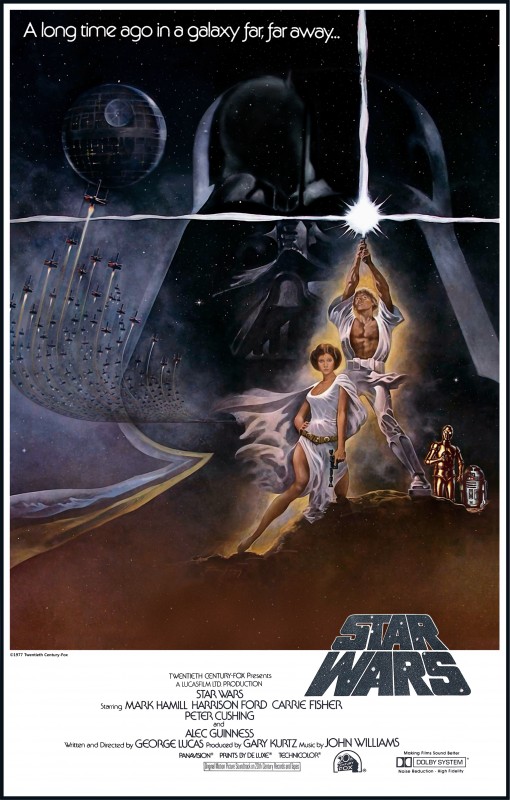
My first exposure to the genre was Star Wars: A New Hope. I saw it when I was seven, right around the height of my dinosaur phase. Everything about the movie completely blew me away, from the Jawas and Sand People of Tatooine to the stormtrooper gunfights and lightsaber duels. After watching Luke blow up the Death Star, I spent the next few hours running around the yard pretending to fly my own starfighter.
In a lot of ways, I’ve never really stopped.
My parents made me wait until I was nine to watch The Empire Strikes back, because it was rated PG. Without any exaggeration, I can say that those were the longest two years of my life. I was literally counting down days by the end, and to pass the time without going crazy, I read up on all the books about space that I could possibly find.
My father bought the original X-wing flight simulator game somewhere around then, and I soon became totally engrossed in it. Since the 386 was our only entertainment system (no Super Nintendo–I had to visit a friend’s house for that), X-wing became the defining game of my childhood. I spent hours and hours on that game, to the point where I knew exactly which simulated missions the characters from the books were flying and how to complete them faster and easier.
I thought The Empire Strikes Back was a little slow the first time I saw it, but it’s since grown on me, to the point where now it’s my favorite film in the whole series. Thankfully, my parents let me watch Return of the Jedi the next day, and for the next few months my life felt utterly complete.
Around this time I discovered the Star Wars novels and soon immersed myself in them. The Courtship of Princess Leia by Dave Wolverton soon became one of my favorites, as well as the Heir to the Empire trilogy by Timothy Zahn and the X-wing series by Michael A. Stackpole.
But it was Roger Allen McBride who first introduced me to a different flavor of science fiction with his Corellia trilogy. As I mentioned in V is for Vast, those books had just enough of a touch of hard science to intrigue me about the other possibilities of the genre. That was the last Star Wars series that I read before branching out into other works of science fiction.
The Tripod trilogy by John Christopher was my first introduction to the dystopian / post-apocalyptic genre, depicting an enslaved humanity after an alien invasion. Those books really captured my imagination for a while. The Giver was also quite interesting and thought provoking, though since it didn’t involve spaceships or aliens it wasn’t nearly as compelling.
I read a lot of fantasy in my early high school years, including Tracy Hickman, Lloyd Alexander, and (of course) J.R.R. Tolkien. While I enjoyed those books and immersed myself in them for a while, my true love was still science fiction. For almost a year, I watched Star Trek: Voyager religiously with my dad. And every now and again, I’d pick out a science fiction book from the local town library and give it a try. That’s how I discovered Frank Herbert’s Dune.
In eleventh grade, my English teacher had us choose an author and focus our term papers solely on their books for the entire year. She suggested I choose Orson Scott Card, but I chose Cormac McCarthy instead. I’m not sure if that was the worst decision of my high school career, or the best decision, since assigned high school reading tends to make any book feel like it sucks. I discovered Ender’s Game the following summer, and finished it in a delirious rush at 3am the morning after checking it out from the local library.
More than any other book, Ender’s Game cemented my love for the genre, and showed me just how powerful and moving the genre could be. It opened so many insights into the world and human nature, reading that book made me feel like I’d opened a pair of eyes that I didn’t even know I’d had. Looking back, that was probably the moment when I knew I would be a science fiction writer. I’d known I was going to be a writer ever since I read A Wrinkle in Time at age eight, but to be a science fiction writer specifically, that goal was probably cemented by reading Orson Scott Card.
After high school, I served a two year mission for my church, during which I didn’t read any novels or watch any TV or movies. When I came back, though, Orson Scott Card and Madeline L’Engle helped me to ease through the awkwardness of adjusting back to normal civilian life. When I left for college, I expanded my horizons even further, starting with Isaac Asimov’s Foundation series and Edgar Rice Burrough’s Princess of Mars.
When I discovered Pioneer Books in downtown Provo, I knew I’d found my favorite bookstore in Utah Valley. I have so many fond memories sitting cross-legged on the floor in the science fiction section, browsing through the musty used books for hours at a time. That’s where I discovered C.J. Cherryh, Arthur C. Clarke, Robert A. Heinlein, Ursula K. Le Guin, and numerous other authors who are among my favorites today.
When I discovered Spin, Robert Charles Wilson soon became one of my favorites. I picked up that novel as a free PDF from Tor, and read it over the summer while studying abroad in Jordan. Once again, that same hard sf sensibility I’d gotten from Roger Allen McBride touched me in an unforgettable way. But it was the human element of that book that really moved me–in fact, it’s always been about the human element. The world building in Downbelow Station was great and all, but the romance of Merchanter’s Luck had a much more lasting impact. Starship Troopers had some good ideas, but it was Mandella’s personal journey in The Forever War that moved me almost to tears. The intrigue of the Ender’s Shadow series was quite entertaining, but it was Ender’s Game and Speaker for the Dead that really taught me what it means to be human.
I finished my first novel, Genesis Earth, shortly after returning from that study abroad, and tried to capture the same sensibility from Spin as well as the intimately human element. Since then, I’ve written several more sci-fi novels, some of them tragic, some triumphant, but in all of them I’ve tried to get as close as I can to the personal lives of the characters. I don’t know if I’ll ever write a character portrait so intimate as Shevek’s in Ursula K. Le Guin’s The Dispossessed, but I certainly hope to someday.
For me, science fiction started out as a wonderfully exciting entertainment and turned into something much more meaningful. If there’s anything the genre has taught me, though, it’s that the two aren’t mutually exclusive–that you can have your adventure and learn what it means to be human as well. Indeed, the more imaginative the adventure, the greater the truths I’ve taken from it.
Because of that, even though I’m almost in my thirties now, I can’t possibly foresee a time when science fiction isn’t a major part of my life. It’s a love affair that’s grown just as much as I have, and continues to grow with each new author I discover and each new book I write. When I’m old and grizzled and pushing eighty, I’m sure there will still be a part of that twelve year old boy in me, still running around the yard flying his starship.
L is for Lost Colony
 As we discussed in I is for Interstellar, space colonization is a major theme of science fiction, especially space opera. Of course, things don’t always go smoothly. Space is a really, really, really big place, and sometimes, due to war or famine or simple bureaucratic mismanagement, colonies get cut off from the rest of galactic civilization. They become lost colonies.
Some of my favorite stories are about lost colonies: either how they became cut off, or how they reintegrate after so many thousands of years. In many of these stories, the technology of these colonies has regressed, sometimes to the point where the descendents may not even know that their ancestors came from the stars. When contact is finally made, the envoys from the galactic federation may seem like gods or wizards.
Because of this technological disconnect, stories about lost colonies often straddle the line between science fiction and fantasy. After all, Clarke’s third law states:
Any sufficiently advanced technology is indistinguishable from magic.
Of course, the line between science fiction and fantasy has always been a fuzzy one. Hundreds of attempts have been made to define it, but they all fall short. In the end, it often breaks down to certain recurring tropes, like dragons and wizards versus ray guns and rockets, but even that doesn’t always work.
For example, Anne McCaffrey’s Dragonriders of Pern is technically about a lost colony far into the future, but it’s got dragons and castles and other tropes that belong squarely in fantasy. Then again, the dragonriders have to fight alien worms who invade every few dozen years from a planet with a highly elliptical orbit, so there’s still a strong science fiction basis undergirding the whole thing.
And that’s just Dragonriders of Pern. What about Marion Zimmer Bradley’s Darkover series, or C.S. Lewis’s Space Trilogy? Trigun is more western than fantasy, but it’s also full of sci-fi tropes like giant sand-crawling monster ships and a weird post-apocalyptic backstory. And then there’s all the Japanese RPGs that combine magic with mechas, with Xenogears as one of the best examples. For a distinct Middle Eastern flavor, look no further than Stargate.
It’s no coincidence that all of these stories feature a lost colony of one kind or another. When the characters don’t know that they’re living in a science fictional universe, it’s very easy to throw in tropes from other genres. By no means is it required–Battlestar Galactica and Dune are evidence enough of that–but they certainly present the opportunity to do so. After all, lost colony stories basically present a hiccup in humanity’s march of progress, breaking the essential science fiction narrative for all sorts of interesting side stories and tangents.
One perennial favorite of science fiction writers is to suggest that Earth itself is a lost colony from some other galactic civilization. That forms the entire premise behind Battlestar Galactica: the original twelve colonies have been destroyed in the human-cylon wars, and the last few survivors are searching for the legendary thirteenth colony of Earth, hoping to find some sort of refuge. Apparently, Ursula K. Le Guin’s Hainish cycle also plays with this trope, though she’s never very explicit with her world building. It can be a bit tricky to twist the lost colony trope in this manner, but if pulled off right it can really make you sit back and go “whoa.”
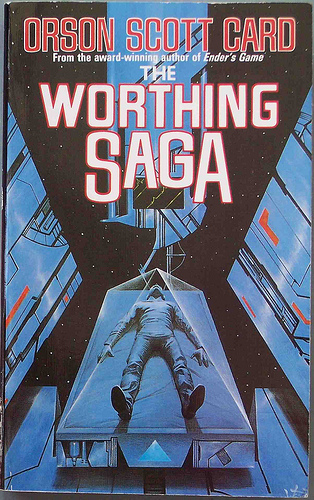
My personal favorite is probably Orson Scott Card’s The Worthing Saga, about a colony of telepaths that breaks off from a collapsing galactic empire and actually becomes more advanced than the rest of humanity. When Jason Worthing and Justice re-establish contact, the descendents of the galactics are basically pre-industrial subsistence farmers who view them as gods–which, in a certain sense, they almost are.
It’s a great story that really entranced me, not just for the science fictional elements but also for the distinct fantasy flavor. Orson Scott Card’s handling of viewpoint in that book is truly masterful, so that I felt as if I were viewing everything through the eyes of his characters. Since the farmers don’t know anything about their spacefaring ancestors, all the parts from their point of view feel like a completely different story. It was really great.
My first novel was actually a lost colony story, combined with a first contact. I trunked it a long time ago, but many of the earliest posts on this blog are all about my experience writing it. As for my other books, Desert Stars contains elements of this, though the lost colony in question is actually a nomadic desert society that lives on the capital planet of the galactic empire, just outside of the domes where all the more civilized folk live. Heart of the Nebula is basically about a society that puts itself in exile in order to escape the privations of the Hameji. And in… no, I’d better not spoil it. 😉
The lost colony isn’t one of the flashier or more prominent tropes of science fiction, but it’s definitely one of my favorites. It’s a great way to add depth and intrigue, as well as bend genres. For that reason, I think this trope does a lot to keep science fiction fresh.