NPR’s Top 100 Science Fiction & Fantasy

In case you didn’t know, NPR just put together a list of the Top 100 Science Fiction and Fantasy novels of all time.  The list had a panel of judges who vetted nominations, but the voting was public and turnout–over 60,000–was pretty high.

I usually don’t like top 100 lists, but this one did a pretty good job representing the genre.  I recognized about 2/3rds of the titles, and most of my own personal favorites were included.

There were a few notable exceptions, however.  David Gemmell wasn’t represented at all–a travesty of the highest proportions.  Neither was C.J. Cherryh, which I find very surprising.  Robert Charles Wilson has certainly written some books worthy of the list, and Dave Wolverton’s On My Way to Paradise–which, I would argue, is one of the best science fiction novels ever written–was notably absent.

Also, a few of the titles were further down on the list than I would have put them.  The Dispossessed by Ursula K. Le Guin came in at #78, while I would have put it at least in the top 20.  A Canticle for Leibowitz did better at #35, but was it really an inferior book to The Handmaid’s Tale?  Come on, people.

One thing I don’t think this list represents well (or top 100 lists in general) is the way in which sf&f fandom has split into dozens of communities and tribes, almost like Darwin’s finches on the Galapagos Islands.  Before science fiction went mainstream, it was possible to follow all the various titles and developments.  Now, however, there’s so much out there that it’s impossible to be fully cognizant of everything.

I think fandom has split into some very distinct communities clustered around the popular authors and sub-genres, and there’s not a whole lot of overlap between them.  None of them are large enough to spawn an entirely new genre (with the possible exception of paranormal romance), but lumping them all into science fiction & fantasy can be a bit problematic.

That said, I think this is a pretty good list.  What do you think?

More thoughts on indie publishing

Since my last post on indie publishing, I’ve been thinking a lot about this subject.  I haven’t decided to take the plunge into self published ebooks yet, but I have decided to make some changes in my writing and my career strategy, in order to position myself more favorably if/when I choose to do so.

Basically, my new strategy is something like Japan or Saudi Arabia’s approach to nuclear weapons: they don’t have an explicit nuclear program (since that would violate the nuclear non-proliferation treaty), but they have gathered the equipment, resources, and expertise together so that if they decided to go nuclear, they could do it in a year or less.

First, though, I attended Brandon Sanderson’s class lecture this Thursday, in which he had some very interesting things to say about ebooks and the publishing industry.  This was part I of his “how to get published” lecture, and here are some of the more interesting points he made:

  • Almost all the indie writers who are making it big have at least one loss leader ($.99 or less) on their list.
  • No one really knows whether indie publishing will be viable for large numbers of writers, or whether authors like Amanda Hocking and Joe Konrath are outliers.
  • Successful indie published books are typically:
    1) short (70k to 80k words)
    2) written in a pulp genre (thriller, romance, paranormal, sword & sorcery, etc)
    3) promoted very well through social networking
  • We have not yet seen any indie successes in epic fantasy, young adult / middle grade, historical fiction, or non-fiction.
  • The produce model vs. unlimited shelf space argument for going indie doesn’t apply as much to science fiction & fantasy as other genres, because:
    1) sf&f stays on the shelves in bookstores longer than other genres
    2) sf&f series grow better with a big push on the first book
    3) sf&f makes a lot of money on hardcover, unlike other genres

A lot of these points tend to mesh with what I’m hearing from my other sources–and Brandon really represents the last of the successful writers to make it big on the old model, before the ebook revolution began to take off.  He doesn’t make as big a deal on the current 25/75 split on net ebook sales as I would make, but then again, he’s making most of his money through print.

So anyways, here is what I plan to change about what I’m doing in order to better position myself to best take the ebook plunge, if/when I decide to do so:

1) Write at least 2 polished novels per year

Kris Rusch and Dean Wesley Smith make very good arguments about how being able to write well quickly is a huge asset for a writer these days.

There are many good reasons for this:

1) Writing faster gives you more practice with craft, which tends to improve quality.
2) The best way to promote  your books is to constantly write new books.
3) The limited shelf space argument against writing quickly is now moot with ebooks.

In particular, I want to increase my writing speed in order that I can have a larger list to put out if/when I decide to go with indie publishing.  It’s much harder to be successful if you’ve only got one book available for sale; if/when I decide to take the plunge, I want to have at least three.

So far this year, I’ve finished one (Bringing Stella Home), but that’s because it was already sitting in the queue and only needed a quick touch up.  I would like to get Worlds Away from Home polished before the end of the year, and possibly one other project, such as Edenfall.

2) Reduce production time to as close to one year as possible

Right now, it takes me on average about two years to write a polished, salable novel.  That’s not a problem, because I have a lot of projects in the queue, but it’s not as fast as I would like.  I wrote Genesis Earth and Bringing Stella Home while I was still a journeyman writer, figuring out my craft.  I should be able to produce a lot faster.

Towards that end, I’m going to try to get Edenfall finished and polished within a year.  Since it’s already March, that might mean getting it polished by February of next year, but I still want to try.

My biggest weakness is first drafts; I always tend to get stuck midway and drop the project for a while before I feel ready to finish it.  That’s something I would like to change.  Then again, that might just be part of my writing process, and shouldn’t be forced.  However, I certainly could go through my revisions much faster.

3) Write out the direct sequels while the first book is still unpublished

Previously, I thought it was a bad idea to write out all the books in a series or trilogy before the first one is ever picked up.  After all, a rejection from a publisher on the first book is a rejection on all the other books in the series as well.  Using this reasoning, it was much better to write the first book of another trilogy, in order to maximize how much I could submit at any given time.

With indie publishing, however, it’s much better to release the whole trilogy all at once, so that readers who finish the first book can immediately pick up the others.  Again, the paradigm here is that the best way to sell books is with other books; if they loved the one, they’ll buy the others, especially to find out what happens next.

Of course, the best model is probably to have an open series with several indirect sequels with recurring characters in the same world.  With the Gaia Nova books, that’s exactly what I plan to do: Worlds Away from Home is set in the same universe as Bringing Stella Home, but with different characters and different story arcs.

However, Genesis Earth has serious trilogy potential, and with Edenfall I’ve decided to actually write the other books.  If/when I decide to take the plunge, I want to be able to release at least the first two books in that trilogy at the same time.  In fact, Genesis Earth is perhaps the biggest reason why I’m thinking so seriously about going indie, but that’s a subject for a whole other post.

4) Experiment with pulp genres such as space adventure stories

When Brandon said that the pulp genres tend to do better, I wasn’t sure whether that includes what I write.  I write primarily science fiction, but not the kind of stories you’d read only for entertainment and promptly forget once you’re finished.  If anything, I want to write more like Ursula K. Le Guin, whose stories are so meaningful they stick with you long after you’ve finished them.

Then again, there tends to be a lot of overlap in science fiction between the thoughtful, meaningful stuff and the pulps.  Ender’s Game and Starship Troopers immediately come to mind as awesome, entertaining stories that also have a lot of depth.  In his lecture, Brandon made it clear that “pulp” does not necessarily conflict with high art–just that the primary purpose of the story is to entertain.

I can live with that–and I actually have several story ideas that would translate well with the pulp mentality.  I’d like to do a novel (or a series of novels) with Danica from BSH and her mercenary team, perhaps as a sort of origin story for Roman, Anya, Artyom, and the others.  I’d like to revisit the Hameji as well, with a sort of “Ain Jalut in space” involving Sholpan’s son (BSH was basically the Mongol conquest of Baghdad in space).  I’ve already started an “Odyssey in space,” as told from a female Telemachus character–that’s To Search the Starry Sea.  All of these are, at their core, space adventure stories, and might translate well as pulps.

5) Commit to releasing one book every 6 months if/when I take the plunge

This is related to the first strategy on the list, but it’s more of a business plan than a personal writing goal.  Basically, if/when I take the plunge, I want to:

1) have at least 3 finished, polished books to put out at first,
2) know that I can put out one book every six months at least.

This not only means developing a backlist, it means doing some soul searching as a writer to find out how difficult it is to keep up with this pace–and adjusting my writing habits accordingly.  I’m optimistic that I can, but it’s something of a paradigm shift, and I want to make sure I’ve made that shift before I take the leap.

Anyhow, these are my thoughts on how to alter my current writing strategy.  I haven’t yet decided to go indie, but when the time comes, I think that these things will help me to maximize my potential if/when I decide to do so.

Of course, what do any of us really know?

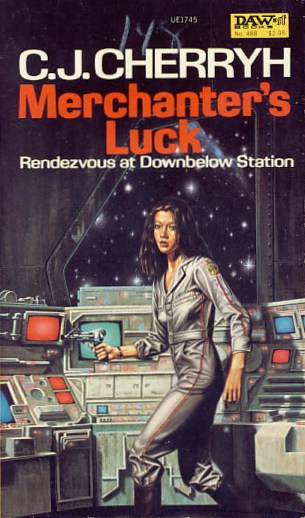
Merchanter’s Luck by C. J. Cherryh

He was a down and out merchanter, the captain, crew, and sole proprietor of a run-down bucket of bolts spacecraft.  She was a daughter of one of the finest starfaring clans, with seven hundred cousins standing between her and the one thing she wanted more than anything else: command of a starship.

They met at Pell during the height of the Company War–the key strategic point on the border between Union and Earth.  Their fateful meeting would affect not only the outcome of the war, but the course of their own lives–for the starship Lucy of Wyatt’s Combine was not at all what she seemed to be.

Before I review this book, I need to issue a disclaimer: you probably aren’t going to enjoy it very much unless you’ve already read Downbelow Station.  Cherryh isn’t the best at easing her readers into her worlds, and without the background on Union, Alliance, and the Company War, you’ll probably be hopelessly lost.

That said, I absolutely loved this book.

The premise is so awesome.  Space adventure hardcore, with a beautiful love story set amidst an epic interstellar war, where alliances are constantly broken and no one can be trusted…oh man, I LOVED this book!

While the premise seems pretty standard, C. J. Cherryh transcends the well-worn tropes and cliches of her genre by intimately developing her characters and working their motivations into the story until they are the ones driving the plot, and not the other way around.

Every character is unique, and though they act in ways that may seem strange to our modern sensibilities, there are always reasons for everything they do, cultural or otherwise.  As windows into their far-future spacefaring culture, they give the reader a wonderful view of Cherryh’s unique and marvelously constructed universe.

The thing that surprised me the most, however, was the sharp contrast between this book and Downbelow Station. While Downbelow Station traces the epic arc of the Company War through the viewpoints of a large cast of characters, much like Tolkien or Dune, Merchanter’s Luck focuses more on the characters themselves, in much the same way as David Gemmell or Ursula K. Le Guin.  In other words, while Downbelow Station is comparable to “high” or epic fantasy, Merchanter’s Luck would fall closer to “low” fantasy or sword & sorcery.

The interesting self-realization I took from the book was that I’m much more interested in the intimately personal stories than the sweeping epic tale of the Rise and Fall of cultures and civilizations.  I suppose that’s why I’m more of a David Gemmell nut than a Tolkien fanatic, and perhaps why I’m more into space opera and military sf than epic fantasy.  In all of my novels, the focus is always on the individual characters and their personal conflicts, and whenever I get sidetracked and focus too much on the overworld story, it always falls apart. 

Merchanter’s Luck definitely doesn’t get sidetracked, and that’s why I loved it so much.  I fell in love with the characters almost from the very first page–from the blurb on the back cover, even.  And most of all, I fell hopelessly in love with the starship Lucy:

You know you’re doing science fiction right when your readers bemoan the fact that they weren’t born in the 26th century, when they could command their own spaceship.  C. J. Cherryh is an amazing writer, and if I had the chance, I would teleport into her Union-Alliance universe in a heartbeat.

If you love well-crafted far-future worlds and stories about the people that live in them, check out Downbelow Station (or really, just the first chapter–that’s all you need for a solid grounding) and read this book!

Falling back into the groove

Today I surprised myself and wrote nearly 4k words, some of which might actually be good enough to keep.  Huzzah!

The novel is coming along very nicely, and I’m starting to get really excited with where it’s going.  That’s huge, because up to this point, the nagging “this is crap, what are you doing with your life?” voices have been getting me down.  Yeah, the draft I’m writing will need a lot of work, but the story’s got potential, and I can see it.  That’s the most important part.

The interesting thing was that after pounding out the first thousand words, the writing started to really flow.  The right words and phrases started coming quite naturally, almost on their own, instead of waiting for me to mercilessly hunt them down.

An example:

The weather was perfect–sunny, clear, and neither too hot nor too cold. Upset by the sound of their engines, flocks of pretty white birds took to the air, filling the sky around the green banks like noisy, low-flying clouds. Down in the cabin, Kariym began to sing a lilting ballad about a young boy in love with his brother’s betrothed. His deep bass voice bellowed over the roar of the engine, lifting Jalil’s spirits. It was a very good day to be alive.

They rode upstream over the river for the next hour. Almost immediately they left the main body of the convoy far behind, taking the reconnaissance position for the advance guard. Occasionally, they passed a town or a bridge–magnificent works of steel and stone that soared over their heads, spanning the entire vast width of the river. Mostly, however, the banks were empty and unsettled–nothing but long, straight stretches of thick green bush, with the occasionally rocky outcropping to break the monotony.

Of course, the writing’s not perfect–I’ll be the first to say that it needs considerable work–but at least it’s decent.  Decent for a rough draft.

One of the most annoying things about writing is when I unconsciously break into alliteration.  I’ll write a sentence, only to realize that I can’t let it stand as it is because every noun, verb, and adjective starts with the same sound.  Like that last phrase: “starts with the same sound.” Augh!

I’m finding, though, that when used in moderation, that tendency towards alliteration can be somewhat helpful.  There’s nothing quite as pleasurable as reading a good story with delicious, flowing prose, like Ursula K. Le Guin’s The Dispossessed or Robert Charles Wilson’s Spin. Excellent books.  I’d be more than happy if I could write as beautifully as them someday.

In the meantime, though, I’m just plugging away, trying to make the next chapter, scene, paragraph, and sentence better than the last.  Fortunately, now that I’m excited about the story again, things are going very nicely.

Oh, and happy fourth on the fifth.  I spent most of the day with family (not writing), bouncing around Provo and doing various stuff.  I’ve got a ton of chores to do tomorrow, though, so I’d better get to bed.  Night!

Red Mars by Kim Stanley Robinson

For eons, sandstorms have swept the barren, desolate landscape of the red planet.  For centuries, Mars has beckoned to mankind to come and conquer its hostile climate.  Now, in the year 2026, a group of one hundred colonists is about to fulfill that destiny.

I first picked up this book two and a half years ago, when I was still trying to read a novel a week.  I’ve got to be honest; this was the book that made me break that new years resolution.  It is freaking huge, and some points are more interesting than others.

That said, this is an awesome piece of hard science fiction.  Lots of people have written about Mars, but very few have done it believably.  Kim Stanley Robinson does an job here–you can tell that he put in a ton of research, both into Martian geography (areology?) and feasible technology.

When I read science fiction, however, that’s not what I generally read for.  I’m more interested in characters, conflict, and thematic elements–in other words, the stuff that makes for a good story.  As far as that stuff goes, my opinion of Red Mars is somewhat mixed.

For example, the first chapter starts out with a murder, as seen from the point of view of the murderer.  Right away, I’ve got a reason not to sympathize with the main viewpoint character.  When we get into his mind and I see his motivations for killing the character, I like him even less–and he’s one of the main, driving characters.

Some of the characters are more sympathetic, and I enjoyed the sections in their point of view.  Others, however, were just plain boring–I neither loved them nor despised them.  Because of this, a lot of the character drama early in the novel didn’t engage me much; stuff was happening, but I didn’t really care.

When it comes to setting, Red Mars is also somewhat mixed.  Robinson goes to great depths to describe the Martian landscape, and several of his setting descriptions were quite interesting and wonderful.  At the same time, he explains everything in a very clinical, scientific way–his imagery is never as poetic and captivating as Ray Bradbury’s, or Ursula K. Le Guin’s, or George R. R. Martin’s.  I came away with a lot more knowledge about Mars, but not quite as much of a sense of wonder.

Things did get interesting once the political tensions started to come into play.  Robinson’s portrayal of the colonization of Mars raises a lot of interesting questions about the political relationship between Earth and Mars once those colonies start to become self-sufficient.  He follows things through right to the war for independence, and the implications of the conflict are quite interesting.  I finished the last hundred pages or so at a sprint.

All in all, I wouldn’t recommend this book unless you’re already a fan of hard science fiction.  Like most hard sf, character and conflict plays second string to scientific plausibility.  Within its sub-genre, however, Red Mars is awesome.  Let’s just put it this way: even though I got bored with it the first time, I knew I would one day pick it up and finish it.  I don’t regret that I did.

Christmas break 2009

Christmas was great this year!  I spent it in Texas, with my extended family–the family on my dad’s side, who I almost never see.  The break has been a lot of fun so far!  No school or work obligations, lots of time to lay back and relax, plenty of games to play and books to read, plus fun people to hang out with–it’s been great!

Most of my cousins are young teenagers right now, and are a lot different than I remember.  However, I was able to get some presents for them that I think worked out well.  David is into his iPod, so I got him some U2 albums (How to Dismantle an Atomic Bomb and Joshua Tree).  Savannah and Nash are both avid fantasy readers, so I got Savannah Mistborn: The Final Empire and Nash Victory of Eagles (the one chain bookstore in Midland didn’t have His Majesty’s Dragon, so I got him another from the series).  Daniel, I didn’t know what to get, so I gave him my old camera.

Ashley (who is older) was telling me about how she lived abroad and wants to spend some time in Australia, so I got a travelogue on Australia by the same guy who did A Walk in the Woods. Based on her reaction, I think she’s going to like it!

It was much easier to get stuff for direct family, since I know them better.  For Kate, I got Soulless, a steampunk / paranormal mystery novel that had an awesome release party at World Fantasy 2009.  I don’t know if she’ll like the book, but the party was very steampunk / regency fantasy with the cosplayers, so I think she will.  I got Danny The Screwtape Letters, since I know he likes that kind of religious fiction–turns out he’s been meaning to read it for a while!  Mykle, I got the first book in C. S. Friedman’s latest series, since I know that she’s his favorite author–24 hours after Christmas, he’s already 200+ pages into it!  And for Sarah and Mykle, I got them both $20 gift certificates to Pioneer Book in downtown Provo.  They were very happy with that!

I wish I’d had the time to get presents for everyone in the family, but with moving out, coming here so quickly, and not having a car (or much of an idea what they wanted), it just wasn’t very practical.  I did get my mom a gift certificate to B&N, but I haven’t gotten anything for my dad yet.  I will, though–he wants stuff from our Christmas memories, and I happen to have all my old childhood journals in my carry on luggage.  Lots of Christmas memories in those!

I’m satisfied with what I got, even though it wasn’t all that much.  Besides the generic clothes, socks, ties, candy, popcorn, and other stuff, I got a spiffy tool kit from Robin and a flexible tripod from pop.  Very nice!  They will add some weight to my luggage, but I think I can give some of it to mom or pop to bring home.

As far as writing goes, I’m less than 13k words from the end of Bringing Stella Home 2.0.  It’s not quite ready for alpha readers yet, but I want to get it ready soon (it’s going to take so much work! <sob>).  If I average 2.6k words over the next five days, I’ll have it finished in time to start something new by new years!

That’s the goal.  As for what the next novel is going to be about…let’s just say it’s Homer’s Odyssey meets C. J. Cherryh and Ursula K. Le Guin in space, where Telemachus is a girl and the story is primarily from her point of view.

I hope I can pull it off!

The Dispossessed by Ursula K. Le Guin

Urras and Annares, a world and its moon, separated by the gulf of space and two hundred years of mutual contempt.  On Urras, capitalist and socialist nations vie for dominance over the world’s rich and abundant resources.  On  Annares, the anarchist exiles scrounge for a meager living, but live in peace–and in hope.

Shevek has never known any other world than the anarchist utopia of Annares.  His life’s work is to develop a unified theory of simultaneity–a tremendous feat that will rework the paradigm of space travel and communication.  When the people of Annares reject his theory, however, he voyages to Urras in the hopes that by offering his theory as a gift to all nations, he can bridge the gap between the worlds.

Hopelessly inexperienced in the cutthroat ways of the propertarians, Shevek has no idea what he is getting himself into.  In his gilded prison, with nations vying for control of his person, can he find allies who share his idealistic, utopian vision?  Or is he alone in a world of greed, lies, and murder?

This is, quite possibly, one of the most impressive and beautiful works of literary science fiction that I have read.  It may be the best novel I’ve read all year.  Le Guin’s characters are so deep, her ideas so compelling, her worlds so rich, her writing so poetic and beautiful that I hardly know where to start.

One of the many things that made this book so good was the depth of Le Guin’s character development.  The story had a plot, and Le Guin dropped just enough pieces of it here and there for you to know that there was one, but more than anything this book is a portrait of an incredibly interesting man, Shevek.

The book actually contains two stories that merge into one in the end.  One taking place in the present, after Shevek arrives at Urras, and the other is a series of flashbacks showing how he arrived at that point.  Le Guin alternates brilliantly between past and present to reveal insights into Shevek’s character that would otherwise remain unexplored.  By the end of this novel, I felt that I knew this man–and loved him–better than anyone in real life, including myself.  It blew me away.

Le Guin’s worldbuilding, too is incredible.  Before reading this book, I didn’t consider myself an anarchist, but after spending so much time in the utopian society of Anarres, I almost want to become one.  Le Guin meticulously extrapolates her world from her highly perceptive understanding of human nature, paying such attention to detail that her anarchist world is not only surprisingly plausible, but enviable as well.  This is the kind of world that I would like to visit, explore, and perhaps even settle down in and live.

Her ideas, like her world, are meticulously well thought out and incredibly compelling.  In the Hainish cycle, Shevek is the inventor of the ansible drive, the technology that eventually enables peaceable diplomatic missions to other worlds, such as the one chronicled in The Left Hand of Darkness. Shevek’s struggle is to find a way to let this technology bring peace and break down walls, rather than empower tyrants to conquer and destroy.  Time and again, Shevek’s egalitarian, anarchist values come to the surface, clashing not only with those of capitalist Urras, but with our own.

All of this would be enough to make this a compelling, memorable story–but Le Guin’s stunning, beautiful prose puts this book into a league of its own.  The rhythm and beauty in her words made every page a joy to read, with descriptions that kept me entranced and dialogue that made her characters leap off of the page.  Above all, her prose conveys with powerful and compelling clarity the many life-changing ideas and themes of this story.  The book’s last words still haunt me.

The Dispossed is, without a doubt, is one of the best works of Science Fiction that I have read.  I would even go so far as to claim that it is a superior book to Le Guin’s better known work, The Left Hand of Darkness. If I could read a book this insightful every month, I would be a much better man, and have a much deeper and imaginative understanding of the world than I presently have.  This book is a true masterpiece.

Convention jitters

World Fantasy starts in less than 72 hours, and I’m getting nervous about it.  Really nervous.  This is the first big-time science fiction convention I’ve ever been to, and I’m worried that it will be too intimidating, or that I’ll make a fool of myself, or that I won’t put myself out there enough, or…

All the same, I’m expecting to have fun.  Lots of fun. 🙂

But between now and 5:00 am Thursday morning (when we take off for California), I have to: 1) grade 20 papers, 2) take a midterm, 3) write two essays, 4) run at least 30 regressions, 5) read 2 poli sci articles, and 6) finish American Babylon and write up a report on the last three chapters.

Yeah.  Not fun (except the regressions–what can I say, I’m a nerd).

In unrelated news, I met an interesting girl at Leading Edge last week.  She’s at least as much of an sf&f fan as I am, and one of the very, very few girls I’ve met who prefers science fiction over fantasy.  Somehow, she convinced me to read The Dispossessed by Ursula K. LeGuin with her (or maybe I convinced her to read it with me?), but I started it tonight, and it’s really good.

Technically, I’ve got a class for Washington Seminar that I should go to tomorrow…but I can skip it and listen to the mp3 while I’m driving to California.  Don’t want to miss Leading Edge this week, for obvious reasons.

Speaking of which, if I don’t go to sleep right now, I’m going to be barely functional for the next two days.  Not good.  G’night.