Planning out the next year of writing

I’ve made some major changes to my writing process recently, mostly having to do with the accountability systems that measure my writing productivity. Instead of tracking daily word count, which I’ve done consistently for the better part of the last decade, I now track my average daily words per hour across all writing sessions.

What I found by tracking word count was that my writing and my family life were consistently coming into conflict, which wasn’t good for either. With three small children and a wife who no longer works from home, I’m currently in a season of life where I simply cannot dedicate as much time to writing.

So instead, I’m striving to do just enough writing each day to keep my writing skills sharp, so that when I do get the opportunity to dedicate a whole day or a whole weekend to writing, I can make the most of it. So instead of measuring the quantity of writing I do each day, I’m measuring how efficiently I can use my writing time, and striving to maximize that.

Over the holiday break, I also did quite a bit of thinking over all my current writing projects and how I should prioritize them in the coming year. Basically, for each WIP, I asked myself two questions: “how would I feel if this was the only book I wrote in 2026?” and “how would I feel if I never made any progress on this book for the rest of the year?” Based on that, I put my current novel WIPs in the following order:

  1. Captive of the Falconstar
  2. The Soulbond and the Sling
  3. The Unknown Sea
  4. Lord of the Falconstar

More than any other book I really want to finish Captive of the Falconstar this year. It’s science fiction, not fantasy, but it’s part of an unfinished trilogy that I’ve been committed to finishing for quite some time now. Even though I want to pivot to writing fantasy, I don’t want to leave a bunch of unfinished series as I do that. Also, it’s a really good book that I think that readers of the first book, Queen of the Falconstar, will find immensely satisfying. So I really want to finish and publish this book this year.

I don’t know exactly how long it will take me to finish it. Hopefully sometime around the spring, at which point I’ll put it up for a 2-3 month preorder. But I’m pretty overwhelmed with my other obligations right now, especially family, and we haven’t yet gotten into a good routine with my wife’s new job. So it might take a lot longer than that. But I am consistently working on it a little each day, and I expect it will be finished and published by the end of the year.

But even though I want to make progress on this series, I actually don’t want to lay everything aside to finish it. Which is why the next two books, in order of priority, are both fantasy. The Soulbond and the Sling is one that I really want to finish writing this year, even if I don’t end up publishing it in 2026. As I’ve said in previous posts, I don’t want to launch this new epic fantasy series until I have the first three books finished and ready to rapid release.

But I already have a complete human-revised AI draft of this book, so all I have to do now is go through and rewrite it in my own words. That’s going to take some time, simply because it’s such a massive book, but I want to get it done and finished and ready to publish, even if I end up holding off on that for the next couple of years.

Of course, while I continue to work on The Soulbond and the Sling, I will also continue to work on book 2, The Soulbond and the Lady. The rough AI draft of that book is already complete, but the final AI draft is going to take a lot of work, so it will probably take me as long to finish that as it takes to write and revise the final human draft of book 1. So I probably won’t finish The Soulbond and the Lady this year.

If I can finish a third book, I would like it to be The Unknown Sea. This would be the fifth installment in the Sea Mage Cycle, and so far, it’s been one of the funnest books to write. If you’ve enjoyed the other books in the series, I think you’re really going to enjoy this one, and I would really love to get it out there for everyone to read. Like all of the Sea Mage books, this one is relatively short, so finishing it shouldn’t be too difficult. It’s just a matter of making the time.

One thing you may notice is that I haven’t included any of the Christopher Columbus books in this lineup. After giving it some serious thought, I’ve decided to put that series on hold for the forseeable future. I just think it’s more important to pivot to pivot to writing fantasy, which means finishing all of the unfinished science fiction trilogies and writing new fantasy books to release in the coming years. 

So that’s my writing plan for 2026. I may also start a new WIP at some point, just because I can’t help myself—in fact, I rather expect it. But if and when I do, I’ll probably take it no farther than the rough AI draft before putting it on the back burner. In fact, it might be a good idea to put several such projects together, outlining and prewriting them just enough that I can pick them up and run with them when I’m ready to commit to such a project. That should scratch my creative itch just enough without taking too much time from the WIPs I’m committed to finishing.
2019-07-25 Newsletter Author’s Note

This author’s note originally appeared in the July 25th edition of my author newsletter. To sign up for my newsletter, click here.

So Mrs. Vasicek has been sick with the flu for the past two weeks. She’s getting better, but we’ve both been less than productive, and any semblance of a daily routine has basically been shot. Turns out that having your wife around all day is a very distracting thing. Who would have thought?

All of this has got me thinking about habits and routines: how important they are, how to make them work, and how not to get discouraged. I’ve been self-employed basically since graduating from college nine years ago. I’ve worked a lot of side jobs, but nothing that I’d call a “day job,” at first because there weren’t any (graduating in a major recession is tough), and later on because I wanted to focus on my writing career—which so far, has been working out.

When you’re self-employed, you basically have to make your own daily routine, because there isn’t anyone else to make it for you. A lot of people struggle with this, especially after quitting their day jobs. If you aren’t careful, you’ll find yourself sitting on the floor in your underwear eating peanut butter straight from the jar (not that I have any experience with this, of course). But if you buckle down and push through that phase, you learn a few things.

First, you learn that even the best routines always fall apart at some point. It’s just the nature of the beast. The circumstances of life are always changing, which means that you’ve got to be constantly adapting to them. Hanging on doggedly to a favorite routine just for the routine’s sake is setting yourself up for failure. Goals are a mean to an end, not an end in themselves.

Second, guilt is not a very good positive motivator. It’s helpful to keep you from doing the things you shouldn’t be doing, but it’s a horrible way to get yourself to do the things you should. I’ve known a lot of writers who constantly beat themselves up for not meeting their writing goals, to the point where it’s practically a full-time job. For a while, I’ve been there myself. Not good.

The best way to make yourself more productive is to find ways to make it more enjoyable. Personally, I find that writing is most enjoyable when I’m immersed in the story that I’m trying to tell. Sometimes, the best way to get immersed is to take a break, and sometimes, the best way is just to sit down and write. It takes a while to figure out what works. I’m still trying to figure it out better.

Third, when making a new routine, make sure to keep your eye on the end goal. What good is eating an elephant one bite at a time if you’re eating the wrong elephant? That’s why, when your routine starts to fall apart, it may be better to rethink what you’re trying to accomplish and rebuild it from the ground up, even though it’s easier just to tweak it.

That’s where I’m at right now. I could just push my deadlines back a couple weeks and try to go back to how things were going, but there’s a lot of other business related stuff on my plate that I’ve been neglecting, and I get the impression that the best way to move forward with writing is to prioritize that other stuff and get it out of the way.

Breaking down the elephant

I came to a realization about productivity just recently. It’s one that I’ve known for a while now, but never really applied to my own quirks and strengths.

In order to accomplish a massive, multi-stage task (like writing a novel), you have to break it down into manageable chunks first. Otherwise, you’ll just get overwhelmed. If you try to eat an elephant in one sitting, you won’t be able to do it, but if you process the ground elephant meat into meal-sized tupperware containers, put some recipes together, set a meal schedule, and freeze the meat until you need it, then eating an elephant becomes much more doable.

The question is, what’s the best way to break down the elephant? The answer, of course, is that it depends on the person.

Some writers break their WIPs down into chapters. Others prefer raw word count as a measure of progress. Others use story beats, or a timer, or a hard and fast deadline. A lot of writers don’t use much of a system at all, which is probably why so many of them fall behind.

The hardest part of writing is often just getting yourself to sit down and do it. The blank page really is the most intimidating part of the job. If I had to guess, I’d say that about 50% of writer’s block is not having a good way of breaking down the elephant. And by “good system,” I mean one that is personalized to work for you.

I’ve tried out a lot of systems that didn’t really work—for me, that is. I’m sure they work just fine for other people.

For a long time, I used raw word count, but then I found myself cutting corners by dropping a project and going back to revise a half-finished one, just to get a higher word count boost. After that, I started tracking hours worked per day, but again the quality of my work fell as I started looking for busywork just to feel like I’d accomplished something.

I bounced back and forth between unfinished projects, sometimes starting new ones, sometimes making progress on old ones. Every once and a while, the story would hit me in just the right way to compel me to finish it, which is how I’ve finished probably 80% of the books I’ve written over the past three years. But that’s a very unreliable way to write books.

Then I started using a timer to break my work down into short, measurable writing sessions. The main reason I did this was to work my way up to hitting 10k words in a day (something I’m still working on). The idea was to develop more focus and train myself to write faster. What I didn’t realize until now was that this is a great way to break down the elephant.

Before, I would wake up in the morning and think “how am I going to write X,XXX words before the end of the day?” Understandably, this was a bit intimidating, and over time it tended to grind me down. But now when I wake up, the question is “am I ready for the day’s first writing session? Why not—it’s only 20 minutes.” And then I’m off.

Now, I’m not completely in that mindset yet. I still tend to think in terms of daily word count, which can make me fall back into the old habits of procrstination. And if the day starts off with something non-writing related, it can really throw me off. But using this method, I was able to get through 66% of Gunslinger to the Stars in about six weeks. And if I keep working on it, I’ll bet I can accomplish much more.

I do not consider myself a fast writer. Some of my professional writing friends think that I’m fast, but there are tons of indies out there who write much faster (and better) than me. But a lot of it really just comes down to the psychology of breaking down the elephant. And now that I’ve got a system, I just need to be better about using it.

If you guys are interested in keeping track of my writing progress, I’ll go back to using the WIP progress bars. I took them down in order to keep the sidebar from getting too cluttered, but that is a major reason why readers come to an author blog (to see the ongoing progress on the author’s next book), so I’ll redesign things a bit and figure it out. It would certainly help me to get back on the horse, knowing that people are following this sort of thing.

Right now, I’m about 35k words from finishing The Sword Keeper, a project I’ve been working on and off on for the last four years. It’s a fantastic book, perhaps even the best I’ve ever written, and getting it done is going to be huge.

After that, I’ll probably finish Gunslinger to the Stars. Put it on the back burner after LTUE, but it shouldn’t be too hard to finish it up. It’s a rip-roaring adventure that doesn’t take itself too seriously, and I could frankly use the break.

And then? I think it may be time to finish the Genesis Earth trilogy. Book two, Edenfall, has been on the back burner for a looong time (almost five years), but there seems to be a lot more interest in it now, with sales of Genesis Earth increasing and readers posting reviews that say “can’t wait for the next book!” When you guys speak, I listen.

So that’s the plan for the next couple of months. Beyond that, I have a couple of short stories coming out soon, so be sure to keep an eye out for those.

Thanks for reading!

George R.R. Martin may not be your bitch, but I am

Last week, George R.R. Martin surprised no one and disappointed everyone when he announced that The Winds of Winter would not come out before the next season of the Game of Thrones TV series that covers the events in that book. He apologized profusely to his fans, most of whom seemed to take it graciously, at least to his face. However, it spawned some heated discussions in the online communities that I frequent (most notably The Passive Voice) about the implicit contract between writers and reades.

This discussion is not new, even with regard to Mr. Martin. Way back in 2009, Neil Gaiman addressed this issue in a blog post where he stated quite memorably that “George R.R. Martin is not your bitch”:

People are not machines. Writers and artists aren’t machines.

You’re complaining about George doing other things than writing the books you want to read as if your buying the first book in the series was a contract with him: that you would pay over your ten dollars, and George for his part would spend every waking hour until the series was done, writing the rest of the books for you.

No such contract existed. You were paying your ten dollars for the book you were reading, and I assume that you enjoyed it because you want to know what happens next.

So that’s one end of the spectrum: that writing is an art, that it can’t be forced, that trying to force it is wrong, and that writers have no obligation to their readers to force anything. Readers should not stalk their favorite writers or tell them what they should or should not be doing to produce the next book. As Mr. Martin said in his latest post:

Unfortunately, the writing did not go as fast or as well as I would have liked. You can blame my travels or my blog posts or the distractions of other projects and the Cocteau and whatever, but maybe all that had an impact… you can blame my age, and maybe that had an impact too…but if truth be told, sometimes the writing goes well and sometimes it doesn’t, and that was true for me even when I was in my 20s.

On the other end of the spectrum, we have Larry Correia. Two days after Mr. Martin announced that The Winds of Winter would not be finished in time for the TV series, Mr. Correia announced his own plans for the year: which of his books are coming out, which books he plans to write, which project he’s going to collaborate on, and which conventions and events he will (or more notably, will not) be attending.

I don’t know whether he meant this as a dig at Mr. Martin specifically, but he included the following statement:

To all those sensitive artist types who whine about how they can’t rush art, and can’t get any writing done, oh, BS. Quit your crying, put your big girl panties on, and treat it like your job. Because it is a REAL JOB. And like all real jobs, if you don’t work then you shouldn’t GET PAID. So shut up, quit screwing around, and get back to work.

The part that really stood out to me, though, was his announcement that he would not be at DragonCon or GenCon this year:

I’m skipping DragonCon and GenCon this year, which pains me because I love those, but again, I’m trying to up the novel production, and all those cons in a row over the summer kick my butt.

I found it interesting because George R.R. Martin is well-known as a frequent convention attendee, to the point that by his own admission attending these conventions is his “way of life.” Larry Correia knows that his writing productivity takes a hit when he attends too many conventions, but George R.R. Martin either doesn’t know or has chosen to prioritize attending fannish events over his own writing.

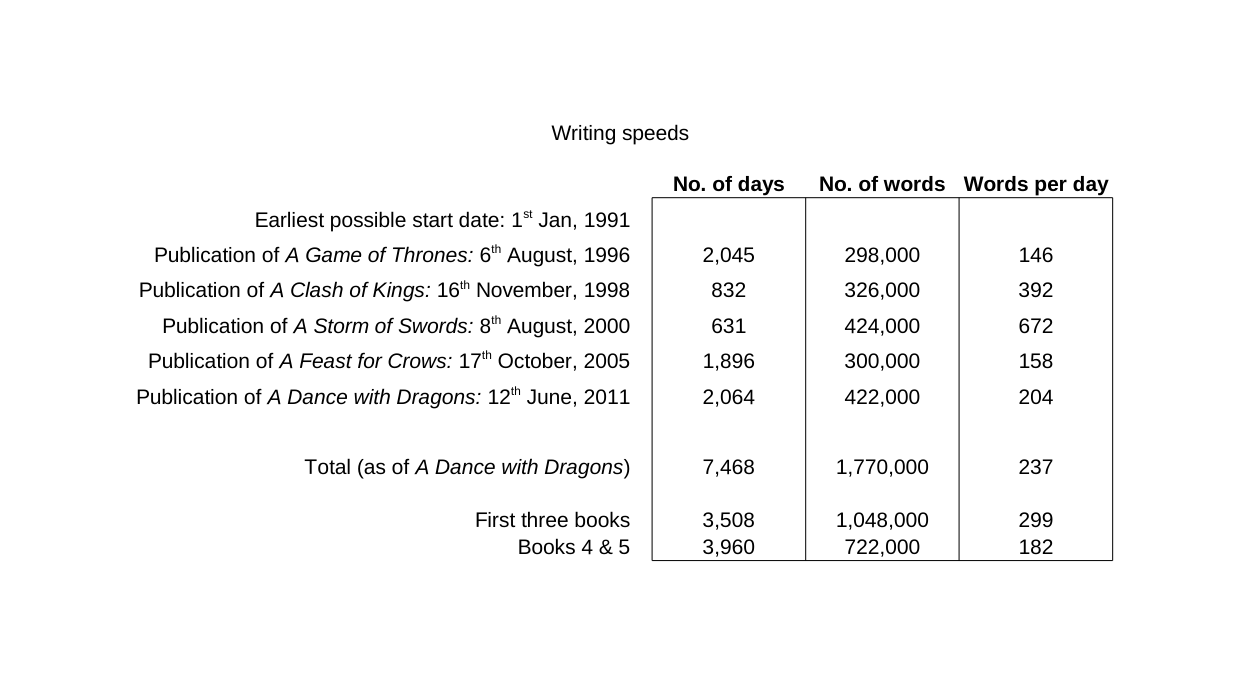
This made me curious about Mr. Martin’s writing productivity, so I did a little digging and found the following figures, calculated by his fans:

grrm_wordcount

Those numbers are rather stunning. He averaged only 200 words a day when writing A Dance with Dragons? Just for reference, this blog post is about seven hundred words so far, and I’m writing it while taking a break from my other writing (word count so far today: 1,100 words, and that’s a little low). Even if we allow for five drafts written at the same speed, five drafts still only comes to 1,000 words a day.

Now, I do think Mr. Gaiman makes a good point that it is neither healthy nor helpful to try and micromanage everything that a writer does. We can’t spend every waking hour working on the next book, and even if we did, it probably wouldn’t turn out as well, because refilling the creative well is an important part of the writing process. And I also have to admit that if you ran a similar calculation on my own books (especially the early ones), you would probably find some similarly embarrassing figures.

(Though to be fair to myself, I tend to have multiple irons in the fire at any given time, so a straight start date to publication date calculation doesn’t tell the whole story—and it probably doesn’t tell the whole story with George R.R. Martin as well. But still, even if those figures were twice as high, they would still be absurdly low for a working writer.)

When Mr. Gaiman and Mr. Martin say that the writing “comes when it comes” and there’s nothing they can do about it, I think they’re wrong. Dead wrong. Writing is an art, but it is also a craft. It can’t be forced, but it can be structured. Mr. Correia has evaluated how productively he writes and structured his convention-going plans accordingly. Has Mr. Martin?

I also think they’re dead wrong about the writer having no obligation to the reader. That’s total bunk. Reading is an act of collaboration between the writer and the reader: without readers, stories would never exist. They would just be markings on a page, or electrons on a drive, or at best ideas and daydreams in the writer’s head. If a tree falls in the forest, does it really make a sound? If a book is never opened, does it ever tell a story?

Part of this may be the difference in perspective between indie writers and traditionally published writers. In the traditional system, writers were paid an advance on royalties by their publishers. The contract also allowed for royalties, but those figures were set so low that most books never earned out their advance. Publishers made up for it by raising the advances for the writers they wanted to keep.

In contrast, indie writers live and die by their royalty checks. Had a good month? Congratulations, you can afford to eat. Had a bad month? Tsk, tsk. Better hurry up with that WIP of yours, because the longer it takes to publish it, the longer it takes for you to get paid.

But even for the fantastically successful writers who never have to worry about how they’ll pay their bills, I still believe that they have as much of an obligation to their readers as the rest of us. Without readers, we would not be able to do what we do. Without readers, it would be impossible to pursue writing as a career. We all want to live the dream, and the only way to do that is by treating our readers well.

So George R.R. Martin may not be your bitch, but I most certainly am. Writing is not something that happens only sometimes: it’s my job, and I do it every day. And as for accountability, I absolutely feel that I’m accountable to my readers. They are the whole reason I am able to do this in the first place. If that makes me their bitch, then so be it.

Towards a new measure of writing productivity

When I decided back in college that I wanted to write professionally, I made a point of tracking my daily word counts. I even made graphs with the data, showing both my daily count and a seven-day rolling total (some of you may remember how I used to post those graphs on this blog). Tracking my daily word count like that was very helpful when I first started out. It helped me to develop the discipline to write daily, and gave me the encouragement I needed to push ahead even when I didn’t feel like writing. It also gave me a lot of satisfaction to see how much I had written over time.

But then I started to notice some problems with that system. For one thing, it didn’t track revisions very well. I eventually decided to count progress on a revision the same as counting new words, but that meant that whenever I revised something, my word count shot up dramatically. Consequently, I focused more on revising old stuff than on writing new words, since that was the fastest way to boost my word count. Also, because I didn’t feel as much pressure to push forward, I sometimes spent months at a time on revisions that should have taken just a couple of weeks.

Then I went overseas, and everything about the old system threw me into a funk. Adjusting to a new culture can be difficult and exhausting, not to mention that it takes up a lot of mental headspace. These made writing extremely difficult, but because of the daily word count tracking, I didn’t feel like I could take a break. But when I tried to write, it didn’t come out well because of all the stress I was going through. Of course, the more I failed to meet my word count expectations, the worse I felt for it. The thing that had been such a great motivator at the start of my career now threatened to drag me down.

So I did what all good creative people do and abandoned the routine that wasn’t working. And it helped–it really did. Without all the useless pressures and misplaced incentives, I wrote a novella in little less than a month.

But then I started to feel lost. Without those word counts, I had no way of measuring my productivity. The pressures were gone, sure, but so was any sense of orientation. I had no idea whether I was writing as much as I could reasonably expect to, or whether I was falling behind. My daily rhythms would fall out of whack at the slightest interruption. The self-imposed deadlines that I thought would keep me in line instead gave me one more thing to procrastinate about–and I am a master of procrastination.

So I looked for other metrics that I could use to gauge my productivity. For a while, I tried using a timer, with the idea that measuring time spent writing would be better than measuring raw word count. That experiment ended in disaster. It added even more pressure than the word counts did, and drove me so hard to busywork that my creativity was almost stifled. For some people, the clock might be a good source of motivation, but for me it was absolutely horrible.

I looked around for something better than word count, and never really found it. Eventually, I learned how to do my work without a direct way to measure it. When writing is your calling, you can’t not write, so I learned how to listen to my own creative rhythms and nurture them. That worked pretty well when I was excited about a project, but when I ran into a block, everything took a hit. And even when everything was going well, I still felt kind of lost without a concrete way to measure my productivity.

Last month, I ran into a pretty big block with Strangers in Flight (Sons of the Starfarers: Book III). I had expected to finish that book by the end of May, but instead I ran into some problems and had to go back and rewrite a few chapters. That should have taken two or three days, but instead it took two or three weeks. And during those weeks, I figured that I needed to change things up a bit.

I decided to base my new system on word count, since that seems to be the most reliable and objective measure of writing productivity. Instead of measuring it quantitatively, though, I decided to set a daily minimum word count, and mark on a calendar the days where I reach it. For new words, that minimum is 2,000, and for revised words, it’s 4,000. That seems to work with my natural rhythms–just enough so that I have to push myself, but not so much that I put it off and procrastinate instead.

So far, the new system seems to be working. As soon as I implemented it, progress on Strangers in Flight took off, to the point where it should be finished in just a couple of days. This past week, my daily routine was thrown off a bit from getting Comrades in Hope ready for publication, but even while I was busy with formatting and uploading, I managed to get 2k words written (on the author’s note and a short story). That surprised me, and makes me wonder if maybe the next time I publish a book, I can still manage to keep my writing routine intact.

The really nice thing about having a concrete way to measure your daily productivity is that it helps you to separate your work life from your personal life. When you’re self-employed, the two tend to blend into each other a lot, so that you’re always wondering if you should be spending your time doing something work related. But by keeping a daily minimum word count, I can say to myself “all right, today’s work is done–time to go play” and not feel guilty about it.

The danger, of course, is that the daily minimum will become a ceiling instead of a floor, holding me back from being as productive as I could be instead of pushing me to do that last little bit. However, I think I have a way around that. On the calendar that I’m using to keep track of all this, I’ll mark down not only the days where I hit my minimum word count, but the days where I double (or even triple) it. That way, if I hit the 2k mark a little early, I’ll still have incentive to push farther. Besides, that 2k minimum isn’t set in stone. I plan to review it each month, and change it accordingly.

In any case, that’s my new system. If you guys want an update in a month or two on how it’s working, let me know–I’d be happy to share any insights I might have. But blog posts don’t count toward my daily word count, and since the rest of my afternoon is wide open, I’d better get cracking at it!

Productivity? Yeah, about that…

So, for the past week, I’ve kind of been between projects.  I finished the revisions for Stars of Blood and Glory last Saturday, after a week or two of light revisions, but since then it’s been a bit of a struggle. I’m still working on Star Wanderers: Benefactor, and progress on Lifewalker had been coming along, but haven’t managed to really immerse myself in either those stories yet.  As a result, I don’t really have much to show for this past week, other than a scene or two in Benefactor and a new first chapter for Lifewalker.

One of the problems, I think, is that I haven’t really been able to turn off my internal editor.  Even with my blog posts, I’m constantly going back and rewriting the previous sentence.  This sucks, because it slows down the writing, makes the process tedious and painful, and doesn’t necessarily improve the quality of my writing either (at least, not beyond a certain degree).

What I really need to do is run with a project until I hit my stride, and then do all I can just to keep a steady pace.  So that’s what I’m going to do with Lifewalker this next week: force myself to write without really caring too much about whether the stuff on the page is pretty good.  Because usually, when I don’t angst about it too much, it actually turns out pretty well.  Sure, I might write myself into a hole I can’t get out of (at least, not without breaking the story), but if that’s the case I can always toss out a couple of chapters and redo things.

So far, Lifewalker has surprised me quite a bit.  I have a general direction I want the story to go, and a vague idea of where the main character is going to go up, but when it comes to a particular scene, things will pop up out of nowhere that takes the story in all sorts of interesting directions.

For example, my main character is currently wandering a post-apocalyptic Utah with just a handful of possessions.  One of them is a copy of Brandon Sanderson’s Mistborn: The Final Empire.  At one point, he spends a night among the people living in the ruins of Santaquin (“Sannakin”).  Out of nowhere, I decided to have him read them a chapter or two from the novel, which of course confuses the heck out of them.  So then they start asking him questions, like whether the world before the apocalypse was covered in ash like in the novel, which leads them to all sorts of wild and ridiculous speculations.  The aside only lasts a couple of paragraphs, but it takes things in a whole direction that I hadn’t planned it to–one that really fleshes out the world.

This is my first time writing post-apocalyptic fiction, and while it seems a bit daunting, when I actually sit down and focus on putting out new words, wild and interesting things happen.  The research is a bit daunting, but the story takes place two hundred years after the apocalypse event, so there’s actually a fair amount of leeway.  As long as I’ve got Google Earth running in the background, with ready access to Wikipedia when I need it, I should be all right.

As for Benefactor, don’t worry, that one’s coming along as well.  When I’ve had too much of the post-apocalyptic world, it’s actually quite refreshing to come back to the familiar universe of the Star Wanderers series.  Bouncing between the two stories should be a good way to avoid burnout–though at my current pace, that’s the least of my worries.

Next week is going to be fairly eventful.  I’ve got a job on Monday that will take up most of the day, and LTUE will keep me occupied all Thursday, Friday, and Saturday.  Still, I should be able to get in at least a chapter or two in both stories.  We’ll see how it goes.

That’s about all for now.  It’s getting late, so I’d better turn in.  Night!

Slow going (but still going)

I’ve been back in the States for exactly one week now, and while my stomach is still having trouble adjusting, I’m more or less used to the American way of life.  Not much culture shock this time, though that could change once I get back to Utah.  That place is pretty strange.

So without a foreign culture to navigate (or a job, though hopefully that will soon change), I have a lot more time to focus on my writing.  Trouble is…it’s coming slow.  Like, reeeally slow, at least for me.  I’ve been clocking in at less than 800 words per hour, sometimes as low as 500.  I’m still hitting betwen 1.5k and 2k words per day, but still, it’s way more of a struggle than it needs to be.

I think the main problem right now is that I’m writing with my internal editor looking over my shoulder.  Somehow, I seem to have forgotten how to turn him off (maybe that’s why I didn’t get very much written in Georgia, hmmm…).  To compound matters, it seems like every ten minutes I want to get up and do something else.  That’s not a very good way to be productive at anything, let alone writing.

Fortunately, I think I’m slowly getting the good habits back.  I’m writing a little less than two scenes a day, and the momentum is building.  With this timer constantly staring me in the face, I’m much more conscious about how I structure my day.  I haven’t hit four hours of productive writing time yet, but I am consistently getting to three, so I think it’s just a matter of self discipline before I can up that to four.

All boring writer stuff, I know.  But the long and short of it is that I’m slowly getting back into the swing of things.  If I can turn off that internal editor and start writing faster, I think I can finish The Sword Keeper before the end of the month.  That would free me to work on a lot of other things, most noticably publication of Stars of Blood and Glory.  That’s the next one in the publishing queue, though I’m still waiting on a couple of first readers <cough>.

That’s about it.  I just wanted to vent some frustration, since man, writing is tough when your internal editor is breathing down your neck.  But don’t worry–I’ll shut him up soon, and my writing will be better because of it.

Time to get immersed back in story.

A Letter From My 2013 Self

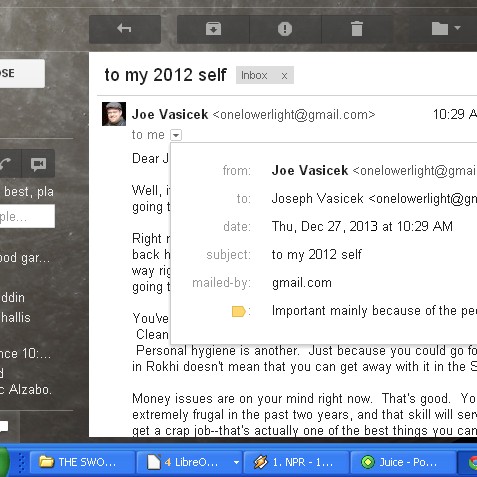
tomy2012selfSo shortly after writing up my last blog post, I got an email from myself marked December 27, 2013.  How freaky is that?I don’t know if it’s a glitch or a feature, but apparently in 2013, you can use gmail to send messages back in time.

In any case, the letter is pretty interesting, so I thought I’d post it.  Here it is:

Dear Joe,

Well, it’s been an interesting decade so far, hasn’t it? Not a bad time to be alive–and that’s going to be even clearer by the end of 2013.

Right now, you’re still in the Republic of Georgia, anxious to get on that flight and head back home. Don’t be. You’re going to miss that place, even though it’s hard to feel that way right now. Your time there has changed you a lot more than you realize, though it’s going to take most of the year for you to figure that out.

You’ve picked up some bad habits, mostly from the other expats. Swearing is one of them. Clean up your language–it’s not going to do you any favors, especially back in Utah. Personal hygiene is another. Just because you could go for days without showering back in Rokhi doesn’t mean that you can get away with it in the States.

Money issues are on your mind right now. That’s good. You’ve learned how to be extremely frugal in the past two years, and that skill will serve you well. Don’t be afraid to get a crap job–that’s actually one of the best things you can do right now. The economy hasn’t improved much since you left, but if you look in the right places and speak with the right people, you’ll be able to make ends meet without too much trouble.

Remember, your writing career should be your main focus. Don’t go chasing after the dollar. You’ve experienced a taste of success in the last few months, and you’re going to taste it again. It comes in spurts, though, so be prepared for that. You’ll figure it out–in fact, you’re already most of the way there. Just remember to keep your butt in that chair, and you’ll be all right.

By the way, you really should spend more time on your business plan. Don’t just use it as motivation to write something else–that stuff is actually important. In Georgia, you can get away with winging it, but not in the States. That’s going to take some getting used to as well.

Your biggest anxiety right now is your supposed lack of self-discipline. That’s actually not as much of a problem as you think. After spending a year in Georgia, you might feel incapable of working another honest day in your life, but that feeling will soon pass. In fact, 2013 is going to be a very productive year for you. All that self-discovery is going to pay off in a big way soon. So don’t worry about it so much, and remember, you haven’t written your best book yet.

Perhaps the most important thing about your year in Georgia is that it really lit a fire under your butt. You know what I’m talking about. If you can travel alone to a foreign country, you can work up the courage to ask her out. No, I’m not going to tell you who. You’ll know her when you see her. But you may have to trim the beard. Just sayin’.

You won’t spend the entire year back in the States, but when you do go overseas again, you won’t be alone. No, I won’t tell you who you’ll go with, or where. Some surprises are better left unspoiled.

There’s more I could tell you, but that’s enough for now. You’ll figure things out on your own, same as you always have. Hope for the best, plan for the worst. Follow the path of least regret.

Joe

Some thoughts on internet access, self-discipline, and productivity

As many of you probably know, for the past four months I’ve been living in a small Georgian village in the foothills of the Caucasus Mountains.  It isn’t as remote as some places in this country (like Tusheti, where some people still practice pagan animal sacrifices), but my internet access has been limited, especially compared to the 24/7 access I had back in the States.

I knew that coming in, and was actually looking forward to it.  I had the option to buy a USB stick from the phone company that would give me service, but I wanted to experience living off the grid for a while to see if that would increase my writing productivity.  Long story short: it didn’t.

In order to use the internet, I have to take a marshrutka (small passenger bus) about half an hour to Kutaisi, where the most convenient place to get wifi is McDonalds.  I can usually go for two or three days without internet, but so many other things in my life (work, family, publishing) are tied up in it that it’s not a good idea to go much longer.

Since each trip takes a huge chunk out of my day, it’s become a lot harder to keep and maintain any sort of momentum on any of my writing projects.  Also, cutting out the internet hasn’t increased my self-discipline at all, it’s just driven me to find different ways to distract myself.

In the end, I think I actually would have been more productive if I’d ponied up the 70 GEL and bought a USB stick from the phone company.  I certainly would have saved a lot of money, considering all that I’ve spent on these trips to Kutaisi.  But at least I’ve learned a few things from the experience.

First, I’ve learned that all of the high-priority things that I absolutely must do on the internet only amount to an hour or two each week.  And even for most of those things, it isn’t a disaster if I put them off for a day or two.  It’s possible to structure your internet time around everything else in your life, rather than vice versa.  In fact, that’s almost certainly a better way to live.

Second, the enjoyment I get from recreational internet usage maxes out after about two hours.  Anything beyond that, and I become something of a zombie.  It’s a weird feeling when you run out of things to do on the internet, but when you realize that you don’t actually enjoy scrolling down an endless list of photos and status updates, it’s a lot easier to pull back and say “no.”

Third, you don’t need social media to sell books.  I made more in book sales in the first week of this month than I did in the first quarter of this year, and my Facebook and Twitter pages are a wasteland.  It might help you if you already enjoy that sort of thing, but it’s not an absolute requirement for success.  Certainly, you don’t have to open a vein and spill everything.

Fourth, exercising good self-discipline doesn’t mean cutting something completely out of your life, but learning how to properly manage it.  The internet isn’t an either/or thing, it’s a matter of finding and maintaining the proper balance.  In the future, I plan to do what Dean and Kris recommend, which is to have two computers: one for internet usage, and one for writing.

Fifth, for me personally, it’s actually healthy to have a couple of harmless distractions available while I write.  I deleted all of the games off of my computer about a month ago, and I haven’t been able to write more than a thousand words a day ever since–often, much less.  Before, whenever I hit a rough patch, I would play a quick round of super-melee in Star Control II and come back to it with fresh eyes.  Without that, I find myself taking my butt out of the proverbial chair and wandering around until I find something else to do, which inevitably takes more time and energy.  A lot of games (Tetris, Spider Solitaire) are addicting and should be nixed, but for me personally at least, opening up something that isn’t a time-sink can actually help to keep me going.

That’s just about all I can come up with now.  I’m sure there are other lessons to be had, but these are the major ones.  I’m coming back to the States on the 31st, and should be back in Utah in time for LTUE and Conduit.  It’s going to be interesting living with 24/7 internet access again; hopefully, it won’t be too hard to adapt back.

Some new thoughts on productivity

I’ve been thinking a lot about writing and productivity, mostly because I seem to be struggling a lot with it lately. With nanowrimo just starting, this is a pretty topical thing to blog about, but I also want to look at it from a long-term career perspective, since that’s what I’m personally more interested in.

As writers, when we spend all our time procrastinating or fail to meet our word count goals, we tend to beat ourselves up and frame the problem in terms of a lack of self-discipline. If only we had greater will power, we could buckle down and pound out five or ten thousand words a day like those super-prolific authors.

While there’s definitely something to say for raw self-discipline, though, I think there’s another dimension to writing productivity that we tend to miss. Not all writing-related activities are productive–and not all non-writing related activities are totally unproductive. In order to make the most efficient use of our writing time, I think it’s more important to understand and respect our individual creative process than it is to merely force ourselves to produce more words.

To better understand my own creative process, I took a little time to group every writing-related thing I do into four different categories:

  • Writing activities
  • Fill-the-well activities
  • Publishing chores
  • Procrastinating

WRITING ACTIVITIES

This should be pretty self-explanatory. It’s basically all the stuff that leads directly to a finished manuscript. It requires the highest amount of energy and produces the most important content.

Activities in this category include:

  • Writing new material
  • Making substantial revisions (putting in and taking out)
  • Updating chapter and scene outlines

FILL-THE-WELL ACTIVITIES

This is the non-writing stuff I do that helps me to be more productive when I switch back to the writing activities. Basically, it’s the stuff I do before and after I write that helps me to maintain a creative momentum.

Activities in this category include:

  • Reading
  • Blogging
  • Catching up on blogs
  • Listening to podcasts
  • Doing mindles chores
  • Going on walks
  • Exploring new places
  • Watching movies
  • Playing RPGs
  • Talking with friends
  • Reviewing first reader feedback
  • Writing character outlines
  • Making book soundtracks

PUBLISHING CHORES

This is all the professional stuff that I have to do, which may feel productive while I’m doing it, but actually takes time away from the stuff I should be doing. I still have to do it, but I should waste as little time doing it as possible.

Activities in this cateogry include:

  • Ebook formatting
  • Producing cover art
  • Writing blurbs and book descriptions
  • Writing author’s notes
  • POD typesetting
  • Handing financial stuff (royalties, invoices, etc)
  • Researching the publishing industry
  • Processing copy edits
  • Sending out email newsletter

PROCRASTINATION

Again, pretty self-explanatory. This is the stuff I shouldn’t do, but end up doing anyway in order to avoid stuff that feels like work. It’s all the stuff that I need to cut out entirely if I want to maximize my productivity.

Activities in this category include:

  • Minecraft
  • Alpha Centauri
  • Any other game that I can’t stop thinking about
  • Checking ebook sales numbers
  • Dicking around on Facebook and Twitter
  • Browsing the Kindle Boards
  • Watching TV and Youtube
  • Minecraft

So now that that’s done, what next?

I’m still figuring this part out, but I think the best thing to do would be to put as much distance as possible between the stuff that boosts productivity (writing and filling the well) and the stuff that doesn’t (publishing chores and procrastination).

The way I see it, there are basically two ways to do this:

  • Physically separate the activities. Do all your writing on a machine that’s disconnected from the internet and doesn’t have any games installed, and do everything else on a separate computer.
  • Set aside blocks of time specifically for writing. Organize your schedule so that writing is a priority, while acknowledging the need to take breaks and refill the creative well.

I can’t really do the first one while I’m here in Georgia, but I definitely can do the second. So far, I’ve found that waking up early to start the day with an hour of writing helps me a ton to build and keep momentum. However, I need to do a better job setting time aside in the afternoon, both for writing and for refilling the well. If I don’t, I usually end up procrastinating by default without realizing it until it’s too late.

So anyhow, those are some of my latest thoughts on writing and productivity. What are yours? Does this square with your experience, or is there a better way to think about it that I’ve missed?