Response to Correia’s awesome rant on fans vs. authors

So Larry Correia wrote an awesome rant the other day about fan entitlement and writing professionalism. The thing that set him off was a discussion on his author Facebook page where a bunch of readers were castigating Patrick Rothfuss for taking 6+ years to write his next book. A bunch of them started arguing that authors have a moral obligation to their readers to finish their books, and Larry called bullshit.

Do I have opinions? Why, yes, thank you for asking.

For the most part, I think Larry is spot on, especially about how free market capitalism is the best solution to this problem. Basically, books are just a product—nothing more, nothing less. Readers buy the product, and authors create it. When a reader buys a book, that’s all they’re buying. When an author writes a book, that’s all they’re creating. The free market works things out. The problems only arise when readers think they’re entitled to something more than what they’ve bought, or when authors think they’re entitled to more than what they’ve earned.

As a libertarian sci-fi writer, I could go on and on about the virtues of the free market and how capitalism is the best and most righteous economic system ever invented by man, but for now I’ll save that zeal for my fiction. In particular, there’s a short story recently I wrote for a $12,000 writing contest that is sure to lose because it shows just how evil and destructive a universal basic income would actually be. But I digress.

I know people mean well. I know people think they are helping. I know that you think it is a compliment. Maybe the first couple hundred times, but then after that it becomes a continual droning whine.

If a writer still bothers to post on social media to interact with their fans, and they post about them doing anything, literally anything other than writing, somebody inevitably is going to jump in and say “YOU SHOULD BE WRITING!”

The really sad part you helpful entitled types don’t get is that other stuff non-writing stuff is a vital part of the creative process. Since most of what authors do is in their heads, they never really stop working. So when I’m shooting guns, or painting minis, that is the activity that I do to uncork my brain, so that I can go put in another day of creating imaginary stuff tomorrow.

Authors either have a life outside of writing, or they burn out. Or, alternatively, they just check out and don’t interact with their fans anymore. Because even though there are a hundred cool fans for every entitled whiny douche, the entitled whiny douche is the one that sticks out.

Yes, yes, a thousand times yes. I’m not at a point in my career yet where I have thousands of rabid-at-the-mouth fans screaming at me constantly to get back to work, but I can definitely see how it gets old.

Also, writers genuinely do need to refill the creative well from time to time. To an outside observer, it might look like we’re dicking around, but in reality we’re noodling out our next story, so that when we do sit down to write, the words actually come.

If you think that writing is as easy as sitting down at a keyboard and mashing out words, you might as well kidnap your favorite author, break his legs, and chain him to a typewriter in your basement.

To My Fellow Authors

Get your shit together.

Seriously, act like a professional. In any other job in the world, if you wasted all your time fucking around and didn’t get any work done, you’d get fired. Writer’s Block is a filthy lie. I couldn’t have Accountant’s Block. Oh, woe is me, I can’t make these spreadsheets because I’m just not feeling it today—FIRED.

But if you’re honestly working, and you’re doing the best you can with what you’ve got, you don’t have to take shit off of entitled douches.

The trouble with writing is that it isn’t always clear when the work is done. I’ve had multiple award-winning author friends tell me at conventions that they’re impressed with how prolific I am, and yet I never—NEVER—feel like my work is done.

I totally agree with Larry that if you want to write professionally, you have to treat it like an actual profession. Right now, I’m retooling my writing process so that I can put out two or three times as many books. “Writer’s block” is not an entitlement or a badge of honor. It’s a disease.

This YouTube video is the best take I’ve seen on the subject. I watch it over and over again, sometimes every day. Whenever I don’t think I can meet my next deadline. Whenever I feel like there’s something repelling me from sitting down to write. Rewatching this video gives me a burning desire to finish my WIP, look that resistance in the face, and scream “rest in peace, motherfucker!” I swear, I should get that woodburned on a plaque and hang it over my desk. Best motivation ever.

Screw writer’s block. Screw all that artsy fartsy crap. There’s nothing quite so awesome as looking at your name on a book cover and thinking “yeah, I wrote that.” It never gets old.

I remember a couple years ago when I ran into a really successful author, dude was on top of the world, just got home from a successful book tour, latest book was a huge hit… and he was bummed. I’m talking super depressed. Why? Because Lone Douche in the Wilderness had just ripped him apart on Facebook, and that negativity was enough to screw up all his previous happiness.

Do not give douchebags power over you. Don’t ever let people impose their arbitrary and capricious rules onto you.

To be frankly honest, this is one of the reasons why I don’t do social media anymore. Not because I have a thin skin or can’t take criticism. Not because of a specific instance where someone was a douchebag to me, either. Rather, it was more of a recognition that if I didn’t change course, I would become that douchebag—if indeed I hadn’t already.

There’s something about our current iterations of social media that seems to bring out the worst in people. Twitter in particular is insanely toxic. Future historians (and historical fiction writers) are going to have a heyday writing about all of the online meltdowns of our most prominent cultural and political figures, right up to President Trump himself. It’s a daily occurance at this point, sadly. And yet, the more I look at it, the more it seems that the only winning move in social media is not to play.

Which is not to say that I don’t want to keep in touch with my fans. That’s what this blog and my email list are for. But speaking as a reader for a moment, when I buy a book, I’m not trying to strike up a friendship with the guy who wrote it. I’m just buying a book. Neither am I particularly interested in hearing about whatever social or political cause set them off on a rant today. I just want to read the damn book.

It’s called free market capitalism, and it makes everything so much simpler. If a book looks interesting, I’ll buy it. If I like it, I’ll buy more from the same author. It’s cool and all to feel like we have a connection, but at the end of the day, it’s just books. And readers. And the free market.

Anyways. That’s my take on Larry’s epic rant. Writers and readers, be excellent to each other. That is all.
George R.R. Martin may not be your bitch, but I am

Last week, George R.R. Martin surprised no one and disappointed everyone when he announced that The Winds of Winter would not come out before the next season of the Game of Thrones TV series that covers the events in that book. He apologized profusely to his fans, most of whom seemed to take it graciously, at least to his face. However, it spawned some heated discussions in the online communities that I frequent (most notably The Passive Voice) about the implicit contract between writers and reades.

This discussion is not new, even with regard to Mr. Martin. Way back in 2009, Neil Gaiman addressed this issue in a blog post where he stated quite memorably that “George R.R. Martin is not your bitch”:

People are not machines. Writers and artists aren’t machines.

You’re complaining about George doing other things than writing the books you want to read as if your buying the first book in the series was a contract with him: that you would pay over your ten dollars, and George for his part would spend every waking hour until the series was done, writing the rest of the books for you.

No such contract existed. You were paying your ten dollars for the book you were reading, and I assume that you enjoyed it because you want to know what happens next.

So that’s one end of the spectrum: that writing is an art, that it can’t be forced, that trying to force it is wrong, and that writers have no obligation to their readers to force anything. Readers should not stalk their favorite writers or tell them what they should or should not be doing to produce the next book. As Mr. Martin said in his latest post:

Unfortunately, the writing did not go as fast or as well as I would have liked. You can blame my travels or my blog posts or the distractions of other projects and the Cocteau and whatever, but maybe all that had an impact… you can blame my age, and maybe that had an impact too…but if truth be told, sometimes the writing goes well and sometimes it doesn’t, and that was true for me even when I was in my 20s.

On the other end of the spectrum, we have Larry Correia. Two days after Mr. Martin announced that The Winds of Winter would not be finished in time for the TV series, Mr. Correia announced his own plans for the year: which of his books are coming out, which books he plans to write, which project he’s going to collaborate on, and which conventions and events he will (or more notably, will not) be attending.

I don’t know whether he meant this as a dig at Mr. Martin specifically, but he included the following statement:

To all those sensitive artist types who whine about how they can’t rush art, and can’t get any writing done, oh, BS. Quit your crying, put your big girl panties on, and treat it like your job. Because it is a REAL JOB. And like all real jobs, if you don’t work then you shouldn’t GET PAID. So shut up, quit screwing around, and get back to work.

The part that really stood out to me, though, was his announcement that he would not be at DragonCon or GenCon this year:

I’m skipping DragonCon and GenCon this year, which pains me because I love those, but again, I’m trying to up the novel production, and all those cons in a row over the summer kick my butt.

I found it interesting because George R.R. Martin is well-known as a frequent convention attendee, to the point that by his own admission attending these conventions is his “way of life.” Larry Correia knows that his writing productivity takes a hit when he attends too many conventions, but George R.R. Martin either doesn’t know or has chosen to prioritize attending fannish events over his own writing.

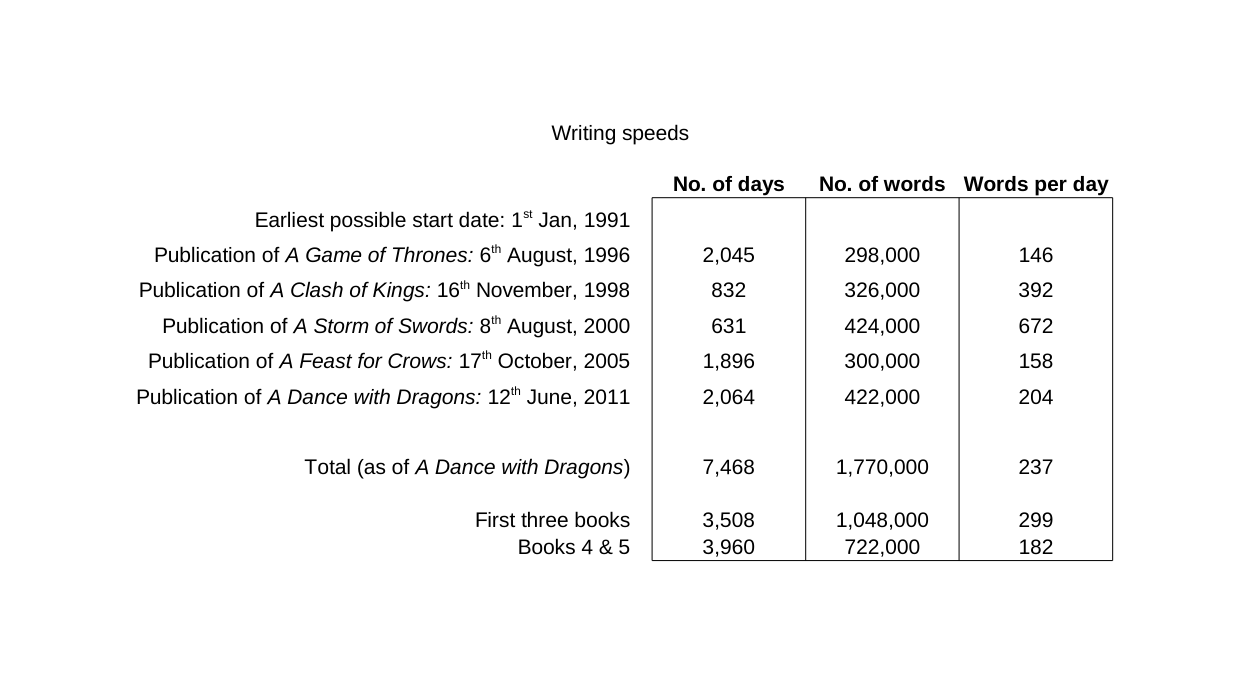
This made me curious about Mr. Martin’s writing productivity, so I did a little digging and found the following figures, calculated by his fans:

grrm_wordcount

Those numbers are rather stunning. He averaged only 200 words a day when writing A Dance with Dragons? Just for reference, this blog post is about seven hundred words so far, and I’m writing it while taking a break from my other writing (word count so far today: 1,100 words, and that’s a little low). Even if we allow for five drafts written at the same speed, five drafts still only comes to 1,000 words a day.

Now, I do think Mr. Gaiman makes a good point that it is neither healthy nor helpful to try and micromanage everything that a writer does. We can’t spend every waking hour working on the next book, and even if we did, it probably wouldn’t turn out as well, because refilling the creative well is an important part of the writing process. And I also have to admit that if you ran a similar calculation on my own books (especially the early ones), you would probably find some similarly embarrassing figures.

(Though to be fair to myself, I tend to have multiple irons in the fire at any given time, so a straight start date to publication date calculation doesn’t tell the whole story—and it probably doesn’t tell the whole story with George R.R. Martin as well. But still, even if those figures were twice as high, they would still be absurdly low for a working writer.)

When Mr. Gaiman and Mr. Martin say that the writing “comes when it comes” and there’s nothing they can do about it, I think they’re wrong. Dead wrong. Writing is an art, but it is also a craft. It can’t be forced, but it can be structured. Mr. Correia has evaluated how productively he writes and structured his convention-going plans accordingly. Has Mr. Martin?

I also think they’re dead wrong about the writer having no obligation to the reader. That’s total bunk. Reading is an act of collaboration between the writer and the reader: without readers, stories would never exist. They would just be markings on a page, or electrons on a drive, or at best ideas and daydreams in the writer’s head. If a tree falls in the forest, does it really make a sound? If a book is never opened, does it ever tell a story?

Part of this may be the difference in perspective between indie writers and traditionally published writers. In the traditional system, writers were paid an advance on royalties by their publishers. The contract also allowed for royalties, but those figures were set so low that most books never earned out their advance. Publishers made up for it by raising the advances for the writers they wanted to keep.

In contrast, indie writers live and die by their royalty checks. Had a good month? Congratulations, you can afford to eat. Had a bad month? Tsk, tsk. Better hurry up with that WIP of yours, because the longer it takes to publish it, the longer it takes for you to get paid.

But even for the fantastically successful writers who never have to worry about how they’ll pay their bills, I still believe that they have as much of an obligation to their readers as the rest of us. Without readers, we would not be able to do what we do. Without readers, it would be impossible to pursue writing as a career. We all want to live the dream, and the only way to do that is by treating our readers well.

So George R.R. Martin may not be your bitch, but I most certainly am. Writing is not something that happens only sometimes: it’s my job, and I do it every day. And as for accountability, I absolutely feel that I’m accountable to my readers. They are the whole reason I am able to do this in the first place. If that makes me their bitch, then so be it.

Thoughts on Clean Reader

cleanreaderIn case you haven’t heard, there’s a new app in the book world that is stirring up quite a bit of controversy. It’s called Clean Reader and it basically goes through an ebook and filters out the profanity, with settings for “clean,” “cleaner,” and “squeaky clean.” It was designed by the parents of a teenager who expressed dismay at finding profanity in an otherwise clean book.

The response from authors has been vociferous. Chuck Wendig (WARNING: Chuck uses so much profanity, he probably deserves a Clean Reader filter setting of his own) predictably came down hard against it, as well as Joanne Harris, the author of Chocolat. Over on KBoards, there’s an ongoing thread of indie authors slamming it as a denial of artistic expression, as a copyright violation, as malicious censorship—basically, the whole gamut. Interestingly, though, Cory Doctorow came out in defense of it.

Personally, this app reminds me a lot of CleanFlicks, a movie rental place here in Utah that edited out objectionable content such as sex, violence, and profanity. I watched the edited version of Zombieland while I was in college, and while I enjoyed it, it was… short. CleanFlicks did a lot of business, right up until the US Supreme Court shut it down.

While I can see why some writers would hate this app, I actually sympathize more with the readers. Living in Utah, I know a lot of people (some of them in my own family—hi Kate!) who are exactly the kind of people for whom Clean Reader was made. And much like Cory Doctorow, I think that their right to control their own reading experience trumps the writer’s right to freedom of expression.

The act of reading is fundamentally a collaborative experience. Until someone opens a book and reads it, that book is just symbols on a page, or bytes of data on a storage device. Meaning is only generated through the act of reading—in a very real sense, the story is created by the reader just as much as by the writer. As much as we writers like to think of ourselves as free to write whatever we want, without readers, that freedom counts for very little. And that’s exactly the way it should be.

A lot of writers are making fun of Clean Reader on the basis that the very premise is flawed—that filtering out profanity won’t do anything to clean a fundamentally dirty story. But while that’s true of some books, I do think there’s a middle ground where the app can give some value.

For example, my first novel Genesis Earth is a mostly clean science fiction adventure romance with a few tense moments where the characters use a mild level of profanity. As a writer, it didn’t feel right to have my characters say “darn” instead of “damn,” or “crap” instead of “shit.” Sanitizing the book on that level would have kicked most readers right out of the story. But if a reader who is sensitive to that use of language wants to read a filtered version of Genesis Earth, the story is not going to be fundamentally changed by filtering out those words.

Probably the biggest objection to Clean Reader is that it enforces or promotes a censorship regime that many writers find objectionable. Of course, most of the people who make that argument probably have no idea what “censorship” really entails, just like the people who throw out accusations like “socialist,” “sexist,” “racist,” etc. But putting that can of worms aside, is it right for people to use apps like this—say, parents of young children—to control what other people read?

I am a diehard libertarian, but I actually think that beneath a certain age, parents do have a right to censorship. As legal guardians of their children, parents have a right and a responsibility to raise them as they see fit. If you don’t allow parents to censor what their children are exposed to, then you’re basically saying that society as a whole should raise them, or (God forbid!) the government. I think that’s a horrible idea. Children should be raised by the people who are closest to them, and responsible parents/guardians should be free to raise their children as they (and only they) see fit.

So I’m actually rather supportive of the Clean Reader app. I personally wouldn’t use it, either for myself or for my children, but if other readers do then I have no objection to that. Writers should be free to write whatever they want, and readers should be free to read whatever they want, however they want to read it.

Things I learned in 2014 (Part 1)

Last week, Kris Rusch wrote an interesting blog post reflecting on 2014 and things she observed that indie writers learned, so I thought I’d do something similar and reflect on some of the things that I learned last year about the business and the craft. Here goes!

Readers of SF&F want longer books.

I did a lengthy blog post about this earlier, but the basic gist of it is that readers in my genre want longer, more immersive books. There’s a place for the short stuff, especially for high concept sci-fi, but most readers of speculative fiction want worlds they can get lost in with characters that become their best friends. It’s practically impossible to do that in a story that takes less than an hour to read, so to satisfy those readers, you’ve got to write long.

You can’t have a healthy career with only one income stream.

Between 80% to 90% of my income in 2014 came from Amazon. Times were good in the spring and summer, but then Amazon launched their ebook subscription service (Kindle Unlimited). None of my books were enrolled in KU, but because of the way that Amazon skews the rankings to favor KU books, my Amazon royalties took a huge hit.

I knew back in 2011 when I started that I needed to cultivate multiple income streams if I wanted to have a steady career, but I’d gotten complacent. Since my Amazon earnings were paying all the bills, I figured I was doing all right. But you can’t measure the healthiness of a career in just the revenue it’s bringing in right now; you’ve got to look at contingencies for the future, including the worst case scenario.When most of your revenue comes from a single client, that makes your career far too brittle.

So looking to the future, I can’t say that I have a healthy, steady career until I’m earning at least as much from all my other income streams as I am from Amazon.

I’ve been relying far too much on Amazon’s algorithms.

Related to the last point, I learned that I’ve been relying far too much on Amazon to sell my books. In fact, I can say that the Amazon algorithms were the linchpin of my marketing strategy (inasmuch as I actually had one, heh).

Amazon has the best book recommendation engine in the industry by far. It’s done a lot for my career, connecting my books with many readers who have gone on to become fans. But what the algos give, the algos can take away. To build a career with staying power, you have to constantly work to find new readers in a variety of different ways.

I’ve always believed that cream rises to the top. That said, if you’re starting at the bottom of the ocean, you’ve got a long, long way to rise. Up until now, I’ve been operating under the belief that readers will find me without me making much of an effort to find them. I learned this year that you’ve got to meet in the middle. You don’t have to hand sell every book (thank goodness!), but you do have to make an effort to make your books visible somehow.

A well-articulated negative review does more to sell books than a blasé positive one.

This one surprised me. When I published Brothers in Exile (Sons of the Starfarers: Book I), it garnered a fairly painful two-star review on Amazon about a week or two after launch. The review had some positive things in it, but it also had some negative things that were pretty spot on. Being the angsty writer that I am, I thought my chances had tanked. Instead, sales of the book immediately shot up, and stayed fairly high for about a month.

Readers aren’t stupid. They understand that not everyone has the same tastes in books, and parse their reviews accordingly. A negative review that is articulate and well-reasoned will lend a lot more credibility and cultivate a lot more interest than a string of positive reviews that lack any real substance. It sounds counterproductive, but it’s often the negative reviews that sell the book.

Sometimes you actually can get the best results by doing it yourself.

When I redid the covers for the first three Gaia Nova novels, I decided at first to hire a cover designer. For various reasons, though, that didn’t work out, so I decided to do them myself. I’d done the typography myself on the old ones, and let’s just say they left something to be desired.

The reason I wanted to hire the work out was because I didn’t think I’d get the best work if I did it myself. I figured that if I hired someone who was an expert in it, it would turn out so much better. Instead, when I did it myself, I discovered that my own skills had improved to the point where I could produce really good work myself.

It is possible, especially in self-publishing, to become so skilled at every aspect of the production process that you can do it all yourself and still produce a quality book. The learning curve is so sheer that it’s practically a cliff, but you can do it. And even if the work that you produced at the start of your career wasn’t all that good, you can improve to the point where your work is on par with that of professional designers.

The trouble is, it takes so much time and effort to get to that point that you may be better off hiring the work out. It takes a certain type of personality to DIY everything and produce a quality product without feeling overstretched. I’m pretty sure that’s my personality type, though of course I still have a lot to learn. But just because it’s DIY doesn’t necessarily mean it’s going to be of an inferior quality.

There are other things I learned in 2014 about the craft and business of writing, but this post is starting to get long so I think I’ll table it for the next post. Take care!

O is for Online Presence

When you’re an indie author, your business exists almost exclusively on the internet. Chances are that ebook sales make up the bulk of your revenue, and those are entirely online. And without the backing of a major publisher, you probably aren’t going to get many books into bookstores (although it is possible). Most of your print sales are going to be online as well.

So if the bulk of your business is online, it only makes sense that you should maintain an online presence or persona of some kind. But what sort of presence should this be? Do you need to be on social media, even if you don’t really enjoy it? What about blogging? What are the dos and don’ts of maintaining an online presence?

Honestly, I don’t think it really matters which platforms you use to build your online presence, so long as you’re accessible in some way. Marketing gurus say that you have to be on social media, but my Star Wanderers books took off when I was living in a developing country with very limited internet access, and hardly ever posted to Facebook or Twitter at all. Even now, my Facebook author page is kind of a ghost town–I post links to each blog post, and I respond whenever a fan drops in with a comment, but that’s about it.

In my opinion, the most important thing to keep in mind when building an internet presence is to do the things that feel the most genuine and authentic. Facebook has never felt very authentic to me, except when I’m interacting with people I know in real life. Twitter, though, had an in-the-moment format that I really enjoy. Even then, I don’t feel nearly as authentic on Twitter as I do on my own blog, where I can post my thoughts and observations without restriction. For that reason, the core of my online presence is my blog, and I use my social media accounts to funnel people here rather than using social media as an end destination.

Besides being authentic, I think it’s important to be gracious to your fans and to not insult or repel them. A handful of authors (such as John Scalzi and Larry Correia) have developed personas that are highly opinionated, controversial, and crude, but they do it in such a way that it draws a following and keeps them. You don’t have to be liked by everyone–indeed, if you’re being authentic you certainly won’t–but you need to be careful to show respect and basic decency toward your fans. They are your bread and butter, and if they find your online behavior repulsive, you’re going to have a very hard time making and keeping them.

When it comes to politics and religion, I try not to be too divisive. Those are certainly important parts of my life, so it wouldn’t be very authentic of me to ignore them completely, but I don’t want my political opinions or religious beliefs to get in the way of my fans enjoying my stories. I don’t write stories just for Mormons, or just for libertarians, or just for white men–I write stories for people who look up at the stars and wish that they could go there. For that reason, I try to be mindful that the people who enjoy my stories might not (indeed, certainly do not) all look or act or believe like I do. I may disagree with them on some issues that I personally find important, but I don’t have to let that come between them and my stories.

The author-reader relationship is a fascinating thing that I have much still to learn about. Right now, my approach is basically to keep from getting in the way as much as possible. Occasionally I’ll get a piece of fan mail that will gush about something they loved about a story but criticize something they didn’t. I never argue back against it, since arguing isn’t going to change the experience they had when they read the story. Instead, I thank them as graciously as I can for reading.

My goal as an author is to stay out of the way of my readers enjoying my stories. For those who do enjoy the stories and want to connect with me, I write author’s notes at the back of all my books and keep an online presence on my blog where they can reach me. But if they don’t want to do that, that’s fine too. I try to be as authentic as I can without alienating anyone who enjoys my stories, and the key to that is to always be grateful for my readers. Writers may create stories, but readers bring them to life, since without anyone to read them, stories are basically dead.