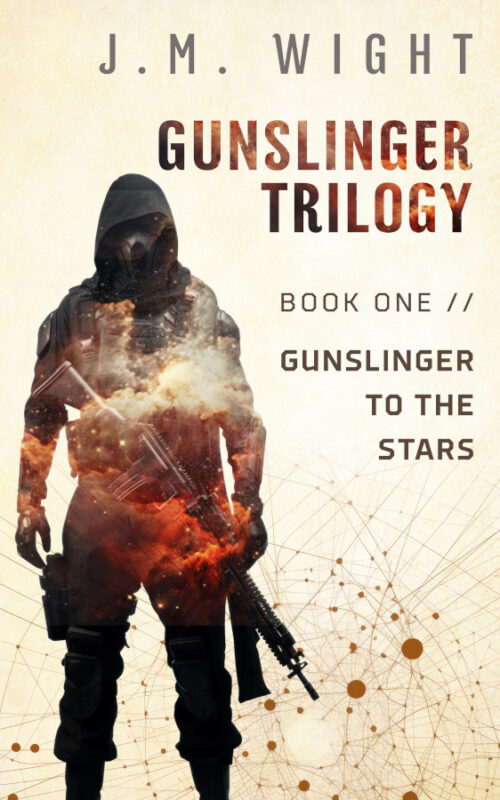
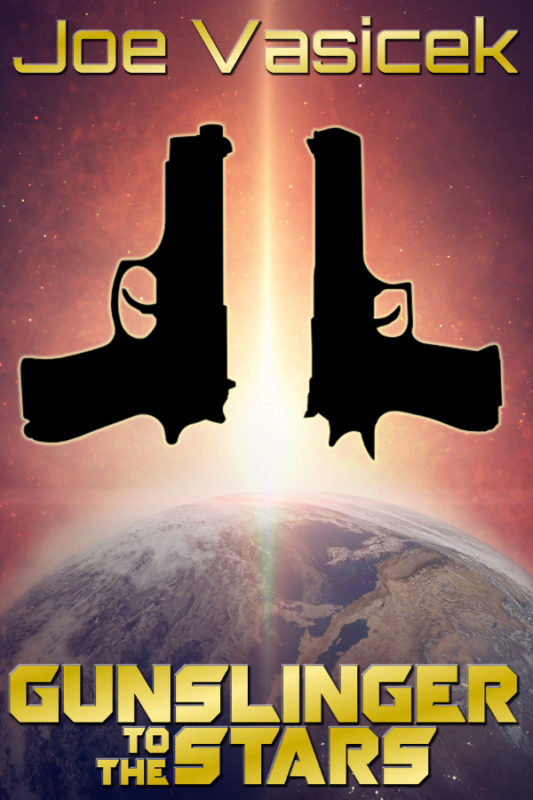
What does it mean to do the right thing when the galaxy around you is chaotic, corrupt, or outright absurd? Gunslinger to the Stars takes that question and drops it squarely in the lap of Sam Kletchka—a mercenary gunslinger navigating a dangerous galactic frontier who keeps choosing responsibility even when no one is watching, rewarding, or deserving. At its heart, this space-western adventure is about moral courage: the stubborn, unfashionable insistence on doing the right thing in a universe that rarely makes it easy.
Where the Idea Came From
This theme grew out of a mashup of influences—long conversations with writer friends, a subplot from Schlock Mercenary, and the realization that a “rogue Immortal” character needed a counterweight with a strong personal code. Around the same time, I was watching Breaking Bad, fascinated by characters like Mike Ehrmantraut—tough, pragmatic men who do terrible things for complicated reasons. To push back against such a villainous force, I imagined Sam Kletchka: a gunslinger in a messy, morally gray universe who lives by a code and keeps choosing the harder path simply because it’s right, even when the galaxy doesn’t care.
How Moral Courage Shapes the Story
At every major turning point in Gunslinger to the Stars, Sam Kletchka’s choices are defined by moral courage—the instinct to protect others even when it’s dangerous, inconvenient, or unwinnable. He charges after kidnapped empaths when walking away would be safer; he shields Jane’s diplomatic idealism with his hard-won pragmatism; he survives abandonment in the desert through sheer stubborn responsibility; and he repeatedly throws himself into battles around war rigs, jumpgates, and alien war parties because no one else can or will. His personal code drives the story’s conflicts, shapes the character dynamics, and pushes this space-opera adventure toward a climax where courage isn’t about glory but about doing the right thing in a lawless, unpredictable, morally gray galaxy.
What Moral Courage Says About Us
Sam’s story reflects something deeply human: we don’t get to choose the worlds we’re born into, but we do get to choose what kind of people we become. In a galaxy run by Immortals, riddled with slavers, warlords, and manipulative telepaths, Sam’s personal code becomes his anchor—the thing that keeps him from becoming the very wolf he warns Jane about. His courage isn’t flashy heroism; it’s the uncomfortable, everyday kind that demands sacrifice, loyalty, and integrity when it would be easier to look away. In that sense, the book becomes a mirror for readers who love character-driven science fiction that asks what we stand for when the world pushes back.
Why This Theme Matters to Me
I wrote this book at a very different time in my life—years after Genesis Earth, when my own view of the world had shifted. I still believed in cultural understanding and bridging divides, but I’d also seen enough to know that evil doesn’t always yield to good intentions. Like Sam, I firmly believe in the right to defend oneself and others, and I’ve had long debates about the responsibilities that come with that. I wanted to write a character who lives at the intersection of those values—someone who understands violence, hates it, but won’t walk away when others depend on him. That tension, that conviction, is why moral courage felt like the beating heart of Gunslinger to the Stars.
Where to Get the Book










Related Posts and Pages
Explore the series index for the Gunslinger Trilogy.
Return to the book page for Gunslinger to the Stars.