Coming of Age and Loss of Innocence in Edenfall

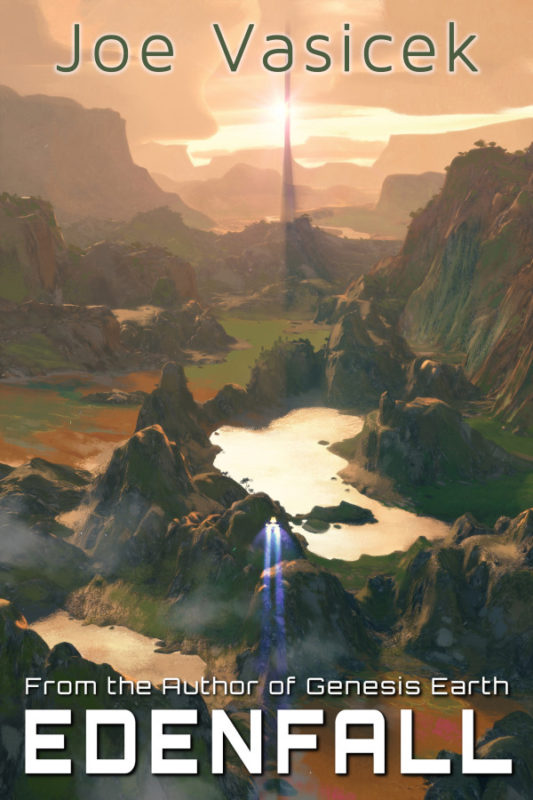
Edenfall by Joe Vasicek is a science fiction coming-of-age story about a girl raised in an isolated paradise who is forced to confront the larger human world for the first time. The novel combines coming of age and loss of innocence with fish out of water, raised outside civilization, first love, entrusted with a dangerous secret, protective older sister, and paradise lost tropes. Set on a distant world millions of years in humanity’s future, the story begins with youthful freedom and wonder before developing into a tense, sometimes dark adventure about responsibility, moral judgment, love, violence, and the painful transition from childhood into adulthood.

Tropes at a Glance: Coming of Age, Loss of Innocence, Fish Out of Water, Raised Outside Civilization, First Love, Entrusted with a Dangerous Secret, Protective Older Sister, Paradise Lost

Why Edenfall Is a Coming of Age and Loss of Innocence Story

At the beginning of Edenfall, Estee has grown up in a world almost completely untouched by human civilization. She runs barefoot across an alien savannah, explores the wilderness with her younger sister, knows the native “little people” and their customs, and lives with her parents and siblings beneath the ruins of an ancient human space elevator. She is adventurous, curious, impulsive, and confident in the natural world around her—but extraordinarily innocent about the civilization her parents left behind.

That innocence becomes impossible to preserve when a human military expedition arrives from across the stars. To Estee, the newcomers are almost as alien as anything in science fiction: she has never encountered soldiers, cities, military hierarchies, or many of the social customs they take for granted. Even ordinary human assumptions about clothing, privacy, relationships, and authority can be bewildering to her.

What begins as curiosity quickly becomes a much harder education. Estee discovers that the wider human world contains cruelty, political ambition, warfare, betrayal, and moral choices far more complicated than anything she has previously faced. At the same time, she begins experiencing new emotions of her own, including attraction, romantic longing, and an increasing sense of responsibility for people besides herself.

Her coming of age is therefore both an awakening and a loss. She gains knowledge, judgment, independence, and the ability to carry adult responsibilities—but she can never return to the effortless innocence with which she began.

How Coming of Age and Loss of Innocence Drives the Story

Estee’s innocence shapes almost every major decision she makes in Edenfall. Early in the novel, she responds to danger primarily with curiosity. A mysterious object descending from the sky is something she wants to investigate. Strange newcomers fascinate her even when they frighten her. The boundaries between good and evil initially seem simple because she has experienced so little of either.

As events become more dangerous, those simple assumptions break down. Estee has to learn that people cannot always be judged by the group they belong to, that authority does not necessarily make someone good, and that even people with weapons and power must choose whether to use them rightly. Her father ultimately places an especially difficult burden on her: she must decide for herself whom she can trust.

That requirement to exercise moral judgment without having a parent make the decision for her is central to her transformation. Estee begins the novel as a child whose parents define the boundaries of her world. Increasingly, she has to navigate beyond those boundaries using the principles they taught her rather than their direct protection.

Her relationships change along with her. Her younger siblings become people she increasingly feels responsible for rather than merely companions in childhood adventures. Her relationship with Khalil introduces trust, admiration, attraction, and first love. And the threats facing her family turn the preservation of something larger than herself into a personal responsibility.

In Edenfall, growing up is not merely becoming tougher or more capable. It means learning enough about human nature to make consequential choices while refusing to become as cruel as the world that forced those choices upon her.

Supporting Tropes and Genre Conventions

Fish Out of Water / Raised Outside Civilization

Estee is a particularly unusual fish out of water protagonist because she does not initially travel into an unfamiliar society. Instead, human civilization arrives in her isolated world.

She has grown up with her family and the indigenous little people, far removed from ordinary human culture. As a result, things that the newly arrived soldiers consider commonplace can be completely foreign to her. She knows how to track through wilderness, avoid dangerous predators, and navigate the landscape, yet she may not understand a handshake, a city, military rank, or why strangers expect her to dress differently.

This reversal allows Edenfall to make ordinary human society seem strange by presenting it through the eyes of someone encountering it for the first time.

First Love / Romantic Awakening

Estee’s relationship with Khalil forms the romantic side of her coming-of-age story. Because she has never known an unrelated young man before, she initially has no framework for understanding the attraction she feels toward him.

Her growing admiration for Khalil becomes trust, emotional intimacy, and eventually romantic longing. These feelings are genuinely new to her, and the novel treats her first experience of attraction as another form of discovery: she is learning not only about the wider human world but also about herself.

The romance therefore develops alongside the loss-of-innocence plot rather than existing separately from it. Estee is discovering both the darkness of adulthood and some of its beauty.

Entrusted with a Dangerous Secret

Early in the crisis, Estee’s parents entrust her with a piece of hidden data connected to their discoveries about the ancient human civilization that once inhabited their world. Protecting it gives Estee a responsibility that the newly arrived soldiers do not initially realize she carries.

More importantly, her task eventually becomes morally complicated. Keeping the secret away from dangerous people is only half of her responsibility. She must also recognize when she has found people worthy of receiving it.

The dangerous secret trope therefore reinforces the coming-of-age story by transforming Estee from a passive child being protected by adults into someone whose judgment can affect the lives of everyone around her.

Protective Older Sister

Estee is established as the oldest sister from the opening pages, where even her playful adventures with Celeste contain small moments of responsibility. As the danger grows, however, that ordinary sibling dynamic takes on much greater weight.

She increasingly becomes the person who keeps her younger sisters moving, watches over her baby brother, makes decisions under pressure, and tries to protect the family members who once shared her carefree childhood. The change is gradual but fundamental.

The protective older sister trope gives Estee’s maturation an especially concrete form: adulthood arrives when she can no longer assume that someone older will always be there to take responsibility.

Paradise Lost

The setting of Edenfall gives its loss-of-innocence story an explicitly Edenic dimension. Estee begins in a beautiful, isolated world where human civilization exists mostly in stories told by her parents. Her childhood is associated with open skies, wilderness, family, exploration, and freedom.

The arrival of outsiders changes not only Estee but the physical world around her. Military vehicles cut across the grasslands. Bases and weapons intrude upon familiar landscapes. Violence enters places that once represented safety.

The destruction of innocence is therefore both personal and environmental. Estee loses her childhood paradise at the same time that the paradise itself is being transformed. Even the novel’s imagery and chapter progression repeatedly draw on ideas of Eden, knowledge, exile, and the fall.

How Edenfall Develops These Tropes

What makes the coming-of-age story in Edenfall unusual is the direction from which adulthood arrives.

Estee has not been raised in a broken or oppressive society from which she longs to escape. She begins with extraordinary freedom. Her parents have deliberately removed themselves from civilization and raised their children in an alien wilderness where many of humanity’s customs and institutions simply do not exist. The wider human world therefore represents both possibility and danger.

That creates an interesting inversion of the traditional science fiction coming-of-age story. Estee is not dreaming about escaping a restrictive home and discovering the universe. The universe comes to her—and what it brings forces her to reconsider the value of the sheltered world she once took for granted.

The novel also avoids equating maturity with cynicism. Estee learns that human beings are capable of terrible things, but she also encounters courage, restraint, loyalty, sacrifice, and people willing to oppose evil even at great personal cost. One of her most important lessons is that the world cannot be neatly divided into categories of “good people” and “bad people.” Character must be judged through choices.

Her first love reinforces the same idea. Attraction opens another door into adulthood, but the relationship is tied to questions of trust, restraint, responsibility, and the difference between wanting something and being ready for it.

The result is a coming-of-age story in which knowledge carries moral weight. Estee’s innocence cannot survive what she experiences, but the knowledge that replaces it does not have to corrupt her. Growing up means learning enough about good and evil to choose between them consciously.

The Story’s Tone and Emotional Payoff

Edenfall begins with a strong sense of wonder. Estee’s alien world is colorful, wild, beautiful, and dangerous in ways she understands. Because readers first experience that world through her familiar and affectionate relationship with it, the later intrusion of human conflict feels increasingly disruptive.

The tone consequently moves from adventurous and pastoral to tense, tragic, romantic, and ultimately bittersweet. Moments of discovery and first love sit alongside military violence, family danger, moral betrayal, and the destruction of childhood certainties. Yet the novel is not nihilistic. Its darker events repeatedly force characters to demonstrate what they believe through courage, loyalty, restraint, sacrifice, and protection of the innocent.

The emotional payoff comes from watching Estee become capable of carrying responsibilities she could scarcely have understood at the beginning. She cannot recover the innocence she loses, but neither is she simply crushed by that loss. She learns to move forward into an uncertain future while protecting what remains worth saving.

For readers looking for science fiction coming-of-age stories about loss of innocence, a girl raised outside civilization, first love, dangerous secrets, sibling responsibility, and the loss of an Edenic home, Edenfall brings those tropes together in a high-stakes alien-world adventure.

Where to Get the Book

Related Posts and Pages

Explore the series index for the Genesis Earth Trilogy.

Return to the book page for Edenfall.

Is Brothers in Exile for you?

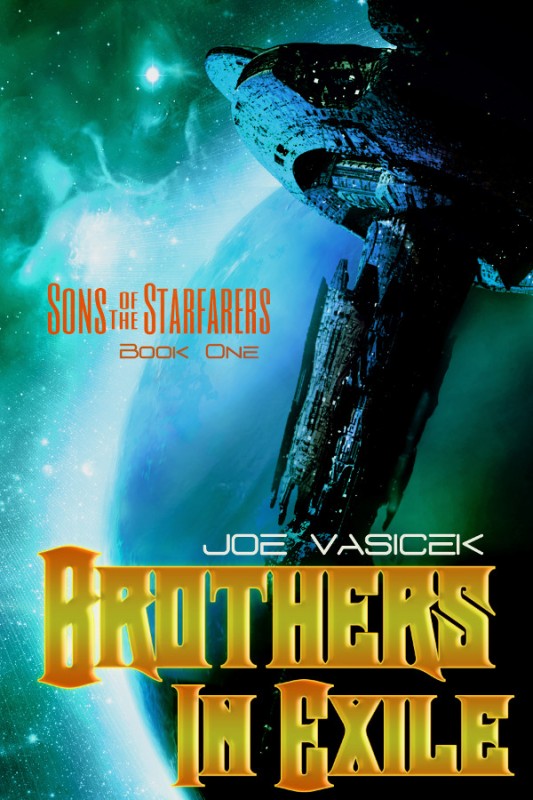
Brothers in Exile by Joe Vasicek is a character-driven space opera / adventure sci-fi about two brothers trying to survive as independent starfarers on the edge of a growing empire. When their routine run takes them to a silent derelict station—and a discovery they can’t ignore—the story turns into a tense, momentum-driven ride through frontier ports, bad deals, and the early tremors of interstellar conquest.

Brothers in Exile is Book 1 of Sons of the Starfarers, a clean, character-driven space opera series about starfarers caught in the early tremors of imperial expansion.

What Kind of Reader Will Love Brothers in Exile?

If you love…

  • frontier space opera: starships, stations, salvage, dangerous trade routes
  • space opera with heart: loyal crews, sacrifice, and family bonds under pressure
  • clean, hopeful science fiction (minimal profanity, no explicit sex) with faith, family, and conscience in the background
  • high-stakes trouble that escalates fast: one decision → bigger consequences → empire-scale ripple effects
  • mystery + rescue momentum, where “we can’t just walk away” drives the plot

…then Brothers in Exile is probably your kind of story.

What You’ll Find Inside

Isaac Deltana is the careful one—the older brother trying to keep their ship, their finances, and their lives from flying apart. Aaron is the spark—reckless, brave, and stubbornly determined to do the right thing once he believes something matters. The tone is tense but humane: a fast-paced, character-driven space adventure with heart, built around survival, moral choice, and the bond between brothers as the Outworlds begin to feel the shadow of the Gaian Imperials stretching outward.

What Makes Brothers in Exile Different

A lot of space opera is driven by lone wolves or chosen ones; this one is driven by family—two brothers who can’t stop being brothers even when everything is going wrong. It has the frontier trading feel of classic space opera, but puts family and moral choice front and center. It has a “scrappy ship on the fringe” flavor you might associate with Firefly, but the moral center is steadier and the tone is less cynical. And while there’s big-picture geopolitics (expansion, control, annexation), the story stays grounded in human-scale decisions: what you owe a stranger, what freedom costs, and how far you’ll go to keep someone from being used or erased.

What You Won’t Find

You won’t find grimdark nihilism, explicit sexual content, or shock-for-shock’s-sake violence. This is clean, character-driven space opera—fast-moving and emotional—rather than slow, technical hard sci-fi. The science is ‘believable enough,’ but the focus is on choices, consequences, and the bond between brothers.

Why I Think You Might Love Brothers in Exile

I wrote Brothers in Exile because I wanted a space adventure where the relationship mattered as much as the action. In my author’s note, I talk about how the brother dynamic in the film Gettysburg (and the real emotional weight behind it) helped shape the characters Isaac and Aaron—the older brother trying to be the responsible one, and the reckless younger brother who pushes back against the authority figures in his life. If you enjoy stories where family is both the complication and the strength—where two people face the void together and refuse to stop caring—I think you’re going to enjoy this book.

Where to Get Brothers in Exile

Related Posts and Pages

Explore the series index for the Sons of the Starfarers series.

Return to the book page for Brothers in Exile.

Is Gunslinger to Earth for You?

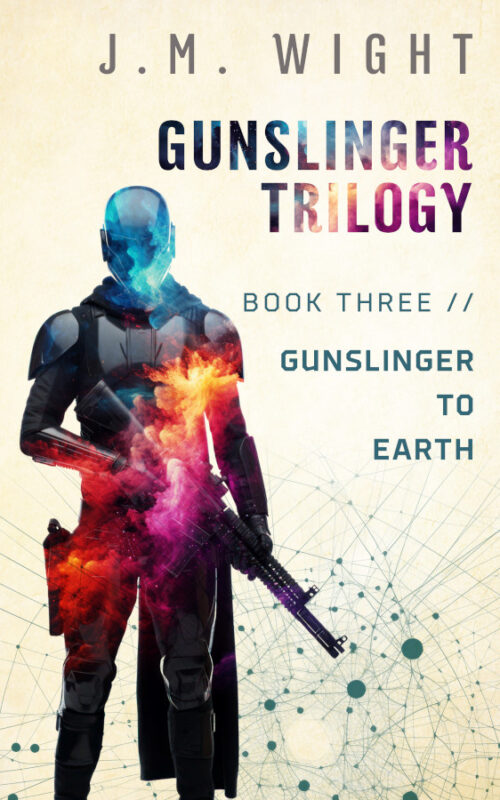
Gunslinger to Earth is a character-driven space opera adventure about crossing a cosmic no-man’s-land to discover what happened to the home you thought was lost forever. It blends gunslinger-style starship action, found-family dynamics, political revolution, and end-times mystery as Rex Carter, Sam Kletchka, and Jane Kletchka risk everything to follow Earth into an impossible anomaly. It’s a fast, hopeful, and surprisingly tender finale that wraps up the Gunslinger Trilogy with both high stakes and a genuine sense of homecoming.

What Kind of Reader Will Love This Book?

If you love…

  • Space opera that feels like Firefly meets end-times science fiction, with a gunslinger pilot, a loyal found family, and a war-torn galaxy trying to pull them apart
  • Stories where faith, prophecy, and cosmic mystery actually matter to the plot, not just as window dressing
  • Coming-of-age under fire, as Rex Carter tries to decide who he is and where he belongs while revolutions, wormholes, and vanished planets rearrange the map of human history
  • Character-focused military SF with moral clarity, loyalty, and hope, rather than grimdark cynicism

…then Gunslinger to Earth is probably your kind of story.

What You’ll Find Inside

Gunslinger to Earth is a story rooted in space opera adventure, end-times science fiction, and prophecy-driven mystery. The hero of this third book in the trilogy is Rex Carter, a cadet still reeling from the day Earth and Luna vanished into an impossible anomaly. Torn between his patriot girlfriend Charlotte, his loyalty to Sam and Jane, and his fear for his family back home, Rex has to grow up fast as he’s swept into a mission to follow Earth across the “world-bridge” and find out what really happened.

The mood balances tense, boots-on-the-deck action (derelict ghost ships in the anomaly, desperate battles near wormholes, claustrophobic escapes from Luna) with a deep, almost awe-struck sense of wonder as the crew finally confronts a transformed Earth and the fulfillment of ancient prophecies. The style is fast-paced, voice-driven, and accessible—more “frontier adventure with big ideas” than hard-science textbook—with a strong throughline of family, faith, and the search for home.

What Makes It Different

Fans of classic space opera and military SF—think Firefly, The Expanse, or David Weber—will recognize the starship battles, political tensions, and ragtag crews, but Gunslinger to Earth takes those ideas in a very different direction. Instead of treating religion and prophecy as background flavor, this book leans straight into them: the disappearance of Earth isn’t just a physics problem, it’s tied to the City of Enoch, the fulfillment of Latter-day Saint-style millennial prophecies, and a literal “new Earth” where history has turned a corner.

Where many space war stories focus on winning the next battle or installing the next regime, this one asks what happens when the war is suddenly dwarfed by something much bigger—when the homeworld itself is renewed and taken off the game board. It’s less about toppling empires and more about how ordinary, stubbornly decent people respond when God, history, and politics all collide at once. And because it’s the capstone of the Gunslinger Trilogy, it doesn’t just raise the stakes; it actually lands them with a clear, hopeful ending.

Readers who enjoy the moral backbone of Lois McMaster Bujold, the frontier grit of Firefly, and the cosmic mystery of The Expanse will find familiar elements here—but woven together in a way that feels genuinely new.

What You Won’t Find

You won’t find grimdark nihilism, graphic sex, or wall-to-wall gore here. The story has violence, war, and real loss—this is a revolution and an end-times crisis, after all—but it’s written at about a PG-13 level, with the camera panning away from anything needlessly explicit. You also won’t find a sneering, anti-religious tone; faith and prophecy are treated respectfully and sincerely, even when characters struggle to believe them. This is a cleaner-but-still-intense sci-fi adventure that focuses more on meaning, loyalty, and wonder than shock value.

Why I Think You Might Love It

I wrote Gunslinger to Earth during a major turning point in my own life—just after I started dating the woman who would become my wife, at a time when I was reinventing my writing process so I could tell better stories more consistently. In a lot of ways, this book is about that same kind of turning point on a galactic scale: the moment when old patterns break, a long-promised future finally arrives, and you have to decide who you’re going to be on the other side of it. My hope is that if you care about loyalty, about home, about the possibility that history is going somewhere meaningful, then this story will leave you with the same feeling it gave me while I was writing it: that even in the middle of chaos, there’s a way through—and it leads somewhere worth fighting for.

Where to Get the Book

Related Posts and Pages

Explore the series index for the Gunslinger Trilogy.

Return to the book page for Gunslinger to Earth.

The Choice to Believe in Gunslinger to Earth.

See all of my books in series order.

Moral Courage in Gunslinger to the Stars

What does it mean to do the right thing when the galaxy around you is chaotic, corrupt, or outright absurd? Gunslinger to the Stars takes that question and drops it squarely in the lap of Sam Kletchka—a mercenary gunslinger navigating a dangerous galactic frontier who keeps choosing responsibility even when no one is watching, rewarding, or deserving. At its heart, this space-western adventure is about moral courage: the stubborn, unfashionable insistence on doing the right thing in a universe that rarely makes it easy.

Where the Idea Came From

This theme grew out of a mashup of influences—long conversations with writer friends, a subplot from Schlock Mercenary, and the realization that a “rogue Immortal” character needed a counterweight with a strong personal code. Around the same time, I was watching Breaking Bad, fascinated by characters like Mike Ehrmantraut—tough, pragmatic men who do terrible things for complicated reasons. To push back against such a villainous force, I imagined Sam Kletchka: a gunslinger in a messy, morally gray universe who lives by a code and keeps choosing the harder path simply because it’s right, even when the galaxy doesn’t care.

How Moral Courage Shapes the Story

At every major turning point in Gunslinger to the Stars, Sam Kletchka’s choices are defined by moral courage—the instinct to protect others even when it’s dangerous, inconvenient, or unwinnable. He charges after kidnapped empaths when walking away would be safer; he shields Jane’s diplomatic idealism with his hard-won pragmatism; he survives abandonment in the desert through sheer stubborn responsibility; and he repeatedly throws himself into battles around war rigs, jumpgates, and alien war parties because no one else can or will. His personal code drives the story’s conflicts, shapes the character dynamics, and pushes this space-opera adventure toward a climax where courage isn’t about glory but about doing the right thing in a lawless, unpredictable, morally gray galaxy.

What Moral Courage Says About Us

Sam’s story reflects something deeply human: we don’t get to choose the worlds we’re born into, but we do get to choose what kind of people we become. In a galaxy run by Immortals, riddled with slavers, warlords, and manipulative telepaths, Sam’s personal code becomes his anchor—the thing that keeps him from becoming the very wolf he warns Jane about. His courage isn’t flashy heroism; it’s the uncomfortable, everyday kind that demands sacrifice, loyalty, and integrity when it would be easier to look away. In that sense, the book becomes a mirror for readers who love character-driven science fiction that asks what we stand for when the world pushes back.

Why This Theme Matters to Me

I wrote this book at a very different time in my life—years after Genesis Earth, when my own view of the world had shifted. I still believed in cultural understanding and bridging divides, but I’d also seen enough to know that evil doesn’t always yield to good intentions. Like Sam, I firmly believe in the right to defend oneself and others, and I’ve had long debates about the responsibilities that come with that. I wanted to write a character who lives at the intersection of those values—someone who understands violence, hates it, but won’t walk away when others depend on him. That tension, that conviction, is why moral courage felt like the beating heart of Gunslinger to the Stars.

Where to Get the Book

Related Posts and Pages

Explore the series index for the Gunslinger Trilogy.

Return to the book page for Gunslinger to the Stars.

Discover if Gunslinger to the Stars is for you.

See all of my books in series order.