M is for Merchanter

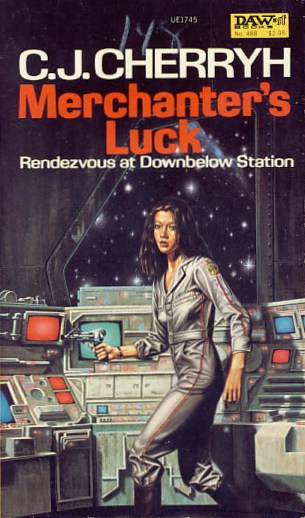
CherryhMerchantersLuckCoverIf space is an ocean and interstellar colonization is happening on a grand scale, then it should come as no surprise that so many starship captains are intrepid merchants, traveling the galaxy in pursuit of a good business deal.  Whether they’re doing it legally as entrepreneurs or illegally as smugglers, you can find these guys in almost any space opera, from Star Wars and Star Trek to Firefly and Foundation.

Ever since Marco Polo and Sindbad the Sailor, intrepid merchants have played a major role throughout history.  The brave adventurers who travels to exotic locales to bring you all the best deals, these are often the guys at the forefront of exploration and expansion.  After all, Columbus sailed the ocean blue to find a better trade route to India–discovering a new world was just a side benefit.  The British Empire had its origins in mercantilism, forming the empire to protect their trade routes (and later, to secure markets and resources for their industrialized economy).

Unlike their real-world counterparts, however, space merchanters have a lot more challenges to contend with than sandstorms and bandits.  Science fictional universes are teeming with all sorts of exotic dangers, from black holes and solar flares to space pirates and strange alien races.  Unless FTL communication is in force, the immensity of space often makes it impossible to know exactly what to expect on your next FTL jump.  And then there’s all the normal space stuff, like busted airlocks and critical failures in the oxygen recyclers.

The best stories, though, are the ones that world build their merchanters to the point where they form their own distinct society.  This may overlap with the proud merchant race, though IMO it works best when it’s more than just a hat that everyone wears.  The merchanters from C.J. Cherryh’s Alliance-Union universe are a great example, where the entire society has restructured itself around the nomadic spacefaring lifestyle.  Another is Heinlein’s Citizen of the Galaxy, where the free traders have developed a strict social hierarchy that defines everyone’s role in running the spaceships.

Since space-centered science fiction largely grew up in the Cold War era, I wonder how much of this trope stems out of the clash between communism and capitalism.  The original Star Trek certainly shows a lot of Cold War influences, with the Klingons originally playing proxy for the Russians.  Is the genre’s fascination with the adventurous space merchant somehow an outgrowth of that world-shaping conflict?  And if so, how do the stories differ on the Soviet side?  It makes me wish I could read Russian, since the Soviets certainly had their own fascination with science fiction and space opera.

In my own work, this trope plays a central role.  Most of the major characters in my stories are merchants of one stripe or another.  James McCoy from Bringing Stella Home is the son of a merchanter, and comes from a mining colony where interplanetary trade drives the local economy (setting up the conflict for Heart of the Nebula after the Hameji take over).

But the trope takes special prominence in my Star Wanderers novellas, which was largely a reaction to C.J. Cherryh and Heinlein.  I wanted to create a spacefaring society on the starbound frontier that revolved not only around trade and colonization, but much more personal struggles like finding love and fighting loneliness.  In that sense, the stories are a lot more like Merchanter’s Luck than Downbelow Station–more about the lives of individual characters than the grand sweep of galactic history.

Either way, I’m a big fan of this trope.  If you’ve got any examples from your favorite books, please share!  Wish-fulfillment is a huge part of any fictional genre, and science fiction is no exception.  If I could leave it all behind to become a merchant to the stars, you can bet I’d do it in an instant!

Trope Tuesday: Settling the (Final) Frontier

I love stories about colonization, especially when they’re set in space.  There’s just something about a small group of rugged pioneers striking out into the harsh, unforgiving wilderness to make a new life for themselves.  Maybe it’s just something about my American heritage, or all those 4x games I played as a kid, but I doubt it.  Ever since the dawn of time, we humans have been on the move, looking for new and better places to call home.  Small wonder, then, that so many of our stories, both ancient and modern, are about settling the frontier.

Since space is the final frontier, this trope is very common in science fiction.  Heinlein was a huge fan of it, but he wasn’t the only one to play with it–not by a long shot.  John Scalzi (The Last Colony), Nancy Kress (Crossfire), C.J. Cherryh (40,000 in Gehenna), Anne McCaffrey (Freedom’s Landing), and Kim Stanley Robinson (Red Mars, Green Mars, and Blue Mars) are just a few of the many science fiction writers who have explored this trope in their works.  In recent years, several sci fi miniseries (Battlestar Galactica, Terra Nova) have used it as a major premise as well.  And of course, you have all the classic 4x games like Masters of Orion and Alpha Centauri.

Space Colonies can come in a variety of different flavors:

  • Lost Colony — What happens when the original colonists lose all contact with the outside universe and no one thinks to check up on them for a while.  Can either turn into a story of survival or a clash of cultures, if/when they ever re-establish contact.
  • Cult Colony — Religion is one of the few things that will drive massive numbers of people to leave everything behind and start over in a new world.  Just look at the Pilgrims for a real-world examples.  In space colonies of this type, you can expect to see some extremely radical people, since the isolation of deep space tends to compound their fundamentalist tendencies.  Expect these to be both weird and frightening.
  • Space Amish — Something of a combination of the two, except with much more primitive technology.  Expect to see log cabins, horse- (or giant lizard) drawn carriages, and other tropes closer to the Western genre.  Sometimes, they may be hiding a superweapon.
  • Penal Colony — Australia in space (ahem…IN SPAAACE!!!).  What happens when the empire needs a place to conveniently exile all the troublemakers and rabble rousers.  Not a place for the faint of heart.
  • Wretched Hive — What happens to a penal colony when the prisoners actually run the place.  Like the previous type, except taken up to eleven.  Or not, depending on the history and culture.  Tatooine is the eponymous example.
  • Death World — As the name would suggest, this is not the kind of place you’d want to homestead.  Anyone who does is bound to be a badass.  The Empire and the Federation often recruit most of their soldiers from here.
  • Company World — I couldn’t find this one listed on tvtropes.  Basically, it’s a planet that is owned and governed entirely by a private corporation, which expects to make a tidy profit off of the place.  The colonists are basically indentured servants (since robots simply wouldn’t do) and have almost no property or rights.  Expect the story to be about sticking it to the man.

These are just a few of the many possibilities that you can play with when settling the frontier.  In my opinion, however, the essential elements are as follows:

  • The story is not just about exploring a new world, but establishing some kind of a permanent presence there.
  • By coming to the new world, the colonists must leave everything from their old, familiar lives behind.
  • The colonists must resolve the story conflict through their own self-reliance, not by waiting for an outside force to save them.

I’ve only dabbled with this trope, but it does play a role in many of my stories, most notably in the Star Wanderers series.  Genesis Earth also has elements of it as well, though it’s not the main driver for the plot.  It is a major factor in Heart of the Nebula, though, the (currently) unpublished sequel to Bringing Stella Home.  And in my future books, you can definitely expect to see this trope again.

No more word counts and other paradigm shifts

This August, it will be five years since I decided to start writing on a professional level.  A lot of things have changed since then, and in some ways they’re changing even faster now.

For example, in May 2009 I started a spreadsheet to keep track of my daily word counts.  I’ve been keeping it diligently ever since then, with graphs and everything.  But just recently, I’ve decided to stop doing that.  Word count is a very shallow indicator of progress: it only measures quantity, and often leads to unnecessary angst or diverts attention from more important things.

Instead, I’m going to focus more on deadlines and work to develop some other, better indicators.  Number of books published per year is probably a key one, as well as number of manuscripts finished.  But deadlines are probably going to be the most important drivers from here on out: publishing deadlines as well as writing deadlines.

Another thing that’s shifting is my revision process.  I know that a lot of beginning writers hate Heinlein’s rules, but almost all the long-term professionals swear by them–especially the ones with careers that I would like to emulate.  This makes me think that I need to scale back on the revisions and develop more trust in my creative voice.

Just as a point of reference, Heinlein’s rules are:

  1. You must write.
  2. You must finish what you write.
  3. You must refrain from rewriting, except to editorial order.
  4. You must put the work on the market.
  5. You must keep the work on the market until it has sold.

I’m currently on the second draft of Stars of Blood and Glory, and what I’ve found so far is that the overall story is actually pretty good.  Some of the scenes are a little out of order, and some of the plot-lines are missing elements that need to be added in, but aside from a few chapters where I got lost for a couple of pages, not a lot needs to be changed.

Of course, I could spend a draft or two tweaking every other sentence, tossing out most of what I wrote in the heat of my creative passion–but would that really make the story any better?  I recently had Kindal’s writing group critique my first chapter–the one that I revised pretty heavily in April–and they found all sorts of problems that weren’t in the original draft, as I wrote it back in December.

Don’t get me wrong–I do think there is an important place for revision.  But I think it’s best epitomized by Tracy Hickman in this episode of Writing Excuses:

We write from the heat of our passion, but we edit to see the fire through the smoke.

And even Tracy only does three drafts.

The other thing that’s changing is how I look at alpha reading.  I used to have different tiers of alpha and beta readers–most of whom were writers in other genres, and not really fans of  science fiction.  I asked them to give me as much feedback as they could, and bugged them for weeks or months at a time asking if they’d read my story.  I then compiled all their line-by-line comments into one giant master-file, which I kept open on the left side of my screen as I made the changes to my manuscript on the right.

Well, I’ve started to realize that there’s a huge difference between reading for criticism and reading for enjoyment.  Because of that, a lot of the things my alpha and beta readers pointed out were things that most regular readers probably wouldn’t have noticed.  Towards the end, I started to get wise on this, and only followed about a third of the criticism that I received.

Don’t get me wrong–I do appreciate the feedback.  A lot of it helped me to see and fix problems that I’d otherwise missed.  But a lot of it came out in casual conversations with my readers after they’d finished the story–not in the line-by-line comments on the original draft.

For those reasons, I think I’m going to change the way I ask for feedback.  Instead of alpha and beta readers, I’m going to go with a handful of “test readers”–readers who enjoy the kind of science fiction I like to write, but who may or may not be writers themselves.  Instead of asking for a detailed, line-by-line critique, I’m going to ask them three things:

  1. Did you enjoy the story?
  2. If you stopped reading it, where did you stop?
  3. Did you enjoy it enough to pay for it?

I’ll ask them to give it three chances, and if they still can’t finish, that’s okay–just let me know where the hangups were.  And if they do finish it, I might have some questions for them–but then again, I might not.  It all depends on the story.

Compared to where I was when I started out–or even where I was three months ago–those are some pretty huge paradigm shifts.  I have no idea how it’s going to turn out.  I’ve grown a lot as a writer recently, and I hope that this is moving me in the right direction, but I won’t really know until I’ve tried it out for a while.

In any case, this post is long enough.  I’d better get back to writing.

Heinlein’s rules for the digital age

I’ve been thinking a lot about Heinlein’s rules and how they apply to my own writing career.  While a lot of newer writers like to debate Heinlein, all of the long-time professionals tend to agree with him.  For that reason, I think it’s worth taking a serious look at his rules and doing my best to follow them.

The trouble is that Heinlein formulated his rules before the digital age, when self-publishing was non-viable and writers sold to editors, not to readers.  While I wouldn’t go so far as to say his rules are outdated, I do think that they need to be tweaked a little in order to apply to today’s aspiring professionals.

As a disclaimer, I should say that I’m only a beginning writer without much authority or experience.  However, my goal is not to debate Heinlein, but to explore ways in which his advice can be adapted to myself and writers in my position.  If any of you have any thoughts or input, I would very much like to hear it.

So anyhow, here we go:

Rule One: You Must Write.

Pretty straightforward: if you want to write for a living, then the bulk of your time should be spent writing.  Too many indie writers spend all their time and energy promoting their one book when they should be writing others.  If promotion gets in the way of writing, then you should stop promoting and just go write.

Personally, I could probably spend a lot more time writing new material as opposed to revising stuff I’ve previously written (yes, that’s the infamous third rule; I’ll get to it in a minute).  I tend to spend a month writing something new, then take a couple of months to revise old works without producing new material.  If I want to be strict about following Heinlein’s rules, I should probably change that.

Rule Two: You Must Finish What You Write.

Another straightforward rule, but you’d be surprised how hard it is when you know you can publish whatever you write.  Kris Rusch calls these ideas “popcorn kittens,” after a popular youtube video that embodies what goes on in our minds when we have the freedom to create anything.  The problem with too much freedom is that it’s a struggle not to flit from one idea to another, dabbling in all of them but carrying none to completion.

I myself had this problem over the summer, and to some extent I’m struggling with it now.  The key is just to buckle down and have the discipline to finish what you start.  Pretty straightforward.

Rule Three: You Must Refrain From Rewriting, Except to Editorial Order. 

This is Heinlein’s most controversial rule, especially for new writers.  However, I think he has a good point.  If a story is fundamentally broken, revising it is no more effective than stirring around a pile of crap; and if the story works, revising it without first getting a trusted second opinion could actually make it worse.  After all, writers are often the worst judges of their own work.

The key question, then, is where to go for that second opinion.  In the old days, money flowed from the editors to the writers (or at least from the publishers, who employed the editors), but in the new world of publishing, it’s exactly the opposite.  Most of us can’t afford to hire editors for extensive developmental edits, especially when we’re just starting out, and while it’s possible to publish a rough draft, for most of us it’s probably not a good idea.

My approach is to share my unpolished work with a network of trusted first readers, and use their feedback to guide me in the revision process.  I don’t always adopt all of their suggestions, but I carefully consider each one.  Most of the time, I use them to see where the problems are, then use my creative mind to come up with a solution, sometimes taking the book in an entirely new direction.  And if something works well for some but doesn’t for others, I figure it’s not a problem but a judgment call that requires my attention.

Using this method, it currently takes me about four or five drafts before I feel confident enough to publish something.  If I really wanted to follow Heinlein’s rules, I would probably try harder to nail it on the first draft, but I’ve found that my creative process works better in revision mode than while writing new material.  So long as I can revise efficiently enough to produce at least two novels each year, I think I’ll be in good shape.

Rule Four: You Must Put Your Story on the Market.

In the old days, this meant submitting your manuscript to contests, magazines, and publishing houses, not self-publishing.  For short stories, contests and magazines are probably still the best place to start.  However, with novels, indie publishing is generally much better.

The trouble is that publishing your own work is as scary as hell, especially when it’s close to your heart.  This is probably the main thing keeping most new writers from going indie: the need for external validation which grows out of a lack of much needed self-confidence.

The key, I believe, is to get some emotional distance between yourself and your work.  As a rule, I don’t respond to reviews, good or bad.  As for external validation, I don’t seek it at all.  I only publish the stories that I believe in, and even if I’m nervous about sending them out into the world, I figure it’s better to suck it up and do it anyway.  It was the same with writing queries; the only difference is that the market is now the readers, not the editors.

Rule Five: You Must Keep It On The Market Until It Has Sold.

This is especially challenging for indie writers.  When weeks go by without a single sale, it’s easy to believe that your work is crap and that you should just take it down.  It’s even worse when your book isn’t selling and you get a bad review.

Just like with queries, however, the key is to keep your work out there until it finds its natural audience.  With indie publishing, you have all the time in the world, provided you don’t lose confidence.

The key question in my mind is whether to take down your old, crappy stuff as your writing improves, or to leave it up alongside your newer, better work.  Personally, I think it should come down to the readers; if the old stuff is consistently getting bad reviews, it’s probably better to take it down, but if not, might as well keep it up.

So there you have it.  From Heinlein’s rules, I’ve more or less crystalized the following approach:

  1. Always make time to write, even at the expense of promotion.
  2. Only chase new ideas if you know you can finish what you start.
  3. Don’t revise without first getting feedback from trusted readers.
  4. Don’t wait for external validation before you publish.
  5. Keep your work up, even if it doesn’t sell.

Not quite as pithy as Heinlein’s rules, but they seem pretty reasonable.  I don’t have the experience to say whether they follow his, however, so if you have any comments or suggestions, please chime in.

The interior designer’s approach to story

I recently read a fascinating post on John Brown’s blog with an interesting exercise for analyzing the kinds of stories you most like to read.  By finding out what really turns you on in a story, you can have a much better idea what to write, and how to make your own stories better.

He prefaced the exercise with a story about the interior designer who helped them to decorate their house.  The designer spread out a number of home magazines in front of them, and told them to go through and tear out the pictures that most turned them on.  After doing this, they analyzed the pictures to see what they had in common, and thus discovered how to best decorate their house.

The exercise works much the same way.  First, pick out five books you really like that immediately come to mind.  Mine are:

As many of you know, these are some of my favorite books of all time.  I’ve reread three of them, and I intend to reread the other two at some point.

Next, pick out the elements that these books have in common.  Here’s what I came up with:

1) Set in a different time and place.

Not all these books are science fiction, but the all take place in a world far removed from our own.  Only Spin takes place largely on Earth, but the events of the story transform the world as we know it so much that by the end of the novel, it’s completely different. SPOILER (highlight to see) Besides, at the very end, the two main characters leave Earth by going through the giant portal to another planet, so the novel is arguably about escaping the world as we know it.

2) Stakes that are much more personal than global.

This was interesting, and highlights something I realized when I compared Merchanter’s Luck with Downbelow Station.  In all of these stories, the central driving conflicts are extremely intimate and personal.

To be sure, many of these stories also have an epic backdrop; Mistborn certainly does.  However, I was much more interested in Vin’s growth and development than I was in how the Ska would overthrow the Lord Ruler–in fact, Mistborn is my favorite book in the trilogy for that very reason.

3) Encourages deep introspection.

This shouldn’t come as too much of a surprise if you’ve followed this blog for a while, but I love love LOVE stories that make me see the world in a new way.  Thrillers and adventures are all fun and good, but if it doesn’t make me think, I’m usually like “meh” at the end.

4) Female characters who aren’t weak or passive.

This one might be a bit more controversial, but in all of these stories, I’ve noticed that the female characters are pretty strong, even if they aren’t all kick-butt Katniss wannabes (ugh…I hate Katniss).  Even in Legend, which is largely dominated by men, you still have the earl’s daughter, who is one heck of a spirited woman.

5) Life and death conflicts.

This is interesting: in all of these books, the threat of death is immanently real.  Some of them, such as Legend and On My Way to Paradise, are among the most violent books I’ve ever read.  I’m not sure what it is, but there’s something about life and death struggles that really draws me.

6) Romantic in a broad sense.

I’m using Tracy Hickman’s definition here, in which romance is all about teaching us to feel and bringing us in touch with our deepest feelings.  That’s the central theme of On My Way to Paradise: learning how to be a man of passion after witnessing some of the worst atrocities of war.

All of these books not only make me feel, they are about the feelings that they inspire.  In other words, the emotional elements of the story are both a part of and deeply embedded in the story’s central theme.

The exercises isn’t complete after this, though.  For the last part, take another five books and analyze them to see how they compare.  My second list includes:

So how does the list stack up?  Let’s see…

  1. Definitely true.  NONE of these stories take place in the world as we know it–and that’s awesome.
  2. A Canticle for Leibowitz might seem like an exception, since it follows the broad rise and fall of human civilization after the nuclear apocalypse.  But the things that really drew me to the story were the more personal elements: the novice who makes the illuminated manuscript of the electrical diagram, for example, or the abbot at the very end who SPOILER tries desperately to convince the single mother not to take her baby to the mercy killing station after the bomb fatally irradiates them.  In any case, it’s telling that A Canticle for Leibowitz made this list, whereas none of Arthur. C. Clarke’s books even came to my mind.
  3. Definitely true.  Even Citizen of the Galaxy, which is more adventure fiction than high concept sf, features a fascinating society of interstellar traders that really made me sit back and think about the way we structure our society.  Heinlein has a really awesome way of doing that with everything he writes.
  4. The only possible exception here might again be Heinlein, who had some very extremist views of women (putting it lightly).  However, if I recall, Citizen of the Galaxy has a female character at the end who helps pull out the main character from his indigent circumstances and helps him to come into his own.  Again, they might not all be kick-butt tramp-stamp vampire slayers, but they certainly aren’t weak.
  5. Less true of The Neverending Story and The Dispossessed, but while the central conflicts might not be about life and death, the threat of death (or a total loss of identity) certainly comes into play.
  6. Definitely true.  Few books have taught me to feel more deeply than The Neverending Story.  An absolutely magnificent piece of literature.

So there you have it.  According to this exercise, I should write books set in another time and place, where strong female characters face life and death decisions that personally impact the people in their lives and make the readers think and feel.  Interestingly enough, that is a PERFECT description of Bringing Stella Home, as well as Desert Stars and Into the Nebulous Deep.

Cool stuff.  Makes me want to write.  So on that note, I think I will.

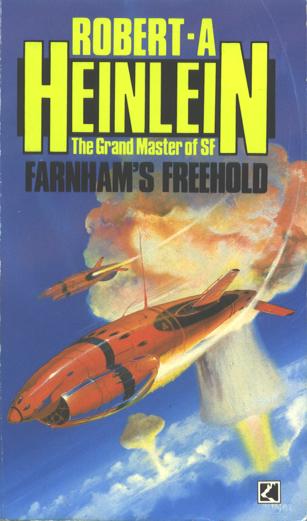
Farnham’s Freehold by Robert Heinlein

Bomb warning.  Third bomb warning.  This is not a drill.  Take shelter at once.  Any shelter.  You are going to be atom-bombed in the next few minutes.  So get the lead out, you stupid fools, and quit listening to this chatter!  TAKE SHELTER!

Thus begins the wild and crazy story of Hugh Farnham, a middle aged suburban American, with his alcoholic wife Grace, his law student son Duke and daughter Karen, their black house servant Joseph, Karen’s sorority sister Barbara, and the cat Mr.-Livingston-I-Presume.  When the Russians nuke the peaceful town of Mountain Springs into oblivion, only the uncanny foresight and resourcefulness of Hugh keeps them alive.  When they open their bomb shelter and climb outside, however, they find themselves in a world that defies anything they could ever imagine.

This book was incredible. I finished it at 4:00 am on a Sunday night, and honestly I wouldn’t have it any other way.  The characters are memorable and engaging, the plot face-paced and thrilling, the world fantastically imaginative, and the story both entertaining and thought provoking.  Wow.

Heinlein is an unparalleled storyteller, and I think he does it by creating worlds that are innately fascinating and imaginable and populating them with characters who act like real people, with the full range of reactions and motivations that real people have.

Consider the basic premise: who hasn’t wondered what World War III would be like?  No one who grew up during the Cold War, certainly.  And as for surviving and colonizing an uncivilized wilderness, people of all ages have been enthralled with that idea since Robinson Carusoe and The Swiss Family Robinson.  Heinlein capitalizes on this urge by telling us a story that we love to tell ourselves.

But the thing that really drew me in was the characters.

I’ll confess, when I got to the part where they open the bomb shelter and find themselves in a pristine, virgin wilderness instead of a blasted city, I threw the book across the room.  Up to that point, everything about the nuclear attack had been so realistic that the cross-dimensional time travel element totally threw me out.

However, even after I put the book down, I couldn’t stop thinking about Hugh Farnham.  The down to earth, no nonsense resourceful man who took the Boy Scout motto “Be Prepared” to a whole new level–who had the chutzpah to draw a gun on his own son when his rebellious behavior threatened to unravel the group–his undying attitude of “never surrender”–I just couldn’t stop thinking about him.  So I picked the book back up and finished it, and am I ever glad I did!

But it wasn’t just Hugh Farnham.  Grace, with her debilitating alcoholism and irrational outbursts, was a character I really loved to hate EVEN THOUGH she reminded me of people in my own family.  Joe, the longsuffering polite servant who changes so frighteningly with the reversal of fortune in the second half of the book; Duke, whose dysfunctional relationship with his father leads to so many problems; Barbara, the 60s era divorcee who goes from outsider to one of the closest members of the group–man, there were some memorable characters.  And NONE of them were caricatures; all of them had strengths and weaknesses, and while some fell prey to their flaws, others rose above them and triumphed magnificently.

I suppose that Farnham’s Freehold is a good example of pulp science fiction at its best: an imminently entertaining story that is also meaningful and thought provoking.  If so, then this is definitely the kind of stuff I want to write.  The descriptions may be sparse and the prose rather unremarkable–but man, the story…what a wild and crazy ride!