Farewell to 2024!

It’s new year’s eve, finally! Another year, another voyage around the M-class dwarf star we call Sol!

A lot of other writers and podcasters are doing recaps of their year, highlighting some of their best moments as well as analyzing what they learned and what changed. Generally, though, these people are either single or have producers and assistants to help them with their content. Since neither of those is true for me (I literally just put my son down for a nap, though it sounds like it will be a while before he falls asleep), I’ll just write a quick blog post with some off-the-cuff thoughts.

It’s been a very busy and eventful year for me, writing-wise, though most of that probably won’t be visible from the outside until about the middle of next year. I’ve totally reworked my writing process in ways that should start yielding a lot of new books around then, and hopefully continue to yield them for the forseeable future. If successful, I will probably write a non-fiction book about it sometime, but that’s still in the nebulous future.

I published four novels this year, all in a new series, and I’m currently writing two more in the same series (the Sea Mage Cycle). Interestingly enough, it’s one of my best rated series, which probably shows how much I’ve improved as a writer since I first started indie publishing. Also, it’s much more of a fun adventure fantasy series than some of my other stuff, which either tends toward sprawling, ambitious space opera or sober dystopian think-pieces, both of which tend to take themselves a little too seriously. But I’m happy writing fantasy adventure, so if it turns out I can carve out a comfortable niche in this subgenre, I’ll certainly enjoy leaning into it.

Four novels in a year is about four times what I typically produce, but I was starting to feel a little burned out, so after taking a break to write some AI-assisted short stories, I decided to take some lessons from the experience and spend the rest of the year reworking my creative process. It didn’t take long for me to learn that writing quality AI-assisted novels isn’t that much harder than writing quality AI-assisted short stories—indeed, in some very key ways, it’s actually easier. So since novels are much more lucrative than short stories, I decided to stop writing them and to focus exclusively on novels.

I still plan to keep putting out a new title every month in 2025, just like I have for the last several years. Until now, most of those titles have been short stories, simply because I wasn’t able to write fast enough to regularly publish anything longer. But this year, I’m hoping to put out at least five novels, perhaps more, especially if I can get to the point where it only takes a month to write them. On the off months, I will republish old short story singles, so if there are any that you remember that you want to see again, let me know and I’ll put them into the publishing queue.

I’ll have to write at length with how I’ve reworked my writing process, and not just from the AI angle. I’ve also figured out how to hack my ADHD so that a lot of the things that used to be liabilities (a hyperactive, easily distractible mind, a hunger for novelty, a constant desire to start new projects or to chase new ideas, etc) are now assets instead of liabilities. But to really get into that, I first need to write about how I hacked my ADHD to read more books—which would probably make a great blog post for January 2025, since I’m sure many of my readers are making resolutions to read more books. I used to struggle to read more than thirty or forty books in a year, but now I consistently finish a book every 2-5 days, and have been for the last year and a half. So that should make a very interesting post.

On a more personal note, my big resolution for this year is to hike Mount Timpanogos at least once, and be in good enough shape that it doesn’t totally wipe me out. It should be too hard. I enjoy hiking, but I’ve put off hiking Mount Timp for years, assuming I would get around to it some other time. Well, I’m 40 now, so if I don’t do it soon there’s a chance I may never do it. Besides, it would be great to get back into hiking again, and perhaps even tackle some truly difficult mountains, not just the big local one that’s emminently doable. But for this year, it’s Mount Timpanogos (and maybe Mount Nebo, if Timp isn’t enough of a challenge).

The kids are getting older, and we’ll probably have to figure out homeschooling before the end of this next year. We’re also moving back into our house in Orem, after my wife gets her PhD. Before we do, I’d like to build a little free library that we can post on the corner of our property, and maybe even a bench, if I can get around to it. But the library is definitely something I want to finish before we move back in. Should be a fun woodworking project.

So that’s what we’re up to around here. Definitely looking forward to another long trip around the sun!
Reading Resolution Update: After Action Report

My 2022 reading resolution: Read or DNF every novel that has won a Hugo or a Nebula award, and acquire all the good ones.

Earlier this month, I finished my last Hugo/Nebula book and ordered the last two ones that I hadn’t yet acquired. The first of those (Powers by Ursula K. Le Guin) arrived just this morning, and the other one (Way Station by Clifford D. Simak) is supposed to arrive next week, so I think that now is a good time to do a retrospective and share some of my thoughts.

There were 104 books in total, including the most recent award winners (I decided not to count the retro-Hugos midway through the year). Of those, I’ve read 35 through from start to finish, and decided that 24 were worth keeping. The rest of them (69, or almost exactly two thirds) I DNFed.

Finishing one in three books is actually about on par for me. I’ve found that if I don’t allow myself to DNF books early and often, I just don’t read. Also, it doesn’t really surprise me that nearly one third of the books I read all the way through didn’t really impress me. What can I say—I’ve a very opinionated man.

Of the 28 books that have won both a Hugo and a Nebula, I finished 12 (or about two-fifths) and found that eight (or a little over a quarter) were worth keeping. So not much different than the overall totals.

Of the 45 books that won only a Hugo, I finished 18 (exactly two-fifths) and found that 14 (about a third) were worth keeping. So my personal taste seems to be tilted more toward the Hugo than the Nebula. The difference becomes even more stark when you take out the 20 books that were nominated for (but did not win) a Nebula, a whopping 16 of which I DNFed. Excluding those, we’re left with 25 books, 14 (or more than half) of which I finished, and 11 (or just under half) I thought were worth keeping.

The contrast becomes even sharper when we look at the Nebula-only winners. Out of the 31 books that didn’t win a Hugo but did win the Nebula, I finished only five (less than one-sixth) and found that only two were worth keeping. Both of those were books that weren’t even nominated for the Hugo. When we look at the 16 Nebula-winners that were nominated for a Hugo but didn’t win, I finished only two of them (one-eight) and didn’t think that any of them were worth keeping.

So the best predictor that I wouldn’t like a book is if it won a Nebula and was nominated for a Hugo, but didn’t win. In other words, if the SFWA crowd (which is mostly authors) said “this is the best novel published this year!” and the denizens of Worldcon said “yeah… no,” that almost guaranteed I would hate it. In fact, just getting nominated for a Nebula is enough to make a book suspect.

This is why, earlier in the year, I posited the theory that SFWA has done more to ruin science fiction than any other organization. I saw this trend coming all the way back in the spring, when I was only halfway through the reading list. In the early years, SFWA was all about politicizing science fiction, and in the last few years, it’s basically turned into a nasty bunch of mean girls all trying to get a Nebula for themselves.

I tracked a few other awards just to see if there were any correlations. For the 18 books that placed in any category in the Goodreads Awards, there were only four books that I finished and two that I thought were worth keeping. Network Effect by Martha Wells received 22,971 votes in the Science Fiction category in 2020, which came to 9.69%. Blackout by Connie Willis gained only 337 votes in 2010, but that was 9.19% back then. Both of those books were keepers. The only other book that got a higher percentage for its year was Redshirts by John Scalzi, with 4,618 votes at 10.82%, but I DNFed that one. Most Hugo/Nebula winning books didn’t even clear the 5% threshold in the Goodreads Choice Awards, and in my experience anything under 10% that doesn’t immediately jump out to me probably isn’t worth reading.

Of the six Hugo/Nebula books that were nominated for a Dragon Award, the only one I even really finished was Network Effect by Martha Wells. But that makes sense, since it’s no great secret that the Hugo/Nebula crowd is trying to sabotage the Dragons by pulling exactly the same shenanigans that they accused the Sad Puppies of doing. Accusation is projection is confession, after all. As of 2022, there has never been a Hugo/Nebula winning book that has also won a Dragon, and while part of me hopes that it stays that way, another part of me is very curious to read the first book that does.

Almost all of the 104 Hugo/Nebula winning books placed somewhere in the various Locus recommended reading lists, which isn’t surprising since those lists are generally regarded as feeders for the Hugos and Nebulas (and used to get more people voting in them, too). Of the seven books that weren’t on a Locus list, the only one I finished was They’d Rather Be Right by Mark Clifton and Frank Riley, which also has the distinction of being the most difficult book to find.

(A lot of people think They’d Rather Be Right was the worst book to ever win a Hugo, but I actually enjoyed it. Unlike most Hugo/Nebula books, it was remarkably anti-Malthusian, which is probably why it’s so hated. As for the worst book to ever win a Hugo, I personally grant that distinction to Dreamsnake by Vonda N. McIntyre.)

There were only ten Hugo/Nebula books that won or were nominated for a World Fantasy Award, and I only finished two of them (and didn’t think either were worth keeping). Perhaps that means that makes it the actual best predictor that I’ll hate a book, but ten is a pretty small sample size, so I’m holding off judgment for now.

The best two decades for me were the 50s (7 books, 4 keepers) and the 00s (16 books, 6 keepers), though the 80s came in close with five keepers out of sixteen books—and let’s be honest, Blackout and All Clear by Connie Willis are basically two halves of the same book. In contrast, the worst two decades were the 70s (only one keeper out of 13 total books) and the most recent decade, the 10s (15 books, 2 keepers).

So far, the 20s aren’t shaping up to be much better. In fact, I think it’s entirely fair to say that given the state of fandom since the election of President Trump (and the general state of insanity in this post-Trump era), a Hugo or a Nebula should count as a mark against a book, rather than for it. That is, the primary value of these awards is to tell you which books to avoid. Perhaps this will change at some point in the future, like it did after the madness of the 70s or the malaise of the 90s (not a good decade for science fiction, apart from books published by Baen), but I’m not holding my breath.

So that was my reading resolution for 2022. If I hadn’t allowed myself to DNF, I can guarantee that I never would have accomplished it. As it stands, though, I’m pretty satisfied with how it turned out.

What sort of reading resolution should I set for 2023?

Reading Resolution

My resolution last year was to read or DNF 100 books. I was doing pretty well on it through the summer, but then I stopped using Goodreads and lost count. (No particular reason, other than that I just fell out of using the site. It’s clunky and difficult to navigate, and after I started using my wife’s spreadsheet system for tracking my reading, I just didn’t feel like posting updates.) Counting children’s books, I definitely hit 100—probably more like 120—but without counting children’s books, it was probably closer to 80.

I do really want to keep up on my long-term goal to become a better reader—or to be more well-read, which amounts to the same thing. This last week, I’ve been giving that goal some serious thought, and I’ve decided on the following new year’s resolution for 2022:

Read or DNF every novel that has won a Hugo or a Nebula award, and acquire all of the good ones.

Ever since 2015, I’ve been pretty jaded about the Hugos (and the Nebulas, to a lesser extent). However, for a long time they were the most important and authoritative awards in science fiction, and by using it as a reading list, I hope to get a better sense of how the genre has evolved over the years, including how in recent years it has fallen to the woke insanity of our time.

There are 110 novels that have won either a Hugo or a Nebula award (or both). Of those, I’ve already read or DNFed 33 as of today, January 1st. I anticipate that I will DNF many of the rest, but I’ll give them all an honest try, and differentiate between hard DNFs (where I know I’ll never get back to reading it) and soft DNFs (where I intend to come back to it later). For purposes of this resolution, though, I’ll count both, since as a reader I believe in DNFing early and often.

As for acquiring them, that shouldn’t be too hard, and will help to build our family library, which is one of my long-term goals. Paperback Swap is great for acquiring used books, especially mass market paperbacks, which is actually my preferred format for most books (great for stuffing in a back pocket or tossing in a backpack, and you don’t mind it as much if someone borrows and never returns it). The added benefit of using Paperback Swap is that it will help me to get rid of some of the books I’ve acquired over the years that I’ll probably never read.

That’s actually a huge problem for me, and I was thinking about making another resolution to have read at least half of the fiction books that we own before the end of the year, but I think this reading resolution will help with that enough that I don’t need to make it more complicated. I’ve found that it’s generally better to set one resolution and focus on that, rather than setting so many that I’ll probably forget all of them by mid-March. Besides, having a bunch of unread books isn’t actually much of a problem, unless you don’t have a place to store them. We do.

While putting together the spreadsheet of all the Hugo and Nebula winning books, I discovered some very interesting things. One of them had to do with the age of each winner at the time they won the award. The average age was about 46, with Samuel Delany coming in as the youngest for Babel-17 in 1967 at age 25, and Ursula K. Le Guin as the oldest for Powers in 2009, at age 80. (Her first novel to win either award was The Left Hand of Darkness, in 1970 when she was 41.) The average age skewed younger in earlier decades; now, it’s closer to 50.

Another very interesting thing to look at is which authors have had children and which ones haven’t. Of the Hugo and Nebula award-winning novels that I’ve DNFed, almost all of them are from authors who are childless. That’s not too surprising when you consider how much it changes your perspective on the world to have or adopt a child. What’s really surprising to me is how many of these authors are childless, and how many of the childless authors are writing books for children. Since 2015 and 2016 respectively, none of the living authors who have won a Hugo or a Nebula award for best novel have had any children of their own—or if they have, it’s not public knowledge and the internet doesn’t know.

So anyways, that’s basically the long and short of it. I’ll keep track of this goal through the detailed spreadsheet I’ve set up for it, and post updates throughout the year. And when I’m done with the Hugos and Nebulas, I’ll probably move on to the Dragon Awards, which may actually be harder since 1) there are more than half a dozen sub-categories, 2) many of the winning novels are the umpteenth book in a long-running series, and 3) I probably won’t DNF as many of them.

What are your reading resolutions?

2020-01-16 Newsletter Author’s Note

This author’s note originally appeared in the January 16th edition of my email newsletter. To sign up for my newsletter, click here.

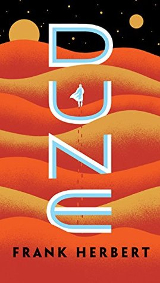
For my birthday last year, Mrs. Vasicek got me the first three books in the Dune series by Frank Herbert. I looove the new cover art, which is mostly why I wanted them, but I’ve only ever read the first book. Since the other books are on our shelves now, I pretty much have to read them, but it’s been years since the last time I read it.

So that’s why I’m reading Dune for the third time, and wow, it is so much better than I remembered. Part of that is because there is so much going on that you have to reread it two or three times just to get it all. The first time I read Dune, I thought it was okay but not all that great—certainly not on par with Lord of the Rings, which everyone compares it to. In reality, though, most of the story went right over my head. I read it again a couple of years later, after catching up on some of the lore, and that time I was much better able to appreciate it.

My own book Desert Stars takes place on a desert planet in a far distant future, but that’s basically where the similarities end. The politics of empire, with the emperor, the great houses, and the spacing guild; the Mentat human supercomputers and secretive Bene Gesserit with their megalomanaical breeding program; the Fremen, the spice, and above all else the transcendant leap in evolution, perfected in Paul Atreides, that allows certain people to see past this dimension into the future. Dune may just be the most perfect science fiction novel ever written.

Having said that, I should point out that Mrs. Vasicek doesn’t really like it. She feels that the characters fall flat, that their near-superhuman abilities strain credulity and make them much less interesting, and that the omniscient point of view makes the book too dense. In the seven months that we’ve been married, I’ve learned that I shouldn’t dismiss her judgment too quickly. Not only does it go a long way toward promoting marital tranquility, but more often than not, she’s actually right.

Then again, she’s only read Dune once. When I read it for the first time, I had many of the same criticisms. And while new things did stand out on my first rereading of it, including things about the characters, it wasn’t like they leaped off the page or the prose itself became any less dense. Mostly, it was all the other things that really stood out: the world building, the politics, and the statement the book makes about mankind’s ultimate destiny.

My new year’s resolution for 2020 is to read 100 books. When I told my sister that, she said “you should read at least 100 of them before the baby is born.” Dune is such a massive brick of a book that I’m already a couple of weeks behind, but I don’t care. It’s really, really good. I’m looking forward to the other ones!

2019-11-07 Newsletter Author’s Note

This author’s note originally appeared in the November 7th edition of my author newsletter. To subscribe to my newsletter, click here.

One of the things I’ve come to really love about married life is reading in bed with Mrs. Vasicek. Right now, I’m finishing House of Assassins by Larry Correia, and she’s reading the Westmark Trilogy by Lloyd Alexander. She just finished the mystery novel A Better Man (making a few jokes about the title), and I just finished Genghis Khan and the Making of the Modern World, which has revived my perennial fascination with the Mongols.

It’s great to share a book with someone you love, but it’s also great to share the same space as the person you love while totally immersed in a book. Those are two different things. I’m also rediscovering how refreshing it is to end a long day by unwinding with a good book for an hour or two.

Reading stands apart from other leisure activities. Whenever I spend too much time on YouTube, or playing computer games, or doing something else involving the internet and a screen, I always come away feeling drained. Not so with reading. In fact, it’s the exact opposite.

Reading a good book always leaves me feeling replenished, like I’ve just come back from an exciting adventure, or come to the end of a perfect day. The books that stick with me always seem to have changed me in some way, even if it’s so subtle that I can’t tell how.

Unlike watching TV or YouTube, reading takes work. It isn’t laborious, but the act of reading requires just enough effort that when I’m tired or worn out, screens and the internet usually win out. But when I make the conscious decision to turn away from those things and open up a book instead, I never regret it. The same can’t be said when I come to the end of a YouTube binge.

It’s never too late to start a new habit or set a new resolution, but there’s something about getting married that makes it easier. So in an effort to read more (and finally get to all the books that I’ve accumulated over the last few years), I’m setting a goal to read two books a week. That’s 100 books over the course of a year, with a bit of allowance for unforeseen interruptions.

A hundred books sounds like a lot, but as a writer, it’s probably on the low end of what I should be reading anyway. Hopefully the quality of my writing improves as I do it. If I get into the habit now, then it shouldn’t be too difficult to make and keep that resolution for 2020.

What are some of the ways that you enjoy reading? With a spouse? With a pet? Alone? In a warm and quiet place? With a beverage of something tasty? Or maybe in a crowded place, with lots of opportunities for people watching?

I suppose there are just as many ways to read as there are ways to write, which is to say that there’s one for every reader. May you be fortunate enough to spend lots of time with yours!

Beginning of September Update

It’s September, my favorite month of the year! Maybe I’ll revisit that post in a blast from the past or something. So many reasons why September is awesome.

Things are going well on the writing front. I’ve switched up my daily routine to make more writing time, and it’s working well so far. My alarm goes off at 5:45 am (just after oh-dark-thirty) and I write for about an hour before heading off to my part time job. I’ve found that I tend to write a lot more when I start first thing in the day, so the earlier I can start, the better.

I won’t bore you with the rest of my routine, unless you want me to write a post about it. There’s a bunch of interesting lifestyle tweaks I’ve been trying out, like reading a couple chapters from one of the books I’m reading as soon as I get back from work in the afternoon, in order to refill the creative well and not get caught in a Youtube / general internet trap. Stuff like that.

My current WIP is A Queen in Hiding (Sons of the Starfarers, Book 7) which is proving to be a surprisingly difficult book. It’s definitely one of the weirdest things I’ve ever written, and that’s saying a lot. In Captives in Obscurity, Reva and Isaac get assimilated into a hive mind, and things only get crazier from there.

Sometimes, stories come really easy, almost like they spring fully formed from the mind. Other times, I’ve found I have to throw out almost the entire first draft before I discover the story.

The weird thing is that it has nothing to do with actual book length. Stars of Blood and Glory and Outworlder are totally different lengths, but they both came out almost perfect in the first draft. However, almost all of the Star Wanderers novellas took multiple drafts filled with stuff that had to be cut. Heart of the Nebula took years to finish, and I had to throw out multiple characters and subplots. I struggled for a long time with Genesis Earth, until I decided to throw the whole thing out and start with a blank page. The book was finished less than four weeks later.

The holy grail, of course, is to write a perfect book in four to six weeks (or less!) every time I set off to start a new one. But as awesome as it would be to barf rainbows and poop gold, all of those things sadly remain out of reach.

My goal at this point is to publish the last four Sons of the Starfarers books in 2018, two months apart from each other. Ideally, I’d like to have the next one up for preorder in time for the previous one’s release. It’s going to take some coordination, but I already have all the covers, which leaves just the writing and editing (metadata and formatting doesn’t take more than a day).

Unfortunately, that isn’t going to happen unless I can get A Queen in Hiding ready to go by December. So that’s what I’m trying to do.

Gunslinger to the Galaxy is on hold for now, though so far it’s coming along very nicely. I should be able to pick it up and finish without too much trouble. Edenfall is also on hold, for how much longer I really don’t know. Before the end of 2018, I’d like to publish either the one or the other, but publishing them both is probably a bit of a stretch.

Also, I haven’t even started The Sword Bearer yet (second book in the Twelfth Sword Trilogy), though I have lots of great ideas for it. Since The Sword Keeper is coming out in just a couple weeks, I should probably get on that.

On the publishing side, I dropped the ball a bit in August. It took so much energy to get The Sword Keeper ready for publication that I totally spaced publishing anything. I do have a bunch of shorts that are nearing the end of the submissions gauntlet, and some bundles that can go up too.

I don’t sell many print books, but I want to get print versions of all of my books up, including short stories. That’s going to be an ongoing project for a while. I also want to put up audiobook versions eventually, but it’s going to take some time to get that ball rolling. However, it has moved up the priority list.

That’s pretty much it. So much stuff I want to do, so little time to do it. Time, money, or youth: you can only pick two (and one of them isn’t your choice).

Take care, and thanks for reading!

Resolutions and such for 2014

Yes, I know this post is a couple of days late.  Yesterday I was busy publishing Star Wanderers: Deliverance (Part VIII), though, and the day before that I was on the train, and today I had to renew my vehicle registration … enough!  On to the resolutions.

1. Publish something every 6 weeks.

One thing I really need to get better about is publishing new work.  So this year, I’m going to do my damnedest to follow a regular publishing schedule.  I don’t know what I’ll be publishing, exactly, but I have a pretty good idea, and surprisingly enough it actually works out to a lot less work than you’d think:

  • WEEK 1: SW-VIII: Deliverance (already done)
  • WEEK 7: SW V-VIII:  Tales of the Far Outworlds (the second STAR WANDERERS omnibus–basically, I just need to write the Author’s Note and get a cover, since the stories have already been written).
  • WEEK 13: Science Fiction from A to Z (a book version of last year’s A to Z blogging challenge, released just in time for this year’s A to Z, for which I’ve already thought of an awesome theme).
  • WEEK 19: Heart of the Nebula (rough draft already written, just need to rewrite/revise).
  • WEEK 25: Sons of the Starfarers Book I: Brothers in Exile (already written).
  • WEEK 31: Sons of the Starfarers Book II: ??? (this one I still have to write).
  • WEEK 37: Sons of the Starfarers Book III: ??? (also need to write, but both of these are novellas so they shouldn’t take too long).
  • WEEK 43: Open slot–maybe I’ll publish Lifewalker in this slot.
  • WEEK 49: Sons of the Starfarers Omnibus I-III (just in time for Christmas).

Of course, this is all just a tentative schedule–I could definitely change it depending on which stories you guys want me most to write.  The point is that it’s doable–surprisingliy doable.  I might even break the schedule once or twice to release a surprise project, depending on how things go.

Then again, I might need the extra writing time in order to finish my second resolution, which is:

2. Write at least 2 short stories per month and submit them to traditional markets.

In other words, Operation Short Blitz.  Since I’ve already outlined my goals and objectives for that one, on to resolution 3:

3. Read a book every week

Or at least 50 books before the end of the year.  This is a recurring one that I’ve never quite been able to do, but I really need to read more, so I figured I’d bring it back.  It’s also a good excuse to get more active on Goodreads, which I’ve been meaning to do for some time.

Now for some non-writing related resolutions:

4. Keep a detailed weekly personal journal

I’ve kept a journal off and on since 2nd grade, but in the past few years I’ve been really lax about it.  My excuse was that the blog counts sort of as a journal, but that’s not really true, because there are things in my life that I would never want to talk about publically on this platform.  At the same time, I’m not a teenager anymore–I don’t need to keep a super secret diary stashed beneath my mattress in order to cathartically vent my hormones and thus maintain my sanity.

So for this year, I’m going to completely redo the way I do journal writing.  Instead of free-writing, I’m going to keep it deliberately structured.  Instead of writing it only for myself, I’m going to write it for the benefit of my future kids and grandkids.  I’ll include some private stuff in there, but nothing I wouldn’t mind being read years later.

Honestly, I still haven’t figured out exactly what I’m going to do for this goal, but I plan to at least write in it every week.  In any case, it makes for a good Sunday project–not just writing in it, but figuring out exactly where I want to go with it.

5. Get to the point where I can run a mile ever day.

Writing is a sedentary activity, and I definitely need to get out and be more active.  My grandpa got fit and lost a lot of weight later in his life, and one of the things he told me that was key was to run a mile a day.  Currently, I can’t quite do that–I tried that about a month ago, and I pulled something on the third day that put me out for about a week.  But it’s definitely something I can work up to.

My brother-in-law is a runner, and he advised me to start by walking.  Walk at least a mile a day for a week, then the next week walk two, then the week after that walk for most of the days but throw in a running day somewhere in there.  Gradually work up until you’re running more than walking, then soon enough you’ll be running every day.

So that’s what I’m going to do.  I’m starting out with the two-mile walks, since the one-milers are way too easy.  Maybe I’ll hike the Y a few times before I start running, just to build up muscle strength.  And when the snow melts, I’ll definitely be climbing some mountains.

What I’d really like to do is get a treadmill desk.  Those things are expensive, though, and there isn’t much room for them where I’m currently living.  In any case, the best resolutions are the ones that don’t require a huge monetary investment or a massive shift from your current lifestyle, since those are the ones that are most likely to get done.

And just for the heck of it, here’s a crazy impossible stretch goal:

6. Finish hiking the 7 peaks.

Those of you who have been following me for a while probably remember that last year, I made only one resolution, and that was to climb four of the seven peaks here in Utah county.  Well, I only got to two of them: Spanish Fork Peak and Santaquin Peak.  And guys–they were amazing!  Real adventures.  Santaquin peak especially was just spectacular–without a doubt, the most perfect hike of my life.  But then things got busy and I never got around to hiking the other two, blah blah blah lame excuses.

So this year, I want to revisit that goal, and since four is a lame number to stop at, I figure I’ll just shoot for all seven of them.  It’s going to be tough–Cascade Mountain is a beast, and from what I’ve heard, Lone Peak has some cliffs that are especially harrowing–but by golly, I’m going to do it!

And if I hike Mount Timpanogos this year, maybe I’ll finally break the curse that is keeping me trapped here in Provo.

In any case, those are my resolutions for 2014.  What are yours?

A not-so-obligatory New Year’s resolution

First of all, happy New Years!  I hope you’re all looking forward to 2013 as much as I am.  Last year was full of awesome life-changing experiences, but I have a feeling that this one is going to be even better.

So after chatting about resolutions with some old friends, I’ve decided that a good new year’s resolution should be more than just another mundane daily goal.  Those are great, but you shouldn’t just set them at the beginning of the year and forget about them around February or March, you should adjust and rework them constantly no matter what time of the year it is.

Instead, a good resolution is some extraordinary task or challenge with a deadline of December 31st.  Basically, it’s something from your bucket list that you hope to accomplish that year.  Because it’s extraordinary, it’s not something that you forget in a month or two.  And the deadline gives you a sense of urgency, so you don’t put it off for “someday.”

With that in mind, here’s my 2013 resolution:

Hike four of the seven peaks of Utah County.

I was originally going to go for all seven, but I’m not (yet) an experienced climber, and some of the peaks look a little difficult.  Others, though, seem pretty doable.  I’ve hiked Y Mountain several times, and got a chance to do a little hiking in Georgia.  Four shouldn’t be too much, even with my relatively limited skill level right now.

Here are the seven peaks:

Of course, I’ll wait until June to make the first hike (probably Provo Peak).  In the meantime, I’ll do what I can to get ready: eat healthy, climb a few smaller mountains, and otherwise get in shape for the big ones.

As far as writing goes, I’m going to go back on the early morning writing schedule and shoot for three hours of writing new words per day.  My monthly goal is to start / finish / publish at least one thing, and my yearly goal is still to finish at least two novel-length works (2012 was Star Wanderers I-IV and Stars of Blood and Glory).

But it’s hard to call any of those goals resolutions, since most of them are probably going to change over the coming weeks and months.  It’s hard to know exactly what life’s going to throw at me once I get back in Utah, so I’m going to stay flexible and just try to do the best I can.

I do want to publish Stars of Blood and Glory next month, and I think I can finish The Sword Keeper before then–if not, then definitely Star Wanderers: Benefactor.  After that, I’d like to do a print version of Star Wanderers I-IV with some decent cover art.  And Star Wanderers: Dreamweaver will probably be out sometime in the spring.

Beyond that, who knows?  It all depends on where the muse takes me.  One thing’s for sure, though–I’ll definitely keep writing.

A Letter From My 2013 Self

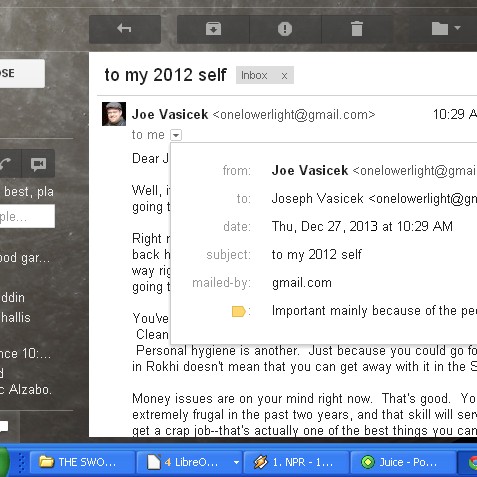
tomy2012selfSo shortly after writing up my last blog post, I got an email from myself marked December 27, 2013.  How freaky is that?I don’t know if it’s a glitch or a feature, but apparently in 2013, you can use gmail to send messages back in time.

In any case, the letter is pretty interesting, so I thought I’d post it.  Here it is:

Dear Joe,

Well, it’s been an interesting decade so far, hasn’t it? Not a bad time to be alive–and that’s going to be even clearer by the end of 2013.

Right now, you’re still in the Republic of Georgia, anxious to get on that flight and head back home. Don’t be. You’re going to miss that place, even though it’s hard to feel that way right now. Your time there has changed you a lot more than you realize, though it’s going to take most of the year for you to figure that out.

You’ve picked up some bad habits, mostly from the other expats. Swearing is one of them. Clean up your language–it’s not going to do you any favors, especially back in Utah. Personal hygiene is another. Just because you could go for days without showering back in Rokhi doesn’t mean that you can get away with it in the States.

Money issues are on your mind right now. That’s good. You’ve learned how to be extremely frugal in the past two years, and that skill will serve you well. Don’t be afraid to get a crap job–that’s actually one of the best things you can do right now. The economy hasn’t improved much since you left, but if you look in the right places and speak with the right people, you’ll be able to make ends meet without too much trouble.

Remember, your writing career should be your main focus. Don’t go chasing after the dollar. You’ve experienced a taste of success in the last few months, and you’re going to taste it again. It comes in spurts, though, so be prepared for that. You’ll figure it out–in fact, you’re already most of the way there. Just remember to keep your butt in that chair, and you’ll be all right.

By the way, you really should spend more time on your business plan. Don’t just use it as motivation to write something else–that stuff is actually important. In Georgia, you can get away with winging it, but not in the States. That’s going to take some getting used to as well.

Your biggest anxiety right now is your supposed lack of self-discipline. That’s actually not as much of a problem as you think. After spending a year in Georgia, you might feel incapable of working another honest day in your life, but that feeling will soon pass. In fact, 2013 is going to be a very productive year for you. All that self-discovery is going to pay off in a big way soon. So don’t worry about it so much, and remember, you haven’t written your best book yet.

Perhaps the most important thing about your year in Georgia is that it really lit a fire under your butt. You know what I’m talking about. If you can travel alone to a foreign country, you can work up the courage to ask her out. No, I’m not going to tell you who. You’ll know her when you see her. But you may have to trim the beard. Just sayin’.

You won’t spend the entire year back in the States, but when you do go overseas again, you won’t be alone. No, I won’t tell you who you’ll go with, or where. Some surprises are better left unspoiled.

There’s more I could tell you, but that’s enough for now. You’ll figure things out on your own, same as you always have. Hope for the best, plan for the worst. Follow the path of least regret.

Joe