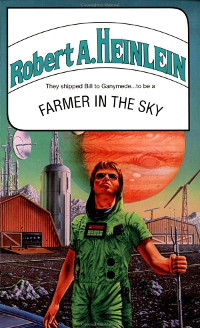
Farmer in the Sky by Robert A. Heinlein

As a general rule, Heinlein novels are either really controversial (The Moon is a Harsh Mistress), really meta (The Number of the Beast), really fun (Citizen of the Galaxy), or some combination of all three (Starship Troopers). Farmer in the Sky is one of the really fun ones.

This novel was written before the Apollo 11 moon landing, but it read like something from an alternate reality long after that pioneering era, where the space program never slowed down. For that reason alone, it was a fascinating book. You can really see how it inspired people back in the 50s and 60s to reach for the stars.

More than that, it was really fascinating to get into the knitty gritty of colonizing a world like Ganymede. This is one of Heinlein’s juveniles, so he doesn’t get too technical, but you can definitely tell that he did the research and built a plausible near future world. More than that, it’s the kind of world I’d actually love to live in. Ganymede is the new frontier, and the colonists who settle it are pioneers in every sense of the word. Not everyone makes it, of course, but those who do are rugged, resourceful, and remarkable.

This was a really quick read. There was a lot of little stuff that dates it to the 50s, like gender relations and the prevalence of the Boy Scouts, who are sadly no longer a cultural force in today’s society. None of it bothered me or threw me out of the story. If anything, it added to the novel’s charm.

Heinlein knows his stuff. This was a really fun book. If you’ve never read any Heinlein, Farmer in the Sky is a good place to start.

Trope Tuesday: Colony Ship

It’s been a while since I did the weekly Trope Tuesday posts, but those were a lot of fun and they still get a lot of traffic, so I’m going to bring them back with a couple of changes. Instead of focusing on the trope itself, essentially rewriting the description on the tvtropes page, I’m going to pick apart what I like about it and focus instead on the trope’s appeal. I’m also going to pick tropes that are in my own books, so that I can talk about how I’m using them.To kick things off, this week’s trope is the Colony Ship. A staple of space opera, this trope is exactly what it says on the tin: a giant starship, often a worldship or a starship luxurious, taking a band of colonists to settle the final frontier. Essentially, this trope takes the wagon train to the stars concept to its logical conclusion, since what is a wagon train but a band of hopeful colonists? And since this is space, there’s no limit to where you can take it!

I love this trope because it’s so hopeful. Even in dark post-apocalyptic stories like A Canticle for Leibowitz, the possibility of taking humanity to the stars shines like a beacon of hope, an interstellar ark that can fling a light into the future. No matter how badly we screw up Earth, we can still atone for our sins by starting over with a clean slate out among the stars.

One of the other things that makes this trope appealing is that it’s not that far removed from reality. On that other wiki, there’s an article on Generation Ships with a link to this very interesting academic paper on the feasibility of building giant worldships. Just as Science Fiction conceptualized satellites, robots, and cloning before they were actually built, this may very well be the case with interstellar colony ships as well. I doubt that NASA or SpaceX are currently working on any prototypes, but we’re definitely on a path that will lead us there, if we have the courage and tenacity to follow it through.

If faster-than-light travel is in play, then the people who set off on the colony ship are usually the same people who build the colony. If FTL is not in play, though, things get really interesting. Sanderson’s second law of magic states that the limitations of a magic system are inherently more interesting than the powers, and since sufficiently advanced space travel is itself a kind of magic (see Clarke’s third law), then it makes sense that sublight colony ships are more interesting than FTL ones.

Sublight colony ships come in two basic types: generation ships and sleeper starships. In a generation ship, the colony ship itself becomes something of a miniature world, often like a city in a bottle (with all of the juicy story implications that come with it). In a sleeper starship, the colonists freeze themselves in stasis, opening the possibility for stuff like lightspeed leapfrog.

In my current WIP, Heart of the Nebula, I’ve combined both of these subtropes to create a hybrid generation sleeper ship. The ships are designed for sublight travel through a region of space where FTL is impossible, but there are too many colonists to fit in all the cryotanks. Subsequently, those who don’t go to sleep have to turn their tiny little ship into a self-enclosed home. When the sleepers wake up, they find that they’ve become living relics to the great-great grandchildren of their friends and relatives.

The main character in Heart of the Nebula is James McCoy, who you might remember from Bringing Stella Home. Just before he goes into cryo, he rescues his people from a terrible enemy, so that when he wakes up he’s a living legend. People have been watching movies about his exploits and doing grade school reports on him for generations. But the thing that made him a legend also put a lot of lives at risk, so that he’s also an extremely divisive figure. To make things worse, most of his friends didn’t go into cryo, so they’re all gone by now. But their great-great grandkids are still around …

As you can see, Colony Ships can be a lot of fun to play with. I’m definitely having fun with it now, and I plan to return to this trope often in the future!

I love these trailers

Holy cow, I cannot get enough of this trailer for Civilization: Beyond Earth! It’s like something from a book I would write. There’s the classic Science Fiction story about leaving Earth to colonize the stars, but there’s also a deeply human element to it. And I love the religious element to it, how the colonists take the old religions of Earth with them to the new world. Awesome.

This definitely looks like a game I want to play. I grew up with Civilization 2, perhaps the most classic title in the series, and discovered Sid Meier’s Alpha Centauri in college. In a lot of ways, Alpha Centauri shaped my love for Science Fiction, and gave me many ideas that later influenced my stories. Genesis Earth is, in some very key ways, a response to the vision of humanity’s future presented in SMAC.

While on the subject of awesome trailers, it’s worth pointing out this one for the new Christopher Nolan film, Interstellar:

Again, this looks like a fantastic story–the kind of one that I’d love to tell just as much as I’d love to hear. And with all of our modern problems like climate change, resource depletion, wealth disparity, terrorism, and global war, it strikes frighteningly close to home. Are we as a species on the verge of driving ourselves extinct? What will we do if our home planet can no longer support us? Where could we go, and what could we hope for?

So much awesomeness. I really, really, REALLY want to see this movie and play this game! But even more, these trailers make me want to write an awesome story along those same lines. I’ve already written at least one novel that addresses these issues, and it’s definitely part of the background of the Gaia Nova universe, but I want to revisit these same issues again.

Maybe in Starship Lachoneus? Who knows?

Z is for Zenith

pioneer_book_scifiHas space opera passed its zenith?

Sometimes, it certainly looks that way.  All the major stuff seems to be reprints of past series and reboots of decades-old franchises.  Star Trek, Star Wars, Stargate, Battlestar Galactica, Ender’s Game, Dune, Babylon 5–all the big names seem to have had their start at least a generation ago.  At any science fiction convention, you’re likely to see more gray-haired men than kids in their teens and twenties.  And if you go to a publishing conference, new adult, urban fantasy, and paranormal romance are ascendant.

I’ve noticed that people are using the term “science fiction” increasingly to describe stories that don’t have anything to do with space.  Dystopian, post-apocalyptic, steampunk, even time travel–all of these subgenres are certainly part of the fold, but they’re very different from the stories about starships and alien worlds.  And then you have all the markets for short fiction that have been forced out of business–and even a few larger publishers, like Night Shade Books which is now selling off all its assets (read: authors) to avoid bankruptcy.

I remember going to World Fantasy 2010 in Columbus, Ohio, and feeling dismayed at the complete lack of science fiction.  World Fantasy is (or was, at least) the premier professional conference for speculative fiction literature, but all of the attention was going to urban fantasy and steampunk.  On the freebie table where publishers often dumped ARCs and review copies of their books, the only space opera stuff I really saw were a couple of titles by Glen Cook and one other guy–and I watched that table hawkishly for the full three days of the conference.

Sometimes, it seems as if it would be so much better if I had grown up in the 80s.  That’s when science fiction really had its heyday.  But all through the 90s, the genre seems to have been on the decline, much like NASA and the US space program.

So is space-centered science fiction on the way out?  Have we passed the glory days, and it’s now just a long decline until it becomes an obscure niche, beloved by some, but enigmatic to others?

In spite of everything I said above, I actually don’t think so.  In fact, I think we’re on the cusp of a science fiction renaissance, and that sci-fi geeks like myself will look back twenty years from now and wish that they were born in our era.  Here’s why:

1) Scientific discoveries are transforming the way we see the universe.

The day I posted P is for Planets, NASA’s Kepler mission announced the discovery of three Earth-like worlds orbiting in the habitable zones of their stars.  The existence of alien Earths is not conjecture–it’s a confirmed fact.  As our ability to study these worlds improves, it’s only a matter of time, IMO, before we find a world that has life.

We’ve discovered the Higgs-Boson.  We’re unraveling the fundamental building blocks of the universe.  We’ve built telescopes to look back to the dawn of time itself, and we’re learning more about the cosmology of the universe every year.  Perhaps even more remarkably, we understand now how little it is that we actually know–that the entirety of the observable universe is only about 5% of it, and even that’s optimistic.

All of this will take time to trickle down to the popular consciousness, but with all the new discoveries that are happening, I think that’s already in the process of happening.  In particular, I think the recent discoveries in the realm of exoplanets and astrobiology are going to shake things up in a major way in the next five or ten years.

2) The privatization of space travel is paving the way for a rapid expansion into space.

The US space program has been plagued with funding problems since at least the end of the Cold War space race.  Since the space shuttle program was retired just last year, the only way for our astronauts to get into space is through the Russian Soyuz spacecraft at Baikonur.  If NASA had to put a man on the moon, they do not currently have the knowledge or technology necessary to do it.

In the private sector, though, it’s been a very different story.  SpaceX has had a number of successful launches recently, most notably sending the first unmanned resupply capsule up to the International Space Station.  And just a couple days ago, Virgin Galactic had the first successful test flight of its rocket-powered spacecraft.

It’s sad to see the space shuttle go, but there are a lot of reasons why the program was flawed and inefficient to begin with.  By handing things off to the private sector and turning space exploration into a viable business venture, we can hopefully overcome those inefficiencies and eventually make space accessible to the general public.

And then you have the organizations like Mars One that are looking even further ahead to the colonization of Mars.  There’s a groundswell of excitement for Martian colonization that is starting to get some real money behind it.  Will it go anywhere?  It’s hard to say right now, but even if it suffers another decade or two of setbacks, it’s getting public attention, especially from the younger generation.

3) Video games are bringing a fresh new look and feel to the genre.

Not all of the big sci-fi series hail from 70s and 80s.  Halo started up as recently as 2001, and it’s a multi-billion dollar franchise with games, books–even Legos.  In fact, there are lots of sci-fi video game franchises right now, many of them right on par with other classic space opera.  Just look at Starcraft, for example, or Mass Effect, or Eve Online and Sins of a Solar Empire.  The number of sci-fi games has been exploding.

In fact, this explosion has been happening for some time.  While literary science fiction may have suffered something of a decline back in the 90s, that was the heyday of games like Master of Orion and Sid Meier’s Alpha Centauri.  Flight simulators like Flight Commander and X-wing proliferated like crazy, while even some of the classic RPGs like Final Fantasy borrowed heavily from science fiction tropes.  And those are just a few of the games that I can list off the top of my head!

Whether or not literary sf is on the decline, a whole new generation has been introduced to the genre through the medium of video gaming.  This is not just a small niche audience playing this stuff, either–in the US at least, Halo is as mainstream as Monopoly or Settlers of Catan.  In fact, you could say that science fiction is more mainstream now than it ever has been, and a lot of that is due to sci-fi video games.

4) The e-publishing golden age is giving us thousands of new voices.

But what about the world of literary sf?  Are we in a decline?  Do people just not read science fiction anymore?  How bright is the future for science fiction literature?

Actually, this is the area where I’m the most optimistic of all.

The publishing industry is changing at the speed of light, much in the same way that the music industry changed about a decade ago.  Just as the MP3 revolution allowed all sorts of eclectic yet entrepreneurial artists to thrive without the oversight of record labels, the epublishing revolution is opening all sorts of doors for the enterprising author.  And while the changes are driving publishers (such as NSB) out of business, they are enabling authors who only sell in the mid-list range to make a respectable living.

At Worldcon 2011, Ginger Buchanan (senior editor at Tor) asserted that there has never been a runaway science fiction bestseller.  In the eyes of New York publishing, that may be true–but New York has a notorious record for missing the catch in pursuit of one big fish.  Because of epublishing, whole new genres like New Adult that publishers thought would never sell are now going mainstream.

And even the niches that stay niches are becoming quite lucrative for the authors who can build a decent following.  When author cuts out the middlemen and develops a direct relationship with the readership, it only takes a thousand true fans or so become a financial success.  As Kris Rusch pointed out so aptly, those numbers may bring only scorn from New York, but for the writers who actually produce the content, that’s a vein of pure gold.

I can’t tell you how many success stories I’ve heard from fellow sci-fi writers over on the Kindle Boards, who started just for the grocery money and ended up quitting their day jobs.  But as Hugh Howey pointed out, the runaway bestsellers are not the true story of the epublishing revolution–it’s the little guys who only sell a few hundred copies a month but are earning enough to support themselves writing what they love.

Indeed, we’re already starting to see an explosion of new science fiction, thanks largely to the ease of electronic self-publishing.  I’ve only read a few of them so far, but Nathan Lowell stands out among them, as well as my good friend Kindal Debenham.  These guys and so many others are bringing a fresh new voice to space opera, revitalizing the genre in ways that simply weren’t economical back in the days of Big Publishing.

So even if space opera as a literary genre isn’t quite large enough to go mainstream, it is large enough to support a wide range of new voices under the emerging business models.  And as the epublishing revolution continues to mature, I think we’re going to see a new golden age comparable to the era of the pulp adventure stories.

I’ve been publishing my own work since 2011, and I can attest that there’s never been a better time to be a writer.  I’m not quite making enough to go full-time yet, but at the rate things are going, it will only be a  year or two before I realize my dream of making a living telling stories that I love.  And if they’re the kind of stories that you love too, then that’s great news for all of us!

So has science fiction reached its zenith?  I don’t think so.  It went mainstream about a generation ago, which was definitely a huge moment, but for the last few decades it’s been in the process of branching out and rediscovering itself.  Right now, I think we’re on the verge of a wonderful new renaissance that is going to blow us all away.  As a lifelong reader and writer of science fiction, I certainly hope that’s the case.  And because of the reasons listed above, I sincerely believe that it is.
S is for Space Station

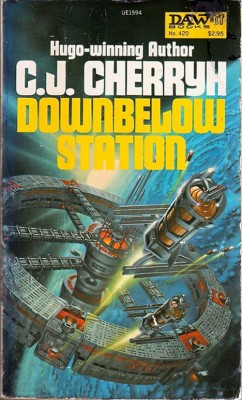
downbelow_stationPlanets are not the only setting for science fiction stories–space stations are common as well.  From the Death Star (“that’s no moon…”) to Downbelow Station, the Venus Equilateral to ISPV 7 to the Battle School in Ender’s Game, space stations are a major staple of any space-centered science fiction.

The reasons for this should be fairly obvious.  Before we can go to the planets and the stars, we need to have a permanent presence outside of this massive gravity well we call Earth.  The easiest and most logical place to expand first is to orbit, where supplies can be ferried up without too much difficulty and astronauts can escape in case of an emergency.  Indeed, with the International Space Station, that’s exactly what we’re doing right now.

In science fiction, of course, space stations go much further than they do in real life.  They’re often giant orbital cities, with thousands of people living and working there permanently.  Often, they feature some sort of rotating toroidal structure in order to simulate gravity.  If there are settlements on the planet below, the station often serves as a major hub for commerce, serving as a waypoint for interstellar merchants and wholesalers who ferry their wares up to orbit.  And if the planet is still being colonized, then the space station often serves as an important umbilical to the outside universe.

They can also have strategic value in the event of a war.  Battleships need to be serviced too, after all, and a station’s position in orbit can provide an excellent platform from which to bombard or lay siege to the planet.  Alternately, outposts at more distant locations like the Lagrange points can serve as a staging ground for future attacks–a sort of astronomical “high ground,” if you will.  If nothing else, abandoned stations may contain supply caches that can aid a fleeing starship, or provide shelter behind enemy lines, as was the case with the first Halo game.

Stations can come in all sorts of different flavors, from the puny to the magnificent.  The most eye-popping station of all is probably the Ringworld from Larry Niven’s series of the same name.  As the name would imply, the station is a giant ring–so huge, its circumference is the orbit of a habitable planet, with the sun at its center!  Gravity is provided by rotation, and night and day by giant orbiting panels that block out the sun at regular intervals.

My favorite stations, though, are the more realistic ones–the ones that I can imagine myself living on someday.  That was one of the things I enjoyed about Downbelow Station by C.J. Cherryh–her depiction of human expansion into space is eminently believable, and her stations are a natural extension of that.  I also really enjoyed her focus on the social dynamics of living on a giant station, and what it would be like to live in such a society.

The Battle School from Ender’s Game is another huge favorite of mine.  One of the advantages of building a structure in space is that gravity becomes malleable, so that some parts of the structure can simulate Earth-surface gravity while others leave people completely weightless.  The Battle School uses that to its advantage, with the main training room a zero-g laser tag battle arena, where the students have to learn how to stop thinking in terms of the planar dimensions, where “up” and “down” have any meaning.  It’s really quite fascinating.

It should come as no surprise that space stations pepper my own works.  They’re especially common in the Star Wanderers series, where few worlds have been terraformed and orbital platforms make up the majority of human living space (at least in the Outworlds).  In Sholpan and Bringing Stella Home, James, Ben, and Stella are all from a space station–a distinction that is especially useful for Stella, since her Hameji captors despise the “planetborn.” Genesis Earth takes that a step further, as spaceborn Michael and Terra have never been to the surface of a planet before until midway through the novel.  Just as going into space is paradigm shifting for us, the experience of walking on a planet proves just as transformative for them.

L is for Lost Colony

worthingsagaAs we discussed in I is for Interstellar, space colonization is a major theme of science fiction, especially space opera.  Of course, things don’t always go smoothly.  Space is a really, really, really big place, and sometimes, due to war or famine or simple bureaucratic mismanagement, colonies get cut off from the rest of galactic civilization.  They become lost colonies.

Some of my favorite stories are about lost colonies: either how they became cut off, or how they reintegrate after so many thousands of years.  In many of these stories, the technology of these colonies has regressed, sometimes to the point where the descendents may not even know that their ancestors came from the stars.  When contact is finally made, the envoys from the galactic federation may seem like gods or wizards.

Because of this technological disconnect, stories about lost colonies often straddle the line between science fiction and fantasy.  After all, Clarke’s third law states:

Any sufficiently advanced technology is indistinguishable from magic.

Of course, the line between science fiction and fantasy has always been a fuzzy one.  Hundreds of attempts have been made to define it, but they all fall short.  In the end, it often breaks down to certain recurring tropes, like dragons and wizards versus ray guns and rockets, but even that doesn’t always work.

For example, Anne McCaffrey’s Dragonriders of Pern is technically about a lost colony far into the future, but it’s got dragons and castles and other tropes that belong squarely in fantasy.  Then again, the dragonriders have to fight alien worms who invade every few dozen years from a planet with a highly elliptical orbit, so there’s still a strong science fiction basis undergirding the whole thing.

And that’s just Dragonriders of Pern.  What about Marion Zimmer Bradley’s Darkover series, or C.S. Lewis’s Space Trilogy?  Trigun is more western than fantasy, but it’s also full of sci-fi tropes like giant sand-crawling monster ships and a weird post-apocalyptic backstory.  And then there’s all the Japanese RPGs that combine magic with mechas, with Xenogears as one of the best examples.  For a distinct Middle Eastern flavor, look no further than Stargate.

It’s no coincidence that all of these stories feature a lost colony of one kind or another.  When the characters don’t know that they’re living in a science fictional universe, it’s very easy to throw in tropes from other genres.  By no means is it required–Battlestar Galactica and Dune are evidence enough of that–but they certainly present the opportunity to do so.  After all, lost colony stories basically present a hiccup in humanity’s march of progress, breaking the essential science fiction narrative for all sorts of interesting side stories and tangents.

One perennial favorite of science fiction writers is to suggest that Earth itself is a lost colony from some other galactic civilization.  That forms the entire premise behind Battlestar Galactica: the original twelve colonies have been destroyed in the human-cylon wars, and the last few survivors are searching for the legendary thirteenth colony of Earth, hoping to find some sort of refuge.  Apparently, Ursula K. Le Guin’s Hainish cycle also plays with this trope, though she’s never very explicit with her world building.  It can be a bit tricky to twist the lost colony trope in this manner, but if pulled off right it can really make you sit back and go “whoa.”

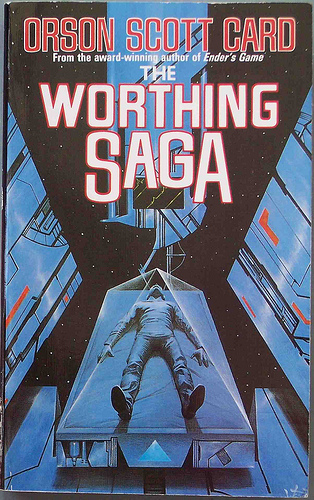
My personal favorite is probably Orson Scott Card’s The Worthing Saga, about a colony of telepaths that breaks off from a collapsing galactic empire and actually becomes more advanced than the rest of humanity.  When Jason Worthing and Justice re-establish contact, the descendents of the galactics are basically pre-industrial subsistence farmers who view them as gods–which, in a certain sense, they almost are.

It’s a great story that really entranced me, not just for the science fictional elements but also for the distinct fantasy flavor.  Orson Scott Card’s handling of viewpoint in that book is truly masterful, so that I felt as if I were viewing everything through the eyes of his characters.  Since the farmers don’t know anything about their spacefaring ancestors, all the parts from their point of view feel like a completely different story.  It was really great.

My first novel was actually a lost colony story, combined with a first contact.  I trunked it a long time ago, but many of the earliest posts on this blog are all about my experience writing it.  As for my other books, Desert Stars contains elements of this, though the lost colony in question is actually a nomadic desert society that lives on the capital planet of the galactic empire, just outside of the domes where all the more civilized folk live.  Heart of the Nebula is basically about a society that puts itself in exile in order to escape the privations of the Hameji.  And in… no, I’d better not spoil it. 😉

The lost colony isn’t one of the flashier or more prominent tropes of science fiction, but it’s definitely one of my favorites.  It’s a great way to add depth and intrigue, as well as bend genres.  For that reason, I think this trope does a lot to keep science fiction fresh.

Trope Tuesday: Planetville (aka Adventure Planets)

swmapsmall

Adventure townsIN SPAAACE!!!

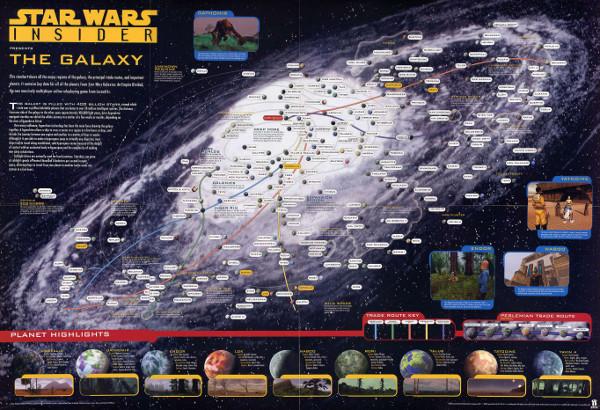
Seriously, that’s the best way to describe it.  In Westerns and TV serials, the heroes travel from town to town, with a new adventure in each place.  Well, in science fiction, we don’t hop towns, we hop planets.  Why?  Because we can.

Unfortunately, since planets and towns are actually pretty different kinds of places, there’s a lot of room to do things poorly and turn this trope into a cliche.  Any story that doesn’t consider (or at least lampshade) the implications of space travel and planetary colonization is in danger of becoming over-the-top campy–although, to be fair, there is an audience for that.

That doesn’t mean there isn’t room for this trope in fiction that takes itself a little more seriously.  In fact, I take issue with some of the descriptions on the Planetville page.  From tvtropes:

Unfortunately, because Sci-Fi Writers Have No Sense of Scale, stories about Planetville make no sense. Nobody seems to realize how BIG a planet is — everything in Planetville takes the same amount of time as stories set in towns or countries. In the updated Wild West story, the outlaws are “exiled from the planet” just like they’d be exiled from Dodge City, and have to quietly leave… instead of flat out challenging the authorities to find them when they have an entire planet in which to hide. When the space Nazis invade, they seem to need the same number of soldiers and time as the Earth Nazis needed to invade Europe. And when the crew of the Cool Starship finds the cure for the alien plague, the logistical issues of distributing it to an entire planet rarely get mentioned at all. These considerations are minimized or left out entirely in many stories.

To address these criticisms point by point:

1) Scale is relative to technology and the predominant modes of transportation.  When my ancestors crossed the plains to settle in modern-day Utah, they had to walk.  It took them months to get here and many of their family members died along the way.  Today, I can make the same trip by car in a day or two.  As technology changes, so does the sense of scale.

2) Unlike what some tropes would have you believe, not all planets are Earth-like.  In fact, it appears that most planets outside our solar system are wildly different.  In practical story terms, this means that any part of the world that’s remotely habitable is probably going to be immediately around the colony. Consequently, the local authorities probably will have the power to exile trouble makers from an entire planet, since exile from the colony would mean de facto exile from the planet as well.

3) Anyone venturing outside of the dome would have to carry just about everything necessary for life, including air, water, food, etc.  You might as well try to hide in Antarctica as hide on an alien planet.  It can be done, of course, but to do all that and stay hidden, that’s going to be tough.  You might as well set up a rival colony for all the effort–but at that point, the story is about a lot more than just hiding from the authorities.

4) If your planetary colonies are only as populous as an average WWII era city/town, then yeah, you’ll only need as many soldiers as it took to conquer them.  The biggest difference is that they’ll fly a really cool starship.

5) Again, if the planet isn’t habitable and the population is contained within a handful of relatively small colonies, then distribution shouldn’t be too much of a problem.

However, the tvtropes page does make this valid point:

A side effect of this is that the characters never realize that things can happen in parts of planets. You will never see aliens trying to capture a planet’s equator, or its polar caps — it’s the whole planet or bust.

In the end, I think the key to doing this trope well is to know your setting well enough to fit the story to it.  Tropes are tools, and when done well, this trope can accomplish everything it sets out to do while making perfect sense within the context of the story.

In my own work, this trope is most prevalent in the Star Wanderers series.  Every novella takes place at a different planet or space station, sometimes multiple planets per station.  Because most of the stars in this universe have only recently been settled, the colonies are small and terraforming is quite limited.  In Desert Stars, I used a similar concept, except with large domed areas of a single planet, instead of multiple planets (Adventure townsUNDER THE DOME!!!).  In cases where the planets are Earth-like, however, or where travel between planets is costly and difficult, this trope doesn’t really ever come into play.

Trope Tuesday: Settling the (Final) Frontier

I love stories about colonization, especially when they’re set in space.  There’s just something about a small group of rugged pioneers striking out into the harsh, unforgiving wilderness to make a new life for themselves.  Maybe it’s just something about my American heritage, or all those 4x games I played as a kid, but I doubt it.  Ever since the dawn of time, we humans have been on the move, looking for new and better places to call home.  Small wonder, then, that so many of our stories, both ancient and modern, are about settling the frontier.

Since space is the final frontier, this trope is very common in science fiction.  Heinlein was a huge fan of it, but he wasn’t the only one to play with it–not by a long shot.  John Scalzi (The Last Colony), Nancy Kress (Crossfire), C.J. Cherryh (40,000 in Gehenna), Anne McCaffrey (Freedom’s Landing), and Kim Stanley Robinson (Red Mars, Green Mars, and Blue Mars) are just a few of the many science fiction writers who have explored this trope in their works.  In recent years, several sci fi miniseries (Battlestar Galactica, Terra Nova) have used it as a major premise as well.  And of course, you have all the classic 4x games like Masters of Orion and Alpha Centauri.

Space Colonies can come in a variety of different flavors:

  • Lost Colony — What happens when the original colonists lose all contact with the outside universe and no one thinks to check up on them for a while.  Can either turn into a story of survival or a clash of cultures, if/when they ever re-establish contact.
  • Cult Colony — Religion is one of the few things that will drive massive numbers of people to leave everything behind and start over in a new world.  Just look at the Pilgrims for a real-world examples.  In space colonies of this type, you can expect to see some extremely radical people, since the isolation of deep space tends to compound their fundamentalist tendencies.  Expect these to be both weird and frightening.
  • Space Amish — Something of a combination of the two, except with much more primitive technology.  Expect to see log cabins, horse- (or giant lizard) drawn carriages, and other tropes closer to the Western genre.  Sometimes, they may be hiding a superweapon.
  • Penal Colony — Australia in space (ahem…IN SPAAACE!!!).  What happens when the empire needs a place to conveniently exile all the troublemakers and rabble rousers.  Not a place for the faint of heart.
  • Wretched Hive — What happens to a penal colony when the prisoners actually run the place.  Like the previous type, except taken up to eleven.  Or not, depending on the history and culture.  Tatooine is the eponymous example.
  • Death World — As the name would suggest, this is not the kind of place you’d want to homestead.  Anyone who does is bound to be a badass.  The Empire and the Federation often recruit most of their soldiers from here.
  • Company World — I couldn’t find this one listed on tvtropes.  Basically, it’s a planet that is owned and governed entirely by a private corporation, which expects to make a tidy profit off of the place.  The colonists are basically indentured servants (since robots simply wouldn’t do) and have almost no property or rights.  Expect the story to be about sticking it to the man.

These are just a few of the many possibilities that you can play with when settling the frontier.  In my opinion, however, the essential elements are as follows:

  • The story is not just about exploring a new world, but establishing some kind of a permanent presence there.
  • By coming to the new world, the colonists must leave everything from their old, familiar lives behind.
  • The colonists must resolve the story conflict through their own self-reliance, not by waiting for an outside force to save them.

I’ve only dabbled with this trope, but it does play a role in many of my stories, most notably in the Star Wanderers series.  Genesis Earth also has elements of it as well, though it’s not the main driver for the plot.  It is a major factor in Heart of the Nebula, though, the (currently) unpublished sequel to Bringing Stella Home.  And in my future books, you can definitely expect to see this trope again.

Story Notebook #6

Alright, it’s time to go through another story notebook.  This one covers the spring and summer of 2010, right after I graduated.  It was a weird transitional period in my life, when I didn’t really know what I was doing or where I was going, but I was determined to keep on writing anyway.

I filled three pocket notebooks with story ideas in 2010, and last time I mistakenly thought I’d covered one that went from graduation through the end of the year.  While putting my records in order before going abroad, I found that this one actually came a little earlier.

Lots and lots of story ideas…2010 was definitely a good year for that.  So anyhow, here we go:

A planet settled by people with aircars: there will be no asphalt roads, only packed earth.

An interesting consequence of futuristic technology; too often, stories come up with something flashy without really thinking through all of the implications.  Can you imagine a world without asphalt?  If you can, then please take me there!

A task-oriented woman who thinks men are fickle because they’re always trying to come across as macho, trying to save face, etc.

This makes me think of something I heard somewhere about gender roles and politicians.  If I remember it correctly, most men go into politics for the fame, power, and glory, while most women go into politics because something in their community is broken and they feel it’s their duty to fix it.  Not sure if that’s true or not, but this story idea made me think of that for some reason.

Humanity has been domesticated by a super-intelligent alien race and bred into several different breeds with wildly varying physical characteristics.

In other words, a post-human universe where humans have been bred as pets, like dogs.  Can you imagine a world where the physical differences between humans of different races are as great as this:

Can these two even physically reproduce?

A fantasy where the traveling hero is actually the bad guy.

I think Girl Genius already beat me to that, though Othar is more of an annoyance than a genuine villain.

An interstellar Sir Richard Burton.

Now that would be an interesting series.  Sir Richard Burton was a British adventurer who went to the Middle East before doing that was cool.  He made the first English translation of the 1001 Arabian Nights (as well as the Kama Sutra, apparently), and was one of the first European explorer to sneak into Mecca–certainly the first non-Muslim explorer.  I hear he was quite a character.

A planet on a highly eccentric orbit where habitability is sustained by large glowstones that absorb high amounts of energy and emit heat slowly.

Ooh, I’d forgotten about this one.  I’ll have to use it sometime–maybe in a science fiction / fantasy mashup.  You know, with dragons and stuff.

A werewolf who is tame around just one person.

I’m pretty sure this one has been done, and I’m also pretty sure I’m not interested in reading it.  Sorry, Twilight fans–or maybe you’re welcome?

A landscape more vertical than horizontal, where the architecture reflects this (like the old Knight building).

The Knight building was a multi-split-level administration building at BYU where Leading Edge used to meet.  Lots of stairs, entrances on just about every level–it was a weird building (but not quite as weird as the JKB).  But yeah, a vertical landscape would be cool–though I guess that’s pretty common in cyberpunk, with all those cities.

An alien species that communicates only by touch.

“What the–augh!  Get it off of me!” Thus begins humanity’s first interstellar war.

Purgatory for fictional characters, where all the plot hole stories go.

I’m pretty sure that was a South Park episode.

A religious order that believes that developing math skills is the key to self and enlightenment, becuase math is the only science that is completely a priori.

Heh, I’ll bet my Dad would like that story.  It might be the first one of mine that he actually buys.

A man frames himself to go to prison so that he can go to law school / have time to write.

When you’re unemployed and struggling to make ends meet, some otherwise unsavory options begin to look pretty attractive…

What if humanity had a blight like the American Chestnut, where everyone over the age of 20 dies of a horrible disease?

I actually started writing that one.  Finished the first chapter, kind of in a pseudo-Victorian first person style, like Robinson Crusoe.  I have no idea when I’ll finish it, but the universe is really, really fascinating.

A world where novelists / storytellers convey their tales telepathically without translation into words.

And then SOPA gets passed, and all of us creative types are screwed.

What if the mountains were sentient? What would they think of the human race?

“Dang it!  Not another cavity!”

Land of the sleeping rainbows

I think this is actually a real place in southern Utah; I just thought it would make a cool story prompt.

What if the Amish really are 18th century people, guarding a natural time portal in central Pennsylvania?

That would be a fun one to research. “Hello, I’m writing a time travel novel…can I join your village for a year?”

Marital therapy that involves swapping bodies.

I’m pretty sure Disney did something like that in the 60s.  With the way the country has changed, I’m sure it would be much different if someone did it again today.

And that just about does it for this notebook.  As always, feel free to use any of these ideas in your own work.  It isn’t “stealing” if it hasn’t actually been written yet (unless congress passes a revamped version of SOPA that…hmm, that gives me an idea…).

Thanks guys!  See you around!

Story Notebook #7

All right, it’s been forever since my last story notebook post, so I figure it’s time to do another one.

Last time, I shared the story ideas I from my fifth story notebook, during my time in Washington DC.  This next notebook is pretty tattered, and it covers my time from graduation to winter of last year.  One of the reasons it’s falling apart is probably because I didn’t have a car and had to bike everywhere.  That’s probably why I weighed fifteen pounds less, too.

EDIT: This notebook actually covers the end of summer to the the winter, after I’d gotten a car.  Minor point, but it’s worth noting to clarify.

Anyhow, here we go:

Machu Pichu…IN SPAAACE!!!  Seriously, an exploration mission that finds abandoned ruins on another planet.

Happens fairly often in science fiction, though it isn’t something I’ve tried my hand at yet.  Although I guess there was some of that in Genesis Earth, and I’ve got a couple of ideas for something similar in the Gaia Nova Universe…moving on!

A knight sets out to rescue the damsel from the dragon, but the damsel slays the dragon and becomes the monster that the knight must slay.

Hmm, this one sounds promising.  Of course, “knight,” “dragon,” and “damsel” are all archetypes, not literal characters.  For example, if Raoul is the knight, the Phantom is the dragon, and Christine is the damsel in distress…wow, that would be disturbing.

What if Earth is a wildlife preserve for an interstellar species that is far more advanced than us?

Kind of like “They’re Made of Meat”?  I think Predator might have done something like this, except that Earth was a hunting preserve.

A society where people achieve immortality by uploading their consciousnesses to a normal human fetus through a process called “reconception.” They do this because computer hardware is incompatible with human wetware.

I’m pretty sure I retrofitted this story idea from a play on the word “inception.” Man, that was a good movie.

Planetary colonization scheme: send down a group of genetically modified humans, who are hardy, extremely fertile, have shorter gestation periods, etc, and have them do the dirty work of building the first settlements.  Then send the regular humans after a couple of generations, when they’ll be revered as gods for their superior technology, and have the two cultures intermarry.

I had a long involved dream about this story idea shortly after I had it.  Sounds like a good idea for a series; one of these days, I’ll have to write it.

A character who sees right through all the pretenses and lies of society to know people for what they are–a magnificent judge of character who isn’t swayed by power, position, or pretend honors (eg high paying jobs)

In other words, Captain Moroni–IN SPAAACE!!!

An offworld version of Australia or Siberia, where convicts create their own country.

This idea could single handedly save the US space program.

A society in which everyone must remarry every X number of years.

Wow–I want to use this right now in my current WIP!  Okay, maybe that would be a bad idea.

What if dreams are not only the subconscious working through the events of the past day, but of events that our consciousness perceives as lying in the future?  That the subconscious transfers information non-linearly through time and space?

So shiny…must..resist…

A character who can read minds, knows every dirty thought inside your head, and isn’t disgusted by it.

If I ever met a girl like that, my first question for her would be “will you marry me?”

What if the evolution of our society in the information age is like simple celled organisms evolving into complex ones?  Where the AI overmind will organize into a giant organism as complex as a human being?

Reminds me of an excellent story on Escape Pod titled “Endosymbiont.” You should drop whatever it is that you’re doing and listen to that story right now!

An evil overlord who wants to unite mankind under the overmind instead of under his own rule

Kind of like a mashup between Sauron and Javier.

Perhaps every generation has an impossible battle, and whether they rise to meet it or fail to overcome it defines that generation’s place in history.

If that’s true, I’m pretty sure my generation is failing.

A fantasy that romanticizes the minion.

An AI that falls in love with its creator.

A person who appears schizo but actually jumps between close possible universes.

Better yet, a story that mashes all of those ideas together!

A character who loses the mental ability to translate sounds into words and language–who sees everyone else as animals.

I’m pretty sure this happened in The Silmarillion at some point.

A character who believes that existence itself is an epiphanic prison.

…and appears schizo but actually jumps between close possible universes…

What if war and terror is normal everywhere else in the world, and all of us Americans living our quaint middle class lives are ridiculously sheltered?

Uh, I’m pretty sure that’s not fiction…

A fast food place that uses time travel to delver full course meals.

<facepalm> Oh man, there are so many ways that could go wrong.

And finally:

A future world in which smiles have been turned into a commodity.

WE…ARE..THE NINETY NINE PERCENT!

And that concludes my sixth story notebook.  I sense an encouraging trend; some of these ideas were pretty good!  Or maybe I’m still too close to them…in any case, there’s no telling until someone actually sits down and writes the story.

So if you feel like taking one of these ideas and running with it, feel free!