I don’t usually pay any attention to the infighting among the various pundits and media personalities, even on my own side of the aisle, but as a former Daily Wire subscriber I found this very interesting. Not sure I totally agree with Malcolm & Simone on everything here, but they did share a very interesting perspective, especially as conservative influencers who (allegedly) got treated pretty dirty by Ben Shapiro as they were just getting started. If you follow any conservative media, you’ll probably find this interesting.
Author: Joe Vasicek
Joe Vasicek is the author of more than twenty science fiction books, including the Star Wanderers and Sons of the Starfarers series. As a young man, he studied Arabic and traveled across the Middle East and the Caucasus. He claims Utah as his home.
Is The Riches of Xulthar For You?
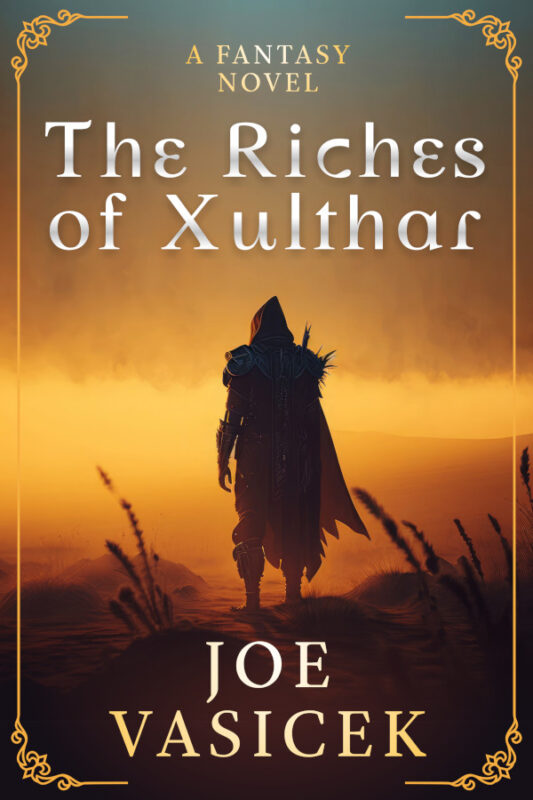
The Riches of Xulthar is a sword-and-sorcery desert adventure about a fallen nobleman, a freed slave woman, and a legendary lost city whose treasure may be more curse than blessing. It delivers a fast-moving heroic fantasy quest with cursed coin, dark sorcery, ruined temples, undead servants, moral temptation, and a slow-burning bond between two wounded people learning what freedom really means.
What Kind of Reader Will Love The Riches of Xulthar?
If you love classic sword-and-sorcery adventures with lost cities, cursed treasure, desert ruins, dark kings, monster-haunted catacombs, and heroes who have to fight both outward evil and inward temptation, then The Riches of Xulthar is probably your kind of story.
If you enjoy fantasy about honor, freedom, slavery, moral courage, and the corrupting power of wealth, this story gives those themes a mythic adventure shape: a dangerous quest across the wastes, a cursed city at the end of the road, and two protagonists who must decide what they are truly willing to serve.
If you like romantic fantasy where the emotional bond grows out of danger, trust, sacrifice, and shared moral struggle, Roderick and Laria’s journey gives the story a strong character-driven heart beneath the sword fights and sorcery.
If you enjoy fantasy that feels old-school in its adventure structure but more intimate in its emotional focus, The Riches of Xulthar blends pulp adventure, moral fantasy, and redemptive romance into a compact, high-stakes quest.
What You’ll Find Inside
Roderick is a disgraced nobleman seeking the lost city of Xulthar in the hope of breaking the curse that destroyed his family’s honor. Along the way, he rescues Laria, a slave woman who has never truly owned anything—not even herself—and their journey through the desert becomes as much about freedom, agency, and love as it is about cursed treasure and dark magic. The tone is adventurous, mythic, sensual, and morally serious, with fast-paced action, eerie ruins, dangerous supernatural encounters, and a hopeful emotional arc beneath the darkness.
What Makes The Riches of Xulthar Different
Readers who enjoy Robert E. Howard-style lost-city adventure, classic sword-and-sorcery quests, and treasure-hunting fantasy will recognize the familiar pleasures: desert wastes, ancient ruins, sorcerous kings, monster-haunted temples, and a warrior with a sword in his hand. But The Riches of Xulthar turns the treasure quest inward by asking whether wealth can ever restore honor, whether freedom is worth its burden, and whether a man can reject the very prize he set out to claim. Unlike many old-school sword-and-sorcery stories, the female lead is not merely a prize, temptation, or rescued captive; Laria’s moral insight and growing agency become essential to the heart of the story. The result is a heroic fantasy adventure that uses the lost-city quest to explore slavery, self-mastery, family, corruption, and the kind of love that makes freedom meaningful.
What You Won’t Find
You won’t find a sprawling epic fantasy cast, court intrigue, or a heavily political worldbuilding saga; this is a focused sword-and-sorcery quest built around two central characters and one cursed destination. You also won’t find nihilistic grimdark: the story contains violence, slavery, sensual temptation, dark magic, and peril, but its moral center remains hopeful. This is not a sanitized cozy fantasy, but neither is it cynical or despairing.
Why I Think You Might Love It
What I love about The Riches of Xulthar is that it takes the classic fantasy question—“What if the treasure is cursed?”—and makes it personal. Like Queen of the Falconstar, this is a story about power, agency, and a woman learning to stand in a world that wants to use her, but here that struggle is filtered through mythic sword-and-sorcery rather than space opera. Roderick’s quest begins as a search for wealth and restored honor, but the real treasure is the freedom he and Laria learn to choose together: freedom from slavery, freedom from despair, freedom from the lies of cursed power, and freedom to build a new life out of the ruins of the old one.
Where to Get the Book








Related Posts and Pages
Explore my other standalone books here.
Return to the book page for The Riches of Xulthar.
What happens when a shuriken and a frisbee have a baby?
This was so cool. I would love to see an expert chakram thrower practice his (or her) art in a mock fight against practitioners of other martial arts.
Remember, it’s faster to switch to your chakram than reload your crossbow!
“Better to meet a star-crossed end…”
It is better to meet a star-crossed end with sword in hand than to take the coward’s path.
From The Riches of Xulthar by Joe Vasicek
Daily Wire is an anti-Mormon channel now
About a week ago, the Daily Wire posted an article on their site titled “7 Reasons Joseph Smith Was a False Prophet” by Matt Fradd. This article was adapted from some exclusive content on Matt Fradd’s DW channel and released under the Daily Wire banner. Needless to say, it caused quit a commotion among DW’s Latter-day Saint subscribers.
This is not the first time the Daily Wire has shown a surprising degree of antipathy toward the Church of Jesus Christ of Latter-day Saints. About a year ago, Phil Cabot, one of DW’s producers, posted on his personal X account that Mormons aren’t Christians, and got into some heated online arguments about that. A couple months ago, shortly after Matt Fradd joined the Daily Wire as a host, he interviewed Joe Heschmeyer, an anti-Mormon who bizarrely argued that Mormonism is a “species of atheism.” And when the mass shooting at the church in Michigan happened last year, the Daily Wire’s coverage went out of the way to avoid using the full name of the Church of Jesus Christ of Latter-day Saints, only editing the article after receiving backlash for it.
But all of these things were relatively minor. Phil Cabot is entitled to express his personal opinions on his own X feed. Matt Fradd can interview whoever he wants on his own show. And lots of news outlets fail to mention the full name of the church, intentionally and otherwise. However, this recent article—which was posted under the Daily Wire banner, not Matt Fradd’s channel—crosses the line. It demonstrates that the Daily Wire, as a company, has chosen to oppose the Church of Jesus Christ of Latter-day Saints and post openly anti-Mormon content. Which means that if you subscribe to the Daily Wire, your money will fund anti-Mormon content.
Andrew Klavan, my personal favorite Daily Wire host, took some heat for his take on the whole controversy. His response was basically “come on guys, can’t you take a joke?” Which is an incoherent thing to say, considering that the 7 Reasons article wasn’t intended as joke at all. But Klavan’s response makes sense when you realize he saw The Book of Mormon Musical over the weekend, and probably didn’t read Matt Fradd’s article at all. His explanation makes a lot more sense.
With that said, I didn’t cancel my family’s DW membership in a fit of outrage. I canceled it because the Daily Wire has clearly become an anti-Mormon channel, and I simply don’t want my money to fund that sort of content.

The question here for Latter-day Saints is this: is your religion more important to you than your politics, or do your politics come before your religion? This is the position the Daily Wire has placed us in. If you continue to keep your DW membership because you want to support their reporting and their conservative political activism—both of which are very good—know that you are doing so at the expense of your faith.
With all of that said, I actually don’t think it’s stupid of the Daily Wire to do this. With the collapse of the woke left and the ongoing cultural shift toward Christian revival, the next big fight in the culture wars is going to be a relitigation of all the old sectarian divisions within Christianity. Which means that the conservative Christian right is going to need a new enemy to hold them all together. The last time we had a major national revival, that enemy was the Catholics, which is how we ended up with Prohibition and immigration restrictions targeting (among other groups) the Irish and Italians. But all the Christian denominations hate the Mormons, partly out of how they see us as uniquely heretical, and partly because of how threatened they feel because of our church’s success.
The Daily Wire has been struggling a lot recently, and it appears that they are desperate to find a new brand of outrage bait to fill the hole that has been made by the collapse of the woke left. If it’s stupid of them to turn on the Mormons, it’s because they’re doing it too early. But ultimately, this is the cultural direction the conservative right is going to take. The Daily Wire is just ahead of the curve.
That’s why I canceled our DW membership. I encourage all my fellow members of the Church of Jesus Christ of Latter-day Saints to do the same.
The Moral Cost of Revenge in Captive of the Falconstar
Revenge can feel like freedom when every other kind of freedom has been taken away. In Captive of the Falconstar, a captive woman begins with one simple desire: to go home, reclaim her true name, and return to the life that was stolen from her. But as captivity, betrayal, and humiliation harden inside her, revenge begins to look like the only path left—not just a way to punish her captors, but a way to feel powerful again.
That is what makes the theme so morally dangerous. The desire for revenge is understandable, even righteous in its beginnings, because it grows from real injustice. But revenge does not simply restore what was lost. It reshapes the wounded, narrows their choices, and asks whether striking back is worth the cost to the soul.
Where the Idea Came From
The emotional center of this theme comes from Sonya’s captivity and the way her longing for home is slowly twisted into a hunger for revenge. At the beginning of the book, Sonya dreams of Petyr and Graznav Station, waking to the bitter reality that she is aboard the Falconstar, forced to serve Zlata—now Lady Zenoba—who has embraced the identity and power of the Hameji. Sonya’s first act of resistance is not violence, but memory: insisting that her name is Sonya, not Gulchen, and clinging to the hope that “somedayshift” she will be free.
But the more Sonya is denied escape, the more revenge begins to replace home as the thing that keeps her alive. Genzerig recognizes this weakness and exploits it. He does not merely offer her freedom; he asks whether she wants the Valdamar Clan to suffer for what they have done. When Sonya accepts, revenge gives her “some measure of control over her life”—but it also places that life in the hands of another manipulator. That tension is the seed of the theme: revenge begins as Sonya’s attempt to reclaim agency, but the farther she follows it, the more she discovers that revenge has its own chains.
How the Moral Cost of Revenge Shapes the Story
The moral cost of revenge shapes Captive of the Falconstar by turning captivity into something more dangerous than physical imprisonment. At first, anger helps the wounded survive. It preserves memory, identity, and dignity in a world determined to rename, reshape, and possess them. But as the story unfolds, that anger becomes vulnerable to manipulation. Revenge begins to offer purpose, but that purpose comes through secrecy, deception, and the temptation to treat every relationship as a battlefield.
This is especially powerful because the book refuses to make revenge feel simple. The people who have caused harm are not flattened into faceless monsters, and the people seeking revenge are not magically purified by their suffering. As emotional ties shift and loyalties become complicated, revenge becomes harder to separate from betrayal. The deeper the characters go, the more they must ask whether they are pursuing justice, survival, power, or merely the illusion of control.
That is where the revenge arc becomes most painful. Revenge promises agency, but it can also trap a person inside choices made from fear, grief, and humiliation. By the time the path begins to look darker than expected, turning back may no longer be easy. In a story filled with space opera politics, captivity, dynastic ambition, rival loyalties, and morally gray choices, revenge becomes one of the book’s central emotional engines: a wounded person reaching for freedom, only to discover that vengeance can become another kind of captivity.
What the Moral Cost of Revenge Says About Us
The moral cost of revenge reveals how easily pain can disguise itself as justice. When someone has been wronged, betrayed, or stripped of dignity, the desire to see the guilty punished is deeply human. But Captive of the Falconstar asks what happens when revenge becomes the story a wounded person tells herself in order to keep going. Sonya’s hunger for revenge is not irrational; it grows from real suffering. Yet revenge cannot give her back the life she lost, and it cannot restore the innocence that captivity destroyed. Instead, it risks making her more like the people who used her: calculating, secretive, and willing to turn intimacy into leverage. The hope in this theme lies in the possibility that even after walking far down the path of vengeance, a person may still recognize the cost—and still long for something better than destruction.
Why This Theme Matters to Me
After everything that happened to Sonya in the previous book, I wanted to give her a more active role and make her more of an agent in her own story. That was why I chose to give her a revenge arc: because revenge is one of the most emotionally understandable temptations in fiction. When a character has been genuinely wronged, part of us wants to see them strike back. But I’m more interested in what revenge does after that first rush of satisfaction fades—how it narrows the soul, how it keeps old wounds open, and how it can trap someone in the very pain they are trying to escape. In Captive of the Falconstar, I wanted to explore a revenge arc that is not simple or clean, but tragic, human, and morally complicated.
Where to Get the Book


Related Posts and Pages
Writing full-time over the summer
My parents were both high school teachers, and they told me that the three best things about being a teacher are: June, July, and August. My wife is a BYU professor, so she’s got a two month break instead of a three month break, but she can take it anytime over the summer, and she’s decided to start it next week. That way, she’ll be watching the kids from the end of BYU kindergarten to the week after Writers Cantina in July, giving me all that time to write full-time.
I am really looking forward to it! With luck, I can finish The Unknown Sea and push far enough into Lord of the Falconstar that I can put it up for preorder before Captive of the Falconstar is released. It’s going to take a lot of work, but I think I can do it. Captive took me a total of 120 hours to write, and I’m already about a third of the way through The Unknown Sea, so I can probably finish that by the first half of June. And then, I’ll go full ahead on Lord of the Falconstar to have that trilogy well and truly done by the end of the summer.
Looking forward, we have a wedding at the end of May, and a family trip up to Idaho in the first week of June. Coeur d’Alene is a solid 10 hour drive from Orem, Utah, which is one heck of a crazy haul, but we’ve done it before, though not with three kids. We’ll only be there for a weekend. Other than that, we’ll be at home for most of that time. So that’s the plan.
As for The Unknown Sea, it’s coming along very well, but I only have another half hour to work on it before it’s time to put the kids to bed, so I’d better get back to that now.
Are Plants Intelligent?
My wife tipped me off to this one. Interesting stuff.
Is Captive of the Falconstar For You?
Is Captive of the Falconstar for you?
Captive of the Falconstar is a dark, character-driven space opera about captivity, ambition, survival, and the brutal politics of power among the Hameji star clans. It follows Zenoba as she tries to secure her place as Queen of the Falconstar, while Sonya—still trapped as a captive servant—clings to the hope of freedom, home, and revenge. This is a tense, intimate, politically charged story for readers who like their space opera full of court intrigue, moral danger, starship raids, and emotional betrayal.
What Kind of Reader Will Love Captive of the Falconstar?
If you love dark space opera with dynastic politics, warrior star clans, arranged marriages, captivity, espionage, and power struggles inside a ruling household, then Captive of the Falconstar is probably your kind of story. This book is especially for readers who enjoy morally complicated female characters, ruthless survival choices, political marriages, pregnancy and succession stakes, revenge arcs, and stories where personal relationships become battlegrounds for control, loyalty, and identity.
What You’ll Find Inside
Inside Captive of the Falconstar, you’ll find a former captive who has remade herself into a queen, a still-captive servant who refuses to forget who she was, and a weakened star clan fighting to restore its lost power. The story moves between intimate household tension, religious prophecy, starship combat, espionage, and political maneuvering, with a mood that is dark, intense, sensual, and increasingly dangerous. The pacing balances character drama with bursts of military space opera action, making the book feel both personal and epic.
What Makes Captive of the Falconstar Different
Where many space operas focus mainly on fleets, empires, and battles, Captive of the Falconstar puts dynastic survival and household politics at the center of the conflict. It has the clan warfare and starship action of military science fiction, but the emotional engine is closer to a dark court-intrigue fantasy, where marriages, heirs, names, servants, concubines, and rival queens matter as much as weapons and ships. Readers who enjoy the political intensity of royal fantasy, but want it transplanted into a star-spanning frontier setting, will find a lot to sink their teeth into here. What sets it apart is the way it refuses to make power simple: survival, loyalty, ambition, love, and coercion are all tangled together aboard the Falconstar.
What You Won’t Find
This is not a light, cozy, or comfort-read space adventure. It deals directly with captivity, slavery, sexual power dynamics, coercion, polygyny, pregnancy, revenge, and morally compromised choices, so readers looking for clean-cut heroes or a straightforward romance may not be the right fit. You also won’t find a simple “escape from the villains” story—the book is much more interested in what captivity does to identity, and what people become when power is the only protection they can find.
Why I Think You Might Love It
I think this story matters because it pushes the questions from Queen of the Falconstar even further: what happens when a woman survives by becoming ruthlessly competent, only to discover that the system she has mastered can still turn against her? Zenoba fascinates me because she is brilliant, dangerous, and deeply human, while Sonya gives the story its wounded conscience and its hunger for justice. If you like stories about power, identity, survival, and the terrible cost of becoming what the world demands, I think Captive of the Falconstar will stay with you.
Where to Get the Book
Related Posts and Pages
A time-lapse geologic history of the Earth
I just find it so fascinating how alien this planet used to be—and not that long ago, on a geologic timescale.