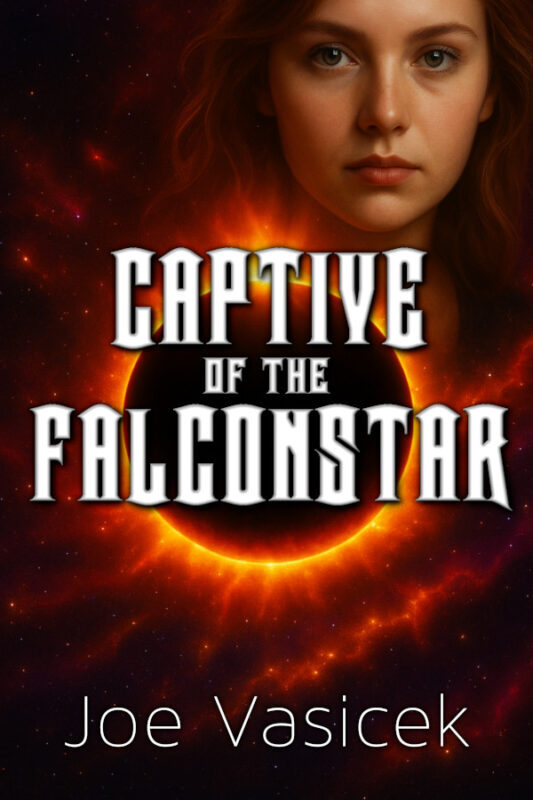
The Moral Cost of Revenge in Captive of the Falconstar

Revenge can feel like freedom when every other kind of freedom has been taken away. In Captive of the Falconstar, a captive woman begins with one simple desire: to go home, reclaim her true name, and return to the life that was stolen from her. But as captivity, betrayal, and humiliation harden inside her, revenge begins to look like the only path left—not just a way to punish her captors, but a way to feel powerful again.

That is what makes the theme so morally dangerous. The desire for revenge is understandable, even righteous in its beginnings, because it grows from real injustice. But revenge does not simply restore what was lost. It reshapes the wounded, narrows their choices, and asks whether striking back is worth the cost to the soul.

Where the Idea Came From

The emotional center of this theme comes from Sonya’s captivity and the way her longing for home is slowly twisted into a hunger for revenge. At the beginning of the book, Sonya dreams of Petyr and Graznav Station, waking to the bitter reality that she is aboard the Falconstar, forced to serve Zlata—now Lady Zenoba—who has embraced the identity and power of the Hameji. Sonya’s first act of resistance is not violence, but memory: insisting that her name is Sonya, not Gulchen, and clinging to the hope that “somedayshift” she will be free.

But the more Sonya is denied escape, the more revenge begins to replace home as the thing that keeps her alive. Genzerig recognizes this weakness and exploits it. He does not merely offer her freedom; he asks whether she wants the Valdamar Clan to suffer for what they have done. When Sonya accepts, revenge gives her “some measure of control over her life”—but it also places that life in the hands of another manipulator. That tension is the seed of the theme: revenge begins as Sonya’s attempt to reclaim agency, but the farther she follows it, the more she discovers that revenge has its own chains.

How the Moral Cost of Revenge Shapes the Story

The moral cost of revenge shapes Captive of the Falconstar by turning captivity into something more dangerous than physical imprisonment. At first, anger helps the wounded survive. It preserves memory, identity, and dignity in a world determined to rename, reshape, and possess them. But as the story unfolds, that anger becomes vulnerable to manipulation. Revenge begins to offer purpose, but that purpose comes through secrecy, deception, and the temptation to treat every relationship as a battlefield.

This is especially powerful because the book refuses to make revenge feel simple. The people who have caused harm are not flattened into faceless monsters, and the people seeking revenge are not magically purified by their suffering. As emotional ties shift and loyalties become complicated, revenge becomes harder to separate from betrayal. The deeper the characters go, the more they must ask whether they are pursuing justice, survival, power, or merely the illusion of control.

That is where the revenge arc becomes most painful. Revenge promises agency, but it can also trap a person inside choices made from fear, grief, and humiliation. By the time the path begins to look darker than expected, turning back may no longer be easy. In a story filled with space opera politics, captivity, dynastic ambition, rival loyalties, and morally gray choices, revenge becomes one of the book’s central emotional engines: a wounded person reaching for freedom, only to discover that vengeance can become another kind of captivity.

What the Moral Cost of Revenge Says About Us

The moral cost of revenge reveals how easily pain can disguise itself as justice. When someone has been wronged, betrayed, or stripped of dignity, the desire to see the guilty punished is deeply human. But Captive of the Falconstar asks what happens when revenge becomes the story a wounded person tells herself in order to keep going. Sonya’s hunger for revenge is not irrational; it grows from real suffering. Yet revenge cannot give her back the life she lost, and it cannot restore the innocence that captivity destroyed. Instead, it risks making her more like the people who used her: calculating, secretive, and willing to turn intimacy into leverage. The hope in this theme lies in the possibility that even after walking far down the path of vengeance, a person may still recognize the cost—and still long for something better than destruction.

Why This Theme Matters to Me

After everything that happened to Sonya in the previous book, I wanted to give her a more active role and make her more of an agent in her own story. That was why I chose to give her a revenge arc: because revenge is one of the most emotionally understandable temptations in fiction. When a character has been genuinely wronged, part of us wants to see them strike back. But I’m more interested in what revenge does after that first rush of satisfaction fades—how it narrows the soul, how it keeps old wounds open, and how it can trap someone in the very pain they are trying to escape. In Captive of the Falconstar, I wanted to explore a revenge arc that is not simple or clean, but tragic, human, and morally complicated.

Where to Get the Book

Buy from Amazon Kindle
Buy from Apple Books
Buy from Barnes and Noble Nook
Buy from Smashwords

Related Posts and Pages

Explore the series index for The Falconstar Trilogy.

Return to the book page for Captive of the Falconstar.

Sophie’s Third Choice

“Your wife, or your child? You must choose between them. If you do not, I shall kill them both.”

“Then take me instead.”

“My good man. Did you not hear what I said? If you do not choose—”

“I do choose. I chose myself. Are you going to respect my choice or not?”

“That isn’t one of your choices.”

“Yes it is. You may have the power to take our lives, but you don’t have the power to force me to make such an awful choice. Kill me, and let them go free.”

“Very well. If that is your choice, then I shall kill them both.”

“You think you have power? Life and death is nothing. Liberty is everything. With all your power, you cannot take that Liberty whereby God has made us free.”

“There is no God.”

“Then put that gun to your own head, because when all is said and done, the only power that matters is the power to face your own death manfully; all else is simply cowardice. But if not, know that the day will come when you and I will stand before the judgment bar of God, and I will be called to testify of what you did this day. Then you will weep and wail, and cry for the mountains to fall upon you and hide your face from the wrath of Almighty God. But they will not, and you will be compelled to stand before God with a perfect knowledge of all your guilt, and a perfect memory of all your crimes. Then we will see who has power. Then we will see who is free.”

“You try my patience, son. Try it any further, and I shall kill all of you.”

“Then shoot, and be damned.”

There is always a third choice. There is always a solution to the Kobayashi Maru. Never believe in no-win scenarios.

Trope Tuesday: Eagle Squadron

pdrm8846cYou’ve got your standard mercenaries: hired guns who fight for money.  Then you’ve got your fighting for a homeland types: mercenaries (usually) who used to have a cause to fight for, but now all they’ve got is each other, and maybe the hope that someday they’ll find a new homeland to replace the one they’ve lost.  Invert that, and you’ve got an eagle squadron: a ragtag bunch of volunteers who leave their homeland to fight for someone else’s cause, usually a sympathetic rebel faction or band of underdog freedom fighters.

It isn’t really fair to group these guys with mercenaries, since they aren’t fighting for money or fortune.  Far from it.  They believe so totally in the cause they’re fighting for that they’re willing to give up their lives for it, even though they could easily go home and live out their lives peaceably.  At least, that’s how it is on the idealist side of the sliding scale.  On the more cynical side, eagle squadron is really just a Legion of Lost Souls full of thugs and criminals who are hoping to clear their names.  Or, even further down the scale, perhaps they just love killing.

Even on the idealist side, there’s always the possibility that your terrorists are our freedom fighters.  After all, where did Al Qaeda come from?  The Mujahideen, volunteers from all over the Muslim world who joined with the Afghan freedom fighters against the Soviet invasion of the 80s.  When they won, it galvanized their Islamist cause and inspired them to take the fight to their homelands, many of which were ruled by dictators.  Since the United States props up many of these dictatorships, it was only a matter of time before they turned on us as well.

The name from this trope comes from three volunteer squadrons of US fighter pilots in World War II, who joined the RAF in the fight against the Nazis back when the United States was still neutral.  Since the Nazis have pretty much become the standard of all that is evil in the eyes of our modern society, the eagle squadrons are now heroes by default.  War is of course more complicated than that, though there is still room for heroism even in a world of moral ambiguity.

When the eagle squadron makes the ultimate sacrifice, you can count on them being remembered as heroes for all time.  That’s basically what happened with the Alamo: a bunch of frontier Americans sympathetic to the cause of Texan Independence went to join the fight against Santa Anna and made a bloody last stand when the war went out of their favor.  Of course, since history tends to be written by the victors, it’s arguable that this only happens if the survivors go on to win the war.  After all, plenty of expatriates volunteered to fight for the Nazis, but we don’t remember them in quite the same way.

Wow, this post turned out to be way more cynical than I’d intended.  The basic drive behind this trope is the yearning for an ideal, a cause to fight for.  We root for the eagle squadron because we want to believe that all it takes to defeat evil is for good men from across the world to take up arms against it.  If Eagle Squadron is led by the Incorruptible, then that might actually be the case, though it’s difficult to make that kind of a story anything other than black and white, one-dimensional, and utterly inauthentic.

I haven’t played with this trope too much yet, though I’ve been meaning to write a prequel book in the Gaia Nova series that tells the origin story for Danica and her band of Tajji mercenaries.  Her father was an admiral in the Tajji rebellion, and when the star system fell to the Imperials, they killed her entire family.  She escaped, though, and was taken in by an eagle squadron commander that fought alongside her father against the Imperial oppression.  After getting back on her feet, she leaves the Eagle Squadron to start her own military band, intent on getting revenge for the loss of her homeworld.  I’m not sure yet how the eagle squadron will play into that, but I see the commander as trying to dissuade her from this path.

In any case, it’s definitely a trope I want to play with.  I had a lot of fun with fighting for a homeland in Stars of Blood and Glory, so this would be a way to revisit some of the dynamics that made that story interesting.  You can definitely expect to see more of this from me in the future.

X is for Xenocide

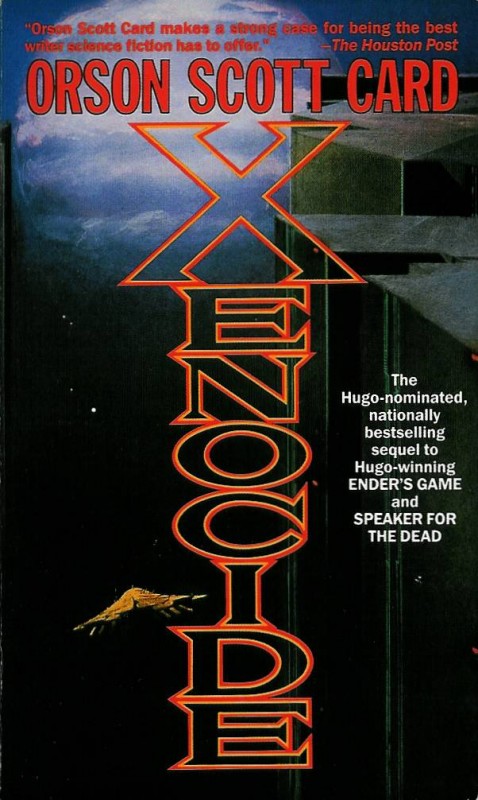
xenocideThis post isn’t just about the third book in the Ender’s Game series–it’s about the genocide of an entire alien race, which is actually a fairly important trope in science fiction.

Of all the evils of our modern era, perhaps the most heinous is the systematic extermination of an entire race or ethnicity.  These acts of genocide not only cross the moral event horizon, they create specters and villains that live on from generation to generation.  Just look at how the Nazis are portrayed in popular culture–even today, they are practically mascots of the ultimate evil.

And for good reason.  There really is something evil about the total annihilation of a foreign culture.  It’s one of the reasons why terms like “genocide” and “ethnic cleansing” are so controversial, especially in conflicts that are still ongoing–and there are so many unresolved conflicts where the systematic and purposeful annihilation of a race or culture is still happening.

Is wholesale genocide a phenomenon unique to our modern age?  Probably not, but modern science has enabled it on a scale that was previously impossible.  This became all too clear to us after World War II.  Only a generation before, great numbers of people believed that we were on a path of progress that would eventually culminate in world peace.  If there was any of that sentiment left, it was shattered with the liberation of Auschwitz and the bombings of Hiroshima and Nagasaki.  Suddenly, we realized that systematic mass destruction and genocide were not only possible, they were a modern reality.

It should come as no surprise, then, that science fiction immediately began to explore this issue.  From Frankenstein to 1984, science fiction has been full of cautionary tales of science gone wrong, issuing a critical voice of warning.  But after 1945, it went much further, exploring the issue in ways that can only be done in a science fictional setting.

Is genocide ever morally justifiable?  In our current world, probably not, but what if an alien race was bent on our destruction?  If their primary objective was the utter annihilation the human race, and negotiation was impossible?  Wouldn’t it be justifiable–perhaps imperative even–to stop such a race by annihilating them first?

This is what is meant by the term “xenocide.” A portmanteau of “xenos,” the Greek word for stranger, and “genocide,” it denotes the complete extermination of an alien race.

Xenocide forms the core conflict of Orson Scott Card’s Ender’s Game series (hence the title of the third book) and features in The Forever War by Joe Haldeman.  Battlestar Galactica presents an interesting twist, where the cylons debate the ethical questions surrounding the complete annihilation of the humans.  And then, of course, there’s all the time travel stories involving Hitler–let’s not even go there.

The interesting thing about xenocide stories is that even though they describe a dilemma that does not currently exist in our modern world, they inevitably come down to issues of Otherness that lie at the very core of the evils of genocide.  In order for xenocide to be morally justifiable, you have to know your enemy well enough to know that there’s no possibility of forging any sort of peace with them.  And to know them that well, they cease to be quite so alien.  It’s one of the major themes in Orson Scott Card’s work–that to defeat an enemy, you have to know them so well that you can’t help but love them.

In our modern world, genocide is only possible when an ethnic group is relegated to the position of Other–when they are made out to be so different and unlike us that we can never possibly relate to or mix with them.  They become “sticks” (Germany), “cockroaches” (Rwanda), “animals” and “barbarians” (Israel).  That is precisely why it makes us uncomfortable in stories about xenocide–because it turns the well-intentioned saviors of humanity into knights templar, or possibly the very monsters they are trying to destroy.

By positing a situation in which genocide might actually be justifiable, science fiction helps us to understand exactly why it is so reprehensible–and that’s only one of the ways in which the genre can uniquely explore these issues.  That’s one of the things I love so much about science fiction: its ability to take things to their extreme logical conclusions, and thus help us to see our own real-world issues in ways that would otherwise be impossible.

Since most of my characters are human, xenocide as such isn’t a major theme in my books, but genocide certainly is.  In the Gaia Nova series, the starfaring Hameji look down on the Planetborn as inferior beings and think nothing of enslaving them and slagging entire worlds.  That’s how Prince Abaqa from Stars of Blood and Glory sees the universe at first, but by the end of the novel he’s not quite so sure.  Stella from Sholpan and Bringing Stella Home also deals with these issues as she comes to realize how it’s possible for the Hameji to hold to such a belief system.

If genocide is one of the ugly skeletons in the closet of this screwed up modern world, then xenocide is science fiction’s way of taking those skeletons out and dignifying them with a proper burial.  By wrestling with these issues in stories set on other worlds, we are better able to humanize the Other and prevent these horrors from happening again on our own.  In this way and so many others, science fiction helps us to build a better world.

Trope Tuesday: Honor Before Reason

nedstarkIf you can’t do something smart, what do you do? Something right–at least, when this trope is played straight.

Characters who place honor before reason tend to be idealists, starry-eyed or otherwise.  It’s not that they’re stupid–at least, not always–but they do tend to be vulnerable to flaw exploitation.  If the Fettered can’t take a third option, this is how he often gets trapped.

On the other hand, without this trope, we wouldn’t have as many heroic sacrifices or men of their word. In the dark, everyone would turn out to be a jerkass, and the world would be a terrible place to live.

Since the best stories often have some sort of moral dilemma at their core, there’s something about this trope that speaks to us, even (or perhaps especially) in the face of sadistic choices and necessary evils.  It appeals to the more innocent part of us that still wants to believe in incorruptibility.  On the other hand, characters who follow this path don’t tend to think creatively enough to actually solve the problem–or at least, solve the problem without committing the ultimate sacrifice.

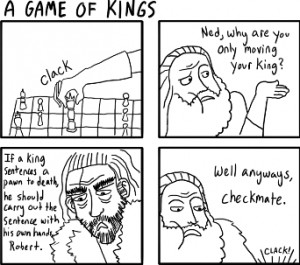
Not surprisingly, this trope is a very good indicator of where a story stands on the Sliding Scale of Idealism vs. Cynicism.  In idealistic stories, characters who place honor before reason are often vindicated, such as Bilbo in The Hobbit or Luke Skywalker in Star Wars.  In more cynical stories, the honorable characters not only get eaten alive, their noble idealism actually makes the problem worse.  The classic example of this is Ned Stark from A Game of Thrones, as the cartoon above suggests.

The opposite of this trope, reason before honor, is shoot the dog.  Interestingly enough, in the first scene in which Ned Stark appears, he commits an act that arguably fulfills both tropes at the same time (executing a man who is most likely innocent but has been found guilty by the law).  Lawful stupid doesn’t necessarily come into play, but it often overlaps.  Again, it all goes back to the scale.

This trope pops from time to time in my own writing, though I’m not nearly as cynical about it as George R.R. Martin.  Jalil from Desert Stars generally fits this trope, though Tiera is just as honorable and definitely not stupid about it.  Stella from Bringing Stella Home fits this trope at first, though her choices are vindicated later on.  In Stars of Blood and Glory, though, there’s a character who fits this trope perfectly, and I’m not sure whether he gets vindicated or not.  It will be interesting to see what the readers have to say about that.

Trope Tuesday: Freudian Trio

Last week, I blogged about the Three Faces of Eve trope.  But if we’re going to discuss power trios in any depth, we first need to examine the classic Freudian Trio, one of the most prevalent combos and, in some ways, a precursor to all others.

As you might expect, the Freudian Trio borrows heavily from Sigmund Freud, specifically, his theory of the Id, the Ego, and the Superego.   The main idea is that the human mind is divided into three parts: the Id, which comprises our basest animal instincts; the Superego, which comprises our concepts of morality and social norms; and the Ego, which struggles to find a balance between the two.

In the Freudian Trio, these elements of the psyche are represented by:

Each of these character archetypes are fascinating in their own right, and deserve to be examined in much greater depth.  However, in the Freudian Trio, it’s the combination of the three that proves so fascinating.

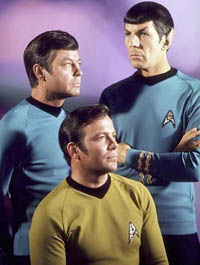
When faced with an interesting moral dilemma, the McCoy often wants to screw the rules and run in with guns blazing, while the Spock advocates caution, reminding us of the prime directive.  Or maybe the McCoy is paralyzed by indecision, while the Spock is the only one cold enough to make the sadistic choice.  In either case, the way the Kirk manages to resolve it will almost always reveal something deeper about the world or human nature.

The thing that’s truly amazing is how prevalent this trope is in fiction.  To name a few:

  • Star Trek: McCoy (Id), Spock (Superego), and Kirk (Ego).
  • Star Wars: Han (Id), Leia (Superego), and Luke (Ego), also:
  • Star Wars: Emperor Palpatine (Id), Grand Moff Tarkin (Superego), and Darth Vader (Ego).
  • Ender’s Game: Peter (Id), Valentine (Superego), and Ender (Ego).
  • Lord of the Rings: Gollum (Id), Sam (Superego), and Frodo (Ego), also:
  • Lord of the Rings: Gimli (Id), Legolas (Superego), and Agagorn (Ego), also:
  • Lord of the Rings: Dwarves (Id), Elves (Superego), and Humans (Ego).
  • Arthurian Legend: Sir Gawain (Id), Sir Lancelot (Superego), and King Arthur (Ego) (I would argue that Guinevere fits the Id role better, but I’m not an expert).
  • The Dark Knight: The Joker (Id), Harvey Dent (Superego), and Batman (Ego).
  • The Matrix: Neo (Id), Trinity (Superego), and Morpheus (Ego).
  • Shaun of the Dead: Ed (Id), Liz (Superego), and Shaun (Ego).
  • Fullmetal Alchemist: Edward (Id), Alphonse (Superego), and Winry (Ego).
  • The Melancholy of Haruhi Suzumiya: Haruhi (Id), Yuki (Superego), and Kyon (Ego).
  • Final Fantasy VI: Kefka (Id), Leo (Superego), and Emperor Gestahl (Ego).
  • Final Fantasy VII: Barrett (Id), Cloud (Superego), and Tifa (Ego).
  • Myst: Achenar (Id), Sirrus (Superego), and Atrus (Ego).
  • Starcraft: Zerg (Id), Protoss (Superego), and Humans (Ego).
  • Homestar Runner: Strong Mad (Id), Strong Sad (Superego), and Strong Sad (Ego).
  • The Good, the Bad, and the Ugly: Tuco (Id), Angel Eyes (Superego), and Blondie (Ego).
  • 20,000 Leagues Under the Sea: Ned (Id), Conseil (Superego), and Aronnax (Ego).
  • Twilight: Jacob (Id), Edward (Superego), and Bella (Ego).
  • Archie Comics: Veronica (Id), Betty (Superego), and Archie (Ego).

The Betty and Veronica one is particularly interesting because it’s also a love triangle.  In fact, most love triangles feature some kind of play on the Freudian Trio: the good girl vs. the bad girl, the nice guy vs. the jerk, the girl next door vs. forbidden love, prince charming vs. the loveable rogue.

Sometimes, the villains come from a dysfunctional or broken Freudian Trio, where one of the three died, was kicked out, or was never part of the combo in the first place.  When this happens, it’s called (aptly enough) a Evil Duo.  Examples include Pinkie and the Brain, Lex Luthor and the Joker, and Kefka and Gestahl (though that particular duo was very, very, VERY short lived).

Finally, it’s worth pointing out that the Freudian Trio is so common, it even occurs in real life.  Perhaps the best example of this would be World War II, where Churchill was the Id, Stalin was the Superego, and Roosevelt was the Ego.  With quotes like “never, never, never, never give up,” Churchill practically embodied the McCoy (his drinking penchant also helped), while Stalin, with his fanatic adherence to communism and his “million is a statistic” approach to the revolution, was as cold and calculating as you can get.  FDR was the one who held the alliance together, and it was only after his death that the Cold War really broke out.

Of course, it’s possible that we only see this trope everywhere because our brains are programmed to see it.  But if that’s true, it makes for an even stronger argument that the Freudian Trio plays on some powerful, universal archetypes.

Trope Tuesday: True Neutral

The True Neutral is something of an enigma.  They generally take no side, either because they have moved beyond good and evil, or because they simply don’t see good and evil the way we do.  Or because this isn’t their war and they just want to be left alone.  Or…well, let’s get to it.

From the easydamus character alignment page:

A neutral character does what seems to be a good idea. She doesn’t feel strongly one way or the other when it comes to good vs. evil or law vs. chaos. Most neutral characters exhibit a lack of conviction or bias rather than a commitment to neutrality.

Some neutral characters, on the other hand, commit themselves philosophically to neutrality. They see good, evil, law, and chaos as prejudices and dangerous extremes. They advocate the middle way of neutrality as the best, most balanced road in the long run.

As you might expect, this alignment doesn’t describe just one type of character.  In fact, there are many different archetypes that fall under True Neutral.  They include:

That’s quite a spread, isn’t it?  The main thing to keep in mind is that these are the characters who refuse to take sides–not just in whatever overworld conflict is driving the story, but in the ethical questions that the story raises (unless neutrality itself is their answer).

My favorite example of this trope is the Childlike Empress from The Neverending Story.  As the very embodiment of Fantasia, she transcends good and evil so completely that her power, the Auryn, cannot be used to forbid a monster from acting on its own evil nature.  Truth from Fullmetal Alchemist is another good example of a transcendent True Neutral.

With everyday, down-to-earth characters, though, this alignment tends to tick me off.  The Ents, for example, very much fall under this trope (as does Tom Bombadil…unless you subscribe to this theory).  Most others examples either come across as weak, selfish, or cowardly to me, so I don’t really care much for this alignment–unless it’s the starting point of a well-constructed character arc.

For that reason, in my own work, most True Neutrals are either straight-up antagonists or gradually shift in alignment as the story progresses.  In Genesis Earth, Michael Anderson starts out as one of the weaker True Neutral types, but changes as events in the story make him grow.  In Desert Stars, Sathi probably falls into this type, though I’m not so sure; either way, he’s very easily manipulated by his Neutral Evil wife.  In Bringing Stella Home, Ilya falls under this alignment due to his moral cowardice, and Anya might as well, though more as a Selfish Good than anything else.  Roman probably does too, but more because he’s old and wants to give up the fight; that’s something I’m currently working on in Stars of Blood and Glory.

I haven’t done a transcendent True Neutral yet, but if I ever write a heroic fantasy tale with gods and demons, I probably will.  After all, if Michael Ende did it in my favorite novel of all time, how can I resist?

Trope Tuesday: Lawful Good

Lawful Good is the character alignment that is the most unambiguously heroic.  These are the white hats, the caped crusaders, the knights in shining armor who fight for Truth, Justice, and the American way.  They might not always be smart, and they might not always be nice, but you can always count on them to do the right thingalways.

From the easydamus character alignment page:

A lawful good character acts as a good person is expected or required to act. He combines a commitment to oppose evil with the discipline to fight relentlessly. He tells the truth, keeps his word, helps those in need, and speaks out against injustice. A lawful good character hates to see the guilty go unpunished.

Although most Lawful Good characters are unambiguous, their conflicts are often quite complicated.  This is because their dedication to the moral code is itself a weakness which an intelligent villain can exploit.  Typically, this is done by putting them in a situation where they have to choose between being lawful (catching the bad guys) or being good (saving all the innocent people who will die in the process).  A smart Lawful Good character, however, will come up with a third option that turns the ethical dilemma on its head, though it might require a heroic sacrifice.

Very often, these kinds of characters appeal to us because they represent some higher ideal which we wish we could follow.  However, that’s not always the case, especially in more cynical works like A Game of Thrones, where the most lawful good characters also tend to be the most stupid.  Ultimately, it all comes down to the bias of the writer; even when you’re trying not to be didactic, it’s hard not to use the Lawful Good character as a vehicle for some sort of message.

A shallow Lawful Good will be little more than a paragon for whatever virtue they’re meant to represent.  A more nuanced Lawful Good will have some sort of a flaw (besides the backhanded ones), or some sort of internal conflict connected with their moral code to make them more human and relatable.

My favorite Lawful Good would probably be Sir Galahad from Le Morte d’Arthur, but mostly because of the sharp counterpoint he provides next to all the thugs and criminals other Knights of the Round Table.  Carter from Halo: Reach is a pretty cool Lawful Good, though he wasn’t my favorite (that would be Jorge).  And even though he’s a complete idiot, Ned Stark is still the only adult character from A Game of Thrones that I found remotely likable.

In my own work, Jalil from Desert Stars starts out as Lawful Good, though he shifts to Lawful Neutral in the middle and up to Neutral Good by the end.  In Bringing Stella Home / Sholpan, Lars and Narju definitely fall under this alignment, putting a lot of pressure on Stella to live up to their ideals.  I explore Lars’s idealistic character a bit further in Heart of the Nebula, a direct sequel to Bringing Stella Home which I hope to release later this year.  And in Star Wanderers, Noemi tends to fall under this alignment–though the story is not so much about saving the world as it is about saving each other.

Trope Tuesday: Character Alignment

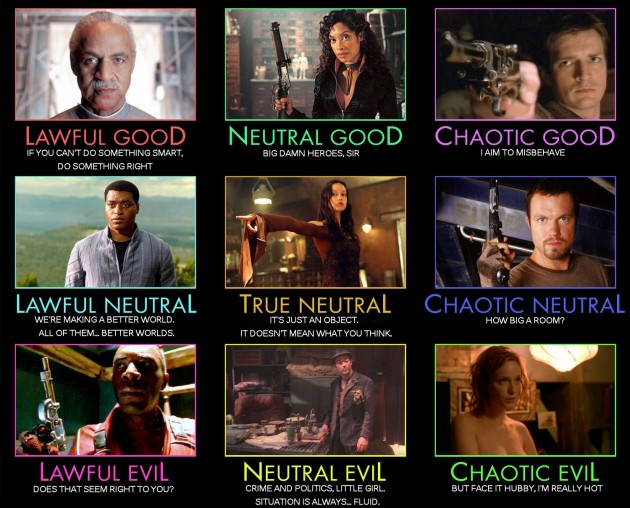
Alternate versions put 20th Century Fox in the Lawful Evil slot.

I love personality tests.  There’s something immensely satisfying about putting yourself on a grid that tells you something new and insightful about yourself and the people around you.  My personal favorite is the Meyers-Briggs test (I’m an ENTP), but I like playing around with others as well.

Character alignment is what you get when you combine fictional characters with the role they’re supposed to play in the story.  It’s a way to categorize the different ways they react to problems and ethical dilemmas, and to see which are inclined to be enemies and  which are inclined to be allies.

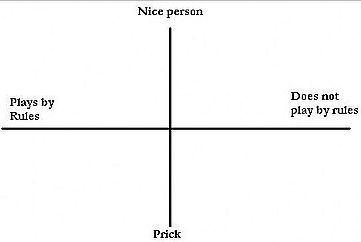
These systems initially arose out of RPG systems like Dungeons and Dragons, which use numbers, charts, and statistics to turn a story into a playable game.  There are many different kinds of alignments, but the most well-known is probably the one used by D&D, which charts characters along a good-evil axis and a lawful-chaotic axis.  In practice, the result looks a little like this:

Of course, that’s a very simplified version.  The tvtropes page goes into much greater depth, but I’ve personally found that this page right here does a much better job explaining the concepts behind the chart.

The horizontal axis, law vs. chaos, describes how much the character values order and authority vs. their own independence and freedom.  Lawful characters value honor and obedience, while chaotic characters value innovation and rebelliousness.  Characters who are neutral with regards to law and chaos generally respect authority, but put their own interests first and go against the established norms when that’s the best way to further their own ends.

The vertical axis, good vs. evil, describes how well (or poorly) characters tend to treat other people.  Good characters are altruistic and make sacrifices to protect the defenseless, whereas evil characters will kill, rob, or torture the innocent simply for the evulz.  Characters who are neutral with regards to good and evil don’t like to hurt others, but are not above pursuing questionable means to achieve their own goals.

Put together, the alignments create a 9-square chart, like the one at the top of the post.  While it’s certainly not obligatory to fill every slot, doing so can add a greater degree of depth to your story, as it certainly did with Firefly.

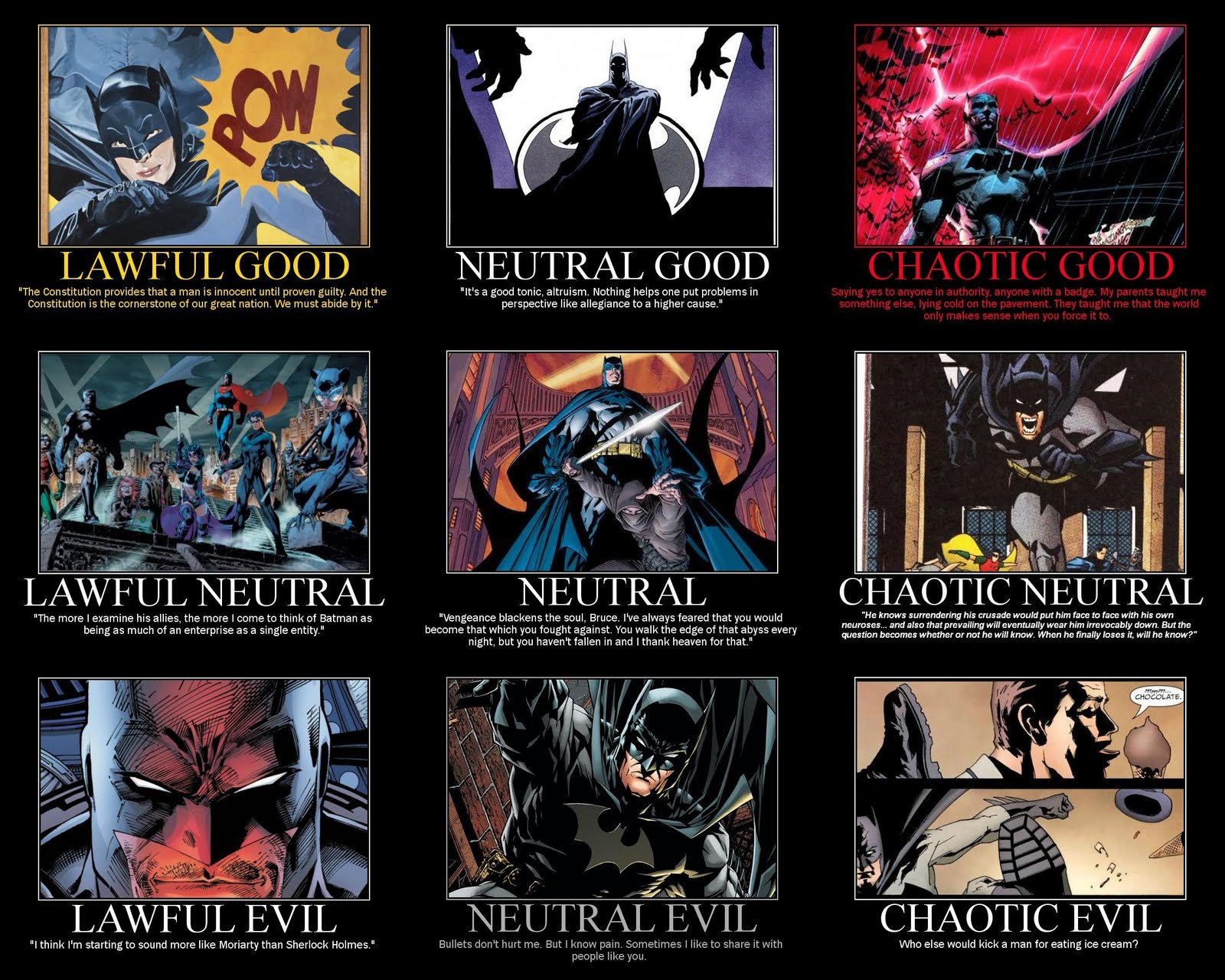
As with any formula, however, there is danger in holding too closely to the chart and becoming inflexible.  In real life, people switch alignments all the time, just as personalities can change and evolve (in high school, for example, I was an INTP).  Not only that, but some characters even fulfill all the possible roles, depending on the incarnation and the story.

Because I'm BATMAN!

The point is, character alignment is just a tool, not a hard-and-fast rule that needs to be used with every story.  If it’s a helpful way to think about your characters and set them up with interesting conflicts, great.  If not, don’t sweat it; Homer and Shakespeare were telling great stories long before this chart.

I’m going to be going overseas soon, so I expect my internet access is going to be spotty for the next couple of months.  Because of that, I’m going to write up a bunch of Trope Tuesday posts on each of the nine alignments and schedule them to post automatically.  So stay tuned for more!