Fantasy from A to Z: H is for Heroes

When David Gemmell, my favorite fantasy author, broke into the field in the 1980s, his books were considered to be part of the “heroic fantasy” subgenre. If the two major divisions of fantasy were epic fantasy (sometimes also known as “high fantasy”) and sword & sorcery (sometimes known as “low fantasy”), heroic fantasy was very much in the sword & sorcery vein. Then the stars of George R.R. Martin and Joe Abercrombie began to rise, and heroic fantasy gave way to what we now know as “grimdark.” 

On a superficial level, both grimdark and heroic fantasy appear to have much in common. Both subgenres tend to feature morally gray characters, worlds that are dark and brutal, and a great deal of graphic violence. George R.R. Martin is famous for killing off his characters, and David Gemmell likewise tends to kill off about half of his starting characters in every book. 

But if you spend enough time with both subgenres to get past the superficialities, you’ll see that they are totally different—and in some key ways, diametrically opposed. Not all grimdark descends into total nihilism, but much of it unfortunately does. But heroic fantasy is defined by the fact that it is not utterly nihilistic. Which isn’t to say that all heroes are noble and bright—gray morality is still very much a trope of the subgenre—but the very fact that heroes exist is enough to keep heroic fantasy from delving too deep into nihilism.

This is why I love practically everything that David Gemmell has written, but I couldn’t get past the first book in George R.R. Martin’s Song of Ice and Fire. I acknowledge that Martin is a brilliant and gifted writer. There were parts of A Game of Thrones where I felt more immersed in Martin’s fantasy world than in almost any other book I’d read. But by the end of the book, I hated all of the characters and was rooting for Danaerys to come with her dragons and burn them all to cinders (which was apparently the plan all along, if season 8 of the show followed Martin’s outline).

The thing is, George R.R. Martin is obsessed with the idea of victimhood. All of the characters in A Song of Ice and Fire are either victims or victimizers, or both. That is, apparently, the most interesting aspect that Martin finds about them. Which explains why his series did so well in the 00s and the 10s, when intersectionality was on the rise and critical theory came to dominate so many aspects of our culture. In any other time, Martin’s obsession with victimhood would not have gained such a following—which explains why it took him nearly five decades to hit his big break.

But where Martin is obsessed with victimhood, Gemmell was obsessed with heroism. He had a penchant for taking the most despicable and morally bankrupt characters, putting them in circumstances that demanded something more of them, and showing them rise to the occasion, making a heel-face turn and becoming the hero that the story demanded. It’s so immensely satisfying for me, every single time. Even the villains will sometimes turn into heroes by the end—though when they don’t, you can always expect them to have creative and satisfying deaths. No “creative subversion” of reader expectations there!

For Gemmell, there’s nothing very complicated about being a hero. There’s no list of defining characteristics or attributes. There’s also nothing particularly complex that a character has to do. For Gemmell, a hero is simply a person who does something heroic. Nothing more, and nothing less.

At this point, I’d usually give examples, but since all of them are spoilers, all I can say is go and read David Gemmell’s books! Some of the best heel-face turns are in Winter Warriors and Hero in the Shadows. I also really loved the protagonist’s redemption in The Swords of Night and Day. And of course, if you really want a great example of an unlikely hero, read Morningstar. That’s basically the whole plot of the book.

Like Gemmell, I prefer to write stories with heroes rather than anti-heroes. My Sea Mage Cycle books are generally more light on violence than a typical Gemmell book, but in The Widow’s Child and The Winds of Desolation, I put the main characters into some tough circumstances that forced them to step up and play the part. Same with The Sword Keeper, my first fantasy novel. And of course, with the Soulbond King books that I’m currently writing, where the main character is patterned after King David, there will be lots of opportunities for him to do heroic things, even if he is a more complicated character.

Heroes are so important to me that I honestly cannot read any fantasy book that doesn’t have one. When I look back on all of the big-name fantasy books that I’ve DNFed, that honestly is the major defining factor. Fortunately, the fantasy genre is full of excellent heroes—and with the way trends are shifting, I think we are going to see a lot more of them soon.

Fantasy from A to Z: C is for Conan

Before there was J.R.R. Tolkien, there was Robert E. Howard. And before there was Middle Earth, there was Conan the Barbarian and the Hyborian Age.

Robert E. Howard had an amazingly prolific writing career, cut tragically short by his suicide. When I think of all the books and stories we could have had if Howard had not shot himself in grief after the death of his mother, it fills me with a profound sense of loss (and makes me want to rewatch the excellent biopic about him—or more accurately, his girlfriend—The Whole Wide World). I love Howard’s fantasy stories—not just the ones about Conan and his adventures, but the ones about Bran Mak Morn, Kull of Atlantis, Solomon Kane… honestly, he wrote so many stories that I have yet to exhaust them all. 

But my favorite are the stories about Conan the Barbarian, who is undoubtedly his most famous literary creation. Over the course of the last century, Conan the Barbarian has taken on a life of his own, with dozens of writers taking a stab at writing stories in the Cimmerian’s world. My favorite of these is probably John Maddox Roberts, though I have a soft spot for L. Sprague de Camp. Harry Turtledove also wrote an excellent Conan novel, Conan of Venarium. 

In a lot of ways, Robert E. Howard’s Conan stories set the standard for modern fantasy—or at least for the sword & sorcery strain for it. Tolkien later established the epic fantasy strain, and you can make a solid argument that every other successful fantasy book is derivative of one or the other (or both). Where the epic fantasy strain tends run super long, with novels in the 200k word to 400k word range, the sword & sorcery strain tends to run much shorter, with many of the original Conan stories clocking in at under 10k words. In fact, from what I’ve gathered, until Lord of the Rings became popular in the 60s and 70s, most readers thought that the natural length of a fantasy story was under 10k words.

For the Conan stories, that’s probably true—or at least, under 40k words, since many of Howard’s original novellas are quite good. My favorite of his is probably either “The Tower of the Elephant” (perhaps the most classic Conan story) or “The Black Stranger,” which had a very interesting Mexican standoff between three stranded pirate captains that Conan totally blows up. I also really enjoyed “Iron Shadows in the Moon,” mostly because the female love interest gets an interesting and satisfying character arc. The crucifixion scene from “A Witch Shall Be Born” was really great, too, and of course, the brutal savagery of “Red Nails” made a really big impact—though since that was the last Conan story Howard wrote before he shot himself, it has a very dark edge to it.

Howard only wrote one Conan novel, and to tell the truth, I wasn’t particularly impressed by it—it just felt like a generic Conan story, padded with a bunch of filler to increase the length. But I did really love Conan the Marauder by John Maddox Roberts, where Conan rises through the ranks of a horde of nomadic tribesmen, starting as their slave and eventually becoming the right-hand man of the Hyborian age’s Genghis Khan. The two major villains of that book had exceptionally satisfying deaths, and the writing was almost as pulpy and glorious as Howard’s writing itself.

After you’ve read all the original Conan stories, you really should watch The Whole Wide World. It’s a wonderful film about the only woman Howard ever loved, his on-again off-again girlfriend Novalyne Price, and their turbulent relationship. As a writer, I really appreciated the glimpse that the movie gives into the life of the author himself—and on how some of his eccentricities as a writer mirror my own. Thankfully, though, my family life has been much more stable. I don’t blame Novalyne Price for rejecting Howard, but I am very thankful for my own wife and children. My own writing changed dramatically when I became a husband and father. I can only imagine what wonderful stories we would have had if Robert E. Howard’s life had taken a similar path.

The book I’ve written that comes closest to matching the mood, theme, and action of a typical Conan story is probably The Riches of Xulthar. It isn’t nearly as good as the original Conan stories, but I do think it compares favorably against some of the later knock-offs. The idea for it came when I was playing around with ChatGPT and asked it to write me a fantasy adventure story in the style of Robert E. Howard. Things took off from there. Riches of Xulthar was my first AI-assisted novel, though after using AI to generate the rough draft, I rewrote the whole book to put it in my own words, which is the process I use for all of my AI-assisted books. If you’re interested, you can do a side-by-side comparison between the AI draft and the human draft on my blog. 

Short-form vs. long-form fantasy

For the last month, I’ve been doing a lot of research into the fantasy genre, rereading all of the original Conan the Barbarian stories by Robert E. Howard and a bunch of the other ones too, by authors like L. Sprague De Camp, Lin Carter, Bjorn Nyberg, Robert Jordan, etc. I’ve also been reading a lot of epic fantasy, like the Wheel of Time series by Robert Jordan and the Stormlight Archive by Brandon Sanderson. And I’ve also read some essays on the genre, most notably “The Critics, the Monsters, and the Fantasists” by Ursula K. Le Guin, and “The Making of the American Fantasy Genre” by David Hartwell. Oh, and opening a bunch of chats with ChatGPT, though those are of limited usefulness (for some reason, ChatGPT hallucinates like crazy when you ask it to recommend any noblebright fantasy that isn’t more than two or three decades old).

From what I’ve gathered, there are basically two camps or schools within secondary-world fantasy: the heroic / sword & sorcery camp, based off of Howard’s Conan the Barbarian, and the epic fantasy camp, based off of Tolkien’s Lord of the Rings. According to David Hartwell, those are the only two franchises to achieve breakout success: everything else has either achieved only moderate commercial success in its time before petering out, or gained only a niche audience. Apart from Conan, the fantasy genre as a whole didn’t really take off until Terry Brooks immitated Tolkien with his Shannara series, thus launching a wave of Tolkienesque epic fantasy in the 70s and 80s that morphed into Grimdark in the 90s, 00s, and 10s.

So for a while, I was looking into all the various tropes and archetypes that make Conan and LOTR tick, and trying to use those to differentiate the two. But lately, I’ve been wondering if maybe I’ve been overthinking all of this, and the real difference between the two is that Tolkien mastered long-form fantasy, and Howard mastered short-form fantasy. In other words, what if the defining difference between the two camps doesn’t have to do with tropes so much as with the length of the actual story?

I suspect that short-form fantasy is poised to make a resurgence, especially with all of the challenges associated with writing and selling long-form fantasy in the 2020s. Larry Correia is right: Rothfuss and Martin have ruined the epic fantasy field for new authors by failing to finish their series in a reasonable timeframe. Unless you are independently wealthy or already have a large and loyal following of readers, it just doesn’t make commercial sense to write a lengthy series of +200k-word fantasy epics. Better to write shortier, punchier 40k-word novels instead, especially if you can churn them out every other month or so. That seems to be the model that works best for indies, at least in adjacent genres like urban fantasy and paranormal.

Anyway, that’s my current thinking on the subject. What’s your take on it?

Stormrider by David Gemmell

I thoroughly enjoyed the Rigante series. It has everything that I’ve come to love about David Gemmell’s books: scarred but good-hearted people struggling to do the right thing in the face of great hardship and evil, some of which lies within. Every chapter is compelling and filled with conflict, and while you know that most of the characters are going to die, none of them is beyond redemption.

There were a lot of things in particular that I liked about this book. One of them was the early-modern feel and aesthetic to the world-building. A lot of fantasy worlds are locked in a perpetual state of medieval technology, with very little growth or development. In Stormrider, however, Gemmell advances the world of the Rigante a couple of steps up the tech tree, to a tech-level more on par with the 30 years war.

It’s not just window dressing, either, because the introduction of things like gunpowder has a direct effect on things like battle tactics and duels for honor, which directly affect the story. And yet, there’s still the same undercurrent of magic that made the other books in the series so great. The Sidh may have left the world, but their influence remains, and their magic has not yet faded completely.

My one big issue with the book had to do with the climactic battle leading up to the ending. It wasn’t exactly a deus ex machina, but in some ways it felt very much like it came out of left field and wrapped things up in a way that was just a bit too neat and tidy. That said, it wasn’t nearly as unsatisfying on a character-based level—on the contrary, it brought several of the character arcs full circle in a way that I thoroughly enjoyed. It just wasn’t as good as some of Gemmell’s other endings.

For that reason, I’m only giving this book four stars. However, a 4-star Gemmell book is like a 5-star book from anyone else. Stormrider may fall just short of the standard that Gemmell sets with his other books, but it still clears the bar for truly a truly great fantasy novel.

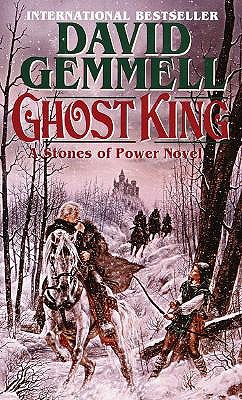
Ghost King by David Gemmell

Ghost KingAnother review of a David Gemmell book?  Yes, because I’m just that much of a fanboy.
With the Drenai series finished, I decided to sink my teeth into the Stones of Power series.  This series confuses me, because I’ve read The Jerusalem Man, which was retroactively put in as book three, but that’s a post-apocalyptic tale of the gunslinger Jon Shannow, but the series actually starts in Arthurian England.  As soon as I got a couple chapters into the first book, though, I began to see the connection.

Ghost King is an alternate history tale of King Arthur (Uther, in the book), and how he rises to become the Blood King of Britannia.  His grandfather, Culain, takes him into the mountains after the Brigantes assassinate his father, and there trains him to become a leader and a warrior.

Culain, of course, is one of the immortal Atlantians, just like his friend Maedhlyn (Merlin).  After the fall of Atlantis, they have wandered the Earth as gods, using the powers of the Sipstrassi stones to accomplish wonders.  Worshipped in turn by the Greeks, the Romans, the Hittites, and the Babylonians, Culain has tired of immortality and now wants to live out a mortal life.  But his jilted lover, the Ghost Queen, wants revenge on him for leaving her.  She was the one who killed Uther’s grandmother and mother, and who now wants to kill him and rule all of Brittania.  But her son Gilgamesh has corrupted her, so that in a parallel universe she must kill twenty pregnant woman every month just to replenish the magic of her Sipstrassi …

Okay, I might as well give up trying to explain the plot, because it only gets crazier.  Somewhere in this parallel dimension, a lost Roman legion has been wandering for hundreds of years, consigned to the void by Culain.  Also, Gain Avur (Guenevere) is in there too, as well as the Lance Lord (Lancelot), though he doesn’t come in until the epilogue.  There are also demons and vampyres, all sorts of battles, and lots of other crazy stuff.  It’s pretty freaking dang awesome.

I really enjoyed Uther’s transformation from the weak, bookish boy to the warrior king, as well as the budding of his relationship with Gain Avur (what can I say, I’m a sucker for romance).  My favorite character, though, was Prasamaccus, a crippled Brigante peasant who becomes one of Uther’s close advisors.  He’s basically a regular guy who gets sucked up into the whole adventure, but he’s level-headed and practical enough that he manages pretty well.  He’s also just a good person, which was quite refreshing in a world full of death and drama.

At one point, after rescuing Uther, he’s a guest in Uther’s chief general’s villa.  The general gives him a servant girl for the night, since in this world most men think nothing of bedding a slave.  Prasamaccus is a peasant, though, and he’s kind of shy.  The girl was actually captured in a raid in Germany, where she was raped, and this is her first time bedding someone since those traumati not the monster she’s afraid that he’ll be–they actually share a really tender moment of intimacy that heals much of her trauma and introduces him to the love of his life.c events.  She’s absolutely terrified, but so is Prasamaccus–he’s a cripple, and assumes that women just don’t want him.  He spends the night with the girl but doesn’t force her to sleep with him, and when she realizes how gentle he is–that she holds the power, and that he’s not the monster she’s afraid that he’ll be–they actually share a really tender moment of intimacy that heals much of her trauma and introduces him to the love of his life.

It’s poignant, story-rich moments like that that make me such a David Gemmell fanboy.  Usually they happen in the midst of war, between battle-hardened friends who are forced by circumstance to do something heroic, but they also happen in the quiet moments between characters who carry other scars.  That whole thing in the previous paragraph only happened in three pages or so, but it was still so incredibly powerful and moving.  Every moment of a David Gemmell book is like that, sometimes from the very first paragraph.  It’s awesome.

As far as David Gemmell books go, I’d put this one in about the middle of the pack.  It’s not quite as powerful as Legend or Wolf in Shadow, but it doesn’t meander as much as White Wolf or have such an anti-climactic ending as Ironhand’s Daughter (which was probably split by the publisher–more on that when I review The Hawk Eternal).  The characters aren’t quite as memorable as Druss, Skilgannon, or Waylander, but they are pretty awesome nonetheless.  I’d rate this book a 3 compared to Gemmell’s other books, but a 4.5 out of fantasy overall.  Definitely worth a read.

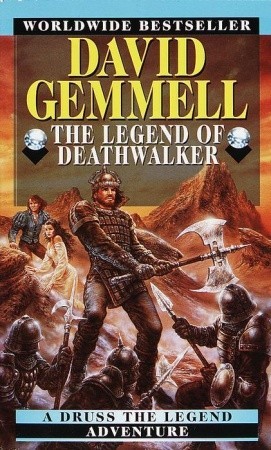
The Legend of Deathwalker by David Gemmell

legend_of_deathwalkerI’m not even going to try to write a synopsis of this story.  It’s just like all the other books in the Drenai series, which is why I love it so much.  Basically, this one gives the story behind the rise of Ulric, khan of the Nadir, and the origin of the Nadir people.  Interestingly enough, Druss the Legend plays a major role.
This was the last book in the Drenai Saga that I hadn’t read, so reading it was a very bittersweet experience.  On the one hand, this one is just as good as all the other books in the series, and made me want to revisit Legend and some of the others.  On the other hand, I knew that once I’d finished it, there wouldn’t be any more Drenai books left.  So I took it slow for the first half, but naturally I finished it at a breathless late-night sprint a day or two later.

I’ve been thinking a lot lately about why I love David Gemmell’s books so much.  There are many reasons, but I think the main reason is that his writing is honest.  He strips away all the incidental stuff and gets right at the heart of the stuff that matters.  He doesn’t pussyfoot around, either–if his characters do something despicable, he doesn’t make any excuses for them.  He tells it like it is.  This can make for a very brutal story, but it also makes for a very cathartic one.

The other reason I love his books so much is because he does such a good job depicting raw, unrepressed manhood–not the stupid stuff like driving big cars and eating meat, but manning up and facing your greatest fears.  It’s about friendship, and honor, and fighting with all of your strength for something you believe in.  It’s about all that raw, pent-up energy we all have, that animal urge that drives us to competitive sports and first person shooters, and channeling it for a heroic cause.

The craziest thing is that the fight itself is actually more important than whatever side the characters are fighting on.  In this book, Druss is actually fighting to help bring about the rise of the Nadir khan who later invades his homeland and kills him on the walls of Dros Delnoch.  None of that matters, though, because Druss doesn’t fight with malice.  For him, it’s all about fighting for something, not against something, and the battle itself is just as important as the victory.  I don’t think I can put it better than this:

“Can we win here?” Sieben asked, as the shaman’s image began to fade.

“Winning and losing are entirely dependent on what you are fighting for,” answered Shaoshad. “All men here could die, yet you could still win. Or all men could live and you could lose. Fare you well, poet.”

The best thing about David Gemmell’s books is the fact that none of the characters–not even the bad guys–are defined by their own evil.  The Nadir are supposed to be the evil chaotic race of the Drenai universe, but when you come to understand what they’re fighting for, their hopes and dreams for a better future, you can really see what’s good in them.  Likewise, the more civilized Gothir are kind of like the evil white men who want to put down the savages and keep them in their place, but there are good and honorable men among them too.

And yet, even though the two sides clash, and good men die on both sides, it somehow isn’t tragic.  That’s the crazy part.  It’s almost like you can feel the characters salute each other as they die in a good cause, the way Ulric gave Druss a proper funeral in Legend, even though the two were blood-sworn enemies.  In David Gemmell’s world, honor and courage are more important than life or money.  Everyone dies; dying well is more important than living without honor.

This book is incredible.  As I was reading it, I decided it was the best David Gemmell book I’ve ever read–which is something I do every time I read one of his books.  I feel like I’m a better man for having read them.  If he had written a hundred books in this series, I would happily read them all.  The fact that there are no more new ones deeply saddens me, but I know I’ll revisit these stories again in the future.

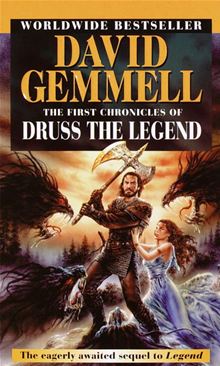
The First Chronicles of Druss the Legend by David Gemmell

druss_chroniclesBefore Dros Delnoch, before Skeln Pass, before the Legend there was a seventeen year old woodsman and his young bride Rowena.  They lived a happy, simple life until slavers attacked their village and carried her away.
But Druss would stop at nothing to save her.  With the demon-cursed blade Snaga, he crossed oceans and continents, fighting corsairs, brigands, armies, empires, even chaos beasts to find her.  And with each battle, the legend grew.

But the greatest challenge Druss would face was not a warrior or a monster, but an old family curse from beyond the land of the living.

Oh man, it’s been far, far too long since I’ve read a David Gemmell book.  Far too long.  And this one was perfect.  It had everything you could possibly ask for in a book by David Gemmell: honor, glory, blood, war, mystics and evil sorcerers, monsters from beyond the grave, great empires and epic sieges, and even a good deal of romance.  And Druss himself is such an awesome character, an unassuming, simple hero who may be brash and may have a temper, but is never completely corrupted by evil.

That said, this is a brutal, brutal book.  The pithiest way I can describe it is Taken meets Lord of the Rings.  People get killed.  Women get raped.  In fact, I think most of the women in the book get raped.  Certainly, more than 50% of the characters die, most of them in a grisly, violent way.  And not everyone is redeemed.  In fact, some of the noblest characters fall.

But man, this is a good book.  Where other fantasy books start off with the lore of the world, painting an exquisitely detailed picture of the world and the magic and the history, Gemmell just throws you right in and grabs you with the story.  Things happen, and they happen quickly.  From the beginning, he snags his hooks in you.

But more than anything, the story means something.  Not in the sense that there’s some kind of underlying moral, or the characters are all black and white.  They aren’t.  People do good things for the wrong reasons, and bad things for the right reasons.  Some of the most despicable characters rise up to do heroic things, while some of the noblest and most honorable characters end up fighting for evil through no fault of their own.  But through it all, there’s so much truth, so much insight, that you can’t help but come away feeling like you’ve been through life and death, and seen the best that both have to offer.

I’m gushing, I know.  This book is INCREDIBLE.  Definitely on par with Gemmell’s best.  I wish he could have written a hundred novels just like it.  I would have read them all.

This is the second to last book in the Drenai series that I’ve read.  The only one that I haven’t gotten to yet is The Legend of Deathwalker, and I plan to get to that one right away.  After that, I’ll probably move on to the John Shannow novels, and then the Rigante series.  In three years, I wouldn’t be surprised if I’ve read every book that David Gemmell has ever written.  He’s just that kind of an author to me.  And if he were still alive, you can bet I’d be ravenously devouring every new book that comes out…

Sadly, the number of David Gemmell books in the world is finite.  But still, there’s quite a few left before I read them all.  And one day, somewhere in the far-off future, I hope to write books as incredible as his.  To one day surpass him would be an impossible dream…but as the Ventrians say, may all your dreams come true save one, for what is life without a dream?

Awesome, awesome book.  If you’re a fantasy reader and brutal stuff like rape doesn’t trigger you, you definitely need to give the Drenai Series a try.  Start with Legend, but get to this one shortly thereafter.  It’s an amazing, incredible read.

Up to my elbows in book surgery

That’s probably the best term for what I’m doing with Heart of the Nebula right now.  Basically, I let some of my darlings live, and they grew some extra limbs and started drooling acid without my realizing it.  But now, I’ve put enough distance between myself and the first draft that I have no qualms about grabbing the axe and chopping off heads.

Don’t worry; this is all a normal part of my creative process.  Maybe someday, stories will burst fully formed from my head like Athena from the brow of Zeus, but for now, my ideas are a lot more like baby turtles–if I’m lucky, one or two out of a dozen will actually reach the water and survive.  Protip: don’t follow the lights.

Speaking of ancient mythology, I’m reading the Argonautica right now, and I can’t help but notice that it would make a really, really, REALLY awesome science fiction story.  No, seriously–think about it.  A group of legendary heroes sets out on an epic voyage in search of some applied phlebotinum macguffin, have all sorts of adventures on strange and distant planets, get the girl to fall in love with the captain, and bring her back with them to their homeworld.  It would also work well as a heroic fantasy, but space is so much more awesome.

Incidently, Kutaisi was the capital of ancient Colchis, where Jason and the Argonauts came seeking the golden fleece.  People still speak of Medea as if she were a real person–generally, they think she was a dirty traitor who sold out her own people.  But people still enjoy the love story, and if you keep your eyes open you can see restaurants and hotels named after her.

So yeah.  Ancient Greek mythology + science fiction = win.  You can definitely expect to see some more of that in my own writing in the future.

In other news, I recently did an interview on fellow indie author Ty Johnston’s blog.  In it, I talk a little about my travel writing, what draws me to speculative fiction, my favorite number (hint: it’s 12), and my insights into the ancient Mayan calendar and the 2012 apocalypse.  It was a lot of fun–you should definitely check it out.

If you would like to host me for an interview on your blog, shoot me an email!  I’m always up for stuff like that.  Otherwise, I’d better roll up my sleeves and get back to hacking up operating on my book.

Trope Tuesday: The Cavalry

Things look bleak: the Big Bad is on the verge of conquering the world, and the heroes have gathered for one last stand.  Just when it looks like all hope is lost, a horn sounds in the distance, and the cavalry arrive to save the day.  Whether a ragtag bunch of minor characters, an army of unlikely heroes, or the ultra-heroic Eagle Squadron, the timely reinforcements use their overwhelming force to crush the villains and save the day.

When done right, this trope can be one of the defining moments of greatness of the entire work.  When done wrong, however, it becomes little more than a Deus Ex Machina of the most unsatisfying kind.  How, then, can this moment be done right?

As with any Deus Ex, one of the keys is to adequately foreshadow the end.  This often takes the form of Gondor Calls For Aid, when the heroes petition the cavalry for assistance before going into battle. To make things interesting, the relationship between the two parties is often complicated and ambiguous, making it doubtable that the cavalry will actually show up.

However, I think it goes deeper than this.  In order for the arrival of the cavalry to be satisfying, it needs to not invalidate everything that the heroes have already gone through.  If the cavalry shows up after the heroes have defeated the Big Bad, and essentially rescue them from a heroic sacrifice, that’s satisfying.  If the heroes are still fighting the Big Bad and the cavalry comes out of nowhere to hand them an unearned victory, that’s cheap.

In English 318R, Brandon Sanderson often used the film versions of the Lord of the Rings Trilogy to illustrate this.  The Battle of Helm’s Deep was satisfying, because the entire premise was to hold out until the third day.  When Eomer arrived with the Rohirrim on the morning of the third day and swept away the Uruk-Hai, that didn’t invalidate King Theoden’s efforts because all he was trying to do was survive.

In the Battle of Minas Tirith, however, Aragorn’s arrival with the unbeatable army of the dead was kind of cheap, because the premise was to defeat the orcs, not to hold out for reinforcements.  Gondor could have just stood down and let the orc army capture the city, and they still would have won in the end.

The two genres where you’re most likely to see this trope are westerns (trope namer) and heroic fantasy. Just about every David Gemmell novel involves a cavalry moment of some kind, and I looove it.  It’s also quite common in military science fiction, too–basically, any story where war is a major part of the narrative.

The variations on this trope are also quite fascinating.  For example:

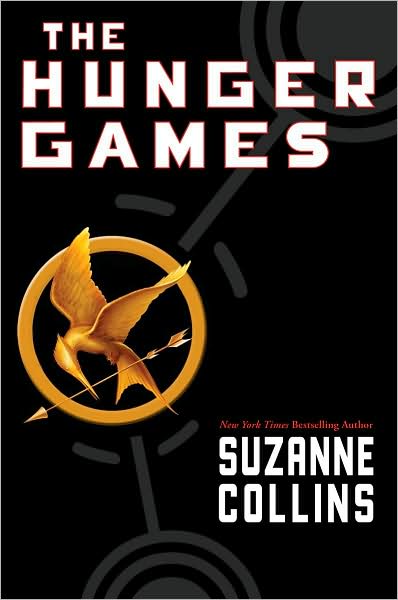
The Hunger Games by Suzanne Collins

This book review is going to be a bit unconventional, so please bear with me.

Normally, I only review books on my blog if I feel I can recommend them.  They might not be perfect, but overall, the praise outweighs the criticism. However, for me personally, The Hunger Games was a huge disappointment.

I’m not going to do a little book blurb like I usually do, because I want to spend all the available space on this post explaining the reasons why I was so disappointed.  Also because of that, this post will be full of spoilers.  Consider yourself warned.

First, let me say that I don’t think this book was all bad.  Suzanne Collins is very good at plot and pacing, and she knows how to keep a reader hooked.  In that way, this book reminded me of the old Michael Crichton thrillers that I devoured as a kid.

However, two crucial things killed about half of the suspense for me: the fact that this book was the first in a series, and the first person viewpoint.

From the very beginning, we know that Katniss isn’t going to die.  We know it, because she’s narrating the story to us directly (in present tense, which personally irks me, but I won’t go into that).  Unlike other gladiator-style heroic fantasies, where the major draw is to see who lives and who dies, we have that spoiled for us.

Of course, the argument in favor of the first person is that it helps the reader feel a closer connection with the viewpoint character.  The problem is, I never did.  At the end of the book, Katniss still feels like an outsider to me; I never felt like I got inside her head well enough to know who she really is.  When I try to imagine her, all I can envision is a wide-eyed mannekin.  She just didn’t come alive to me.

Why? Because the whole time, she’s only got one thing on her mind: survival.  I don’t see anything but fragmentary glimpses of her other motivations, and those are never fully fleshed out.  Her experiences growing up were just so traumatic that I can’t relate to her, and Suzanne Collins never provides a reference point outside of the awfulness of Katniss’s crapsack world.

Which is another thing that got to me: the setting.  Every time I opened the book, I dreaded going back to Collins’ world–and not in a good, “ooh, this world is so creepy/frightening” way, but in a “man, this place just makes me depressed” kind of way.  It wasn’t even that original–Panem is basically the USA as North Korea (though it could take place anywhere, for all the details Collins gives us).

What’s more, the setting is full of inconsistencies.  The people are starving to death, but the forests are full of game and wildlife.  In North Korea, people raze the forests for fuel and timber, driving all the game out.  Yes, I know the people of District 12 mine coal, but all of it presumably goes to Capitol, just like in District 11 all the grain goes to Capitol and the people still starve. Which makes me wonder: why are all the districts specializing in only one commodity?  That’s just stupid.

Which brings me to another thing: the sheer idiocy of the rulers of Panem.  If the Hunger Games are supposed to remind the people of how subjugated they are, why allow the tributes the opportunity to do something like pull a romance stunt?  Why spend all that time primping and preening them, interviewing them, and giving them an opportunity to manipulate the crowds?  When the people of District 11 sent Katniss the bread, why didn’t a government censor stop that from happening?  And finally, when Katniss and Peeta were the only ones left standing, why give them the opportunity to upstage the games by falling on each others’ swords?

Seriously, that last point got to me more than any of the others.  When they announced the rules change, that Peeta and Katniss were supposed to kill each other after all, why couldn’t the GM see the potential for things to go wrong?  Seriously, having them both kill each other–or refuse to kill each other–was such a blatantly obvious choice, I saw it the moment the rule change came into play.  The fact that the villains didn’t just threw me out of the story.

But that wasn’t the first thing that threw me out of the story.  The first thing was the parade, with Katniss and Peeta marching into the arena with their flaming cloaks.  All this time, Katniss has been set up as the underdog–she isn’t pretty, she isn’t strong, she’s mildly sympathetic for volunteering in place of her sister, but the audience in that arena is looking for blood, not sympathy.  So when the crowd goes wild for her and Peeta, I just didn’t buy it.

It only got worse as things went along.  When the tributes did the skill check, Katniss–who, from the beginning of the story, has been set up as the underdog–scores higher than anyone else.  Every time she’s in front of an audience, everyone is oohing and ahhing.  It made me want to gag.

Honestly, you know what it seemed like?  It seemed like Suzanne Collins fell in love with Katniss so much that she wanted to spoil her, even though the story required her to keep up the pressure.  She made sure to torture Katniss in the games–so much so that it felt downright melodramatic at times–but while they were still in Capitol, waiting for the games to start, Katniss felt like a spoiled Mary Sue.

And as for the romance, it fell completely flat from the beginning.  Katniss was nothing but a manipulative faker from the beginning–granted, because she needed to in order to stay alive, but the least she could have done was coordinate that with Peeta.

And that’s another reason why I had such little sympathy for her–she’s a callous, manipulative, lying little heartbreaker, like far too many women in this world.

So yeah, The Hunger Games was, in my opinion, a huge disappointment.  I can partially see why it did so well (strong female protagonist, excellent plot structure and pacing, lots of hooks and cliffhangers), but personally, I don’t think it deserves half the praise it’s gotten.  And after what friends have told me about the rest of the series, I can guarantee that I won’t be reading them.