Fantasy from A to Z: X is for eXpectations

What sort of books are fantasy readers looking for today? What are the expectations that readers have for the genre?

Overall, the fantasy genre is growing. Sales are up, both in traditional and indie publishing, and the big names in the field (like Brandon Sanderson) are doing quite well. It’s clear that the fantasy genre as a whole is robust and healthy.

When you break it down by publishers and subgenres, however, things start to look a little different. Romantasy is dominating the traditional publishing world, but most of it is little more than pornography for women, dressed up with fantasy trappings. And because of how traditional publishing now relies on a few big blockbusters to make most of their earnings, romantasy is sucking all of the oxygen out of the room, making it much more difficult for debut and midlist authors in the other fantasy subgenres.

In the world of indie publishing, litRPG has begun to demonstrate some staying power. It was the new hot thing back in the early 2020s, but it’s attracted enough attention and developed enough of a following that it has become a major subgenre that is likely to endure for some time. I could be wrong about that, but from what I see, that’s where most of the innovative authors and whale readers (ie >1 book per week) are focusing their attention these days.

But because of the way that the algorithms tend to govern the indie publishing cycle (and the way that indie publishing has unfortunately turned into a zero-sum, pay-to-play game with online advertising), the rise of litRPG in the indie publishing world may very well be sucking all of the oxygen out of the room in the same way that romantasy is sucking it out of the traditional publishing world. 

Both subgenres are also very gender-biased, with women gravitating toward romantasy and men gravitating toward litRPG. This reflects the broader social and political trend of men and women going separate ways, across a whole host of different metrics. So as the gender divide continues to widen in society generally, that will probably reinforce the divide between romantasy and litRPG, creating a positive feedback loop (or death spiral, depending on how you look at it).

Sword and sorcery continues to do okay, and has probably been given a boost by the recent release of Conan the Barbarian into the public domain. But most of sword and sorcery got siphoned off into grimdark back in the 00s—in fact, you could say that sword and sorcery reinvented itself as grimdark. And while grimdark has resisted the feminization of literature, standing as one of the few remaining bastions where male readers continue to feel at home, I think grimdark has already passed its peak. In a post-pandemic, post-Trump world, I think most readers are hungry for books that are less nihilistic and more uplifting.

Which brings us to epic fantasy. While Brandon Sanderson continues to dominate this subgenre, with his massive kickstarters and huge book releases, it’s debatable whether his readers are hungry for more epic fantasy, or just for more Brandon Sanderson. He’s kind of a subgenre all to himself. Recent streaming adaptations like Wheel of Time and Rings of Power have failed miserably, and Game of Thrones has fallen almost totally out of cultural significance, with George R.R. Martin’s failure to finish the last book (and Patrick Rothfuss’s failure to finish his own series) becoming something of a meme.

In fact, the failure of these two big-name authors to finish writing their books may have struck epic fantasy a mortal wound. Because of how they have been burned, a large number of epic fantasy readers are now unwilling to commit to a series until after it is complete. But very few authors can afford to write a truly epic series and release the whole thing at once. It takes several years to write a series like that—and what are authors supposed to do if the first one flops? 

In other words, debut epic fantasy authors are damned if they do, and damned if they don’t. If they release the first book by itself, it will probably sink into obscurity before they can write and release the next book. And if by some measure of hard work and tenacity they manage to write a whole series and hold back from publishing until they’re ready to release it all at once, if the first book still fails to sell, they’re SOL and all that hard work was for nothing. 

This is also why traditional publishers are so unwilling to publish a new epic fantasy series from a debut or a midlist author. A bestseller like Larry Correia might be able to dip his feet in that pond (and do quite well—I highly recommend his Sons of the Black Sword series), they won’t do that for anyone else. Which is fine, except that indie publishing epic fantasy is just as hard—arguably more so.

For these reasons, I don’t think it’s an exaggeration to say that Patrick Rothfuss and George R.R. Martin have done more to kill epic fantasy than they have to grow it.

But this may actually have created an opportunity for those authors who are willing to drive into the smoke. After all, there’s much less competition if you can manage to break in and build a decent following. But how much hunger is there for epic fantasy, compared to other fantasy subgenres? And how can a newer/midlist author reach them, without a big push from a publisher or the algorithms?

Back into writing!

So we are more or less moved into our new (old) house, though there is this overdue kid’s book from the library that somehow got lost during the move, and we haven’t been able to find it… but aside from that, we are more or less settled in. Our five year-old has started kindergarten, my wife is starting her new job, and by the time this post goes live, we will have acquired office chairs from the BYU surplus sale, so I won’t have to be standing all the time like I am as I write this.

I’ve already gotten back into writing my epic fantasy, The Soulbond and the Sling, and am making steady progress on it again. The AI draft is about 66% complete, and it’s good enough that if I were writing it under a secret AI-only pen name, I would feel comfortable publishing it as-is. But my personal standard of quality is higher than that, especially for epic fantasy, so after the AI draft is complete, I will rewrite the whole thing without any AI, to put it in my own voice (and will probably add a whole lot of other stuff to it too—you know, the kind of setting and character details you’d expect in a proper epic fantasy, giving it much more depth).

(Also, as a side note, I do not have a secret AI-only pen name… though I must admit, a part of me kind of wants to start one. With a little bit of market research to figure out the pulpiest genres where I could really excel… but no, with two (soon to be three) small kids and a wife who works full-time, there are only so many projects I can work on at a time.)

I’m also working on The Road to New Jerusalem for my J.M. Wight pen name, though that one has been going much more slow. I really have no idea how much market appeal this one is going to have, and doubt it will do much more than help me to flesh out the world for a potential series in the same universe (a post-apocalyptic Mormon polygamist romance, which also probably has limited market appeal). However, I feel impressed that this is a book I need to see through to the end, so my goal is to finish it before October, at which point I will probably focus on The Soulbound King.

Beyond that, I’m also working on two other novels that I hope to finish before the end of the year (or, more realistically, sometime early next year, since I’m sure the new baby will throw things off for a while. The first is The Unknown Sea, a Sea Mage Cycle book, which is going to be a lot of fun. The rough AI draft is already done, and I had a real blast writing it.

The other one is Captive of the Falconstar, the sequel to Queen of the Falconstar. The rough AI draft is also done for this one, but the revised AI draft is going to take a bit more work. Also, I need to redo the cover and blurb. But I’m really looking forward to getting this one out, and completing the trilogy, which has stood unfinished for nearly a decade now. Yes, I really need to finish these unfinished series, and fully intend to do so—not just with this one, but for all of them.

Over the next year, I hope to transition from being a science fiction writer who occasionally writes fantasy, to a fantasy writer who occasionally writes science fiction. My two big unfinished sci-fi series are the Falconstar Trilogy and the Outworld Trilogy. The plan right now is to finish Falconstar first, knocking out the last two books almost at the same time (the rough AI draft for Lord of the Falconstar is also complete), and then spend a little more time on Return of the Starborn Son to finish that trilogy strong. For a long time, Star Wanderers was my flagship series, so I want to do right by it. But I haven’t even outlined book 3 yet, so it’s going to be a while.

And when Return of the Starborn Son is done, I will probably release another volume of my author’s notes, since hey, why not? But that won’t be for a while—probably not until this time next year, at the absolute soonest. However, Return of the Starborn Son probably will come out before The Soulbond and the Sling, since for marketing reasons I don’t want to release an epic fantasy trilogy until all three books are ready to rapid release. And yes, I fully blame George R.R. Martin for conditioning epic fantasy readers not to try out a new series until it is complete. It is what it is.

So that’s the long-term plan. I will probably start a few new projects as well, including a relaunch of my Christopher Columbus stories, once I figure out what I want to do with that series. But for now, I’m just going to focus on The Road to New Jerusalem and The Soulbond and the Sling, until we are back into a new routine. BYU classes start on September 3rd, so it will probably be a little crazy until then. And the way things are shaping up, I half-expect they will induce my wife at the tail-end of September. So maybe we won’t actually get into a new routine until sometime next year. But either way, I’ll do my best to keep writing.

Fantasy from A to Z: K is for Kings

Why are kings and kingdoms so common in fantasy?

Part of it has to do with the genre’s nostalgic yearning for a distant past. One way of understanding the modern era is to see it as an unending series of political revolutions that have spread like a slow-moving contagion from one part of the world to another. 

It started with the English Civil War, then died down for a while until it manifested in the American Revolutionary War, which resulted in the creation of the United States. After that, it spread to France, leading to the French Revolution and a very messy tug-of-war between the Republicans and the Monarchists, ultimately leading to the permanent end of the French monarchy. 

Then we had the aborted revolutions of 1848, which ultimately gave us Karl Marx and Socialism, the Bolivarian revolutions in Latin America, the American Civil War, which culturally was something of an echo of the old English Civil War (with the Cavaliers in the south and the Puritan Roundheads in the north), and ultimately the Bolshevik Revolution which gave us global communism, etc etc.

I won’t belabor the point (though if you want to hear a good podcast that covers all this stuff, check out Revolutions by Mike Duncan). The point is that the modern era has basically been one long series of very messy wars to depose the old medieval kings and emperors. Today, the only monarchies that survive are either constitutional monarchies that no longer exercise direct political power (for example, King Charles of the United Kingdom), or else they are strange aberrations that only exist because of unique regional history and economic circumstances (for example, Mohammed bin Salman of Saudi Arabia, whose dynasty depends almost entirely on the country’s oil reserves).

Fantasy is all about hearkening back to a romantic view of the premodern past, even if that past never existed. So it shouldn’t come as a surprise that most fantasy—especially classic fantasy—tends to feature kings and kingdoms. Never mind that historically, many medieval kings were almost totally beholden to their dukes, especially in the time before gunpowder, when the dukes could just hole up in their castles and openly defy their kings. That’s why Europe has so many medieval castles.

Of course, some fantasy like George R.R. Martin’s Song of Ice and Fire does a really good job of capturing the complex dynamics of feudal politics. A lot of the old sword & sorcery also plays around with those kinds of medieval political tensions, balancing the nostalgic aspect of fantasy with the savagery of backstabbing courtiers and brutal hand-to-hand combat. Robert E. Howard’s classic Conan the Barbarian stories are a great example of this, with Conan ultimately rising to become King of Aquilonia.

Both grimdark and sword & sorcery embrace the medieval savagery—indeed, it’s a large part of the nostalgic yearning. Other subgenres play down the savagery, either by making the king a distant power, or by making the world out to be a lightly-populated wilderness. Lord of the Rings is a good example of both, though it still defaults to feudal monarchy as the majority political system.

Is there a subconscious yearning for old-fashioned monarchy that fantasy quietly fulfills? Perhaps, but I don’t think so. If kings and kingdoms are the default system of government in most fantasy novels, I think that’s because it was the default for much of the medieval era. In books like Game of Thrones where the political intrigue is a key aspect of the story, you get into the more complicated aspects of feudal politics, but that’s not necessarily a requirement.

Personally, I enjoy fantasy with a little bit of medieval-style political intrigue, though most grimdark tends to overdo it. I did really enjoy Larry Correia’s Saga of the Forgotten Warrior, though (no spoilers please—I haven’t yet read the last book!) Robert E. Howard hits the sweet spot, I think, with a world so wild and savage that no king has managed to subdue it, and even a barbarian can rise to become a king.

Fantasy from A to Z: E is for Epic

What is the ideal length of a fantasy novel? Of a fantasy series?

Fantasy, as a genre, is known for being big. Big stakes, big emotions, big battles—and big books. It isn’t unusual for a single fantasy novel to run well over 200,000 words. Authors like Brandon Sanderson regularly turn in doorstoppers, with Words of Radiance clocking in at over 400,000 words, longer than the entire Lord of the Rings trilogy combined. And of course, there’s J.R.R. Tolkien himself, whose influence looms large over the genre. The Lord of the Rings helped establish the idea that a fantasy story needs room to breathe—and to expand.

Series length is no different. Some of the most beloved and influential fantasy series are also some of the longest. Steven Erikson’s Malazan Book of the Fallen spans ten main volumes and several more side novels. Robert Jordan’s Wheel of Time ran for fourteen massive books (fifteen, if you count the prequel). These stories require commitment, but for many readers, that’s part of the appeal. Once they find a world they love, they want to spend as much time there as possible.

But not all fantasy needs to be long.

Robert E. Howard, one of the foundational voices in the genre, wrote mostly short stories. His Conan tales, often published in pulp magazines like Weird Tales, rarely ran longer than a few thousand words. Yet they endure. David G. Hartwell, in “The Making of the American Fantasy Genre,” points out that Howard and Tolkien were arguably the two most successful fantasy authors of the twentieth century. Before The Lord of the Rings took off in the 1970s, most fantasy readers thought of the short story as the natural format for the genre. That pulp tradition carried strong into the mid-century, where fantasy shared shelf space with science fiction in magazines and anthologies.

That clearly isn’t the case anymore. In today’s market, a 90,000-word fantasy novel is often considered short. Readers are more than happy to put up with a bit of filler or extra padding if it means they get to linger in the world a little longer. And to be fair, there is something immersive about a book that takes its time. When done well, it can feel less like reading a story and more like living inside another world.

That said, I still believe in the value of economy of words. Economy of words doesn’t mean writing short—it means writing lean. It means using only as many words as the story needs. Louis L’Amour is a great example of this. His prose is tight, clear, and evocative. Most of his novels are quick reads, but they pack a punch. He could sketch a character in half a page and make you care about them. That’s not to say all of his books were short—The Walking Drum is a long and sprawling novel—but even there, his style is efficient. Every scene does something. Every word earns its place.

So why does epic fantasy run so long? Does it always have to be padded with extra filler? Not when it’s done well. One of the defining features of epic fantasy is that the world itself becomes a character. Tolkien mastered this. Middle-earth isn’t just a setting; it has a history, a culture, and an arc. The long travelogues, the deep lore, the songs and genealogies—they help build a sense of depth that makes the final conflict in The Return of the King resonate on a mythic level. You’re not just watching Frodo destroy a ring; you’re watching the curtain fall on an entire age.

And when the world has that kind of weight—when it grows, transforms, and carries the burden of history—it’s no surprise that a single book often isn’t enough. That’s one of the reasons epic fantasy so often stretches into multi-volume series. If the world is a character, it needs space for its own arc to unfold. A hero might only need three acts to complete their journey, but a world? That can take a bit longer.

Still, there’s more than one way to structure a series. Take Louis L’Amour again. He wrote mostly short standalone novels, but many of them followed the same families—like the Sacketts or the Chantrys—so that readers who wanted more could get it. You didn’t have to read them in order. You could pick up whichever one you found first and still get a complete story. That’s a far cry from most modern fantasy series, where the series itself is a single, complete work that must be read in order. After all, try starting The Wheel of Time at book five or A Song of Ice and Fire at book three, and you’ll be utterly lost.

My copy of The Lord of the Rings is a single-volume edition, the way Tolkien originally intended it. The main reason it was split into multiple books was to save on printing costs (Tolkien himself split the book into six parts, but the publisher turned it into a trilogy). Frankly, I think it works better that way. When a series beings to sprawl, the middle books often sag, and readers can definitely feel that. Just look at Crossroads of Twilight (Book 10 of The Wheel of Time) and how much the fans hate that book. I also remember when A Dance with Dragons first came out, with a 2.9-star average on Amazon that held for several years. (That rating has since improved, but I suspect that a large part of it is due to review farming by the publisher.)

Another risk inherent in writing a long, sprawling series is that the author will never finish it. George R.R. Martin is the most infamous example here—fans have been waiting for The Winds of Winter for over a decade, with no firm release date in sight. Patrick Rothfuss has faced similar criticism, with readers growing increasingly frustrated over the long delay between The Wise Man’s Fear and the long-promised third book in the Kingkiller Chronicle. And Orson Scott Card has yet to finish his Alvin Maker series. Seventh Son was published when I was just four years old, and though I enjoyed the first two books in that series, I refuse to read the rest of it until Card finishes the damned series.

I’m not alone. Many readers, burned one too many times, now refuse to even begin a new fantasy series until it’s complete. I can’t blame readers for feeling this way, but it does create a real challenge for new and midlist authors trying to break into the genre. Without the benefit of an established readership, it’s hard to convince readers to invest in book one of a planned trilogy or longer series. And if readers don’t start the first book, the rest may never see publication.

Right now, I’m writing an epic fantasy series based loosely on the life of King David. According to my outline, it’s a seven book series, but I’ve decided instead to split it into two trilogies (each with a complete arc) and a bridge novel (kind of like what Frank Herbert intended for the Dune books, though he died before he could finish the final book of the second trilogy). My plan is to wait until the first trilogy is totally written, publish the first three books within a month of each other, and promote that trilogy while I write the bridge novel and sequel trilogy.

In the meantime, I’ve been having a blast writing short fantasy novels in the Sea Mage Cycle, in-between drafts of my larger books. With The Sea Mage Cycle, I’m following a series structure that’s much closer to what Louis L’Amour did with his Chantry and Sackett books. Each book is a standalone, and the books can be read in any order, but they all tie together with recurring characters/families. As with all epic fantasy, the world itself is something of a character, but each book is more like a single thread in the tapestry of that wider story.

Not every epic needs to be long. Not every story benefits from being part of a massive, sprawling series. But when done well—when every word pulls its weight, when the world itself becomes a living character, when the structure supports the arc instead of smothering it—epic fantasy becomes something truly special.

It becomes epic, in every sense of the word.

How I would vote now: 2006 Hugo Award (Best Novel)

The Nominees

Learning the World by Ken MacLeod

A Feast For Crows by George R.R. Martin

Old Man’s War by John Scalzi

Accelerando by Charles Stross

Spin by Robert Charles Wilson

The Actual Results

  1. Spin by Robert Charles Wilson
  2. Accelerando by Charles Stross
  3. Old Man’s War by John Scalzi
  4. Learning the World by Ken MacLeod
  5. A Feast For Crows by George R.R. Martin

How I Would Have Voted

  1. Spin by Robert Charles Wilson
  2. Old Man’s War by John Scalzi
  3. No Award
  4. Learning the World by Ken MacLeod

Explanation

This is going to be controversial, but I don’t think any of George R.R. Martin’s A Song of Ice and Fire books should have been nominated for the Hugo Award. In the first place, those books are pure fantasy, and while the line between fantasy and science fiction can become blurry at times, with everyone drawing it in a slightly different place (Dragonriders of Pern, for example), I do think it’s important to draw that line somewhere, because each of us as readers draws that line somewhere. Some readers read only fantasy, some read only science fiction, and even among readers who read both, they scratch very different itches.

(As a side note, A Dance With Dragons came out right when I was indie publishing my first few books, and I remember being super annoyed that it was monopolizing all of the top spots on the Amazon bestseller charts for subgenres like science fiction > action & adventure, even though it was very clearly not a science fiction book. That annoyed me as both a writer and a reader.)

More than that, though… how do I say this? I know that a lot of people are (or were) huge fans of Game of Thrones, that it had a huge and lasting cultural impact, and that the writing quality of both the books and the miniseries was quite excellent, at least for the first few books/seasons… but to what end? The HBO series itself is blatantly pornographic, and the books are even worse, glorifying the immorality and horrific violence that characterizes the series. Worse, there is no good or evil in this world: only power. This means that there are no heroes, only victims and victimizers.

I’m not sure how much Game of Thrones is responsible for shaping our current cultural decay, and how much it was simply a reflection of the culture in which it was created, but this obsession with power and the victim-victimizer complex lies at the heart of all of the social pathologies currently driving the West to cultural and spiritual suicide. It’s the force driving our own modern Game of Thrones, between the MAGA disciples of orange Jesus and the machinations of our Big Tech and Deep State overlords, with their hordes of hypnotized NPC zombies protesting in behalf of [current thing], all while remaining carefully masked. It turns out that when you embrace Martin’s paradigm, rejecting good and evil for the pure pursuit of power, and define everyone by their victimhood status, it leads to the death of everything in your culture that is good, true, and beautiful.

And even laying all of that aside, the fact that Martin hasn’t finished the damned series yet has done more to destroy the epic fantasy genre than all the other things that his career has otherwise accomplished. If you’re a new fantasy writer and you have a great idea for an epic fantasy series, you’d better have a good day job or a sugar daddy/momma, because most readers won’t give your series a chance until after you’ve finished the last book. But can we honestly blame the readers for this, when Martin ran off with their money and left them all burned?

Back when Game of Thrones / A Song of Ice and Fire was still ascendant, fans and readers were all mesmerized by how skillfully George R.R. Martin could subvert their expectations and pull off twists that no one had foreseen. It turns out that the biggest expectation that Martin ever subverted was the expectation that he would finish the damned series.

Anyways, that’s enough ranting about George R.R. Martin and the pathological effect that I believe he’s had on the culture. I read A Game of Thrones back in 2010 and decided to skip the rest of the series. The writing was fantastic, but I hated all of the characters and could tell that things were going to get way too dark and way too graphic in the later books. And now, I wish I lived in a world where George R.R. Martin was still a mostly unknown midlist author, with a small cult following but not a lot of influence on the culture overall. It would be a much better world.

I skipped Accelerando, because I’ve read enough Charles Stross to know that his particular brand of grungy cyberpunk nihilism rubs me the wrong way. Learning the World wasn’t terrible, but I DNFed it because I got bored, though I could be persuaded to try it again. It was just too much of an idea book, without enough story to really hook me.

Old Man’s War… my thoughts on that one are complicated. I cannot stand Scalzi as either an author or a human being. He’s basically an obnoxious internet influencer who made it big back in the days of the blogosphere, before “influencer” was a job title. Of course, to be an influencer, you have to either 1) be an extremely attractive woman, or 2) be off your rocker somehow, and that definitely describes Scalzi. He is an obnoxious blowhard who likes to argue with people on the internet for fun and profit, except he’s apparently not as good at social media as he was at blogging, so he’s pivoted to writing science fiction and playing the SFWA mean girls game instead.

But most of that happened after Old Man’s War, so it’s not exactly fair to judge the book on all of that. And I have to admit, I enjoyed it back in 2008 when I read it. It’s basically a retelling of Starship Troopers and The Forever War, but without all of the nihilism and politics—and since the nihilism and the politics are the things that got me hung up on both books (though I actually enjoyed the politics of Starship Troopers; the part that slightly annoyed me was getting a lengthy treatise on human sociology instead of an adventure novel), Old Man’s War was basically a retelling with all of the good parts and less of the bad parts. So I’ll grudgingly give Scalzi his due and admit that his first book is good enough to deserve an affirmative vote.

But Robert Charle’s Wilson’s Spin is easily the best book on the ballot from this year, and possibly the best Hugo-nominated book that I’ve read from this whole decade. It’s fantastic. One of the best science fiction novels I’ve ever read. The rest of the trilogy is just as good, too. In fact, Spin and its sequel Axis were a huge influence on my own Genesis Earth, though it may not be obvious at first glance. I read Spin when I was studying overseas in Amman, Jordan, while I was still working on the first draft of Genesis Earth. The next year, I read a whole bunch of Robert Charles Wilson’s other books, and I have to say that I have yet to read a book he wrote that I didn’t enjoy. His books have had as much influence on me as Ursula K. Le Guin, and largely scratch the same itch.

So that’s how the 2006 Hugos shape up for me: three books that I didn’t like, and two that I did—and one of those books is one of my all-time favorites.

Writing and Publishing Plans moving forward

Over the past few months, I’ve been spending a lot of time experimenting with AI writing and finding ways to incorporate it into my writing process. The goal so far has been twofold:

  1. Develop the ability to write one novel per month.
  2. Get to a level where I can write 10k words per day.

I’ve accomplished both of those things, but I can’t hit them consistently without burning out. Writing with AI has proven key to both of them, but I feel like I need a lot more practice with AI-assisted writing before I’ve achieved any level of mastery. Once I have mastered AI-assisted writing, however, I should not only be able to achieve both goals consistently, producing a much higher quantity of work, but should also be able to maintain or exceed the current quality of my writing as well.

However, I was thinking about it from a reader’s perspective on my morning walk last week, wondering what I would think if, say, David Gemmell was still alive and writing Drenai books, or Roger Zelazny was still alive and writing Amber books. What would I think if either of them announced that they had found a way to incorporate AI into their writing process, so that they could produce a new Drenai/Amber book once every month, instead of once every year? Better yet, what if Andrew Klavan—who is both still alive and still writing Cameron Winter books—announced that he would start publishing new books monthly. As a fan of all these writers, what would I think of that?

Assuming that there was no drop-off in the quality of these new, AI-assisted books, I would find this really exciting, and would probably become a much bigger fan, simply from the fact that I’m reading so much new stuff. However, after a while this might become too costly to me to keep up, leading me to fall away and not be quite so current on what they’re producing. I would still love them as authors, but if they published too quickly, I might have to take a break after a while—and if they continued to publish at that rate, I might never catch up. After all, there are lots and lots of authors that I love, and I can’t dedicate more than a fraction of my reading time to any particular one of them.

So there’s probably a sweet spot, between publishing too much and publishing too little. Most authors are probably on the Patrick Rothfuss / George R.R. Martin side of that line, where fans wish they would write more and write more quickly. But at a certain point, it is possible to overwhelm most readers by writing too much. Of course, there will always be a core group of fans who will read everything much faster than you could ever possibly write, even with AI assistance, but if that’s the only group you’re catering to, then you probably won’t ever have more than a cult following, because you won’t be able to convert casual readers into superfans.

With all of that said, I feel like I’ve gotten to a good place right now, where I’m publishing a free short story every month. I think that’s actually been a really effective way to turn casual readers into fans, and to keep my name fresh in the minds of my readers. And if Gemmell, or Zelazny, or Klavan were producing a free short story every month, I would definitely subscribe to their newsletters and drop everything to read it.

So keeping up the free short story per month is probably a good idea. But for novels, it might be better to release a new one every two or three months instead. Free short stories are much less of a time and money burden on the readers, and thus are effective at turning fans into superfans. But with the novels, which do take more time and money to read, it’s probably better to throttle that back a little bit.

The interesting thing to me is what that means for my creativing process, especially once I’ve reached the point where it takes less than a month for me to produce a novel. If I’m only publishing a novel every 2-3 months, that means that I can—and probably should—take a break between each novel WIP. Which means that the thing I should be shooting for isn’t to maintain a writing speed of one novel per month, month after month after month, but to hit that speed in creative bursts, taking some down-time to replenish the creative well and prepare for the next project.

It’s a very different writing paradigm from the one I’ve been following for the past decade. Until now, I’ve basically always had a novel WIP that I’ve actively been working on, and whenever I feel like I need a break, I usually move on to a different novel WIP. From time to time, I’ll “take a month off” to work on short stories, but the goal there has always been to write X number of stories in no more than a month or two, once again making writing the focus instead of recharging the creative well.

How would things be different if instead, I told myself “I’m taking a break in order to prepare myself to write my next novel,” with a plan for books and other media to consume in order to get things ready for it? And then, instead of taking several months or even years to write the project, to produce it in just a few weeks of white-hot creative heat, afterwards necessitating a break for a while just to cool down? Until now, I’ve never tried anything like that, because I haven’t thought myself capable of producing work that quickly. Indeed, the very thought of taking an extended break from having an active writing WIP has struck me as being lazy. But now that I know I can produce that quickly, perhaps this is a new paradigm that I ought to at least explore.

For my current WIP, Captive of the Falconstar, I’m not stressing out about finishing it in less than a month. But I am following all the benchmarks that I developed, and watching closely to see what takes more time to write than I thought, and what takes less. And it may very well turn out that the best way to improve quality is to get into that white-hot creative heat that comes from producing quickly, so that’s something that I’m watching closely as well.

In Defense of Black & White Morality

I was born in 1984, and for most of my life, stories with black and white morality—in other words, stories about the struggle between good and evil, with good guys who are good and bad buys who are bad—have been considered unfashionable and out of style. This is especially true of fantasy, where grimdark has been the ascendant subgenre for basically the past two decades. The Lord of the Rings movies gave us somewhat of a respite from this, but the popularity of George R.R. Martin’s Game of Thrones seems to have turned everything darker and grittier, to the point where I just don’t enjoy reading most new fantasy anymore.

I remember going to conventions like World Fantasy 2009 and talking with other aspiring writers, most of whom could not stop gushing about this George R.R. Martin guy and how he was subverting reader expectations in new and innovative ways. So I picked up a copy of Game of Thrones, and after finishing it, I thought: “yeah, the writing was pretty good, and the story did have a lot of unexpected twists… but I hated literally every character in this book who was still alive by the end of it.”

Looking back, it seems like the greatest reader expectation that GRRM subverted was the expectation that he would finish the damned books. Then again, the books only really took off after the TV series got big, and I suspect that the real reason the TV series got so big was because of all the porn sorry, the sexposition that the writers threw in. (Sex + exposition = sexposition. Seriously, the term was coined because of Game of Thrones.)

So for at least the last three decades (Game of Thrones came out in 1996), grimdark fantasy has been in style, with its morally ambiguous characters and its gray-on-grey or gray-on-black morality. Meanwhile, stories that are unambiguously about the struggle between good and evil have been considered trite, passé, or otherwise out of style. We live in a modern, complex world, and stories with such black-and-white conflicts are far too simplistic and unsophisticated to speak to our times.

That’s a load of horse shit, and here’s why.

But first, because we live in the stupidest of all possible timelines, I need to preface this discussion by stating what should be obvious to anyone capable of free and independent thought: namely, that talking about morality in terms of “black” and “white” has not a damned thing to do with anyone’s race. Seriously. It is not racist in any way to use “black” to symbolize evil and “white” to symbolize good, and the term “black and white morality” is not an example of white supremacy or whatever. Frankly, only a racist would think that it is.

But if you’ve only recently recovered from the insane left-wing cult that dominates every aspect of our society right now, and terms like “black” and “white” still trigger you, perhaps it will help to keep these two images in the forefront of your mind as we talk about morality in terms of black and white:

Now, on to something of actual substance.

The biggest complaint against black and white morality is that it divides all of the characters into black hats and white hats. In other words, all the bad guys are unambiguously bad, and all the good guys are unambiguously good, with no room in the middle for moral ambiguity or complex ethical dilemmas. So in other words, the spectrum of morality in your story looks something like this:

Now, while that may work for a certain kind of story, I will concede that it’s usually a sign of poor writing. This is especially true of epic fantasy, where complex worldbuilding and an expansive cast of characters is typical for the genre. Black hats and white hats might work for a twenty minute episode of a classic western, but not for a multi-book epic fantasy series.

However, when black and white morality is done well, it looks a lot more like this:

Notice that every shade of gray is contained within the spectrum. Indeed, allowing for the extremes of good and evil is the only way to hit every shade of morality and have it mean anything at all.

Think of Lord of the Rings. Yes, there are purely evil characters like Sauron, and purely good characters like Gandalf, but in between those two extremes there is a lot of moral ambiguity. For example, you have Boromir, who falls to the temptation of the ring but redeems himself with his sacrifice; Gollum, who ultimately rejects the last remnants of good that is in him, but still ends up serving the good in the end; Sam, who isn’t particularly noble or heroic, but bears the ring without succumbing to its temptation because of the power of friendship; Faramir, a noble and heroic figure who nevertheless knows his own limits and recognizes that the ring will corrupt him if he takes it; etc etc. Even the hero of the story, Frodo nine-fingers, succumbs to temptation in the end, and only succeeds in his quest by a brilliant subversion of the reader’s expectations.

Now, let’s contrast (pun intended) black and white morality with gray and grey morality, which TV Tropes defines as “Two opposing sides are neither completely ‘good’ nor completely ‘evil’.” Here is what that looks like when it’s done poorly:

…and here is what that looks like when it’s done well:

Does anything about those two images stand out to you? Because the thing that stands out to me is that they look almost identical—which means, as a newbie writer, it’s much easier to get away with a badly written gray-and-grey story than a badly written black-and-white story. Little wonder that all those aspiring writers at World Fantasy 2009 were gushing about George R.R. Martin.

Of course, since there’s only so much of this morally gray soup that readers can stand, two other sub-tropes of graying morality have emerged to satisfy the readers’ unfulfilled needs: black-and-gray morality, which TV Tropes defines as “Vile villain, flawed hero,” and white-and-gray morality, where “the best is Incorruptible Pure Pureness, and the worst is an Anti-Villain.”

Representing both of those visually, here is what black-and-gray morality looks like:

…and here is what white-and-gray morality looks like.

Much more satisfying than the nihilistic, soul-sucking soup that is gray-on-grey morality, but taken individually, neither one truly represents the full spectrum of moral complexity. The only way to include every shade of gray within your story is to do black-and-white morality, and to do it well.

Also, do you notice how the gray on the right side of the black-and-gray spectrum looks a lot darker than the gray on the left side of the white-and-gray spectrum? Those are both identical shades of 50% gray, but they appear darker or lighter than they actually are, simply by association with only one of the extremes.

Likewise, even if a black-and-gray or white-and-gray story is done well, it will still feel like it’s totally black or white. And if you read a white-and-gray story for the contrast reading after a black-and-gray story, the effect will be more similar to reading a badly written black-and-white story, regardless of the quality of either one.

To get the full spectrum of morality, with all of its finer nuances and shades of gray, you must include both extremes of good and evil. Remember, here is what that looks like:

Which is why it’s a load of horse shit to say that black and white morality is “unsophisticated” or “simplistic.” Done poorly, perhaps that’s true—but you can say that of any book done poorly. Done well, though, a black-and-white tale of good and evil is more satisfying and complete than any other kind of tale is capable of being, even if done well.

“But Joe!” some of you may be saying right now. “What about blue-and-orange morality? What about that most bizarre of moral codes that is neither good nor evil, lawful nor chaotic, but bacon and necktie? What does that look like, represented visually?”

Fine. Here’s your blue-and-orange morality, which TV Tropes defines as “morality that’s bizarre, unconventional and distorted by human standards”:

He who takes the bacon path shall be with dinner blessed,
But he who takes the necktie path shall be for dinner dressed.

And here’s a poem by ChatGPT to explain the finer nuances of it:

In bacon’s sizzling embrace, flavors shall dance and sing,
A feast for the senses, a delightful offering.
Juicy and savory, its aroma fills the air,
Blessed is the one who follows the bacon’s dare.

Yet the necktie path, with elegance and grace,
Leads one to adornment, a refined embrace.
In formal attire, he walks the path of class,
Dressed for the occasion, ready to raise a glass.

For bacon nourishes the soul, brings joy and delight,
A savory indulgence, a culinary highlight.
While the necktie adorns, a symbol of esteem,
Preparing for gatherings, where memories gleam.

So choose your path wisely, with heart and desire,
Whether blessed with bacon or dressed to inspire.
For in the journey’s choice, a tale shall unfold,
Of dinners blessed or dressed, both stories worth being told.

Short-form vs. long-form fantasy

For the last month, I’ve been doing a lot of research into the fantasy genre, rereading all of the original Conan the Barbarian stories by Robert E. Howard and a bunch of the other ones too, by authors like L. Sprague De Camp, Lin Carter, Bjorn Nyberg, Robert Jordan, etc. I’ve also been reading a lot of epic fantasy, like the Wheel of Time series by Robert Jordan and the Stormlight Archive by Brandon Sanderson. And I’ve also read some essays on the genre, most notably “The Critics, the Monsters, and the Fantasists” by Ursula K. Le Guin, and “The Making of the American Fantasy Genre” by David Hartwell. Oh, and opening a bunch of chats with ChatGPT, though those are of limited usefulness (for some reason, ChatGPT hallucinates like crazy when you ask it to recommend any noblebright fantasy that isn’t more than two or three decades old).

From what I’ve gathered, there are basically two camps or schools within secondary-world fantasy: the heroic / sword & sorcery camp, based off of Howard’s Conan the Barbarian, and the epic fantasy camp, based off of Tolkien’s Lord of the Rings. According to David Hartwell, those are the only two franchises to achieve breakout success: everything else has either achieved only moderate commercial success in its time before petering out, or gained only a niche audience. Apart from Conan, the fantasy genre as a whole didn’t really take off until Terry Brooks immitated Tolkien with his Shannara series, thus launching a wave of Tolkienesque epic fantasy in the 70s and 80s that morphed into Grimdark in the 90s, 00s, and 10s.

So for a while, I was looking into all the various tropes and archetypes that make Conan and LOTR tick, and trying to use those to differentiate the two. But lately, I’ve been wondering if maybe I’ve been overthinking all of this, and the real difference between the two is that Tolkien mastered long-form fantasy, and Howard mastered short-form fantasy. In other words, what if the defining difference between the two camps doesn’t have to do with tropes so much as with the length of the actual story?

I suspect that short-form fantasy is poised to make a resurgence, especially with all of the challenges associated with writing and selling long-form fantasy in the 2020s. Larry Correia is right: Rothfuss and Martin have ruined the epic fantasy field for new authors by failing to finish their series in a reasonable timeframe. Unless you are independently wealthy or already have a large and loyal following of readers, it just doesn’t make commercial sense to write a lengthy series of +200k-word fantasy epics. Better to write shortier, punchier 40k-word novels instead, especially if you can churn them out every other month or so. That seems to be the model that works best for indies, at least in adjacent genres like urban fantasy and paranormal.

Anyway, that’s my current thinking on the subject. What’s your take on it?

Chat GPT Writes Fantasy in Various Authors’ Styles

Generic (no author style specified):

Once upon a time, in a land far, far away, there was a brave knight named Sir William. He was renowned throughout the kingdom for his valor, loyalty, and unwavering sense of justice. One day, a dreadful dragon named Gorthor, known to terrorize the kingdom, descended upon the land, spreading fear and destruction wherever it went.

Princess Elara, the fair and kind-hearted daughter of King Roland, was taken captive by the fearsome dragon and locked away in a tower atop a treacherous mountain. The king was devastated, and his subjects lived in fear of the dragon’s wrath. But Sir William, hearing of the plight of the princess and the suffering of the kingdom, knew that he had to act.

With his sword in hand and armor gleaming in the sunlight, Sir William set off on his quest to slay the dragon and rescue Princess Elara. He journeyed through thick forests, crossed raging rivers, and traversed treacherous mountains, facing numerous challenges along the way. But he was undeterred, for his determination and bravery were unmatched.

As Sir William approached the dragon’s lair, he could feel the scorching heat of its breath and hear its monstrous roars echoing in the distance. Undeterred, he marched forward, steeling himself for the battle ahead. The dragon emerged from its lair, its scales gleaming with malice, and attacked with its fiery breath and razor-sharp claws.

Sir William fought with all his might, dodging the dragon’s flames and striking with his sword. The battle was fierce and intense, with the ground trembling from the dragon’s fury. But Sir William refused to back down, fueled by his desire to save the princess and free the kingdom from the dragon’s tyranny.

With a mighty swing of his sword, Sir William struck a fatal blow to the dragon, piercing its heart. The dragon let out a deafening roar before collapsing, defeated. The kingdom rejoiced as the news spread that the dragon had been slain.

Sir William ascended the mountain and unlocked the tower where Princess Elara was held captive. She greeted him with tears of joy, thanking him for his heroism. Sir William was captivated by her beauty and grace, and he knew that she was worth every battle he had fought. They descended the mountain together, hand in hand, as the kingdom welcomed them with open arms.

King Roland was overjoyed to be reunited with his daughter, and he honored Sir William for his selfless bravery. The princess and the knight fell in love, and they were wed in a grand ceremony attended by the entire kingdom. Sir William became a legend, with songs and tales of his courage and valor echoing throughout the land.

And so, Sir William and Princess Elara ruled the kingdom with wisdom, fairness, and compassion. They lived happily ever after, and the dragon Gorthor became a distant memory, a tale of a brave knight who slayed the beast and rescued the princess, eternally cherished in the hearts of the people.

In the style of Brandon Sanderson:

Sir William, a knight hailing from the planet Scadrial in the cosmere, embarked on a perilous quest to defeat the dreaded dragon Gorthor and rescue Princess Elara, daughter of King Roland of Alderia. Armed with an Allomantic steel spike, Sir William utilized his enhanced physical abilities to navigate through the treacherous terrain and fend off beasts of the wilds.

As he journeyed through the dense forests of Alderia, Sir William encountered a mysterious old woman who revealed herself to be a Feruchemist. She gifted him with a metalmind that stored strength, fortifying his resolve for the challenges ahead. With newfound determination, he traversed raging rivers and scaled towering peaks, all while tapping into the stored strength in his metalmind to push beyond his physical limits.

Upon reaching the dragon’s lair, Sir William faced Gorthor in an epic battle of steel and flame. His Allomantic steel enhanced his agility, allowing him to dodge the dragon’s fiery breath, while his Feruchemical strength empowered him to wield his sword with unmatched prowess. The battle was fierce, and Sir William drew upon every ounce of his Allomantic and Feruchemical powers to gain the upper hand.

As the fight reached its climax, Sir William tapped into his metalmind to deliver a devastating blow, piercing Gorthor’s heart and vanquishing the dragon. But the victory came at a cost, as Sir William’s metalmind was depleted, leaving him weakened and vulnerable.

Princess Elara, who had witnessed the battle from her prison in the tower, rushed to Sir William’s side, tending to his wounds with her Healing powers as a Lightweaver from Roshar. Her radiant abilities mended his injuries, and their connection grew stronger as they bonded over their shared experiences.

With Gorthor defeated and Princess Elara freed, Sir William’s deeds spread across the cosmere, earning him the admiration of other Knights Radiant from different planets. He and Princess Elara returned to Scadrial, where they were wed in a grand ceremony attended by representatives from various worlds in the cosmere.

Together, they ruled Alderia with wisdom, fairness, and compassion, drawing upon their combined knowledge and abilities. Under their leadership, the kingdom flourished, and the people hailed them as legends in their own right. Sir William’s tale of courage and sacrifice spread far and wide, becoming a part of the cosmere’s history and inspiring future generations of Knights Radiant to rise up and protect the realms from the forces of darkness.

Little did Sir William know that his encounter with Gorthor was not a mere coincidence, but a ripple in the greater tapestry of the cosmere’s interconnected realms. The dragon’s appearance was but a symptom of a greater threat looming in the shadows, a threat that would require Sir William and Princess Elara, along with their newfound allies from across the cosmere, to join forces and face the challenges that lay ahead in order to safeguard all of creation.

In the style of George R.R. Martin:

In the grim realm of knights and dragons, where honor and loyalty were scarce commodities, Sir William’s tale took a darker turn. As he battled the dragon Gorthor, the creature’s claws tore through his armor, leaving him with grievous wounds that festered with infection. Princess Elara’s efforts to nurse him back to health were valiant, but the scars that marred Sir William’s body were a constant reminder of the brutal reality of their world.

As they returned to King Roland’s castle, they found themselves embroiled in a web of political intrigue. King Roland, swayed by the whispers of cunning advisers, questioned Sir William’s motives and cast doubt on his intentions. Rumors spread like wildfire, painting Sir William as a threat to the kingdom rather than a hero. Princess Elara, torn between her love for Sir William and her loyalty to her father, found herself caught in the crossfire.

In the shadows, enemies lurked, seeking to undermine Sir William and seize power for themselves. Betrayal came from unexpected quarters, as allies turned against him, driven by their own ambitions and greed. Sir William’s once staunch allies dwindled, leaving him isolated and vulnerable. He realized that the dragon’s defeat was only the beginning of his struggles.

Princess Elara, torn between her duty to her father and her love for Sir William, faced her own battles. Her father’s health deteriorated, and his advisers vied for influence, manipulating her at every turn. She learned that the dragon’s capture had been part of a larger conspiracy, and she had to navigate a treacherous path to uncover the truth and protect her kingdom.

As tensions mounted, Sir William and Princess Elara found themselves at odds, torn apart by conflicting loyalties and the machinations of those who sought to undermine them. The kingdom descended into chaos, and war loomed on the horizon. Sir William, once a celebrated hero, became a hunted man, forced to go into hiding as he sought to clear his name and unravel the web of deceit that threatened to tear the kingdom apart.

With each step, Sir William faced new dangers and encountered foes both familiar and unexpected. His once noble cause had become a desperate fight for survival, as he struggled to stay one step ahead of those who sought his downfall. Princess Elara, torn between her love for Sir William and her duty to her kingdom, had to make impossible choices that would forever change the course of their lives.

In the end, Sir William’s fate was tragic. Betrayed by those he trusted, he fell in a final, desperate battle, his legacy tarnished and his name forgotten. Princess Elara, heartbroken, was forced to pick up the pieces and carry on, forever haunted by the choices she had made and the cost of power and politics.

And so, in the realm of knights and dragons, where honor and treachery walked hand in hand, Sir William’s story became a cautionary tale of the perils of ambition, the fleeting nature of glory, and the harsh realities of a world where even the bravest of knights could fall victim to the darkness that lurked in the hearts of men. The dragon’s defeat had been but a fleeting moment of triumph, swallowed by the relentless tide of intrigue and betrayal that plagued the kingdom.

In the style of Robert E. Howard:

The sun sank low, casting shadows that seemed to crawl across the rugged terrain as Sir William ascended the perilous mountain path. His armor weighed heavy, but his resolve burned hotter than the dragon’s breath that he knew awaited him at the peak. Legends of the fearsome beast, Gorthor, had spread like wildfire, and the princess, Elara, held captive in its lair, was in dire need of rescue.

Sir William’s sword gleamed with deadly intent, the only companion he needed as he pressed on, his mind focused on the task at hand. His steps were measured, his senses keen, as he navigated the treacherous trail that wound higher into the mountains. The dragon’s roars grew louder, a savage symphony of primal rage that set Sir William’s blood boiling.

Finally, he reached the dragon’s lair, and the beast emerged in all its terrifying glory. Its scales glinted with malice, its breath a searing inferno that scorched the air. Sir William met the creature head-on, his sword slicing through the air with the precision of a seasoned warrior.

The battle was brutal, a clash of steel and flame that shook the very foundation of the mountain. Sir William’s sword danced with deadly grace, finding its mark again and again, but the dragon was a formidable foe. Its claws slashed through the air, and its fiery breath threatened to consume Sir William. Yet he fought on, his eyes blazing with determination.

With a mighty swing of his sword, Sir William struck a fatal blow, piercing the dragon’s heart. The beast let out a monstrous roar, its lifeblood staining the ground. Sir William stood victorious, his chest heaving with exertion, his armor spattered with dragon’s blood.

He made his way to the tower where Princess Elara was held captive, the door creaking open to reveal her tear-streaked face. She rushed into his arms, and Sir William held her close, their relief palpable. The princess’s gratitude shone in her eyes, and Sir William’s heart swelled with a sense of accomplishment.

As they descended the mountain together, they were met with cheers from the kingdom. King Roland embraced his daughter, and Sir William was hailed as a hero. He and Princess Elara ruled the kingdom with wisdom and courage, their bond deepening with each passing day. Sir William’s name became a legend, spoken in awe by those who heard the tale of the knight who had slain the dragon and rescued the princess from its clutches.

The dragon Gorthor was vanquished, but Sir William knew that danger lurked in every shadow, and that new adventures awaited. He would forever be remembered as the hero who had stared death in the face and emerged victorious, his legend destined to live on in the annals of history as a testament to the indomitable spirit of a true warrior.

In the style of Ursula K. Le Guin:

Once upon a time, in a world shrouded in mystery and magic, Sir William, a knight of noble birth, heeded the call of duty and embarked on a quest to confront a fearsome dragon named Gorthor. Clad in his armor of polished steel, he rode forth with his sword gleaming in the pale moonlight, driven by a sense of purpose that burned like a fire within him.

As he journeyed through the wilderness, Sir William beheld the beauty of the land he swore to protect. The ancient trees whispered ancient wisdom, and the rivers sang melodies that echoed through his soul. He encountered creatures both fantastical and fearsome, yet he remained steadfast, for his heart was set on saving Princess Elara, the beloved jewel of the realm.

At last, Sir William reached the foot of the mountain where the dragon’s lair was said to be hidden. The air crackled with an otherworldly energy, and the mountain loomed ominously, as if guarding a secret known only to the stars. With measured steps, Sir William ascended the treacherous path, his senses heightened, his sword at the ready.

The dragon Gorthor, with scales that shimmered like midnight stars, emerged from the shadows, its fiery breath casting an eerie glow in the darkness. The battle that ensued was a dance of danger, a symphony of steel and flame. Sir William moved with grace and skill, dodging the dragon’s onslaught while striking with precision, his heart pounding with every swing of his sword.

But the dragon was cunning, its movements as swift as the wind, and it tested Sir William’s resolve. The knight faltered, feeling the weight of the challenge before him. Yet, in that moment of doubt, he found strength in the memory of the princess he sought to rescue, and he pressed on, determined to prevail.

With a final, mighty swing, Sir William’s sword found its mark, piercing the dragon’s heart. Gorthor let out a mournful cry and crumbled to the ground, its once fearsome form reduced to mere ashes. Sir William stood victorious, but his heart was heavy with the weight of the battle.

He ascended the mountain to the tower where Princess Elara was held captive. As he opened the door, he beheld her, a vision of grace and courage. Her eyes shone with gratitude as she embraced him, and Sir William felt a warmth spread through his chest, a feeling he had never experienced before.

Together, they descended the mountain, hand in hand, their hearts intertwined. The kingdom rejoiced at their return, and King Roland greeted them with tears of joy. Sir William and Princess Elara wed in a ceremony that united the realm, their love a beacon of hope in a world often fraught with darkness.

They ruled with wisdom and compassion, their reign marked by fairness and justice. The memory of the dragon Gorthor faded into legend, a cautionary tale of the consequences of greed and tyranny. Sir William and Princess Elara’s legacy lived on, a tale of valor and love that inspired generations to come.

And so, in the annals of history, the tale of Sir William and Princess Elara, a knight and his beloved, passed into legend. Their names were spoken in hushed whispers, their deeds woven into the tapestry of folklore. For in a world where darkness lurks, the light of courage and love will always shine, a testament to the enduring power of the human spirit.

In the style of J.R.R. Tolkien:

In the time of yore, when shadows loomed and darkness encroached upon the realm, there arose a valiant knight known as Sir William of the House of Evergreen. Clad in armor that bore the markings of ancient lore, and wielding a sword forged in the fires of the dwarves, he set forth on a perilous quest to vanquish the dragon that had plunged the land into fear.

Through ancient forests and across mist-shrouded moors, Sir William journeyed, guided by a vision of a fair princess, Elara, whose heart was pure and whose soul shone like a star in the night sky. He faced daunting challenges along the way, from foul creatures that lurked in the shadows to enchanted barriers that sought to impede his progress. But his resolve remained unshaken, for he bore in his heart a sense of duty and a steadfast determination to set things right.

At last, Sir William reached the dragon’s lair, a desolate peak shrouded in darkness and wreathed in smoke. The dragon, known as Gorthor the Dread, emerged from the shadows, its scales glinting with malevolence, and unleashed a torrent of fire. Sir William stood firm, his shield raised, and his sword gleaming with the light of the stars.

A battle of epic proportions ensued, as Sir William faced the dragon with unwavering courage. He danced and dodged, his sword slashing through the air with the precision of an elven blade. The dragon’s fiery breath and mighty talons tested his mettle, but he fought on, his eyes fixed on the dragon’s heart, the only vulnerable spot.

With a resolute swing, Sir William struck a decisive blow, piercing the dragon’s heart and bringing it down with a roar that echoed across the land. The dragon’s flames faded, and Gorthor the Dread fell, defeated. The realm rejoiced as news of the dragon’s demise spread far and wide.

Sir William ascended the towering peak where Princess Elara was held captive, her beauty shining like a beacon in the darkness. Her eyes were filled with tears of gratitude as she embraced him, and Sir William’s heart swelled with joy. Together, they descended the mountain, hand in hand, amidst cheers and celebrations from the grateful people.

King Roland, overjoyed at the safe return of his daughter, bestowed upon Sir William the highest honors, and the knight was hailed as a hero throughout the realm. He and Princess Elara were wed in a grand ceremony that united the kingdom in jubilation.

Sir William and Princess Elara ruled with wisdom and compassion, bringing a new era of peace and prosperity to the land. Their story was woven into the tapestry of legends, a tale of valor, love, and sacrifice that echoed through the ages. And so, the name of Sir William of the House of Evergreen, the dragon slayer, and his beloved Princess Elara, the fair and kind-hearted, were revered in the annals of history, a beacon of hope for all who heard their tale.

…and as a poem in the style of J.R.R. Tolkien:

In the days of yore, when shadows fell,
And dragons roamed o’er hill and dell,
A knight of noble heart and might,
Set forth to face a fearsome plight.

Sir William, with his sword so bright,
And armor gleaming in the light,
Embarked upon a perilous quest,
To slay the dragon, cursed and blessed.

Through darkened woods and mountains high,
He traveled with a steadfast eye,
His heart filled with a solemn vow,
To save the princess, here and now.

With each step, danger lurked near,
As whispers echoed in his ear,
And shadows danced with eerie grace,
Testing his courage in that dark place.

But onward he pressed, undeterred,
His sword at hand, his soul unblurred,
For he was driven by a dream,
Of a princess fair, and her heart’s gleam.

At last, he reached the dragon’s lair,
A cavern filled with smoke and glare,
And there he stood, so brave and bold,
Facing the dragon, fierce and cold.

Gorthor, the beast with scales of fire,
Roared and breathed a seething pyre,
But Sir William stood firm and strong,
And sang a song, a valiant song.

With blade and shield, he fought the fight,
As sparks and flames lit up the night,
His sword struck true, his aim was keen,
As he battled the dragon, fearsome and mean.

And then, with one final strike,
He pierced the dragon’s heart alike,
Gorthor fell, defeated and still,
His fiery breath no longer ill.

With victory won, Sir William climbed,
The tower where the princess chimed,
Elara, fair as morning light,
Embraced him, tears of joy so bright.

Together, they descended down,
To a kingdom that had lost its frown,
King Roland and his people cheered,
As the dragon’s threat had disappeared.

In wedded bliss, Sir William and Elara,
Ruled with wisdom, fair and clear,
Their love a beacon, a guiding star,
For all who sought hope, far and near.

And so, their tale was passed along,
In songs and stories, old and strong,
Of a knight who slayed a dragon dire,
And a princess whose heart was pure fire.

In the style of Terry Pratchett:

Once upon a time, in a land that had an unusually high number of hills, but a suspiciously low number of dragons, there lived a knight named Sir William. He was known far and wide for his impressive mustache, which was as bushy as a hedgehog and just as prickly, and his uncanny ability to always find the silver lining in the darkest clouds.

One day, the peaceful kingdom was thrown into turmoil when a fearsome dragon named Gorthor decided to drop by for an extended vacation. The dragon’s arrival was met with panic and chaos, as it had a penchant for hoarding treasure and breathing fire on anyone who dared to challenge it. Princess Elara, who had a knack for getting into trouble, found herself captured by the dragon and locked away in a tower that had seen better days.

Sir William, armed with his trusty sword, which he had affectionately named “Whisker,” knew that he couldn’t let the kingdom fall into chaos. With a determined gleam in his eye and a flask of tea at his side, he set off to rescue Princess Elara and rid the kingdom of the dragon’s fiery antics.

As he made his way to the dragon’s lair, Sir William encountered all sorts of peculiar creatures, from talking trees who dispensed cryptic advice to mischievous fairies who played pranks on him. He even had a humorous exchange with a grumpy troll who demanded a toll for crossing a bridge that was barely held together with twigs and string.

When he finally reached the dragon’s lair, Sir William was met with a blast of scorching flames and an impressive display of tail-whipping. But he didn’t let that dampen his spirits. With a quick thinking and a little help from a magically enchanted umbrella that he had acquired from a whimsical wizard, Sir William managed to outwit the dragon and land a well-aimed strike with his trusty sword.

The dragon, startled by the unexpected turn of events, let out a surprised yelp and flew off into the sunset, leaving a trail of glittering treasure in its wake. Sir William wasted no time in rescuing Princess Elara, who was delighted to see him and grateful for his heroic efforts.

As they made their way back to the kingdom, Sir William and Princess Elara were met with jubilant cheers from the kingdom’s inhabitants. King Roland, relieved to have his daughter back safe and sound, bestowed upon Sir William the title of “Chief Dragon Trouncer” and declared a day of feasting and celebration in his honor.

Sir William and Princess Elara, who had developed a mutual admiration for each other’s wit and bravery, fell in love over cups of tea and their shared love for a good pun. They got married in a ceremony that was as joyous as it was hilarious, with the kingdom’s inhabitants regaling each other with tales of Sir William’s daring exploits and clever comebacks.

From that day on, dragons thought twice before venturing into that kingdom, for they knew that they would be met with a knight whose sword was sharp, and whose wit was even sharper. Sir William and Princess Elara ruled the kingdom with kindness, humor, and an unwavering sense of justice, and they lived happily ever after, with plenty of tea and puns to keep them entertained for the rest of their days. And the dragon Gorthor? Well, it decided to take up a career in stand-up comedy, regaling audiences with tales of the knight who had managed to outwit it with an umbrella.
The Generational Cycles of Grimdark vs. Noblebright

A couple of months ago, I was discussing genre trends with my indie publishing mastermind group where we drew some fascinating connections between grimdark fantasy, noblebright fantasy, and Strauss-Howe generational theory. In that discussion, we came up with a theory that predicts when each type of fantasy (grimdark, nobledark, noblebright, and grimbright) will be ascendant, and explains exactly why. According to this theory, grimdark is currently in the beginning phase of a multi-generational decline, and will be replaced by noblebright as the ascendant form of fantasy by about the mid-2030s.

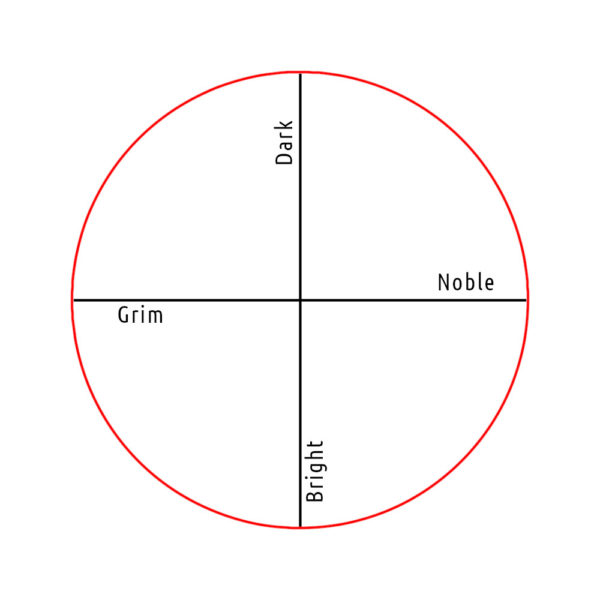
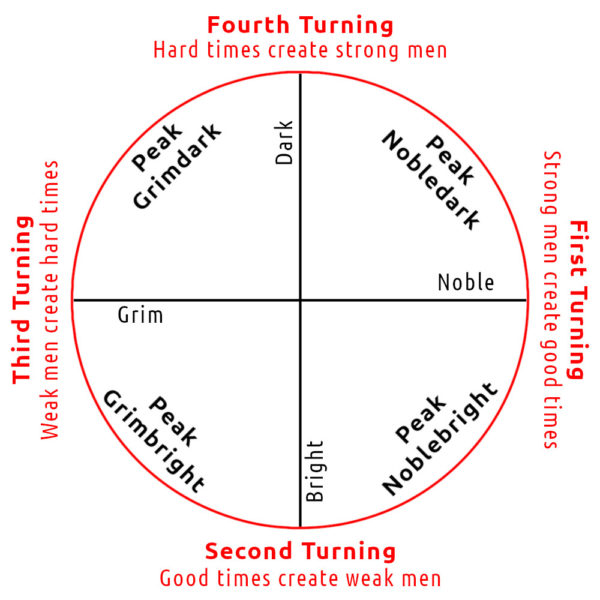
To start, we need to understand the difference between grimdark and noblebright. Both forms of fantasy exist on a field with two axes: noble vs. grim and bright vs. dark.

The bright vs. dark axis describes whether the fantasy takes place in a world where good usually triumphs over evil (bright), or a world where evil usually triumphs over good (dark).

The noble vs. grim axis describes whether the characters have the power to change the world (noble), or whether they do not (grim).

Thus, with these two axes, we get the following combinations:

  • Noblebright: A fantasy world where good usually triumphs over evil and the characters have the power to save it.
  • Grimbright: A fantasy world where good usually triumphs over evil, but the characters aren’t on a quest to save it and are usually preoccupied with smaller concerns.
  • Grimdark: A fantasy world full of moral shades of gray, where evil usually triumphs over good and the characters are either anti-heroes or otherwise fail to save the world.
  • Nobledark: A fantasy world where evil usually triumphs over good, but the characters are empowered to change it.

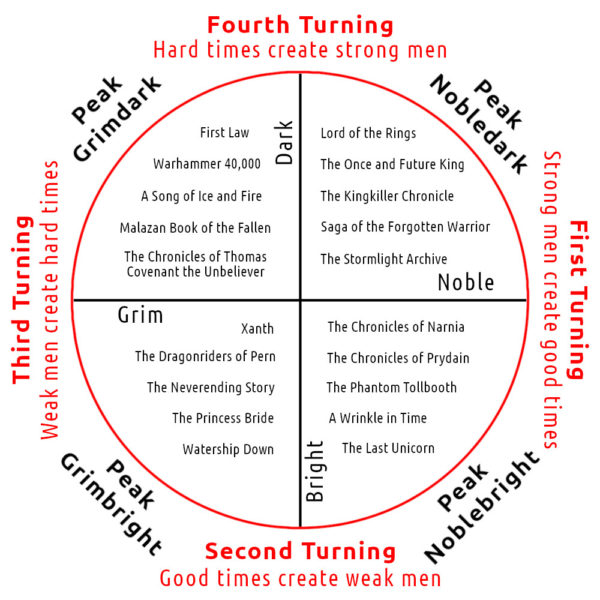
These categories are subjective to some degree, and fans will often disagree about which category to put each book/series. However, I think that most fans will agree on the following examples:

  • Noblebright: The Chronicles of Narnia by C.S. Lewis
  • Grimbright: The Princess Bride by William Goldman
  • Grimdark: A Song of Ice and Fire by George R.R. Martin
  • Nobledark: Lord of the Rings by J.R.R. Tolkien

Next, let’s review in the broadest possible terms William Strauss and Neil Howe’s generational theory. To really understand their work, I highly recommend that you read The Fourth Turning. I have some criticisms of the finer nuances of that book, but their ideas are really excellent, and their predictions hold up surprisingly well three decades later.

If I had to boil their theory down to one simple, easy-to-understand statement, it would be this:

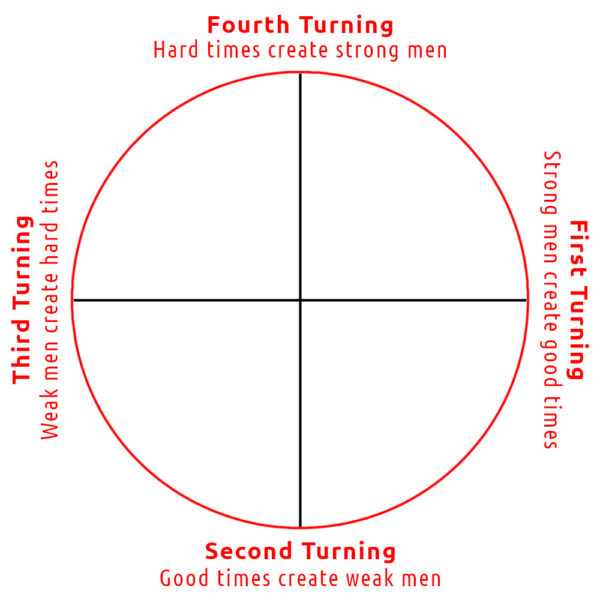
Strong men create good times.

Good times create weak men.

Weak men create hard times.

Hard times create strong men.

Thus, our society and culture passes through a secular cycle that takes about 80-100 years to complete (or in other words, the length of a long human life). The cycle has four seasons, or turnings, each one corresponding to a generational archetype (since it takes about 20-25 years for people born in the one turning to start having children of their own, thus moving us into the next generational turning).

The first turning happens when the society comes together after resolving a major crisis (eg the Revolutionary War, the Civil War, World War 2) and builds a new, stable order. The second turning happens when their kids rebel against that order, seeking freedom (eg the First and Second Great Awakenings, and the various counterculture movements of the 60s). The third turning happens when the order breaks down completely and everyone goes their own way (eg World War I, the Roaring Twenties, and the culture wars of the 90s). Finally, the fourth turning happens when the society faces a major existential crisis that totally reshapes it.

According to the theory, each axis of the grimdark/noblebright field corresponds to a different generational turning. Thus, stories that are noble have the most resonance in a first turning, stories that are bright have the most resonance in a second turning, grim stories resonate most in a third turning, and dark stories resonate most in a fourth turning.

In other words, the generation that comes of age during a major existential crisis will tend to gravitate more toward fantasy where evil typically triumphs over good, whereas the generation that comes of age during a period of rebuilding will tend to gravitate more toward fantasy where the characters have the power to change the world. And so on for bright and grim stories: the generation that comes of age during a spiritual awakening will gravitate more toward stories that take place in a world where good usually triumphs over evil, and the generation that comes of age in a declining and/or decadent society will gravitate more toward fantasy where the characters are relatively powerless.

Another way of thinking about it is to consider what each generation is not going to be drawn to, or which stories are not going to resonate well. An American who came of age in the 40s and 50s, when US power was on the rise and the Pax Americana was reshaping the world, isn’t going to resonate well with grim stories about powerless characters. Likewise, a boomer who came of age during the counterculture movements of the 60s and 70s isn’t going to resonate well with a dark fantasy world where evil usually triumphs, because (as much as they hate to admit it) they grew up in a very sheltered world that generally made sense—so much so, in fact, that they couldn’t help but rebel against it.

According to this theory, the next generational turning begins when one of the four forms of fantasy (noblebright, grimbright, grimdark, or nobledark) is at a peak. Over the course of the turning, that fantasy form declines until the next form in the cycle becomes ascendant, at which point the next generational turning begins.

Thus, at the start of a first turning, nobledark stories are typically ascendant, where the fantasy worlds are dark and morally gray, but the characters are empowered to save the world. As that generation successfully establishes a new order, the culture’s taste in fantasy shifts away from dark stories and toward noblebright stories, where the characters are still empowered but the world is more ordered and stable.

At the start of the spiritual awakening that characterizes a second turning, noblebright fantasy is ascendant: stories with an optimistic outlook on the world where the characters are larger than life. But as the awakening progresses, people in the society care more about freedom and individuality and less about the group, so stories about characters who sacrifice everything to save their world resonate less with them. Thus, by the end of the second turning, the ascendant form of fantasy is grimbright, which is really more of a slice-of-life fantasy about beloved characters having fun (but not world-altering) adventures.

At the start of a third turning, where the social order has started to break down and corruption begins to permeate all levels of the society, these grimbright stories start to take a darker tone. Readers find it too “unrealistic” to believe that good always triumphs over evil, and they certainly do not believe that good people have the power to change the world—at least, not the “smells like teen spirit” world that they inhabit. Their tastes shift away from the fun, adventurous slice-of-life of grimbright, and toward the dark and gritty anti-heroes of grimdark.

Finally, at the start of the fourth turning, grimdark is ascendant, but readers are starting to lose patience with it. As each new crisis in the real world compounds with all the others, they find it unbearable to read about characters that don’t have the power to change the fantasy worlds they inhabit. At the height of the fourth turning, society reaches an existential breaking point where, in the words of Strauss and Howe, “all of [our] lesser problems will combine into one giant problem, [and] the very survival of the society will feel at stake.” (The Fourth Turning, p277) At this point, readers are ravenous for books about characters who are empowered to fight back against the tides of evil and darkness. Grimdark fantasy declines and nobledark fantasy ascends.

I haven’t read all of the series in the diagram above, but I do have a pretty good sense of most of them, and I put the diagram together with the help of my mastermind group. The key thing about it is that each fantasy series came out in roughly the generational turning that corresponds with each quadrant.

Now, it’s worth pointing out that these trends aren’t absolute. In each of the secular seasons, you can find examples of contemporary fantasy that runs counter to trend. For example, David Gemmell’s Drenai Saga came out in the 80s, at the start of the last third turning when grimbright should have been ascendant, and yet the Drenai Saga is solidly nobledark. Terry Pratchett’s Discworld books had their heyday in the 90s, 00s, and arguably 10s, but they probably fall into grimbright (though you could make the argument that, as absurdist fantasy, they are more similar to grimdark: stories where good and evil really doesn’t matter, and the characters are just doing their best to go along).

But the theory doesn’t state that each fantasy form’s antithesis dies completely when that form is ascendant: only that it reaches a nadir of decline in its resonance with the culture. But without sufficient contrast, the ascendant form cannot stand out. Thus, there still has to be some noblebright Paolini to provide sufficient contrast with the grimdark of Abercrombie and Martin, some low fantasy slice-of-life Legends and Lattes grimbright to make the epic nobledark high fantasy of Sanderson stand out stronger.

According to this theory, as we continue to muddle our way through this present fourth turning, the decline of grimdark fantasy will accelerate, and the bestselling fantasy books of the 2020s will mostly be nobledark. And indeed, we can already see that happening with the meteoric rise of Brandon Sanderson (especially his Stormlight Archive series), the popular enthusiasm surrounding Larry Correia (whose Saga of the Forgotten Warrior falls squarely into nobledark), and the enduring anticipation of Patrick Rothfuss’s fans for the conclusion to the Kingkiller Chronicle. Meanwhile, enthusiasm for George R.R. Martin has waned significantly with the train wreck of Game of Thrones, and Abercrombie, though still quite popular, seems to be testing the nobledark waters with his YA books.

It would really be interesting to do a deep dive on the generational archetypes and make a study of how that affects the fantasy forms that run counter to the cycle. But that’s beyond the scope of this blog post, and frankly I need to get back to writing my own books. But what do you think of this theory? Does it resonate with you, or is there something that we missed?