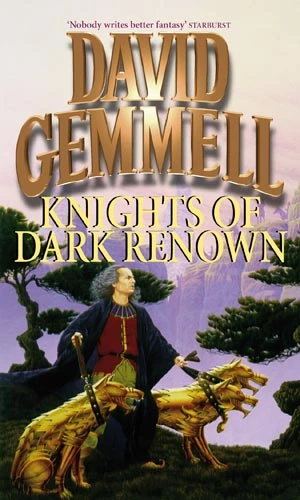
When David Gemmell, my favorite fantasy author, broke into the field in the 1980s, his books were considered to be part of the “heroic fantasy” subgenre. If the two major divisions of fantasy were epic fantasy (sometimes also known as “high fantasy”) and sword & sorcery (sometimes known as “low fantasy”), heroic fantasy was very much in the sword & sorcery vein. Then the stars of George R.R. Martin and Joe Abercrombie began to rise, and heroic fantasy gave way to what we now know as “grimdark.”
On a superficial level, both grimdark and heroic fantasy appear to have much in common. Both subgenres tend to feature morally gray characters, worlds that are dark and brutal, and a great deal of graphic violence. George R.R. Martin is famous for killing off his characters, and David Gemmell likewise tends to kill off about half of his starting characters in every book.
But if you spend enough time with both subgenres to get past the superficialities, you’ll see that they are totally different—and in some key ways, diametrically opposed. Not all grimdark descends into total nihilism, but much of it unfortunately does. But heroic fantasy is defined by the fact that it is not utterly nihilistic. Which isn’t to say that all heroes are noble and bright—gray morality is still very much a trope of the subgenre—but the very fact that heroes exist is enough to keep heroic fantasy from delving too deep into nihilism.
This is why I love practically everything that David Gemmell has written, but I couldn’t get past the first book in George R.R. Martin’s Song of Ice and Fire. I acknowledge that Martin is a brilliant and gifted writer. There were parts of A Game of Thrones where I felt more immersed in Martin’s fantasy world than in almost any other book I’d read. But by the end of the book, I hated all of the characters and was rooting for Danaerys to come with her dragons and burn them all to cinders (which was apparently the plan all along, if season 8 of the show followed Martin’s outline).
The thing is, George R.R. Martin is obsessed with the idea of victimhood. All of the characters in A Song of Ice and Fire are either victims or victimizers, or both. That is, apparently, the most interesting aspect that Martin finds about them. Which explains why his series did so well in the 00s and the 10s, when intersectionality was on the rise and critical theory came to dominate so many aspects of our culture. In any other time, Martin’s obsession with victimhood would not have gained such a following—which explains why it took him nearly five decades to hit his big break.
But where Martin is obsessed with victimhood, Gemmell was obsessed with heroism. He had a penchant for taking the most despicable and morally bankrupt characters, putting them in circumstances that demanded something more of them, and showing them rise to the occasion, making a heel-face turn and becoming the hero that the story demanded. It’s so immensely satisfying for me, every single time. Even the villains will sometimes turn into heroes by the end—though when they don’t, you can always expect them to have creative and satisfying deaths. No “creative subversion” of reader expectations there!
For Gemmell, there’s nothing very complicated about being a hero. There’s no list of defining characteristics or attributes. There’s also nothing particularly complex that a character has to do. For Gemmell, a hero is simply a person who does something heroic. Nothing more, and nothing less.
At this point, I’d usually give examples, but since all of them are spoilers, all I can say is go and read David Gemmell’s books! Some of the best heel-face turns are in Winter Warriors and Hero in the Shadows. I also really loved the protagonist’s redemption in The Swords of Night and Day. And of course, if you really want a great example of an unlikely hero, read Morningstar. That’s basically the whole plot of the book.
Like Gemmell, I prefer to write stories with heroes rather than anti-heroes. My Sea Mage Cycle books are generally more light on violence than a typical Gemmell book, but in The Widow’s Child and The Winds of Desolation, I put the main characters into some tough circumstances that forced them to step up and play the part. Same with The Sword Keeper, my first fantasy novel. And of course, with the Soulbond King books that I’m currently writing, where the main character is patterned after King David, there will be lots of opportunities for him to do heroic things, even if he is a more complicated character.
Heroes are so important to me that I honestly cannot read any fantasy book that doesn’t have one. When I look back on all of the big-name fantasy books that I’ve DNFed, that honestly is the major defining factor. Fortunately, the fantasy genre is full of excellent heroes—and with the way trends are shifting, I think we are going to see a lot more of them soon.