Blogging vs. journal writing

So as you may have noticed, I generally blog a lot less nowadays than I did just a couple of years ago. That doesn’t mean I don’t blog at all, or that I don’t value keeping a blog, but it’s just not something I do as frequently as I used to. I’ve been wondering why that is—about what changed to make me blog less frequently. And I think I’ve found the answer.

Last year, one of my new year’s resolutions was to keep a detailed weekly personal journal. All of my other 2014 resolutions eventually fell by the wayside, but that was the one that I actually accomplished. In fact, towards the end of the year, I switched from keeping a weekly journal to keeping an almost daily journal. By December, I had written 169,000 words—more than four hundred pages—about the personal events in my life for the year 2014 alone.

I’ve been a journal writer ever since elementary school, but when I started this blog back in 2007, I kind of took a break from that. My reasoning at the time was that my blog was my journal, and while I recognized that there were some parts of my life that I wanted to keep private, I figured that those just weren’t worth writing about.

After living and studying in Jordan for a summer, I realized that there was value in keeping a private journal in addition to my blog, and I started up another one. But I kept it fairly infrequently, sometimes with months going by between journal entries. In 2012 when I went to Georgia, I had a lot more things happening in my life to write about (and a lot less access to the internet), so I kept it much more regularly. But then I came back to the States, and life fell back into a monotonous routine.

The thing that changed in 2014 was the realization that I wasn’t just keeping a journal for myself, but that I was keeping it for my children, grandchildren, and others who would come after. When I was a teenager, journal writing was an act of self-discovery, and for that reason it was much more private. As an adult, though, I already have a pretty firm sense of who I am, so the self-discovery is much less important. Keeping a personal historical record, though, both for myself and for my family, is much more important to me.

Even though I’m not just keeping a journal for myself anymore, there is still a lot of sensitive information in there that really shouldn’t be available for public consumption at the present time. That’s especially true now that my blog is less of a personal project than it was when I started it. Now that I’m a professional writer, I’m a lot more careful about what I post here. I still try to be honest and genuine, but I’m probably not going to blog about, say, my romantic relationships or personal spiritual experiences.

It’s weird, though, because the roles are now reversed. Back in 2007, I felt free to blog about anything but didn’t know what to write about in my journal. Now, I know exactly what sorts of things to write about in my journal (I’ve already up to 42,000 words for this year) but have no idea what to write for my blog. And that’s the main reason why I haven’t been posting quite as much.

So for those of you who do keep up with this blog, what sorts of things do you want to hear about? I’m happy to post weekly updates on my writing, though I’m worried it might get tedious after a while (contrary to popular belief, writing is one of the most boring professions on the planet). Do you want to hear more of my thoughts on current and political events? More reflections on life as an indie author? More insights about the worlds and characters in my books? More tvtropes?

This blog is not going anywhere, so don’t worry about that. But it’s going to change as I figure out exactly what I want to use it for.

Things I want to learn in 2015

I was going to follow up my retrospective 2014 post with another one, but instead I want to look ahead at the things I hope to learn in 2015. Of course, I’m sure that many of the things I’ll learn are things that I couldn’t have foreseen, but it helps to have some direction to start out with. Here goes!

How to consistently sell books outside of Amazon

If I learn nothing else this year, I want it to be this. In 2014, about 90% of my sales were through Amazon, and when they came out with their Kindle Unlimited subscription service, my income took a big hit (Amazon requires all books in KU to be exclusive, so none of my books qualified). If I can grow my non-Amazon sources of income to more than 50% of my total revenue, that would be fantastic.

So far this year, I’m off to a good start. I have a book featured in Apple’s ongoing First in a Series Free promotion, and that’s given my books on iBooks a huge boost. In fact, I wouldn’t be surprised if I sell more books on iBooks this month than I will on Amazon. But the key here is to sell consistently on the other platforms. Right now, I have no idea how to do that—but I definitely want to learn!

How to turn readers into lifelong fans

I’ve been publishing for the last four years now, and I’ve picked up a few fans along the way, but I get the sense that most of the people who read my books are just casual readers who find my books interesting but tend to move on after they’ve read them. Perhaps this is normal, but I would like to take things a step further and build a strong fanbase around my books.

Up until now, I’ve mostly focused on writing books, not in connecting with the people who actually read them. But I want to do a lot more of that next year—not only in order to sell more books, but also to connect with the fan community in general and make a more lasting contribution to the genre.

How to write (harder) better faster (stronger)

If I could write 10,000 words a day—good words, publishable words—that would absolutely fantastic. So far, the most I’ve managed in a single day is about 5,000. Right now, I’m lucky if I hit 2,000. It’s aggravating, because I feel like I’m so ridiculously slow, and the stuff that I do write usually needs some cleaning up before it’s publishable … basically, I just want to be a robot unicorn who farts rainbows and writes a bestselling novel every 72 hours.

Barring that, I’d just like to learn how to overcome some of the things that get in the way of writing.

How to write memorable characters that readers fall in love with

Of all the areas of craft that I’d like to work on, this is the one that probably needs improvement the most. I’ve had lots of readers tell me that a particular story resonated with them, but I’ve never had a reader tell me that they were crazy about a particular character. I think I’m reasonably good at writing characters that are complex and three-dimensional, but that’s a separate thing from writing a character that readers fall in love with.

I think I’ll stop here for now. There are other things that I’m sure will be good to learn, but these are the ones I especially want to learn in 2015.

Things I learned in 2014 (Part 1)

Last week, Kris Rusch wrote an interesting blog post reflecting on 2014 and things she observed that indie writers learned, so I thought I’d do something similar and reflect on some of the things that I learned last year about the business and the craft. Here goes!

Readers of SF&F want longer books.

I did a lengthy blog post about this earlier, but the basic gist of it is that readers in my genre want longer, more immersive books. There’s a place for the short stuff, especially for high concept sci-fi, but most readers of speculative fiction want worlds they can get lost in with characters that become their best friends. It’s practically impossible to do that in a story that takes less than an hour to read, so to satisfy those readers, you’ve got to write long.

You can’t have a healthy career with only one income stream.

Between 80% to 90% of my income in 2014 came from Amazon. Times were good in the spring and summer, but then Amazon launched their ebook subscription service (Kindle Unlimited). None of my books were enrolled in KU, but because of the way that Amazon skews the rankings to favor KU books, my Amazon royalties took a huge hit.

I knew back in 2011 when I started that I needed to cultivate multiple income streams if I wanted to have a steady career, but I’d gotten complacent. Since my Amazon earnings were paying all the bills, I figured I was doing all right. But you can’t measure the healthiness of a career in just the revenue it’s bringing in right now; you’ve got to look at contingencies for the future, including the worst case scenario.When most of your revenue comes from a single client, that makes your career far too brittle.

So looking to the future, I can’t say that I have a healthy, steady career until I’m earning at least as much from all my other income streams as I am from Amazon.

I’ve been relying far too much on Amazon’s algorithms.

Related to the last point, I learned that I’ve been relying far too much on Amazon to sell my books. In fact, I can say that the Amazon algorithms were the linchpin of my marketing strategy (inasmuch as I actually had one, heh).

Amazon has the best book recommendation engine in the industry by far. It’s done a lot for my career, connecting my books with many readers who have gone on to become fans. But what the algos give, the algos can take away. To build a career with staying power, you have to constantly work to find new readers in a variety of different ways.

I’ve always believed that cream rises to the top. That said, if you’re starting at the bottom of the ocean, you’ve got a long, long way to rise. Up until now, I’ve been operating under the belief that readers will find me without me making much of an effort to find them. I learned this year that you’ve got to meet in the middle. You don’t have to hand sell every book (thank goodness!), but you do have to make an effort to make your books visible somehow.

A well-articulated negative review does more to sell books than a blasé positive one.

This one surprised me. When I published Brothers in Exile (Sons of the Starfarers: Book I), it garnered a fairly painful two-star review on Amazon about a week or two after launch. The review had some positive things in it, but it also had some negative things that were pretty spot on. Being the angsty writer that I am, I thought my chances had tanked. Instead, sales of the book immediately shot up, and stayed fairly high for about a month.

Readers aren’t stupid. They understand that not everyone has the same tastes in books, and parse their reviews accordingly. A negative review that is articulate and well-reasoned will lend a lot more credibility and cultivate a lot more interest than a string of positive reviews that lack any real substance. It sounds counterproductive, but it’s often the negative reviews that sell the book.

Sometimes you actually can get the best results by doing it yourself.

When I redid the covers for the first three Gaia Nova novels, I decided at first to hire a cover designer. For various reasons, though, that didn’t work out, so I decided to do them myself. I’d done the typography myself on the old ones, and let’s just say they left something to be desired.

The reason I wanted to hire the work out was because I didn’t think I’d get the best work if I did it myself. I figured that if I hired someone who was an expert in it, it would turn out so much better. Instead, when I did it myself, I discovered that my own skills had improved to the point where I could produce really good work myself.

It is possible, especially in self-publishing, to become so skilled at every aspect of the production process that you can do it all yourself and still produce a quality book. The learning curve is so sheer that it’s practically a cliff, but you can do it. And even if the work that you produced at the start of your career wasn’t all that good, you can improve to the point where your work is on par with that of professional designers.

The trouble is, it takes so much time and effort to get to that point that you may be better off hiring the work out. It takes a certain type of personality to DIY everything and produce a quality product without feeling overstretched. I’m pretty sure that’s my personality type, though of course I still have a lot to learn. But just because it’s DIY doesn’t necessarily mean it’s going to be of an inferior quality.

There are other things I learned in 2014 about the craft and business of writing, but this post is starting to get long so I think I’ll table it for the next post. Take care!

Upcoming plans for 2015

I think my favorite time of the year is the week between Christmas and New Year’s. It’s a time for reflection, of looking at what you accomplished in the previous year and setting resolutions for the next one. In that spirit, here are some of the writing and publishing things I’d like to accomplish in 2015:

  • Publish at least six new books
  • Put out print editions of all of my books (except for short stories)
  • Get to the point where at least 50% of my book sales are outside of Amazon

I’ve got a lot of projects on the back burner, and I’m sure that I’ll start lots of new ones in the coming year, but these are the ones I really want to focus on in 2015:

Heart of the Nebula — This is one that I definitely want to release this year. It’s the fourth novel in the Gaia Nova universe, a direct sequel to Bringing Stella Home, and I’m really, really excited about it. For the past month or so, I’ve been in “finish this damn book mode” (which is why I haven’t blogged much), but I’m set to finish it by the end of this week and send it out to my first readers. You can definitely expect to see this one soon.

Sons of the Starfarers — The main reason I haven’t released Friends in Command (Book IV) yet is because my first readers told me it has some serious issues, which need to be fixed by adding another viewpoint character. It shouldn’t be too hard to do that, but before I do a major revision I always try to take a month or two off to work on other things so that I can come at the project with new eyes. I’ll pick up Friends in Command in January, and write the next one, Captives in Obscurity (Book V) immediately after.

Will I finish this series in 2015? I honestly don’t know. The books started as novellas, but each one has been a little longer than the last one, so by the end they’ll all probably end up as full novels. I could probably still do it if this was the only series I worked on all year, but I don’t want to limit myself in that way. Definitely, though, you can expect to see at least the next three books before the end of 2015.

The Sword Keeper — This unfinished fantasy novel has been sitting on my hard drive for about two years, and it’s time that I buckled down and put it out there. I tried to finish it last summer, and the main obstacle was that I had to do some serious world building. For a speculative fiction writer, that should be easy, right? Well … I’m kind of weird in that I tend to do most of my world building from the seat of my pants. But now that I’ve figured out what the holdup was, it shouldn’t be too hard to fix.

These are all books that I want to release before the end of 2015. I’m sure there will be others—perhaps even for story ideas that I haven’t come up with yet. It will be exciting to see how the year turns out!

The next big dream

When I graduated from college, my goal for my writing career was this: to make a living telling stories that I love. It seemed, at the time, like an impossible dream–something so far out of my reach that I couldn’t possibly achieve it without years and years of constantly frustrated effort.

Well, guess what? For the past six months or so, I’ve more or less been doing it. I live below the poverty line in a basement with two other guys, and I have to donate plasma to cover the difference in my expenses each month, but writing is my main gig and I’m making enough to pay all my bills with it. Barely.

There’s more to life than making a living, though, even doing something that you love. My current month-to-month lifestyle isn’t particularly well suited for anything except, well, living month-to-month. So I need to make some changes, and to do that, I first need to dream a little bigger:

A really good dream should be–or at least seem to be–a little bit impossible. That way, you don’t have to worry about achieving it too soon. At the same time, it shouldn’t be too impossible. If you can’t see myself ever achieving it, then what’s the point?

For example, one of my bucket list goals is to look down on this planet from space. With the awesome advances in spaceflight that companies like SpaceX and Virgin Galactic are making right now, I can totally see that happening in my lifetime. But setting foot on an alien world? Nah, I don’t think that’s in the cards for me.

(Then again, if we figure out how to live forever, maybe it could actually happen. Even just adding another 50 or 100 years to my life would probably let me live to see a permanent base on the Moon or Mars. So maybe impossible is actually better–I don’t know.)

A friend of mine is building a business that he hopes will one day make him a cool seven figures. His mom makes six figures, but her name is also on six mortgages, so she’s pretty much tied to her job. One of his big dreams is to pay off all those mortgages for her so that she can retire.

When that happens, he’s going to celebrate by getting a bunch of friends together on a road trip to Texas. We’ll take a big refrigerated meat truck down there and go wild boar hunting until it’s packed full of pork. Then we’ll come back to Utah and have the mother of all barbecues. 😀

That’s the kind of dream I need to shoot for: something specific and personal that sounds kind of crazy but is still just barely within reach. In other words, it should be something that’ll make a good story when I finally achieve it. Or maybe I won’t achieve it–maybe the dream itself be so awesome that just the act of striving for it will make all the difference. As David Gemmell once wrote:

May all your dreams come true save one, for what is life without a dream?

It’s going to take more than one blog post to figure this whole dream thing out, so I’ll just leave that here for now. It’s definitely going to be on my mind for the next little while. If you have any impossible dreams of your own, please do share!

How going indie is like driving a manual (plus a cover reveal)

A couple of weeks ago, I got a new (to me) car. It’s a 2005 Ford Focus / Saleen: a two-door hatchback that drives like a racing car and gets about thirty miles per gallon (WA-A-AY better than the gas guzzler I was driving before). It’s also a manual transmission, which is perhaps the biggest difference between this and my previous car.

This is my first time driving stick shift, and I have to say, it is a lot of fun! When you drive a stick, each hand and each foot is doing something different. There’s a lot more to keep track of, and if you do things in the wrong order (like braking without engaging the clutch, or starting without giving it some gas), you run the risk of making the car stall or doing nasty things to your transmission. On the other hand, driving a manual gives you a much better feel for the engine and what it’s capable of. You can feel when you’re putting too much stress on it–or alternately, when you can push it a little further.

I usually like to walk everywhere, but ever since I got this car, I just want to drive it! It’s way more fun than driving an automatic, even with (or indeed, because of) the extra challenge. So today, while I was walking to BYU campus (alas, the parking situation there makes driving a major pain), I got to thinking about it, and I realized that driving a manual is a lot like being an indie author.

When you’re an indie, you have a lot more things to juggle, just like driving a manual. This gives you much greater control of your career, but it also makes it easier to stall or screw up. At the same time, because of that extra control, you’ve got a much better feel for the market, and probably a better connection with your readers. And for me at least, the extra challenge doesn’t make it less enjoyable, it actually makes me enjoy it more!

Nothing Found

This week, I had the first day where I sold 100+ books in a 24 hour period. That was pretty awesome! I’ve been running a $.99 sale for Star Wanderers: The Jeremiah Chronicles (Omnibus I-IV), and it got picked up by a couple of ebook sites that really pushed it in the right way. Now that I know how to run a sale like that, I hope to do it again, perhaps for Black Friday. And if you haven’t picked up this one yet, it’s on sale for $.99 through Friday.

Marketing and promotion is one of the harder parts about going indie for me, kind of like how finding the clutch point and starting without stalling is hard when you first drive a manual. The more that I practice, though, the better that I get at it, and the more I enjoy it.

Another area where I think I’ve more or less stalled is in my covers. When I put out the first few Gaia Nova novels, I spent a fair amount of money hiring out artists to do the illustrations, but I did the typography myself. On those earlier covers, it definitely shows. For my later books, I worked with a bunch of cover designers, and seeing their work made me realize that there’s definitely room for improvement on those earlier ones, especially for the print editions.

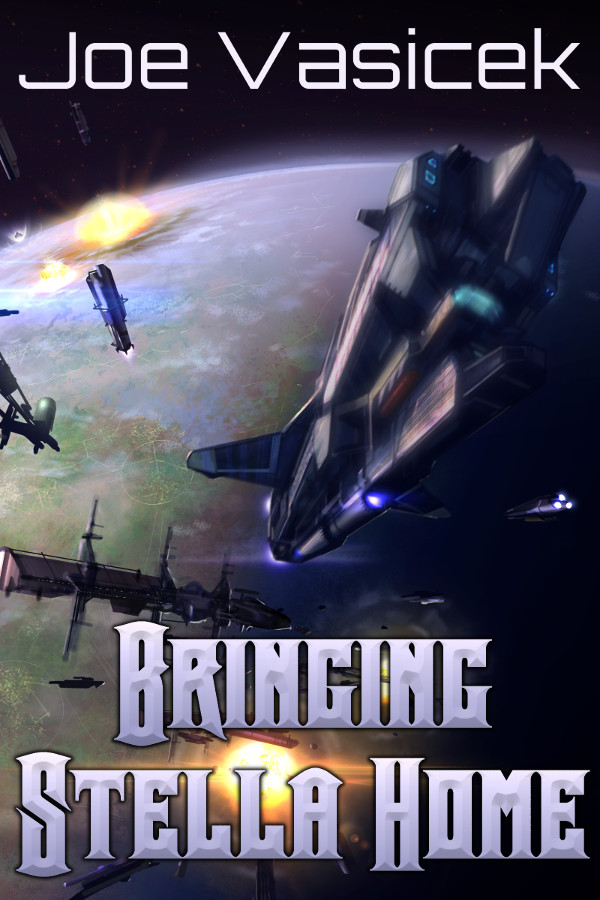
I’ve decided to redo the covers for those three novels (Bringing Stella Home, Desert Stars, and Stars of Blood and Glory), keeping the illustrations but changing the typography. I tried to find a cover designer to do it, but I wasn’t able to find one that did satisfactory work, and after playing around with them for a bit I think I can actually do them myself. I’ve got a lot more experience with covers and cover design now than I did when I was starting out, and I’ve learned a few photoshop tricks as well.

In any case, here is what I came up with for Bringing Stella Home:

BSH (cover)How do you like it? I rather like how it turned out, though I’ll admit I’m still learning. I did the new design just this morning, so I figure I ought to wait a couple of days and maybe seek out some feedback from professional designers before I go through with it.

I hope to have the new edition out before the end of the month. The content and story will all be the same, but the cover and metadata will be updated, and some minor errors such as typos will be fixed. I also hope to do the same thing with Desert Stars and Stars of Blood and Glory. Once the new editions are out, I’ll probably run some sales and giveaways with them, so definitely stay tuned!

As for my other projects, the next book in the Sons of the Starfarers series is out with my first readers, so it’s on track for a January release. My next WIP is The Sword Keeper, a fantasy novel I think I’ve mentioned before, and I hope to get that one knocked out in about a month or so. It’s already halfway finished, so the hard part is just ahead. There are also a couple of Gaia Nova novels that I’ve been meaning to get around to, and probably will before the end of the year.

That just about does it. Look out for more covers soon! I’m definitely having fun with the new ones. 😀

STRANGERS IN FLIGHT coming out soon! (and other updates)

SSF-III (thumb)So, I have great news! Sons of the Starfarers, Book III: Strangers in Flight will be coming out in just a couple of days. Everything is squared away for the release–all I need to do is finish approving the edits, write a teaser for the next book, and put the ebook together!

This will probably be the last time that I publish a book without putting it on pre-order first. From now on, I want to have the next book out on pre-order before the last one is released, so that my readers can pre-order the next book while it’s still fresh in their minds. Also, this will give each book a firm release date, so that readers know when the next book is going to come out.

Until now, there’s been no advantage in holding a book until it’s ready to be published. Smashwords and the iBookstore started allowing pre-orders about a year ago, but since most of my sales are on Amazon at this point, I held off from taking advantage of that option. Perhaps that was a mistake.

In any case, now that Amazon allows pre-orders, I plan to retool my publishing process in order to make that a part of how I do things. However, since I’m still writing Book IV: Friends in Command, that means that it probably won’t be until Christmas when that book comes out. I don’t want to upload anything less than a finished product for pre-order, so I need to build up a queue in order to get things going.

However, the first Sons of the Starfarers omnibus should be available for pre-order in just a couple of weeks. All I really need is the cover, and my cover designer is already working on it. So if you haven’t bought the first book yet, or don’t mind waiting until October, the omnibus should be a few bucks cheaper than buying all three books individually.

In other news, I’m back in Utah, getting into the swing of things after a lengthy family vacation. I’ve got a bunch of short stories on submission now, which should be interesting if/when they get picked up by the magazines, but that’s more of a long-term thing (and besides, I still have a lot to learn when it comes to writing short stories–it’s much harder in some ways than writing novels!). There’s a couple of other side projects that I have simmering on the back burner, but right now, Sons of the Starfarers is definitely taking most of my focus.

That just about does it for now. I’ve got some chili cooking on the stove, so I’d better get back to that and then finish those edits. Later!

KDP now allows pre-orders!

So I got an email recently from Amazon Publishing, about how they now allow indie writers to do pre-orders! That means that I can upload a book on Amazon 90 days before its publication date, and it will have its own page and everything.

Honestly, I’m not sure how I’ll use this new tool, because I tend to publish things as soon as they’re finished. I don’t want to upload anything except a finished product for pre-order, on the off-chance that something comes up and I can’t have it ready in time. However, since I already have ongoing series (such as Sons of the Starfarers) where people are waiting for the next book, I want to put those books up as soon as they’re finished.

It’s a marketing tool that I’ll have to learn and experiment with. Right now, the biggest value I see is in launching new series, so that people who buy book 1 can immediately pre-order the next couple of books right after finishing the first one. Of course, that means I actually need to write the first few books before publishing the first one, but that’s probably a good idea anyway.

What I’ll probably do is arrange my publishing schedule so that I’m publishing books not as soon as they’re finished, but between 30-60 days after. The pre-orders will give me a buffer and allow me to release the books on the same day across every retail channel. It will help to keep things organized and create more consistency, so that you all know what to expect.

In the short term, though, that means I need to write a lot more in order to create this buffer and have books lined up for regular releases. In other words, I need to get to work!

Q is for Quitting the Day Job (or never having one to begin with)

Writing is one of those gigs where everyone expects you to have a day job, since common wisdom says that writers don’t make money. In traditional publishing, that may be generally true, but self-publishing is an entirely different game. It isn’t necessarily easy to make a living as an indie writer, but it is possible–much more possible than it is in the traditional industry.

I can’t speak authoritatively on when it’s right to quit the day job because I never really had one. I graduated in 2010, during the height of the “jobless recovery”–the soporific catchphrase invented by Washington policy wonks to describe the weird phenomenon where GDP was improving but unemployment was still in the crapper. For everyone outside of the Emerald City of Washington, we were still deep in the quagmire of the Great Recession.

I had just gotten back from an internship in the Emerald City that had severely disillusioned me to all things political. That rendered my degree in Political Science pretty much useless, and I found myself hitting the streets of Provo looking for something–anything–that would pay. I sold my body as a plasma donor, I sold my soul as a call center interviewer, and eventually I settled into that weird blend of mercenary prostitution that constitutes temp work. But even the temp jobs were scarce, and I found myself living from month to month, barely scraping enough to get by.

That’s when I learned about self-publishing. By this point, I already knew that I wanted to be a full-time writer. That was my plan A, and since it didn’t look like I’d ever land a steady day job, there was no plan B to fall back on. The stuff I was writing didn’t seem to be anything New York was interested in–not enough to pay a living wage, at least–so I jumped into self-publishing with both feet and never looked back.

When you first start out self-publishing, chances are that you’ll languish in obscurity for a while, barely selling enough books to make pizza money month to month. That was certainly the case with me. My economic situation wasn’t improving, so in 2012 I decided to go overseas and teach English in the Republic of Georgia.

GEORGIA | hyper – travel from Piotr Wancerz | Timelapse Media on Vimeo.

Besides temp work (which doesn’t really count), teaching English is the closest thing I’ve had to a day job. And while I loved the adventure of living in another country, the job itself wasn’t really all that fulfilling. It was really hard to balance writing with all the other stuff going on, even though the job took no more than 20 hours per week. It took up a lot of mental space, and that was enough to make writing really difficult.

So I came back to the States in 2013 and did my best to settle back in. Then, a weird thing started to happen. My books, which before had only earned pizza money, suddenly started earning grocery money. That soon grew to grocery and gas money, and before the end of the year, I was making rent money on top of that as well. My Star Wanderers books had started to take off, and even though they weren’t spectacular bestsellers, they pushed me up to the point where writing was my primary source of income.

Today it’s still touch and go, but I’m more or less making a living off of my books. I’m considering going overseas again, only this time, I’d live off of my royalties instead of getting an ESL job. Then again, there’s this girl I’ve been seeing, and she might keep me in this country for a while. If things work out, I have no idea how that would change things, but I imagine it would raise the making-a-living bar pretty substantially. With the way my book sales are growing, though, I’m confident that things will work out.

Back when I still planned on getting a day job, I thought that there would be some sort of magic threshold where, once I crossed it, I would make my entire living off of my writing career and would never work another job again. Instead, what I’ve found is that it’s more of a zone, where some (or perhaps even most) of your income is from book sales, but you still have to take on an occasional paying gig to make ends meet. There is no magic threshold at which you’ve “made it,” it’s more about just making it up as you go along.

All of this is made much, much easier by the fact that Amazon pays monthly royalties like clockwork. Barnes & Noble does too, and Smashwords and Kobo are also reliable, though a little less predictable as to when they’ll get their money to you (Smashwords seems to be holding onto my royalties until the end of this month, which is really annoying because usually they pay in the first week of each quarter). Since sales reports are instantaneous, I can look at how my books sold in March and know how much I’ll make in May.

It also helps that my earnings per book are significantly higher as an indie than they would be if I were signed with a traditional publisher. I don’t get an advance, but that’s okay because advances these days are pitiful anyway (seriously, $5,000 paid out over the course of two or three years? That’s less than I made as a volunteer ESL teacher in Georgia). And since I can publish as many books as I can write, I’ve been able to put out a lot more books as an indie, without the hassle of trying to run them past a committee of overworked editors in the bowels of some New York publishing house.

As for when it’s right to quit your day job, I have absolutely no idea because I never had one. But the fact that I (a nobody) am making it even without a day job says a lot. If you want to quit your day job and make a living as a writer, your chances of making it are a lot better if you take the indie route.

P is for Pricing

One of the most contentious issues among indie writers is how to price our books. With self-publishing, the decision is left up to the author, which can lead to some wacky rationales for pricing. Here are just a few of them:

My book is worth more than a cup of coffee.

This is clearly a rationale that is driven more by emotion than by reason, yet most of us fall into it when we first start out. I know I did. The idea that people would spend more for a cheap hamburger than for a novel that took me months of agony to write was a blow to my ego, one that took me a while to get over. But I’m glad that I did, because this reason is just silly.

Books are so different from hamburgers or ice creams or lattes that comparing them is like comparing apples to oranges–no, like comparing apples to transistor radios. So what if people are willing to spend more for cheap fast food than for your awesome, amazing, life-changing book? That fact is irrelevant, because the two are not analogous. The quicker you can learn to suck it up and disconnect your prices from your ego, the sooner you’ll learn to treat your writing like a career.

I have to price my books low because I’m a new, unknown writer.

This is another rationale you may be tempted to fall into when you’re first starting out. It grows directly out of impostor syndrome–the fear that you’re really just faking it as an author, and that someone is going to call you out on it if you don’t first.

This also comes more from the emotional side than the reasonable side. Believe it or not, there are readers who have never heard of Stephen King, or James Patterson, or J.K. Rowling, or Brandon Sanderson. Tracy Hickman is fond of pointing out that there are whole provinces in China where no one has ever heard his name. Everyone is an unknown to someone, but that doesn’t mean that your fans will love your books any less–or not be willing to pay any more for them.

For most readers, I think price is just one factor of many, and not nearly as crucial a factor as we might think. When I released my first Star Wanderers omnibus, I priced it at $4.99 while the other parts were at $2.99, and priced myself for the fall in revenue as readers abandoned the individual parts for the omnibus. Instead, both the omnibus and the parts sold about equally, even though the omnibus was clearly a better deal. I have no idea why that was, but it told me that not every reader pinches pennies, at least at price points under $5.

If I price my books too low, I will devalue my work.

This rationale grows out of the idea that sometimes, people are more willing to buy something that costs more because the perceived value is higher. Starbucks does this with coffee, and Apple does this with their devices. The idea is that consumers are conditioned to attach a product’s value to its price, or at least to correlate the two.

I used to believe this, but I don’t anymore. Instead, I think this is the kind of thing that authors want to be true, but they want it so badly that they blind themselves to how things actually are. I recently dropped my prices across the board, and I not only found that my sales increased, but that my overall revenue increased as well. In my experience, readers attach value much more to things like blurbs, samples, and cover art than they do to price, and that “devaluing” your work is a great way to hook more readers with a great deal. In fact, I now believe that the best price is the one at which other writers scream at you to stop devaluing your work.

I need to price my book high enough so that I’m earning at least minimum wage.

Books earnings don’t work like wage earnings at all, and confusing the two will cause even more problems than confusing your book with a cup of coffee. Seriously.

Writing isn’t about getting paid for putting in your time, it’s about getting paid for the value that you create. If you create something that the market deems has value, it becomes an income stream that will continue to pay you for years, perhaps even decades. With a wage job, on the other hand, all you get is a paycheck.

The two paradigms are so dissimilar that I don’t even know where to begin in explaining how stupid it is to compare indie writing to a wage job. When you are a self-published writer, you are not an employee–you are the boss. You don’t merely have a job–you own a business. Your earnings don’t come from payroll, they come from revenue. At a certain point, higher prices lead to lower revenue, and sometimes that point puts you below minimum wage. It sounds tough, but that’s just how the market works.

You’re not entitled to a living wage just because you wrote a book. Write more books, write better books, and keep on publishing them until your revenue does exceed minimum wage. Pretty soon, you’ll be shocked to find that you’re still getting paid for work that you did years ago, and still making money even when you take a day, or a week, or a month off. I know that I certainly am.

There are other weird and wacky rationales for book pricing, but those are the biggest ones that come to mind. As for rationales that actually make sense, I can think of only two:

  1. I want to maximize my revenue with my current books.
  2. I want to build a following for my future books.

Once you’ve figured out which one you want to follow, the only rational way to figure out what prices work the best is to experiment with them, even if the experiments make you cringe. You have to be data driven, and not emotionally driven, if you want to find the sweet spot.

For the past few months, I have been experimenting with the prices of my science fiction books, collecting the weekly data from Amazon and watching the trends. Here is what I’ve found:

Perma-free — The best price for attracting new readers, but only if the free book leads directly to another book, such as the next book in the series. This is also the easiest and most effective price point to promote.

$.99 — The best price for building an audience, and the most effective way to create a sales funnel in conjunction with a perma-free book. When I dropped the prices of my Star Wanderers stories to $.99 from $2.99, I saw a marked increase in the percent of readers who went on to buy Part II after buying Part I. I also saw an increase in positive reviews, both on Amazon and Goodreads.

$1.99 — A dead zone. It really is. This price point has all of the drawbacks of $.99 and $2.99, with none of the benefits. When I briefly priced my Star Wanderers books at this price point, sales AND revenue fell below what they were at $.99.

$2.99-$3.99 — The best price points for maximizing revenue, at least in science fiction. At $2.99, you jump from the 35%-40% revenue rate to the much more lucrative 65%-70% rate. And even though $3.99 might seem low, I’ve generally found that I sell enough copies at that price point to more than make up the difference from the increased earnings per sale (but lower sales) at a higher price point.

That said, when the Star Wanderers books were all $2.99, they didn’t sell nearly as well, even with the first book in the series perma-free. And the fall in revenue when I dropped the price to $.99 was not nearly as dramatic as I had expected. Instead of falling to 1/6th of what it had been at $2.99, it fell to more like half, due mostly to increased sales of the omnibuses, which stayed up at $3.99.

$4.99 — I’m not sure what I think of this price point. I priced my Gaia Nova books at $4.95 for years, and never saw many sales come from it. Then again, those books have yet to really take off, so I can’t say with any authority that this price point is really bad. However, I will probably avoid it in the future, except possibly for omnibus works.

$5.99 — Again, I can’t really say that this point is dead, but I can say that my sales were much more sporadic here than they were at $3.99. At best, though, I’d generally earn as much revenue per week at this point as I would at $3.99. At worst, I’d earn nothing.

I can’t say anything about the higher price points because I haven’t experimented with them. As for print books, I don’t sell enough to really be able to say. Again, this is only for science fiction–pricing varies widely from genre to genre, so what works for what I write may not work for what you write. Even within science fiction, I’m sure there are some differences.

At the end of the day, though, I think it’s important to recognize that pricing is an important part of the author-reader relationship. You don’t want your readers to feel like they’re getting screwed–you want them to feel like they’re getting a good deal. For a long time, I think I priced my Star Wanderers books a bit too high, and generated a bit of ill-will among readers for it. Even though I want to earn a living, I hate it when price becomes an obstacle to readers enjoying my books.

As David Gaughran put so astutely in one of his recent posts, value is something that readers attach to a book, whereas price is something that we as self-publishers attach to it. If the price is lower than the value, readers will be satisfied enough to keep coming back for more–and that right there is the key to building a career.