J is for the Joys of Self-Publishing

Brandon Sanderson teaches an English class at Brigham Young University, and I was one of his students back in 2008 and 2009. At LTUE this year, he asked me to come in and speak to his class about what it’s like to be an indie writer, so I prepared a short ten minute presentation on the things that I love the most about self-publishing. They are:

1. I have complete creative freedom.

As an indie, I don’t have to worry about agents, editors, marketing departments, interns, or anyone else who could kill my project before it has a chance to get out into the world. If I can write it, I can publish it. If I want to write something crazy like a story about Amish vampires in space, or steampunk Mormon airships, or orcs falling in love on the battlefield, I can do it without having to worry whether it will ever find a home outside my hard drive.

Of course, if I write stuff that’s more niche, chances are that it’s only going to find a niche audience. But that’s okay, because:

2. I don’t have to be a bestseller to find success.

With the way that the royalty numbers for indies work out, I don’t have to be a mega blockbuster bestseller to have a viable career. In fact, all I really need is to sell a thousand or so books per month–which seems like a lot until you realize that there are 1.4 billion English speakers in the world (over 300 million of whom are native). Plus, if I have thirty or forty books out, I can make a comfortable living selling no more than double digits on each one.

It’s the thousand true fans principle at work, and for indie writers, it really does work. I only started self-publishing three years ago, and I’m already making enough to keep my head above water. And to everyone except my small handful of fans (who don’t even come close to a thousand), I’m just another nobody.

3. I have the flexibility to reinvent myself and try new things.

As an indie, I’m not locked down by any contracts that I can’t get out of. That gives me a great deal of flexibility in how I can run my career. If I wanted to unpublish everything and start over under a different name, I could do that. If I wanted to try out a new genre, or dabble in something experimental like serials, I could do that. At any time, I can completely remake myself however I want.

That flexibility is crucial because of how quickly the market is changing. Publishers are consolidating and going bankrupt, bookstore chains are struggling, and new technologies and business models are opening the doors to all sorts of new opportunities. As an indie, I’m in a great position to take advantage of them.

4. I can connect directly with my readers and fans.

Not just in the sense of connecting through social media, but connecting through my books as well. If my fans are clamoring for a sequel, I can write it and get it out to them while it’s still fresh in their minds. If they have trouble finding my books somewhere, I can clear the problem up myself without getting tied up in the bureaucracy of a large publisher.

The two most important people in the book world are writers and readers. As an indie, I can make sure that no one comes between my readers and me.

5. I’ve learned to treat my career like a small business.

A lot of writers view this as a downside, or at least a hassle they’d rather not deal with. They decide not to self-publish because all they really want to do is write. After all, isn’t it better to get someone else–an agent, for example–to handle the business side of things? Isn’t it better not to have to worry about all that stuff?

For me personally, the answer is a clear and resounding NO. The business stuff isn’t a hassle–it’s actually kind of fun! Plus, the fact that I know exactly where all the money is, how much I’m getting paid, and how much I owe gives me much more peace of mind than trusting all that stuff to an agent ever would. Far from taking away from my writing time, it’s actually given me more time since the only real person I have to deal with is myself.

Besides, freelancing is just AWESOME. I love being self-employed! True, my boss is a jerk and all of my coworkers are boring, but that’s okay because

6. I have no one to blame for my failures, but my successes are all my own.

This, more than anything else, is what I love the most about self-publishing. If my books flop, it’s on me. If they hit the top 100 lists for their subcategories and garner dozens of positive reviews, that’s on me too. I’ve had books that have done both–in fact, I’ve got a book right now that’s currently #263 Free in the Kindle Store.

Yes, there are a lot of ways that I can screw up as a self-published writer. But there are a lot of ways that I can succeed, too. Like everyone, I have to deal with the fear of failure, but I don’t have to worry about not getting the credit–or the reward–for my success. As an indie, it’s all on me, and that’s exactly the way I want it to be.

H is for Hybrid Author

Is it worth seeking traditional publication if you’re an indie writer? Are there advantages to going with a legacy publisher after you’ve published yourself?

A lot of writer throw around the word “hybrid” as if that’s their ultimate goal–the thing that’s going to make their career. A hybrid author is an author with their feet in both sides of the publishing world: the legacy world, with corporate publishers or small but reputable houses, and the indie world with their self-published books.

This might be a bit controversial, but I’m going to throw down the gauntlet and argue that most of the praise of the hybrid path is either hype or wishful thinking. From what I’ve seen, most hybrid authors fall into one of three camps:

  • Veteran authors who are disillusioned with the legacy industry and are doing everything they can to self-publish everything. They still have contracts that they can’t get out of, though, so technically they are considered ‘hybrid,’ even though many would rather not be.
  • Indie authors who haven’t been disillusioned about traditional publishing yet and believe that a legacy publisher would carry some of the burden for things like marketing and promotion. In other words, indies who believe that the grass is greener on the other side of the fence.
  • Unpublished writers who have been submitting to traditional publishers for years, and have deer-in-the-headlights syndrome with all the new publishing options available to writers. They’ll dabble with self-publishing, but their heart is still set in the old world.

So would I ever consider signing with a traditional publisher? I’ve thought about it quite a bit over the last few years, and I’ve come up with four conditions that have to be met before I’d do so. Please keep in mind, though, that I am not a contract lawyer, and that the following is my opinion and not legal advice.

Three of them are deal breakers on my side. They are:

1. Non-compete clauses

This is absolutely non-negotiable. In fact, if I see any sort of non-compete clause in a contract sent to me, I’ll pull out of negotiations altogether since it shows to me that the publisher is negotiating in bad faith.

A non-compete clause is a contract clause that says something like “the author shall not publish or cause to be published anything that may compete with the work.” Basically, it’s a publisher’s way of clamping down on you and saying you can’t publish anything without their approval. There is no f****** way I would ever tie myself up like that–not only would it kill the self-publishing side of my career, but it would also be unfair to my readers who have come to expect regular releases from me.

Let’s flip this on its head and say that I put in a non-compete clause for my publisher. For example, suppose I signed a contract with Tor Books that said “the publisher (Tor Books) shall not publish or cause to be published anything that may compete with the author’s work.” Can you see how ridiculous that is? How insanely one-sided it makes the contract out to be?

A publisher would never sign one, and neither will I.

2. Rights reversion clauses

If I’m going to sign a contract with a traditional publisher, I want to know when that contract is going to end. Life of copyright is life of the author plus 70 years, and that is far too long for me. But a lot of traditional publishing contracts contain loopholes that keep the rights from ever reverting back.

There are reasons why a publisher would want to hold onto your rights without actually publishing your book. Copyright is an intellectual property, and shows up on a corporate publisher’s ledger as an asset. Just by sitting on your rights, they’re able to show an accounting gain. So if they can hold onto your rights, they probably will.

I won’t sign a contract unless it includes an explicit date when the rights will revert to me. The length of the term and the options for renewal are open to negotiation, but having an explicit date is not.

3. Any payment terms based on net

Right now, the industry standard for ebooks is 25% of net. What does that mean? It means “we’ll pay you 25% of the revenue from your ebooks, after costs.” What costs, you may ask? There’s the rub–they aren’t specified.

“Net” is how Hollywood screws people over. It’s how a rockstar can go on a multi-million dollar tour and end up owing the record label money. It’s a dirty trick of creative accounting that the large corporate publishers are now starting to employ. In the old days, they used to base royalty payments off of the list price of the book. Now, though, New York is becoming more like Hollywood and less and less author friendly.

The fourth condition is a deal breaker for most publishers, on which I don’t see myself giving any ground. It is:

4. Ebook rights

Ebooks are where the money is. Legacy publishers understand this, and they’re doubling down on them. Hugh Howie, who signed a print-only deal with Simon & Schuster, has since said that the publishers are not open to considering that sort of deal now–not even for a massive bestseller like him.

The thing is, what value does a legacy publisher bring to epublishing? In less than an hour, I can craft an ebook that’s formatted better than most of the ebooks coming out of New York. As an indie, I have access to all the same online bookstores and distribution channels as the big publishers. And by self-publishing, I have control over the critically important metadata–a ball that legacy publishers often drop by relegating it to the lowest employees on the corporate ladder.

When it comes to ebooks, I do not see a single item of value that legacy publishers can bring to the table. Rather, I see a host of liabilities, and for what? With self-publishing, I can earn up to 70%-80% for every ebook I sell. With a publisher, I’d be lucky to get 15%–and that’s if they’re being generous.

For novels and other book-length works, it simply does not make sense to me to sign with a traditional publisher. Not in today’s industry, at least. And with the way legacy publishers are clamping down and making rights grabs, I don’t see it ever making sense in the foreseeable future either.

HOWEVER …

For short stories, the situation for authors is much more favorable. The magazines have no inclination to tie you up with non-compete clauses, the rights to the story revert back to you soon after publication, the payment is usually based on word count and specified in the contract, and the ebook rights stay with you (the magazine might purchase non-exclusive digital rights, but that won’t prevent you from republishing it as an ebook on your own).

I can see myself going hybrid by publishing short stories through the traditional markets. In fact, that’s exactly what I’m trying to do. Besides the chance to refine my craft by working on my short game, I figure that getting picked up by the major magazines will help to draw new readers to my other books. I have no idea how much it will help, but I figure it’s worth trying out. Besides, science fiction is a genre where reputation can make a big difference to your career, and you can build a reputation a lot more effectively through traditional short story markets than through self-publishing.

At the same time, though, that’s more of a side project than anything. My bread and butter is self-publishing, and that’s where my feet are firmly planted. I don’t see that changing anytime soon.

Experimenting with prices

So now that the last Star Wanderers novella is out and I’m hard at work on the next book, I’m thinking very seriously about experimenting with my prices. I haven’t done a lot of price experimentation, especially since writing became my main source of income about six months ago. I just recently landed a job to save up some money, though, so that gives me a little more space to try things out.

Right now, I’ve basically got three pricing tiers for ebooks: novels and omnibuses at $4.95, novellas at $2.99 (especially Star Wanderers), and short stories at $.99. My best sellers by far have been the Star Wanderers novellas. Now that Part VIII is out, though, I’ve noticed that fewer people who start the series are going through and finishing the whole thing. I’ve also got a fair amount of pushback in the reviews, saying that the $2.99 price for the novellas is too high.

The tricky thing is that at any lower price point, my royalties take a huge hit. At $2.99, I get a 70% royalty from Amazon and a 65% royalty from pretty much everywhere else. At anything less, I get a 35% royalty. That means that at $1.99, I have to sell three times as many books to make the same as I would from one $2.99 sale. At $.99, I have to sell six times as much.

But wait, it gets trickier. The general consensus (inasmuch as there is a consensus about any aspect of epublishing) is that $1.99 is a dead price point. In other words, a book priced at $1.99 will sell so many fewer copies than a book priced at $.99 that they earn less revenue. A $2.99 book may also sell less than a $.99 book, but the increased royalty rate makes up for the shortfall.

Up until this point, my pricing strategy has been to maximize revenue, so that I can have more time to write. That worked fairly well: I put out one novel and four novellas in 2013, finished up the Star Wanderers series, and started a number of other projects that will hopefully bear fruit in 2014. But now that Star Wanderers is complete, I think it might be time for a change in strategy.

What I’ve learned in the past month is that readers will drop out of a series early if 1) the series is long, and 2) the individual parts in the series are priced relatively high. A lot of readers either drop out after Part II or pick up the omnibus, but the ratio of sales between Part II + Omnibus I-IV and Part VIII frankly isn’t that great. From Part V to Part VIII, it’s almost 1:1, but a lot of readers are dropping out right at the beginning–a lot more than when there were only four parts.

Part of this may be that the story just isn’t engaging that many people, but another part may be that the price has become something of an obstacle, especially as readers look ahead at all the other books in the series. Length probably also plays a role–my Star Wanderers books are fairly short, leaning more toward the low-end of the novella spectrum. Combined with the fact that many full-length sci-fi novels are now priced at $2.99, that probably only makes readers balk all the more.

I want to see what will happen if I drop the price low enough that it ceases to be an obstacle. Will fewer readers drop out after the first couple of books? Will more of those readers move on to my other books? Exactly how much of a hit will my revenue take?

For all of these reasons, I’m going to drop the price of my individual Star Wanderers novellas to $.99 for a month to see what happens. To keep the omnibus price competitive, I’ll drop it to $3.79 and release the second omnibus at $3.79 as well. I will raise the list price of the print editions, though (mostly to shoot for extended bookstore distribution), and probably raise the price of my novels from $4.95 to $5.99.

I have no idea how this is going to turn out, which makes me kind of nervous. Since I want to move on to other projects, though, including a spinoff series that I hope to launch later this year, I think it’s more important to encourage readers to read through Star Wanderers as a whole without putting any potential obstacles in their way.

So yeah, that’s the plan. We’ll see how it goes. I’m open to any feedback or ideas, so if you have any thoughts to share either as a reader or as a writer, please don’t hesitate.

Lindsey Stirling, Nichieri, Susan Boyle, and thoughts on discoverability and greatness

I saw a couple of things on Youtube that made me think recently about the importance of quality work, especially in the arts.

I’m a casual fan of Lindsey Stirling–I’ve watched most of her videos, put them on in the background from time to time, and get a kick out of following her career. For those of you unfamiliar with her, she’s a Youtube sensation who combines violin music, dance, and dubstep/electronica, often in some interesting and beautiful places. This is her most popular video, and probably her best work so far:

Her career is interesting because it follows a path very similar to a lot of self-published authors. She started by putting out videos on Youtube, built up a huge following that way, turned down a number of deals from traditional record labels and put out her first album herself. Now, she’s touring all over the world, collaborating with a bunch of other Youtube artists, and doing a lot of other amazing stuff completely independently.

The other day, I was really surprised that she was on America’s Got Talent back in 2010. Apparently, this was before she got really big, and the connections she made while on the show helped her find success later on:

Two things stood out to me from that video.  First, the judges were right–even though she was pushing herself, this was not her best work, and it showed in a way that was rather glaring. I hate to say that because I like so much of her stuff, but it’s really true–her performance fell short.

The second thing that stood out to me was her response to the criticism. It must have been incredibly painful to stand up there in front of everybody and get hammered like that, but she still managed to smile, be gracious, thank the judges, and focus on the positive without being confrontational. That takes class.

When I was in Georgia, I watched a lot of TV, especially on the Rustavi 2 channel. One of the most popular shows is Nichieri (ნიჭიერი), a talent competition show set up much like The X Factor or America’s Got Talent. Even though I didn’t really understand anything the people were saying, I could still really tell when a contestant did some truly amazing.

There’s something about greatness that makes you sit up and pay attention–something that makes it stand out on its own. It’s something timeless and stirring, something that drives you to keep coming back to it, or at least to remember it long after it’s passed. With poor quality stuff, like bad writing, clumsy performance, or the like, you tend to forget it (unless of course it’s a spectacular failure, which in a weird way gains a sort of greatness of its own to a certain extent). But good quality stuff sticks with you–indeed, it’s almost like it becomes a part of you. It certainly becomes part of the culture.

When it comes to talent shows like Nichieri, The X Factor, and America’s Got Talent, the greatest moment has to be Susan Boyle. Everything about it is just perfect, from the awkward, homely way she started out to how she blew everyone away with her stellar performance. She didn’t look like she had it, and she certainly didn’t act like she had it, but she did, and she knew it. She didn’t settle for anything less than her best, and she didn’t let anyone else put her down.

In a lot of my discussions with other indie writers, we talk a lot about discoverability. We’re all anxious to be read, to be heard, to be discovered–to get our shining moment. The thing is, though, that moment is not enough if you don’t have quality work. It’s not going to keep you down or “ruin” your career, necessarily–Lindsey Stirling has come a long way since her disappointing performance on America’s Got Talent. But that’s only because she produces quality work.

I think I need to spend a lot less time trying to boost my discoverability and a lot more into producing the best work that I possibly can. The thing to remember, though, is that quality is subjective and you can’t please everyone. As Lindsey later said, “A lot of people have told me along the way that my style and the music I do … is unmarketable. But the only reason I’m successful is because I have stayed true to myself.” You can’t compare yourself against others, either–you can only really compete against yourself.

How do you know when you’ve done your best? That can be a little tricky, partly because it’s a moving target. I think Genesis Earth and Bringing Stella Home represent my best work at the time, though when I look back at those books I see things that could be improved. I tend to think that Desert Stars is my best work to date, though I’m not so sure anymore. Do I only think that because I struggled so much and for so long with that book? Just because something is a joy to create doesn’t mean that it’s any less than something you toiled and suffered over.

Star Wanderers was both a gift story and an experiment. The novella format was new to me at the time, so I did a lot of learning on it. Outworlder, Dreamweaver, Homeworld, and Deliverance came to me in a white-hot creative heat, but Sacrifice and Reproach were a real struggle. Is there a discernible difference in quality between them? Not that I can tell. I do think that the later stories hold together better on their own, though. I didn’t really hit my stride with the novella format until I started branching off into other characters’ viewpoints.

This is all on my mind because my next big project, Sons of the Starfarers, is something that I really want to do right. I don’t just want to write it for the sake of putting it out there (though I recognize that writing quickly doesn’t always mean sacrificing quality). I don’t just want to put it out so that I can make my work more “discoverable,” though that’s certainly a motivation. I don’t even just want to do my best. I want to improve my writing and storytelling so much that this becomes the best thing that I’ve ever written.

At LTUE a few years back, Tracy Hickman said that as writers, it is important for us to believe that we have not yet written our best book. That’s so incredibly true. You have to always believe that you can do better, not to make you depressed when you look back, but to make you enthusiastic as you look forward. Imagine what would have happened if Lindsey Stirling thought that her performance on America’s Got Talent was the best that she’d ever do! Her career hadn’t even dawned yet.

I think it’s the same with me. I’ve gained a little exposure, suffered a few setbacks, and experienced a small measure of success, but the big stuff is yet to come. And even though I may not want to be the next Brandon Sanderson or Orson Scott Card in terms of popularity, I do need to shoot high in terms of quality. Before I work on my discoverability, I need to make sure that I’m putting out some truly amazing stuff. I need to shoot for greatness.

Operation Short Blitz

Primary Objective: To master the art and craft of short-form storytelling.

Secondary Objective: To achieve name recognition in the speculative fiction field through publication in the major short story magazines.

For some time, I’ve wanted to branch out and learn how to write well in short form.  I’ve written several novels, and I feel I have a pretty good understanding of that form, but short stories have always eluded me.  I want to turn that around and really gain a degree of proficiency with short fiction, so that it’s not a big blind spot for me and that I can really master that aspect of storytelling.

My purpose in doing this isn’t to make money, though I certainly hope to make something (I write for a living, after all).  Rather, it’s to expand my storytelling capabilities and build a name for myself.  Most working SF writers have a short story component to their careers, so I figure it’s time to work on my own.

Since prestige is more important than money, I’m going to focus on getting published in the major magazines, and won’t self-publish unless either the story fails to sell anywhere (at which point I may just trunk it) or the first publication rights have already been exercised.  I do expect to self-publish my stories eventually, but not until I’ve gotten as much mileage out of them as I can.

Strategic Outline:

The Science Fiction & Fantasy Writers of America (SFWA) keeps a list of qualifying markets for membership, which is useful for picking out the best magazines to submit to.  If I can get my stories published in these magazines, which pay the highest rates and have the widest circulation within the field, I figure that Operation Short Blitz can definitely be considered a success.

In addition to the SFWA qualifying markets, there are a number of semi-professional markets that would be good to submit to as well.  I’ve heard that Ralan.com is a good site for finding those, as well as Duotrope (though the site now requires a subscription).  I won’t submit to the semi-pros until I’ve exhausted the professional markets first, though.

Even if I seriously doubt that a story is good enough to get picked up by the best markets in the field, I’ll still start at the top and work my way down.  I remember hearing that the editor of Analog (or was it Asimov’s?) once got really mad at a writer who told him that he didn’t have a story that was good enough for his magazine, since that writer was basically trying to do his job for him, and writing his own rejections instead of giving his stories a chance.  That isn’t going to be me.

(Although, there are some markets like Tor.com that have ridiculously long response times.  For those, I suppose it’s better to wait until I’ve really got a zinger of a story to send them, since I can only send one submission to a place at a time.)

I fully expect to get rejected by everybody, multiple times for multiple stories.  That’s okay–it’s all part of the process.  I’ll probably get a sidebar widget or something to track my progress, with total rejections as a prominent stat.  Maybe when I hit 500 or 1,000 or something, I’ll do something special.  It’s a milestone of progress, or at least of effort, so I definitely plan to own it as such.

Even though my goals aren’t financial, I probably won’t submit to markets that only pay in contributor copies (or don’t pay at all, for that matter).  Those publications aren’t really going to help me make a name for myself, and if I wanted to write for exposure, I could just as easily publish my stories myself.  There’s no sense in writing for exposure unless you’re the one who has the control.

Of course, I’m going to have to write a lot in order to have a lot to submit.  My goal for now is to write at least two short stories per month, preferably one every week.  I figure that’s a good balance to strike between this and my other writing projects.  My novels and novellas still take priority, but I’ll make time for Operation Short Blitz as well.  Besides, sometimes it helps to take a break and work on something that you can start and finish quickly.

For fun, I’ll post a quick summary of each story I write, with the word count, genre, how long it took me to write, and what my thoughts are on it.  If you guys can keep me honest and make sure I don’t slack too much, that would be awesome.  I won’t be posting them, though, or really any excerpts either, since I need to keep the first publication rights in order to sell them (almost no-one takes reprints, unfortunately).

Logistical Considerations:

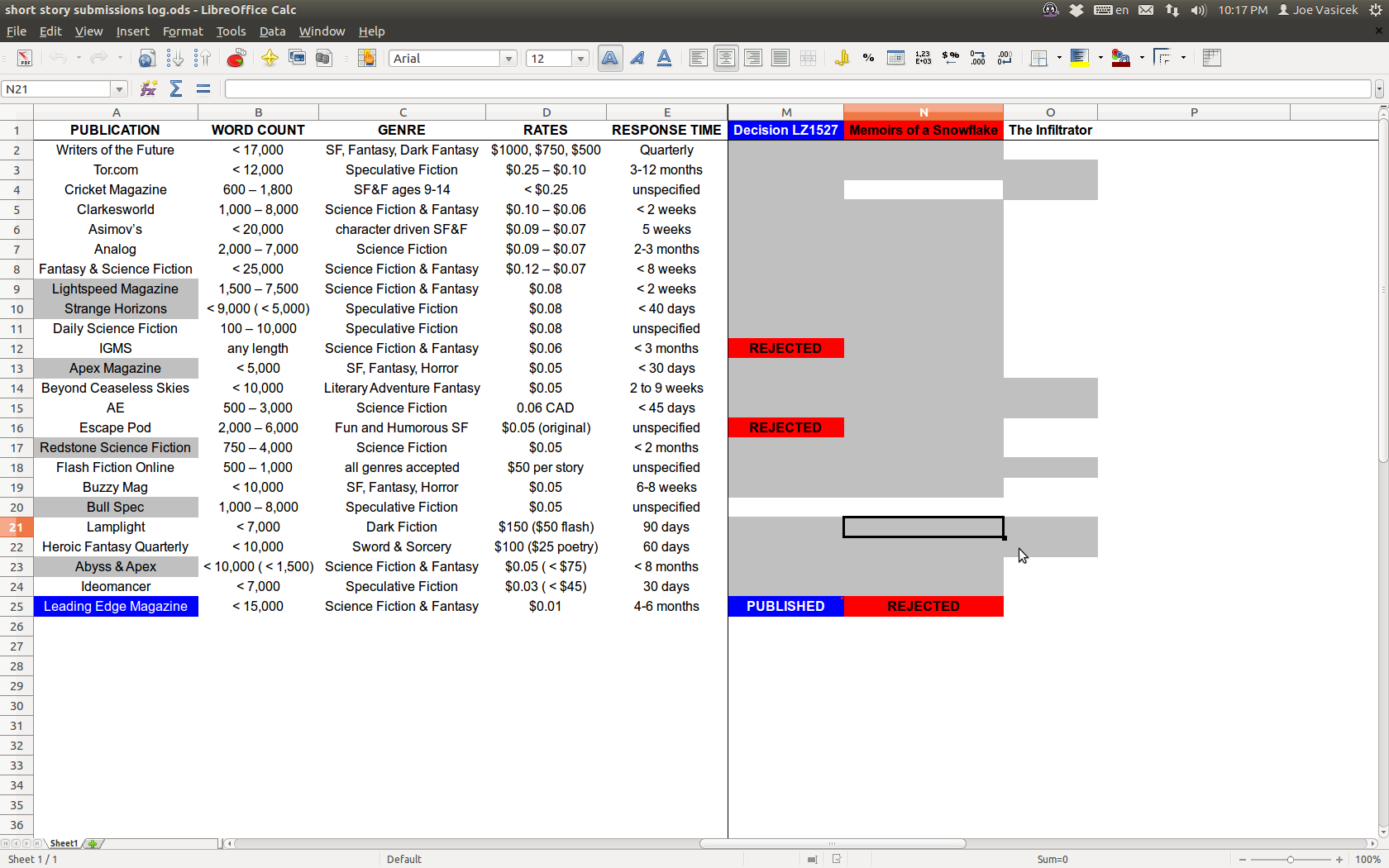
In order to do this as efficiently as possible, I’ve put together a spreadsheet of all of the magazines I hope to submit to, ranking them in order of preference and listing all of the relevant information about them.  This information includes:

  • Name of the publication.
  • Word count requirements.
  • Genre qualifications.
  • Payment rates.
  • Expected response time.
  • Name(s) of the editor(s).
  • Link to their guidelines.
  • Link to their submission system.
  • Whether they accept reprints.
  • Whether they accept multiple/simultaneous submissions.
  • Whether they’re a SFWA qualifying market.
  • The length of any exclusivity period in their contracts.

In addition to everything listed above, I’ll also keep a column for each story I’ve written, to indicate which markets I’ve sent them to and any result.  I’ll keep things color coded for convenience: red = standard form rejection, yellow = personalized rejection, green = currently on submission, blue = published, white = haven’t submitted yet, and gray = doesn’t qualify for submission.

Basically, it looks something like this:

Screenshot from 2013-12-10 22:17:50Whenever I write a new story, I’ll list it in a new column on the spreadsheet, gray out any markets that I don’t plan to send it to, and immediately send it out on submission, starting with the market at the top and working my way down.  If it goes through all the markets and doesn’t get picked up by any of them, then I’ll either trunk it or self-publish, but not until I’ve gone through all the markets first.

I’ve got to admit, one of the big motivations for me is this spreadsheet.  There’s something about having all of my stories organized and color coded in a place where I can see them all that makes me want to write more of them.  What can I say?  I’m a nerd.

Tactics:

For the duration of this operation, I’m going to adhere strictly to Heinlein’s rules, which are:

  1. You must write.
  2. You must finish what you write.
  3. You must refrain from rewriting, except to editorial order.
  4. You must put what you write on the market.
  5. You must keep it on the market until it has been sold.

No matter how great the temptation, I will not revise a story after it’s finished.  If it’s broken, I’ll just trunk it and write something else, or rewrite it from scratch.  If I workshop it, I’ll do it the way Dean Wesley Smith advises, which is to workshop it after you’ve sent it out, in order to learn how you can improve on the next one.

The reasons for this are twofold.  First, a lot of writers I whom respect (especially short story writers) swear by Heinlein’s rules, so I plan to try them out and see just how well they work for me.  Second, I don’t want to become a master reviser or editor, I want to become a master writer.  I wrote almost all of my college essays the night before they were due, and could easily pound out an A+ essay on a first draft by the end of my college career.  I wouldn’t be surprised at all if short stories are similar.

Since I have a lot of other writing projects to deal with, I’ll probably limit myself to two or three days at most for each story.  I average around 2,500 words a day when I’m on project, so if it takes me a week to write a 5,000 word short story, I’m probably doing something wrong.

Like I said above, my goal is to write at least two stories per month, preferably one per week.  I usually take Sundays off, so I figure that Friday/Saturday would be a good time to work on a short story.  It’s at the end of the week, so it won’t interrupt my normal work flow too much, and gives me a chance for a nice break.  If I don’t finish it in one weekend, I can put it off until the next one.  I’ll try that out and see how it goes.

Of course, the only way to get great at writing short stories is to read a lot of them too.  I already subscribe to Escape Pod and the Clarkesworld podcast, and just signed up for Daily Science Fiction as well.  If any of you guys have good recommendations for short stories or magazines, let me know–I’m definitely interested in reading as much great stuff as I can.  And of course, I’ll still keep working at the slushpile for Leading Edge.

That just about does it, I think.  This is definitely uncharted territory for me, so I expect I’ll be learning a lot of great stuff along the way.  For now, though, this is how I plan to go about doing it.  It will probably take a couple of years before Operation Short Blitz really comes to fruition, but I plan to stick with it until it does.

Wish me luck!  And if you want to join me by doing something similar, let me know how it goes!

3am thoughts, or why everyone says to be an accountant

I’ve been reading in bed on my smart phone recently, which is probably a bad idea because it makes it harder to go asleep.  At the same time, though, it tends to get my mind rolling, and when 3am comes around my thoughts tend to go some really interesting places.  Sharing those thoughts is probably going to get me into trouble, but hey, you might find them interesting, so why not?

When I was eight years old, I knew I was going to be a writer.  There was never any question about that.  I spent all my free time making up stories, and my favorite stories were the ones I found in books.  However, I knew I never wanted writing to be my job, because 1) everyone hates their jobs, and I didn’t want writing to ever become something I hated, and 2) everyone knows that writers can’t make a decent living.  Even at the young age of eight, I had bought into some of society’s most pervasive myths about jobs, careers, and how to make money.

Americans are generally horrible with money–we struggle to keep budgets and put all sorts of things on credit, and pay more than twice what our houses are worth by signing mortgage contracts we barely even read.  Because we’re so horrible with money, we tend to see it as a sort of magical force, something that can solve all our problems and make us happy.  Rich people are like powerful wizards or sorcerers, so far above the rest of us that we can hardly fathom their ways.

Nowhere is our stupidity about money more apparent in the fact that most of us spend our lives acquiring it by working for some sort of hourly or salaried wage.  Wages and salaries are basically the same, in that they convert time into money.  That’s why we all measure income in terms of dollars per hour, or salary per year.  But for anyone who understands how money works, that is stupid, stupid, stupid, stupid.  Money comes and goes, but time?  Time is one of the most finite and precious resources known to man.

All of us are going to die someday.  Most people are scared shitless by that fact, so we try to ignore it or put off thinking about it until some unspecified time in the future, like when we’re retired.  But not all of us get the opportunity to put our affairs in order after retiring comfortably from the workforce.  In fact, any of us could die tomorrow, or the next day, or at any other time.  And even if we do all live to be centenarians, our time on this Earth is still finite.  It’s non-renewable, too–you can’t go back and relive that day or that hour or that minute once it’s passed, no matter how much you regret it.

Converting time into money is basically trading gold for lead, or wine for water.  Yet that’s exactly what we do, because money is this strange, magical force that so few of us understand.  And the machines that do all the converting for us are businesses and corporations.

Questions like “where do you work?” “what is your job?” and “what do you make?” are much more common than “what do you do for a living?” That’s because most of us have bought into this idea that money comes from working for someone else, exchanging your time directly for a salary or paycheck. Sure, we do stuff with that time, but we don’t actually own it–the company does. While we’re on the clock, the company owns us and anything we produce. That’s the pact we make in exchange for this magical substance we call money.

It wasn’t until college that I started to become disabused of the childhood notion that I shouldn’t pursue writing as a career path. For one thing, I came to realize that plenty of people love their work–that just because you do something as a job doesn’t necessarily mean that you’ll come to hate it. But it wasn’t until I graduated unemployed in the middle of a recession that I realized how much of a myth it is that writers can’t make a living.

You see, people say that about every career choice–every career, that is, except accounting. That’s because accountants are the ones who work for the businesses and corporations, counting the magical money. Since we all get our money from businesses and corporations, exchanging our time for money, the only career with complete security is the one that the businesses and corporations will always need. After all, they’re not going to go belly up, are they? Not the big ones, anyway. They can’t–they’re the magical machines where all the money comes from.

Of course, anyone who knows anything about money knows that the only real way to make a lot of it is to produce something of value that can scale. It’s not about time at all–it’s about producing something that people want, and producing it in such a way that the more you sell, the more you make. At no point in that equation does time become a variable. It’s certainly a variable in the production equation, but even there, it’s not necessarily the most important one.

The most important thing, though, is that you have to really own what you produce–and that means owning all the failures as well as the successes. When you work for a corporation, it’s easy to shift the blame. It’s a rare case where one person is solely responsible for bringing down the whole collective enterprise. But when you work for yourself, you can’t blame anyone else when things go wrong. You’ve got to be ready to take the risk, and the bigger the payoff then chances are the bigger the risk.

That’s why everyone says that you can’t make a living as a writer. They say the same thing about making a living as a sports caller, or a musician, or a political activist. I’ve even had people tell me that there’s no money in math or in Arabic. They say that because they think that money is supposed to come from corporations, and corporations only really need people who can count their money. Every other part of the business they can either figure out how to do it with robots or outsource the work to India. They might not outsource all of the jobs, but there’s always a risk that they’ll outsource yours (unless you’re an accountant, of course, because corporations always have money).

In the end, though, it’s all just silly. Money isn’t some sort of vague magical force, and it doesn’t come out of the void from businesses or corporations–it comes from making something that people are willing to pay you for. It comes from producing something of value, or at least convincing people that you have something of value. And you don’t need to sell your time at $7.25 an hour or $24,000 per year to do that. You just need hard work, a great idea, and the opportunity to succeed as well as fail.

So can you make a living as a writer/artist/blogger/activist/global nomad/whatever your dream happens to be? Of course! It won’t be easy–you’ll probably fail a lot, perhaps even spectacularly–but it is possible. So why not give it a try? At the very least, you shouldn’t buy into the myth that accounting is the only career path guaranteed to make you any money.

Laying the groundwork for a couple new series

So I just got back from vacation at Cape Cod, which turned out completely different from what I’d expected.  When I left, I said that I’d probably just write like I usually do, except in a different place.  Instead, I took a break from my WIPs long enough to catch a new vision for my career and come up with a really good idea for a new spin-off series in the same universe as Star Wanderers.

The story idea is really awesome.  I don’t want to talk about it too much, since I haven’t even written it yet, but the main characters will be Isaac and Aaron from Benefactor, and the basic premise will start out fairly similar to Outworlder.  From there, though, I expect it to take shape in some very different ways, turning into much more of an epic space opera.

I plan to stick with the novella series format, since I’ve had a lot of success with that so far.  I know that some readers complain about shorter works, but when doing a series of this type, it’s important to put out new titles regularly, and I can do that much easier with novellas than with novels.  Besides, there are a lot of other reasons why I prefer novellas, as I pointed out in this post.

That said, I expect these ones to run a little longer, such as the 30k-40k word (90-140 page) range.  But I won’t really know until I’ve written them.

Before that, I’ve got two more Star Wanderers stories to put out: Reproach (Part VII) and Deliverance (Part VIII).  Both of those are already written; I just have to run them by my first readers and make some revisions before putting them out.  If all goes well, Reproach should be out in September and Deliverance should be out in October.

So that’s the plan.  Career-wise, what I really need to do is replicate the success of Star Wanderers by starting some new storylines that follow the same series format.  It’s a little unnerving, since I don’t know what will stick, but I don’t want to be dependent on just one series–you’ve got to have multiple entry points.  Besides, this new series is a spinoff, so hopefully readers from the first one will carry over.

It’s at this point that I’m hitting myself, because what I really need is to have three books that I can release before Christmas.  In general, I’ve found that it’s better to wait until you have three books out before you make the first in a series permanently free.  I wish I’d spent a lot more time this summer writing new things, rather than revising old stuff or finishing up old series.  But oh well–better to start now than wait until next year.  And who knows?  Maybe I can still pull it off.

For this new series, I plan to invest a little more in cover art.  The NASA images have been good for Star Wanderers, but to really hit the publishing trifecta (title, cover, blurb), I need to commission some original art.  I have the money now, and probably the best thing I can do at this point is reinvest it.  Expect those covers to be awesome.

Oh, and the other elements of the trifecta?  I don’t have a blurb yet, but the working title is Sons of the Starfarers.  Pretty cool, eh?

So there’s that.  I’m currently revising Reproach, but I think I can finish that on the train and send it out to my beta readers before the end of August.  As for The Sword Bearer, I’m going to put that project on hold again, mostly so I can focus on this.  I’ve also been running into some problems with that project, mostly having to do with the worldbuilding.

For that reason, I’m thinking of doing a series of prequel novellas in order to flesh out that world and the backstory.  If it goes well, that should turn into its own thing, kind of like how Star Wanderers fleshes out the background for my Gaia Nova books.  I’m thinking of something along the lines of David Gemmell: heroic fantasy with a real focus on courage, valor, and unlikely heroism.  I’ve already got the first scene of the first book in my head, and it’s pretty dang awesome.

So many stories, so little time … I’d better get back to writing!

It’s finished! Now onto the next thing.

Well, over the weekend, I finished the first draft of Star Wanderers: Reproach (Part VII).  Technically, I finished it at 4:30 am on Saturday, but I’m counting that for the Friday May 31st deadline that I set when I started the project.  I was determined to finish the thing before I went to bed, and nearly pulled an all-nighter.  Still recovering.

Star Wanderers: Benefactor (Part VI) needs some work before I feel it’s ready to be published, but I’m not sure if that’s what I want to move on to next.  From a business standpoint, that would appear to be the most prudent decision, since my Star Wanderers books are selling fairly well and expanding the series while the momentum is still good is probably the surest way to capitalize on that.  However, from a creative standpoint, I think it might be better to give this draft some more time to mull around in the back of my head, like I did for Genesis Earth, Bringing Stella Home, and Desert Stars.

Also, I really want to finish the first draft of Lifewalker.  All of my friends and family who have read bits and pieces of it are raving for me to finish it–literally, every time I talk with my Dad, he asks me when it’s going to be done.  I really do enjoy the voice of the main character in that one, and I stopped it only to finish Reproach, not because it was giving me any troubles.  If I go ahead with that now, I can probably finish it by the end of the month, with time to start work on another project (possibly Benefactor).

It’s difficult for me to talk meaningfully about a project that only I and a couple of other people have seen, so here are the first few paragraphs from the current draft, just to give you a taste of it:

My given name is Isaac Jameson, but most people know me as the Lifewalker. It is a fitting title. I am a stranger and a wanderer; death has cheated me not once, but thrice. For more than three generations, I have wandered the Earth, watching men and women spring up as wheat, bear seed, and pass away with the autumn frost. Yet with each passing generation, I alone remain—with each new crop of humanity, death refuses to harvest me. Some would see this as a blessing, but it is not. It is a curse worse than the fever that steals an infant from its mother, or the blight that takes the mother from her newborn child. It is hard enough to say goodbye to those you have known and loved—those who have shared everything in their lives with you, holding nothing back. But to say goodbye to everyone you have ever known—to find yourself a stranger in your own homeland, a man washed up on the shores of time while the world spins wildly beneath you—yes, that is a fate that can make death seem like a mercy. But I digress.

I suppose I should start this volume with a brief description of the land of my birth. Far to the west, beyond the lakes of the north and the great river of the plains, a series of great, craggy mountain ranges cross the land. In the heart of these mountains, almost a year’s journey by wagon from the eastern coast, lies a great salty sea. It is a desolate and lifeless place, and so far as I can tell, always has been. I only visited it once, but saw no signs of habitation along its briny beaches, ancient or otherwise. However, only a few short miles to the east, the ruins of a once-great city still stands. Its rusting skyscrapers are not as tall or as numerous as those in Boss-town or Old Neyark, but there are enough to show that it was once a place of some importance, before the years of the Blight.

South of these ruins, and beyond the numerous villages and communes that thrive in its shadows, lies a wide mountain valley with a freshwater lake at its center. The lake is extremely shallow, and the reeds grow thick along its southern coasts. It is a good place for catfish and mussels, as well as heron and other waterfowl. The mountains rise sharply all around it, but more especially to the east, though none of them are quite high enough to boast a peak that is snow-capped year round. A monument to the letter Y can still been seen on the face of one of the nearer foothills, though the coloring has long since faded. The northeast border of the valley is guarded by a mountain that looks like a young maiden, sleeping on her back with a hand on her pregnant belly. Some say that the child she carries is the hope of the new world. A narrow river runs just south of this mountain to the lake, through the heart of the land of Provorem.

Just for fun, I posted a longer version on the minecraft server where I currently play.  It’s possible to make books inside of the game, and fill them with a couple thousand words of text.  I’ll probably do a couple more minecraft books with bits and pieces of Lifewalker, and possibly a couple of other projects as well.

At the same time, I’ve got an idea for another project, one that has the potential to turn into a series of heroic fantasy novellas, along the lines of Star Wanderers.  I talked it over with my brother-in-law over the weekend, and while the world and the characters still need fleshing out, I think the core idea is pretty solid.  Part of me wants to drop everything and work on that right now, but the other part feels like a deer in the headlights with a semi full of story ideas bearing down on me…

All good problems to have.  But don’t worry–if I don’t have anything new published before the end of this month, I’ll definitely have something by the end of July.  That’s my unofficial goal now: at least one new published something every two months.

Gotta write.  Later!

Hey! Are you an aspiring writer / artist / creative whatever?

If you are, you really really really need to check out this webcomic about the three jaguars.

It’s about the three main voices in every professional artist’s head, and how they bicker and play off of each other.  As someone whose been in the writing business for a few years, I can say that it’s absolutely spot on (and not just because they’re anthropomorphized jaguars).  Seriously, this webcomic needs to be like a primer for all creative types or something.

The thing I’ve learned the most by following this webcomic has to do with the marketing voice.  I’ve always had it in the back of my mind that marketing is evil.  And if you do it wrong, it really is.  But if you do it right, it’s actually pretty amazing:

…your goal in marketing is to create sustainable relationships with people who want you to succeed; in short, to seek patrons, rather than one-time customers. To do that, you can’t be focused on the money or the one-time sale. You want to inspire customer loyalty. You want people to be invested in your success. You want them to feel special … because they are.

A lot of the stuff I do, like keeping this blog, or putting Author’s Notes at the end of all my books, comes back to this idea of making meaningful connections with people.  I just never saw it as marketing.  But if marketing yourself is really about focusing on people rather than obsessing about sales, that’s totally something that I can do–something that I’m excited to do!

The character I can relate to the most is probably Business Manager.  It’s the entrepreneurial spirit I can trace back to my grandpa, who started his own oil company in West Texas and was successful enough to put all us grandkids through private school.  But Artist is definitely in there as well–it’s why I’m always jumping from project to project, driving my inner business manager crazy.

So yeah, if you’re a creative type, you’ll definitely want to check out this webcomic.  It’s written by the self-published author whose books briefly got pulled from Amazon during the Space Marine controversy (fortunately for all of us, she held out and won).  Lots of good stuff there–she really knows what she’s talking about.

In the meantime, let me leave you with this incredible piece of orchestral trance music.  It’s quite possibly the most epic thing I discovered last week.  The video is pretty good too.

Take care!

Thoughts on serials and ebook pricing

I’m going to do something potentially dangerous and discuss pricing strategies in a rather candid way.  I may risk turning off some of my potential readers, especially the ones who don’t like shorter works, but I want to be as open and transparent as I can, since I figure it’s only fair, especially to someone who’s just getting started with my books.

First of all, let me just say that if I could, I would make all my books free and write for love instead of money.  The trouble, though, is that I have to eat, and at some point in the (hopefully) not too distant future I’m going to have to feed a wife and children as well.  If I made all my books free right now, I would have to spend all my time and energy doing something other than writing, and as a result there would be far fewer books for you to read.

In the last year, I’ve discovered that the best way to make money self-publishing is to write in series, preferably at a short enough length that you can release a new installment every other month.  A lot of other writers are discovering this, which is why there is such an explosion of series and serials.

I know a lot of readers don’t like this.  And when a writer takes a perfectly good novel and splits it arbitrarily into parts, each one without a solid arc or story structure to hold it together, I get a little bit ticked as well.  But the reality is that if you can tell a story in a series of short, self-contained novellas rather than a single novel, it will probably meet with better commercial success.

The price points for novellas are kind of tricky, though.  For anything priced below $2.99, Amazon takes 65%, whereas from $2.99 to $9.99, the self-publisher takes 70%.  To give that some perspective, you would have to sell 10x the number of copies at $.99 to earn as much on one sale of a book at $4.99, and 6x for a book at $2.99.

The trouble, of course, is that for a series where each installment is priced at $2.99, the readers may end up paying a lot more, depending on the lengths of the story arcs and the size of each installment.  Novellas are kind of in a gray area, where $.99 seems kind of cheap for that much story, but three or four installments at $2.99 really add up–especially with so many other ebooks priced at $5 or below.

Now, I’d like to believe that most readers judge the value of a story by its quality and not by its word count, or by how much they have to pay per word.  There are books like City of the Saints that I don’t mind buying in $2.99 increments at all.  At the same time, though, I think there’s something to be said about keeping prices fair.

This is all on my mind right now because I’m getting ready to release the first Star Wanderers omnibus and expand that series considerably over the next year.  It’s the series that sells best out of any of my books, and the one with the most potential to make it so that I can go full time.  Plus, I really love writing in this universe, and have a lot more stories in it to tell.

Right now, this is the pricing structure I’m following:

  1. Outworlder — free (15,000 words)
  2. Fidelity — $.99 (17,000 words)
  3. Sacrifice — $2.99 (19,000 words)
  4. Homeworld — $2.99 (20,000 words)
  5. Dreamweaver — $2.99 (19,000 words)

Parts I through IV make a complete story arc, though of course each individual novella is a self-contained story on its own.  With Part I at free and Part II at $.99, I figure readers have a good way to figure out if these are the kinds of stories that they’ll want to read.  But if I keep pricing the stories at $2.99, at some point this series is going to get really expensive.

So here’s what I plan to do to alleviate that:

1) Make new releases free to newsletter subscribers.

For every Star Wanderers story up to this point, I’ve made it free for the first two weeks on Smashwords and given that code out through my email newsletter.  I did that originally as an incentive to get people to sign up for my newsletter, but I think it’s a good series strategy as well.  This way, if someone discovers Star Wanderers now, they can buy all the previous installments at the higher $2.99 price point and look forward to receiving any future installments for free.

Some may question the business sense of giving away free books to readers who are willing to buy them, but the way I see it, the fans are the ones who are selling these books, not me.  I’m willing to put a free book in the hands of someone who already loves the series, and is more likely to write a glowing review or to share it with a friend.  And since sales of this series continue to grow, that strategy would seem to be paying off (or at the very least, it’s not biting me in the ass).

2) Try to put more story into each individual installment.

If $2.99 seems a lot for a short novella, then maybe I need to expand on them, with things like extra subplots and viewpoint characters.  Of course I don’t want the stories to feel like they’re padded, but if I can enrich the story in a way that really adds to it, then that’s certainly something that I should do.

For all of the Star Wanderers series so far, each novella is told from the point of view of just one character.  This sort of focus can be good, because it really gets me into the head of that character.  However, sometimes it’s also good to play things off of another character’s story, both to act as a foil and to provide contrast.

That’s what I’m doing with Reproach (Part VII) right now.  It’s not just from Mariya’s point of view, but Noemi’s as well, and that adds a lot to the tension as you see their competing motives and the way their views of the world really clash.  It’s delicious.  Benefactor (Part VI) is just from Jakob’s viewpoint, just because I wanted the story to really focus on his character, but most of the other stories kicking around in my head have room for at least another viewpoint character without taking away from the spirit of the series itself.

3) Price the omnibus editions less than the sum of their parts.

For someone who is just getting started with Star Wanderers, $2.99 might seem like a lot to pay to get caught up.  That’s only going to get more daunting as the series gets longer.  For that reason, I’m inclined to price the omnibus editions much lower–at least $4.95, which is the price of one of my novels.  At 70,000 words or so for Parts I-IV, that seems only fair.

I am a bit worried that sales of the individual novellas will drop off once I release the omnibus, but I figure if I’m constantly releasing new ones, those should cover the slack.  Since Dreamweaver (Part V) is already out, and Benefactor (Part VI) will be out in another month or so, new readers who come in through the omnibus will have more than enough to keep them coming back.

The other benefit of doing it this way is that it reduces the chance that readers will drop out midway through the story arc.  It seems that a few of them are doing that, or at least taking a while to get from Part II to Part III to Part IV, etc.  By having them all in one omnibus and encouraging readers to buy that instead of the individual parts, hopefully they’ll have more of a chance to get hooked, making it all the more likely that they’ll keep coming back.

So that’s my plan, at least for now.  When The Jeremiah Chronicles comes out next week, I’ll price it on parity with my other novels, even though that’s somewhat less than all the individual parts.  I’ll make all new Star Wanderers novellas free for my newsletter subscribers, and do what I can to enrich them with extra viewpoints and subplots (without just padding them, of course).  This way, I hope my readers won’t feel like I’m ripping them off, and I’ll still have a good shot of making a decent living at this.

With the way things have been going, I’m actually really excited.  The slow build approach is working, and if it keeps up then I think I may be making enough to go full-time by this time next year.  I’ll be sure to keep you posted as things come along.

In the meantime, if you have any thoughts or comments, please don’t hesitate to share.  I’m still thinking this issue through, and there’s a lot I have left to learn.  In fact, I feel like I’m only just starting to figure it out, so any other perspectives on this topic would be much appreciated!