Thoughts on making a living as a writer

As many of you know, my biggest life goal (besides obtaining a signed first-edition copy of David Gemmell’s Legend) is to make a living telling stories that I love.  Accomplishing that goal is no small task.  For the last five years, I’ve been focused on that goal like a hellfire missile, and as of right now it continues to elude me.

I’m getting closer, though.  I’ve got 14 ebooks out, hopefully 18 by the end of the summer, and they’re actually selling.  I won’t go too much into specifics, but my gross income is about 30% to 40% of what I’d need to cover all my expenses without another job.

Granted, I’m a young single guy with good health and no dependents, living on a shoestring budget in the cheapest housing in one of the cheapest states in the US, but that’s not an insignificant accomplishment.

Right now, I’m reinvesting all of that into the business, in order to boost sales and to avoid self-employment tax.  But if I have a difficult month and need something to fall back on, my books are generating a fair amount of passive income, and that income is growing.  If I keep doing what I’m doing, and things stay on more or less the same trajectory, I expect that I’ll be making enough to support myself in one or two years.

That’s actually a little better than the timetable I set a year ago, where I determined to go full-time by 2016.  Then again, I also set a goal to be married by then, and I have no idea how that will change things.  I suppose my spouse’s income would be able to supplement my own, but then there’s insurance and taxes and all sorts of other expenses that I can expect to go way up.

(At the same time, I have this wild dream of running off with my wife to some remote part of the world and spending a couple of years on some crazy-insane adventure, like trekking across Mongolia, or joining a Bedouin tribe, or couchsurfing across Europe.  The world is a very different place outside of the US, and the cost of living in much of the world is significantly lower.  Especially in the developing world, people know how to make do and be happy with much, much less.)

Even if I suffer a major setback, like an irreversible drop in sales or a technological shift that made my current business model obsolete, making a living is no longer a pie-in-the-sky sort of dream.  It’s within reach, and I think I have a pretty good idea how I’ll get there.

First of all, it’s probably not going to be a sudden, earth-shaking event.  It’s much more likely that I’ll ease into it gradually, first as a fallback for months when work is slow, and then as a way to pay off my bills while I keep a part-time job for spending money.  One day, I’ll wake up and realize that it’s been five or six weeks since I’ve done anything but write, and then I’ll open up my budget and realize that I’ve arrived.

As I get married and start a family, my expenses will no doubt rise, and I or my wife may have to take another job for a while to make ends meet.  Then again, if book sales continue to snowball with each new release, then we might be able to time it so that the kids start arriving just as the writing income really starts to take off.  Even then, book sales fluctuate so much from month to month that until we have a significant amount of money in savings, we’re always going to feel like we’re a couple of weeks away from having to find another job.

And then, with the writing bringing in a comfortable six-figure income, we might finally be able to afford a house.  It’s almost impossible to get a mortgage as a self-employed freelancer, so I fully expect to pay for most of the house up front.  Good thing I don’t want to live in a city.

Of course, it’s also possible that the writing will never bring in a six-figure income.  Science fiction is a relatively small genre, and the only stories I really care to tell are the ones that take place on other worlds.  But that’s okay–as long as I’m able to support myself and my family, I’ll be happy.  Anything above that, and it’s not about the money.  In fact, it’s really not about the money right now.

The point of all this is that I don’t expect there to be a moment where I’ve suddenly “arrived.” If anything, it’s just going to be a continuation of what I’m doing right now, scaled up to meet life’s changing demands.

And you know what?  I’m okay with that.

My resume might look a bit checkered, and job interviewers may raise their eyebrows when they see that I’m a college graduate, but these odd jobs give me a lot more flexibility than a stable “day job” with insurance and all that.  I like being able to take a week or two off to do nothing but write, even if the off-time is unintentional on my part.  I know how to be flexible, and I’m quite comfortable living a lifestyle where I don’t know where I’ll be getting my next paycheck.

And to friends and family who are concerned because I’m almost thirty and don’t have a full-time job … don’t be.  I’m following my dream, and my dream is within reach.  Everything else is just a stepping stone.  I have a career, I’ve taken full responsibility for it, and I’ve turned it into something profitable.  If making a living as a writer is a bit like making grizzly bear soup, I’ve already killed the bear.

In related news, I learned this week that I’ve been pirated in Japan.  I’m not sure whether to be flattered or alarmed, but since my books are 1) available from multiple retailers 2) relatively inexpensive, and 3) DRM-free (on all the sites that allow it, anyway), I’m not too concerned about it cutting into my income.  I am worried about people downloading my books from an unsafe site that might give them a virus or something, but people will be people and there’s not much I can do about that.

If anything, it’s just another sign that I’ve arrived–or rather, that I’m exactly where I’ve wanted to be all along, and it’s just a matter of making things work.

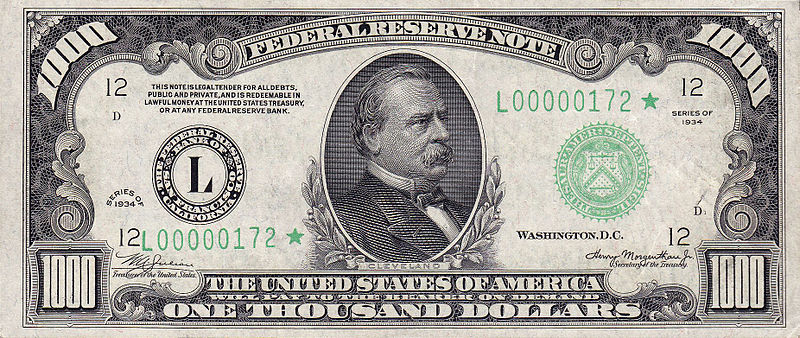
1000 posts and counting

1000dollars
Not quite the same, but we’ll run with it anyway.

According to my WordPress dashboard, this is the 1,000th post on this blog.  I was going to hold off and do something big and momentous for the occasion, but then I figured it would be better to do a quick footnote and get on with the regular program.

Nine hundred ninety nine blog posts ago, I was a college student at BYU who had just decided to write my first novel instead of a massive Final Fantasy VI fanfic.  The year was 2007, I had a bunch of unfinished novels and stories left over from high school, but I’d never actually finished anything.  I started this blog so that my writing friends could keep me honest.

If I could have seen myself now, I probably would have thought that I’m crazy (I think I got those verb tenses right…).  Back in 2007, writing was still a hobby.  I had dreams of turning it into something a little bit more, but I never intended to try and make it my full time career–though if you’d asked me what I wanted to do for a career, I couldn’t have given you an answer.

A thousand blog posts from now, where will I be?  Married, probably, with a couple of kids (or at least one on the way).  Hopefully by then, I’ll have turned this writing dream into a full time career–heck, I’m not all that far from making it happen right now.

The 2013 me hopes that I’ll be living somewhere exotic, having an extended overseas adventure with my lovely wife.  But the truth is that I’ll probably be settled down somewhere, trying to pay off a house and raise a family the responsible way.  If that’s the case, I’ll probably look back on my 2013 self and think he’s crazy.

But hey, who knows what the future will bring?

One thing that’s almost certainly true is that I’ll still be blogging.  I don’t just blog to promote my books, or to build my “platform” (oh how I hate that word), or anything slimy like that.  I’ve been blogging since before I decided to turn this writing thing into a career, and I keep on doing it because I love doing it.  Because really, how in the heck can you get to a thousand of anything without loving it?

On that note, I should add that I’ve signed up for the Blogging from A to Z Challenge for the month of April.  Every day (except Sundays), I’ll do a post that starts with a different letter of the alphabet, starting at A and going down to Z.  My theme is going to be things I love about science fiction and fantasy, and it’s going to include a number of common tropes.  It’s going to be fun!

So yeah, here’s to the first thousand posts on this blog.  It certainly won’t be the last! 🙂

If you’re thinking of self publishing, read this. All of it.

I just read a fascinating Q&A on Reddit with Hugh Howey, author of the self-published phenomenon Wool.  After six trancelike hours reading through all the comments, all I can say is “wow.”

Okay, I guess I can say a little more.  Yesterday, I listened to Brandon Sanderson’s lecture on self-publishing from his English 318 class this year.  While I agree with much of what he says, a lot of it is already out of date.  Probably the biggest thing is whether it’s still advantageous for indies to go with a traditional publisher after making a name for themselves.  In 2011, Amanda Hocking had some good reasons for going traditional.  In 2012, Hugh Howey has some very good reasons not to.

The other big thing, though, is this idea of author platform–that to be a successful indie, you have to find some way to drive large numbers of people to your books.  Well, not necessarily.  Hugh Howey was a nobody for three years, and the title that finally pushed him over the tipping point was the one he promoted the least.  To me, that shows:

  1. current sales are not a predictor of future sales, and
  2. a great book will grow into its audience independent of its author.

Granted, there may be a threshold that needs to be crossed before word-of-mouth really starts to kick in, but if a nobody with passable cover art and no author platform can cross it, that threshold isn’t very high–and that’s good news for all of us.

The way I see it, there are three big myths that writers struggle with in making the shift from traditional to indie publishing:

1) The flood of crap books will keep you from getting noticed

This grows out of the paradigm of limited shelf space–that the best way to get noticed is to have your book occupy more space relative to all the other books on the shelf.  This might be true in the brick and mortar world, but the rules are much different in the digital realm.

Think about it: how many new blogs are launched every single day?  Thousands, if not hundreds of thousands.  And yet people still find the good content amid the sea of crap.  On Youtube, an average of one hour of video content is uploaded every single second.  And yet there are still entertainers making a lot of money through their Youtube channels.

The rules in the digital realm are completely different from everything in the physical world.  Figuring that out requires a huge paradigm shift, one that even indie writers struggle with.

2) Publishing a book is an event that must be promoted

This grows out of the paradigm of velocity, or as Kris Rusch puts it, the “produce model” of publishing:

Every month publishing comes out with brand new product. Shelf space is limited in every single brick-and-mortar bookstore.  Big Publishing makes the bulk of its money during the first few months of a book’s existence.  So if a book sits on a bookstore’s shelf until the book sells and that sale takes six months to a  year, the bookstore and the publisher lose money.

Better to dump the old inventory on a monthly basis—for full credit for unsold items—than it is to have the inventory sit on the shelves and grow “stale.”

Of course, the flaw in this logic is that digital shelf space is unlimited, therefore books do not “spoil.” No matter how much time passes, an ebook can still be found in the same place.

Therefore, does it really make sense to make a big deal over an indie book release?  Maybe to jump start some word-of-mouth, but it’s not like your career is going to be harmed if you do nothing.  In fact, it might be better to hold off until you have a few more titles up, so that when you give the first one that push, readers will have something else to read once they’ve finished it.

3) To succeed you need to find a way to “break in”

This grows out of the gatekeeper paradigm, where the system is closed and the few entry points are guarded by a select group of taste makers whose job is to bestow legitimacy on those who meet the qualifications to get in.  It’s the concept of patronage, where success comes from being chosen by a wealthy benefactor, and it’s connected with the idea that you haven’t truly “arrived” until <fill in the blank>.

The flaw with this paradigm, of course, is that publishing is no longer a closed system.  The gates haven’t just been flung open, the walls themselves have been torn down.  The job of the taste makers is no longer to protect readers from the dross, but to lead them to the gems–which is honestly much closer to what it should have been in the first place.

So what does this mean for creators?  It means that there’s no longer a system to break into.  You don’t need to write better than everyone else, you just need to find (and keep) your 1,000 true fans.  Success isn’t bestowed upon you by some higher authority, it’s something that you discover on your own as you hone your craft and build your business.

Honestly, this is one that I still have a lot of trouble with.  When I left to teach English in Georgia, in the back of my mind I had this vague notion that I was going into a self-imposed exile, and wouldn’t come back or settle down until I’d “broken in.” Of course, this made me quite discouraged, because it felt like things were out of my control–or worse, that I’d somehow failed.

But listening to Brandon’s lecture and reading Howey’s Q&A session helped me to remember that it’s all still in my control.  I don’t need a benefactor, I just need a good plan, if that makes any sense.  So right now, I’m thinking things through and making the necessary revisions to that plan.  There probably won’t be any big ones–I still think I’m more or less on the right track–but it will be good to update my paradigm.

By the way, the title of this post applies to the Q&A with Hugh Howey, not to the post itself.  Though if you are thinking of self publishing, I hope it’s helped out in some way.

Also, I just finished part I of Wool, and it deserves every bit of praise that it’s got.  Expect to see a review of the omnibus shortly.

No more word counts and other paradigm shifts

This August, it will be five years since I decided to start writing on a professional level.  A lot of things have changed since then, and in some ways they’re changing even faster now.

For example, in May 2009 I started a spreadsheet to keep track of my daily word counts.  I’ve been keeping it diligently ever since then, with graphs and everything.  But just recently, I’ve decided to stop doing that.  Word count is a very shallow indicator of progress: it only measures quantity, and often leads to unnecessary angst or diverts attention from more important things.

Instead, I’m going to focus more on deadlines and work to develop some other, better indicators.  Number of books published per year is probably a key one, as well as number of manuscripts finished.  But deadlines are probably going to be the most important drivers from here on out: publishing deadlines as well as writing deadlines.

Another thing that’s shifting is my revision process.  I know that a lot of beginning writers hate Heinlein’s rules, but almost all the long-term professionals swear by them–especially the ones with careers that I would like to emulate.  This makes me think that I need to scale back on the revisions and develop more trust in my creative voice.

Just as a point of reference, Heinlein’s rules are:

  1. You must write.
  2. You must finish what you write.
  3. You must refrain from rewriting, except to editorial order.
  4. You must put the work on the market.
  5. You must keep the work on the market until it has sold.

I’m currently on the second draft of Stars of Blood and Glory, and what I’ve found so far is that the overall story is actually pretty good.  Some of the scenes are a little out of order, and some of the plot-lines are missing elements that need to be added in, but aside from a few chapters where I got lost for a couple of pages, not a lot needs to be changed.

Of course, I could spend a draft or two tweaking every other sentence, tossing out most of what I wrote in the heat of my creative passion–but would that really make the story any better?  I recently had Kindal’s writing group critique my first chapter–the one that I revised pretty heavily in April–and they found all sorts of problems that weren’t in the original draft, as I wrote it back in December.

Don’t get me wrong–I do think there is an important place for revision.  But I think it’s best epitomized by Tracy Hickman in this episode of Writing Excuses:

We write from the heat of our passion, but we edit to see the fire through the smoke.

And even Tracy only does three drafts.

The other thing that’s changing is how I look at alpha reading.  I used to have different tiers of alpha and beta readers–most of whom were writers in other genres, and not really fans of  science fiction.  I asked them to give me as much feedback as they could, and bugged them for weeks or months at a time asking if they’d read my story.  I then compiled all their line-by-line comments into one giant master-file, which I kept open on the left side of my screen as I made the changes to my manuscript on the right.

Well, I’ve started to realize that there’s a huge difference between reading for criticism and reading for enjoyment.  Because of that, a lot of the things my alpha and beta readers pointed out were things that most regular readers probably wouldn’t have noticed.  Towards the end, I started to get wise on this, and only followed about a third of the criticism that I received.

Don’t get me wrong–I do appreciate the feedback.  A lot of it helped me to see and fix problems that I’d otherwise missed.  But a lot of it came out in casual conversations with my readers after they’d finished the story–not in the line-by-line comments on the original draft.

For those reasons, I think I’m going to change the way I ask for feedback.  Instead of alpha and beta readers, I’m going to go with a handful of “test readers”–readers who enjoy the kind of science fiction I like to write, but who may or may not be writers themselves.  Instead of asking for a detailed, line-by-line critique, I’m going to ask them three things:

  1. Did you enjoy the story?
  2. If you stopped reading it, where did you stop?
  3. Did you enjoy it enough to pay for it?

I’ll ask them to give it three chances, and if they still can’t finish, that’s okay–just let me know where the hangups were.  And if they do finish it, I might have some questions for them–but then again, I might not.  It all depends on the story.

Compared to where I was when I started out–or even where I was three months ago–those are some pretty huge paradigm shifts.  I have no idea how it’s going to turn out.  I’ve grown a lot as a writer recently, and I hope that this is moving me in the right direction, but I won’t really know until I’ve tried it out for a while.

In any case, this post is long enough.  I’d better get back to writing.

What’s your backup?

...have you?

So I just got back from Easter vacation in Turkey, at Trabzon and Lake Uzungöl.  It was pretty awesome–I’ll definitely be blogging about it in the next couple of days!  First, though, I wanted to share something interesting that happened on the way back.

While I was hanging out in Batumi with some other TLG volunteers eating Adjarian khatchapuri (an experience in itself), we got to talking about what we’re going to do with our lives after we get back to the States.  Most of them didn’t really want to think about it, which surprised me, so I asked why.

They told me they didn’t want to have to figure out the rest of their lives–that coming out to Georgia to teach English was a way of putting off those major life decisions.  Fair enough.  They then asked me if I’ve figured it out.   I said yes: that I want to be a full-time writer, and that I’m out here to see the world and get some cultural experience as I try to make that dream a reality.

One of the girls then asked what my backup was if that didn’t work out.  To be honest, I had no idea what to say.  My plan at this point is to just keep teaching and traveling until the dream becomes a reality.  Am I confident that it will?  Eventually, yeah–as long as I keep writing, which I certainly will.

I thought about it a bit on the way back, and realized that my mindset has shifted tremendously in the past few years.  When I was back in college, and to some extent for the first year after I graduated, I used to worry a lot about my “backup plan.” It was a way of addressing the fear of failure, of creating an illusion of safety by having a “fallback.”

I’m sure there are careers where that’s a good idea.  Generally, those are careers with definite paths, where if you don’t pass a certain number of checkpoints, you’re basically screwed.  With writing, though, there is no set path that everybody follows–especially now with ebooks and epublishing.  Because of this, it’s impossible to really fail–either you keep on trying until you make it, or for one reason or another you give up.

Ever since I graduated in 2010, I’ve been structuring my life in such a way that I can continue to pursue my writing.  Every job I’ve taken has just been a stepping stone, a bridge to allow me to keep pursuing this dream.  Have I made it yet?  No, but I haven’t given up yet either, so I haven’t had to fall back on my backup–whatever that would mean at this point.

From the outside, it probably looks like I’m being hopelessly responsible–that, or willfully oblivious to a hundred things I should be worried sick about.  However, I’m actually quite confident that I’m on the right path and things will work out–and that surprises me.  It’s like that moment when you realize you’re actually swimming, not just kicking and thrashing about the pool.

Worst case scenario, I fall head over heels in love with an awesome, wonderful girl, and after a few heady months filled with blissful romance, I wake up one morning and realize that I’m married.  If that happens, I might have to put my writing on hold for a while until I get things sorted out so that I can support both myself and my wife–but then again, with her help, I might be able to do twice as much, or even more.  Perhaps that will help my writing career even more than trying to go it alone.

So really, there is no back up plan or worst case scenario–just the future.  And as Georgians are so fond of saying, “no one can know what will happen in future.”

What a relief.

Staying in Georgia

So I’ve decided to stay here in Georgia for another semester.  Things are working out really well, I enjoy teaching English, and for the full experience I think it will be better to stay for a full year.

I’m not sure if I’ll stay in Kutaisi yet, though.  It’s a convenient place to live, but I have upwards of 30 kids in my classes, which can be a real challenge.  I’d kind of like to spend the next semester in a village or small town, where I can know all the kids by name.  Then again, I really like it here in Kutaisi, and I’m doing so much where I am that I’d kind of like to stay, just to see how things turn out.

Currently, I’m teaching grades 1-6, 9-10, and 12.  It sounds like a lot, but I’ve got great co-teachers who help out a ton.  I teach 18 class periods per week, which is enough to keep me busy but not so much that I feel overwhelmed.  My favorite grade to teach is probably 4th or 5th, where the kids know enough to surprise you but don’t have all the issues that come with teenagers.  There are different things I enjoy about each grade, though, so it’s good to have a mix.

The second semester doesn’t start until September, so that’ll give me a few months off to do whatever I like.  My current plan is to come home and work on getting print editions of my books out.  TLG will pay for my flight out and back, and my parents will let me stay at their place over the summer, so I think things will work out quite well.

As for what to do in December once this tour is finished–that’s an entirely different question.  I could probably leverage my experience here in Georgia to get a much higher paying job in Asia or the Persian Gulf, but all I’m really looking for is a job situation to tide me over until my writing career takes off.  That, and an awesome cultural experience.

What I’d REALLY like to do is find some remote desert village in the Middle East, where the locals will pay for room and board, my book royalties will pay the rest, the cultural experience will give me a chance to practice my Arabic, and my teaching skills will make a real difference in the local community.

Towards that end, I found this site called Workaway.  A friend of mine used it to get a short-term job in a Bedouin camp in Wadi Rum, and there are TONS of other opportunities listed just like it.  I freaked out a little when I saw it, because it looks AWESOME.  When I was in Jordan, I used to fantasize about spending some time in the desert with the Bedouin, so getting the chance to actually do that would be amazing!

TLG will pay for my flight home at the end of the second semester, but I can opt to go anywhere else, so long as the ticket price isn’t any more than Tbilisi to JFK.  Since this is the year my sister’s get together with their in-laws for Christmas, it might be better to go straight from Georgia to my next job at the end of December.

I was thinking about it as I walked around my neighborhood earlier today, and it made me wonder: why did I wait so long?  There are so many awesome opportunities overseas–if you don’t have any debt or anyone you need to support, you could spend years hopping from one random adventure to the next.  I could spend years doing that.  And with epublishing, all I really need is my netbook and periodic internet access to put up new books as I write them–everything else more or less takes care of itself.  It’s fantastic.

In any case, that’s the plan for now.  I’m taking the night train to Tbilisi tonight, so I’d better go get ready for that.  See you around!

Finding the right price

One of the most controversial parts of indie publishing is deciding what price to set for your books.  Epublishing is so new that there isn’t any good data to base pricing decisions off of, and everyone seems to have a different feeling as to what is “fair.” Most readers (including me) agree that $12.99 is a little outrageous for an ebook, but beyond that, the opinions are all over the map.

When I published Genesis Earth, I priced it at $2.99 and haven’t changed it since.  It remains my best selling novel, but at maybe 5 to 10 sales per month, that really doesn’t mean much.  Besides, it’s impossible to know whether price has been the main factor in that.  I briefly dropped my other novels to $2.99, and it had absolutely no effect.

My ultimate goal is to make a living off of my writing, so if my books aren’t going to sell much better at $2.99 as they are at $4.95, from a business perspective I’d rather go with the higher price.  However, as a reader, I’m opposed to paying more than about $5 for an ebook, even from an author I love.  Others might be willing to pay more, but if I can build a readership large enough to support myself at the $4.95 price point, I’d much rather do that.

So, after experimenting with price points and thinking things through, here’s the scheme that I think I’m going to follow:

  • Short stories: $.99
  • Novellas and novel installments: $1.49
  • Short novels (under 90k words): $2.99
  • Longer novels (over 90k words): $4.95

The important thing, of course, is to build a readership that is willing to pay for my work.  I have no idea how to go about doing that, but as far as pricing goes it’s probably important to pick a scheme and be consistent.  Some of my friends are doing quite well at $2.99, while Dean Wesley Smith advises charging much more, but this is the scheme that makes the most sense to me–which honestly isn’t saying much.

About the only thing I can say is that the best way to push a title is to make it free.  All of my short stories were free at one point or another, and even after the initial rush was over, I was still getting around 80 to 100 downloads per week, sometimes more.  I have no idea how many of those people actually read the stories, or how many of those people went on to buy my other titles, but sales did seem to be slightly better across the board when I had at least something out for free.

Now that I’ve got eight titles out, I think it may be a good idea to drop the price of at least one of them for free and keep it there permanently.  David Gaughran recently featured a guest blogger who used this strategy to push her other titles at places like Barnes & Noble, which isn’t as indie friendly/agnostic as Amazon or Smashwords.

For that reason, I’ve decided to make Sholpan free again and to keep it there for the foreseeable future.  It’s already available for free at Barnes & Noble, KoboSmashwords, and Diesel, but Amazon hasn’t matched the price yet–and that’s where you can help me.

If you go to Sholpan’s Amazon page and scroll down to the Product Details, there’s a link that says “tell us about a lower price.” If you click on that, it asks for a link to the site that’s selling the ebook at a reduced price.  If enough people fill that out, I’m hoping that Amazon’s algorithms will take notice and match the price–so if you could take a moment and do that for me, I’d greatly appreciate it!

Also, if you’ve read the novella and enjoyed it, I’d appreciate it greatly if you’d take the time to post a favorable review.  Amazon has some weird thing where they copyright reviews written on their site, but for everywhere else you can just copy and paste the same review across multiple sites.  And a lot of them allow you to just leave a rating without writing a review, including Goodreads (Sholpan’s page is here).  I don’t want anyone to be disingenuous, of course, but if you enjoyed the book and took the time to rate it or leave an honest review, I would greatly appreciate it.

Thanks so much!  Until next time, I’ll see you around.

Getting settled in the land of the Kartulis

About three weeks have passed since I came to Georgia, and I’m starting to feel comfortably settled in this new place.  I like it a lot out here: my host family is great, I get along really well with everyone at the school where I work, the kids are so crazy eager to learn it’s awesome…really, I couldn’t ask for more.

Of all the places in Georgia where TLG volunteers are placed, Kutaisi seems like one of the best.  It’s the second largest city in the country, so it has access to several amenities such as markets, hospitals, restaurants, parks, and basically anything else you’d  expect in an urban center.  However, it’s about 200 km from Tbilisi and has very little exposure to the West, so culturally it’s very authentically Georgian.  It’s also much less crowded, and (in my opinion) much more beautiful.

My host family is great; I get along with them real well and already feel like a member of the family.   My youngest host brother, Kako, is 9 years old; I showed him Star Control II over the weekend, and he’s been addicted to it ever since.  We also play chess, and I’ve kind of taken him under my wing to teach him the basics of good strategy.  He’s getting steadily better!

Gura and Kati are the two teenage kids; they also speak English, so we’ve had some fun discussions.  Besides Facebook and her cell phone, Kati is really into books; I showed her my Kindle, and she wants me to help her persuade her father to get her one!  Gura is into Call of Duty and spends a lot of time hanging out with his friends; he lacks confidence when it comes to English, but he knows it better than he thinks he does.

The parents don’t speak much English, but they are really good people.  It’s a working class family; the dad works as a welder, and the mom is a nurse part-time and a home-maker full time.  They spend an amazing amount of time and energy on their kids, which is pretty typical for this part of the world.  They’re both non-smokers, and they’re very respectful of the fact that I don’t drink coffee, tea, or alcohol.  Some of the extended family keeps trying to push wine on me, but in the land known as the cradle of wine, that’s to be expected.

We basically spend all of our time in the family room when we aren’t sleeping; it’s where the heater is, so despite the relatively cramped space it’s the most comfortable room in the apartment.  Furniture consists of a couch, a computer desk and office chair, a bucket seat from an old van, a folding table, several small wooden chairs and a stool.  The TV isn’t quite a member of the family, but when the power isn’t out, it’s usually on.

The neighborhood is this bizarre mix of urban and rural elements.  The roads are super muddy and free-range chickens wander everywhere at will, but everyone lives in 9-story apartments that were built back in the Soviet days, when Kutaisi was a major center for the auto industry.  The school was built 50 years ago this year and has barely been renovated since, but it’s just starting to get some much-needed attention, with a computer center and a resource room for special needs students.  When the weather clears up, I’ll bring my camera to school and take some pictures so you can see what the classes are like.

I’ll have to do a post later on Georgian culture; there are some really bizarre and paradoxical juxtapositions, such as the way they mix religion and alcohol, or their strong belief in the nuclear family with their easy-going acceptance of bride-napping as a “Georgian tradition.” I have yet to really get a handle on all this stuff.  However, as a culture, they have a great respect for literature; when people ask my profession and I tell them I’m a writer, their eyes light up, and they show me a degree of deference that I never would have gotten back in the States.

Partly to have something to talk with them about, I’m reading War and Peace by Leo Tolstoy right now.  I just finished Book III, where Napoleon smashes the Russians and Austrians in the Battle of Three Emperors.  Everyone says that it’s the best novel ever written, and now that I’m in the thick of it, I’m starting to agree with them.  There’s a lot of really good storytelling here, as well as passion and depth.  I have the feeling that I’m going to be on a Russian literature trip for a while, though I should probably pick up some Rustaveli and Kurban Said as well.

As far as writing goes, I’ve had some difficulty settling down into a solid routine, not because of lack of time so much as trouble with my current WIPs.  Star Wanderers has more or less stalled; I ran into another wall midway through part III, and I’m still not quite sure how to get past it.  I’ve decided to take a break for a while, but I think my experiences here with the Georgian language are going to give me what I need to really make this novel come together.

In the meantime, I’m working on the 2.0 draft of Stars of Blood and Glory.  I’ve decided to try something new: revising not by chapter, but by viewpoint character.  Isolating each of the five viewpoints is helping me to see which ones work, and which ones are missing something.  I’ve also been using Dan Well’s 7-point outlining method, which is helping out a ton.

It feels like I could be writing more, but I’m not pushing myself too hard at this point.  I’m still adjusting to life in this totally new culture, and I’m also spending a lot of energy getting my TEFL career off on the right foot.  It’s paying off; I’m having a great time teaching, more than I thought I would.  Pretty soon, though, I’m going to start putting more energy into my writing.  I just hope that I’ll have enough mental space left over to really immerse myself and make it work.

Teaching English and other future plans

I got my flight plans today from the TLG people in Georgia!  I’ll be flying out next week from JFK, connecting in Kiev and arriving at Tbilisi Wednesday afternoon.  On Monday, I’ll take the train down to my aunt and uncle’s place in New York city and spend a couple of days with them before flying out.

As you can imagine, I’m really excited about all of this!  It’s an adventure, a chance to experience a new culture, and an opportunity to start a new career and get some good experience, both for my resume and for my writing.  Since this is such a huge change in direction, I want to do some thinking aloud about where I see myself going in the next couple of years.  If you have any ideas or suggestions, please chime in!

Stay in Georgia for 2+ years: Right now, this honestly doesn’t seem too likely, but I’m not ruling it out.  After getting some English teaching experience, I’ll probably want to take a higher paying job somewhere else.  The biggest reason to stay would be if I find a local girl I’m interested in pursuing, but that’s not why I’m going out there so I’m not planning on it.  But then again, you never know.

Spend 1+ year(s) in Georgia and take a job in the Persian Gulf region: This is probably the most likely scenario. After teaching in Georgia, I’ll hopefully be in a good position to apply for for more lucrative jobs in Saudi Arabia or the other Gulf states.  I also really want to go down there because of the chance it would give me to work on my Arabic.  From what I’ve heard, there’s not a whole lot of interaction with the local culture, but I’m sure there’s plenty to see and do–and if there isn’t, then all the more time to spend writing.

After a couple of years in the Gulf, I’ll probably have enough money saved up to come back to the US and focus for a while on my writing career. That would be pretty awesome.  Or maybe I’ll decide to take that money and travel for a bit.  The potential downside, though, is that it’ll probably be harder to find a girl in Saudi Arabia–but then again, you never know.

Spend 1+ year(s) in Georgia and take a job elsewhere in the Middle East: Not as lucrative as the gulf, but the cultural experience might be more fulfilling.  I’ve already been to Jordan once, but only long enough to barely whet my appetite. 🙂 I’ve got friends there, too, which is also huge.  And even if I go somewhere besides Jordan, it will give me a great chance to work on my Arabic, maybe even more so than the Gulf.

The biggest downside, of course, is the security situation.  With the revolution in Syria quickly turning to a bloody civil war, and the brinksmanship between Israel and Iran getting worse by the day, it doesn’t look like things are going to be any better a year from now.  I’ll have to keep an eye on developments as they happen, and stay away from the region if thing heat up too significantly.

Spend 1+ year(s) in Georgia and take a job in Eastern Europe: This would be my second preference, after taking a job in the Middle East.  I’ve got a friend in the Ukraine who says it’s really good there, and I’ve got a lot of Czech heritage so it might be good to shoot for a job in the Czech Republic as well.  I won’t be able to work my Arabic as much, but my sister is making a lot of family history breakthroughs so it would be kind of cool to get in touch with those people.  Also, the security situation is considerably less volatile.  Not sure about pay, but I’m sure it will be enough to get by.

Spend 1+ year(s) in Georgia and take a job in East Asia: I don’t have a whole lot of interest in East Asia right now, but I hear there are some fairly lucrative teaching jobs out there, and I have a lot of friends with connections to Japan and China.  It would definitely be another adventure, that’s for sure.

Spend 1+ year(s) in Georgia and come back to the United States: This is probably the least likely scenario.  My main goal in going to Georgia is to use the experience with TLG to launch into a career teaching English as a second language.  Coming back to the states after a successful run would be kind of pointless…but hey, sometimes life gets in the way, so I can’t rule it out.

Come back to the United States in June: Right now, I’m only signed up with the TLG program through June, but if I find the program agreeable I’ll probably stay on for another semester.  Probably.  It really depends, and I can’t say for sure.

If I did come back to the states after fulfilling my term, it would probably be because I change my mind about pursuing a TEFL career altogether.  The only real way I can see that happening is if teaching English seriously hinders my writing, and that seems highly unlikely (it’s only thirty hours per week, including prep time).  From everything I’ve seen, this seems like a career I’m well suited for, and one that will be much easier to balance with my writing than anything else short of working graveyard shift at a hotel.

And if, by some random fluke of luck, my books start to sell like crazy while I’m overseas, I’ll probably still pursue this career choice, at least for the next few years.  When you don’t have anything else to get you out of the house, writing can be extremely boring.  Besides, I want to have something to write about, and what better way to do that than to spend a few years living and working abroad?

So that’s what I see happening in the mid- to near-future.  I’ll definitely post regular updates on my adventures, though the main focus of this blog will still be my writing.

And as for the next week, I plan to revise through Star Wanderers: Part II before leaving, then work on the next two parts of that novel before potentially moving on to Edenfall.  Really, I have no idea what I’ll do, but before Tuesday, I want to at least get Star Wanderers: Part II ready for my first readers.

Whatever happens, it’s going to be an adventure!

STARS OF BLOOD AND GLORY 1.1 is finished!

That’s right!  After what felt like six hours of un-anesthetized brain surgery, Stars of Blood and Glory 1.0 is finally complete!  Here are the stats:

words: 76,326
chapters: 18, prologue & epilogue
ms pages: 360
start date: 20 Dec 2011
end date: 2 Feb 2011

Some extended stats, just for fun:

days spent writing: 36
miles traveled: ~5,500
viewpoint characters: 5
characters from other novels: 9
major characters who die: 3
space battles: 5
planets slagged: 1

The wordsplash:

Wordle: Stars of Blood and Glory 1.1

And the most influential song while writing:

It’s good to finish another novel, but this one definitely needs a lot of work before I feel that it’s of publishable quality.  I think I know how to fix it, but my mind needs a break in order to give it a fresh approach.  I’ll probably let it settle for a few months, then come back either this spring or summer.

I’m pleasantly surprised with how quickly I was able to finish this book.  Thirty-six writing days is something of a personal record.  Still, it feels like it needs a little more fleshing out.  76k is definitely too short for a novel of this type; hopefully in the second draft, I’ll be able to bring it up to 80k or 90k.

In other news, I heard back from the TLG program, and I’m happy to say I’ve been accepted!  I’ll fly out to Georgia in a little less than two weeks, have a seven day orientation period at Kutaisi, then ship off to wherever the Ministry of Education decides to send me.  I’ll be there until at least June, then either renew for a second semester or go somewhere else, maybe Eastern Europe or the Middle East.

Needless to say, I’m pretty excited!  Hopefully, this new career will be a good fit, and I’ll have many awesome adventures in the next few years.  Even if my writing starts to take off and my books start selling hand over fist, I’ll probably keep teaching for a while just for the experience.  Writing is fun, but when you have nothing else to keep you busy it can also get quite boring.

The next few weeks are going to be pretty freaking busy, so I’m probably going to ease off on the writing, at least until I get settled into the new routine.  Before I leave, I need to:

  • Find affordable expat insurance.
  • Pick up a 220 to 120 volt converter and plug adapter.
  • Publish Journey to Jordan on Amazon and B&N.
  • Get some new clothes.
  • Clean my parents’ guest room.
  • File state taxes for Utah (federal taxes are already filed).
  • Write up the last couple of Trope Tuesday posts for the backlog.
  • Finish the covers for Star Wanderers (while I still have access to my desktop computer).
  • Read up on Georgian customs and mentally prepare myself for the inevitable culture shock.

Shouldn’t be too hard, but it’s only going to get crazier once I’m over there.  I’ll be sure to keep you updated as much as I can, though; this is going to be fun!

So yeah, another novel down; this one makes my sixth.  Just another 94 to go before I reach my lifetime goal of one hundred!