Write every day or quit now?

Hoo-boy, do a bunch of writers have their panties in a twist over this article. Who would have thought that the suggestion to “write every day” could be so triggering? Not just for aspiring writers, either, but for Hugo-award winning authors as well.

I’m being a jerk, of course. So is Stephen Hunter. But he isn’t wrong.

Writing is hard. Habits are automatic. Turn writing into a habit, and you’re much more likely to succeed. That’s it. That’s the whole message.

In particular, I really liked this part:

The most important thing is habit, not will.

If you feel you need will to get to the keyboard, you are in the wrong business. All that energy will leave nothing to work with. You have to make it like brushing your teeth, mundane, regular, boring even. It’s not a thing of effort, of want, of steely, heroic determination… You do it because it’s time.

Now, do I follow this advice? Do I write every day? No, but I probably should. It would certainly make life interruptions easier to deal with. I would probably finish a lot more books, too. Right now, I write almost every day, but there’s a very big difference between finding success and almost finding success.

As far as professional goals go, making writing into a daily habit is a pretty damn good one. Unless, of course, you’re just a professional victim and/or Twitter queen with a writing hobby. Which seems to be the case for a great many butthurt people.

And what if health, or circumstances, or whatever else prevent you from writing every day? What if just the title of the article throws you into fits of self-guilt? Remember that it’s free advice. It’s just an opinion. Take a deep breath and like it or leave it as you will.

Personally, I like it. It feels right. If writing were so habitual that I didn’t have to expend any willpower to do it, I could get so much other stuff done. Why would I want to do otherwise?

Great article. Check it out.

Rethinking free

I recently read an interesting blog post on Dean Wesley Smith’s blog, about how, how not, and whether to make your books free. The conclusion he comes to is this:

Free is short time, limited supply, and never on the major bookstore shelves.

In other words, no permafree, no free pulsing, and no publishing free online content on sites like InstaFreebie unless it’s for a limited time.

Three or four years ago, I probably would have pushed back pretty hard against this advice. There are still points of it that I disagree with, such as the idea that giving anything away for free devalues all your other work. Perhaps that’s true for physical product, but for digital content I think there’s a solid argument to be made that the rules have changed.

That said, a lot has happened in the last three or four years. Permafree worked really great until about the middle of 2014, at which point I noticed that it was a lot harder to generate any kind of interest in my free books. I switched to a free pulsing strategy in 2015, which was a lot more effective at giving away free books, but that didn’t always translate into more sales.

In fact, there’s a passage from Dean’s blog that sums it up real well:

A customer walks through your door and you have a wall of twenty pies in glass cases, all the smaller short story pies in a case in the center, and some specials near the cash register.

And there on your wall are three pies that say, “Free.”

And a bunch of short stories that are “Free.”

The customer can take an entire pie for free or buy one. As a customer, what would you do? Duh. You take the free pie and leave.

And pretty soon your customers start to change. The only people who come through the door are people who only want the free stuff. They would never buy something under any circumstances, but you are giving your pies away for free, so they take one.

Pretty soon there would be lines out the door to get your free pies and you would make nothing. The free takers would crowd out and devalue the pies you are trying to sell.

Now, I don’t entirely agree with Dean here. My 90-day sales chart on Amazon shows a predictable uptick in sales every time I set a book free and send out an email to my list. Most of my subscribers signed up through InstaFreebie, which means they’re probably not quite fans yet (and probably signed up for a bunch of authors’ lists).

But my long-term data tends to agree with Dean. Back in 2012 and 2013, there was a very clear correlation between free downloads and royalties / paid sales. Then, in 2014, that correlation started to become fuzzy. Over the next several months, it got progressively fuzzier (even though I was giving away more books), until today there’s really no correlation at all.

Obviously, YMMV and I can only speak for my own books. But there have been a lot of major shifts in the ebook market over the last five years. Kindle Unlimited has had a huge impact on the effectiveness of permafree, or any kind of free book strategy for that matter.

Point is, it may be personally useful to rethink my free strategy. I’m not going to stop doing the free book thing altogether, since I do think there’s still value to it (if for no other reason than that little sales bump, plus the handful of “thank you!” responses I get from my email subscribers each month). But instead of free pulsing two books each month, usually including a first-in-series novel, it may be better to do a 99¢ novel and a free short story.

The two biggest mistakes I’ve made so far in my writing career have been 1. underpricing my books, and 2. unpublishing books that were still selling. (I still can’t believe how stupid I was) Holding onto a free books strategy that isn’t working could easily become a close third. I’m not going to throw the bus into reverse while it’s barrelling down the highway at 70 mph, but some experimentation and a course correction may be in order.

Writing is not a business

I recently read Rich Dad, Poor Dad by Robert Kiyosaki. It’s a fantastic book, not only because it gives you a basic education on financial literacy, but because it gives you a solid foundation for making money in general. It’s one of those books that really deserves its bestseller status.

About midway through reading it, I realized that I’ve been thinking all wrong about my writing. Everyone always says that if you want to write professionally, you should treat your writing as a business. But that’s not entirely correct.

Writing is not a business, it is an investment. Publishing is a business.

The basic argument of Rich Dad, Poor Dad goes like this: if you want to be wealthy, don’t work for money—make your money work for you. How? By owning more assets than liabilities. An asset is something that puts money in your pocket. A liability is something that takes it away.

When you write a book, you are creating an asset. A book is an intellectual property that generates money. Dean Wesley Smith compares it to a piece of pie in a magical bakery, where you can cut infinite pieces for your customers. With online publishing through ebooks and print-on-demand, that’s not a bad analogy.

If I were to cease all of my publishing activities right now, including all marketing and promotion whatsoever, my books would still generate income. It probably wouldn’t be a lot, but it would still be something. Even starting from zero, with a single book on Amazon under a totally unknown name, over time it will generate a small trickle of income.

A book is an asset. Writing is how you create that asset. Publishing is how you service that asset to make it more profitable.

As an indie writer, I am my own publisher. The business that I own is a publishing business, not a writing business. It’s a subtle but important distinction. I could still create books if I weren’t my own publisher, but at that point I’d be a contractor, not a small business owner.

Writers are not paid by the hour. As an indie, I’m still earning money on work I did ten years ago, and I fully expect to continue earning income on that work for the rest of my life. That’s because writing is an investment. Not a job. Not even a business. An investment.

Which is not to say that the publishing aspect—or in other words, the business aspect—is less important. Quite the contrary. A rental property is an asset, but it won’t make any money unless you find renters and take care of the upkeep. Similarly, a prime plot of farmland is an asset, but it won’t make any money unless you work it.

So how do you “work” your books? By publishing them, of course. Publishing is your business. This includes marketing, promotion, branding, and the like. Publishing is the business that makes your assets—your investments—profitable.


The implications of this are really interesting. For example, suppose you have a book that doesn’t sell very well, or that gets a bunch of negative reviews. Does that make you a failed writer? Does it spell doom for your career? It’s easy to think so if you think of writing as your business.

But when you think of writing as an investment, everyone changes. Got a book that tanked? That’s okay, it’s just that book. Every investor gets it wrong every once in a while. Learn from the mistake and pick a better investment next time.

If all your books are tanking, is that a sign that you’re just not cut out for this writing thing? Possibly… or it could just be that you need to work on your publishing. Even the richest farmland needs to be tilled, and fertilized, and watered properly. Perhaps you just need to learn how to market better, or brand your books better, or do a better job of finding and connecting with your readers.

On the flipside, suppose you have a book that used to do well, but now it isn’t selling as well as you would like. You’ve clearly done a good job of marketing it in the past, but what can you do now? Market it even harder? Or recognize that this is just a normal part of the investment cycle and go out to develop a new asset?

If writing is your business, then the success or failure of your books is a direct reflection of yourself as a writer. With that kind of mindset, it’s easy to fall into some traps. On the one extreme are those who believe that publishing well is secondary to writing a good book, and that therefore they should devote the bulk of their time and energy to writing. On the other extreme are those who seek validation so hard that they put all of their effort into the publishing aspect and neglect the writing. The truth is NOT somewhere in the middle, because both extremes grow out of a faulty premise: that writing is your business.

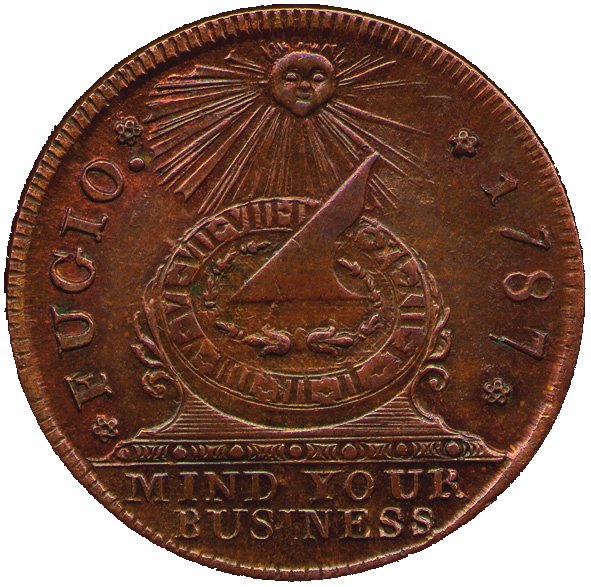
This is the Fugio cent. It was commissioned by the Continental Congress before the ratification of the Constitution, and designed by Benjamin Franklin. Fugio means “I fly,” referring to the sundial, which represents time. Taken with the inscription below, it is a reminder that we can all leave the world a better place by doing our best in whatever line of work we choose to pursue.

For many of us, writing is more than just a hobby, or a job, or even a career. It is a vocation. It is our calling. And yet, we live in a commercial world, where the price of a thing is often conflated with its value. How, then, can we best fulfill our calling as writers? By ignoring the demands of the market? By fancying that our books are simply unappreciated by those of inferior tastes? Or by losing sight of our calling for that lucre that will perish with us?

Benjamin Franklin’s message is that we can best fulfill our calling by pursuing excellence in every aspect of it. That includes the commercial aspect as well as the artistic, the practical as well as the spiritual. When we truly learn how to excel, we will see that there is no contradiction between the two sides.

Writing is our calling. Publishing is our business. Our books are investments, many of which may very well outlive us. By understanding this, I firmly believe that we can mind our business as well as Franklin admonished us, and truly fulfill our calling.

The timelessness of novels

Every few months, an article about the “death of the novel” makes the rounds on the internet. This subject, the impending doom of one of literature’s most enduring forms, is a perennial favorite for bookish handwringers everywhere. If it isn’t ebooks that’s going to kill the novel, it’s millennials, the internet, our dwindling attention spans, or one of a hundred other things.

As a professional writer, though, I am awestruck by the timelessness of the novel. Think about it:

From its origin with Don Quixote in 1605, the modern novel has endured through social and political upheaval, global pandemics, the collapse of numerous societies, the most devastating war the world has ever seen, genocide and holocaust on an industrial scale, and rise and fall of half a dozen global empires. The world today would be unrecognizable to a person from Cervantes’ time, yet the novel has endured.

Movies didn’t kill the novel. Television didn’t kill the novel. Video games didn’t kill the novel. On the contrary—numerous franchises from Star Trek to Halo have a thriving line of novel tie-ins. When the ebook revolution was just getting started, people thought that so-called “enhanced novels” would dominate the marketplace. They failed to realize that all of the added audio-visual content was a distraction for most readers. Plain text is not a bug, it’s a feature.

It’s important here to make a distinction between novels and other literary forms, such as novellas and short stories. The other forms have endured as well, but not with anything approaching the popularity of the novel. Short stories are great for exploring an idea, but not so good at immersing the reader into another world. Novellas are great for telling an intimate story about two or three characters, but not nearly as good at conveying scope or intrigue.

There’s something about a novel-length story that captures the imagination in a way that other forms just can’t. Whether it’s the large cast of characters, the intricate world-building, or the interplay of numerous subplots, novels are more immersive, and therefore have the capacity to be much more satisfying. Little wonder, then, that the novel has endured.

I’ve seen this in my own books, too. Over the years, I’ve done relatively little to promote my full-length novels, and yet they still chug along with a steady month-to-month trickle of sales. When I do promote them, such as with this month’s free run of Genesis Earth, the results are astounding. My full-length novels also tend to receive much higher reviews.

In my second year of self-publishing, I got impatient and switched to novellas. While I don’t think that was a mistake, it did not provide the foundation for a lasting career. The Star Wanderers novellas did well for a couple of years, but I don’t think they’re going to endure in their current form.

I love writing novellas, but the books that I’m proudest of are all novels. Where novellas entice, novels satisfy. Where novellas tell an intimate story, novels possess greater depth. As such, I think it’s time for a change.

In the next couple of months, I’m going to prune back my catalog a bit. The Star Wanderers series will still all be up there, but I’m going to remove the individual novellas from sale, keeping the omnibus editions instead. This will pave the way for a sequel novel, Children of the Starry Sea, which I’ve already started work on.

I will probably remove most of my older short stories, and some of the derivative works. I don’t want to clutter my book pages with my earlier practice work, or anything that looks too obviously self-published.

I’m not sure what I’m going to do with Sons of the Starfarers just yet. I’ll definitely finish the series, but I’m not sure whether to do the other two omnibus editions or to just release each individual book in print. I’m toying with the idea of releasing the last four books in rapid succession, to build some momentum for the series, but it would take some time to write them, which means that Patriots in Retreat (Book VI) would be delayed for maybe a year.

I’m definitely going to turn Genesis Earth into a trilogy. No idea when the next book, Edenfall, is going to come out, but I’m going to do as thorough a job with that book as I did for Genesis Earth, which means it may take a while.

Novels take a lot longer for me to write than shorter books, but the end result is generally worth it. The trouble is that without a busy release schedule, sales tend to dwindle as you fall out of readers’ minds. I’ll try to make up for that by upping my marketing game and running more free and group promotions. In the meantime, anything you guys can do to spread the word would help!

I’ve got a couple of really awesome projects that should be coming out before the end of the year: The Sword Keeper, Gunslinger to the Stars, and a bunch of other stuff that’s really going to branch out my catalog. I’ve also got a couple of short stories that should be appearing in some new markets soon. Be sure to keep an eye out, and let me know what you think!

Thoughts on series and perma-free

For the last five years, the conventional wisdom among most indie writers has been to write short books in sequential series and make the first book permanently free. It’s a strategy that works, to a certain extent. It’s what got me from making pizza money on my book sales to making a humble living at this gig. However, I’m starting to question that wisdom.

I have two books available for free this month: Genesis Earth and Star Wanderers: Outworlder (Part I). Genesis Earth was my first indie published novel, a “standalone with series potential” (specifically, a trilogy) written according to the conventional wisdom for breaking into traditional publishing. Outworlder is a very different book: the first in an eight-book novella series, strong enough to stand alone but short enough to leave the reader wanting more. And for several years, it was perma-free.

Outworlder was the first of my books to make it big. It’s gotten tens of thousands of free downloads and driven thousands of sales (I don’t have the exact numbers because I haven’t yet collated all of my sales reports from the past five years, but that’s something I plan to do). It was largely on the success of Outworlder and the Star Wanderers series that I built my early career.

But over time, downloads of Outworlder slowed to a bare trickle, and sales did as well. I could give it a short-term boost by running a few strategically placed ads, but it would always fall back down to a baseline that was simply unacceptable.

Also, when you have a book that’s permanently free, it tends to accumulate a lot of negative reviews. It’s strange, but some people seem to feel more entitled to XYZ when they get it for free, as opposed to paying for it. Or maybe these are the people who try to go through life without actually paying for anything? Who hoard everything, even the stuff that they hate, so long as they can get it for free? I don’t know.

Certainly, that’s not true of everyone who reads free books. But when you have a perma-free book, it tends to accumulate more of the barely-coherent “dis buk sux” kinds of reviews from people who probably weren’t in the target audience to begin with. And over time, that tends to weigh the book’s overall rating down, which unfortunately can be a turn-off for people who are in the book’s audience.

Contrast that with Genesis Earth. I launched it at full price with a blog tour (which I put together myself, among writer friends whom I knew personally and who had readers who would probably enjoy the book). It sold about a hundred copies in the first ninety days, then slowed to a very low trickle—maybe one or two sales each month, if that. Things continued like this for several years.

Then, back in December, I made it free for one month. Downloads immediately shot up, and continued strong throughout the entire month. Even without any advertising, I was still getting maybe 50 downloads per day on Amazon, plus a constant trickle on the other platforms. For the next couple of months, sales of all my other books grew as well

For April, I decided to make it free again, just to see if I could duplicate that kind of success. I haven’t done any paid advertising for it, but I have submitted it to various sites and newsletters that will promote free books. The result? Thousands of downloads, with a baseline rate of more than a hundred downloads per day.

Genesis Earth has never been perma-free, but every time I set it free for a limited time, it’s like I’ve released the pent-up flood waters. In contrast, Outworlder struggles to get any downloads at all, even when it’s free for only a limited time.

Part of this may have to do with the reviews. Genesis Earth has a much better overall book rating, simply because most of the people who read it over the years were the ones willing to pay full price. This also means that the book has grown into its own niche organically, since the people who have bought Genesis Earth also tend to buy other books similar to it. Retailers like Amazon take note of this, and tend to associate these books with each other in things like also-bought recommendations.

This is all just speculation, but when all of this comes together, it seems to result not only in a higher download rate when the book is free, but more downloads from people who are in the book’s targeted audience.

The mos fascinating result of this is that when the book goes back to full price, sales get a small but long-lasting boost. I’ve seen this with Bringing Stella Home, which was free in March. It’s not a huge boost—maybe only five or six books a month—but it boosts all of the other books in the series as well, and lasts for a couple of months. It’s not just Amazon where this is happening, either—in fact, it may be boosting sales on the non-Amazon platforms even more.

Bringing Stella Home is different, though, because it’s a full-length novel (about 110k words, or +300 pages) in a series that can be read out of order just fine. In other words, more of the “stand-alone with series potential” that was the convential wisdom in the old tradpub world. Like Genesis Earth, it has never been perma-free.

So what’s the takeaway?

That maybe the convential wisdom among indies is all wrong. That perma-free actually taints books and makes it harder for them to stick in the rankings, or to grow into their natural audience. That longer stand-alone books with recurring characters set in the same universe may be better for gaining long-term traction than shorter, more episodic books. Also, that the more books you give away for free—not just first in series—the better that all of your books will sell.

My experience is purely anecdotal, and there’s a lot more analysis I need to do before I can say anything for sure. From what I can tell, though, it seems that the best strategy is to write longer, fuller books that satisfy more than they entice, and to use free as a marketing strategy for only a limited time.

In other words, the collective wisdom of KBoards is completely off the mark, and Kris Rusch (who regularly gets vilified on KBoards) actually knows what she’s talking about most of the time.

Like I said, this is all anecdotal and more analysis is required. But I’m very curious now to make some of my non- first-in-series books free for a month, just to see if it has a similar boost. With Bringing Stella Home, for example, a lot of readers seem to be jumping over books 2 and 3 to read Heart of the Nebula, the direct sequel (but book 4 in the Gaia Nova series order). It would be very interesting to see if Desert Stars has an awesome free run as well, resulting in more sales after it reverts back to full price.

Lots of interesting stuff to consider. It’s definitely going to inform my writing and marketing efforts in the future.

Can you make a living writing short fiction?

This question has been on my mind for the last couple of weeks, ever since I made a couple of semi-pro story sales. From all of the classes and conventions I’ve attended, the answer has been no, but I’m starting to wonder if that hasn’t changed in the last few years.

First of all, it’s worth pointing out that short stories are not like longer books. In my experience (and I am not a master of the short form by any stretch), short stories do not sell as well in ebook form as longer books. That’s been corroborated anecdotally by virtually every indie writer I’ve spoken with.

At the same time, they aren’t like longer form books in the traditional sense either. I have three deal breakers when it comes to traditional publishing: no non-compete clauses, no ambiguous rights reversion, and no payments based on net. Short story markets typically only buy first publication rights with a 6-12 month exclusivity period, and pay by the word. That means that there’s no reason (unless you want to self-publish immediately) not to sell your short stories to a traditional market first.

(For the sake of argument, I’m going to assume that you’re not writing erotica. It’s a completely different market with its own idiosyncracies, which I’m going to ignore just because I don’t write it. But numerous indies have already proven that it is definitely possible to make a living writing short-form erotica.)

So let’s do a little back-of-the-envelope to see what a professional short-story writer can make.

According to SFWA, a short story is any piece of writing less than 7,500 words long. For the sake of argument, let’s say you average about 4,000 words per short story.

If you write one short story per month, you’ll have 12 by the end of the year. If you write two per month, you’ll have about 25. That comes to about 300 words per day.

If you buckle down and write one short story a week (only 600 words per day), you’ll have about 50 short stories by the end of the year. Raise that to two short stories per week, and that’s 100 short stories per year.

For the sake of argument, let’s say you’ve written 100 short stories. The next step is to put them on submission, using a database like The Submission Grinder to help you find markets. Here are the basic rules you’ll follow:

  1. Start at the top-paying markets and work your way down.
  2. Don’t submit to a market that pays less than $50 for your story.
  3. Don’t submit to markets that purchase full copyright (in other words, markets that won’t allow you to self-publish it after they buy it).

The professional markets pay upwards of $.06 per word. For a 4,000 word short story, that comes to $250 per sale. If we apply the Pareto principle to short story sales, only about 20% of our 100 stories will sell at this level (which is pathetically low for a professional short story writer, but let’s err on the conservative side). That comes to $5,000.

For the other 80 stories, let’s say you only manage to sell half of them at the minimum $50 rate—pathetic, I know, but we’re trying to be conservative. Forty stories at $50 each comes to $2,000. Together with the professional sales, that comes to a total of $7,000.

For reprint rights, let’s just apply the Pareto principle again to say that reprints account for about 20% of your income from traditional story sales, and original sales account for 80%. $7,000 divided by .8 is $8,750, which we’ll round down to $8,500 just to make the math easier.

So before you do any kind of self-publishing, you’ve got a positive balance of $8,500 just from writing and submitting those 100 stories. It’s not a lot, but it’s not insignificant either.

Now let’s say it takes about three years for you to make that $8,500, since it takes about two or three years to submit a story to all of the pro and semi-pro markets. That’s about $750 per quarter, or two professional sales, two or three semi-pro sales, and two or three reprint sales.

If I were going to self-publish short stories in order to make a living off of them, I would bundle and price them like this:

  • Singles for $.99 (ebook only).
  • Bundles of 3 for $2.99 (ebook only).
  • Collections of 10–12 for $6.99–$7.99, with paperback editions.

For the sake of argument, let’s ignore the $.99 singles. They only bring in 35¢ per sale, and you’re probably not going to release all of your short stories as singles. They can be useful for promotions, especially if you make them free from time to time, but they aren’t going to be moneymakers.

If you put all 100 stories into the $2.99 bundles, that comes to 33 (which we’ll round up to 35, just to make the math easier). The royalty rate on each of those sales is 70%, or $2. If you average only 8 sales each month of the $2.99 bundles, that comes to $560.

Looking at it another way, let’s apply the Pareto principle to say that 20% of those 35 bundles are selling a book a day. That’s 7 bundles making about $60 a month, or $420, and the rest are making $105, bringing the total each month to $525.

So for argument’s sake, let’s round down and say that you’re making $500 a month on your $2.99 bundles.

For the larger collections, let’s say you average only about 5 sales each per month, earning about $5 per sale. That’s $50 per collection, or $500 for 10 collections. Paperback sales may add to that, but let’s be conservative and just roll print sales into that number.

If it seems unusual to sell that much with self-published short stories, remember that each story published in a magazine serves as a de-facto advertisement for your self-published stories. With each new magazine publication, your name is put in front of hundreds or even thousands of short story readers, a portion of whom will search for you online and find your other work. Combine that with periodic free promotions on your singles, and it shouldn’t be too hard to build an audience.

So a typical month at these numbers would look something like this:

  • A pro-sale or a couple of semi-pro / reprints ($250)
  • About 250 sales of the $2.99 bundles ($500)
  • About 100 sales of the print/ebook collections ($500)

This is after only a year’s worth of work, writing 2 short stories per week or about 1.2k words per day. It might take a few years to get to this point, since it takes a few years to submit a short story to all of the markets, but if you can keep up this pace then by the time you’ve got 100 self-published short stories, this is probably what your career is going to look like.

And this is using conservative numbers. If you manage to sell half of those 100 stories to professional markets, the numbers go way up. Same if you have a couple of bundles that sell more than 1 copy per day. Same if you build a respectable email list that can push a couple hundred sales with each new release.

So is it possible to make a living writing short fiction? Well, let’s flip that question around and ask: is it possible to make a living writing short non-fiction? Of course it is—it’s called freelance writing. If anything, writing fiction gives us an advantage, because with fiction, the author is the brand.

These numbers look meager ($1,250 a month isn’t a great living), but remember, it’s only after 100 stories, or a year’s worth of work, writing at 1.2k words per day. If you can keep that up for several years, your income will scale up accordingly—especially on the self-publishing side.

Before the digital disruption of publishing, short fiction was dying a long, slow death. There weren’t a lot of paying markets for it, and self-publishing wasn’t a viable option. Now, there appears to be a renaissance of the short form. New pro and semi-pro markets are popping up all the time, ebooks and print on demand are opening up all sorts of new opportunities, and reader engagement has never been higher. That’s true of short fiction just as it’s true of the longer forms.

Is it easy to make a living writing short fiction? Hell no! It requires a tremendous amount of self-discipline, personal organization, and dedication. Even though 1.2k words/day isn’t a whole lot, headspace does become an issue with multiple stories. Above all else, you need to have an iron-thick skin when it comes to rejection. I’ve accrued over 150 rejections and only 4 semi-pro story sales over the course of my career.

But if you’re a prolific, hard-working writer with an efficient system for submitting, self-publishing, and marketing, then in theory at least it appears to be possible to make a living writing non-erotica short fiction.


Why SSF-V: Captives in Obscurity won’t be coming out in January

Okay, so here’s the deal.

Back in May, I made what might possibly be the worst mistake of my entire publishing career: I severely underpriced all of my Star Wanderers books. For the year and a half leading up to that decision, sales had been declining rather steadily, and I was getting rather desperate for some way to reverse that. By lowering my prices from $2.99 to $.99 for that particular series, I thought I would bring in some new readers who would go on to buy my other books, and that that would offset the loss in income.

At the time, I kind of had an impression in the back of my head that it was a bad idea. And for a while, I listened to that impression. But when you feel desperate, there’s a temptation to shift strategy and just do something, especially if it’s easy and produces immediate results.

So from May to October, I severely underpriced my books. In October, I went through all the data I’d collected, and realized that I’d categorically failed to accomplish any of my goals. Sales had increased by only two or three copies a week for the books I’d discounted, and sales for the non-discounted books hadn’t increased at all. Meanwhile, my writing income had fallen precipitously, to the point where I could barely cover costs.

At the same time, my personal expenses started to become a problem. I’ve always been frugal, but a couple of unexpected expenses combined with poor planning and lack of work meant that by the end of the summer, my emergency savings were drained and I had to make some hard choices. Long story short, I had to pull most of the money out of my business account in order to avoid going into debt.

I’m doing okay right now, so don’t worry about that. Work opportunities have picked up with the Christmas season, so I should be able to get by for the next couple of months just fine. And as for the writing end of things, business is still profitable, so if I just let it sit for a couple of months I should be able to replenish the money I had to take out. It’s not like I’ve eaten my seed corn.

At the same time, though, it kind of is like I’ve eaten my seed corn, because I don’t currently have the money to pay for editing and cover art. In a couple of months, I will, but not soon enough for a January release.

I had originally planned to release Captives in Obscurity (Sons of the Starfarers: Book V) in January. And on the writing end, I’m still doing pretty good: I’ve heard back from my first readers and should have the revisions done by the end of the month. But the actual production isn’t something I can do right now, so I have to put the project off until the money comes in.

So that’s what’s going on. It kind of sucks, but lesson learned.

As for Captives in Obscurity, barring any more problems, it should come out in March. And I do still plan to publish some short stories between now and then. The nice thing about short stories is that they’re small enough that you can do most of the editing/art yourself. It’s kind of like the difference between planting a backyard garden and planting several acres of farmland. In fact, if things go well I should be launching a pen name soon, potentially as soon as December.

And for the future, I will be careful not to underprice my books. If I could, I would love to give away all of my books for free (in fact, I actually do: on Smashwords, my books are available on a “reader sets the price” arrangement), but that just isn’t practical. Lesson learned.

The Self-Sufficient Writer: Lifestyle Choices

Before I go on with this series, I feel I should take a step back and discuss the topic of lifestyle choices.

The Merriam-Webster dictionary defines lifestyle as “the typical way of life of an individual, group, or culture.” According to Wikipedia, this includes “interests, opinions, behaviors, and behavioral orientations,” and is constrained by things like demographic background, personal values, preferences, and outlooks.

In other words, your lifestyle is the way you choose to live your life within the constraints of your own circumstances. Some circumstances can be more constraining than others, but still, lifestyle is fundamentally a choice. Even in abject poverty, there are people who choose to live differently than others.

So what sort of constraints does a writing career place on your lifestyle? Well, let’s talk shop for a minute.

If you’re a writer, you’re going to need the tools of the trade. Today, that normally means a computer with a word processor, though you can also use a typewriter or pen and paper. If you have a publisher, you’re going to need some way to contact them, either by snail mail or email. If you are your own publisher, you’ll need an internet connection, a bank account, and a computer with basic formatting and image editing software (Calibre, Gimp, Blender, etc).

In other words, all you really need to be a professional writer is a computer, an internet connection, and a bank account. You may need more depending on what you’re writing and who you’re writing it for, but those are the basic tools.

So what does this mean in terms of lifestyle choices? It means that writers have a lot of options. For most careers, your income earning potential gets lower the farther out you live from a large city. Not so for writing. You could actually live in rural Mongolia with nothing but a backpack and a horse, and so long as you can come into Ulaanbataar every couple of months and find an internet cafe, you can self-publish just like anyone else.

In other words, there is no “writing lifestyle.” There are only writers who have adapted their writing careers to the kind of life they want to live.

On one hand, every single one of my ancestors going back billions of years has managed to figure it out. On the other hand, that's the mother of all sampling biases.This makes it all the more important to consciously choose what sort of lifestyle you’re going to live, rather than letting circumstance choose it for you. If you don’t, it won’t be long before you find yourself in your underwear, eating nutella straight out of the jar, sitting in front of a grease-stained monitor clicking through an endless loop of Youtube videos. Just like no one is going to force you to meet your deadlines or write everyday, no one is going to force you to put your life in order.

Self-sufficiency is a lifestyle choice. It’s not a life hack, or a weird trick, or something you can learn in an afternoon. It takes work. It requires change. You will have to pay tuition by making mistakes along the way. And even though it can be fun, it can also be frustrating and painful.

When making a lifestyle change, it’s generally a good idea to take a step back first and figure out your goals and vision. By having a vision of what you want for your life, you’re much more likely to get there. This vision will be a reflection of your values and your deepest desires. Specific, measurable goals will help you to translate this vision into action, and provide the direction that you need to achieve your vision.

I have three main goals for the kind of lifestyle I hope to live. I haven’t achieved these goals yet, but I’m working toward them and hope to achieve them in the next three to five years.

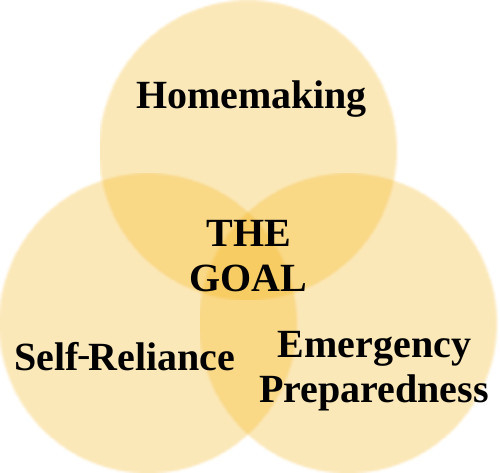
Goal 1: Prepare my family well enough to survive any disaster and rebuild.

Emergency preparedness is a very important thing to me. It gives me both a sense of security and a sense of independence to know that if crap ever hits the fan, I won’t be a helpless victim.

Disasters come in a variety of flavors. There are natural disasters like hurricanes and earthquakes, man-made disasters like an economic collapse, and personal disasters like bankruptcy or the unexpected death of close family members. While it’s important to have contingency plans for each one, it’s also important to recognize that every plan falls apart upon contact with the enemy.

I plan to blog extensively about preparedness later on in this series. In the meantime, I’d recommend checking out Listening to Katrina for some very interesting perspectives on this subject. I learned a lot from reading that blog.

One of the most important things I learned is that prepping is about more than just surviving the disaster: it’s about surviving it well enough to rebuild. As much as I love reading post-apocalyptic stories, I don’t want to be stuck in a fallout shelter eating canned beans forever. We invented civilization for a reason, and if it ever falls, I want to be one of the guys who helps to rebuild it.

As a writer, I feel that emergency preparedness is even more important because the likelihood of facing a personal disaster is that much greater. If my writing career ever takes a wrong turn and falls out from under me, I want my family to be able to survive that long enough for me to successfully reinvent myself. According to Kristine Katherine Rusch, it’s common for working writers to face a major career crisis every ten to fifteen years or so, and I don’t think I’ll be an exception to that rule.

Goal 2: Develop a home economy that can provide for my family’s basic needs.

Most households in the United States produce consumer debt and not much else. If the US dollar became worthless and we all had to live off of what we had at home, within a couple of weeks, most of us would be screwed.

In a previous post, I talked a little bit about the concept of a home economy and how I experienced that concept while living overseas. It’s one of the things that I hope to implement once I have a family of my own. Instead of producing nothing but debt, I want my home economy to produce food, water, and even things like electricity and heating if it ever becomes necessary.

For me, one of the most important components of self-sufficiency is being able to produce most, if not all, of the food my family eats. Growing a garden, keeping chickens, baking bread, making cheese and yogurt—these are all things that I hope to do, and am working now to learn.

Two books that helped me get started on this path were The Forgotten Skills of Self-Sufficiency and More Forgotten Skills of Self-Sufficiency by Caleb Warnock. I’m also sharecropping this season with a local friend, building garden plots in his yard and growing cabbage, peas, radishes, broccoli, tomatoes, peppers, and zucchini. In a few weeks, we’ll build a chicken coop and get some bantams, which should make for an interesting blog post.

The goal here is not to become 100% self-sufficient in absolutely everything, but to produce enough that we can barter for the things we can’t produce on our own. For example, I don’t expect to ever own my own cow, but I do want to produce enough of a surplus of other things that I could barter with someone who does. Also, while I might not own the cow that produces the milk, I do want to have the capacity to turn that milk into things like cheese and yogurt.

This goal also encompasses being able to live off-grid. At some point, I’d like to switch to solar and become energy self-sufficient. Here in Utah, it’s legal to own and operate your own solar panels, so long as you don’t sell back so much energy to the grid that your electricity bill becomes negative. In other states, though, you have to lease your roof to a third party that technically owns the panels. I’m still learning up on all that, so I’ll probably invite a friend who knows more than me to come on with a guest post.

Goal 3: Make my home a refuge from the world where my family can feel close to God at all times.

This is the most important thing, and the one that will probably make everything else come together. Wherever I live, I want it to actually feel like a home, not just the place I live. I want it to be a safe zone for everyone in my family—a place apart from all of the bad things happening elsewhere. Most importantly, I want it to be a place of love where we can all feel close to God.

I grew up in a home that was very much like this, so for a large part of my life, it’s something that I’ve taken for granted. Having lived on my own for more than a decade and moved on average two or three times each year, I know that it’s something you’ve got to work towards.

Homemaking is often considered to be a womanly thing, but that’s exactly what this goal encompasses. At some point, I’d like to have a woman in my life who could help out with that aspect, but it’s something that I’m sure we’ll both be working on together. In the meantime, I have a sister whose brain I can rack whenever I have a question on the subject.

goalSo that is the kind of self-sufficient lifestyle that I personally want to live. As you can probably tell, family is one of the main themes running through everything. I’m single right now, but I do want to have a family of my own and that’s what I’m working towards.

And while my writing career isn’t explicitly mentioned in any of those goals, it’s definitely wrapped up in all of them. As a writer, my income earning potential is not dependent on how close I live to a major city. That means I can live a little farther out in the country, where we can have enough land to support a substantial home economy. Also, the flexibility of a writing career means that I can be home to spend time with my family, or still have an income if a major disaster happens and we have to bug out.

It’s quite a journey that I’ve set out on. I stumbled onto the path rather accidentally, but have since decided that this is what I want to do—that this is the kind of life I want to live. Your goals will probably look different, based on your own values and desires. If there’s anything about these goals that you find interest, though, I hope you’ll stay for the rest of this blog series where I share some of the more specific aspects of self-sufficiency that I’ve learned and how it all ties in to being a writer.

The Self-Sufficient Writer (Index)

The Self-Sufficient Writer: How I Got Started

One of the best things my father ever did for me was tell me that when I graduated from college, I was on my own. No more rent money or financial support from my parents—I had to become financially independent, and I had to do it soon.

I had a rather unusual college experience. I went to BYU, one of the most affordable colleges in the United States, and I had a full-ride scholarship for all four years. In addition, I started at 21, so that I qualified for the Pell Grant my junior year. Because I was studying Arabic, I also received the Smart Grant. And as if that weren’t enough, I worked an on-campus job for seven out of eight semesters while I was there. My parents paid for my rent probably just because it was the only expense left that they could help with.

All of those scholarships, grants, and jobs allowed me to graduate 100% debt free, which was extremely helpful later on. But the truth was, as a college student, I knew almost nothing about money. I didn’t know much about the world outside of academia either, since that was where I spent all my time. Even the jobs that I worked were all on-campus jobs that only put me at 20 hours per week, doing stuff that didn’t feel all that different from school. So when I graduated in 2010, I was in for a really big shock.

I graduated in the middle of the so-called “jobless recovery,” which was basically a euphemism for “the worst economic collapse in a generation, but hey it’s getting better, right? Right??” Things weren’t nearly as bad in the US as they were (and to a large part, still are) in places like Europe, but still, it was pretty hard. At the height of the recession, a job ad on KSL (the Utah equivalent of Craigslist) would get hundreds of applications in the first 24 hours, never mind how horrible the job was. People were desperate for some kind of income, and so was I.

Fortunately, I had enough time to see this coming. In 2009, I started keeping a daily budget in order to track my expenses and learn how to manage my money. At first, I used the same spreadsheet template that my father uses, but I soon figured out that that wasn’t going to cut it. So I started from the basics, dividing wants from needs, and made separate categories for things like food, rent, health, transportation, etc. I learned very quickly that I was spending too much on food, so I subdivided that into groceries and eating out. It took a while to organize my personal finances to a place where I felt I had a handle on it, but by the time I graduated, I was pretty much on top of it.

A lot of my peers were (and to a large extent, still are) moving back in with their parents after they graduated. I decided early on that I wasn’t going to do that. First of all, my father told me that if I was going to move in with them, I would have to pay rent. I’m sure that if things were really tough, they would have waived that requirement long enough to let me get on my feet, but the arrangement would not have made anyone happy. Second, all of the people I knew—and therefore, all of my best opportunities for getting on my feet—were in Utah, not in Massachusetts.

Now, a little bit of background. I was raised in a devout Mormon household, where we were all taught about the importance of self-reliance and emergency preparedness. Growing up, we had a modest food storage, and we even ground our own wheat to make bread (the most delicious bread you will ever eat is always homemade!). That said, I had never really connected any of that with my own situation. In college, I figured that I wouldn’t worry about stuff like that until I was comfortably established in my own home.

But then, things got tough. I went from working in a call center to taking temp jobs while looking for other employment. Then the temp jobs dried up, and I had to scramble for paying gigs on Craigslist. At the lowest point, I was distributing phone books from the trunk of my car just to earn enough to eat (it’s a decent paying gig if you have a pickup truck and four or five kids (ie slave labor) to do it quickly, but if you’re just one guy with a beat-up Buick, forget it). Money was drying up fast, and I didn’t know what to do.

I learned a lot from the experience, though. Probably the most important thing I learned was that 90% of the time, “security” is just an illusion. If you think you’re secure because you have a job that gives you a reliable paycheck, think again. Markets change, and your company could go down at any time, taking your job with it. That was a lesson we all learned the hard way back in the Great Recession. And if you think the government is there to help you, think again. In a lot of ways, the government only made the recession worse.

I realized very quickly that the only security I could ever hope to have was the security that I provided for myself. In other words, if I didn’t learn self-reliance, I would never have any control over my future. I wanted control—I craved it. I found myself trapped in a system where I had to trade time, one of the most limited and valuable resources, for money. No matter how much (or how little) value I created, I was still paid the same for it. It was a soul-sucking system, and I wanted out of it.

It was around this time that I started self-publishing. I saw the opportunity to take control of my own career and leaped at it. But I was still scraping by on only four figures a year, and while that’s not as bad as it sounds when you’re a healthy single man with no debts and no dependents, it was still pretty tough. With my books barely selling a dozen copies each month in that first year, I knew I couldn’t keep it up for long.

So I ran away—literally. I left the country and decided to start over.

The Self-Sufficient Writer (Index)


The Self-Sufficient Writer: Introduction

Before I graduated from college five years ago, I decided that I was going to pursue writing as a full-time career. That was my dream: to make a living telling stories that I love.

It’s been a crazy ride so far, and I don’t doubt that it’s only going to get crazier. For the better part of a year now, I’ve managed to live that dream, but a changing book market combined with a shift to writing longer books has made for rocky times ahead. That’s just the way things go when you’re self-employed: you never know how much you’re going to make each year, or when your income streams are going to dry up unexpectedly.

As a career writer, there are a lot of other economic challenges I expect to face. Health insurance, for example: the current system here in the US is completely slanted against self-employed people, especially those who don’t want to be totally dependent on the government. Without a steady paycheck, I also expect that I won’t be able to get a traditional mortgage. And self-employment taxes… don’t even get me started.

Point is, it’s tough to make a living as a career writer—and that’s without taking into account how anyone actually makes any money at it. It’s an oft repeated truth in the entertainment industry that no one knows anything, and that’s true of books more than any other segment. No one knows why some books flop and others take off, which can be really frustrating when your ability to make a living depends on that.

Fortunately, there are two sides to the “make a living” equation. It’s not just about building your income streams, it’s also about reducing your expenses. So long as the money flowing in is greater than or equal to the money flowing out, you’re in the black.

Over the past five years, I’ve come to realize that the best security I can ever hope to have comes from learning to live a self-sufficient lifestyle. That means learning how to make, store, and ideally grow my own food, how to fix, reuse, or re-purpose things that are old or broken, and how to DIY as much as reasonably possible. Basically, I’ve learned how to be something of an urban homesteader, insulating myself from economic shocks through developing the skills of self-sufficiency.

It’s been an ongoing process, and I still have a lot to learn. At the same time, though, I’ve managed to cut my expenses fairly significantly, living on just four-figures with little or no debt and still managing to put aside a little each month into savings. I’ve also learned how to eat really well on food that I’ve grown myself, which beats anything you can buy in the store. So while I’m not yet an expert, I do think I’ve learned a few things that are worth sharing.

Over the next couple of months, I plan to write a few blog posts where I share my experiences and explain what I’ve learned. If you’re an aspiring writer like I was five years ago and you want to learn how to make it, or if you’re just someone who’s interested in becoming more self-sufficient in general, I hope you’ll find this blog series interesting and informative. And if you’re already an enthusiast for self-reliant lifestyles, feel free to stick around and share your own experiences! I’m definitely interested in hearing what you guys have to say.

The Self-Sufficient Writer (Index)