Rethinking the blog

It seems that I’m constantly in a state of retooling my writing career, moving from one area to the next a bit like construction projects at a university campus. And every time that I start to retool something else, the blog gets neglected.

Well, it’s time to retool the blog.

A couple of months ago, I tried blogging every day to see how that would work out. Long story short: it didn’t. I found that I either need to focus a ton of energy on the blog, to build a consistent readership, monetize it efficiently, and turn it into its own thing, or else I need to downsize it into something that won’t drain too much energy or resources from all the other things that I’m doing.

I don’t want to get rid of it entirely. I’ve been blogging since 2007, and while I haven’t been consistent about it all through that time, I’m invested enough in it that I don’t want to take it down. The nice thing about blogs, though, is that they wait for you. They’re kind of like hobbies, in that regard.

That makes sense, though, because up to this point I’ve treated this blog as more of a hobby than an actual job. And I’ve never fully integrated the blog itself into my writing/publishing workflow, which is why I’m struggling to justify it now.

When I started the blog in 2007, it was mainly a vehicle to keep in touch with my writing friends (who all had their own blogs too) and encourage each other. Then, when I started publishing, it turned into a platform-building tool—a way to brand myself as an author. But it was never much good for promoting my books.

Later, as my politics began to change, I made the mistake of bringing those politics onto this blog. Then social media began to become really toxic for me, and I decided to pull back. I deleted my Facebook and Twitter, and consciously pared back what I posted to this blog. But politics was what I was interested at the time, so paring that back to avoid damaging my author brand meant that I neglected the blog even more.

In the last two years, I’ve focused a lot more on my email newsletter. At first, it was just a way to notify my readers of new releases. Then, I started doing free and 99¢ sales regularly, and it turned into a way to alert my readers of those. Now, it’s a full-on newsletter, complete with a featured book, a writing update, an author’s note with some personal thoughts and reflections, links to any group promotions I have books in, and a parting quote.

So what’s the point of sharing writing updates and personal reflections here, on the blog, when I’m already doing it on my newsletter? I suppose the blog has two advantages:

  1. It’s a public-facing, searchable platform.
  2. It allows for comments and discussion.

I was talking about this with Mrs. Vasicek today, and she asked if there was any reason why I couldn’t repost the content from my newsletter onto the blog as well. There doesn’t seem to be any harm in it. I don’t think my readers are signing up for exclusive content so much as to keep in touch with my books and my writing. Besides, some readers just don’t do email lists.

Other than that, I’m not sure what I’ll use this blog for. I need to put some thought into it. But if I’m going to downsize it, I need to turn it into a side feature of my online platform, not the main vehicle for that platform itself. That means I need to restructure this site, turning into an author site with a blog on the side, rather than a blog with some book pages on the side.

I’m not going away, though. I’m just retooling. The newsletter will be my main vehicle for sharing updates from now on, though I may do a long-form blog post from time to time. I may also experiment with blogging some of my books, or doing a blog series with the aim of turning it into a book later. If there’s anything else you think might work well, be sure to let me know.

Extra Sci-Fi S3E5: Dune – Origins

It’s always fascinating to learn how the big name authors got their start. As a fan, it pulls back the mystique a bit and makes those authors more relatable, and as a writer, it’s enormously encouraging to learn that even the big names had to pay their dues too.

I wonder what Dune would have become if it were published today? It seems that most of the earlier hurdles had to do with publishers rejecting the manuscript, which wouldn’t be the case in today’s indie publishing world. Of course, it would also take a lot of promotion to give it traction, but Herbert and Lanier did that as well… but would Herbert and Lanier have even met if the book had been self-published first? And would their own promotion efforts have been enough without the boost the book got by being serialized in Analog?

Impossible questions, I know. A middling level of indie success might have prevented Herbert from developing his contacts in journalism and publishing which led to his later success. Or it might have given him more time to write, allowing him to expand Dune into something even greater than what it eventually became. Without having to work with an editor like John Campbell, Herbert might have killed off Alia, or published the story before it was truly ready. Or he might have written a better story.

There are two big takeaways that I took from this video:

First, that the slow-burn path to success is still a legitimate path. We have this idea that books are like produce: after a certain space of time, they spoil. Such is not the case. This was one of the big things that Kris Rusch always harped on, about how indie publishing is different from traditional. In recent years, it seems that indie has taken on a bit of the produce model itself, with authors turning to rapid release strategies to stay relevant. But even in the old world of traditional publishing, books still made it from time to time on the slow-burn model—even classics like Dune.

Second, that publishing well isn’t something you do alone. It takes other people, not just readers, but editors, publishers, and other people with connections, sometimes unlikely connections. This isn’t just on the marketing end of things, or even the publishing end, but on the writing end as well. No man is an island, and no successful indie is ever totally alone.

What are your thoughts?

New plan for the newsletter

So my fiancee helped me to put together a proper newsletter template for my email list, and it looks pretty good! Much better than the template I wrote myself, and I’m not a programmer (she is).

This gives me the opportunity to make some changes to the way I do things, and I’ve decided to grab the bull by the horns. I’m going to write a proper newsletter, not just a simple “here’s some book deals and a couple of promos to check out!” Here’s the new format:

Welcome

A short, 1-3 sentence “Hello, dear reader! I hope this email finds you well,” etc etc. Kind of like I already do.

Featured Book

The main call to action, put at the top for the casual readers who don’t have a lot of time or interest for much else. This may be a preorder, or a new release, or a special offer. Or it may just be a full-price book that I want to feature, for whatever reason. I’ll have to play around with it and see what works.

I’ve decided to go back to the two-button approach: one that says BUY ON AMAZON and goes directly to Amazon, albeit without an affiliate link, and one that says ALL OTHER STORES and goes to the book page here on my blog. For some reason, Amazon won’t let you put affiliate links in emails, which makes this a tough either/or. I’ll get more click-through and sales with a direct link, which is going to cost affiliate income, but I think it’s more important to focus on my own books than it is to game the affiliate system—at least in this section.

Writing Update

This is a brief, 1-2 paragraph section just below the featured book, where I give an update on my current WIP, along with a status bar. Basically, an accountability section, as well as something to keep the fans up-to-date on my writing progress.

Author’s Note

This is the meat of the newsletter, where in 3-5 paragraphs I share something personal with my readers: either a story or insight from the writing process, a behind-the-scenes look at what I do, or something else. In a recent newsletter, I talked about my grandfather and how his entrepreneurial spirit has rubbed off on me. Stuff like that.

From time to time, I also plan to share book recommendations. With my fiancee’s help, I may design a second template with an Author’s Note section that’s better set up for that.

The goal is to provide my readers with a personal connection and something of value that goes beyond “buy my book!” I already do this in the back of all of my novels, and have from the very beginning, so it will be fun to do something similar in my email newsletter.

Book Promotions

This is where I put all the links to all the promotions that I’m currently participating in, usually with other authors. I already do this in my newsletters, and it seems to be fairly popular, so it seems like something I should integrate into its own section, probably towards the bottom so as to incentive readers to scroll down.

Parting Quote

This is something new: a pull quote from the featured book to close out the email. Nothing too long; just enough to give my readers a taste and hopefully leave them intrigued, or thoughtful, or otherwise interested in reading more.

Farewell

The standard “so long, and thanks for reading!” that I always end on. Not a bad catch-phrase for a writer, I suppose.

So that’s the new format. Because I plan to share frequent writing updates in my newsletter, I’ll probably leave off sharing those updates here on my blog. Besides, that’s not really the strength of this medium: blogging is much better suited for community building, brand engagement, and public discussion. I may still share major updates, but not regularly.

That’s pretty much it. If you have any suggestions or other opinions, feel free to share. Also, you can sign up for my newsletter here if you haven’t already done so. That’s going to be the best way to keep up with me from here on out.

Take care, and thanks for reading!

Good things are happening!

It’s been a while since I posted a general update here on the blog, and while I’ve been sharing regular updates to my mailing list, enough has been happening that I suppose I should let all the rest of you know what’s going on.

First, I decided to pull out a bunch of investment money and put it into my writing, in order to go full-time for the next few months (and hopefully for the forseeable future). I shared more about this on my newsletter. Basically, I rewrote my business plan and decided that my best way forward is to go all-in for the next few months, writing more books and growing my business. I have a plan, and if it works, I’ll be able to go full-time indefinitely.

Second—and this may seem to contradict the first—I got a job at the local used bookstore, Pioneer Book! I’ve been going to this bookstore for years, befriending the manager and several employees, and several months ago (before I decided to reinvest in my writing business) I dropped off a resume in the hopes of getting a job there. When I got the call, I wasn’t going to turn it down.

It’s a part-time, 20 hours per week job that fits in perfectly with my writing. It’s also a job where I get to work with books, and be around bookish people, so I’m sure there will be lots of opportunities to learn interesting things that will help as I build my own writing and publishing career. Basically, it’s the perfect day job for a writer, and I’ve really been enjoying it so far.

Writing-wise, I just finished Gunslinger to Earth, the third book in the Gunslingers trilogy, and I’m finishing up the revisions to send it to my editor hopefully in the next few weeks. My next WIP is Edenfall, and I’m hard at work on it now. The goal is to finish it by March, and publish it over the summer.

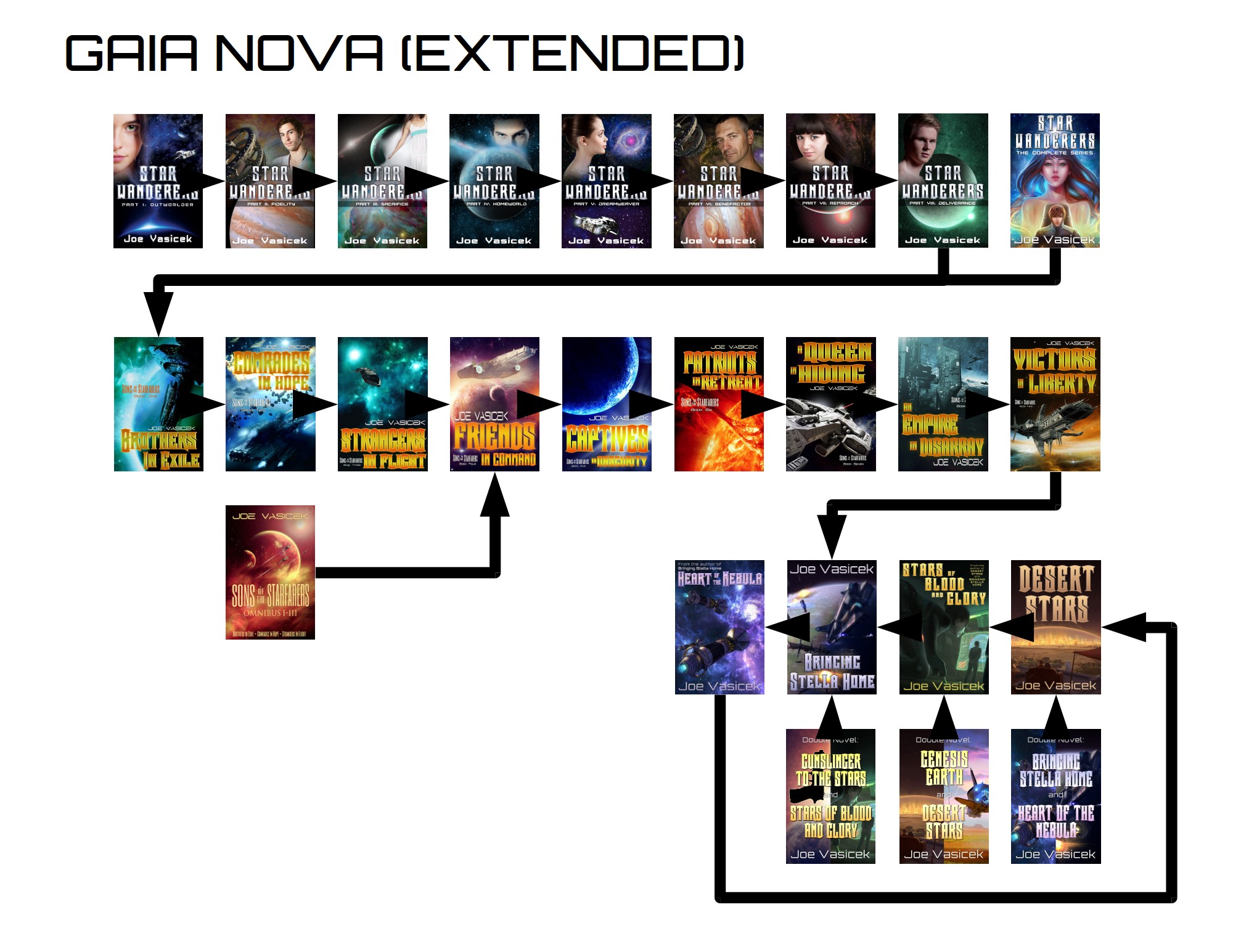
Publishing-wise, I’ve revamped the backmatter in my books again, with a new map for how everything connects to everything else. The biggest change is in my short stories, which aren’t mapped out here, but basically I’m going to focus on putting them into bundles, and have the singles point there. Eventually, I want to have only one or two singles for every bundle, with five to six stories per bundle. I have enough stories written to fill out four bundles, but a bunch of them are still out on submission, so it could take a while.

I’ve also been doing a lot more to build my email list, not just through Prolific Works but also through Bookfunnel, Story Origin, and MyBookCave. There is a method to the madness, and all of this fits into the wider plan. I’ve also updated the pricing on some of my books, and experimenting with AMS ads, though there’s not much to report on that front at the moment.

In short, I’ve been pretty busy. Most of my time and effort is going toward writing. I’ve got a very aggressive writing schedule for the next year, and hope to finish all of my trilogies before 2020, including the Genesis Earth trilogy and the Twelfth Sword trilogy. The way I have it planned out, if I can average 1600 words a day, I’ll be able to do that no problem.

As far as my personal life is concerned, I’ve been dating a really fantastic girl for the last few months and things are going very, very well. I’m not sure how much of that I should share, but you’ll probably hear more about it in the future, if not here on the blog, then definitely in my author’s notes and newsletter.

As of right now, 2019 is looking to be a fantastic year! I’m really looking forward to seeing what the rest of the year will bring, and I expect I’ll have lots of good things to share with you in the future. Take care, and thanks for reading!

New short story goals

In the last few months, as I’ve reworked my business plan, I’ve put a lot of thought into what I want to do with short stories. I’ve written about two dozen of them so far, and while I don’t expect to be known as a short story writer, I do expect that short stories will play an important role in my career, especially with the way that the publishing world is changing.

Objectives

Short stories are a great way for readers to try out new authors, without all the cost in time or money of a novel. It’s also a great way to build a hybrid career, as the professional short story markets have few of the hangups of publishing a longer work with a traditional publisher. It’s not extremely lucrative, though there is money to be made. More than that, it’s a way to gain cache and build your brand, especially if your stories get picked up by a major magazine or anthology in your genre.

So that’s my main objective with short stories: to use them to build my author brand and grow my readership. Self-publishing plays a role in that, but not nearly as much as the professional markets.

Writing

To get picked up by the professional markets, I need to have stories to submit to them, which means that I need to be prolific. Consequently, my goal from here on out is to write a new short story each month. That’s a pace I can maintain that doesn’t interfere too much with my other writing. It can be refreshing to take a WIP break from time to time, and short stories only take a few days at the most.

I know that Dean Wesley Smith says that you should never revise anything, and I’ve been following that advice until now with my short fiction. However, I do feel that it can strengthen my writing significantly to cut the word count by 10%, especially for short fiction where the strongest writing tends to be economical. So I’ll most likely do that to all my stories from now on.

Submitting

In general when submitting, it’s best to start with the top-tier markets and work your way down. This is the order in which I prioritize my submissions:

  1. SFWA qualifying markets
  2. Professional paying markets (6¢ per word or higher)
  3. Semi-pro paying markets (between 1¢ and 5¢ per word)

I’m not sure if I’m going to bother with token paying markets (less than 1¢ per word). Probably not for anything other than reprints. They don’t really put me any closer to my goals. Also, I’m not sure if I actually want to join SFWA, but I do want to qualify for it through my short story sales. Never join a club that would have you as a member, etc etc.

As for non-paying markets, I’ve decided not to submit to them after all. It’s been pointed out to me that giving something away for free after you’ve charged other people money for it is a dick move. Also, there aren’t really any non-paying markets that would bring me closer to my goals. All of the markets with serious cache also pay professional rates, at least in science fiction.

Self-publishing

Until now, I’ve self-published my short stories either immediately after their first sale, or after I’ve submitted all of the professional markets. My guiding philosophy has been that unless there’s a significant opportunity elsewhere, it’s better to self-publish something than to keep it on your hard drive.

However, self-publishing short stories doesn’t help me get much closer to my objectives. Certainly keeping a bunch of singles up for sale doesn’t help much, and it might actually hurt by cluttering up my book pages. They’re good for the occasional newsletter giveaway, or for first-in-series and other stuff, but that’s about it.

Dean Wesley Smith says to charge $2.99 for individual short stories in order to get the higher royalty rate, but I’ve tried that for the last couple of years and haven’t seen much benefit from it. Unless you’re known as a short story writer, I just don’t think short stories are good for making money. Because of that, and also because I’m going to be using them for giveaways and promotions, I plan to sell all of my short fiction (under 10k words) for a token 99¢.

Considering how it’s rude to give something away for free immediately after selling it, I plan to refrain from self-publishing until both the first-publication and reprint markets have been exhausted. That’s because I plan to make my short stories free when I first self-publish them, at least for the initial few weeks. Again, better to put something out for free and raise the price than it is to charge for it at first and make it free later.

When enough short stories have accumulated to put into a bundle, then I’ll unpublish all but the one or two best-rated or most popular singles, and put a link to the bundle in the back of those. In that way, the short story singles will help to sell the bundles, which make more money anyway, since I plan to charge $4.99 for them. This also helps to clean up the book pages, by replacing singles with bundles over time.

So that’s the plan. Submit until all professional and semi-pro markets have been exhausted, then self-publish as singles until there’s enough to put in a bundle. And hopefully sell a bunch of stories to the major markets.

Late December Update

It’s been a while since I posted a writing update on this blog, but seeing as I intend to blog a lot more actively in the coming year, I suppose I should start with an update.

First off, my current WIP. I’m making good progress on Gunslinger to Earth, and should finish it in early January. I’m also revising it as I go along, which means that it should be ready to send off to my editor by then as well. Right now, I’m planning for an April book release. So if you’re enjoying Gunslinger to the Galaxy, which I published just a couple of weeks ago, you’ll soon be able to read the thrilling conclusion to that trilogy as well.

That’s not the biggest thing I’ve been working on, though. The biggest thing would have to be rewriting my business plan in preparation for 2019. I’ve put a lot of work into it, and I think I’ve got it to the point where it needs to be, though I anticipate that I’ll be making a lot of other changes to it as the year progresses.

I can honestly say that I’ve built a business that can sustain itself. The problem for the last few years is that it’s not yet at the point where it can sustain me. But with the perspective I’ve gained from rewriting my business plan, I think that I can change that. The trouble is that it’s going to require a massive investment of time and energy, more than just money.

To make a long story short, I’ve sold off some investments and put it into the business so that I can go full-time for the next six months. If I can grow my writing income six-fold within that time, then I can keep writing full-time indefinitely. This is a huge leap for me, and I have no idea if it will work, but it’s better to have a bad plan than no plan at all. If I fail, I’m sure I’ll learn a lot of valuable lessons from the experience. And if I succeed, then I’ll basically be living the dream, at least until that next tier of success. Onward and upward!

What this means for you is that you can expect to see a lot more writing from me in the future. I’m also working on my short fiction game, which I plan to blog about soon. Currently I’ve got 40 active submissions, and since I plan to write a new short story every month, that number will grow accordingly. Expect to see some more short story publications in the coming months and years, hopefully a couple of high-profile ones.

Ideally, I want to get to the point where I always have a novel up for preorder. That means one new novel each quarter, or four novels per year. Besides that, I’ve got a large backlog of short stories and a few bundles that I intend to publish soon. Also, the blog.

Lots of stuff coming out. You can expect to see a lot more from me in the coming year. The best way to keep up with it all is to subscribe to my email list, so if you haven’t done that already, be sure to do so. Thanks for reading, and see you all next year!

A Change in Direction

This is going to be a rather long post. I’ll preface it with some demographic trends among my generation, then tie that in with my situation and how I got here. From there, we’ll see where it goes.

I was born in the early 80s, which technically makes me a Millennial, though it doesn’t always feel that way. Millennials get maligned for a lot of things, which is pretty typical of all generations as they rise, from what I can tell. Civilization is constantly under attack by barbarians, most of whom we call “children,” which is really just another way of saying this:

So how is my generation currently reinventing the world?

Thus far, not very well. The Great Recession hit us just as we were coming of age, and it shows. We were much more likely to move back in with our parents than previous generations. We’re putting off marriage and home ownership, some because we’re more focused on our careers, others because we just can’t seem to launch.

At the same time, not all of this is bad. In spite of the fact that most of us were never taught home economics or personal finance in high school (thanks, Baby Boomers, for all the participation trophies), we are rapidly learning more responsibility than our parents. Where six out of ten Americans would have to beg, borrow, or steal to cover a $500 emergency expense, nearly half of us Millennials have $15,000 or more in savings.

And yet, the problems we’ve inherited are truly daunting. Our national debt is $21 trillion and counting, and without facing a recession, war, or other emergency event, our deficit is still set to exceed $1 trillion per year for the forseeable future. Just this month, we learned that Medicare is set to run out of money in eight years, and Social Security is not far behind that. And don’t even get me started on the house of cards that is our national pension system.

Up until the 60s, previous generations saved and invested so that their children could be better off than they were. The Baby Boomers not only squandered this wealth, but they stole their children’s and grandchildren’s inheritance as well. History teaches us that there will be a terrible price to be paid for all of this. Our parents have proven themselves incapable of doing anything other than kicking the can down the road to oblivion.

That probably sounds more bitter than I intended it to be. Unfortunately, it’s the truth. Our parents just don’t understand the world that we’re living in. We’ve come of age in a world with far less opportunity than they did.

I had a conversation with my mother last year that demonstrates this. My mother likes to make cascarones for special events, like Easter or birthdays. To make them, however, you need a hollowed-out eggshell, which requires removing the yolk and whites in a very particular way. If you’re accumulating shells through normal consumption, it can get to be rather tedious.

One day, I came into the kitchen to find my mother blowing out eggshells and dumping the whites and yolks down the sink. She’d bought a whole bunch of them for 35¢ a dozen, and decided to just make the cascarones all at once instead of accumulating the shells over time. When I saw this, I was horrified.

“How could you waste all those eggs?” I asked.

“It’s not a waste,” she said. “They were 35¢ a dozen.”

“Yes, but we could have eaten them. That’s perfectly good food you’re dumping down the drain.”

She shrugged, as if it didn’t really matter. But I pressed her a bit further, until I came to a disturbing realization:

My mother has never been as poor as I am.

When I pointed this out to her, her answer was even more disturbing. With anger in her voice, she snapped “that’s because you choose to be poor.”
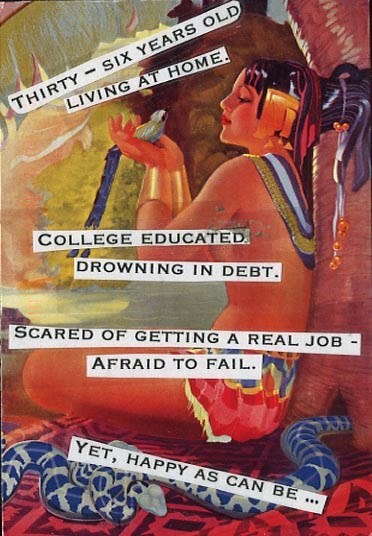
Is that true? Am I, a Millennial, poor because I choose to be poor? Perhaps. I’m not so irresponsible that I won’t own up to my life decisions, which have brought me to this place. But I think there’s this perception in the minds of our parents and grandparents that Millennials are generally like the person who wrote this postsecret above. Drowning in debt, living at home, so afraid to fail that we’ve utterly failed to launch, and yet blissfully oblivious to all of it. Perhaps that’s true for some of us, but not for those who will reinvent the world after our parents are gone.

To be clear, I love my mother and father. I don’t hold any of this against them personally, or anyone else of my parents’ generation (except the politicians who sold our Constitutional birthright, but that’s another rant altogether). Unfortunately, hard truths do not become softer because we choose to ignore them. And hard truth is this:

Hard men make good times.

Good times make soft men.

Soft men make bad times.

Bad times make hard men.
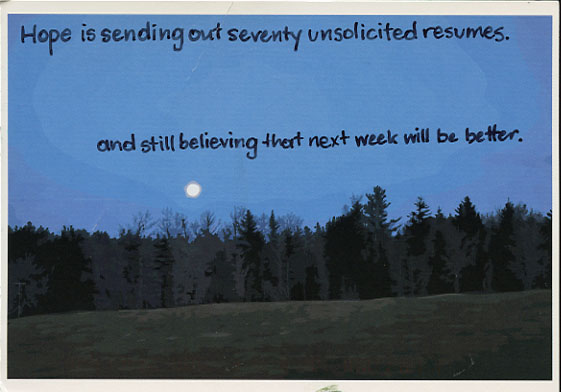
I graduated college in 2010. Through a combination of scholarship money, campus jobs, and (yes) generous parents, I was fortunate enough to graduate without any student debt. At the same time, it was the height of the Great Recession, and jobs were nearly impossible to come by. I can’t tell you how many of my writing friends put their dreams on hold, or abandoned them altogether. Almost all of them.

As a side note, I agree with Mike Rowe that “follow your passion” is bullshit advice. It ranks right up there with “be yourself,” and “you can be anything if you put your mind to it.” Don’t follow your passion. Follow opportunity, and take your passion with you.

But in 2010, I had an opportunity. Without any debt, and without any dependents or other obligations, I decided to pursue a writing career. And unbeknownst to me at the time, the industry was undergoing a revolution that would open the doors to make that possible.

I indie published my first short story, Memoirs of a Snowflake, in March 2011 and never looked back. Since then, I’ve published dozens of novels, novellas, short stories, and other works. It’s been an exhilarating journey. At the same time, it’s been the most difficult struggle of my life. And that is why I must now confront one of my most crippling fears.

Unlike the girl in the postsecret, I am not crippled by the fear of failure. If I were, I would never have published that first story, let alone all the others that followed. Instead, I have a fear of admitting failure, both publicly and to myself. It feels too much like an admission of defeat.

It’s an important distinction to make, though. The Romans admitted failure often and early—it’s how they learned from their defeats, ultimately going on to build one of the most powerful militaries in the ancient world. But they never admitted defeat. Even after Cannae, when Hannibal threatened the republic with utter extinction, the Romans refused to be defeated. And so, while Carthage fell into decline and decadence, the Romans endured until Scipio finally gave them victory at Zama, paving the way for the rise of Western Civilization.

I haven’t had a personal Cannae moment yet, but I do feel like I’ve been fighting a war of attrition. In 2014, the market shifted with the launch of Kindle Unlimited, and I failed to adapt. At that point, I was just on the cusp of going full-time with my writing, though looking back I can see that I didn’t yet have the foundation for a lasting career. Still, to have that dream snatched away when I was just on the verge of catching it, you can understand why I kept plugging along, believing that I was just a month or two from turning things around.

That’s basically what I’ve been doing for the last four years: writing full-time even though the writing doesn’t pay full-time wages. Maybe my mother is right. Maybe I have chosen to be poor.

And yet, while I now believe that I do have the foundation for a lasting career, I need to confront the fact that it may be ten years or more before I achieve it. Should I continue, like so many of my peers, to delay major life decisions until my career reaches that point? Is it worth it to put off marriage, family, and home ownership until my forties or fifties, if that’s what it takes? Or is it time to admit failure so that I can leave this dead end and find another way?

Back in 2010, I had no plan B. It was the Great Recession. I didn’t have a day job because I couldn’t find one—hardly anyone could. And from 2013 to 2014, writing paid well enough that I didn’t need one. Things were looking up, and I was just a couple months away from a sustainable long-term career.

Well, it’s time to admit that that line of thinking has turned out to be a trap. I’m approaching my mid-thirties and I’m still single and poor. I need some kind of long-term backup, because I can’t count on the writing career to take off like I need it to, at least not anytime soon.

So I’ve moved my writing onto a part-time footing. I’m limiting the number of words I write each day, leaving time for other pursuits. And I’m looking for a day job, preferably one that teaches me something useful and pays well enough to make ends meet.

I haven’t been defeated yet, though. Failure is not final until you decide to give up. I have not given up, and will continue to write, even if only on a part-time basis. And when I am making enough to go full-time, I have the foundations in place to do so.

In the meantime, though, I’m not going to put my life on hold for a dream.
Why money should not flow to the writer

Yog’s law states that money should flow to the writer. It’s an old aphorism in the publishing industry, from a time when self-publishing was synonymous with vanity publishing. According to this 2003 post by Theresa Nielsen-Hayden:

For years now, we’ve been dinning Yogs Law into young writers’ heads: Money always flows toward the writer. Alternate version: The only place an author should sign a check is on the back, when they endorse it.

Scalzi, who is also one of the more outspoken proponents of Yog’s Law, added a corrolary in 2014 in response to the argument that the rise of indie publishing renders it invalid:

I disagree, however, that it means Yog’s Law no longer generally holds. I think it does, but with a corollary for self-publishers:

Yog’s Law: Money flows toward the writer.

Self-Pub Corollary to Yog’s Law: While in the process of self-publishing, money and rights are controlled by the writer.

So, Yog’s Law: Still not just a law, but a good idea. The self-publishing corollary to Yog’s Law: Also, I think, a good idea.

Here’s the thing, though: there’s a difference between money that flows to the writer like a meandering stream from the mountains to the ocean, and money that goes to the indie writer first and from there flows outward to the writer’s various publishing projects.

In the last couple of weeks, a massive scandal hit the publishing world when it was revealed that an accountant working at Donadio & Olson, a major New York literay agency, had embezzled millions of dollars over the course of decades from major bestselling authors, including Chuck Palahniuk, author of Fight Club. According to Kristine Katherine Rusch, this is not an anomaly:

Unfortunately, as I have been telling you all for years now, embezzlement and financial negligence is rampant at big name agencies. Almost none have systems set up to prevent it. Of the four agencies I worked with over the decades, two actively embezzled from me.

The last time I threatened one of those agencies with a forensic accountant they threw me out of the agency overnight. By the time I got up in the morning, they had severed my relationship with them and informed all of my publishers that the payments should go directly to me. Just the threat of an audit did that. This is one of the biggest agencies with some of the biggest names in the world. Ask yourself why they were afraid of a standard business practice. You know the answer.

Sorry, folks. I’m not crazy. I didn’t have a bad break-up. This type of financial mismanagement, the kind that led to the embezzlement, is common in these agencies. It’s becoming visible now, because traditional book sales have declined, and so it’s harder for an agency to pay one complaining client with another (non-complaining) client’s advance.

But here’s what I want you to see. I want you to look again at Palahniuk’s apology.

I apologize for cursing my publishers.  And I apologize for any rants about piracy.  My publishers had paid the royalties.  Piracy, when it existed, was small scale.

Now, I want you to think about how many big-name writers you’ve seen railing against piracy and how it’s cutting into their book sales. I want you to think about how many big-name writers blame Amazon (!) for ruining the book business and causing book sales to decline.

I want you to think about how many big-name writers who have said there’s no money in writing, not like there used to be.

All of those writers have agents. All of them.

Money should not flow to the writer. It shouldn’t “flow” at all. It should go to the writer directly, passing through as few hands as practically possible. When it does have to pass through someone else’s hands, the writer should be able to track it at all times.

The problem with Yog’s Law is that it treats a writer’s cashflow like a bunch of tributary streams, meandering lazily from the mountains until they combine into a mighty river. Only after the river flows into the ocean does the writer see any of that money. How much of it was diverted along the way? Siphoned off by unscrupulous agents or publishers? Lost to things outside of the writer’s control?

Cashflow is the lifeblood of any business, and writing is a business. Writers should know exactly where their money is at all times. A system that allows money to “flow” in such a way that the writer cannot track all of it is a fundamentally broken system, even if it follows Yog’s Law.

3am thoughts, or why everyone says to be an accountant (Blast from the Past: October 2013)

A lot of my blog posts this week had to do with money, wealth, and politics, so when I was searching for an old post to bring back, this one made me stop and reflect for a while.

My opinions and perspective have changed a bit since I wrote it, but the fundamental message is still one that I agree with. I’ve trimmed out some of the parts where I think I was wrong, and left the stuff that still resonates. Hopefully it resonates with you as well. Either way, feel free to let me know.


I’ve been reading in bed on my smart phone recently, which is probably a bad idea because it makes it harder to go asleep. At the same time, it tends to get my mind rolling, and at 3am my thoughts tend to go some really interesting places. Sharing those thoughts is probably going to get me into trouble, but hey, you might find them interesting, so why not?

When I was eight years old, I knew I was going to be a writer.  There was never any question about that. I spent all my free time making up stories.  However, I knew I never wanted writing to be my job, because 1) everyone hates their jobs, and 2) everyone knows that writers can’t make a decent living. Even at eight years old, I had bought into some of society’s most pervasive myths about jobs, careers, and how to make money.

Americans are generally horrible with money. We struggle to keep budgets and put all sorts of things on credit, and pay more than twice what our houses are worth by signing mortgages we barely even read. Because we’re so horrible with money, we tend to see it as a magical force, something that can solve all our problems and make us happy. Rich people are like wizards or sorcerers, so far above the rest of us that we can hardly fathom their ways.

Nowhere is this stupidity more apparent than in the fact that most of us spend our lives working for some sort of hourly or salaried wage. Wages and salaries are basically the same, in that they convert time into money. That’s why we all measure income in terms of dollars per hour, or salary per year.  But for anyone who understands how money works, that is stupid, stupid, stupid, stupid. Money comes and goes, but time? Time is one of the most finite and precious resources known to man.

All of us are going to die someday. Most people are scared shitless by that fact, so we try to ignore it or put off thinking about it until we have to. But not all of us get the opportunity to put our affairs in order before we die. And even if we do all live to be centenarians, our time on this Earth is still finite. It’s non-renewable, too—you can’t go back and relive that day or that hour or that minute once it’s passed.

Converting time into money is basically trading gold for lead, or wine for water. Yet that’s exactly what we do, because money is this strange, magical force that so few of us understand.

Questions like “where do you work?” “what is your job?” and “what do you make?” are much more common than “what do you do for a living?” That’s because most of us have bought into this idea that money comes from working for someone else. While we’re on the clock, the company owns us and anything we produce. That’s the pact we make in exchange for this magical substance we call money.

It wasn’t until college that I started to become disabused of my childhood notions about writing for a living. First, I came to realize that lots of people love their work—that just because you do something as a job doesn’t mean that you’ll come to hate it. But it wasn’t until I graduated unemployed in the middle of a recession that I was disabused of the notion that writers can’t make a living.

People say that about every career—that is, every career except accounting. That’s because accountants are the ones who count the magical money. They’re the ones who know where it comes from. Their jobs are the ones that the people with the magical money will always need.

But there are other ways to make money—thousands of ways. Millions, even. It’s not about time it’s about producing something that people want and need. But when you’re working for yourself, that’s hard. You have to own up to your work—the failures as well as the successes.

When you work for a corporation, it’s easy to shift the blame. It’s a rare case where one person is solely responsible for bringing down the whole collective enterprise. But when you work for yourself, you can’t blame anyone else when things go wrong. You’ve got to take the risk.

That’s why everyone says that you can’t make a living as a writer. They say the same thing about any career where you strike out on your own.

In the end, though, it’s all just silly. Money isn’t a vague magical force—it comes from the value you create. It comes from producing something that people are willing to pay you for. And you don’t need to sell your time at $11 an hour or $44,000 a year to do that. You just need hard work, a great idea, and the ability to learn from your mistakes.

So can you make a living pursuing your dreams? The answer to that question depends entirely on you.

What I would do if I were starting out now

In a word, short stories.

Write a bunch of short stories. One or two a week if possible. Keep that up for a year or two, tapering off at the end to transition into novels. But keep writing short stories even after novels have become the main focus.

Make a serious effort while writing short stories to master both the craft and the art of storytelling. View it as an apprenticeship period. Experiment. Try out new things. Join a writing group, preferably of experienced professional writers, and have them rip your stories apart. Soak up as much constructive feedback as possible, and apply it to the next story.

At the same time, don’t spend so much time reworking old stories that you aren’t producing new ones. Learn how to keep a rigorous production schedule. If a story is totally broken, toss it out! Get to the point where you can hit 2k words consistently every day, and knock out a story at least every couple of weeks or so.

In a word, learn how to be prolific.

Experiment with standalones, but also build a couple of universes with recurring characters. Write a few series, both sequential and non-sequential. Focus especially on the non-sequential series, though—the ones where any story can be an entry point. Learn how to find the sweet spot between writing a satisfying ending and leaving a hook for the next one. That sweet spot is different for every genre.

Submit every story you write to the traditional short story markets. Start with the highest paying markets and work your way down. Pay close attention to average response times on sites like the Grinder and don’t submit to any market with an average response time of more than 30 days, no matter how high the pay rate. The goal is to get each story through all of the pro- and semi-pro markets in about a year. If a market can’t get back to you in a timely fashion, it’s not worth your time. Ideally, you want to be receiving multiple rejections every day.

Once you’ve got about twenty or so stories that have come off of submission, start self-publishing.

Use the first couple of stories to learn how the process works. Figure out how to format, do cover work, and write up all the metadata on your own, then do all you can to streamline that process until it becomes automatic. You can outsource some of the more difficult stuff, but learn to do as much as you can on your own. Don’t spend more than about $50 per story to publish it, preferably more like $30.

Once you’ve got a process down, set a rigorous release schedule of 2 stories per month. Keep to that schedule religiously. Don’t worry too much how the stories are selling: they probably won’t sell well until you’ve got a couple dozen or so out. Just focus on getting them out.

Keep an email list, with links to subscribe in the front and back of all your books. Build that list as much as you can. Most of your early marketing efforts should go to building that list, and cultivating a relationship with the people on it. Don’t rely on Facebook, because you don’t own that site and can’t control it. Same with any other social media. Do all you can to bring your readers to a place you control.

Start blogging. Build relationships with other bloggers. Strive to post something new every day. Make it the kind of site that your readers will want to come to. Be sure to have pages for all of your books, as well as a series page that lists every story in every series, in chronological and written order (side note: I really need to write up a series page).

Experiment with free pulsing and price pulsing. Experiment with price points. Experiment with bundles. Experiment with everything.

ORGANIZE YOUR DATA. Ohmygosh. You’re going to be drowning in data after just a few months. Keep all of your sales reports, and compile all that into spreadsheets showing how many sales you got of each title each month, how much you earned from each title each month, etc. Data, data, data! Learn how to thrive with data!

Write a formal business plan, and update it constantly as you go. Write down all the strategies that work, as well as the ones that don’t. Write down all the strategies you want to try out. In case it wasn’t obvious, write down your release schedule. Write down your to do list, organized by urgent / not urgent and important / not important quadrants. Write down everything. WRITE IT DOWN.

Eventually, you’ll get to the point where you’re releasing bundles alongside or even in place of your short stories. Don’t unpublish anything. Maybe update the covers, if you decide your early ones are really really bad. But don’t worry about it too much. Just focus on being as prolific as possible.

As long as you keep moving, you’re going to get somewhere. So always keep moving. Even when you have a disappointing sales month, or a spat of bad reviews, or whatever, just keep moving. Even if you’re moving in the wrong direction, that’s better than not moving at all.

At some point, you’re going to start to see some success. You may even have a breakthrough. At that point, you can start moving on to novels. Hopefully you’ve written a couple of them by now. Your first one is probably utter crap, so toss it out and focus on the good ones.

Hopefully, you’ve written it in the same universe as a bunch of your short stories. That will make the marketing easier, but its not strictly necessary so don’t worry about it too much if you haven’t. Also don’t worry too much if the novel isn’t in a series of its own. It’s better if it is, but standalones have their place too.

Try to write in trilogies, or to write standalones that can easily be turned into trilogies. The first book should stand on its own, the second should end on a low note and hook into the third book, and the third book should blow the reader’s mind away. Brandon Sanderson’s Mistborn series is a great example of this.

If your career hasn’t taken off by now, you aren’t experimenting enough. That, or you’re cutting too many corners. One way or another, you’re going to have to put in the work.

That’s pretty much it. Have fun!