Why I won’t be publishing “The New Covenant” as a free short story single

For short stories, I typically self-publish them first as free ebooks, until I have enough of them to bundle together in a collection. I’ve found that this is a great way to give new readers a taste of my writing and engage my already existing fans. It also helps to market the collections, which is great.

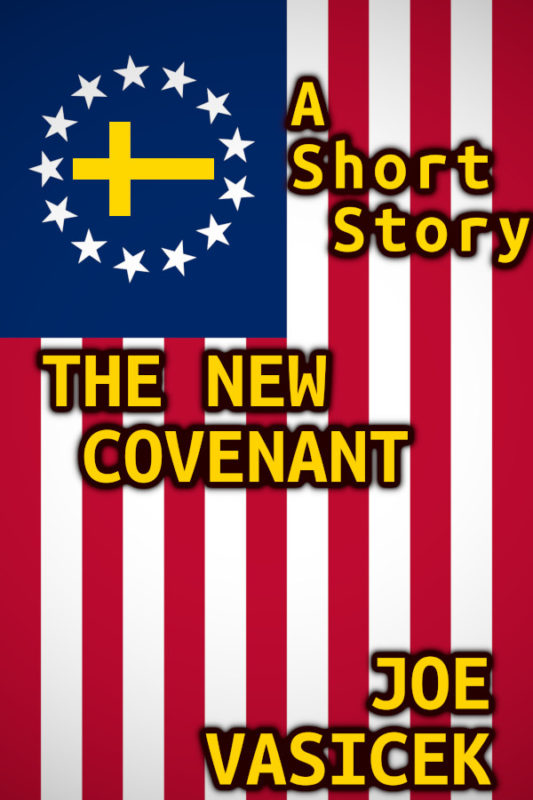
Last week, I was going to publish “The New Covenant,” a post-apocalyptic short story about a theocratic republic in the post-collapse United States that is holding a public execution of four abortionists. The main character is the bishop/mayor tasked with conducting the public execution. While the story doesn’t come down morally or politically on one side or another, he is a sympathetic character, and the execution does indeed take place.

As you can imagine, this is a very politically charged story, perhaps even more than “The Promise of King Washington” which starts out with vultures flying over hundreds of gallows lining the Capitol Mall in Washington DC. Politics has really become a minefield these days, and aside from the authors like Larry Correia who have picked a side and made that a major part of their author brand, it’s very difficult to write about politics or current events without turning everyone off.

Before the war in Ukraine, I used to be able to do that. During the 2020 election, I would share my thoughts in my newsletter, and get emails from fans that said “I totally agree with you, and that’s why I’m voting for Biden!” right alongside other emails that said “I’m so glad you get it! Trump-Pence 2020!” My basic approach was to engage in regular self-reflection, sincerely listen to opposing points of view, avoid outright partisanship, and assume that the person I was writing for was a good, honest person who disagreed with me. And until the war in Ukraine, that seemed to work.

But since the Russian invasion of Ukraine, something has really changed. About a month ago, I wrote an email with some of my then-current thoughts on the conflict, as well as some of my predictions for what will come next, and while I got a few friendly emails, I also noticed a lot of drive-by one-stars and upvotes for one-star reviews on Amazon. I suspect that that newsletter turned off some people, and a small fraction of them decided to take it out on me by one-starring a bunch of my books.

It may also have been something I mentioned on this blog. I haven’t publicly shared my reflections on the Ukraine war, but I have been pretty open about the fact that I’m reading through all of the Hugo and Nebula award-winning books this year, and have reflected rather candidly on that. Since this blog is public, it’s much more likely to attract attention from potential outrage mobs than my email newsletter, and ever since the Sad Puppies, fandom has been downright toxic with outrage mobs of every stripe. So the one-star bombers may have come from there.

Of course, it may also be that the quality of my stories is declining. But I don’t think it’s primarily that, because this is a new pattern of behavior that I haven’t seen before.

My general feeling is that the war in Ukraine has been pouring gasoline on every internet flame war, and that as bad as the partisan divide was in 2021, it’s getting much worse. Which means that it is rapidly becoming impossible to talk about politics or current events without taking a side, making the approach that I’ve taken up to this point untenable. A future historical narrative is being constructed before our eyes, and the stakes are nothing less than the fate of the world.

Of course, that also means that it’s never been more important to bridge the partisan divide. But that isn’t something I can do just by posting my musings and reflections. Every battle needs to be chosen deliberately and with care, and in most cases, the winning move is probably going to be not to play.

I am not ashamed of “The New Covenant.” I think it is one of the timelier and more thoughtful things I have written. But it’s also very political, and not a very good introduction to the rest of my books. I do still plan to publish it, but as part of my fourth short story collection, Beyond World’s End, and not as a free single. And moving forward, I’m going to be more careful about which short story singles I do publish. I’m not going to self-censor what I write, but I am going to be more careful about what I publish.

Navigating Woke SF, Part 4: Götterdämmerung

Governor Andrew Cuomo announced his resignation today, after his sexual harrassment scandal that has seen an overwhelming number of women come forward. As tempted as I am to dive into the politics of this story, I bring it up only to provide context for this:

Yeah, I’m cringing too.

For the last several years—arguably, since the Ferguson riots and President Obama’s pivot toward intersectionality, this country has been progressing steadily toward the woke moral panic that we now find ourselves living through. Unlike the Red Scare, to which it is comparable in both scope and severity, the threat posed by “white supremacists” and other villains of the intersectional left is as laughable and contrived as the term “Cuomo-sexual,” and will age just as badly.

To anyone who studies history, it is obvious that there’s going to be backlash against all the gaslighting and hypocrisy of the woke moral panic that is currently gripping our nation. All around us are signs that the tide is beginning to turn.

The first indication that caught my attention was the “woka-cola” scandal over critical race theory (CRT) in Coca Cola’s employee training. Instead of giving a token response, Coca Cola reversed the policy and fired the executive responsible for implementing the policy. The only reason a major coproration would do something like that is because the scandal was hitting their bottom line in a way that they could not ignore—and yet, there were no organized boycotts on the part of the conservative right. Just a lot of disenchanted consumers quietly saying to themselves: “I think I’ll get a Pepsi instead.”

There are other indications of a growing cultural backlash all throughout our society, from the Marvel Cinematic Universe to viral videos of parents standing up to CRT in their kids’ schools. All of the organizations pushing the woke moral panic are little more than establishment astro-turf backed by corporate money, while the organizations pushing back are genuine grassroots movements—and they’re winning. All of the ground gained by the left during their “long march through the institutions” is about to be lost in a single generation, perhaps even a single decade. Public trust of established institutions is plummeting, and with every glaring instance of “sophisticated” woke hypocrisy, people are rejecting the establishment narrative, just like in V for Vendetta. Bollocks!

So what does this have to do with science fiction? In the second part of this blog series, I pointed out the following:

Traditional sci-fi publishing has trended to the political left (sometimes to the extreme political left) of mainstream American culture since the New Wave era back in the 60s and 70s. It seems that the campus radicals took over much of the field, not to mention the fact that American traditional publishing has always been centered in New York. But until just the last few years, it was still possible for left and right to coexist in our pluralistic society. People of different political persuasions could agree to disagree amicably, and while there may have still been whisper campaigns and secret author blacklists, you could still expect to see a healthy mix of opinions and perspectives in most places that published short stories.

That is not true today. Certain subjects and opinions have been deemed verboten, while others have been exalted to the status of eternal truth, and any story that questions or challenges the politically correct narrative doesn’t have a chance in most of these markets. In other words, science fiction has gone woke.

If I’m right and a major backlash against the woke intersectional left is brewing, then many of today’s most recognized and award-winning publications and editors are going to fall, or at least become relegated to a position of cultural insignificance. Indeed, we had an indication back in 2017 that this was already starting to happen, when it came out that China Mike Glyer buys traffic from Chinese bots to artificially boost the stats for his Hugo award winning site, File 770.

I suspect that these woke institutions within the SF field will try to maintain the illusion of cultural relevance for as long as they possibly can, much as ex-Governor Cuomo did everything he could to maintain the illusion of his fitness to hold office (even publishing a book about his leadership during the pandemic—talk about gaslighting!) until his inner circle had abandoned him, the Biden administration had called on him to resign, calls had come for his arrest, and the New York state congress had a deadline in place to begin the impeachment proceedings.

When the illusions fade and the gaslighting can no longer be maintained, there is going to be a cultural götterdämmerung—a “turbulent ending of a regime or institution.” Or perhaps the götterdämmerung has already arrived, and it ends when the illusions can no longer be maintained. Either way, it seems that the smart move is to reject these woke SF markets—or, as they so arrogantly put it, to “self-reject”—in favor of going indie, going with the semi-pro markets, and otherwise building an audience that isn’t caught up in all this woke madness.

Navigating Woke SF, Part 3: Toward a New Short Story Strategy

So I really love how China Mike Glyer cherry-picked the excerpts that he quoted from my last blog post, leaving out how I said that it’s important to give people the benefit of the doubt, or how you can’t take diversity statements at face value because of all the elitist signalling language. But the thing that I especially love is the way he characterized all of what I said as an “opportunity to learn from a professional why he’s self-rejecting from these short fiction markets.”

No, That’s Not Self-Rejection

There are so many things wrong with the phrase “self-rejection.” On its face, it sounds empowering, but the underlying assumption is that submitting your short stories to the traditional markets is your best/only option, and therefore you’d be a fool not to follow that path. Is that really an empowering message? Or is it actually more empowering—not to mention, straightforward—to say that it’s not you rejecting yourself, but you rejecting them?

For a long time, though, I really did believe that choosing not to submit a story to a high-paying market was tantamount to rejecting my own story. Even as an indie author, I still believed that for a short story to be successful, it had to be traditionally published first.

That was the thinking that informed my old short story strategy. Submit to the traditional markets first, and don’t self-publish until all of the high-paying professional markets have been exhausted, or (hopefully) until the exclusivity period of your contract wears off. You might spend years sending your story out to the markets, only to find that self-publishing is the only way to get it out into the world, but at least you have the moral victory of knowing you didn’t “self-reject.” Except, in a world where it’s possible to be your own publisher, you did reject your own story all those years, simply by choosing to keep it on submission instead of publishing it yourself!

To be fair, when it comes to short stories, self-publishing and traditional publishing are not mutually exclusive. And years of experience with self-publishing short stories has taught me that it’s very difficult to earn significant money with them. As I put it a couple of months ago:

…short stories can be useful to do just about every other thing except make money selling them directly. If you price the singles at $2.99, you might sell as many as one or two per year, making less than $5. If you price them at 99¢, you may sell as many as a dozen per year, if you’re lucky—again, making less than $5. I didn’t have much luck getting bundles of 3-5 to sell, but larger collections of 10 to 12 stories do occasionally sell, and at a decent enough rate that I’m earning more on those stories than I would if I’d sold them individually as singles. But short story collections don’t sell anywhere near as well as novels.

So if you can expect to sell a short story to a high-paying market in a reasonable period of time, it certainly makes sense to put it out on submission instead of self-publishing it first. But as I’ve established in the last two posts, when most of the high-paying markets have gone totally woke, that changes the equation—especially if you are a straight white male who refuses to bend the knee.

To review, here are the potential benefits of submitting to the traditional short story markets first:

  • The pay.
  • Marketing.
  • Prestige and reputation.
  • Networking.
  • Awards and SFWA membership, if you care about that. I don’t.

And here are the potential drawbacks:

  • Lost time.
  • Lost time in exclusivity.
  • Lost time in submission.
  • Lost time not submitting simultaneously.
  • Lost time running out of open markets.

In short, the biggest potential drawback is all of that lost time where you could have self-published that story, but didn’t. Tell me again how that isn’t self-rejection?

Costs and Benefits of Self-Publishing (and How Wokeness Changes the Equation)

So if you can’t really expect to make any money self-publishing short stories, what good are they anyway?

In my previous post, I compared short stories to pawns in the game of chess. The pawn is the weakest piece in the game, but many chess masters still consider it the “soul of the game,” not because of what each piece individually can do, but what they can accomplish when taken together. A strong pawn structure is key to both openings and midgame strategy, and in the endgame, pawns become critically important as they threaten to advance to the final rank, where they can be queened.

Short stories are similar to pawns in this way. Taken individually, they’re not particularly significant, and if you’ve only written or published one or two of them, they’re probably not going to have a huge impact on your career. But when you have a bunch of them and get them to work together, they can build your career (not to mention, help you develop your craft) quite effectively. And there’s always the chance that you can get one optioned for film, just like advancing a pawn to the back rank.

About a year ago, I did something very unconventional and made all of my short story singles free. Here was my thinking behind that decision:

As a short story reader, I’m already used to paying for anthologies—and I’m more likely than other readers to buy them, since I’m the kind of reader who seeks out short stories. So if I pick up a handful of free short stories from an author and come to really enjoy her work, I’m already primed to buy her collections when I finish each story—and that makes the backmatter of each free single the best place for her to advertise her collections.

It’s a bit like first-in-series free, except instead of the one free book pointing to the rest of the series, there’s a bunch of free short stories all pointing to the same one (or two or three) collections. The typical reader is probably going to need to read a few of an author’s short stories anyways to really become a fan, so making all of the stories free could really be the way to go.

Of course, the big downside to this as an author is that you probably can’t sell reprint rights to the stories that are available as free singles. Why would an editor buy your story for their publication if it’s already available for free? So you would have to make the singles free for a limited time, if selling the stories to the reprint markets is part of your strategy.

But if you’re going to eventually bundle those stories into a collection, that’s not really a problem. Publish them as free singles as soon as the rights revert back to you, and then take down the singles when you have enough of them to put into a collection.

In the past several months since embarking on this experiment, I’m happy to report that it’s been a success! Not only have these free short story singles brought in new readers by giving them a wider sample of my work, but they’ve also been quite effective at building engagement among my newsletter subscribers and driving sales of my other works.

So here are the benefits I’ve seen by publishing free short story singles:

  • Marketing. The free short story singles are great marketing tools because the cost to try them out is minimal, not only in terms of price but in terms of time.
  • Discoverability. Nothing is quite as good at getting your name out there as a free story.
  • Name recognition. They say the average person has to see your brand at least seven times before it starts to stick. By putting a bunch of short stories out there that readers can pick up for free, it helps my name to stick with them.
  • Engagement. My short story singles are some of my most—and best—reviewed ebooks. This is something I genuinely didn’t expect, but it’s helped to boost the effectiveness of everything else.
  • Converting casual readers into fans. This has also been a pleasant surprise. Every time I send out a newsletter plugging one of my free short story singles—even one that’s been out for a while—I see an uptick in sales of my other books, as well as an uptick in fanmail from readers who credit the short stories for really turning them onto my work.
  • Regularly putting out new work. This is potentially huge. At the end of the day, nothing else is as good at selling your books as publishing the next book. Ideally, all those books would be novels, but since I’m not the kind of writer who can put out a new novel every month, short stories can pick up the slack—especially if they’re free.

There are still a lot of things that I still want to tweak, both to drive organic newsletter subscribers and to drive sales of my short story collections, but in terms of overall strategy I think I’ve got the self-publishing end down pretty good. So what are the drawbacks?

Because most of the high-paying short story markets only purchase first publication rights, the cost is that you give up what you could have gotten by going with the traditional markets first. But if all of those markets have gone too far woke, that changes the equation considerably:

  • The Pay. If all but a handful of the higher paying markets have gone woke and are therefore off the table, it doesn’t make sense to hold out for the money—nor does it make sense to make pay rates the deciding factor in whether or not to submit. If you have the time on your publishing schedule to send it out, great! Go for it! But don’t let the hope of a couple hundred bucks keep you from putting it out yourself.
  • Marketing. If a market has gone woke, then it’s reasonable to assume that its readers and supporters have also gone woke. Since that’s not my target audience, it doesn’t make sense to hold out for getting published, no matter how large their readership or subscriber base. In fact, publication with a woke market may actually hurt me by turning off the very non-woke readers that I’m hoping to reach.
  • Prestige and reputation. Same as above. If a market has gone woke, their reputation precedes them for both good and ill. Better to know my target audience and stay true to them than to seek honors from those who insist I bend the knee.
  • Networking. If my predictions are correct and the culture is starting to shift decisively against everything woke, then the writers and editors I ought to be networking with are largely working on passion projects and semi-pro startups, not the established markets.

Revised Short Story Strategy

With all of that in mind, here is my new short story strategy:

Stage Zero: Put the Story on the Self-Publishing Schedule

The goal here is to publish something new consistently every month. Every time I write a short story, I immediately put it on the publishing schedule for a month where I don’t have a novel or a bundle already scheduled.

At a minimum, I should have enough stories to fill out the publishing schedule for at least the next six months. That way, if one of them sells to a traditional market, I can bump all the other ones forward, or have time to write something new. And ideally, I should fill out the schedule for the next 12 to 18 months, in order to have more time to put new stories on submission.

But unlike before, I’m not going to wait until a story exhausts all the potential markets before I self-publish it. If the story hasn’t sold yet to a traditional market and it’s slotted to be self-published next month, self-publishing takes precedence.

Stage One: Submit to the Traditional Markets

Before, my plan was to submit to all of the available markets that paid at least 5¢ per word, starting at the highest paying ones and working my way down until all of them were exhausted. But since most of those markets have gone incurably woke and it no longer makes sense to hold out for the pay, I’m now willing to submit to any market that pays at least 1¢ per word.

Since time is the key factor here—and the most relevant cost—instead of starting with the highest paying markets and working my way down, I’ll prioritize markets that allow simultaneous submissions and hit them all up at about the same time. Of course, if the story sells, I’ll promptly inform all of the other markets and withdraw my story. The same holds true if the story is still out for submission when I self-publish it.

For markets that allow simultaneous submissions, I’ll submit to any market that has an average wait time of 90 days or less, but for markets that do not allow simultaneous submissions, I’ll only send my story to them if their average wait time is 45 days or less. Again, time is the key factor here, and the most relevant cost. If a market can’t turn around my submission in less than six weeks, and still demands that I give them the exclusive right to consider my story, free of charge, I’m probably better off submitting elsewhere.

Stage Two: Self-Publish as a Free Short Story Single

This part of the plan remains exactly the same as before. But since ideally I’m turning around stories faster, that means I can put out short story collections faster as well. I’m not sure when I should decide to keep the short story single up while it’s also bundled in a collection, but that’s a publishing decision that has little to do with navigating the woke SF markets, so I’ll mull it over for now.

Stage Three: Bundle in Collections and Submit to the Reprint Markets

Again, this part of the plan is largely unchanged, with the caveat that I won’t be submitting my stories to any market that’s gone totally woke. Because of this, there may be times when my previously published stories aren’t on submission at all, but since that’s already the case, I’m not too worried about it. Besides, submitting to the reprint markets isn’t a high priority.

Conclusions

Thank goodness we live in a time when independent publishing is a viable option! If not, there’s a very good chance that none of my stories would have an avenue for getting out into the world, simply because I’m a straight white male who refuses to bend the knee to the woke establishment’s lies. In spite of all the insanity—and in spite of the fact that most of the major SF&F short story markets have gone completely woke—this is still the best time in history to be a writer and a reader.

Navigating Woke SF, Part 2: When Is It Not Worth Submitting?

So a couple of hours after I published my last blog post, China Mike Glyer of File 770 infamy picked it up for his daily pixel scroll. Hi, China Mike! I thought you might be looking for some red meat to feed your readers—aside from the Chinese clickfarms, of course—but I was especially pleased that you included my affiliate links with the excerpt you copy-pasted! Not only does this bring in some extra cash (thanks, China Mike!), but it also gives me some metrics to compare File 770 with, say, some of the other indie authors that I do newsletter swaps with. And wow… let’s just say there’s a reason why they call you China Mike Glyer and leave it at that.

So in today’s episode of red meat for China Mike, I’d like to pick up where I left off with the last post and pose the question: when is a science fiction market too woke to be worth submitting to? But to answer that question, we first need to answer: why bother submitting short stories to traditional markets at all, when self-publishing is an option?

It’s a good question, because there are a lot of good reasons to self-publish short stories. In my experience, they don’t earn particularly well on their own, but they are quite useful as newsletter magnets to gain new email subscribers, free ebook giveaways to let readers sample your work, and giveaways for newsletter subscribers to remind them that you exist and keep your books in the forefront of your mind. I make all my short story singles free on all the ebookstores, and keep them up until I have enough to bundle them into a collection, at which point I take them down and submit to the reprint markets. It’s a system that’s worked pretty well for me so far.

Potential Benefits of Submitting to Traditional Markets

So why submit to traditional markets first? Why hold off self-publishing in the hopes that you can sell first publication rights? Here are a few of the reasons:

  • The pay. A professional short story sale will bring in several hundred dollars, and even a semi-professional sale (1¢ per word or more) will typically earn more than pizza money. Over the lifetime of a typical story, that’s a good chunk of the income you can expect to earn from it (unless it’s optioned for a movie, of course).
  • Advertising. A short story sale, especially to a higher-paying market, will get your work—and your name—out to many readers who may have never heard of you before. Making your self-published short stories free accomplishes a similar thing, but with a different audience. Lots of readers who follow the magazines don’t typically look up free short stories on Amazon, though I’m sure that some of them do.
  • Prestige and reputation. Whenever you make a professional or semi-pro sale, that’s another human being proclaiming that your story is good enough to pay you for the privilege of publishing it. The SF&F short story markets are incredibly competitive, especially the higher-paying ones. Not all readers care about this, but being able to say that your stories have been published in Analog, or Asimov’s, or F&SF helps to set you apart from other authors—and many readers do sit up and notice. I certainly do.
  • Networking. Breaking into a short story market can be a great way to make connections with other writers and editors in the field, which can open up some really great opportunities later. I’ve had some really great experiences with this, and I look forward to having more in the future. You never know how things will turn out when you put yourself out there!

I suppose you could also include “awards” and “SFWA membership” on that list, but frankly I don’t care much about either of those. Contrary to the impression that China Mike wants to give you, I’m really not much of a drama llama, and as for awards… we’ll get there.

Potential Drawbacks of Submitting to Traditional Markets

Importantly, there are several potential drawbacks to putting your stories out on submission, especially if you have a viable self-publishing strategy. Some of those reasons include:

  • Lost time. It takes a lot of time to submit your stories to all the traditional markets, even just the professional ones. I used public data on The Submission Grinder to discover that the average wait time for professional SF&F markets is about 30 days, which means that if you want to submit to all of them, you won’t be able to self-publish that story for years.
  • Exclusivity. A lot of markets include an exclusivity period in their contracts, which can run upwards of a year or longer. Again, that’s a lot of lost time where you can’t self-publish that story, even if it does sell.
  • A very competitive market. You can keep a story out on submission for years, only to exhaust all but the token-paying markets. This isn’t necessarily a judgment of the story’s quality, either—I have stories that I’ve sent out 30+ times that have received more than 25% personalized rejections, that have never been picked up by a traditional publisher. There are just too many really good stories out there for the higher-paying markets to publish them all.
  • No simultaneous submissions. This one really bugs me. For some reason, most of the higher-paying SF&F markets don’t allow simultaneous submissions—that is, they demand the exclusive right to consider your story before they pay you a dime. What’s worse, the wait times for many of them can stretch on for months. This is how stories end up on submission for years—and all of that is time where you can’t self-publish.
  • Submissions bandwidth. At any given time, there are only between 10-20 SF&F markets open to submissions that pay more than 5¢ per word (for flash fiction, it can get up to 30). The average wait time for these markets is about 30 days, and most of them do not allow multiple submissions. Therefore, if you write more than one short story per month for an extended period of time, you will very quickly run into a bandwidth problem, where there aren’t any available markets to submit to.

So those are the potential costs and benefits that you have to contend with when writing and publishing short stories.

How Wokeness Changes the Equation

Now, let’s get to the first question: when is a short story market so woke that it isn’t worth submitting anything to them? This is something I’ve been thinking about a lot in the past few days, and while I don’t think it’s possible to come up with an objective, impartial standard, I do think that it’s important to draw the distinction, because wokeness changes the cost/benefit analysis substantially.

It wasn’t always this way. Traditional sci-fi publishing has trended to the political left (sometimes to the extreme political left) of mainstream American culture since the New Wave era back in the 60s and 70s. It seems that the campus radicals took over much of the field, not to mention the fact that American traditional publishing has always been centered in New York. But until just the last few years, it was still possible for left and right to coexist in our pluralistic society. People of different political persuasions could agree to disagree amicably, and while there may have still been whisper campaigns and secret author blacklists, you could still expect to see a healthy mix of opinions and perspectives in most places that published short stories.

That is not true today. Certain subjects and opinions have been deemed verboten, while others have been exalted to the status of eternal truth, and any story that questions or challenges the politically correct narrative doesn’t have a chance in most of these markets. In other words, science fiction has gone woke.

(As a side note, this reminds me of a review that I received for my short story “Payday,” in which the universal basic income leads to runaway hyperinflation, causing society to unravel and forcing the protagonist and his family to flee. Sound familiar? In the author’s note, I mentioned how the story had been rejected by all of the pro-paying science fiction markets, and the reader found that even more disturbing than the story itself.)

“Woke” is a slang term describing a basket of socioeconomic and political ideologies that are incompatible with and antithetical to individual rights and liberties. Taken to their logical conclusion, they end in the sort of totalitarian horrors the world saw in the 20th century (and continues to see today in communist China).

I recently listened to an episode of the Jordan B. Peterson podcast where he interviewed Yeonmi Park, a North Korean defector and human rights activist. It was an incredibly powerful interview—well worth listening to in its entirety. One of the things that really struck me was the fact that nightmare dystopian societies can only endure so long as everyone, in their own little way, tacitly supports the lie. In such a society, declaring the truth is itself a supreme act of insurrection, because (in the words of Solzhenitsyn) “one word of truth outweighs the whole world.”

In the science fiction markets that have been taken over by wokeness, the truth is silenced by vicious accusations of white supremacy, transphobia, post-colonialism, and a hundred other virtue-signalling examples of doublethink. If George Orwell published 1984 today, they would probably pan it as anti-Asian and push to get it cancelled or banned. There can be no compromise with these people, as there is no room for discussion or debate. These woke ideologies possess people, who cling to it like the worst possible kind of religion.

I used to think that a story from someone like me would still be able to slip through, if it was good enough. But then I spent a year subscribed to every science fiction and fantasy market that had a free podcast. Most of the stories were poor to mediocre, but the authors hit all the woke intersectional checkboxes—and made sure to tell you that in their author bios. There were some exceptions, of course, but that was the general rule. Whenever there was an exceptionally good story, it was usually from an author who only checked one or two of the boxes—but their story would usually check off a couple more, such as having an LGBTQ+ romantic subplot, or having mostly POC characters. And in the wokest sci-fi podcasts, the editors always made sure to pound you over the head with an explicit political message, sometimes even before the story itself.

Of course, there are still some short fiction markets that care more about the strength of your story than upholding the woke establishment narrative, or making sure all their authors hit all the right intersectional checkboxes. But not generally among the professional-paying markets.

So how woke is too woke?

The events of the past year have convinced me that wokeness is like a cancer: no matter how small or innocuous it is when it starts, if left untreated it will metastatize and grow. The only way to treat it is to remove it from your life. No compromise. No discussion or debate. The woke care nothing for right or wrong, truth or falsehood: only narrative and power. When they look at me, they do not see a person: they see a heirarchy of identities. And if my stories are any good—that is, if they serve the truth—then they see those stories as a threat. After all, “one word of truth outweighs the whole world.”

Therefore, it cannot be a question of degree. If a market has gone even slightly woke, then submitting your stories is an exercise in futility if you don’t hit the right checkboxes or will not bend the knee. And I will never bend the knee.

How To Tell If a Market Is Woke

So now, with a working definition of “woke” (promoting ideologies incompatible with and antithetical to individual rights and liberties) and the determination that wokeness is toxic in any degree, how can I tell if a market has gone truly woke?

First of all, I think it’s important to give everyone—and every market—the benefit of the doubt. There are still people on the political left who can break bread with and hold reasonable conversations with those on the other side of the aisle. Likewise, there are still short story markets that tend to lean left, but will still publish good stories by authors across the political spectrum.

Second, it’s also important to point out that just because an editor hits one or two—or most—of the woke intersectional checkboxes, that doesn’t necessarily mean that the market itself is woke. This isn’t a matter of balancing transgender people of color with straight white males—that’s merely wokeism in reverse! People are people are people, no matter how they identify. Anyone can become ideologically possessed, just as anyone can choose not to be.

So with that in mind, what are the red flags?

1) Has the market won any awards that have gone completely woke?

Specifically, I’m thinking here of the Hugo Awards. They were trending to the left for a very long time, but 2015 was the year that they specifically went woke by voting “no award” over several deserving authors and editors. The transformation was completed in 2017, when the new rules shut out the Sad and Rabid Puppies, and both of those movements died out.

Therefore, if a short story market has won a Hugo since 2015 or been nominated for a Hugo since 2017, I’m not going to bother submitting to them. And if a market has had stories that have won or been nominated for a Hugo in those years, I’m going to ignore the market as well, unless it appears to be a fluke or a one-off.

2) Does the market have an explicit diversity statement in their submission guidelines?

Diversity statements are not actually about reassuring minority authors that they are welcome to submit their stories. Instead, diversity statements are all about signalling. You can see this with the term “latinx.” The vast, vast majority of actual latinas and latinos have either never heard of the term or absolutely hate it, but because it’s a gender non-binary term, the woke absolutely love it—and use it primarily as a signal to other woke people just like them.

Therefore, if a market has an explicit diversity statement that contains woke signaling language, it’s going on the blacklist. Even if the market only put out a diversity statement to keep the woke mob from descending upon them, that’s still a sure sign that they’ve bent the knee.

Occasionally, a market won’t have a separate diversity statement, but will include language like “we welcome submissions from authors of all races, genders, and backgrounds.” In that case, it’s probably best to give them the benefit of the doubt. But if they use the word “latinx,” even once (or “folx,” or “black bodies,” or “indigenous,” or…), then that’s a clear signal that they’re woke.

3) Does the market publish content that is explicitly woke?

Editors always say that the best way to know what they’re looking for is to read a couple of issues or listen to a couple of episodes or stories. That seems like a reasonable standard, so I see no reason why I shouldn’t hold them to it.

Do the editors ever go off on explicitly woke political rants, or try to explain the message of the story in woke ideological terms? Do the author bios read like a checklist of woke intersectional identities? Are the stories themselves often thinly veiled rants about woke issues? Again, it’s important to apply the benefit of the doubt here, but you can tell a lot about a market by what they choose to publish. I won’t be wasting my time with the markets that regularly publish any of those things.

Conclusion

I believe that the culture is changing, and an anti-woke backlash is forming that will shock the people who are too deeply esconsed in their echo chambers (here’s to you, File 770) to see it coming. If I had to guess, I’d say that we hit peak woke in our culture about a year ago, and now that the pendulum is swinging the other way, nothing will stop it until it goes as far to the anti-woke side as it did to the woke side.

I’m not yet sure if this is good or bad. If we reject the lies that wokeism is built upon and embrace the individual rights and liberties that informed our founding documents, it could be very good indeed. But a lot of damage has already been done, and if we merely exchange leftist-flavored collectivism for rightist-flavored collectivism, it could be very, very bad.

That’s why writers and creators like me have a very important role to play—that is, those of us who aren’t afraid to speak one word of truth. That alone is reason enough not to waste one moment of time on these woke science fiction markets whose great day of power is swiftly coming to an end.

My short story strategy has changed a lot in the last year, much like our country. I still need to work through all of the implications of this change in order to formulate a new publishing strategy. But I’ll leave that for another post. This is sufficient for now.
Navigating Woke SF, Part 1: Short Story Markets and Author Blacklists

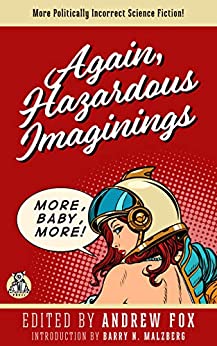
Last year, I had a short story published in the anthology Again, Hazardous Imaginings: More Politically Incorrect Science Fiction. Not only was it one of my highest paying short story sales to date, but it also made it onto the Tangent Online 2020 Recommended Reading List with a *** rating, their highest tier. Only 13 out of 293 stories on the list received that honor—and making the list at all was an accomplishment!

But a funny thing happened after the anthology came out: for a stretch of several months, I stopped receiving personalized rejections for my short story submissions, and instead got only form rejections. Normally when I write a cover letter for a short story submission, I mention the last three markets that I was published in. For example: “My stories have recently appeared in Again, Hazardous Imaginings; Twilight Tales LTUE Benefit Anthology, and Bards and Sages Quarterly (forthcoming).” In a typical month, I’ll get maybe a dozen or so form rejections and a couple of personalized rejections, depending on how many stories I have out on submission.

Back in March, I started to notice that I wasn’t getting any personalized rejections. Suspecting that my publication credit in Again, Hazardous Imaginings wasn’t helping me, I decided to change things up and only list my publication credits for stories listed in Locus Magazine’s Year In Review issue. My thinking was that all of the Hugo and Nebula eligible markets give their yearly reports in that issue, and since all of the editors want to acquire stories that are likely to win awards, a publication credit in one of those markets is more likely to get them to pay attention.

Lo and behold, I started getting personalized rejections again.

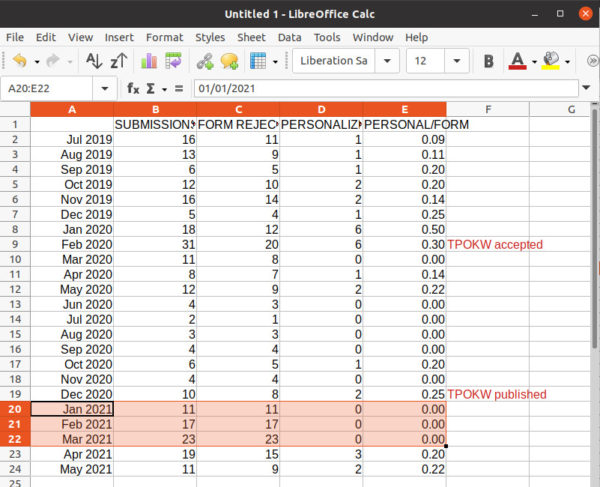
Just to make sure I wasn’t imagining things, I exported my data from The Submission Grinder and made a quick table of my submissions returned for each month going back to July 2019. Before “The Promise of King Washington” was accepted in February 2020, I was getting roughly one personalized rejection for every 5-8 form rejections. Then, for most of 2020, I went through a dry spell where I didn’t have many stories out on submission. Towards the end of the year, I got back in the saddle, and my personalized-to-form rejections ratio returned to what it had been earlier… but then Again, Hazardous Imaginings was published in December, and for the next three months, I received no personalized rejections at all. Then, around March-April, I stopped mentioning my publication credit in Again, Hazardous Imaginings… and I started getting personalized rejections again.

So what happened? Is there some sort of unofficial blacklist for stories published in Again, Hazardous Imaginings? Maybe, maybe not. I don’t know if any of the other authors in the anthology have had a similar experience, nor do I know for certain that mentioning the anthology in my publication credits caused this particular issue. It could be that I was submitting to higher paying markets at the beginning of 2021, and those markets just happen to be more stingy about personalized rejections. It could be that the pandemic has just sapped everyone’s energy.

But now that I’ve made this table, the one thing I cannot say is that the whole thing is just a figment of my imagination. There was a three-month period where I saw significantly fewer personalized rejections than usual, and it just so happened to coincide with the publication of the anthology Again, Hazardous Imaginings and my mentioning it as a publication credit in all of my cover letters.

It’s no big secret that most of the traditional short story markets in science fiction and fantasy trend somewhere between liberal and super woke. All you have to do to get a sense for this is subscribe to their podcasts or read their stories online. For most of 2020, I was subscribed to every science fiction podcast, and I frequently ended up skipping episodes because either the story was too woke, the author bio was little more than a checklist of intersectional victimhood groups, or the editor went off on some sort of political rant (typically of the “orange man bad” variety) that had little or nothing to do with the story. You can also get a good sense of the woke-ness by looking up these magazines’ submission guidelines and reading their diversity statements.

So for the last couple of months, I haven’t been listing Again, Hazardous Imaginings as a publication credit in any of my cover letters, and the response to my stories appears to have returned to the old normal… but it doesn’t sit right with me. Why should I have to hide that I was published in that anthology? Why shouldn’t I be proud of it? It did make Tangent Online’s recommended reading list with three stars, after all. Why should I waste my time submitting my stories to science fiction and fantasy markets that would see that publication credit as a black mark?

In other words, why not blacklist the blacklisters?

When an author decides not to submit their stories to a particular market, it’s often called a “self-rejection,” since the author has already decided that the story won’t be published before the editor gets a chance to consider it. But this is a little different. It’s not my own story that I’m rejecting, but the market as a whole. It’s making the conscious decision that if a magazine is too woke, I’m not going to have anything to do with it.

Here’s another way to think about it: why should I hold out for a year or longer, hoping to earn a couple of hundred bucks for it, when most of the markets that pay that well either aren’t interested in publishing the kind of politically incorrect stories that I tend to write, or aren’t going to publish an author like me who isn’t demonstrably woke enough? Even if I only end up selling it to a semi-pro market for less than fifty bucks, if it only takes a few months to make the sale because I’m not wasting time with the woke markets, does that make it worthwhile?

Or here’s yet another way to think about it: what other benefits do I get with my short story sales, besides how well it pays? If short stories are essentially advertisements for my other work, does it actually make sense to seek publication in the super woke markets, whose readers are mostly woke? Or does it make more sense to be published in the more conservative-leaning markets, with readers who are more likely to enjoy the other stuff that I write? And what about networking with similar-minded authors and editors? I made some really great connections through the anthology Again, Hazardous Imaginings, and even brought Andrew Fox, the editor, onto my newsletter for an interview. It was great!

All of this is happening as we’re starting to see an anti-woke cultural backlash gain momentum. Smarter people than me with a finger on the pulse of the culture say that the Snyder Cut is where the tide began to turn. The thing that tipped me off to it was the surprising waythat Coca-Cola walked back their critical race theory training after the “woke-a-cola” scandal. To my knowledge, there was no organized boycott, yet for a large corporation to backpedal so quickly tells me that they really took a hit to their bottom line.

In the coming months, I think we’re going to see a huge cultural shift against the woke moral panic that has gripped our nation for the last couple of years. That in itself is a subject for another post, but what it means for SF&F is that a lot of these woke awards and woke short story markets are well on their way to going broke. The few that endure will become niche markets for a very small audience that has completely divorced itself from the cultural mainstream—including the vast majority of SF&F readers.

Is it really worth hitching my wagon to such a horse? Or is it better to take a gamble on the up-and-coming markets that might not pay as much, but also aren’t carrying all the woke political baggage as magazines like Uncanny or Lightspeed?

Of course, if the answer to all of these questions is “yes, Joe—go for it!” the next big question is how to determine if a market is too woke? Because some of the markets have diversity statements that are fairly conservative-friendly, like “we welcome submissions from writers of all backgrounds!” and don’t use any of the woke value-signalling terms like “folx,” “latinx,” “QUILTBAG,” “indigenous,” “black bodies,” etc. In fact, I’m pretty sure that many of these markets only put out diversity statements to pacify the woke moral crusaders, in the same way that many boarded up stores and restaurants put up BLM signs hoping that the rioters sorry, the “peaceful protesters” would spare them.

One way to determine this is to look at which markets are chasing the wokest awards. The Hugos went woke in 2015, when “no award” swept the categories dominated by Sad Puppies nominees. That was really the moment when the fandom split, and the anti-woke readership abandoned the Hugos in disgust. The Rabid Puppies swept the 2016 nominations in what amounted to a hilarious sabotage operation (“Pounded in the Butt by Chuck Tingle’s Hugo,” hehe), but by 2017 that had all come to an end.

With that in mind, I went through all of the Hugo Awards to see which markets had either won an award or published a story that had won an award since 2015, and which markets had either been nominated or published stories that have been nominated since 2017. Here is what I found:

Hugo Winning Markets since 2015

  • Uncanny (5)
  • Lightspeed (1)

Markets with Hugo Winning Stories since 2015

  • Tor.com (5)
  • Apex (3)
  • Clarkesworld (2)
  • Lightspeed (1)
  • Uncanny (1)

Hugo Nominated Markets since 2017

  • Strange Horizons (5)
  • Beneath Ceaseless Skies (5)
  • Escape Pod (3)
  • Fireside (3)
  • FIYAH (3)
  • The Book Smugglers (2)
  • GigaNotoSaurus (1)
  • Cirsova (1)
  • Shimmer (1)
  • Podcastle (1)
  • Uncanny (1)

Markets with Hugo Nominated Stories since 2017

  • Tor.com (37)
  • Uncanny (18)
  • Clarkesworld (5)
  • Beneath Ceaseless Skies (3)
  • Fireside (2)
  • Lightspeed (2)
  • Asimov’s (1)
  • Strange Horizons (1)
  • Nightmare Magazine (1)
  • Diabolical Plots (1)

The counts for nominated markets/stories do not include the winners, but do include all of the nominations for 2021, even though the winners have not yet been decided.

I haven’t yet settled on a standard for deciding which markets are too woke for me to submit to. I suppose that’s something I’ll have to decide on a case-by-case basis, and for any who choose to follow my lead on this, it will have to be an individual decision. But I am rethinking the way I submit and publish my short stories, based on this experience. This post has already gone too long, and I still haven’t worked my new strategy out, but if you have any suggestions or ideas I’m interested to hear them.

Are short stories worth publishing?

Every couple of years, I get the short story bug and write maybe half a dozen short stories in the span of just a few months. Then, I get really excited about putting them up on submission, and for the next couple of years I systematically send them out to all the professional markets… and then the semi-professional markets… and then, when only a couple of them actually sell, I self-publish them. My enthusiasm gradually dies down, until I catch the short story bug again, and the cycle repeats.

When I caught the short story bug last year, though, it was immediately after NaNoWriMo, where I wrote 50k words of short stories instead of 50k words of a novel. That was so much fun that I think I’m going to do it every year. In fact, I may try out Camp NaNoWriMo too, just for the fun of it.

But this post isn’t about whether short stories are worth writing. That’s an artistic question, and the answer for most writers is probably some version of “yes, but…” The big question on my mind, however, is whether short stories are worth publishing—that is, are short stories worth it from a career/business perspective?

Several years ago (during one of those times when I’d caught the short story bug again), I wrote a blog post about whether it’s possible to make a living as a short story writer. I speculated that if you spent a year writing two short stories a week, that would give you a hundred stories by the end of the year. Keep it up, and after a few years you would have so many stories that by sheer numbers alone, you could do it.

Dean Wesley Smith came to a similar conclusion back in 2016, and again in 2018. The basic idea is to write like a madman out of hell, keep each one on submission for a couple of years, and self-publish them on a shoestring budget so that even if each one only brings in a few extra dollars, by sheer numbers alone, you make a decent living.

There’s just one problem.

There’s a site called The Submission Grinder that crowdsources writers’ rejection letters and acceptances to produce a lot of useful data on all of the various short story markets. After crunching this data, I discovered there are between 30-50 science fiction and fantasy markets that pay better than 5¢ per word. Most of them are temporarily closed at any given time, and very few of them accept multiple or simultaneous submissions. Furthermore, they all average about 25-30 days to respond to submissions.

What this means is that if you write faster than one short story a month, after only about a dozen stories or so, you will start to run out of available markets. Unless you write under multiple pen names or across multiple genres, you will very quickly develop a backlog of stories that won’t get submitted, simply because there aren’t enough places to submit to. So instead of taking one or two years for each story to work their way through the markets, it will take several more years or perhaps even decades, during which time those stories aren’t making any money for you at all.

As for self-publishing, I am currently experimenting with a lot of different ways to publish short stories, but what I’ve generally found is that short stories can be useful to do just about every other thing except make money selling them directly. If you price the singles at $2.99, you might sell as many as one or two per year, making less than $5. If you price them at 99¢, you may sell as many as a dozen per year, if you’re lucky—again, making less than $5. I didn’t have much luck getting bundles of 3-5 to sell, but larger collections of 10 to 12 stories do occasionally sell, and at a decent enough rate that I’m earning more on those stories than I would if I’d sold them individually as singles. But short story collections don’t sell anywhere near as well as novels.

So if you’re going to publish short stories, the best way to maximize earnings is to submit them to all the professional markets first, and to work your way through those markets as quickly and efficiently as possible. But that requires throttling your output, otherwise you’ll soon end up with a massive backlog of stories waiting for a place to send them. And self-publishing them all isn’t a panacea, because it’s very difficult to make money selling short stories directly. They can be useful for other things, like building your email list, converting readers to fans, and marketing your author brand, but all of this requires making those stories free—at least the singles, if not the collections.

But when you think about it, that makes sense, because most short stories are published for free anyways. When you sell a story to a professional or semi-pro market, it usually ends up on a podcast feed or a website somewhere, available for free in some form. These days, an avid short story reader doesn’t need to spend a dime to find high quality stories produced very well. If they do spend money, it’s usually because they’ve made a conscious choice to support an author, or a magazine, or an anthology that they love.

So is it worth publishing short stories? If you can break into the professional markets, probably yes, otherwise I’m not so sure. And while the best career writing advice is “be prolific,” I do think there’s a point at which the marginal cost vs. marginal benefit of writing another short story really doesn’t make any sense. I suspect that threshold lies somewhere around the point where the submissions backlog starts to build.

I’ll still keep writing short stories, because I do want to crack into those professional markets, and I do think the ancillary benefits of self-publishing short stories makes it worthwhile. But at best, it’s going to be a sideshow compared to everything else I do. Most likely I’ll reserve short stories to NaNoWriMo or Camp NaNoWriMo, and not even bother writing them for the rest of the year.

White Science Fiction and Fantasy Doesn’t Matter

If you are white, and you write science fiction or fantasy, it is only a matter of time before you are cancelled.

This is the logical end of intersectional identity politics, which is really just the resurrected, zombified corpse of Marxism. White people are the oppressors. People of color are the oppressed. All white people are racist, and the only way to fight racism is with more racism. Black lives matter. White lives don’t.

The United States of America is currently engaged in a violent struggle that will determine whether this hyper-racist intersectional ideology will defeat the populist uprising that has its champion in Trump, or whether the country will reject this new form of Marxism and come back from the brink of insanity. But in science fiction and fantasy, the war is already over, and the intersectionalists have won. It is now only a matter of time before they purge the field of everything—and everyone—that is white.

The last chance for the SF&F community to come back from the brink was probably in 2015. The intersectionalists were ascendant, but they hadn’t yet taken over the field. (That happened in 2016, when N.K. Jemisin, an avowed social justice warrior and outspoken champion for anti-white identity politics, won the Hugo Award for best new novel for the next three consecutive years.) A populist uprising within fandom known as the Puppies attempted to push back, and were smeared as racists, sexists, misogynists, homophobes, and Nazis. Whatever your opinion of the Puppies (and there were some bad eggs among them, to be sure), they did not deserve to be silenced, ridiculed, shouted down, and threatened with all manner of violence and death threats for their grievances. After the Puppies were purged, the intersectionalists took over and began to reshape the field in their image.

The John W. Campbell Award for Best New Writer wasn’t renamed the Astounding Award because Campbell was a racist (even though he was). His name was stripped from the award because the people who renamed it are racists—not in the bullshit way the intersectionalists have redefined it, but in the true sense of the word: discrimination based based on race.

Before I get smeared as a white supremacist for writing this post, I want to make it absolutely clear that I welcome racial diversity in science fiction and fantasy. I’ve been very pleased to read some excellent stories from people of color in Lightspeed Magazine recently, including “Miss Beulah’s Braiding and Life Change Salon,” and there have been several excellent stories from Chinese authors in Clarkesworld recently as well. I just don’t think it’s necessary to tear down white authors in order to make space for non-white ones. That’s the racism of intersectionality, and I reject it.

It is much easier for these intersectional racists to cancel you after you’re dead, but they’ll come after you while you’re still alive if they can. That’s what’s happening to George R.R. Martin right now. Frankly, I would have a lot more sympathy for him if he hadn’t made his bed with these people back during the Puppygate debacle. Behold your “true fans,” Mr. Martin. The fact that you’re the biggest name in epic fantasy right now isn’t going to save you.

But if the intersectionalists are all anti-white racists, why are so many of them white? Because for decades, crunchy liberal white folks have been taught that everything bad in the world is their fault, and the world would be better off without them. Climate change. Racism. Colonialism. It’s the white man’s burden 2.0. I know, because I was raised in this milieu. I was forced to read Howard Zinn’s People’s History of the United States in high school, and I know just how false and dangerous it really is. Besides, the revolution always eats its own. If you think you’re going to get a pass because you’ve read How to Be an Anti-Racist, you’ve posted a black square to your social media, and you’ve donated money to any of these social justice causes, you’re deluding yourself.

If you’re white, they’re coming for you. It’s not just your “whiteness” that they want to purge—that’s just a motte-and-bailey tactic to make their racism less overt and more palatable. The only thing they need to know about you is the color of your skin. If they know that, they think they know everything else about you, because they are the true racists—and in the world they’re trying to create, everything white must be purged.

The good news is that the cultural tides are turning, and the racist ideology that drives these folks is at or near its zenith. Marxism always fails, and cancel culture cancels itself in the end. If you play your cards right, getting cancelled can actually boost your career, rather than destroy it.

But the next ten years are going to be very tricky to navigate. Even if the intersectionalists lose on the national level, as I hope and pray that they do, they have already taken over the SF&F field so thoroughly and completely that the only way forward is to abandon all the old institutions and rebuild them from scratch. The indie publishing revolution has made this much more possible, but Amazon still dominates the indie publishing world, and they’ve already donated tens of millions of dollars to these Marxist causes. How much longer do we have before the intersectional ideologues within Amazon rewrite the algorithms according to their ideology? It’s only a matter of time.

Fortunately, if you are resilient enough, time is on your side.

A New Short Story Plan

So I’ve been thinking a lot recently about how best to leverage my short stories, not just from the traditional publishing angle, but from the indie publishing side as well. The problem is that self-published short stories really don’t sell much, so after you’ve sold them to a traditional market, what are you supposed to do?

I’ve tried all of the following things, with varying levels of success:

  • Publish single short stories and charge only 99¢.
  • Publish single short stories and charge $2.99.
  • Bundle 3-5 stories together and charge $2.99 to $4.99.
  • Bundle 10-12 stories into a collection and charge $4.99.
  • Give the singles away for free.
  • Turn the singles into newsletter magnets to gain new subscribers.

Taken individually, there are problems with all of these strategies. Short story singles don’t earn very much at any price, and while they garner a lot of downloads if you make them free, they don’t really lead to sales of other books unless they’re part of a larger series. Even then, not so much.

The bundles and collections don’t do much better. Dean Wesley Smith says you can bundle 3-5 short stories together just fine, (or at least, he used to say that) but I tend to think that readers prefer collections with at least 10-12 short stories in them. At this point, I don’t self-publish a collection unless it has at least 40,000 words.

Short stories can be useful as newsletter magnets, but I’ve found that first-in-series books get a higher CTR than standalone shorts. Besides, it’s much more useful to send a follow up email to a first-in-series book (“Have you read ____ yet? Here’s what comes next.”)

So what’s the best way to self-publish short stories?

Let’s take a look at this from a reader’s perspective for a moment. These days, most short stories from the magazines are available for free. They’re either available on a podcast feed, like Uncanny or Escape Pod, or they’re published on a website for a limited time (sometimes for an unlimited time.) There are a handful of magazines like Asimov’s and F&SF that put their content behind a paywall, (usually a subscription of some kind) but there are also magazines like Clarkesworld that put their content up for free on the podcast AND offer an optional subscription. In fact, I believe it was Clarkesworld that discovered that revenue actually went up when they put everything out for free.

So as a short story reader, there’s really no need for me to purchase single short stories, since so many of them are available from the magazines for free. In fact, I would probably prefer to get my stories from a magazine, since I know they’ve been vetted by an editor. If I like a particular author, I may pick up some of their short stories, but I’m more likely to wait until they’ve bundled them into a collection of some kind, just to maximize the value.

Anthologies are a different story (sorry for the pun.) I have yet to see a short story anthology that isn’t priced like a regular book—no free or 99¢ ebooks. That’s probably because, as a short story reader, I know I’m getting a bunch of stories for that price. It’s kind of like buying an album, back in the days before Spotify: I know I’m going to get a couple of stinkers, but I also know that I’ll get some really great ones too. But if there are only 3-5 stories in that bundle, I’m going to think twice before buying it unless it’s at a super deep discount price. After all, I can always get my short story fix for free.

So if there are enough high-quality short stories availabe from the magazines for free, and self-published singles don’t really earn much at all, what’s the best way to go indie? Here’s my thought: sell anthology-sized collections at full price and make all the singles free, with the backmatter in the free stories pointing to the collections.

As a short story reader, I’m already used to paying for anthologies—and I’m more likely than other readers to buy them, since I’m the kind of reader who seeks out short stories. So if I pick up a handful of free short stories from an author and come to really enjoy her work, I’m already primed to buy her collections when I finish each story—and that makes the backmatter of each free single the best place for her to advertise her collections.

It’s a bit like first-in-series free, except instead of the one free book pointing to the rest of the series, there’s a bunch of free short stories all pointing to the same one (or two or three) collections. The typical reader is probably going to need to read a few of an author’s short stories anyways to really become a fan, so making all of the stories free could really be the way to go.

Of course, the big downside to this as an author is that you probably can’t sell reprint rights to the stories that are available as free singles. Why would an editor buy your story for their publication if it’s already available for free? So you would have to make the singles free for a limited time, if selling the stories to the reprint markets is part of your strategy.

But if you’re going to eventually bundle those stories into a collection, that’s not really a problem. Publish them as free singles as soon as the rights revert back to you, and then take down the singles when you have enough of them to put into a collection.

So under this hybrid publishing system, the typical lifecycle of a short story would look something like this:

Stage One: Submitting to the Traditional Markets

The goal of the first stage is to sell first publication rights to a professional or a semi-pro market (typically a magazine or an anthology.) So before self-publishing, you would submit to all of the traditional markets, and keep the story on submission until it has sold. But you would have to limit yourself to the markets with a pay rate that you’re willing to accept, otherwise you might as well just self-publish.

If my goal is to be a 6-figure author, I should value my time at $50/hour at least (since $50/hour X 40 hours/week X 50 weeks/year = $100,000/year.) That means I can use my writing speed to calculate my minimum pay rate. If I can write 2,000 words in an hour, then that’s $50/2,000 words, or 2.5¢ per word. Round that up to 3¢ per word, and that’s the minimum pay rate that I should be willing to accept.

Once the story has sold, the contract will dictate when I can self-publish. Most contracts have an exclusivity period of a few months to a year. Every contract is different, so how long the story remains in this phase depends on each contract.

Stage Two: Self-Publishing as Free Singles

This is where you start to implement the strategy that I discussed above. As soon as the rights revert back to you, you self-publish them as short story singles—but rather than trying to make money with them, you give them away for free in order to point readers toward your collections.

In other words, after a short story has been traditonally published, it goes through a temporary period where it’s used as a free loss leader. This period ends as soon as the author has enough shorts to bundle into a novel-sized collection—but since there are always at least a few free singles floating around, it serves as an effective way to attract new readers and win over new fans.

Stage Three: Collections and the Reprint Markets

This is the final stage, where you take down the free singles and bundle them into collections instead. Once that’s done, you update the backmatter in all of the other free singles to include links to buy the new collection, and the story starts to earn money for you again.

Because the story is no longer a free self-published ebook, it makes sense to start submitting to the traditional markets that buy reprint rights, since why not? At this point, it’s free money. I generally don’t accept anything less than 1¢ per word, since I’ve found that the token-paying markets don’t make an appreciable dent in any of my stories’ lifetime earnings, but that’s just me.

I think this three-stage lifecycle may be the best way to extract the maximum value from my short stories. Like pawns in the game of chess, it’s not what each story individually is doing, but how they’re working together. A self-published single that sells only a dozen copies (if that) per year isn’t doing much for me, and while I can use them to gain new subscribers, there are more effective tools for that than standalone short-stories.

In any case, I’m going to give it a try. It will be interesting in a few months to see how it turned out!

2019-10-03 Newsletter Author’s Note

This author’s note originally appeared in the October 3rd edition of my author newsletter. To subscribe to my newsletter, click here.

When Mrs. Vasicek and I got married, we decided that there would be no smart devices or screens in our house beyond the master bedroom. Our reasoning had mostly to do with personal health and avoiding bad habits, though there was also some concern about data collection and privacy.

One of the things I really like about this rule is that it keeps me from becoming too attached to my smart phone. Most of us are never be more than an arm’s reach away from our phones, and over time we come to feel almost like they’re a physical part of us. But every night, Mrs. Vasicek and I leave our phones to get ready for bed, and we don’t pick them up again until after we’re fully awake.

I have to admit that I had withdrawals at first, but now I feel much better. My phone is just another tool now; it no longer feels like an extension of myself.

Another thing I really like about this rule is how it sets apart a large section of the house that is free from digital distractions. The bedroom is now a really great place to read. Our one exception to the no screens rule is my Kindle Paperwhite, which uses e-ink anyway so it’s not as bad as an LED screen. It’s also seven-and-a-half years old, so web browsing isn’t really practical.

The other thing I really like is how it sets my mind at ease to know that there’s at least one part of the house where there aren’t any digital recording devices surveilling and collecting data on us. (Please don’t tell me that the Paperwhite is recording me too!)

In the last few years, it seems that Big Tech has been increasingly intrusive in our lives. Over the summer, it seemed like every week there’d be a new story about a Silicon Valley whistleblower, or an undercover investigation, or even a senior Google executive coming out on the record about censorship, bias, and control.

A couple of weeks ago, Glenn Beck did a fascinating interview with Robert Epstein, a researcher who found compelling evidence that Google has both the capability and the motivation to sway major national elections. (Epstein voted for Clinton in 2016, so the interview wasn’t partisan.) It reminded me of a presentation that Chamath Palihapitiya (senior executive at Facebook from 2007 to 2011) gave at Stanford in 2017, where he talked about social media addiction and explained why he doesn’t use social media nor allow his children to do so.

It’s becoming increasingly difficult to navigate our modern, complex world in a way that doesn’t surrender most of our agency to Big Tech and Silicon Valley. It’s also becoming increasingly ambiguous how much of that agency is an illusion, with companies like Facebook and Google influencing us in ways we aren’t consciously aware of.

As an indie author who depends on Amazon for a large part of my income, I’m very much aware of these issues. It’s part of the reason why I’m working so hard to build and maintain this newsletter, so that I don’t have to depend on Big Tech for my book marketing. It’s impossible to be a career author these days without a plan for navigating this world.

Where are we headed? Science fiction gives us a chilling answer. Right now, it appears that China and the East are going the way of 1984, while the United States and the West are going the way of Brave New World.

But those books were written almost a hundred years ago, and technologies have been developed that Orwell and Huxley couldn’t have even dreamed of. It’s time for a new generation of writers to pick up the torch that they handed off to us.

That’s a big reason why I’m writing “Sex, Life, and Love under the Algorithms.” As for where to go next, I honestly don’t know. So much happening in the world today screams out for new science fiction just to make sense of it all, so when I’m not writing fantasy I’ll probably delve more into that.

Whatever else happens, we’re all in this rabbit hole together.

2019-08-15 Newsletter Author’s Note

This author’s note originally appeared in the August 15th edition of my author newsletter. To sign up for my newsletter, click here.

It was not an easy decision to enroll all of my Star Wanderers books into Kindle Unlimited. For years, this was my flagship series, not only on Amazon but on all platforms. Enrolling it in KU means that the ebooks are only available on Amazon now, and the first book is no longer free to non-KU subscribers.

In the indie author community, KU has always been a controversial program. It all boils down to one word: exclusivity. In order to enroll your books in KU, you cannot publish them anywhere else but Amazon. The upshot is that Amazon’s algorithms give your books a huge signal boost—about 2.5x, by my back-of-the-envelope calculations. Getting writers to do anything is a bit like herding cats, but with the right incentive structure you can do it. Amazon wants to be the dominant retailer for ebooks, and KU is their tool for doing it.

I don’t blame readers for subscribing to KU. It seems like a great program: $9.99 per month gives you an awesome selection of books to choose from. And certainly, Amazon can do what it wants on its own platform. If that means reducing the visiblity of books that aren’t exclusive to your platform, so be it. But as a matter of principle, I believe that exclusivity is bad for readers and writers, which is why I’ve stayed out of the program.

Until now. What changed? A few things. Earlier this year, I finally wrote out a complete business plan that describes everything I do (72 pages, 22.2k words). That made me rethink a lot of things, especially my marketing strategy. If Amazon gives books in KU such a huge signal boost, could I use that to bring more readers to my books that aren’t in KU? If none of my books are enrolled in KU, isn’t that just another way of making my books exclusive?

When Kindle Unlimited launched in 2014, I had finally reached a point where I could live off of my book royalties. A lot of that was because of Star Wanderers: with a permafree first-in-series, it got a lot of visiblity. But then, the Amazon algorithms changed to favor KU over permafree. I chose to stay out of KU, and lost more than 60% of my writing income over the next 18 months as a result.

I learned several things from that experience. First, I learned that I couldn’t rely on Amazon to do my marketing for me. I had to come up with a plan. Second, I learned that it was a bad idea to be dependent on just one platform. It was time to diversify.

Paradoxically, this meant doubling down on my decision to keep my books out of KU. But it paid off. In 2014, more than 90% of my writing income came from Amazon. Now, it’s more like 40%-60%, depending on the month. If I had panicked and put all my books in KU, I wouldn’t have those other income streams right now, and many of those readers never would have found me.

Over the years, I also became less dependent on Star Wanderers as well. I began to move toward writing trilogies of longer books instead of longer series of shorter books. And as I wrote and published more books, interest in my Star Wanderers books seemed to wane.

So now I’m in a place where enrolling Star Wanderers into KU actually makes sense. I have a plan and a marketing strategy, I’m not dependent on Amazon anymore, and the books themselves seem well-suited to the experiment. We’ll see how it turns out.

If you’re not an Amazon customer, don’t worry: I’m not going to enroll all of my books in KU, and still plan to release all of my new books wide. For now, it’s just Star Wanderers. And if you are a KU subscriber, I hope you enjoy! These books have a very special place in my heart, and I’m happy to share them with you.