X is for Xenocide

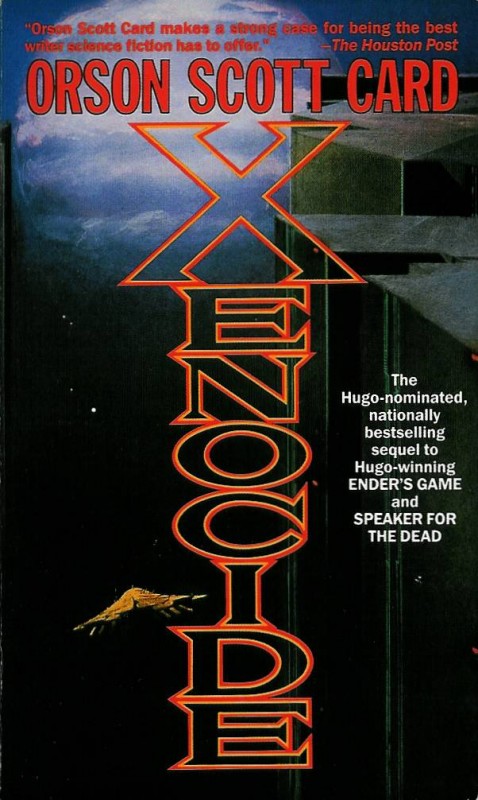
xenocideThis post isn’t just about the third book in the Ender’s Game series–it’s about the genocide of an entire alien race, which is actually a fairly important trope in science fiction.

Of all the evils of our modern era, perhaps the most heinous is the systematic extermination of an entire race or ethnicity.  These acts of genocide not only cross the moral event horizon, they create specters and villains that live on from generation to generation.  Just look at how the Nazis are portrayed in popular culture–even today, they are practically mascots of the ultimate evil.

And for good reason.  There really is something evil about the total annihilation of a foreign culture.  It’s one of the reasons why terms like “genocide” and “ethnic cleansing” are so controversial, especially in conflicts that are still ongoing–and there are so many unresolved conflicts where the systematic and purposeful annihilation of a race or culture is still happening.

Is wholesale genocide a phenomenon unique to our modern age?  Probably not, but modern science has enabled it on a scale that was previously impossible.  This became all too clear to us after World War II.  Only a generation before, great numbers of people believed that we were on a path of progress that would eventually culminate in world peace.  If there was any of that sentiment left, it was shattered with the liberation of Auschwitz and the bombings of Hiroshima and Nagasaki.  Suddenly, we realized that systematic mass destruction and genocide were not only possible, they were a modern reality.

It should come as no surprise, then, that science fiction immediately began to explore this issue.  From Frankenstein to 1984, science fiction has been full of cautionary tales of science gone wrong, issuing a critical voice of warning.  But after 1945, it went much further, exploring the issue in ways that can only be done in a science fictional setting.

Is genocide ever morally justifiable?  In our current world, probably not, but what if an alien race was bent on our destruction?  If their primary objective was the utter annihilation the human race, and negotiation was impossible?  Wouldn’t it be justifiable–perhaps imperative even–to stop such a race by annihilating them first?

This is what is meant by the term “xenocide.” A portmanteau of “xenos,” the Greek word for stranger, and “genocide,” it denotes the complete extermination of an alien race.

Xenocide forms the core conflict of Orson Scott Card’s Ender’s Game series (hence the title of the third book) and features in The Forever War by Joe Haldeman.  Battlestar Galactica presents an interesting twist, where the cylons debate the ethical questions surrounding the complete annihilation of the humans.  And then, of course, there’s all the time travel stories involving Hitler–let’s not even go there.

The interesting thing about xenocide stories is that even though they describe a dilemma that does not currently exist in our modern world, they inevitably come down to issues of Otherness that lie at the very core of the evils of genocide.  In order for xenocide to be morally justifiable, you have to know your enemy well enough to know that there’s no possibility of forging any sort of peace with them.  And to know them that well, they cease to be quite so alien.  It’s one of the major themes in Orson Scott Card’s work–that to defeat an enemy, you have to know them so well that you can’t help but love them.

In our modern world, genocide is only possible when an ethnic group is relegated to the position of Other–when they are made out to be so different and unlike us that we can never possibly relate to or mix with them.  They become “sticks” (Germany), “cockroaches” (Rwanda), “animals” and “barbarians” (Israel).  That is precisely why it makes us uncomfortable in stories about xenocide–because it turns the well-intentioned saviors of humanity into knights templar, or possibly the very monsters they are trying to destroy.

By positing a situation in which genocide might actually be justifiable, science fiction helps us to understand exactly why it is so reprehensible–and that’s only one of the ways in which the genre can uniquely explore these issues.  That’s one of the things I love so much about science fiction: its ability to take things to their extreme logical conclusions, and thus help us to see our own real-world issues in ways that would otherwise be impossible.

Since most of my characters are human, xenocide as such isn’t a major theme in my books, but genocide certainly is.  In the Gaia Nova series, the starfaring Hameji look down on the Planetborn as inferior beings and think nothing of enslaving them and slagging entire worlds.  That’s how Prince Abaqa from Stars of Blood and Glory sees the universe at first, but by the end of the novel he’s not quite so sure.  Stella from Sholpan and Bringing Stella Home also deals with these issues as she comes to realize how it’s possible for the Hameji to hold to such a belief system.

If genocide is one of the ugly skeletons in the closet of this screwed up modern world, then xenocide is science fiction’s way of taking those skeletons out and dignifying them with a proper burial.  By wrestling with these issues in stories set on other worlds, we are better able to humanize the Other and prevent these horrors from happening again on our own.  In this way and so many others, science fiction helps us to build a better world.
W is for Wagon Train to the Stars

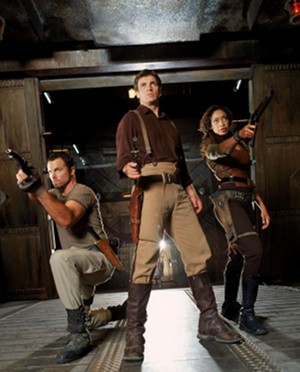
big_damn_heroes_moment_smallWhen Gene Roddenberry pitched the original Star Trek series back in the 60s, Westerns were all the rage.  Consequently, he pitched his show as a “wagon train to the stars,” where a bunch of quirky characters on an awesome starship travel from adventure town to interstellar adventure town, exploring and pioneering the final frontier.

Sound familiar?  Yeah, I thought so.  The concept proved so catchy that it’s been redone time and again, from Battlestar Galactica to Firefly to Doctor Who.  Even though Westerns aren’t nearly as popular as they used to be, many of its tropes are so well suited to Science Fiction that they drive the genre even today.

For example, adventure planets.  In a typical Western, the characters travel from town to town, with a different adventure in each one.  Well, in Science Fiction, the characters do the same thing, except that they’re traveling from planet to planet.  And really, if you’ve got the ability to travel to other worlds, how can you not have an adventure in each one?

A large reason for the Western / Science Fiction crossover is the whole concept of space as the final frontier, which we explored earlier in this series with I is for Interstellar.  There’s a very real sense of manifest destiny in the space exploration community, not because of humano-ethnocentrism (heck, we don’t even know we’re not alone in our local stellar neighborhood), but to ensure humanity’s long-term survival.  The parallels between that and the westward movement in 19th century America aren’t perfect, but they do exist.

Similarly, as we explored in R is for Rebel, the notion of space as the final frontier has a special resonance with the American audience.  The days of the old frontier may be over, but its spirit lives on in our culture, from guns to road trips to our glorification of the rugged, self-made individual.  Today’s Science Fiction, especially the space-focused SF of Space Opera, grew out of the adventure fiction of the pulps, which thrived on that frontier American ethos.

In fiction, the frontier can still be found in two major genres: the Western, which is historical and therefore more backward-looking, and Science fiction, which is futuristic and therefore more forward-looking.  Because Science Fiction isn’t burdened with all of the historical baggage of the traditional Western, it’s a much more flexible medium for story, readily adaptable to contemporary issues and concerns.

For example, where Star Trek echoes the large-scale nation to nation conflicts of the Cold War (Federation vs. Klingons and Romulans), the new Battlestar Galactica series echoes the much more asymmetrical conflicts of the post-9/11 world (Cylon agents who are indistinguishable from humans and may not even know that they are cylons).  At the same time, the wholesale co-opting of Western tropes enables a latent sense of nostalgia, evident in the look and feel of Firefly, or the famous opening lines from Star Wars: A long time ago in a galaxy far, far away.

My first real experience with a wagon train to the stars type of story was probably Star Trek: Voyager, which I watched religiously with my dad every Wednesday night until maybe 9th or 10th grade.  The Western-borrowed tropes are somewhat more muted in that series, but they exist, especially the planetville / adventure towns stuff.  However, it wasn’t until Firefly and Serenity that I really experienced the awesomeness of a true Space Western.  There were a lot of things in Firefly that I really loved, especially the character interactions, the gun-toting action scenes, and especially the starship Serenity.  There were some things I didn’t like so much, like the fact that every planet is basically Wyoming, but overall I really enjoyed the show.

It wasn’t until I started getting more acquainted with straight-up Westerns that I saw the real potential for crossover between the genres.  Stories about mountain men like Jeremiah Johnson really captured my imagination–what would this look like if it were set in space?  In that sense, I came to the Space Western more from the classic Science Fiction side first, rather than the pulp adventure stuff.  But once I discovered the crossover connection, it naturally found a way into my own work.

That’s basically how the story idea for Star Wanderers first came to me.  I was lying on my bed, daydreaming about having my own starship like the Serenity, when I wondered what it would be like for a starship pilot to get roped into an accidental marriage like in the movie Jeremiah Johnson?  The collision between the two ideas was like a supernova exploding in my brain.  I rolled out of bed and started writing, coming up with chapter one of Outworlder almost exactly like it’s written today.  And the more invested I became in those characters and that world, the more the story grew.  I’m writing Part VII right now (Reproach, from Noemi and Mariya’s POV), and so long as people read them I’ll keep writing more.

Genre mash-ups and crossovers are a great way to keep things fresh and come up with some really interesting stories.  Some genres aren’t very well suited for each other (Erotica and Middle Grade, for example), but others come together so well that they seem almost complementary.  That certainly seems to be the case with Westerns and Science Fiction, at least here in the United States where the spirit of the frontier still echoes through the popular culture.

N is for Nebula

659px-NGC_6302_Hubble_2009.full

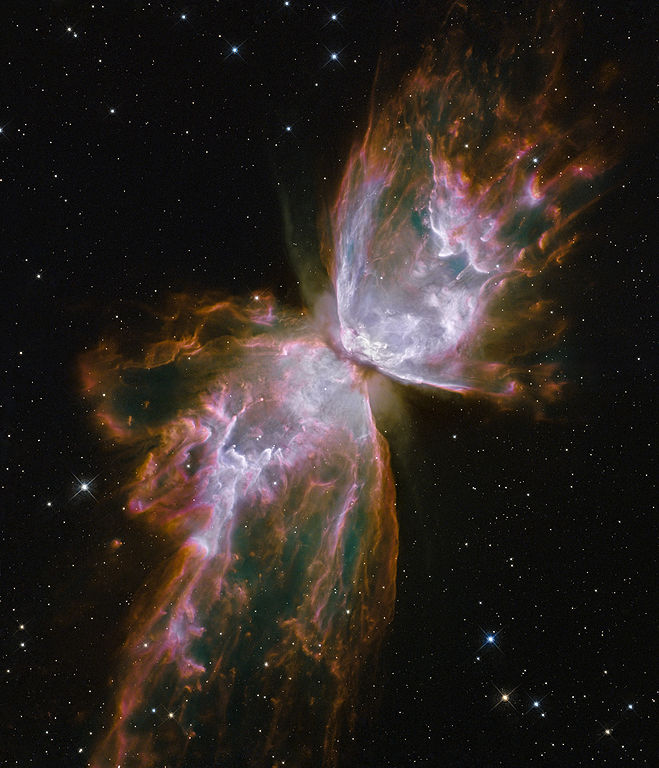
Of all the objects in space, nebulae are some of the most beautiful and awe-inspiring.  These giant clouds of gas and dust span light-years, and often contain stellar nurseries where new stars (and with them, new planets) are born.  Few things can fill me with a greater sense of wonder than a detailed, high-res image of a nebula.

Many of the classic nebulae images come from the Hubble Space Telescope, which has probably done more to bring that sense of wonder to the general public than any other telescope.  These images, all of which are released by NASA into the public domain (with very few restrictions), have been shaping the pop culture dialogue about space and astronomy for more than a generation.  They’ve certainly had a tremendous impact on me.

There are many different kinds of nebulae.  The largest and most stunning ones are mostly diffuse, meaning that they have no clear boundaries where they begin and end.  These come in two basic flavors: emission nebulae, which glow on their own due to ionized hydrogen gas, and reflection nebulae, which consist mostly of dust and don’t glow on their own, but reflect the light of nearby stars.

The Witch Head Nebula is a classic reflection nebula.  Doesn’t it look eerie?  It’s probably because of the way it reflects blue and purple.  Many reflection nebulae share those same colors.

The Orion Nebula, one of my personal favorites, is a massive region of star formation visible just below the three iconic stars of Orion’s Belt.  It contains large regions of both reflection and emission.  In the center of the thickest clouds are dozens of young stars with protoplanetary disks–new solar systems in the process of being born.  How many of these will go on to form planets capable of hosting life?  Just a few billion years ago, our own sun may have been born in a cloud of gas and dust like this one.

The Helix Nebula, also known as the Eye of God, is apt to make you do a double-take the first time you see it!  It looks almost like an eye, watching you from the midst of the heavens.  Just as clouds here on Earth tend to form shapes and patterns that look like other things, so do nebulae.

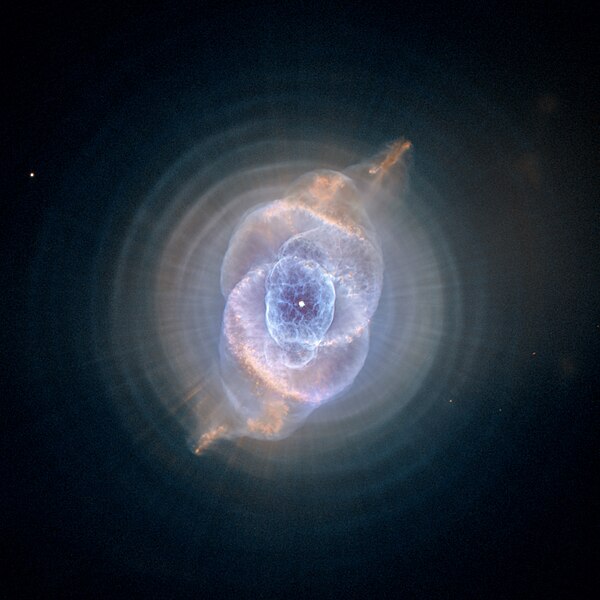
The Cat’s Eye Nebula is another one of those gorgeous space objects that’s apt to give you a double take.  Both the Cat’s Eye and the Helix are Planetary Nebulae, which form after a star burns off its outer layer and collapses into a white dwarf.  The name is kind of misleading, because they don’t really have anything to do with planets at all–they just look a bit like them, when all you’ve got is a low powered telescope to view them with.

One of the most famous Hubble images is the Pillars of Creation, a close-up image of a stellar nursery within the Eagle Nebula.  Stars form when clouds of gas and dust become so dense that they collapse on themselves, creating a gravity well that sucks up more of the surrounding dust and gas.  As enough matter accumulates, the pressure and heat at the center grow until the whole thing goes nuclear.  When nuclear fusion begins, the newborn star sends out a strong stellar wind that pushes away any remaining dust and gas from the rest of the nebula.  After several million years, the whole cloud is blown away, leaving us with a star cluster like the Pleiades.

In the Pillars of Creation, the long, finger-like clouds of the nebula are so dense that they appear dark and opaque, blocking out any light from the other side.  These kinds of structures are called molecular clouds, after their ability to form molecules due to their increased density.  In this image, though, we can see a group of newborn stars just starting to blow away the cloud’s outer shell.  Once the cloud is completely blown away (in just a few thousand years or so), these stars will shine clearly enough for us to see–but for now, they’re hidden inside those pillars where they were born.

The Crab Nebula is particularly fascinating, not only for the stunningly complex structures visible in this image, but because less than a millennium ago, it used to be a star.  In 1054, medieval astronomers in Europe, Asia, and the Americas reported the appearance of a new star, bright enough to be seen even in daylight.  What they actually saw was a supernova, the spectacular death of a massive star.  When a star goes supernova, it explodes with as much energy in just a few days or months as it put out during its entire lifetime.

The outer layers were blasted out to form this nebula, while the inner core collapsed and formed a neutron star–an object so dense that it contains as much as three times the mass of the sun in a sphere roughly the size of New York City.  If the supernova is really big, the star might even collapse into a black hole.

Because of how fascinating and gorgeous nebulae can be, it should come as no surprise that they often show up in science fiction.  When you have a starship and can travel at ease across the stars, nebulae become a part of the geography of space, just like forests and mountain ranges in a fantasy setting.  I haven’t played any of the Mass Effect games yet, but apparently they do this quite a lot.  In the re-imagined Battlestar Galactica series, the colonists are able to set a course for Earth after using the Lagoon Nebula to orient themselves relative to the stars of the zodiac.  And of course, who can forget the classic battle between Kirk and Khan at the end of Star Trek II: The Wrath of Khan?

In real life, though, it’s much more likely that nebulae like the ones above wouldn’t even be visible if you got up close to them.  Even though they’re much denser than other regions of space, they’re still for the most part much less dense than our planet’s own atmosphere.  From a distance, they appear bright because we can see the entire structure in one field of view, but up close, it’s possible that you wouldn’t even know you were in one.

That being said, it sure makes for more exciting fiction when the nebulae are these giant mysterious clouds capable of hiding an entire space fleet.  And really, who knows what these things are actually like up close?  For now, all we can do is watch them from afar.  But someday, if science fiction becomes reality, we may be able to be firsthand witnesses to the births and deaths of stars.

L is for Lost Colony

worthingsagaAs we discussed in I is for Interstellar, space colonization is a major theme of science fiction, especially space opera.  Of course, things don’t always go smoothly.  Space is a really, really, really big place, and sometimes, due to war or famine or simple bureaucratic mismanagement, colonies get cut off from the rest of galactic civilization.  They become lost colonies.

Some of my favorite stories are about lost colonies: either how they became cut off, or how they reintegrate after so many thousands of years.  In many of these stories, the technology of these colonies has regressed, sometimes to the point where the descendents may not even know that their ancestors came from the stars.  When contact is finally made, the envoys from the galactic federation may seem like gods or wizards.

Because of this technological disconnect, stories about lost colonies often straddle the line between science fiction and fantasy.  After all, Clarke’s third law states:

Any sufficiently advanced technology is indistinguishable from magic.

Of course, the line between science fiction and fantasy has always been a fuzzy one.  Hundreds of attempts have been made to define it, but they all fall short.  In the end, it often breaks down to certain recurring tropes, like dragons and wizards versus ray guns and rockets, but even that doesn’t always work.

For example, Anne McCaffrey’s Dragonriders of Pern is technically about a lost colony far into the future, but it’s got dragons and castles and other tropes that belong squarely in fantasy.  Then again, the dragonriders have to fight alien worms who invade every few dozen years from a planet with a highly elliptical orbit, so there’s still a strong science fiction basis undergirding the whole thing.

And that’s just Dragonriders of Pern.  What about Marion Zimmer Bradley’s Darkover series, or C.S. Lewis’s Space Trilogy?  Trigun is more western than fantasy, but it’s also full of sci-fi tropes like giant sand-crawling monster ships and a weird post-apocalyptic backstory.  And then there’s all the Japanese RPGs that combine magic with mechas, with Xenogears as one of the best examples.  For a distinct Middle Eastern flavor, look no further than Stargate.

It’s no coincidence that all of these stories feature a lost colony of one kind or another.  When the characters don’t know that they’re living in a science fictional universe, it’s very easy to throw in tropes from other genres.  By no means is it required–Battlestar Galactica and Dune are evidence enough of that–but they certainly present the opportunity to do so.  After all, lost colony stories basically present a hiccup in humanity’s march of progress, breaking the essential science fiction narrative for all sorts of interesting side stories and tangents.

One perennial favorite of science fiction writers is to suggest that Earth itself is a lost colony from some other galactic civilization.  That forms the entire premise behind Battlestar Galactica: the original twelve colonies have been destroyed in the human-cylon wars, and the last few survivors are searching for the legendary thirteenth colony of Earth, hoping to find some sort of refuge.  Apparently, Ursula K. Le Guin’s Hainish cycle also plays with this trope, though she’s never very explicit with her world building.  It can be a bit tricky to twist the lost colony trope in this manner, but if pulled off right it can really make you sit back and go “whoa.”

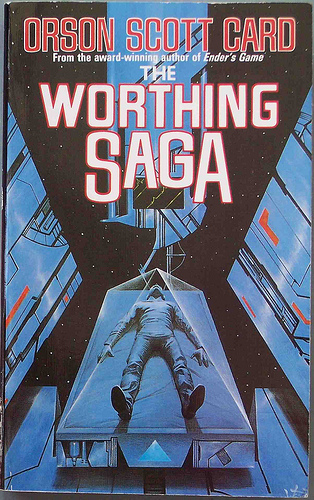
My personal favorite is probably Orson Scott Card’s The Worthing Saga, about a colony of telepaths that breaks off from a collapsing galactic empire and actually becomes more advanced than the rest of humanity.  When Jason Worthing and Justice re-establish contact, the descendents of the galactics are basically pre-industrial subsistence farmers who view them as gods–which, in a certain sense, they almost are.

It’s a great story that really entranced me, not just for the science fictional elements but also for the distinct fantasy flavor.  Orson Scott Card’s handling of viewpoint in that book is truly masterful, so that I felt as if I were viewing everything through the eyes of his characters.  Since the farmers don’t know anything about their spacefaring ancestors, all the parts from their point of view feel like a completely different story.  It was really great.

My first novel was actually a lost colony story, combined with a first contact.  I trunked it a long time ago, but many of the earliest posts on this blog are all about my experience writing it.  As for my other books, Desert Stars contains elements of this, though the lost colony in question is actually a nomadic desert society that lives on the capital planet of the galactic empire, just outside of the domes where all the more civilized folk live.  Heart of the Nebula is basically about a society that puts itself in exile in order to escape the privations of the Hameji.  And in… no, I’d better not spoil it. 😉

The lost colony isn’t one of the flashier or more prominent tropes of science fiction, but it’s definitely one of my favorites.  It’s a great way to add depth and intrigue, as well as bend genres.  For that reason, I think this trope does a lot to keep science fiction fresh.

J is for Jedi

Ben_KenobiAs much as science fiction looks to the future, it also of necessity looks to the past.  And as much confidence as it places in the scientific method, it often turns to religion, simply because of the scope of the great cosmic questions that such stories inevitably pose.

For these reasons, it should come as no surprise that the best science fiction stories often include knights and shamans, priests and warrior monks.  Far from degrading our view of the future, they greatly enrich and humanize it, bringing a sense of meaning and destiny to an otherwise cold and lonely universe.

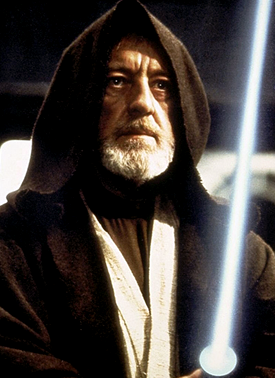
The best example of this is probably the Jedi from the original Star Wars trilogy.  I still get shivers when I hear Yoda explain the force:

Size matters not. Look at me. Judge me by my size, do you? Hmm? Hmm. And well you should not. For my ally is the Force, and a powerful ally it is. Life creates it, makes it grow. Its energy surrounds us and binds us. Luminous beings are we, not this crude matter. You must feel the Force around you; here, between you, me, the tree, the rock, everywhere, yes. Even between the land and the ship.

There are plenty of other examples too, of course–harsh ones like the creeds the Cylons follow in the re-imagined Battlestar Galactica, which they use to justify their genocidal war against the humans.  And then there are the quaint and simplistic ones that happen when a primitive race makes first contact with humanity … as well as the ones from a race so advanced that they make us look like barely evolved monkeys.

So why is religion so prominent in science fiction?  Probably because the best science fiction stories act as a mirror that allows us to see ourselves better.  Throughout history, religion has been one of the most important parts of any human civilization.  Even the modern secular cultures still grasp at the same cosmic questions, striving to find meaning beyond the animal drives of food, sleep, and sex.

At its core, every religion is about telling a cosmic story.  There’s a reason why the Bible starts with the words “in the beginning,” and why the first sura of the Qur’an names Allah “The Merciful and The Compassionate.” Since the best science fiction also tells a cosmic story, is it any surprise that there should be overlap between the two?

The best science fictional religions are the ones that make you want to believe.  The Force in Star Wars was definitely like that to me (the original trilogy, of course–before all that midi-chlorian nonsense).  Orson Scott Card’s philotic web also turned me into a believer, at least for the duration of those books.  Even Eywa from the movie Avatar had some deep undertones that made me wish I was a part of that world.

Religion plays a huge role in my own books, not just the stuff that I believe in real life (though I’m sure that influences my writing), but the stuff that I think the characters would believe.

In Star Wanderers, for example, most of the outworlders are pagans who pray to the stars.  In that universe, astrogation is an act of worship.  The Deltans subscribe to a fusion of pagan and Christian beliefs, which in turn affects how much they value families and children.  I won’t spoil it, since it comes as something of a reveal in Homeworld, but it definitely drives the series.  And of course there’s Jeremiah’s New Earther background, with its guilt complex that leaves him emotionally scarred.

My favorite religion to write so far was the faith of the desert tribesmen in Desert Stars.  I wrote that book just after spending a summer in the Middle East, and my experience of the Muslim culture definitely was a huge influence.  The tribesmen pray to the Temple of a Thousand Stars, the temple erected to the memory of Earth soon after the first colonists made planetfall.  The first half of the book follows Jalil’s pilgrimage to the ancient temple, through the domes filled with strange and decadent people.

When I started the Gaia Nova series, I wanted to create a science fictional universe where any of our real-world religions could still plausibly be true.  The way I got around all the conflicting prophecies of the end times was to have a human colony mission leave Earth soon after our time.  When the colonists woke up, they’d lost the location of Earth, so naturally all the religions developed around the idea that Earth had received its prophesied glorification and become a heavenly paradise.

That’s the short explanation, anyways.  But the books themselves aren’t so much about that as they are about the characters.  If religion is important to them, then that becomes an important part of their story.  And since religion is so important to us here on Earth, I can’t help but believe that it will follow us to the stars.

B is for Space Battles

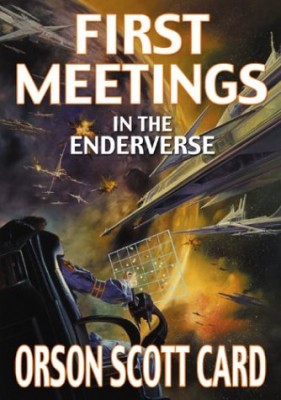
osc_first_meetingsIf you fell in love with science fiction when you were twelve, chances were it was because of the awesome space battles.  That was certainly the case with me.  When I saw Star Wars for the first time, I spent hours running around the house pretending I was flying my own starfighter.  In some ways, I’ve never really stopped. 😛

Ever since space opera became its own subgenre, space warfare has featured prominently in it, probably for the same reasons that Homer and Tolstoy framed their sprawling epics with a tale of war.  Where else are you going to find enough drama to fill volumes?  The fact that it’s set in space makes it so much cooler.

There are a lot of things about the space setting that make war stories different from those set here on Earth.  For one thing, there’s a huge element of exploration and unknown.  Even before we took the first photographs of Earth from space, there pretty much isn’t any corner on this planet that hasn’t been discovered by somebody.  In space, though, it’s still possible to stumble on a hidden planet, or find a mysterious alien artifact that can turn the tide of the war (Halo, anyone?).

For another thing, the dynamics of battle are completely different.  Sure, some stories treat space like an ocean, and there’s certainly a place for that kind of story, but the more interesting ones (at least to me) take into account all the profound differences.  For one thing, the zero gravity means that there is no “up” or “down,” which means that you have to deal with the possibility of attack coming from any direction, not just along a horizontal plane.  That concept alone drives the battles in Orson Scott Card’s Ender’s Game series, where “the enemy’s gate is down.”

One thing that really tickles me is when the story takes things a step further and incorporates things like orbital mechanics and delta-v.  I haven’t seen many books or games that do this, but the ones that do have really engrossed me by making the world feel that much more real.  Glen Cook did it in Passage At Arms, and the new Battlestar Galactica did it in the viper dogfights (though I’m not sure if they did it on the ship-to-ship scale).

The implications of real-world space physics on warfare are quite fascinating.  Rocketpunk Manifesto is an excellent blog that’s almost entirely dedicated to exploring them all, with all sorts of fascinating discussions on what the “plausible mid-future” may look like.  But even if all you’re looking for is an entertaining romp through space, the story telling possibilities are so much greater when you take the constraints of physics into account.

For example, if it takes months or even years to travel between planets, and orbital trajectories are fairly straightforward to figure out, how does it affect things if you can see the enemy fleet coming at your planet that long in advance?  If escape velocity from a gravity well like Earth is so difficult to achieve, what does that mean about the possibility of long-term planetary sieges?  And if starships are so far apart and moving so fast as to make full-on broadsides unlikely, how does that shape the battle tactics and strategy?  In spite of the physical constraints (or indeed, perhaps because of them), the possibilities are endless.

Man, I love me some good space battles.  One of my recent sci-fi favorites that features some epic battles is Wolfhound by my friend Kindal Debenham.  In my own work, you’ll find lots of them, especially in the Gaia Nova series (Bringing Stella Home, Stars of Blood and Glory, and to a lesser extent Desert Stars).  They say that the golden age for science fiction is about twelve years old, and that’s definitely true for me.  Expect to see lots more space battles from me in the future.

Awesome writing group activity with Dan Wells

Went to an awesome Quark writing group activity tonight with Dan Wells. It was great. We critiqued stories, had a Q&A, and then played the Battlestar Galactica game. Good, good times.

The new series of BSG is amazing.  It quite literally inspired my first novel: a story set in a universe where a cylon-style humans vs. robots went down three hundred years previous, and the surviving federation contacted a primitive civilization of fellow humans who thought they were the only survivors.  And then I threw in a first contact story, just to shake things up.

Anyway, BSG is a surprisingly fun game.  It’s kind of like werewolf, in that there’s lots of potential for betrayal and secret combinations. Basically, the players are putting out HUGE fires the whole time (like cylon fleets coming out of nowhere to blast your fleet out of the sky), and you have to work together but you don’t know whom to trust.  It follows the BSG story remarkably well, with enough room for unanticipated twists to make it interesting.

The learning curve is incredibly steep, but once you learn it, it’s way fun.  We didn’t have enough time to finish the game, but we did pretty well, I think.  Dan claims that he betrayed us heartlessly, but the truth is that our interests aligned pretty well for the duration we played.  He probably would have betrayed us had we played much longer, but we didn’t make any egregious mistakes…I think…

Anyway, didn’t get much writing in today (just about 500 words over my lunch break), but the fun and networking at the Quark event was worth it, I think.  I’m very much looking forward to World Fantasy, though I’ve got a TON of stuff to do first.

One thing I realized tonight was that I’m in a perfect position to do nanowrimo this year.  With the Mercenary Savior rewrite coming to a close (hopefully) before the end of October, I currently have no writing projects planned for November.

I was thinking of doing a sequel to Mercenary Savior next, but I don’t want to do that as a nanowrimo–I want to do quality work for that one, and the whole point of nanowrimo is to allow yourself to splurge and write crap.  Maybe I’ll randomly throw all of my characters from all of my projects so far into one giant mesh and see what happens.  I don’t know.

That’s what’s going on here.  Now, if you don’t mind, I’m going to crash.