Excited for a new old project

So a couple of weeks ago, I picked up the manuscript for a novel I’d written years ago, looking to see how much work it would take to salvage it. It’s a direct sequel to Bringing Stella Home, with James McCoy (again) as the main character. Long-time readers of this blog may remember it as Heart of the Nebula.

I wrote the first draft in 2010-2011 (started it almost exactly four years ago, in fact), and right from the start I could tell there were a lot of problems with it. I tried to throw in a romantic subplot that backfired horribly, and several of the major plot points weren’t thought out very well. I pushed through and finished it, though, and in spite of a few extra arms growing out of weird places, there was a lot of stuff in there that I liked.

(Come to think of it, I think this was my NaNoWriMo attempt back in 2010. That would explain why I pushed myself to finish the thing, even though I knew it had problems. I dropped it before the end of November and didn’t pick it up again until March, but since the only other books I had going on at the time were Desert Stars and Bringing Stella Home, I forced myself to finish it just so I had another one. This was back when I was under the impression that every book needs at least five or six revisions to be any good, and that most of the work in writing is actually revising. I no longer labor under those myths).

Over the next few years, I went back to it from time to time to dust it off and run it through a revision pass. Unlike my other novels, though, this one was so broken to begin with that revising wasn’t enough. I changed a lot in the 2.0 revision, cutting out most of the worst problems but not really replacing them with anything better. In the 3.0 revision, I mixed things around a bit but didn’t substantially change the story. Then I went through a bunch of incomplete revision attempts, tweaking scenes and rewriting sentences, but not really changing the story as a whole.

Then last year, I read through all the sundry drafts that I’d written of this story and put together a massive set of revision notes for the 4.0 draft. This time, I tore into the heart of the story itself, reworking plot points and adding new subplots to replace the ones that didn’t work. I went through the whole thing by chapter and scene, making a list of bullet points for all the changes that needed to be made. I also made notes for scenes that I needed to write entirely from scratch, and other notes for scenes that I needed to recycle from previous versions.

It was a massive undertaking, and I got about halfway through it before putting it on hold for other projects. That was nine months ago. Between then and now, enough time passed for me to more or less forget most of my ideas for it.

So earlier this month, I had an opening in my schedule and decided to take a look at this one again. Instead of picking it up where I’d left of, I decided to start from the beginning. Immediately, I was struck by how much better the story was. This wasn’t the three-armed baby I’d stuffed into the closet back in 2011–this was a really compelling story, with an intriguing hook and great potential to go places. The further I got in it, the better it became.

There were a couple of scenes early on that just didn’t work. I could tell that I’d reworked them to death, so I threw them out and wrote completely new ones. This time, they actually worked! By completely getting rid of the problem scenes, amputating those mutated limbs at the base, I was able to free the story from the mess in which it had spawned. For some of these scenes, revision is not enough–they need to be tossed and rewritten from scratch.

Over the last two weeks, I’ve really gotten excited about this project. Not only do I think it’s salvageable, I think I can make a really awesome story from it. I just got to the middle of it today, past the part where I’d stopped back in February. For the next few chapters, I think I’m going to throw out the revision notes entirely and just see where the story goes. I’ll probably write toward the stuff I know I want to keep, but throw out everything else.

So yeah, you can expect to see Heart of the Nebula come out sometime next year, probably in the spring. I still want to run it past my first readers, but I don’t think it’s going to need any major revisions after this one (at least, not any that should take more than a week). Keep an eye out for it!


The Writer by Dosshaus on deviantART
Two new cover reveals!

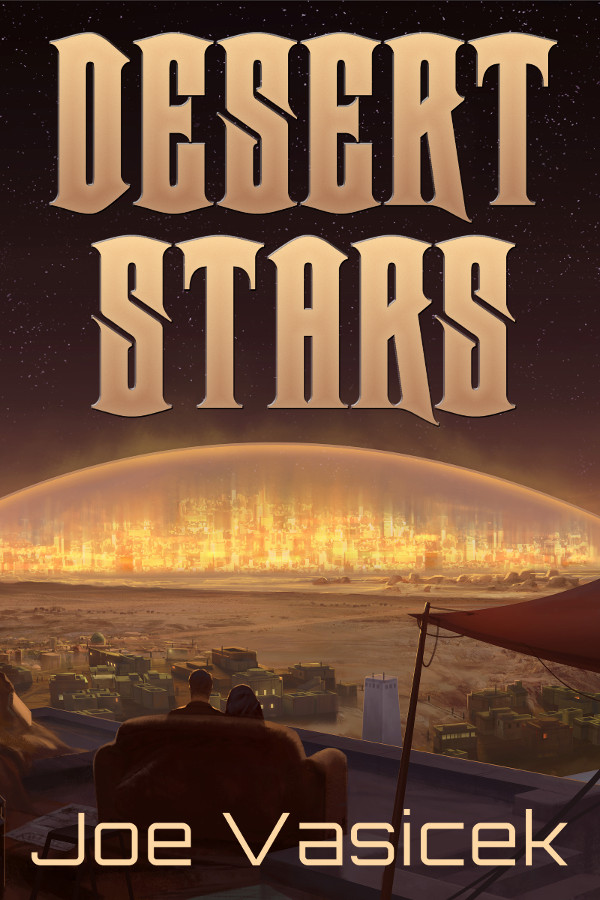
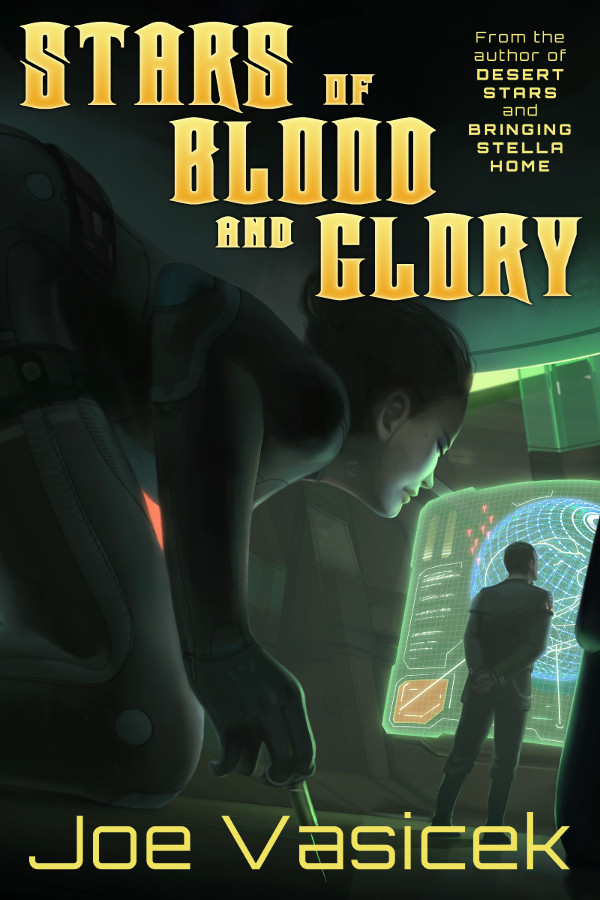
In between writing and revising, I’ve managed to redo the covers for Desert Stars and Stars of Blood and Glory. Check them out!

SBG (cover)DS (cover)I’m really excited to get the new editions out, especially the print editions! Expect to see those soon, like maybe in a week or two.

If you’ve already bought the books, don’t worry; the stories are still exactly the same. The new editions will just have the new covers and some updated metadata. I’m not sure if Amazon automatically updates them if you’ve already bought them, but if it’s an issue, just shoot me an email and we’ll work it out.

Man, designing covers is fun! 😀 I should do it more often!

Still alive, still writing

One of my friends asked why I don’t post on my blog anymore, and I realized that I haven’t posted anything here in forever. It’s not that I’m not doing anything worth blogging about, it’s just that it keeps slipping my mind to post something. So hopefully that will change.

On the writing side of things, I’ve decided not to give myself any specific direction for the rest of the month other than to write at least 2k words per day (or revise at least 10k words). After my last WIP took a month longer to finish than I’d expected, I’ve come to realize that I might be able to be more productive if I changed up which projects I’m working on. So for the next couple of weeks, I’m giving myself permission to work on anything, just to see what excites me the most right now.

I’ve been spending a lot of time with my writing friends recently. We’ve had some very interesting discussions, such as whether the 2nd amendment should apply to nukes and which modern cities are most likely to be abandoned in the next 200 years (Detroit doesn’t count, since it’s pretty much already there). It’s fun to get together and burn things, especially when you have a cast iron skillet and bacon. Good times–maybe I’ll post a couple pictures from the next bonfire.

I just finished all the new covers for Desert Stars, Stars of Blood and Glory, and Sholpan, so you can expect to see a few cover reveals soon! I’m keeping the artwork, but updating the typography to look more, well, professional.

Also, I just got an email from the Writers of the Future contest that they should have the finalists for the 4th quarter decided in about a week, and my story is still in the running! I’m super super nervous about this, because I think the story may actually be good enough to have a decent chance. You never can tell about these things, though–writers are horrible judges of quality when it comes to their own work. In any case, either way, I’ll probably self-publish that story once I hear back.

Winter is here, and I haven’t stocked up on LDS cannery hot chocolate yet. The shame! If the apocalypse happens between now and April, I’ll be broke (I am convinced that the LDS church offers hot chocolate as a food storage item so that we’ll have some form of currency in the event of the apocalypse).

In any case, I’d better get back to writing. Take care!

How going indie is like driving a manual (plus a cover reveal)

A couple of weeks ago, I got a new (to me) car. It’s a 2005 Ford Focus / Saleen: a two-door hatchback that drives like a racing car and gets about thirty miles per gallon (WA-A-AY better than the gas guzzler I was driving before). It’s also a manual transmission, which is perhaps the biggest difference between this and my previous car.

This is my first time driving stick shift, and I have to say, it is a lot of fun! When you drive a stick, each hand and each foot is doing something different. There’s a lot more to keep track of, and if you do things in the wrong order (like braking without engaging the clutch, or starting without giving it some gas), you run the risk of making the car stall or doing nasty things to your transmission. On the other hand, driving a manual gives you a much better feel for the engine and what it’s capable of. You can feel when you’re putting too much stress on it–or alternately, when you can push it a little further.

I usually like to walk everywhere, but ever since I got this car, I just want to drive it! It’s way more fun than driving an automatic, even with (or indeed, because of) the extra challenge. So today, while I was walking to BYU campus (alas, the parking situation there makes driving a major pain), I got to thinking about it, and I realized that driving a manual is a lot like being an indie author.

When you’re an indie, you have a lot more things to juggle, just like driving a manual. This gives you much greater control of your career, but it also makes it easier to stall or screw up. At the same time, because of that extra control, you’ve got a much better feel for the market, and probably a better connection with your readers. And for me at least, the extra challenge doesn’t make it less enjoyable, it actually makes me enjoy it more!

Nothing Found

This week, I had the first day where I sold 100+ books in a 24 hour period. That was pretty awesome! I’ve been running a $.99 sale for Star Wanderers: The Jeremiah Chronicles (Omnibus I-IV), and it got picked up by a couple of ebook sites that really pushed it in the right way. Now that I know how to run a sale like that, I hope to do it again, perhaps for Black Friday. And if you haven’t picked up this one yet, it’s on sale for $.99 through Friday.

Marketing and promotion is one of the harder parts about going indie for me, kind of like how finding the clutch point and starting without stalling is hard when you first drive a manual. The more that I practice, though, the better that I get at it, and the more I enjoy it.

Another area where I think I’ve more or less stalled is in my covers. When I put out the first few Gaia Nova novels, I spent a fair amount of money hiring out artists to do the illustrations, but I did the typography myself. On those earlier covers, it definitely shows. For my later books, I worked with a bunch of cover designers, and seeing their work made me realize that there’s definitely room for improvement on those earlier ones, especially for the print editions.

I’ve decided to redo the covers for those three novels (Bringing Stella Home, Desert Stars, and Stars of Blood and Glory), keeping the illustrations but changing the typography. I tried to find a cover designer to do it, but I wasn’t able to find one that did satisfactory work, and after playing around with them for a bit I think I can actually do them myself. I’ve got a lot more experience with covers and cover design now than I did when I was starting out, and I’ve learned a few photoshop tricks as well.

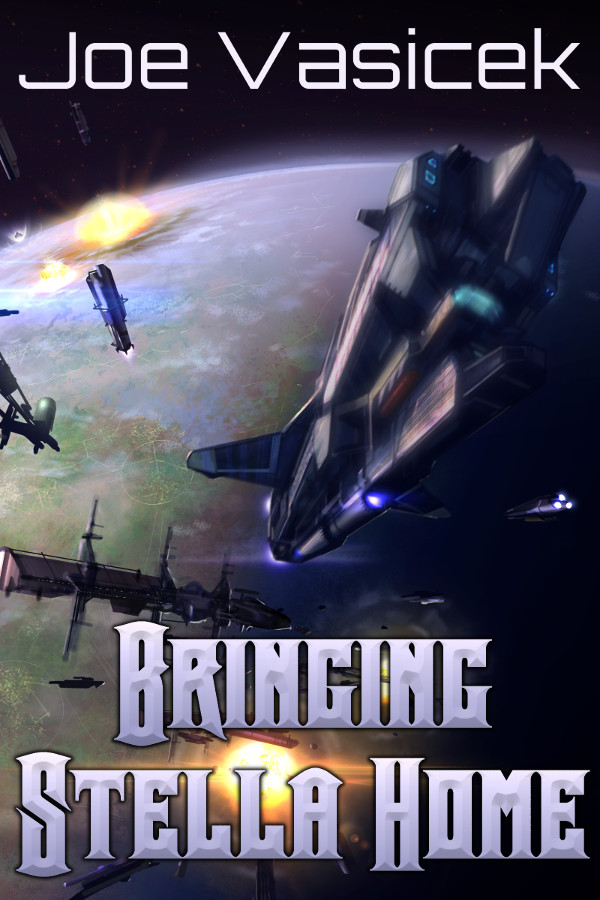
In any case, here is what I came up with for Bringing Stella Home:

BSH (cover)How do you like it? I rather like how it turned out, though I’ll admit I’m still learning. I did the new design just this morning, so I figure I ought to wait a couple of days and maybe seek out some feedback from professional designers before I go through with it.

I hope to have the new edition out before the end of the month. The content and story will all be the same, but the cover and metadata will be updated, and some minor errors such as typos will be fixed. I also hope to do the same thing with Desert Stars and Stars of Blood and Glory. Once the new editions are out, I’ll probably run some sales and giveaways with them, so definitely stay tuned!

As for my other projects, the next book in the Sons of the Starfarers series is out with my first readers, so it’s on track for a January release. My next WIP is The Sword Keeper, a fantasy novel I think I’ve mentioned before, and I hope to get that one knocked out in about a month or so. It’s already halfway finished, so the hard part is just ahead. There are also a couple of Gaia Nova novels that I’ve been meaning to get around to, and probably will before the end of the year.

That just about does it. Look out for more covers soon! I’m definitely having fun with the new ones. 😀

Crazy ideas and other updates

I had the craziest idea today while taking a late-night walk around Provo. It’s for the new series that I’m working on, Sons of the Starfarers, and it’s going to take six or seven books to get there, but it’s going to be AWESOME. Unfortunately, I can’t say much about it because the first book isn’t out yet, but I think you guys are going to be wowed.

I still remember the moment when the final PAGE of Desert Stars came to me. I was driving back to Provo from the Salt Lake Airport (alone, fortunately), and when it popped into my head I must have screamed for five minutes straight. The way that Mira’s final observation wraps everything up–both the overarching story her own personal growth arc–it was just awesome.

Those moments of insight are rare, but when they happen, they illuminate everything. It’s as if the whole story is unfolded to you, so that you can see how everything that came before ties into everything that happens later. It also opens you up to the heart of the story itself, so that you can see what it’s all about. As a writer, I live for that kind of insight. It’s one of the most powerful things that makes the whole endeavor worthwhile.

So yeah, Sons of the Starfarers is coming along nicely. The first book, Brothers in Exile, should be out May 10th, with the next two coming out six weeks apart from each other. That’s the plan, anyway. For updates on when those books come out, you can either follow my blog or sign up for my email list. I’ll post a few excerpts in the lead up before and after Brothers in Exile is published.

For April, though, I’ll be participating in the Blogging from A to Z challenge. Every day except Sundays, I’ll have a post for a different letter of the alphabet, all following a common theme. Last year, I blogged about the science fiction genre and some of my favorite tropes. This year, I’ll be blogging about my experience as an indie writer and what I’ve learned from it over the past three years.

I’ve already written and scheduled the first couple of posts: A is for Algorithm and B is for Book Blurb. Beyond that, I’ll be doing stuff like D is for Discoverability, P is for Pricing, S is for Serials, etc. Whether you’re a writer from one of the indie author communities I’m a part of, or a fan who discovered this blog after reading one of my books, I hope you’ll find this behind-the-scenes series of blog posts interesting. I can already tell I’m going to have a lot of fun with it!

That’s just about it for now. This week, I hope to finish up Book II: Comrades in Hope and get ready to dig into Book III: Strangers in Flight. The stuff in that third book is going to set the stage for some major wow moments later on in the series, and I can hardly wait to dive into it!

Lindsey Stirling, Nichieri, Susan Boyle, and thoughts on discoverability and greatness

I saw a couple of things on Youtube that made me think recently about the importance of quality work, especially in the arts.

I’m a casual fan of Lindsey Stirling–I’ve watched most of her videos, put them on in the background from time to time, and get a kick out of following her career. For those of you unfamiliar with her, she’s a Youtube sensation who combines violin music, dance, and dubstep/electronica, often in some interesting and beautiful places. This is her most popular video, and probably her best work so far:

Her career is interesting because it follows a path very similar to a lot of self-published authors. She started by putting out videos on Youtube, built up a huge following that way, turned down a number of deals from traditional record labels and put out her first album herself. Now, she’s touring all over the world, collaborating with a bunch of other Youtube artists, and doing a lot of other amazing stuff completely independently.

The other day, I was really surprised that she was on America’s Got Talent back in 2010. Apparently, this was before she got really big, and the connections she made while on the show helped her find success later on:

Two things stood out to me from that video.  First, the judges were right–even though she was pushing herself, this was not her best work, and it showed in a way that was rather glaring. I hate to say that because I like so much of her stuff, but it’s really true–her performance fell short.

The second thing that stood out to me was her response to the criticism. It must have been incredibly painful to stand up there in front of everybody and get hammered like that, but she still managed to smile, be gracious, thank the judges, and focus on the positive without being confrontational. That takes class.

When I was in Georgia, I watched a lot of TV, especially on the Rustavi 2 channel. One of the most popular shows is Nichieri (ნიჭიერი), a talent competition show set up much like The X Factor or America’s Got Talent. Even though I didn’t really understand anything the people were saying, I could still really tell when a contestant did some truly amazing.

There’s something about greatness that makes you sit up and pay attention–something that makes it stand out on its own. It’s something timeless and stirring, something that drives you to keep coming back to it, or at least to remember it long after it’s passed. With poor quality stuff, like bad writing, clumsy performance, or the like, you tend to forget it (unless of course it’s a spectacular failure, which in a weird way gains a sort of greatness of its own to a certain extent). But good quality stuff sticks with you–indeed, it’s almost like it becomes a part of you. It certainly becomes part of the culture.

When it comes to talent shows like Nichieri, The X Factor, and America’s Got Talent, the greatest moment has to be Susan Boyle. Everything about it is just perfect, from the awkward, homely way she started out to how she blew everyone away with her stellar performance. She didn’t look like she had it, and she certainly didn’t act like she had it, but she did, and she knew it. She didn’t settle for anything less than her best, and she didn’t let anyone else put her down.

In a lot of my discussions with other indie writers, we talk a lot about discoverability. We’re all anxious to be read, to be heard, to be discovered–to get our shining moment. The thing is, though, that moment is not enough if you don’t have quality work. It’s not going to keep you down or “ruin” your career, necessarily–Lindsey Stirling has come a long way since her disappointing performance on America’s Got Talent. But that’s only because she produces quality work.

I think I need to spend a lot less time trying to boost my discoverability and a lot more into producing the best work that I possibly can. The thing to remember, though, is that quality is subjective and you can’t please everyone. As Lindsey later said, “A lot of people have told me along the way that my style and the music I do … is unmarketable. But the only reason I’m successful is because I have stayed true to myself.” You can’t compare yourself against others, either–you can only really compete against yourself.

How do you know when you’ve done your best? That can be a little tricky, partly because it’s a moving target. I think Genesis Earth and Bringing Stella Home represent my best work at the time, though when I look back at those books I see things that could be improved. I tend to think that Desert Stars is my best work to date, though I’m not so sure anymore. Do I only think that because I struggled so much and for so long with that book? Just because something is a joy to create doesn’t mean that it’s any less than something you toiled and suffered over.

Star Wanderers was both a gift story and an experiment. The novella format was new to me at the time, so I did a lot of learning on it. Outworlder, Dreamweaver, Homeworld, and Deliverance came to me in a white-hot creative heat, but Sacrifice and Reproach were a real struggle. Is there a discernible difference in quality between them? Not that I can tell. I do think that the later stories hold together better on their own, though. I didn’t really hit my stride with the novella format until I started branching off into other characters’ viewpoints.

This is all on my mind because my next big project, Sons of the Starfarers, is something that I really want to do right. I don’t just want to write it for the sake of putting it out there (though I recognize that writing quickly doesn’t always mean sacrificing quality). I don’t just want to put it out so that I can make my work more “discoverable,” though that’s certainly a motivation. I don’t even just want to do my best. I want to improve my writing and storytelling so much that this becomes the best thing that I’ve ever written.

At LTUE a few years back, Tracy Hickman said that as writers, it is important for us to believe that we have not yet written our best book. That’s so incredibly true. You have to always believe that you can do better, not to make you depressed when you look back, but to make you enthusiastic as you look forward. Imagine what would have happened if Lindsey Stirling thought that her performance on America’s Got Talent was the best that she’d ever do! Her career hadn’t even dawned yet.

I think it’s the same with me. I’ve gained a little exposure, suffered a few setbacks, and experienced a small measure of success, but the big stuff is yet to come. And even though I may not want to be the next Brandon Sanderson or Orson Scott Card in terms of popularity, I do need to shoot high in terms of quality. Before I work on my discoverability, I need to make sure that I’m putting out some truly amazing stuff. I need to shoot for greatness.

Trope Tuesday: Foolish sibling, responsible sibling

Whenever you’ve got two characters who interact with each other a lot, chances are that one is a foil of the other.  There are a lot of reasons for this, but the big reason is that it helps to highlight certain character traits by providing contrast.  Because the contrast is the important thing, the relationship between the characters can take a variety of possible forms.  It may be that one is the hero and the other the sidekick, or (if they’re villains) perhaps one is the Big Bad and the other is the Dragon.  If enemy mine or one of the other frenemy tropes is in play, they might be on opposing sides.

Foolish sibling, responsible sibling is what happens when the character foils are siblings.  It’s a subtrope of sibling yin-yang that contrasts the character traits of responsibility and recklessness, duty and prodigality, and how the two opposites somehow manage (or not) to live together and stand up for each other in spite of their differences.

It may be used to set up an aesop, usually along the lines of “be like the responsible sibling, not the foolish one,” but that’s not always the case.  It might be that the younger sibling is closer to earth and the uptight responsible one needs to learn how to loosen up.  Simon from Firefly kind of fits that mold, though he learns to loosen up not from his sister River so much as from the rest of Mal’s crew.

In a lot of stories, it’s not necessarily meant to send a message so much as set up an interesting dynamic between two equally sympathetic characters.  In the movie Gettysburg, for example, Lawrence Chamberlain is the commanding officer of the regiment, and thus has to lead the men, follow military protocol, etc, while his annoying younger brother Tom calls him by name and forgets to salute him, runs around chatting it up with union soldiers and rebel prisoners alike, and generally seems a lot more loose and carefree.

Usually, the responsible character is the older sibling, for reasons that should be fairly obvious to anyone who grew up with siblings.  As the oldest child in my own family, I can readily sympathize with the dutiful son, since I more or less was one.  That’s not always the case, though.  In sitcoms where the middle child is the main character, usually it falls on them to thanklessly pick up the slack (yeah, being the middle child pretty much sucks).  Bart and Lisa from The Simpsons are a good example of this.

I played with this a little in Desert Stars with some of the minor characters: as the second oldest, Surayya generally tries to do things by the book, whereas Amina tends to be more mischievous and conniving.  Michelle and Lars also fall into this trope, with Lars a carefree academy dropout and Michelle a hardworking (though also fun-loving) mechanic on her father’s ship.  Between Desert Stars and Bringing Stella Home, though, Lars completely turns around, so that by Heart of the Nebula (not yet published) he’s quite possibly one of the most responsible characters in the book (and I still have yet to give him a viewpoint … hmmm).

In Sons of the Starfarers, I’m playing with this character dynamic a lot.  Isaac is the oldest son, who always knew he would leave on his father’s starship to fulfill the Outworld traditions and seek his fortune as a star wanderer.  Aaron, on the other hand, kind of got roped into the whole thing unexpectedly (see Star Wanderers: Benefactor) and hasn’t yet matured.  The events of the story will no doubt give him a growth arc, but in the meantime, the dynamic between the two of them is a lot of fun to write.

There are a lot of other issues in that relationship to play with too, such as promotion to parent and always someone better, but I’ll save those for another Tuesday.

Trope Tuesday: The Beach Episode

I’m so glad my Mom doesn’t read this blog.

I’m at Cape Cod this week, at a condo that doesn’t have internet, so it’s going to be a quick and dirty Trope Tuesday post this week (no, not like that) because I’d rather be on the beach than at the Dennisport Public Library.  Speaking of beaches …

One of the commonest beach tropes, at least for most anime and TV shows, is to take the cast of characters and put them on the beach for an episode.  This rarely has anything to do with the actual plot of the show, and is usually just an excuse to parade the characters in swimsuits and/or give the audience a little fanservice.

Actually, that’s not entirely fair.  There’s a bunch of ocean related recreational activities that the characters may participate in, such as beach volleyball (or other games), surfing, making sand castles, burying each other in sand, and getting a suntan (or an embarrassingly painful sunburn).  There may even be a single-episode romantic subplot that results in a beach kiss.

Basically, the beach episode is a chance for the audience to take a breather from the main story arc and hang out with their favorite characters at the beach.  Because really, who doesn’t like to go to the beach every now and then?  And if you can tag along with a bunch of fictional characters who have come to feel like friends, so much the better.

I’ve got to admit, most of the books and series that I’m a fan of don’t really have a beach episode.  The only one that comes to mind is the Melancholy of Haruhi Suzumiya, and that one’s a bit unusual because the beach episode(s) turn into a murder mystery that actually ties in pretty well with the main plot.  Also, the episode is based off of one of the original Japanese novels, so it’s a lot closer to canon than what you’ll see in most anime adaptations from manga (or so I’ve heard).

The beach episode doesn’t pop up in science fiction or fantasy a whole lot, probably because of the secondary world aspect.  I’m sure there are beaches on Middle Earth, but if I see a bunch of hobbits playing beach volleyball in bikinis, I’m sorry but I’m going to have to throw up.  Most fantastical worlds don’t have room for modern-style vacations, because so much of the setting is so far removed from the world we live in.  The last thing you want to do is throw your reader out of the story, so for most sci-fi and fantasy, a trip to the beach is probably a bad idea.

Of course, there are exceptions, depending on the story and the appropriateness for such an excursion in the fictional universe.  If you guys have any favorite examples, please let me know.

Needless to say, since most of my stories take place on alien worlds in the far-distant future, you won’t usually find this trope in my own stories.  However, there is a beach chapter in Desert Stars, where Mira spends some time out in nature, walking along the ocean and taking in the gulls and the waves.  She doesn’t wear a swimsuit, though.  In Stars of Blood and Glory, there’s a planet that’s nothing but ocean, with giant floating cities populated by people who are half Japanese, half Polynesian.  Not any beaches, though–at least, not natural ones.

Trope Tuesday: Curiosity is a Crapshoot

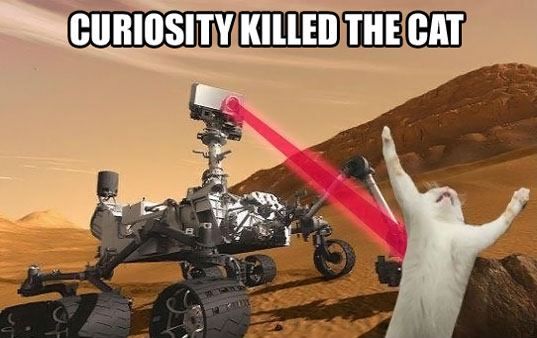
curiosity
Is there life on Mars? NOT ANYMORE!

Is curiosity a bad thing?  Well, it depends how genre savvy you are.  It seemed to work out pretty well for Alice, but not quite so well for Pandora (or the rest of the ancient Greek world, for that matter).  Curious monkeys seem to come out all right, and their constantly curious counterparts also seem to do okay in the end, but anytime you run into schmuck bait you know that things aren’t going to turn out well.

The truth is, for just about every stock Aesop warning about the perils of being overly nosy, you can find another one exalting it as a virtue.  In fact, you could say that curiosity is a crapshoot.

But what is curiosity exactly?  The Merriam-Webster dictionary defines it as “desire to know,” and “interest leading to inquiry.” As you can imagine, there are situations where this could be good or bad.  Thus, what a story says about curiosity often changes depending on its genre.

For example, in most horror stories, curiosity and nosiness are usually bad, leading the protagonists to go places where they shouldn’t and uncover things that should never have been uncovered.  At the same time, a lack of curiosity can also be fatal … in fact, a lot of things can be fatal in a horror story.

In mythology and folklore, curiosity is often even worse.  From Pandora to Eve, Psyche to the proverbial cat, curiosity leads to Very Bad Things.  Perhaps this is because these kinds of stories are mostly tales of warning, passed on from generation to generation as a way to preserve our collective knowledge about the dangers of the world, rather than inspire us to go out and face them.

(As a side note, there are a few exceptions in the realm of folklore.  In the Bluebeard myth, curiosity killed off all of Bluebeard’s previous wives, but combined with cleverness, faith, and friendship, it saved the last one’s life.)

In fantasy, curiosity is often a mixed box bag.  For example, take the hobbits: most of them are perfectly content to live out their lives in the shire, but the few who are inquisitive enough to venture outside end up saving the world in a way that the elves, dwarves, and humans never could.  At the same time, it puts them through a great deal of pain, even after the world is saved–neither Bilbo nor Frodo are ever able to be content in the shire again.

Curiosity, in other words, is complicated.  It’s not just a quirk or a character flaw–it’s an underlying quality of the hero’s journey.  Without curiosity, either of the world around him or the internal struggles within, the hero would be content to live out an unremarkable life.  Certainly he wouldn’t have the capacity for the cleverness, guile, wisdom, and sensitivity that he needs in order to descend into the darkest dungeon, face his own nadir, and return with the elixir of life.  Curiosity may lead to sorrow, pain, or even death, but it also leads to adventure.

As a subgenre of fantasy, many of these issues carry over into the realm of science fiction.  And yet, as a genre unto itself, science fiction has a distinctly positive view of curiosity compared to other genres.  Science is nothing if not the primary process of human inquiry, where curiosity is not only a virtue but the virtue, one of the most important aspects of humanity.  Consider these words from Adam Steltzner, one of the leading engineers of the NASA Mars Curiosity mission:

Likewise, curiosity is a staple of science fiction.  In Star Trek, it’s the basis of the entire mission: “to explore strange new worlds, to seek out new life and new civilizations, to boldly go where no one has gone before.” In Doctor Who, it’s how the Doctor finds his companions.  In Babylon 5, it’s Delenn’s curiosity about the humans that ultimately saves all the alien races.  And in 2001: A Space Odyssey, it’s the gift from the black monolith that helps monkeys to turn bones into space stations (well, not literally, but you get the idea).

Curiosity isn’t a central theme in most of my books, but it is a major part of Genesis Earth.  If anything, that book is about the importance of balancing curiosity about our universe with curiosity about ourselves and what it means to be human.  In Star Wanderers, Noemi’s curiosity is a huge part of her story, helping her to turn around a horrible (not to mention awkward) situation.  In Desert Stars, curiosity is complicated; it leads Jalil far away from home and puts a schism between him and the girl who loves him, but it also leads him to discover the truth about who he is, giving him the strength to return.

In general, I suppose it all comes down not only to genre, but to the underlying worldview of the author of the story.  Since I have a very positive and enthusiastic view of curiosity, it usually works out for the best in the stories that I write. Then again, perhaps that’s why I’m drawn to science fiction … how about you?

Do you like your chapters named or numbered?

There’s an interesting article linked on The Passive Voice blog about the importance of a table of contents, especially in ebooks.  The article is geared mostly for non-fiction, which is a whole different beast from novels and novellas, but the discussion on TPV got me thinking: for ebooks, is it better to name chapters or to merely number them?

In the comments section on TPV, Jamie makes an interesting point:

With e-books in particular I think there needs to be more care taken with the TOC. I can easily find my place with a print book even without a book mark, but with an e-reader, it’s possible to lose your place very easily, and “loc 4950″ is not going to be committed to my memory banks. I know what happens in the chapter titled “His Grace of Avon Takes Command of the Game,” but I’m not sure if that was chapter 16 or 15 “loc 1730″ or what. I won’t remember the number.

For organizational purposes for my own use I title my chapters, and I believe that readers will appreciate that habit, too, and will be more forgiving if they use the Look Inside feature and see those headers vs. if they just see “1, 2, 3.”

I try to make sure the titles are enticing and pique the curiosity of anyone who would see them in a TOC. They’re not spoilers, because unless you’ve made it to the end of the previous chapter, you’ll likely have no idea what the next chapter’s title is referring to (and if it is obvious, it simply increases the suspense/curiosity). The titles Makes Sense in Context (TM).

When I first learned how to make an ebook, the concept of a table of contents for a novel seemed pretty weird.  I was used to reading print books, which you can flip through much easier and find what you’re looking for just from the feel of the pages.  But with ebooks, obviously that’s much different.  A table of contents is more than just a list of chapters, it’s an important navigational tool that can’t be overlooked.

But if chapter hyperlinks are perhaps the only way to flip through the middle of the book, does that mean that merely numbering the chapters is insufficient?  I have to admit, the concept of naming each chapter seems a bit old-fashioned, but the technology has changed and as writers, we need to change with it.

In the context of a hyperlinked table of contents, numbers are practically meaningless.  They can even be quite ugly, if there’s a huge list of them that sprawls beyond the screen.  Chapter titles can sprawl even more, but they at least provide some idea of what lies on the other side of the link.

I’ve done it both ways.  For example, the table of contents for Genesis Earth looks like this:

Table of Contents

Copyright Page
Table of Contents

The Wormhole | The Mission | Terra | Cryothaw | The Ghost Ship | Trust and Deception | Betrayal and Discovery | Arrival | First Contact | Call and Answer | Earth | Rescue | Emotion and Reason | Planetfall | The Natives | Origin and Destiny | A New Genesis | Epilogue

Author’s Note | Acknowledgments

Most of the chapter titles are pretty mysterious, but I was kind of going for that.  And in any case, is it possible to make them completely unambiguous without spoiling key parts of the story?  It seems like the art of naming chapters is much subtler and more complex than you’d think at a first glance.

In contrast, the table of contents for Desert Stars looks like this:

Table of Contents

Copyright Page
Table of Contents

Prologue
Book I: Dome and Desert
1 | 2 | 3 | 4 | 5 | 6 | 7 | 8 | 9 | 10
Book II: Sand and Stars

11 | 12 | 13 | 14 | 15 | 16 | 17 | 18 | 19 | 20 | 21 | 22

Author’s Note | Acknowledgments

I kept the numbers for the chapters, but divided the novel into two sections or “books” and listed the numbered chapters as minimally as possible, to save space.  I suppose it looks all right, but as a guide to navigating the book, I’m not sure how useful it is–not to mention how hard it can be to click on a hyperlink that’s only one character long, especially on a touchscreen.

For Journey to Jordan, there were so many entries that I didn’t bother listing them all in the table of contents.  Instead, I divided each part into sections based on location, then listed the locations in the table of contents and the posts/chapters at the head of each section, complete with hyperlinks.

As a side note, it’s actually pretty amazing how internal hyperlinks can change the experience of the book.  For one thing, it opens up all sorts of possibilities for alternate endings and “Choose Your Own Adventure” type stories.  Is it possible to list a chapter in the <manifest> without including it in the <spine>?  I don’t think it is (at least, not in a well-formatted ebook), but if you could find a way to do that, you could add all sorts of hidden content and Easter eggs …

In any case, for my shorter Star Wanderers novellas, I think I actually prefer numbered chapters.  The stories are short enough that the numbered subdivisions still have meaning, and the chapter lists aren’t long enough to look too cluttered.  Besides, I’ve already started the series in this particular format so I think it will be better to keep it this way.

But for future books and future series … I don’t know.  What do you think?  Are ebook chapters better off named or numbered?