Cooking adventures and an awesome webcomic

So I have a bunch of ideas for blog posts I’d like to write, and I’ll probably get around to them eventually, but I thought I’d drop a line now just to let you all know what I’ve been up to.  It’s been a pretty good week, with some decent progress on the current WIP (Lifewalker) and some other random stuff that may be of some interest.

First, Lifewalker.  It’s coming along quite well.  I’m averaging around 2k words a day, so more of a leisurely pace than a white-hot creative heat, but not too bad.  It’s kind of turned into a post-apocalyptic Western, mostly because I can’t write about southern Utah without the landscape taking over.  This video should give you an idea why:

At the same time, the character’s voice really seems to be taking shape in a way that I like.  He’s kind of drifting right now, but the way he writes about it is very much like an old man reminiscing on the course of his life, lingering on the regrets as well as the triumphs, with some rather wistful commentary on each.  This is really a character that I can just pick up and run with–the story is practically writing itself.

It’s not just the voice, either.  Random stuff is just finding it in–powerful stuff that makes the story awesome.  For example, just in the last chapter, the characters were holding a meeting to see what they should do to rescue some of their friends who had been kidnapped.  Out of nowhere, one of them pulls out a skull from a human baby, with beads and feathers dangling from it like some sort of totem.  He brought it out to show that the people who’d attacked them were not just normal bandits, but cannibals from the Nevadan wastelands, which put them in a whole new category of badassery.  Stuff like that comes out of nowhere every time I write, and it’s awesome.

I’ve had a lot of time to write, though I don’t feel I’ve been using it all productively.  Still, I’m on track to finish this thing by the end of the month, which will be extremely gratifying.

In the meantime, I’ve been experimenting a lot with cooking and gardening.  Just planted some tomatoes in 3-gallon ice cream buckets (with dirt instead of ice cream, of course), and those are growing nicely.  It’s fun to have something to water in the morning, and when they start to yield fruit, I’m sure it will be awesome as well.

But I’ve also been experimenting with the old Egyptian kushari recipe I picked up after the 2008 study abroad.  It always seemed to be missing that one thing that would make the other ingredients come together and achieve that delicious synergy.  Well, I think I’ve found it: chickpeas and cumin, with maybe a touch of vinegar.  It might not be 100% authentic, but when I cooked it this time with that stuff, it tasted heavenly.

So this weekend, I’m going to try to perfect the recipe, something I’ve been wanting to do for years.  I’ll try cooking the rice in chicken broth, and adding more onions and garlic with maybe a little tomato.  Also, coriander–I know that coriander and cilantro are basically the same plant, but I think the coriander will go with this better than cilantro.  Also, it helps to fry it with a little oil after taking it out of the refrigerator, rather than sticking it in the microwave.  I haven’t had a microwave for over a year, and I think I actually prefer cooking without it.

Speaking of food, my roommate’s sister’s roommates dropped off a bag full of crap from their kitchen, since they’re moving out for the summer.  We’ve been having an interesting time combing through it–found some pretty good stuff, actually.  One of the more useful things is a bag full of buckwheat, which is AWESOME because kasha was one of my favorite dishes in Georgia.  Kasha and lobio–delicious!

So yeah, I’ve had food on my mind a lot this week.  If things work out, maybe I’ll post a recipe or two.  Kushari is delicious, cheap, filling, and healthy–a winning combination if ever there was one.  Kasha is pretty simple, but that’s what makes it so great–a simple, hearty food that leaves you feeling warm and whole.

Besides cooking exotic foods, I’ve also been reading a lot of Freefall.  I discovered it just last week, and I have to say, it is awesome.  One of the better webcomics I think I’ve ever read.  Like Schlock Mercenary, it’s a space opera comedy romp, but where Schlock kind of turned dark in recent years (which I’m not complaining about, don’t get me wrong), Freefall has still stuck to its happy-go-lucky roots.  And just like Schlock Mercenary, the humor is not only entertaining, but often wonderfully insightful.
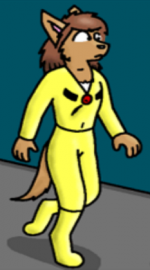
Florence_AmbroseBut by far, the best part of the story is how compelling the characters are.  My favorite is Florence Ambrose, an artificially bred Bowman’s Wolf who is kind of a human-wolf hybrid.  She’s one of only 14 members of her species, and the corporation that created her considers her more as property than an individual. She’s got all these biologically programmed safeguards that force her to obey direct human orders, no matter how ludicrous–but the only way for her species to survive is to convince the corporation that Bowman Wolves are profitable, so that they’ll make more (the whole 50-500 rule and all that).

Somehow, she becomes the engineer of the Savage Chicken, a down-and-out starship captained by the infamous Sam Starfall.  Sam is basically a lazy, larcenous alien squid who wants nothing more than to steal everyone’s wallet and become famous doing it.  At first, it seems like a horrible combination–Florence is basically a good, honest person, who wants to do good work and please everyone.  But as the story goes on, the two develop quite a rapport, and start to rub off on each other.

Florence helps Sam to clean up and get his act together, and Sam helps Florence to learn ways to get around her difficult situation vis-a-vis her safeguards and lack of free will.  More importantly, Sam helps her to stop feeling guilty long enough to recognize that doing the right thing sometimes means breaking (or at least twisting) the law.

As if that weren’t enough, there’s the whole cross-species romance angle between Florence and the biologist who rescues her back in one of the earlier subplots.  As you might expect, it gets really lonely being the only Bowman’s Wolf on the planet–especially when the other 13 are frozen in cryo, on their way to a world several light-years away.  Florence knows that she needs to do what she can to propagate the species, but she’s also got some emotional needs that demand to be satisfied now.  Winston is kind of similar, a lonely parasitic biologist on a frontier terraforming project with only 40,000 humans and a 40-60 male-female ratio.  Except for the whole cross-species issue, they make a really good couple.  I’m riveted to find out what happens next!

So yeah, if I had to sum it up: good, honest, likeable person + insecure future + social limbo + unsatisfied emotional needs = really compelling story.  Plus, she’s half wolf–how cool is that?  What I would give for her incredible sense of smell…

In any case, it’s getting late, and even though tomorrow is Saturday, there’s a bunch of stuff I want to do tomorrow so I’d better cut this short for now.  See you later!
Trope Tuesday: After the End

i am legend2It’s the end of the world as we know it … so why do we feel fine?

On the apocalyptic scale of world destruction, when the thing that wipes out civilization doesn’t quite kill everyone, we’re left with an After the End type setting.  Depending on where the writers fall on the sliding scale of idealism vs. cynicism, this may range from a futuristic Arcadia to a crapsack post- hell on Earth.

Whatever the case, expect to see lots of modern ruins and schizo tech mashups (horse-driven cars?  Wood-wheeled bicycles?).  If anarchism reigns, expect to see lots of punks roaming the wastelands in muscle cars and motorcycles.  If Ragnarok Proofing is in effect and the ruins of civilization haven’t quite decayed yet, expect some variation of a scavenger world.  And if someone from our modern era finds himself lost in this bizarre post-apocalyptic future, expect him to find some sort of constant to reinforce that he’s not in Kansas anymore.

Unlike dystopian settings, where society evolves (or is deliberately turned) into a horrible, hellish place, a post-apocalyptic setting represents a reboot of civilization itself, where one society has passed away and a new one is slowly picking itself up from the ashes.  It has the potential to be a lot more hopeful, and to give the reader a lot more wish fulfillment.  After all, who wouldn’t want to be one of the lucky survivors tasked with rebuilding civilization?  Sure there may be zombies or nuclear nasties wandering about, but on the plus side, you don’t have to worry about your bills or your deadbeat job anymore.

Douglas Rushkoff has some interesting ideas about why this type of story is becoming more and more popular nowadays.  In his new book Present Shock which he’s been promoting recently, he argues that many of us are so overwhelmed by a world where everything happens now that we wish we could end it all and start over.  When we live in an ever-changing present without a coherent narrative to reference our past or our future, we long for something to restore that sense that we’re part of a larger story, even if that story is racing towards a horrible, tragic end.

But every ending is a new beginning, and that’s what lies at the very core of this trope.  When our world passes away, what will the new world look like that takes its place?  Will we learn from our mistakes, or are we doomed to repeat our worst atrocities?  Will we eat each other like dogs, or will we tap into some deeper part of human nature where mercy and compassion lie?

This is all on my mind right now, because I’m writing a post-apocalyptic novel (with the working title Lifewalker) that takes place in Utah 200 years after the end.  Humanity was hit by a plague that kills everyone over the age of 25, so that the only people left are orphans, teenage adults, and their babies.  It’s fascinating to wonder what from our era would fall apart and what would remain, or what would be preserved and how the new society will take shape.

But it’s not the apocalypse itself that I’m interested in, so much as what happens after things stabilize.  The main character is one of the few people who’s immune to the plague, so naturally he feels like a complete outcast.  He’s walking the Earth, riding down the ruins of I-15 with a copy of Brandon Sanderson’s Mistborn in his saddlebag.  And the people he meets … well, let’s just say I wasn’t very kind to Las Vegas.

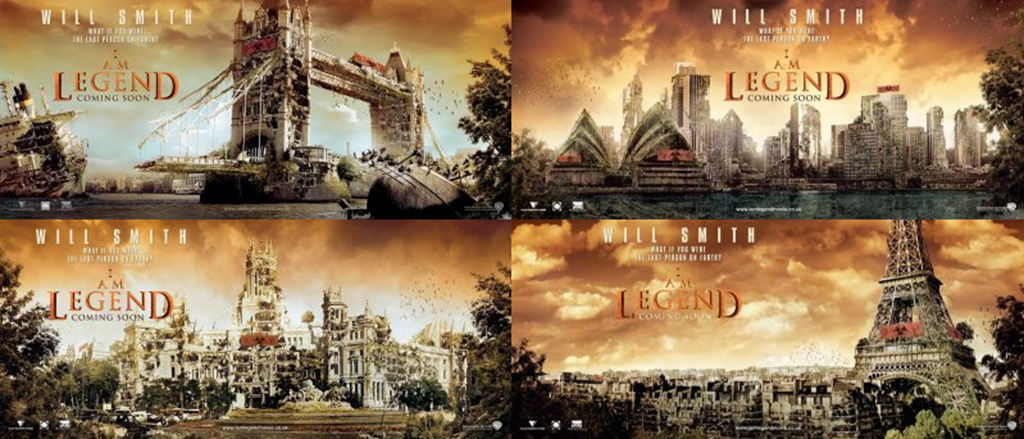
I think that’s another part of the appeal of this trope: it takes our own world and twists it into something fantastic, so that instead of having to wrap our minds around a whole new set of history and physics, we can build on the familiar in wild and interesting ways.  A Canticle for Leibowitz did this very well, with another post-apocalyptic tale set in Utah.  However, the most famous popular example is probably the movie I Am Legend.  I love those long panoramic shots with Will Smith hunting deer in Times Square, or hitting golf balls off the wing of a fighter jet.  Stuff like that really sparks the imagination because it combines something familiar with something wild and different.

Believe it or not, this trope has actually happened in real life.  After the bubonic plague swept across Europe, whole cities were depopulated, with as much as 60% casualties in some places.  When the Pilgrims settled at Plymouth, they were actually building over the ruins of a large Indian settlement that had been wiped out by smallpox just a few years before.  And using DNA evidence, scientists now believe that all of modern humanity is descended from a small group of just 50 females who survived a global volcanic eruption some 70,000 years ago.

So yeah, this is definitely a trope I like playing with.  I’m on track to finish Lifewalker by the end of May, so you can definitely expect to hear more about it in the weeks and months to come.

Also, for those of you looking for resources to help you visualize what the world will look like after the end of human civilization, here are a couple of excellent resources I’ve found.  First, check out The World Without Us, an excellent book written by an environmentalist that poses a basic thought experiment: what would happen if all humans everywhere magically vanished, and all that was left was the stuff that we’ve built?  What, if anything, would remain? (spoilers: not much) If you want to explore that idea but you don’t want to read the whole book, check out this wiki on Life After People, a series of History Channel documentaries that basically posed the same question.  The answers may surprise you.

Thoughts on making a living as a writer

As many of you know, my biggest life goal (besides obtaining a signed first-edition copy of David Gemmell’s Legend) is to make a living telling stories that I love.  Accomplishing that goal is no small task.  For the last five years, I’ve been focused on that goal like a hellfire missile, and as of right now it continues to elude me.

I’m getting closer, though.  I’ve got 14 ebooks out, hopefully 18 by the end of the summer, and they’re actually selling.  I won’t go too much into specifics, but my gross income is about 30% to 40% of what I’d need to cover all my expenses without another job.

Granted, I’m a young single guy with good health and no dependents, living on a shoestring budget in the cheapest housing in one of the cheapest states in the US, but that’s not an insignificant accomplishment.

Right now, I’m reinvesting all of that into the business, in order to boost sales and to avoid self-employment tax.  But if I have a difficult month and need something to fall back on, my books are generating a fair amount of passive income, and that income is growing.  If I keep doing what I’m doing, and things stay on more or less the same trajectory, I expect that I’ll be making enough to support myself in one or two years.

That’s actually a little better than the timetable I set a year ago, where I determined to go full-time by 2016.  Then again, I also set a goal to be married by then, and I have no idea how that will change things.  I suppose my spouse’s income would be able to supplement my own, but then there’s insurance and taxes and all sorts of other expenses that I can expect to go way up.

(At the same time, I have this wild dream of running off with my wife to some remote part of the world and spending a couple of years on some crazy-insane adventure, like trekking across Mongolia, or joining a Bedouin tribe, or couchsurfing across Europe.  The world is a very different place outside of the US, and the cost of living in much of the world is significantly lower.  Especially in the developing world, people know how to make do and be happy with much, much less.)

Even if I suffer a major setback, like an irreversible drop in sales or a technological shift that made my current business model obsolete, making a living is no longer a pie-in-the-sky sort of dream.  It’s within reach, and I think I have a pretty good idea how I’ll get there.

First of all, it’s probably not going to be a sudden, earth-shaking event.  It’s much more likely that I’ll ease into it gradually, first as a fallback for months when work is slow, and then as a way to pay off my bills while I keep a part-time job for spending money.  One day, I’ll wake up and realize that it’s been five or six weeks since I’ve done anything but write, and then I’ll open up my budget and realize that I’ve arrived.

As I get married and start a family, my expenses will no doubt rise, and I or my wife may have to take another job for a while to make ends meet.  Then again, if book sales continue to snowball with each new release, then we might be able to time it so that the kids start arriving just as the writing income really starts to take off.  Even then, book sales fluctuate so much from month to month that until we have a significant amount of money in savings, we’re always going to feel like we’re a couple of weeks away from having to find another job.

And then, with the writing bringing in a comfortable six-figure income, we might finally be able to afford a house.  It’s almost impossible to get a mortgage as a self-employed freelancer, so I fully expect to pay for most of the house up front.  Good thing I don’t want to live in a city.

Of course, it’s also possible that the writing will never bring in a six-figure income.  Science fiction is a relatively small genre, and the only stories I really care to tell are the ones that take place on other worlds.  But that’s okay–as long as I’m able to support myself and my family, I’ll be happy.  Anything above that, and it’s not about the money.  In fact, it’s really not about the money right now.

The point of all this is that I don’t expect there to be a moment where I’ve suddenly “arrived.” If anything, it’s just going to be a continuation of what I’m doing right now, scaled up to meet life’s changing demands.

And you know what?  I’m okay with that.

My resume might look a bit checkered, and job interviewers may raise their eyebrows when they see that I’m a college graduate, but these odd jobs give me a lot more flexibility than a stable “day job” with insurance and all that.  I like being able to take a week or two off to do nothing but write, even if the off-time is unintentional on my part.  I know how to be flexible, and I’m quite comfortable living a lifestyle where I don’t know where I’ll be getting my next paycheck.

And to friends and family who are concerned because I’m almost thirty and don’t have a full-time job … don’t be.  I’m following my dream, and my dream is within reach.  Everything else is just a stepping stone.  I have a career, I’ve taken full responsibility for it, and I’ve turned it into something profitable.  If making a living as a writer is a bit like making grizzly bear soup, I’ve already killed the bear.

In related news, I learned this week that I’ve been pirated in Japan.  I’m not sure whether to be flattered or alarmed, but since my books are 1) available from multiple retailers 2) relatively inexpensive, and 3) DRM-free (on all the sites that allow it, anyway), I’m not too concerned about it cutting into my income.  I am worried about people downloading my books from an unsafe site that might give them a virus or something, but people will be people and there’s not much I can do about that.

If anything, it’s just another sign that I’ve arrived–or rather, that I’m exactly where I’ve wanted to be all along, and it’s just a matter of making things work.

Post A to Z update

So, the A to Z challenge is over, and it’s back to things as usual.  I hope you guys enjoyed it–I’ll probably compile the posts at some point, update them to add some more examples and references, and put it out as a $2.99 ebook.  When I get around to it, that is.  If that’s something that interests any of you, let me know and I’ll get it up sooner.

As far as writing goes, I just went back to work on Lifewalker yesterday, and the story is coming along swimmingly.  This is the post-apocalyptic story about a guy wandering down the ruins of I-15 with a copy of Brandon Sanderson’s Mistborn.  I checked with Peter and Brandon about that, and they said it’s okay.  In fact, they think it’s hilarious.  And it is, I suppose, though the book takes itself fairly seriously.

Just to give you an idea what I’m talking about, here’s an excerpt:

The first night, I stayed in a small village known as Sannakin. The people there were surprisingly friendly, though they assured me that they would have been more cautious if I had come from the south.

“What’s south of here?” I asked the village patriarch over dinner.

He shrugged. “Don’t know—never been that way. Get a lot of tinkers, though, and a merchant ever now and again. There’s people out there, that’s for sure—but it’s a wild and a dangerous country.”

I paid them for their hospitality by reading from Mistborn: The Final Empire. The story confused many of them, especially those who had never seen the ruins of a city. I explained to them that the forefathers used to live in great communes of thousands, or even tens of thousands of people. This sparked a vigorous discussion over how such a large community could possibly provide enough food for itself, and how it would handle the waste. Some people asked me if in the days before the Blight, ash covered the sky as it did in my book. I answered that it probably had, though doubtless the author had exaggerated it somewhat for the purposes of the story. This led to an even more vigorous discussion about the merits of fantasy stories in general, with most of the villagers forming a decidedly negative opinion of the genre. I strongly disagreed, of course, but held my tongue so as not to offend my hosts.

Today, I wrote a passage where the main character had to mediate an argument between two scholars over who was the primary god in the forefather’s pantheon: Batman or Superman.  In a few chapters, he’ll rescue a girl from a band of bloodthirsty cannibal slavers infesting in the ruins of Las Vegas.

As you can tell, this book is a lot of fun. 🙂

As for the publishing side of things, I’m working with an illustrator to get the cover ready for the first Star Wanderers omnibus.  It’s going to be for Parts I through IV, but don’t worry–if you’ve already bought the parts individually, there won’t be any new content except the author’s note.  I’ll either publish that here or send my newspaper subscribers a link for where they can read it.

I’m not sure if anyone really reads the author’s notes at the ends of my books, but I enjoy telling the story behind the story, so I’ll keep doing them.  Besides, I figure some of you have read them, since you’re signing up for my email newsletter and sending me an occasional fan emails.  I really enjoy those, by the way, so thanks for sending them!

That’s just about it for things over here.  In unrelated news, I recently discovered an excellent sci-fi webcomic.  It’s called Freefall, and the archives stretch waaaaay back to 1998 (!!!).  So yeah, I’m going to be busy for a while.

But don’t worry, I’ll still find make time for writing.  I’m doing about 2k words per day right now, so at that rate, the first draft of Lifewalker should be finished before the end of May.

Aaand my roommate wants to sleep, so I’d better get off the computer now.  Later!

Z is for Zenith

pioneer_book_scifiHas space opera passed its zenith?

Sometimes, it certainly looks that way.  All the major stuff seems to be reprints of past series and reboots of decades-old franchises.  Star Trek, Star Wars, Stargate, Battlestar Galactica, Ender’s Game, Dune, Babylon 5–all the big names seem to have had their start at least a generation ago.  At any science fiction convention, you’re likely to see more gray-haired men than kids in their teens and twenties.  And if you go to a publishing conference, new adult, urban fantasy, and paranormal romance are ascendant.

I’ve noticed that people are using the term “science fiction” increasingly to describe stories that don’t have anything to do with space.  Dystopian, post-apocalyptic, steampunk, even time travel–all of these subgenres are certainly part of the fold, but they’re very different from the stories about starships and alien worlds.  And then you have all the markets for short fiction that have been forced out of business–and even a few larger publishers, like Night Shade Books which is now selling off all its assets (read: authors) to avoid bankruptcy.

I remember going to World Fantasy 2010 in Columbus, Ohio, and feeling dismayed at the complete lack of science fiction.  World Fantasy is (or was, at least) the premier professional conference for speculative fiction literature, but all of the attention was going to urban fantasy and steampunk.  On the freebie table where publishers often dumped ARCs and review copies of their books, the only space opera stuff I really saw were a couple of titles by Glen Cook and one other guy–and I watched that table hawkishly for the full three days of the conference.

Sometimes, it seems as if it would be so much better if I had grown up in the 80s.  That’s when science fiction really had its heyday.  But all through the 90s, the genre seems to have been on the decline, much like NASA and the US space program.

So is space-centered science fiction on the way out?  Have we passed the glory days, and it’s now just a long decline until it becomes an obscure niche, beloved by some, but enigmatic to others?

In spite of everything I said above, I actually don’t think so.  In fact, I think we’re on the cusp of a science fiction renaissance, and that sci-fi geeks like myself will look back twenty years from now and wish that they were born in our era.  Here’s why:

1) Scientific discoveries are transforming the way we see the universe.

The day I posted P is for Planets, NASA’s Kepler mission announced the discovery of three Earth-like worlds orbiting in the habitable zones of their stars.  The existence of alien Earths is not conjecture–it’s a confirmed fact.  As our ability to study these worlds improves, it’s only a matter of time, IMO, before we find a world that has life.

We’ve discovered the Higgs-Boson.  We’re unraveling the fundamental building blocks of the universe.  We’ve built telescopes to look back to the dawn of time itself, and we’re learning more about the cosmology of the universe every year.  Perhaps even more remarkably, we understand now how little it is that we actually know–that the entirety of the observable universe is only about 5% of it, and even that’s optimistic.

All of this will take time to trickle down to the popular consciousness, but with all the new discoveries that are happening, I think that’s already in the process of happening.  In particular, I think the recent discoveries in the realm of exoplanets and astrobiology are going to shake things up in a major way in the next five or ten years.

2) The privatization of space travel is paving the way for a rapid expansion into space.

The US space program has been plagued with funding problems since at least the end of the Cold War space race.  Since the space shuttle program was retired just last year, the only way for our astronauts to get into space is through the Russian Soyuz spacecraft at Baikonur.  If NASA had to put a man on the moon, they do not currently have the knowledge or technology necessary to do it.

In the private sector, though, it’s been a very different story.  SpaceX has had a number of successful launches recently, most notably sending the first unmanned resupply capsule up to the International Space Station.  And just a couple days ago, Virgin Galactic had the first successful test flight of its rocket-powered spacecraft.

It’s sad to see the space shuttle go, but there are a lot of reasons why the program was flawed and inefficient to begin with.  By handing things off to the private sector and turning space exploration into a viable business venture, we can hopefully overcome those inefficiencies and eventually make space accessible to the general public.

And then you have the organizations like Mars One that are looking even further ahead to the colonization of Mars.  There’s a groundswell of excitement for Martian colonization that is starting to get some real money behind it.  Will it go anywhere?  It’s hard to say right now, but even if it suffers another decade or two of setbacks, it’s getting public attention, especially from the younger generation.

3) Video games are bringing a fresh new look and feel to the genre.

Not all of the big sci-fi series hail from 70s and 80s.  Halo started up as recently as 2001, and it’s a multi-billion dollar franchise with games, books–even Legos.  In fact, there are lots of sci-fi video game franchises right now, many of them right on par with other classic space opera.  Just look at Starcraft, for example, or Mass Effect, or Eve Online and Sins of a Solar Empire.  The number of sci-fi games has been exploding.

In fact, this explosion has been happening for some time.  While literary science fiction may have suffered something of a decline back in the 90s, that was the heyday of games like Master of Orion and Sid Meier’s Alpha Centauri.  Flight simulators like Flight Commander and X-wing proliferated like crazy, while even some of the classic RPGs like Final Fantasy borrowed heavily from science fiction tropes.  And those are just a few of the games that I can list off the top of my head!

Whether or not literary sf is on the decline, a whole new generation has been introduced to the genre through the medium of video gaming.  This is not just a small niche audience playing this stuff, either–in the US at least, Halo is as mainstream as Monopoly or Settlers of Catan.  In fact, you could say that science fiction is more mainstream now than it ever has been, and a lot of that is due to sci-fi video games.

4) The e-publishing golden age is giving us thousands of new voices.

But what about the world of literary sf?  Are we in a decline?  Do people just not read science fiction anymore?  How bright is the future for science fiction literature?

Actually, this is the area where I’m the most optimistic of all.

The publishing industry is changing at the speed of light, much in the same way that the music industry changed about a decade ago.  Just as the MP3 revolution allowed all sorts of eclectic yet entrepreneurial artists to thrive without the oversight of record labels, the epublishing revolution is opening all sorts of doors for the enterprising author.  And while the changes are driving publishers (such as NSB) out of business, they are enabling authors who only sell in the mid-list range to make a respectable living.

At Worldcon 2011, Ginger Buchanan (senior editor at Tor) asserted that there has never been a runaway science fiction bestseller.  In the eyes of New York publishing, that may be true–but New York has a notorious record for missing the catch in pursuit of one big fish.  Because of epublishing, whole new genres like New Adult that publishers thought would never sell are now going mainstream.

And even the niches that stay niches are becoming quite lucrative for the authors who can build a decent following.  When author cuts out the middlemen and develops a direct relationship with the readership, it only takes a thousand true fans or so become a financial success.  As Kris Rusch pointed out so aptly, those numbers may bring only scorn from New York, but for the writers who actually produce the content, that’s a vein of pure gold.

I can’t tell you how many success stories I’ve heard from fellow sci-fi writers over on the Kindle Boards, who started just for the grocery money and ended up quitting their day jobs.  But as Hugh Howey pointed out, the runaway bestsellers are not the true story of the epublishing revolution–it’s the little guys who only sell a few hundred copies a month but are earning enough to support themselves writing what they love.

Indeed, we’re already starting to see an explosion of new science fiction, thanks largely to the ease of electronic self-publishing.  I’ve only read a few of them so far, but Nathan Lowell stands out among them, as well as my good friend Kindal Debenham.  These guys and so many others are bringing a fresh new voice to space opera, revitalizing the genre in ways that simply weren’t economical back in the days of Big Publishing.

So even if space opera as a literary genre isn’t quite large enough to go mainstream, it is large enough to support a wide range of new voices under the emerging business models.  And as the epublishing revolution continues to mature, I think we’re going to see a new golden age comparable to the era of the pulp adventure stories.

I’ve been publishing my own work since 2011, and I can attest that there’s never been a better time to be a writer.  I’m not quite making enough to go full-time yet, but at the rate things are going, it will only be a  year or two before I realize my dream of making a living telling stories that I love.  And if they’re the kind of stories that you love too, then that’s great news for all of us!

So has science fiction reached its zenith?  I don’t think so.  It went mainstream about a generation ago, which was definitely a huge moment, but for the last few decades it’s been in the process of branching out and rediscovering itself.  Right now, I think we’re on the verge of a wonderful new renaissance that is going to blow us all away.  As a lifelong reader and writer of science fiction, I certainly hope that’s the case.  And because of the reasons listed above, I sincerely believe that it is.

Y is for Yesteryear

Star_wars_oldThey say that the golden age of science fiction is about twelve years old.  That’s definitely true for me.

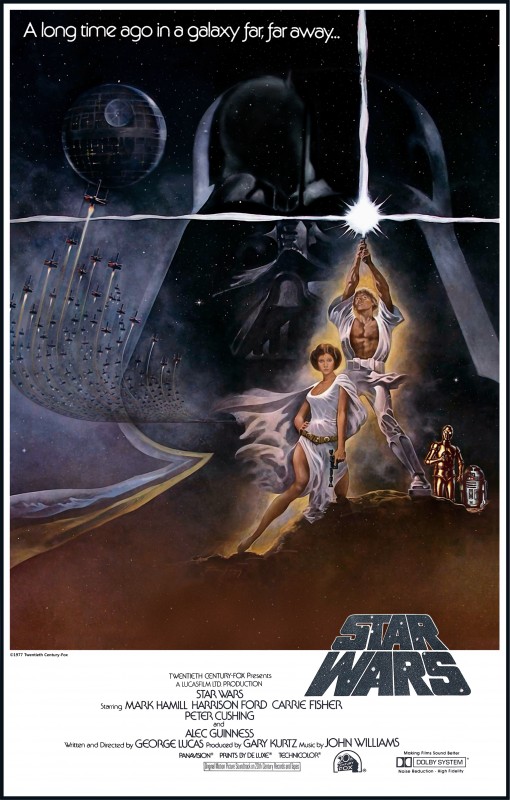
My first exposure to the genre was Star Wars: A New Hope.  I saw it when I was seven, right around the height of my dinosaur phase.  Everything about the movie completely blew me away, from the Jawas and Sand People of Tatooine to the stormtrooper gunfights and lightsaber duels.  After watching Luke blow up the Death Star, I spent the next few hours running around the yard pretending to fly my own starfighter.

In a lot of ways, I’ve never really stopped.

My parents made me wait until I was nine to watch The Empire Strikes back, because it was rated PG.  Without any exaggeration, I can say that those were the longest two years of my life.  I was literally counting down days by the end, and to pass the time without going crazy, I read up on all the books about space that I could possibly find.

My father bought the original X-wing flight simulator game somewhere around then, and I soon became totally engrossed in it.  Since the 386 was our only entertainment system (no Super Nintendo–I had to visit a friend’s house for that), X-wing became the defining game of my childhood.  I spent hours and hours on that game, to the point where I knew exactly which simulated missions the characters from the books were flying and how to complete them faster and easier.

I thought The Empire Strikes Back was a little slow the first time I saw it, but it’s since grown on me, to the point where now it’s my favorite film in the whole series.  Thankfully, my parents let me watch Return of the Jedi the next day, and for the next few months my life felt utterly complete.

Around this time I discovered the Star Wars novels and soon immersed myself in them.  The Courtship of Princess Leia by Dave Wolverton soon became one of my favorites, as well as the Heir to the Empire trilogy by Timothy Zahn and the X-wing series by Michael A. Stackpole.

But it was Roger Allen McBride who first introduced me to a different flavor of science fiction with his Corellia trilogy.  As I mentioned in V is for Vast, those books had just enough of a touch of hard science to intrigue me about the other possibilities of the genre.  That was the last Star Wars series that I read before branching out into other works of science fiction.

The Tripod trilogy by John Christopher was my first introduction to the dystopian / post-apocalyptic genre, depicting an enslaved humanity after an alien invasion.  Those books really captured my imagination for a while.  The Giver was also quite interesting and thought provoking, though since it didn’t involve spaceships or aliens it wasn’t nearly as compelling.

I read a lot of fantasy in my early high school years, including Tracy Hickman, Lloyd Alexander, and (of course) J.R.R. Tolkien.  While I enjoyed those books and immersed myself in them for a while, my true love was still science fiction.  For almost a year, I watched Star Trek: Voyager religiously with my dad.  And every now and again, I’d pick out a science fiction book from the local town library and give it a try.  That’s how I discovered Frank Herbert’s Dune.

In eleventh grade, my English teacher had us choose an author and focus our term papers solely on their books for the entire year.  She suggested I choose Orson Scott Card, but I chose Cormac McCarthy instead.  I’m not sure if that was the worst decision of my high school career, or the best decision, since assigned high school reading tends to make any book feel like it sucks.  I discovered Ender’s Game the following summer, and finished it in a delirious rush at 3am the morning after checking it out from the local library.

More than any other book, Ender’s Game cemented my love for the genre, and showed me just how powerful and moving the genre could be.  It opened so many insights into the world and human nature, reading that book made me feel like I’d opened a pair of eyes that I didn’t even know I’d had.  Looking back, that was probably the moment when I knew I would be a science fiction writer.  I’d known I was going to be a writer ever since I read A Wrinkle in Time at age eight, but to be a science fiction writer specifically, that goal was probably cemented by reading Orson Scott Card.

After high school, I served a two year mission for my church, during which I didn’t read any novels or watch any TV or movies.  When I came back, though, Orson Scott Card and Madeline L’Engle helped me to ease through the awkwardness of adjusting back to normal civilian life.  When I left for college, I expanded my horizons even further, starting with Isaac Asimov’s Foundation series and Edgar Rice Burrough’s Princess of Mars.

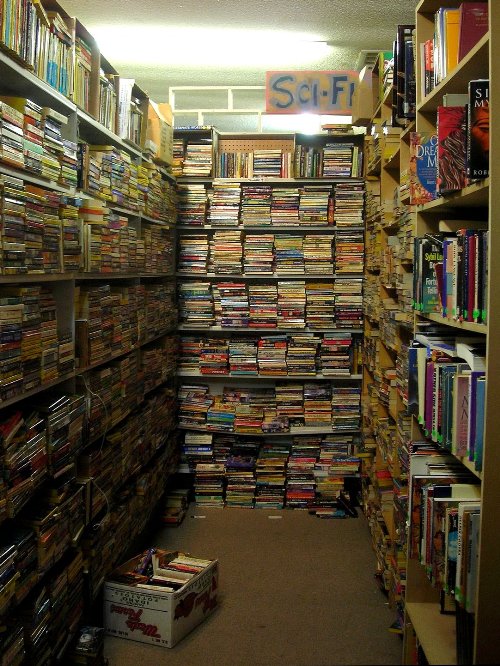
When I discovered Pioneer Books in downtown Provo, I knew I’d found my favorite bookstore in Utah Valley.  I have so many fond memories sitting cross-legged on the floor in the science fiction section, browsing through the musty used books for hours at a time.  That’s where I discovered C.J. Cherryh, Arthur C. Clarke, Robert A. Heinlein, Ursula K. Le Guin, and numerous other authors who are among my favorites today.

When I discovered Spin, Robert Charles Wilson soon became one of my favorites.  I picked up that novel as a free PDF from Tor, and read it over the summer while studying abroad in Jordan.  Once again, that same hard sf sensibility I’d gotten from Roger Allen McBride touched me in an unforgettable way.  But it was the human element of that book that really moved me–in fact, it’s always been about the human element.  The world building in Downbelow Station was great and all, but the romance of Merchanter’s Luck had a much more lasting impact.  Starship Troopers had some good ideas, but it was Mandella’s personal journey in The Forever War that moved me almost to tears.  The intrigue of the Ender’s Shadow series was quite entertaining, but it was Ender’s Game and Speaker for the Dead that really taught me what it means to be human.

I finished my first novel, Genesis Earth, shortly after returning from that study abroad, and tried to capture the same sensibility from Spin as well as the intimately human element.  Since then, I’ve written several more sci-fi novels, some of them tragic, some triumphant, but in all of them I’ve tried to get as close as I can to the personal lives of the characters.  I don’t know if I’ll ever write a character portrait so intimate as Shevek’s in Ursula K. Le Guin’s The Dispossessed, but I certainly hope to someday.

For me, science fiction started out as a wonderfully exciting entertainment and turned into something much more meaningful.  If there’s anything the genre has taught me, though, it’s that the two aren’t mutually exclusive–that you can have your adventure and learn what it means to be human as well.  Indeed, the more imaginative the adventure, the greater the truths I’ve taken from it.

Because of that, even though I’m almost in my thirties now, I can’t possibly foresee a time when science fiction isn’t a major part of my life.  It’s a love affair that’s grown just as much as I have, and continues to grow with each new author I discover and each new book I write.  When I’m old and grizzled and pushing eighty, I’m sure there will still be a part of that twelve year old boy in me, still running around the yard flying his starship.

Some new writing resolutions

So I’ve been following Dean Wesley Smith’s blog pretty closely over the last few days, as he posts about his creative process for a novel he’s ghost writing.  It’s more than a little mind-boggling–he started literally with nothing, not even a working title, and yet he’s averaging between 5k-7k per day.  If he hasn’t already, he’ll probably finish it tonight.

I’m learning a lot from these posts, especially about the importance of switching off your internal critic and trusting your creative instincts.  Over the last couple of days, I’ve tried to do just that with the sword & planet novel I mentioned last week, and I can say that it really works!  By doing all I can to put words on the page and ignoring everything else, I’m averaging about a thousand words per day and the story is unfolding wonderfully.  It’s like a trust fall with my muse, where instead of failing miserably I’ve found she’s there to catch me.

All of this has made me think that I need to reorder my writing routine and make some resolutions in order to keep this momentum going.  If I can overcome some of my bad habits and replace them with good ones, I can be a lot more productive, and writing will be that much more fun.

So here’s what I’m going to do this week:

  • Start every day with writing.  Even if it’s only fifteen or twenty minutes, as soon as I get out of bed I’m going to sit down at the writing computer and pound out a few hundred words.
  • Write in lots of little chunks, rather than one or two large chunks.  In other words, don’t put off writing until the chores are done–put off the chores!
  • Shoot for 1000 words per hour or better.  If the pace starts to flag, switch projects if necessary, even if the other project is fanfic.
  • Go for at least one walk at some point in the day.  Walks do more to re-energize my creative energy than just about anything else.

Basically, I’m going to treat my work-in-progress as something fun, rather than work or a chore.  I’ll use a stopwatch to keep track of how many hours I write each day, but I won’t give myself a quota.

My writing process isn’t the same as Dean’s, and I’m not going to try to imitate his process, but I am going to pick out what I like about it and see what works.  Also, I’m going to focus a lot more on quantity than quality, with the understanding that treating everything as practice will likely improve both.

As for the A to Z blogging challenge, I’ve got two posts left, Y and Z.  I haven’t written them yet, but I’ve got a great idea for both of them.  Since writing takes precedence, though, I may not get to them until later in the day.  It also depends on whether the temp agency calls me up in the morning with a job–they’ve been doing that a lot recently.  Last week I was at a factory making toothbrushes for dogs (true story).  This week, I could be doing anything–or nothing, as the case may be.  I’d like a couple of days of nothing, just for a good chance to write.

X is for Xenocide

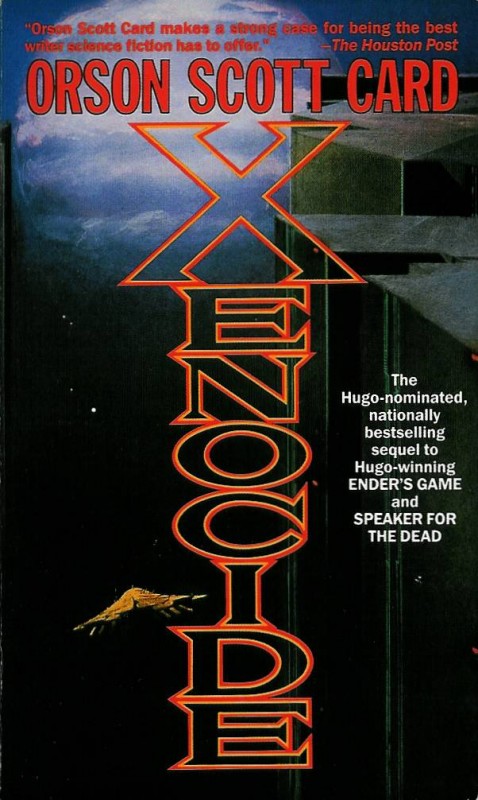
xenocideThis post isn’t just about the third book in the Ender’s Game series–it’s about the genocide of an entire alien race, which is actually a fairly important trope in science fiction.

Of all the evils of our modern era, perhaps the most heinous is the systematic extermination of an entire race or ethnicity.  These acts of genocide not only cross the moral event horizon, they create specters and villains that live on from generation to generation.  Just look at how the Nazis are portrayed in popular culture–even today, they are practically mascots of the ultimate evil.

And for good reason.  There really is something evil about the total annihilation of a foreign culture.  It’s one of the reasons why terms like “genocide” and “ethnic cleansing” are so controversial, especially in conflicts that are still ongoing–and there are so many unresolved conflicts where the systematic and purposeful annihilation of a race or culture is still happening.

Is wholesale genocide a phenomenon unique to our modern age?  Probably not, but modern science has enabled it on a scale that was previously impossible.  This became all too clear to us after World War II.  Only a generation before, great numbers of people believed that we were on a path of progress that would eventually culminate in world peace.  If there was any of that sentiment left, it was shattered with the liberation of Auschwitz and the bombings of Hiroshima and Nagasaki.  Suddenly, we realized that systematic mass destruction and genocide were not only possible, they were a modern reality.

It should come as no surprise, then, that science fiction immediately began to explore this issue.  From Frankenstein to 1984, science fiction has been full of cautionary tales of science gone wrong, issuing a critical voice of warning.  But after 1945, it went much further, exploring the issue in ways that can only be done in a science fictional setting.

Is genocide ever morally justifiable?  In our current world, probably not, but what if an alien race was bent on our destruction?  If their primary objective was the utter annihilation the human race, and negotiation was impossible?  Wouldn’t it be justifiable–perhaps imperative even–to stop such a race by annihilating them first?

This is what is meant by the term “xenocide.” A portmanteau of “xenos,” the Greek word for stranger, and “genocide,” it denotes the complete extermination of an alien race.

Xenocide forms the core conflict of Orson Scott Card’s Ender’s Game series (hence the title of the third book) and features in The Forever War by Joe Haldeman.  Battlestar Galactica presents an interesting twist, where the cylons debate the ethical questions surrounding the complete annihilation of the humans.  And then, of course, there’s all the time travel stories involving Hitler–let’s not even go there.

The interesting thing about xenocide stories is that even though they describe a dilemma that does not currently exist in our modern world, they inevitably come down to issues of Otherness that lie at the very core of the evils of genocide.  In order for xenocide to be morally justifiable, you have to know your enemy well enough to know that there’s no possibility of forging any sort of peace with them.  And to know them that well, they cease to be quite so alien.  It’s one of the major themes in Orson Scott Card’s work–that to defeat an enemy, you have to know them so well that you can’t help but love them.

In our modern world, genocide is only possible when an ethnic group is relegated to the position of Other–when they are made out to be so different and unlike us that we can never possibly relate to or mix with them.  They become “sticks” (Germany), “cockroaches” (Rwanda), “animals” and “barbarians” (Israel).  That is precisely why it makes us uncomfortable in stories about xenocide–because it turns the well-intentioned saviors of humanity into knights templar, or possibly the very monsters they are trying to destroy.

By positing a situation in which genocide might actually be justifiable, science fiction helps us to understand exactly why it is so reprehensible–and that’s only one of the ways in which the genre can uniquely explore these issues.  That’s one of the things I love so much about science fiction: its ability to take things to their extreme logical conclusions, and thus help us to see our own real-world issues in ways that would otherwise be impossible.

Since most of my characters are human, xenocide as such isn’t a major theme in my books, but genocide certainly is.  In the Gaia Nova series, the starfaring Hameji look down on the Planetborn as inferior beings and think nothing of enslaving them and slagging entire worlds.  That’s how Prince Abaqa from Stars of Blood and Glory sees the universe at first, but by the end of the novel he’s not quite so sure.  Stella from Sholpan and Bringing Stella Home also deals with these issues as she comes to realize how it’s possible for the Hameji to hold to such a belief system.

If genocide is one of the ugly skeletons in the closet of this screwed up modern world, then xenocide is science fiction’s way of taking those skeletons out and dignifying them with a proper burial.  By wrestling with these issues in stories set on other worlds, we are better able to humanize the Other and prevent these horrors from happening again on our own.  In this way and so many others, science fiction helps us to build a better world.

W is for Wagon Train to the Stars

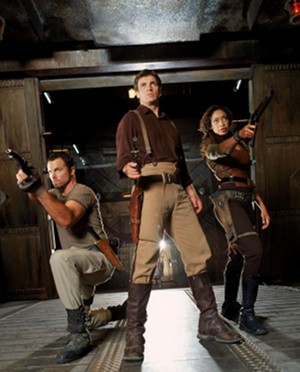
big_damn_heroes_moment_smallWhen Gene Roddenberry pitched the original Star Trek series back in the 60s, Westerns were all the rage.  Consequently, he pitched his show as a “wagon train to the stars,” where a bunch of quirky characters on an awesome starship travel from adventure town to interstellar adventure town, exploring and pioneering the final frontier.

Sound familiar?  Yeah, I thought so.  The concept proved so catchy that it’s been redone time and again, from Battlestar Galactica to Firefly to Doctor Who.  Even though Westerns aren’t nearly as popular as they used to be, many of its tropes are so well suited to Science Fiction that they drive the genre even today.

For example, adventure planets.  In a typical Western, the characters travel from town to town, with a different adventure in each one.  Well, in Science Fiction, the characters do the same thing, except that they’re traveling from planet to planet.  And really, if you’ve got the ability to travel to other worlds, how can you not have an adventure in each one?

A large reason for the Western / Science Fiction crossover is the whole concept of space as the final frontier, which we explored earlier in this series with I is for Interstellar.  There’s a very real sense of manifest destiny in the space exploration community, not because of humano-ethnocentrism (heck, we don’t even know we’re not alone in our local stellar neighborhood), but to ensure humanity’s long-term survival.  The parallels between that and the westward movement in 19th century America aren’t perfect, but they do exist.

Similarly, as we explored in R is for Rebel, the notion of space as the final frontier has a special resonance with the American audience.  The days of the old frontier may be over, but its spirit lives on in our culture, from guns to road trips to our glorification of the rugged, self-made individual.  Today’s Science Fiction, especially the space-focused SF of Space Opera, grew out of the adventure fiction of the pulps, which thrived on that frontier American ethos.

In fiction, the frontier can still be found in two major genres: the Western, which is historical and therefore more backward-looking, and Science fiction, which is futuristic and therefore more forward-looking.  Because Science Fiction isn’t burdened with all of the historical baggage of the traditional Western, it’s a much more flexible medium for story, readily adaptable to contemporary issues and concerns.

For example, where Star Trek echoes the large-scale nation to nation conflicts of the Cold War (Federation vs. Klingons and Romulans), the new Battlestar Galactica series echoes the much more asymmetrical conflicts of the post-9/11 world (Cylon agents who are indistinguishable from humans and may not even know that they are cylons).  At the same time, the wholesale co-opting of Western tropes enables a latent sense of nostalgia, evident in the look and feel of Firefly, or the famous opening lines from Star Wars: A long time ago in a galaxy far, far away.

My first real experience with a wagon train to the stars type of story was probably Star Trek: Voyager, which I watched religiously with my dad every Wednesday night until maybe 9th or 10th grade.  The Western-borrowed tropes are somewhat more muted in that series, but they exist, especially the planetville / adventure towns stuff.  However, it wasn’t until Firefly and Serenity that I really experienced the awesomeness of a true Space Western.  There were a lot of things in Firefly that I really loved, especially the character interactions, the gun-toting action scenes, and especially the starship Serenity.  There were some things I didn’t like so much, like the fact that every planet is basically Wyoming, but overall I really enjoyed the show.

It wasn’t until I started getting more acquainted with straight-up Westerns that I saw the real potential for crossover between the genres.  Stories about mountain men like Jeremiah Johnson really captured my imagination–what would this look like if it were set in space?  In that sense, I came to the Space Western more from the classic Science Fiction side first, rather than the pulp adventure stuff.  But once I discovered the crossover connection, it naturally found a way into my own work.

That’s basically how the story idea for Star Wanderers first came to me.  I was lying on my bed, daydreaming about having my own starship like the Serenity, when I wondered what it would be like for a starship pilot to get roped into an accidental marriage like in the movie Jeremiah Johnson?  The collision between the two ideas was like a supernova exploding in my brain.  I rolled out of bed and started writing, coming up with chapter one of Outworlder almost exactly like it’s written today.  And the more invested I became in those characters and that world, the more the story grew.  I’m writing Part VII right now (Reproach, from Noemi and Mariya’s POV), and so long as people read them I’ll keep writing more.

Genre mash-ups and crossovers are a great way to keep things fresh and come up with some really interesting stories.  Some genres aren’t very well suited for each other (Erotica and Middle Grade, for example), but others come together so well that they seem almost complementary.  That certainly seems to be the case with Westerns and Science Fiction, at least here in the United States where the spirit of the frontier still echoes through the popular culture.

V is for Vast

Pale_Blue_Dot

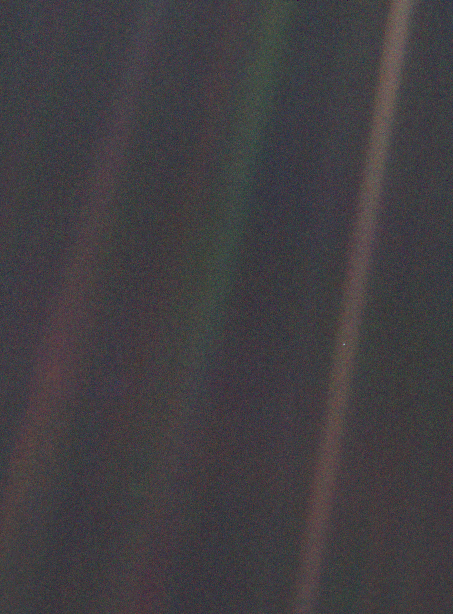
If you don’t know anything else about the universe, you should know this: it’s big.  Really, really, REALLY big.

How big, you ask?  Well, for starters, take a look at Earth in the picture above.  Can you see it?  It’s the pale blue dot in the beam of starlight on the right side of the picture.  As Carl Sagan so famously put it:

From this distant vantage point, the Earth might not seem of any particular interest. But for us, it’s different. Consider again that dot. That’s here. That’s home. That’s us. On it everyone you love, everyone you know, everyone you ever heard of, every human being who ever was, lived out their lives. The aggregate of our joy and suffering, thousands of confident religions, ideologies, and economic doctrines, every hunter and forager, every hero and coward, every creator and destroyer of civilization, every king and peasant, every young couple in love, every mother and father, hopeful child, inventor and explorer, every teacher of morals, every corrupt politician, every “superstar,” every “supreme leader,” every saint and sinner in the history of our species lived there – on a mote of dust suspended in a sunbeam.

The picture was taken by the Voyager 1 spacecraft more than a decade ago.  At the time, the spacecraft was about 6,000,000,000 kilometers from Earth, or 5.56 light-hours.  A light-hour is the distance a particle of light can travel in one hour (assuming it’s traveling through a vacuum).  To give you some sense of scale, in one light-second, a particle of light can travel around the circumference of the Earth seven and a half times.

And lest you think that’s actually a distance of any cosmic significance, consider this: the nearest star, Proxima Centauri, is about 4.24 light-years away.  That’s more than 6,500 times the distance in the photograph above–and that’s just the closest star!

Our galaxy, the Milky Way, is between 100,000 to 120,000 light-years across.  If you were on the other side of the galaxy and had a telescope powerful enough to get a good view of Earth, you would see a gigantic ice sheet over both of the poles with no visible sign of humanity whatosever.  The light from all our cities, from our prehistoric ancestors’ campfires, has not yet traveled more than a fraction of the distance across this galactic island universe we call home.

Seriously, the universe is huge.  If you don’t believe me, download Celestia and take yourself for a spin.  In case you haven’t heard of it, Celestia is basically like Google Earth, except for the universe.  Everything is to scale, and there are all sorts of plugins and mods for exoplanets, nebulae, space probes, and other fascinating celestial objects.

I remember what it was like when I first tried out Celestia back in 2010.  I was at the Barlow Center for the BYU Washington Seminar program, in the little library just below the dorms.  I think it was twilight or something, and I hadn’t yet turned on the lights.  The building had a bit of that Northeast feel to it, like something old and rickety (though not as old as some of the buildings up here in New England).  I turned off the ambient light option to make it look more realistic, and began to zoom out.

Let me tell you, the chills I got as the Milky Way disappeared to blackness were like nothing I’ve felt ever since.  So much space, so much emptiness.  It’s insane.  The vastness between stars is just mind boggling–absolutely mind-boggling.

I got my first introduction to science fiction when I saw Star Wars IV: A New Hope as a seven year old boy.  In the next few years, I think I checked out every single Star Wars novel in our local library’s collection.  It wasn’t enough.  Whenever I was on an errand with my mom, I tried to pick up a new one.  I think they even left some copies of the Young Jedi Knight series under my pillow when I lost my last few baby teeth.

One of those summers, we drove down to Texas for a family vacation.  I picked up the second Star Wars book in the Corellian trilogy, written by Roger Allen McBride.  It was completely unlike any of the other Star Wars books I’d ever read.  In it, Han Solo’s brother leads a terrorist organization in the heart of their home system of Corellia.  They hijack an ancient alien artifact and use it to set up a force field that makes it impossible for anyone to enter hyperspace within a couple of light hours from the system sun.  The part that blew my mind was that without FTL tech, it would take the good guys years to get to the station with the terrorists.

All of a sudden, the Star Wars universe didn’t seem so small anymore.  And it only got crazier.  Roger Allen McBride did an excellent job getting across the true vastness of space.  At one point, Admiral Ackbar mused on just how puny their wars must seem to the stars, which measure their lifespans in the billions of years. For the ten year old me, it was truly mind boggling.

That was my first taste of science fiction that went one step beyond the typical melodrama of most space opera.  And once I had that taste, I couldn’t really stop.  As much as I love a good space adventure, real-life astronomy offers just as much of a sense of wonder.  When a good author combines the classic tropes of science fiction in a space-based setting that captures the true vastness of this universe we live in, it’s as delicious as chocolate cake–more so, even.

I try to capture a bit of that in my own fiction, though I’m not always sure how much I succeed.  In Star Wanderers, the vastness of space is especially significant for the characters because their FTL tech is so rudimentary that it still takes months to travel between stars.  All of that time out in the void can really make you feel lonely–or, if you have someone to share it with, it can bring you closer together than almost anything else.  It’s the same in Genesis Earth, which is also about a boy and a girl who venture into the vastness alone.  The Gaia Nova books lean closer to the action/adventure side of space opera, but the same sensibility is still there.

The best science fiction, in my opinion, both deepens and broadens our relationship with this marvelous place we call the universe.  It’s not just a fantastic setting for the sake of a fantastic setting–it’s the universe that we actually live in, or at least a plausible version of it set in a parallel or future reality.  The universe is an amazing, beautiful place, and my appreciation for it only grows the more science fiction I read.  If I can get that across in my own books, then I know that I’ve done something right.