Writing and Publishing Plans moving forward

Over the past few months, I’ve been spending a lot of time experimenting with AI writing and finding ways to incorporate it into my writing process. The goal so far has been twofold:

  1. Develop the ability to write one novel per month.
  2. Get to a level where I can write 10k words per day.

I’ve accomplished both of those things, but I can’t hit them consistently without burning out. Writing with AI has proven key to both of them, but I feel like I need a lot more practice with AI-assisted writing before I’ve achieved any level of mastery. Once I have mastered AI-assisted writing, however, I should not only be able to achieve both goals consistently, producing a much higher quantity of work, but should also be able to maintain or exceed the current quality of my writing as well.

However, I was thinking about it from a reader’s perspective on my morning walk last week, wondering what I would think if, say, David Gemmell was still alive and writing Drenai books, or Roger Zelazny was still alive and writing Amber books. What would I think if either of them announced that they had found a way to incorporate AI into their writing process, so that they could produce a new Drenai/Amber book once every month, instead of once every year? Better yet, what if Andrew Klavan—who is both still alive and still writing Cameron Winter books—announced that he would start publishing new books monthly. As a fan of all these writers, what would I think of that?

Assuming that there was no drop-off in the quality of these new, AI-assisted books, I would find this really exciting, and would probably become a much bigger fan, simply from the fact that I’m reading so much new stuff. However, after a while this might become too costly to me to keep up, leading me to fall away and not be quite so current on what they’re producing. I would still love them as authors, but if they published too quickly, I might have to take a break after a while—and if they continued to publish at that rate, I might never catch up. After all, there are lots and lots of authors that I love, and I can’t dedicate more than a fraction of my reading time to any particular one of them.

So there’s probably a sweet spot, between publishing too much and publishing too little. Most authors are probably on the Patrick Rothfuss / George R.R. Martin side of that line, where fans wish they would write more and write more quickly. But at a certain point, it is possible to overwhelm most readers by writing too much. Of course, there will always be a core group of fans who will read everything much faster than you could ever possibly write, even with AI assistance, but if that’s the only group you’re catering to, then you probably won’t ever have more than a cult following, because you won’t be able to convert casual readers into superfans.

With all of that said, I feel like I’ve gotten to a good place right now, where I’m publishing a free short story every month. I think that’s actually been a really effective way to turn casual readers into fans, and to keep my name fresh in the minds of my readers. And if Gemmell, or Zelazny, or Klavan were producing a free short story every month, I would definitely subscribe to their newsletters and drop everything to read it.

So keeping up the free short story per month is probably a good idea. But for novels, it might be better to release a new one every two or three months instead. Free short stories are much less of a time and money burden on the readers, and thus are effective at turning fans into superfans. But with the novels, which do take more time and money to read, it’s probably better to throttle that back a little bit.

The interesting thing to me is what that means for my creativing process, especially once I’ve reached the point where it takes less than a month for me to produce a novel. If I’m only publishing a novel every 2-3 months, that means that I can—and probably should—take a break between each novel WIP. Which means that the thing I should be shooting for isn’t to maintain a writing speed of one novel per month, month after month after month, but to hit that speed in creative bursts, taking some down-time to replenish the creative well and prepare for the next project.

It’s a very different writing paradigm from the one I’ve been following for the past decade. Until now, I’ve basically always had a novel WIP that I’ve actively been working on, and whenever I feel like I need a break, I usually move on to a different novel WIP. From time to time, I’ll “take a month off” to work on short stories, but the goal there has always been to write X number of stories in no more than a month or two, once again making writing the focus instead of recharging the creative well.

How would things be different if instead, I told myself “I’m taking a break in order to prepare myself to write my next novel,” with a plan for books and other media to consume in order to get things ready for it? And then, instead of taking several months or even years to write the project, to produce it in just a few weeks of white-hot creative heat, afterwards necessitating a break for a while just to cool down? Until now, I’ve never tried anything like that, because I haven’t thought myself capable of producing work that quickly. Indeed, the very thought of taking an extended break from having an active writing WIP has struck me as being lazy. But now that I know I can produce that quickly, perhaps this is a new paradigm that I ought to at least explore.

For my current WIP, Captive of the Falconstar, I’m not stressing out about finishing it in less than a month. But I am following all the benchmarks that I developed, and watching closely to see what takes more time to write than I thought, and what takes less. And it may very well turn out that the best way to improve quality is to get into that white-hot creative heat that comes from producing quickly, so that’s something that I’m watching closely as well.

How I hacked my ADHD to triple my daily word count

Writing with ADHD can be tough. It’s easy to beat yourself up for being “undisciplined” or “lazy” when the greater problem is that you’re trying to work against your ADHD instead of finding ways to make it work for you. It’s like swimming against a rip current instead of swimming sideways to get out of it.

In the last month, I’ve made a really fantastic breathrough that I think will change the way I write from here on out. So far, it’s helped me to double or even triple my usual word count. The novel I’ve been wrestling with for more than a year now—the longest one I’ve written since I started indie publishing—now looks like it will be finished in just a few of weeks, when I expected it to take a couple of months. Needless to say, I’m really excited.

What changed? I found a way to make my ADHD work for me, rather than against me.

In my previous post, A reading hack for the ADHD addled brain, I explained how I exploited my ADHD to read more books. Basically, I did the same thing, but for writing. There was a lot that had to happen first, though, and the biggest of those was that I had to learn how to make and keep an outline.

Step 1: Learn how to outline properly

For years, I just sort of assumed that I was a discovery writer, probably because of the ADHD. Most of creativity has to do with finding novel or unexpected ways to combine two or more ideas, and when you have ADHD, your brain naturally jumps from idea to idea. That was why I always hated taking meds when I was a kid: I felt that it stifled my creativity. And since most of this idea jumping happened subconsciously, I assumed that outlining would also kill that process.

But after a few years of struggling as an indie author, I realized that my writing process was too slow. In order to succeed, I needed to publish more frequently, but in order to do that, I needed to produce more content regularly. Back then, I would usually write a novel from start to finish, laying it aside for a month or two if I ran into a serious block, and also after finishing each draft. A typical novel would go through two or three revision drafts, so it would literally take years before a +70k word novel was ready to publish.

I decided that the best way to shorten my writing process was to “cycle” through the book, combining all the drafts so that I was working on revisions while simultaneously writing the rough draft. In order to keep track of all that, I needed to keep an outline. So I tried out a few different methods and tweaked them until I came up with a method that worked well for me.

The thought of outlining can scare a lot of writers who consider themselves “pantsers” or “discover writers,” but the thing to keep in mind is that there is no one right way to keep an outline. In fact, there are probably as many ways to outline as there are writers. For some, a couple of quick sketches on the back of a napkin is enough, while for others, it turns into a massive story bible that’s just as long (or longer) than the actual book. But without trying out a lot of different methods, you’ll never figure out what works for you.

It took me a couple of years, but I eventually developed a method that worked really well for me. With it, I was able to write Edenfall and The Stars of Redemption, as well as the last two Gunslinger books, in much less time than it took for my other ones. I was also able to combine all eight of the Star Wanderers novellas into a novel—something I probably wouldn’t have been able to do very well without a solid outline to keep it straight.

But I still would run into blocks that would occasionally derail the project, at least for a little while. I ran into that a lot with my current WIP, Children of the Starry Sea. Sometimes, they were genuine story problems that I needed to work through. More often than not, though, the problem was one of momentum: I was having too many bad writing days interspersed with the good writing days, so that each day felt like I was starting from zero. After a while, that becomes difficult to keep up.

Step 2: Allow yourself to write out of order

When I came back from my second hiatus to work on Children of the Starry Sea, it was clear that my new method wasn’t working as well as I needed it to work. Children of the Starry Sea is much longer than anything I’ve published so far, and I found that I just wasn’t producing enough new words consistently to make my “cycling” process of revisions work.

Around this time, I remembered something I’d heard on a recent convention panel, where one of the authors shared how he collaborated with another author. Instead of going back and forth, he told his cowriter: “how about you just write all the odd chapters, and I’ll write the even chapters, and when we’re both done we’ll combine it all together and see how it turns out.” To their surprise, it actually turned out really well.

So with that in mind, I decided to experiment with skipping around my current WIP, rather than writing it in order from start to finish. If I woke up and felt like I wanted to write an action scene, I would pick one of the action scenes out of my outline and write that. If I felt like I wanted to write the ending, I would skip ahead and write that. If I felt like I wanted to write the next scene, I would go back to where I’d left off and write that.

The outline was the key. Without it, there’s no way I’d be able to keep everything straight and know where each part is supposed to go. The outline also had the added benefit of dividing the novel up into smaller chunks, making the overall project much less intimidating. The way to eat an elephant is to take one bite at a time, just like the way to climb a mountain is to take one step at a time. Same thing with novels.

That’s all well and good, you may be thinking, but what happens when you’ve written all the stuff that you want to write, and all that’s left is the stuff you didn’t want to write? Isn’t that a bit like eating your dessert first, and leaving your vegetables for last? Not really, because chances are that if you really don’t want to write a particular scene, the reader probably won’t want to read it either. So if you can find a way to rework your story so that scene becomes unnecessary, you’re probably better off doing that.

But I actually haven’t had that problem yet. The thing about ADHD is that it actually feels right to jump around all over the place like that. Just because I don’t want to write a particular scene on one day doesn’t mean that I won’t want to come back to it sometime later. And more often than not, writing a later scene actually makes things fall into place with the earlier scenes, and makes me more excited to write them.

It’s as if the project itself is a puzzle. Can you imagine trying to put a puzzle together in linear order, starting from the top left corner and moving to the bottom right? That would be pure torture! Instead, you pick up whatever pieces catch your eye, and try to fit them in with other, similar pieces, until the puzzle itself begins to take shape.

There a lot of disadvantages to writing with ADHD, but there are some areas where the ADHD can actually become a strength, if you learn to work with it instead of against it. I’ve already mentioned how it can help with creativity, since your mind is always bouncing around between different ideas. What I’ve learned in the last month is that writing out of order is another great way to harness ADHD as a strength, since something that leaps out from writing one scene can often lead to a breakthrough in another. Writing out of order gives your ADHD brain the space it needs to make those intuitive leaps, and harnesses the “oh, shiny!” toward something productive, rather than driving you to procrastinate.

Step 3: Start in the middle, not the beginning

For me, the hardest part of writing is getting started. That’s probably my ADHD: it’s always easier to get distracted than it is to settle down and do what you’re supposed to do. Once I’ve settled down, though, and gotten into a groove, I can usually stick with a task until it’s done. In fact, once you’re in something of a flow state, the ADHD can actually make you hyperfocus.

So if the hardest part of writing is getting started, how do you turn that from a weakness into a strength? By leaving the next scene(s) unfinished, so that the next time you sit down to write, the scene has already been started and you just need to figure out the next word. One word leads to the next, and before you know it, you’re in the groove again.

By far, this has been the biggest part of my breakthrough: realizing that I don’t have to write every scene from start to finish in one sitting. In fact, it’s better if I don’t. Instead, I’ll typically finish one or two scenes in the morning, then pick out three to four scenes in the afternoon and write the first couple hundred words or so, deliberately leaving them unfinished so that I have a variety of scenes to choose from the next day.

If the hardest part of writing is getting started, then the hardest part of getting started is feeling overwhelmed at how much you have to do. But if all I have to do is write a couple hundred words, that’s easy! It also works with my ADHD instead of against it, since I get to jump from scene to scene instead of getting bogged down.

With the way that I used to write, most of my “writing blocks” had less to do with the actual writing and more to do with working myself up to write. Many times, I found that if I just sat down and opened up my WIP without thinking too much about it first, the writing would come a lot easier. Starting in the middle is a great way to harness that, because you aren’t confronted with a blank page the moment you sit down. It takes a lot less effort to find the next word than it does to find the first word.

So with where things stand right now, I just need to start four new scenes every day this week and I’ll have every remaining scene in my novel WIP started by Saturday. From there, if I can finish two or three scenes a day, I can easily finish the rough draft stage of this novel WIP before the end of February—which will be amazing, since I’m only at the 65% mark right now, and historically that’s always the part where I find it most difficult to write.

I’m really looking forward to writing a whole novel from start to finish using this method. As soon as Children of the Starry Sea is finished, I’ll start outlining the sequel, Return of of the Starborn Son, and write it the same way. If things go well with my current WIP, I’ll be very optimistic about finishing the next one before the end of the year—perhaps even before the end of the summer.

I do expect things to get crazy around here soon, though. Our second child is due in the early spring, which means enduring a month or two of chronic sleep deprivation. I’ve gotten to be pretty comfortable with writing at 4AM, but we’re also getting a lot more uninterrupted sleep than we were when Princess Hiccup was a newborn. I anticipate that we’ll have at least a month where nothing gets productively done.

So it will be really fantastic if I can finish Children of the Starry Sea NOW, before the baby comes—and not just the rough draft, but the revisions too. Fortunately, I don’t think I’ll have too much difficulty with the revisions. I’ve already cycled through the first half of the book a couple of times, and it’s working pretty well. Also, revisions come a lot easier to me than writing new words. I’m not sure why that’s true, but it is.

And for the record, I don’t advocate jumping around all over the place while doing revisions. It’s probably best to do that part in sequential order, if nothing else than to make sure that all the scenes and chapters flow properly. I haven’t gotten to that part of this writing method yet, so it will be interesting to see how it goes. So far, the stuff I’ve cycled through actually seems to flow pretty well, but I need to take it from the beginning to really be sure.
A weird thing I’ve noticed

So I’ve been making good progress on Children of the Starry Sea, writing about 2k words or one scene per day. But in the last couple of weeks, I’ve also had a bunch of short stories drop in my lap, two of them from dreams.

My best writing time is between 4am and 6am, so on both occassions I simply wrote the story as I dreamed it, or as I reimagined it right after waking up. This has taken a little bit of time away from working on Children of the Starry Sea, but not too much. For the first story, “We Should Have Named You Corona,” I spent one day knocking it out, then was back to work on my novel WIP the next day.

The other story is “On the Eve of the Flood,” and it’s more like I dreamed the general setup, not the actual story. I spent most of today working on it (I had the dream last night), but I still managed to finish another short scene from Children of the Starry Sea, so I don’t think this one is going to distract much from my novel WIP going forward—unless I decide to just buckle down and finish it in the next couple of days, which I may decide to do.

The third story, “Hell From Beneath,” is actually a J.M. Wight story that I wrote a few months ago, but wasn’t very satisfied with. One day, though, the solution to that story’s problems just sort of opened up to me, and I knew what I had to do to fix it. I wasn’t even thinking about it at all—I was working on Children of the Starry Sea, and making quite good progress on it, not even thinking about this other story.

With that one, it took me another three or four days to get back into the headspace for Children of the Starry Sea, just because the other story is so much darker and heavier. But that was more of a momentum / procrastination thing: getting started is always the hardest part of writing, at least for me, and I delayed starting back on Children of the Starry Sea until I was no longer in that headspace. In retrospect, I probably could have solved the headspace problem just by getting back to work, maybe with a partially written scene that was easy to finish.

In any case, the weird thing I’ve noticed is that the more I work on one project, the more it stimulates my mind to work on other projects. It’s not even that it detracts from the primary project—which is good, since otherwise how would I ever finish anything? But it does mean that if I want to have more story ideas, I should focus on whatever project is on my plate, rather than laying it aside and trying to come up with story ideas. In that way, it’s kind of like stargazing: if you look at a star directly, it tends to disappear, but if you look at it sideways, it becomes much more visible.

Or maybe it’s this new writing technique I’m trying out. Instead of trying to write my whole novel front to back, I’ve broken into scenes, and outlined the scenes well enough that I can write them out of order. So each day I ask myself “which scene(s) do I feel like writing today?” which is actually quite liberating.

I’ll do a deeper blog post on this writing technique after I’ve finished Children of the Starry Sea. If it works out well (and so far I think it is) I’ll have a lot of interesting things to share with you. But for now, I find it interesting that the more I write in my novel, the more ideas I get for other stories—and the easier it is to write them.

Why writing every day may still be the best advice

A week ago, I blogged about how writing every day may not be the best advice. I pointed out how following that advice had helped me when I was first starting out, but it had also hurt me later on. I pointed out how sometimes it’s better to work smarter than harder. After all, why throw out 80% of what you write if by taking a little time to properly outline things, you can write a clean first draft?

Well, I’ve been reading a book called The Compound Effect, and it’s made me rethink some of those ideas. The main point the book makes is that it isn’t the big things that make the most difference, but the small, regular things compounded over time.

Is it still a good idea to work smarter? Yes, definitely. If by taking the time to prewrite a book, you can avoid throwing out 80% of your work, then by all means that’s more important than hitting your 2k / 3k / 10k words for the day, or whatever. But here’s the thing: there’s a smarter way to write every day too, and it has to do with momentum.

If you’ve been in a writing rut, it’s very hard to go from 0 to your daily word count goal in a single day. Over time, that goal becomes a ceiling instead of a floor. It’s all very psychological. Your writing time fills up with procrastination or busywork, to the point where it takes all your energy just to hit that daily goal.

All of that changes if instead you say “I’m going to write 500 / 200 / whatever words more than I did the day before.” Even from a rut, it’s not that difficult to go from 0 to 500 in a single day. And once you’ve hit 500, it’s not difficult to hit 1k. Compounded this way, you can soon break through that ceiling and still have energy to hit everything else.

It’s an interesting approach to daily writing goals, one that I’m trying out right now. But for it to really work, you do have to write every day, otherwise the compounding never happens.

When I first started this blog back in 2007, I used to write a lot about momentum. I was very much a novice writer, but even back then I could feel how much easier it was to write when I was on a streak than when I was starting from zero—and a streak can start with a day of just a few hundred words.

The things to avoid are busywork and useless guilt. If your writing goals have become a ceiling that you just can’t break through, perhaps it’s time to recalibrate. Work smarter AND harder.

And now, for no particular reason at all, here’s a Sabaton music video.

Another one done!

The Sword Keeper
Phase:3.0 Draft
100%

It’s done! Draft 2.0 of The Sword Keeper is finished. Still need to run it by some test readers, but it’s looking very good for a release this year.

In other news, the power cable for my laptop decided to die. I’ll replace it eventually, but in the meantime, I’m going to try turning my phone into a writing device. Just got a K480 bluetooth keyboard and I’m excited to try it out. My phone is a device I’ve always got with me, so adapting it for writing could be really great.

I’m also going to try a new writing technique that should hopefully lead to cleaner (perhaps even publishable) first drafts. If it works, this could significantly increase my writing output. It involves cycling through yesterday’s words before writing any new ones, getting into the flow and making any changes as necessary. This is actually very close to how I used to write back in high school, before all those college English classes. I also get the sense that this is how Dean Wesley Smith writes.

All sorts of experimental new things going on with my next WIP, which is Edenfall. Yes, it’s time to complete the trilogy. But before I jump into it, I’m going to take some time to do some serious prewriting, in the hopes (again) of writing a clean first draft. Which, if it works, means that the book will be published that much sooner.

In the meantime, Gunslinger to the Stars is almost ready for publication. My editor is working on it now, the cover art is just about finished, and besides that all that’s really left is crafting the book description and metadata. If all goes well, it should be up for pre-order on iBooks, Kobo, Smashwords, and Nook before the end of the month.

Also, new short story!

Nothing Found

An Answer…

Over the weekend, I read a really interesting post on The Passive Voice blog. It was an excerpt from a post by Dean Wesley Smith, looking at the tools and opportunities we have today and asking why we, as writers, still think that it’s difficult to write like the old pulp writers:

Yesterday, in the last chapter of the book I did about writing a novel in five days while traveling, I made a comment near the end that I found the exercise fun to be able to (just for a few days) feel like I belonged in the world of the pulp writers.

And I made a comment that I was born too late.

A reader wrote me privately with a good comment. Basically the reader reminded me that I should feel lucky to have the modern things we writers use such as computers, control of our own work instead of selling it to gatekeepers and so on.

The reader made a very good point. We do have it so easy, so much easier than the pulp writers did. I know that, I study the pulp writers and their lives.

Yet even with things being easier, it is unusual for a writer in 2017 to write a novel in five days.

So why do writers in this modern world not just write novels every week, week-after-week?

That even “Why?” question…

I knew the answer. Writer’s belief systems. Modern writers don’t believe they can.

That belief has been trained out.

Writers of the modern world have been taught to think that writing at pulp speed is different, unusual, a fantastic feat, massive work, and on and on and on…

I then realized I had done it too. And until tonight I hadn’t caught myself on it.

Look back at the last chapter I wrote. I called the entire idea of a novel in five days, “Crazy.”

Why? Writing a 40 thousand word novel should take me between 35 and 40 hours.

Sitting alone in a room and making stuff up for 40 hours in five days. What is so crazy about that????

And more importantly, what is so difficult about that?????

It’s a fair question. And it got me thinking: what are the false writing beliefs that are crippling me right now?

I can think of a few:

  • First drafts are never publishable.
  • Prewriting is not as important as butt in chair, hands on keyboard.
  • You can’t have more than one active WIP at the same time.
  • You can’t write short stories while working on a WIP.
  • Writing a short story per week is hard.

Well, it’s time to break free from these crippling beliefs, starting with the last one.

I’ve had a bunch of short story ideas recently, and I’m going to start running with them. I’ve neglected my short story writing for the past six months, so my active submissions have dried up somewhat (at least to the pro markets). But a lot of magazines have been giving me personalized rejections, which tells me that I’m not too far from a breakthrough. Trouble is, I just haven’t had anything to send them lately.

If I could write a novel per week, that would be absolutely fantastic. I’d probably write in a crazy obscure genre like Sword & Planet, except it’s not that obscure because Princess of Mars influenced everyone from Clarke, Bradbury, and Heinlein to George Lucas and the US Space Program.

But I’ll start with the short stories. And from there, who knows?

On the way to 10k

A couple of weeks ago, I wrote about how I plan to achieve my writing goal of hitting 10k words of fiction in a single day. The steps I laid out to getting there were:

  1. Write first thing every day.
  2. Write in timed, focused sessions.
  3. Strive to achieve 2k words per hour.
  4. Strive to hit at least 6 writing sessions.
  5. Pre-write each day for the next day.

I’m happy to report that the writing has been coming along very well! Ever since I started timing my sessions and keeping track of how much and how fast I write, it’s been as if someone turned on a switch inside my brain. The words are flowing, the story is coming along very well, and I’m a lot happier and more productive than I was only a month ago.

The main thing that does it is, ironically, forcing myself to stop every half hour or so. When I wake up in the morning and thing of how much I want to write that day, it can be a little daunting. By writing in short bursts, it helps to break the big goal down into parts. When you think too much about all the writing you want to achieve, it’s very easy to get caught up in the procrastination trap. But when you think of it as just a half-hour session of 400-600 words, it seems a lot more doable. And it is!

So things are coming along very well with Gunslinger to the Stars. My goal is to finish the first draft by February 6th and send it out to my first readers shortly thereafter. If things keep going the way they have been, I may actually finish it sooner.

As for reaching 10k words, I’m still a ways off but headed in the right direction. For now, I’m laying the foundation for it: building good habits and hitting a consistent stride. Once I’ve got that laid out, I’ll start to stretch myself, pushing the limits further and further until I’m ready to make the final approach to the summit. No sense in pushing too hard and burning out along the way.

In other news, I’ve sent Captives in Obscurity (Sons of the Starfarers: Book V) off to my editor, and should be getting it back in early February. The cover art should be ready around the same time. If all goes well, the book should be up for pre-order by the end of February, with a release date of May 15th.

I’m not sure when Patriots in Retreat (Book VI) will come out, since I’m still writing it, but as of right now I’m tentatively planning for a release sometime in August. After I’ve finished with Gunslinger to the Stars, I’ll move on to Patriots and see if I can’t knock that out before the end of February. If so, I might actually push the release date up to July.

As for other WIPs I intend to tackle, The Sword Keeper and Edenfall are on the top of the list. The free month for Genesis Earth went a lot better than I had expected, leading me to believe that there’s enough potential to make finishing the trilogy worthwhile. Besides, Edenfall is already plotted out, so if I can keep up the 10k pace it should be a cinch to write. Same with The Sword Keeper.

That just about does it for this post. I intended to write another Self-Sufficient Writer post responding to some of the craziness going on in the world right now, but that will have to hold off until next week. I’ve also got another trope post planned for Monday, so that should be interesting.

In the meantime, I’ll leave you with this video about how many twinkies it would take to power the Death Star. Take care!

George R.R. Martin may not be your bitch, but I am

Last week, George R.R. Martin surprised no one and disappointed everyone when he announced that The Winds of Winter would not come out before the next season of the Game of Thrones TV series that covers the events in that book. He apologized profusely to his fans, most of whom seemed to take it graciously, at least to his face. However, it spawned some heated discussions in the online communities that I frequent (most notably The Passive Voice) about the implicit contract between writers and reades.

This discussion is not new, even with regard to Mr. Martin. Way back in 2009, Neil Gaiman addressed this issue in a blog post where he stated quite memorably that “George R.R. Martin is not your bitch”:

People are not machines. Writers and artists aren’t machines.

You’re complaining about George doing other things than writing the books you want to read as if your buying the first book in the series was a contract with him: that you would pay over your ten dollars, and George for his part would spend every waking hour until the series was done, writing the rest of the books for you.

No such contract existed. You were paying your ten dollars for the book you were reading, and I assume that you enjoyed it because you want to know what happens next.

So that’s one end of the spectrum: that writing is an art, that it can’t be forced, that trying to force it is wrong, and that writers have no obligation to their readers to force anything. Readers should not stalk their favorite writers or tell them what they should or should not be doing to produce the next book. As Mr. Martin said in his latest post:

Unfortunately, the writing did not go as fast or as well as I would have liked. You can blame my travels or my blog posts or the distractions of other projects and the Cocteau and whatever, but maybe all that had an impact… you can blame my age, and maybe that had an impact too…but if truth be told, sometimes the writing goes well and sometimes it doesn’t, and that was true for me even when I was in my 20s.

On the other end of the spectrum, we have Larry Correia. Two days after Mr. Martin announced that The Winds of Winter would not be finished in time for the TV series, Mr. Correia announced his own plans for the year: which of his books are coming out, which books he plans to write, which project he’s going to collaborate on, and which conventions and events he will (or more notably, will not) be attending.

I don’t know whether he meant this as a dig at Mr. Martin specifically, but he included the following statement:

To all those sensitive artist types who whine about how they can’t rush art, and can’t get any writing done, oh, BS. Quit your crying, put your big girl panties on, and treat it like your job. Because it is a REAL JOB. And like all real jobs, if you don’t work then you shouldn’t GET PAID. So shut up, quit screwing around, and get back to work.

The part that really stood out to me, though, was his announcement that he would not be at DragonCon or GenCon this year:

I’m skipping DragonCon and GenCon this year, which pains me because I love those, but again, I’m trying to up the novel production, and all those cons in a row over the summer kick my butt.

I found it interesting because George R.R. Martin is well-known as a frequent convention attendee, to the point that by his own admission attending these conventions is his “way of life.” Larry Correia knows that his writing productivity takes a hit when he attends too many conventions, but George R.R. Martin either doesn’t know or has chosen to prioritize attending fannish events over his own writing.

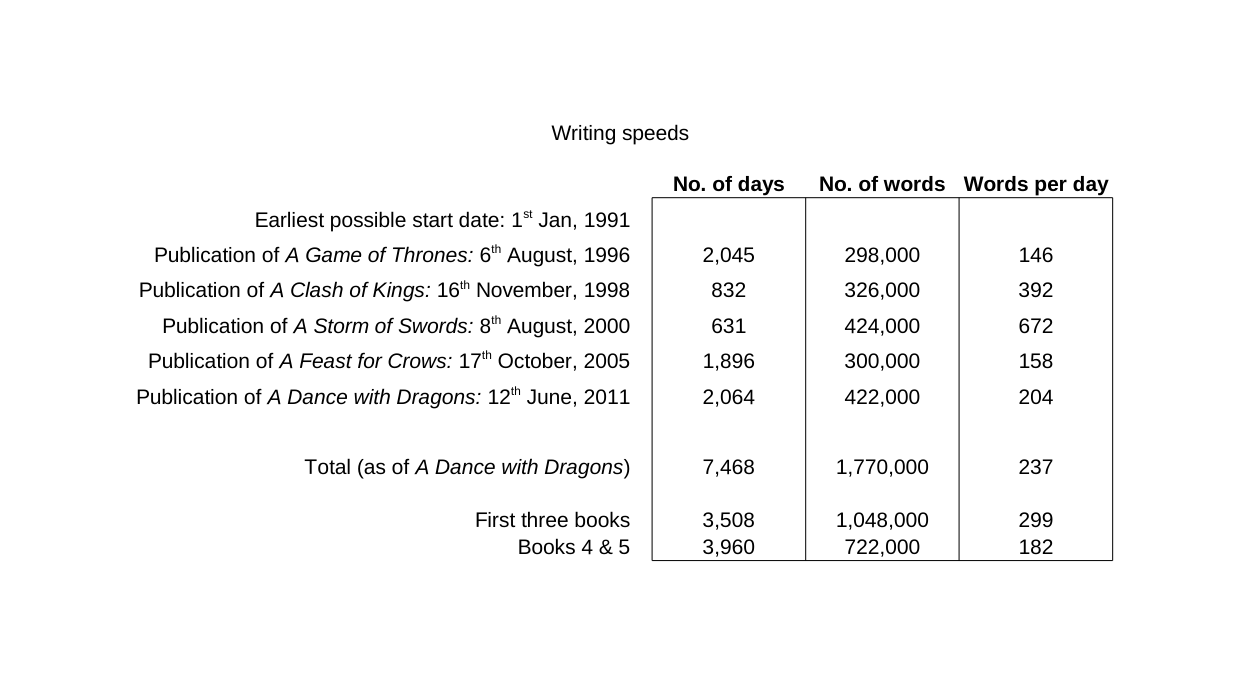
This made me curious about Mr. Martin’s writing productivity, so I did a little digging and found the following figures, calculated by his fans:

grrm_wordcount

Those numbers are rather stunning. He averaged only 200 words a day when writing A Dance with Dragons? Just for reference, this blog post is about seven hundred words so far, and I’m writing it while taking a break from my other writing (word count so far today: 1,100 words, and that’s a little low). Even if we allow for five drafts written at the same speed, five drafts still only comes to 1,000 words a day.

Now, I do think Mr. Gaiman makes a good point that it is neither healthy nor helpful to try and micromanage everything that a writer does. We can’t spend every waking hour working on the next book, and even if we did, it probably wouldn’t turn out as well, because refilling the creative well is an important part of the writing process. And I also have to admit that if you ran a similar calculation on my own books (especially the early ones), you would probably find some similarly embarrassing figures.

(Though to be fair to myself, I tend to have multiple irons in the fire at any given time, so a straight start date to publication date calculation doesn’t tell the whole story—and it probably doesn’t tell the whole story with George R.R. Martin as well. But still, even if those figures were twice as high, they would still be absurdly low for a working writer.)

When Mr. Gaiman and Mr. Martin say that the writing “comes when it comes” and there’s nothing they can do about it, I think they’re wrong. Dead wrong. Writing is an art, but it is also a craft. It can’t be forced, but it can be structured. Mr. Correia has evaluated how productively he writes and structured his convention-going plans accordingly. Has Mr. Martin?

I also think they’re dead wrong about the writer having no obligation to the reader. That’s total bunk. Reading is an act of collaboration between the writer and the reader: without readers, stories would never exist. They would just be markings on a page, or electrons on a drive, or at best ideas and daydreams in the writer’s head. If a tree falls in the forest, does it really make a sound? If a book is never opened, does it ever tell a story?

Part of this may be the difference in perspective between indie writers and traditionally published writers. In the traditional system, writers were paid an advance on royalties by their publishers. The contract also allowed for royalties, but those figures were set so low that most books never earned out their advance. Publishers made up for it by raising the advances for the writers they wanted to keep.

In contrast, indie writers live and die by their royalty checks. Had a good month? Congratulations, you can afford to eat. Had a bad month? Tsk, tsk. Better hurry up with that WIP of yours, because the longer it takes to publish it, the longer it takes for you to get paid.

But even for the fantastically successful writers who never have to worry about how they’ll pay their bills, I still believe that they have as much of an obligation to their readers as the rest of us. Without readers, we would not be able to do what we do. Without readers, it would be impossible to pursue writing as a career. We all want to live the dream, and the only way to do that is by treating our readers well.

So George R.R. Martin may not be your bitch, but I most certainly am. Writing is not something that happens only sometimes: it’s my job, and I do it every day. And as for accountability, I absolutely feel that I’m accountable to my readers. They are the whole reason I am able to do this in the first place. If that makes me their bitch, then so be it.

Resolution: 10k in 2016

Back in 2012, I set a resolution to write 10k words of fiction in a single day. I had read Rachel Aaron’s semi-famous blog post about it, and decided to give it a shot myself. The most I managed, however, was a handful of 5k writing days—impressive, but still far short.

In the years since, my writing pace has slowed down a lot more than I would like—not because of writing-related reasons, but because of things like procrastination, poor time management, and general disorganization. Well, it’s time for a change, and the new year seems like the best time to shake things up.

Rather than set a goal like “write every day” or “write X,XXX words per week,” I think this goal will do a lot more to put me in the right direction. It’s the difference between setting a goal to go to the moon vs. put something new in orbit every few months. When NASA set the moon as their primary goal, it not only provided them with the single-minded focus that they needed to get stuff done, but it led to a tremendous amount of scientific and engineering breakthroughs in the process. I’m hoping that something similar will happen with me.

So here’s the deal:

I can type at a maximum speed of about 100 WPM. Logistically, that means that the absolute minimum time needed to physically hit 10k words is 100 minutes, or 1:40 hours. That’s typing at top speed with no breaks, no mistakes, and no time to slow down and think.

I’ve measured my writing in the past, and found that my typical fiction writing speed is between 800 and 1,000 words per hour. To hit 10k words at that rate, I would have to work for an excruciating 10 to 12 hours a day—and that’s pure writing time. It doesn’t include things like breaks, water cooler chats, dinking around on social media, or any of the numerous other ways that regular employees waste time while on the clock.

Clearly, if I’m ever going to hit 10k words in a single day, I need to increase the speed at which I write. But how?

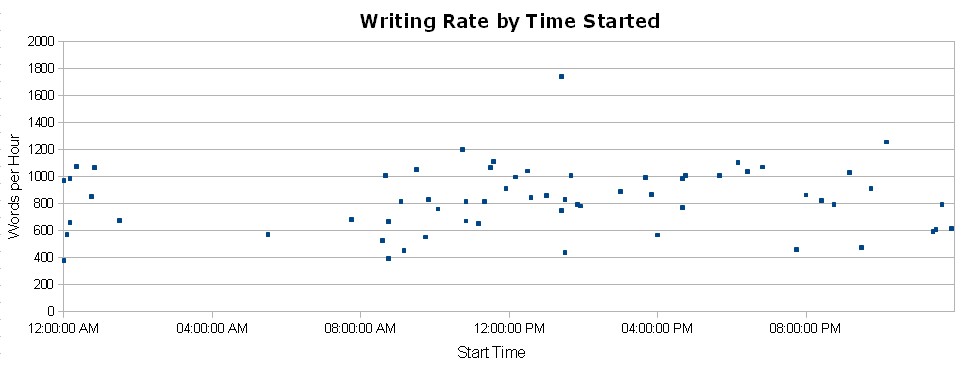
writingrate_by_starttimeWell, I know from my writing log experiment that the time of day doesn’t really affect my writing speed. That means I can start as early as I need to, and the earlier I can start the better. So that pretty much sets up the first step to achieving this 10k goal:

Step 1: Start off each day by writing as soon as possible.

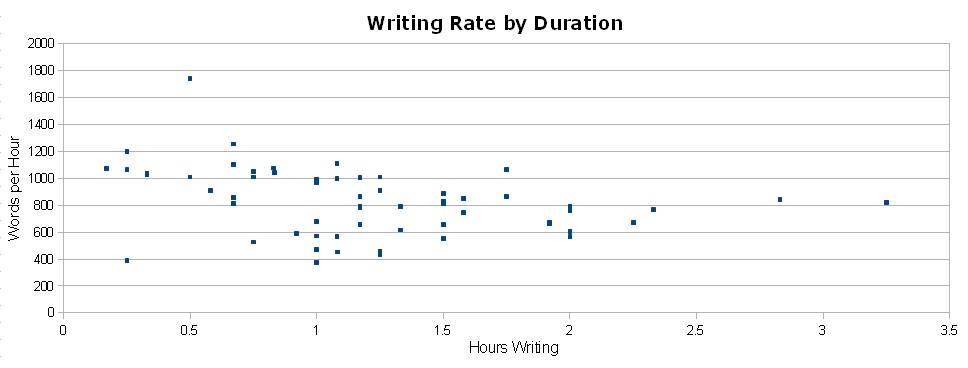
writingrate_by_durationFrom the writing log, it looks like I tend to write fastest in short sprints that are less than one hour. That makes sense: the longer the writing session, the easier it is to get distracted and fall into the procrastination trap.

I have a hunch that the best way to increase my writing speed is to write in short, focused bursts. I’ve never actually tried to limit my writing time before, but it seems that I could really achieve a lot more focus by doing so. It will take some experimentation to figure out the optimal session length, but judging from the data it will probably be less than one hour.

Step 2: Increase speed by writing in short, focused sessions.

Obviously 10 to 12 hours of pure writing time is unreasonable. Even without a day job or other time obligations, burn-out would be a major issue. A much more reasonable amount of time to plan for would be 4-6 hours of pure writing time per day.

At 6 hours, to reach 10k words I would have to write at about 1.6k words per hour, which is reasonable. At 4 hours, I would have to write 2.5k words per hour, which is a lot tougher but still well below the 6k WPH physical limit, especially if I’m writing in short, focused bursts. From this, it’s not difficult to derive the next couple of steps.

Step 3: Increase average writing speed to 2,000 words per hour.

Step 4: Structure each day to achieve 6+ writing sessions.

The real trick to achieving this, as Rachel Aaron and numerous others have pointed out, is to take care of all the non-writing things that make the writing possible. This involves having an outline of some sort, or at least some idea of what is going to go on the page.

I’m a pantser, so I don’t write detailed outlines. However, I’ve found that it can help a lot to sketch out the next few scenes before I write them, and to browse tvtropes like a menu. In addition, long walks really help me to flesh out the story in my head. Without these pre-writing activities, the blank page can be really oppressive.

In more specific terms, I think it’s reasonable to allot 1-2 hours each day to pre-writing activities. Anything more than that would encroach on my actual writing time. Fortunately, I can usually hit two birds with one stone: for example, using my time on tvtropes to find material for blog posts, or outline the next few scenes in my head while hiking or exercising. But it’s important to make time for these things.

Step 5: Spend time each day in pre-writing activities for the next day.

These five steps seem like a good place to start. I’ll post them on my wall and revisit them in a month or so to see how they’re working out.

Ten thousand words in a single day is going to be tough, but if I can hit it at least once this year, I think it will remove a major block in my head and allow the words to really flow. It’s not just about writing faster, it’s about proving to myself that this is something I can do, and to use that as motivation to accomplish much more.

Best of luck with your own resolutions in 2016!

Yay for short stories!

So for the past three weeks while waiting for my first readers to get back to me with their comments on Strangers in Flight, I’ve been working on short stories. It’s a great way to stay busy and productive between projects, and feels really gratifying too because it only takes a week or two to finish things.

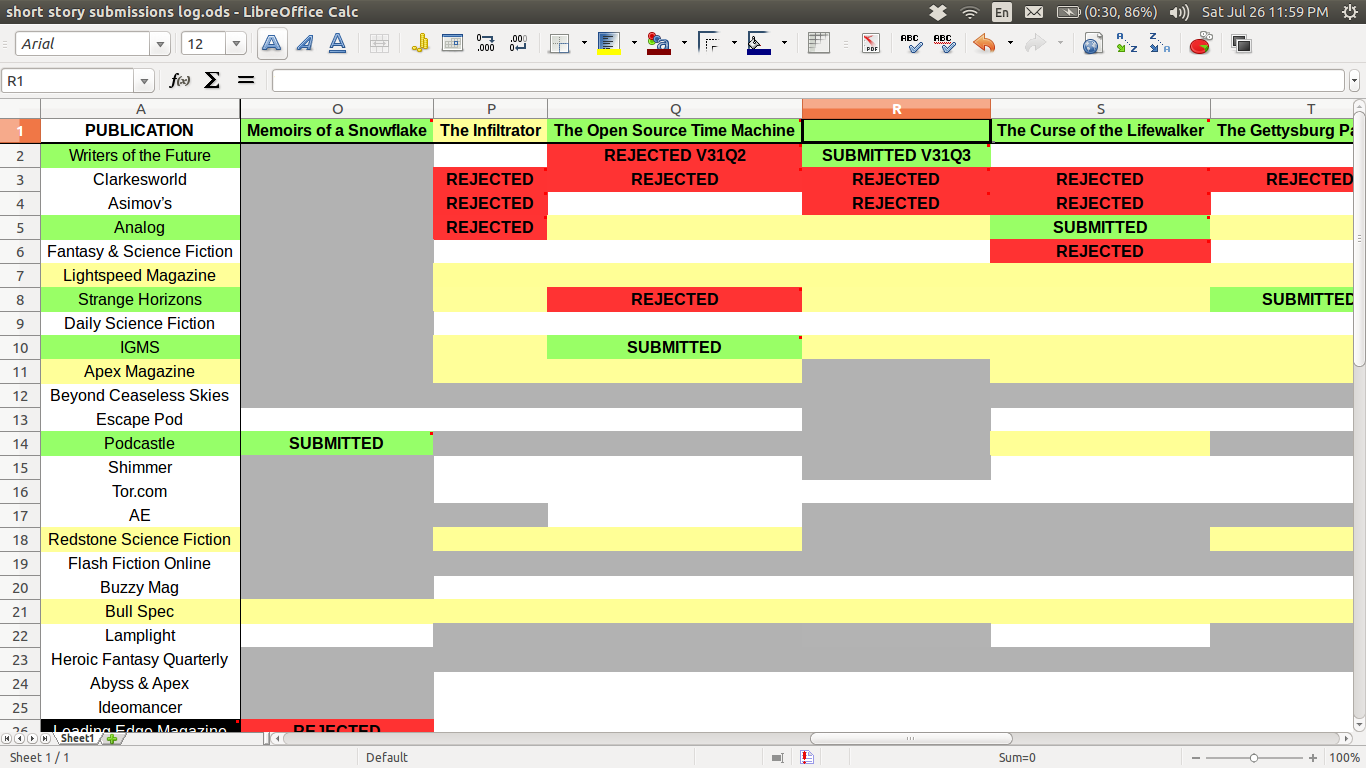
Screenshot from 2014-07-26 23:59:19The really gratifying thing for me, though, is sending off my stories to the magazines and having half a dozen or more on submission at any time. I love self-publishing, but for short stories, it makes a lot more sense to shoot for publication in one of the traditional markets first. They don’t buy exclusive rights, so you’re free to self-publish later, and they put your writing in front of a new audience, giving you some great exposure–all while paying you!

So far, the only market I’ve cracked has been Leading Edge. But the more I write, the sooner that will change! And since I still have the option to self-publish, the rejections don’t feel quite so discouraging. Instead, it’s almost like a friendly competition with myself to see how many rejections I can rack up, and how many stories I can have on submission at one time.

Lately, I’ve been working on a Sword & Sorcery story titled “A Hill On Which To Die.” It started off as a short story, but then it morphed into a novelette–not quite as long as Star Wanderers: Outworlder (Part I), but long enough that most of the markets won’t take it. It’s also long enough that it will probably need a revision once it’s done, and I may run it past a reader or two. It’s definitely turned out to be more work than I’d bargained for.

There’s another story I’m working on about a naturally occurring time portal in rural Pennsylvania, and how the Amish are so isolated from modern society because they’re the ones guarding it. Then I’d like to rewrite “The Infiltrator,” to cut out most of the stuff at the beginning and dive straight into the action. That should take only a day or two. And then, there’s that story about the uplifted Deinonychus that my girlfriend really wanted to read …

Gah! So many ideas to play with! I cannot possibly write fast enough to keep up with them. It’s the most frustrating thing in the world!

I suppose for most of my readers, this talk of short stories is kind of frustrating too, since they probably won’t be available for you to read for a while. But one way or another, they will come out eventually! And it’s definitely better to write something while in that weird space between projects. At least I’m finishing stuff.

So that’s what I’ve been up to lately. I’ll probably finish “A Hill On Which To Die” in a day or two, then work on “That Which Is About is” until it’s finished. It’s an Amish sci-fi romance–I can barely wait to get it all down on the page!c And after that, I’ll probably move on to Strangers in Flight, making the revisions and getting it ready to publish in August.