Wasn’t every self-inflicted wound really aimed at the conscience of the world? —Walter M. Miller, Jr. “The Darfstellar”
Tag: Walter M. Miller Jr.
Reading Resolution Update: Before 2022
My 2022 Reading Resolution: Read or DNF every novel that has won a Hugo or a Nebula award, and acquire all the good ones.
I was going to keep track of my reading resolution this year by mentioning each book and what I liked or didn’t like about it, why I DNFed it if I did, etc… and then I thought about it a little more and realized that that’s a terrible idea. Perhaps if I weren’t an author myself, I could risk bringing down the wrath of the internet by broadcasting everything that I really think about these books, but that’s still a really stupid thing to do—not to mention, a great way to burn a bunch of bridges that, as a writer, I really shouldn’t burn.
Instead, I’m going to post a monthly update where I list all of the books that I read and want to acquire, all the books that I read and probably won’t acquire, and all of the books that I DNFed, without any book-specific commentary. I do think that having some public accountability will help me to keep this resolution, and I do intend to keep it. But because I anticipate DNFing a lot of books that have very, um, merciless fans, this seems like a better way to do it.
So here is how things stood on the morning of January 1st, 2022:
Books that I read and want to / have already acquired:
- Double Star by Robert A. Heinlein (1956 Hugo)
- Starship Troopers by Robert A. Heinlein (1960 Hugo)
- A Canticle for Leibowitz by Walter M. Miller Jr. (1961 Hugo)
- The Man in the High Castle by Phillip K. Dick (1963 Hugo)
- Dune by Frank Herbert (1966 Hugo and Nebula)
- The Left Hand of Darkness by Ursula K. Le Guin (1970 Hugo and Nebula)
- The Dispossessed by Ursula K. Le Guin (1975 Hugo and Nebula)
- Downbelow Station by C.J. Cherryh (1982 Hugo)
- Neuromancer by William Gibson (1985 Hugo and Nebula)
- Ender’s Game by Orson Scott Card (1986 Hugo and Nebula)
- Speaker for the Dead by Orson Scott Card (1987 Hugo and Nebula)
- Barrayar by Lois McMaster Bujold (1992 Hugo)
- Mirror Dance by Lois McMaster Bujold (1995 Hugo)
- The Mule (included in Foundation and Empire) by Isaac Asimov (1946 Retro Hugo, awarded in 1996)
- Harry Potter and the Goblet of Fire by J.K. Rowling (2001 Hugo)
- Farmer in the Sky by Robert A. Heinlein (1951 Retro Hugo, awarded in 2001)
- Fahrenheit 451 by Ray Bradbury (1954 Retro Hugo, awarded in 2004)
- Spin by Robert Charles Wilson (2006 Hugo)
- The Sword in the Stone by T.H. White (1939 Retro Hugo, awarded in 2014)
- Network Effect by Martha Wells (2021 Hugo and Nebula)
Books that I read and don’t plan to acquire:
- The Demolished Man by Alfred Bester (1952 Hugo)
- The Forever War by Joe Haldeman (1975 Hugo and Nebula)
- Gateway by Frederik Pohl (1977 Hugo and Nebula)
- Red Mars by Kim Stanley Robinson (1993 Nebula)
- American Gods by Neil Gaiman (2001 Hugo)
Books that I did not finish:
- The Moon is a Harsh Mistress by Robert A. Heinlein (1966 Hugo)
- Flowers for Algernon by Daniel Keyes (1966 Nebula)
- Lord of Light by Roger Zelazny (1967 Hugo)
- Ringworld by Larry Niven (1970 Hugo and Nebula)
- Rendezvous with Rama by Arthur C. Clarke (1973 Hugo and Nebula)
- Green Mars by Kim Stanley Robinson (1993 Hugo)
- Blue Mars by Kim Stanley Robinson (1996 Hugo)
- Forever Peace by Joe Haldeman (1997 Hugo, 1998 Nebula)
- The Fifth Season by N.K. Jemisin (2015 Hugo)
- The Obelisk Gate by N.K. Jemisin (2016 Hugo)
- The Stone Sky by N.K. Jemisin (2017 Hugo and Nebula)
Trope Tuesday: After the End
 It’s the end of the world as we know it … so why do we feel fine?
On the apocalyptic scale of world destruction, when the thing that wipes out civilization doesn’t quite kill everyone, we’re left with an After the End type setting. Depending on where the writers fall on the sliding scale of idealism vs. cynicism, this may range from a futuristic Arcadia to a crapsack post- hell on Earth.
Whatever the case, expect to see lots of modern ruins and schizo tech mashups (horse-driven cars? Wood-wheeled bicycles?). If anarchism reigns, expect to see lots of punks roaming the wastelands in muscle cars and motorcycles. If Ragnarok Proofing is in effect and the ruins of civilization haven’t quite decayed yet, expect some variation of a scavenger world. And if someone from our modern era finds himself lost in this bizarre post-apocalyptic future, expect him to find some sort of constant to reinforce that he’s not in Kansas anymore.
Unlike dystopian settings, where society evolves (or is deliberately turned) into a horrible, hellish place, a post-apocalyptic setting represents a reboot of civilization itself, where one society has passed away and a new one is slowly picking itself up from the ashes. It has the potential to be a lot more hopeful, and to give the reader a lot more wish fulfillment. After all, who wouldn’t want to be one of the lucky survivors tasked with rebuilding civilization? Sure there may be zombies or nuclear nasties wandering about, but on the plus side, you don’t have to worry about your bills or your deadbeat job anymore.
Douglas Rushkoff has some interesting ideas about why this type of story is becoming more and more popular nowadays. In his new book Present Shock which he’s been promoting recently, he argues that many of us are so overwhelmed by a world where everything happens now that we wish we could end it all and start over. When we live in an ever-changing present without a coherent narrative to reference our past or our future, we long for something to restore that sense that we’re part of a larger story, even if that story is racing towards a horrible, tragic end.
But every ending is a new beginning, and that’s what lies at the very core of this trope. When our world passes away, what will the new world look like that takes its place? Will we learn from our mistakes, or are we doomed to repeat our worst atrocities? Will we eat each other like dogs, or will we tap into some deeper part of human nature where mercy and compassion lie?
This is all on my mind right now, because I’m writing a post-apocalyptic novel (with the working title Lifewalker) that takes place in Utah 200 years after the end. Humanity was hit by a plague that kills everyone over the age of 25, so that the only people left are orphans, teenage adults, and their babies. It’s fascinating to wonder what from our era would fall apart and what would remain, or what would be preserved and how the new society will take shape.
But it’s not the apocalypse itself that I’m interested in, so much as what happens after things stabilize. The main character is one of the few people who’s immune to the plague, so naturally he feels like a complete outcast. He’s walking the Earth, riding down the ruins of I-15 with a copy of Brandon Sanderson’s Mistborn in his saddlebag. And the people he meets … well, let’s just say I wasn’t very kind to Las Vegas.
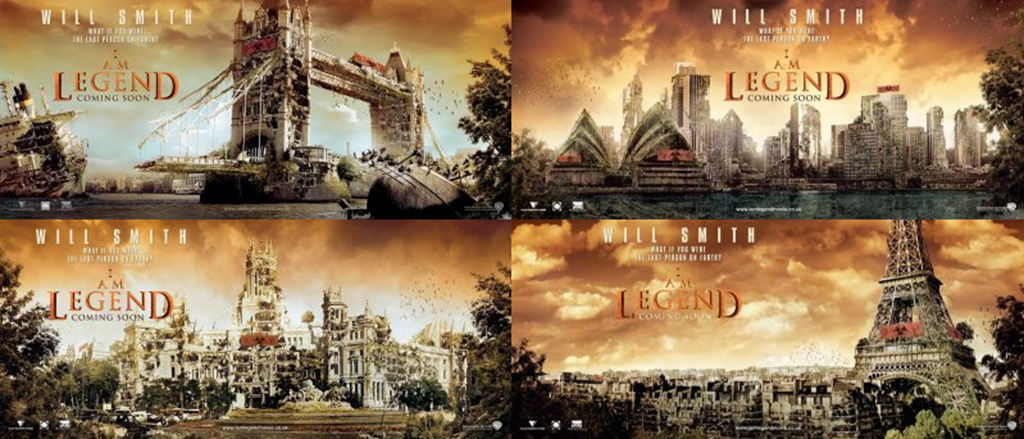
I think that’s another part of the appeal of this trope: it takes our own world and twists it into something fantastic, so that instead of having to wrap our minds around a whole new set of history and physics, we can build on the familiar in wild and interesting ways. A Canticle for Leibowitz did this very well, with another post-apocalyptic tale set in Utah. However, the most famous popular example is probably the movie I Am Legend. I love those long panoramic shots with Will Smith hunting deer in Times Square, or hitting golf balls off the wing of a fighter jet. Stuff like that really sparks the imagination because it combines something familiar with something wild and different.
Believe it or not, this trope has actually happened in real life. After the bubonic plague swept across Europe, whole cities were depopulated, with as much as 60% casualties in some places. When the Pilgrims settled at Plymouth, they were actually building over the ruins of a large Indian settlement that had been wiped out by smallpox just a few years before. And using DNA evidence, scientists now believe that all of modern humanity is descended from a small group of just 50 females who survived a global volcanic eruption some 70,000 years ago.
So yeah, this is definitely a trope I like playing with. I’m on track to finish Lifewalker by the end of May, so you can definitely expect to hear more about it in the weeks and months to come.
Also, for those of you looking for resources to help you visualize what the world will look like after the end of human civilization, here are a couple of excellent resources I’ve found. First, check out The World Without Us, an excellent book written by an environmentalist that poses a basic thought experiment: what would happen if all humans everywhere magically vanished, and all that was left was the stuff that we’ve built? What, if anything, would remain? (spoilers: not much) If you want to explore that idea but you don’t want to read the whole book, check out this wiki on Life After People, a series of History Channel documentaries that basically posed the same question. The answers may surprise you.
The interior designer’s approach to story
I recently read a fascinating post on John Brown’s blog with an interesting exercise for analyzing the kinds of stories you most like to read. By finding out what really turns you on in a story, you can have a much better idea what to write, and how to make your own stories better.
He prefaced the exercise with a story about the interior designer who helped them to decorate their house. The designer spread out a number of home magazines in front of them, and told them to go through and tear out the pictures that most turned them on. After doing this, they analyzed the pictures to see what they had in common, and thus discovered how to best decorate their house.
The exercise works much the same way. First, pick out five books you really like that immediately come to mind. Mine are:
- On My Way to Paradise by Dave Wolverton.
- Spin by Robert Charles Wilson.
- Ender’s Game by Orson Scott Card.
- Mistborn by Brandon Sanderson.
- Legend by David Gemmell.
As many of you know, these are some of my favorite books of all time. I’ve reread three of them, and I intend to reread the other two at some point.
Next, pick out the elements that these books have in common. Here’s what I came up with:
1) Set in a different time and place.
Not all these books are science fiction, but the all take place in a world far removed from our own. Only Spin takes place largely on Earth, but the events of the story transform the world as we know it so much that by the end of the novel, it’s completely different. SPOILER (highlight to see) Besides, at the very end, the two main characters leave Earth by going through the giant portal to another planet, so the novel is arguably about escaping the world as we know it.
2) Stakes that are much more personal than global.
This was interesting, and highlights something I realized when I compared Merchanter’s Luck with Downbelow Station. In all of these stories, the central driving conflicts are extremely intimate and personal.
To be sure, many of these stories also have an epic backdrop; Mistborn certainly does. However, I was much more interested in Vin’s growth and development than I was in how the Ska would overthrow the Lord Ruler–in fact, Mistborn is my favorite book in the trilogy for that very reason.
3) Encourages deep introspection.
This shouldn’t come as too much of a surprise if you’ve followed this blog for a while, but I love love LOVE stories that make me see the world in a new way. Thrillers and adventures are all fun and good, but if it doesn’t make me think, I’m usually like “meh” at the end.
4) Female characters who aren’t weak or passive.
This one might be a bit more controversial, but in all of these stories, I’ve noticed that the female characters are pretty strong, even if they aren’t all kick-butt Katniss wannabes (ugh…I hate Katniss). Even in Legend, which is largely dominated by men, you still have the earl’s daughter, who is one heck of a spirited woman.
5) Life and death conflicts.
This is interesting: in all of these books, the threat of death is immanently real. Some of them, such as Legend and On My Way to Paradise, are among the most violent books I’ve ever read. I’m not sure what it is, but there’s something about life and death struggles that really draws me.
6) Romantic in a broad sense.
I’m using Tracy Hickman’s definition here, in which romance is all about teaching us to feel and bringing us in touch with our deepest feelings. That’s the central theme of On My Way to Paradise: learning how to be a man of passion after witnessing some of the worst atrocities of war.
All of these books not only make me feel, they are about the feelings that they inspire. In other words, the emotional elements of the story are both a part of and deeply embedded in the story’s central theme.
The exercises isn’t complete after this, though. For the last part, take another five books and analyze them to see how they compare. My second list includes:
- The Neverending Story by Michael Ende.
- The Dispossessed by Ursula K. Le Guin.
- A Canticle for Leibowitz by Walter M. Miller, Jr.
- The Worthing Saga by Orson Scott Card.
- Citizen of the Galaxy by Robert Heinlein.
So how does the list stack up? Let’s see…
- Definitely true. NONE of these stories take place in the world as we know it–and that’s awesome.
- A Canticle for Leibowitz might seem like an exception, since it follows the broad rise and fall of human civilization after the nuclear apocalypse. But the things that really drew me to the story were the more personal elements: the novice who makes the illuminated manuscript of the electrical diagram, for example, or the abbot at the very end who SPOILER tries desperately to convince the single mother not to take her baby to the mercy killing station after the bomb fatally irradiates them. In any case, it’s telling that A Canticle for Leibowitz made this list, whereas none of Arthur. C. Clarke’s books even came to my mind.
- Definitely true. Even Citizen of the Galaxy, which is more adventure fiction than high concept sf, features a fascinating society of interstellar traders that really made me sit back and think about the way we structure our society. Heinlein has a really awesome way of doing that with everything he writes.
- The only possible exception here might again be Heinlein, who had some very extremist views of women (putting it lightly). However, if I recall, Citizen of the Galaxy has a female character at the end who helps pull out the main character from his indigent circumstances and helps him to come into his own. Again, they might not all be kick-butt tramp-stamp vampire slayers, but they certainly aren’t weak.
- Less true of The Neverending Story and The Dispossessed, but while the central conflicts might not be about life and death, the threat of death (or a total loss of identity) certainly comes into play.
- Definitely true. Few books have taught me to feel more deeply than The Neverending Story. An absolutely magnificent piece of literature.
So there you have it. According to this exercise, I should write books set in another time and place, where strong female characters face life and death decisions that personally impact the people in their lives and make the readers think and feel. Interestingly enough, that is a PERFECT description of Bringing Stella Home, as well as Desert Stars and Into the Nebulous Deep.
Cool stuff. Makes me want to write. So on that note, I think I will.
A Canticle for Leibowitz by Walter M. Miller, Jr.
 It was said that God, in order to test mankind which had become swelled with pride as in the time of Noah, had commanded the wise men of that age, among them the Blessed Leibowitz, to devise great engines of war such as had never before been upon the Earth, weapons of such might that they contained the very fires of Hell, and that God had suffered these Magi to place the weapons in the hands of princes, and to say to each prince: ‘Only because thine enemies have such a thing have we devised this for thee, in order that they may know that thou hast it also, and fear to strike.’
But the princes, putting the words of their wise men to naught, thought each to himself: ‘If I but strike quickly enough, and in secret, I shall destroy those others in their sleep, and there shall be none to fight back; the earth shall be mine.’
Such was the folly of princes, and there followed the Flame Deluge…
In the new dark ages of man following the nuclear apocalypse, an order of Catholic monks preserves the last vestiges of civilization: a shopping list, an electrical diagram, and other assorted scraps of a long-dead world. As mankind rises from the dust, inevitable tensions arise between the church and the world, between Jerusalem and Babylon, Christ and Lucifer.
This book is epic. Epic. I can’t begin to describe how incredible it is. Virtually every page, especially towards the end, is packed with meaning. A cautionary tale of the folly of man in this fallen world, this story held me captivated right up to the chilling final chapter. Bravo.
As I understand it, Walter M. Miller Jr. wrote this book in the late 50s / early 60s, during the height of the Cold War. Science fiction at that time was both sweepingly visionary and frighteningly pessimistic about the future of mankind, and this book successfully captures both extremes. Like Asimov’s Foundation series, it reads more like a collection of elongated short stories, but Miller’s characterization and attention to detail is superior, in my opinion, to Asimov’s.
The most fascinating aspect about this book is the way that Miller hearkens to the past to give us a vision of our future. Many of his ideas are straight out of Augustine and Aquinas–indeed, in several places, the story feels like it’s set in 3rd or 4th century Europe, which only adds to the delicious irony.
Yet, while this book has a strong Catholic feel, I never felt alienated or excluded from its intended audience. Maybe it’s because my Mormon heritage is more compatible with Catholicism than other religious beliefs, but I don’t think it’s just that; the issues in this book are human issues, not just religious issues, and by focusing on that fact, Miller makes the story much more universal.
Even with all the deep, philosophical elements, this story is wonderfully entertaining. Irony abounds, especially in the first section, in which a young novice takes a simple electrical diagram from the pre-deluge world and, completely unaware of its significance (or lack thereof), spends the rest of his life making a beautiful illuminated manuscript of it. Even though the sections were short, I quickly fell in love with the characters in each one, and connected with them almost instantly.
The final scene, in particular, was incredibly touching. I won’t spoil it for you, but let me just say, if you are or ever have considered taking your own life, read this book, just for the final scene. The degree to which the last abbot clings to life, even in the face of so many good reasons to give up, is just incredible. And the final scene, in which…I won’t ruin it for you. Just read it!
A Canticle for Leibowitz is one of the most powerful, meaningful books I have read in my life. It is more than a good read, more than epic. I class it as one of the best works of fiction this genre has ever produced. If you have ever wondered about the destiny of mankind, or the proper relationship between the secular and the spiritual in our modern age–read this book!