Gotta go fast!

So they’re making a Sonic the Hedgehog movie, and the character design for Sonic is so bad that it’s spawned a bajillion memes. Within days of the trailer’s release, it got so bad that the director said they’d redesign the animation, and suddenly thousands of nine-year-olds became drunk with power.

I have a few thoughts on the whole Sonic fiasco. The first game came out when I was seven, and even though I only ever played it at friends’ houses, stuff like the Green Hill Zone theme definitely scratches the nostalgia itch. That said, never got into it as much as some people.

The new movie actually doesn’t look all that bad. I mean, it doesn’t look great, but it’s got potential. I really like seeing Jim Carrey as Robotnik, that could be really fun. Also… well, okay, that’s pretty much all that looks good so far, but just because it’s a horrible trailer doesn’t mean the movie has to be crap. Right?

The fact that Paramount Pictures made this movie reminds me of the early 00s, when superhero movies started to get big again, and the major studios really screwed up some of the big franchises. Fantastic four, I’m looking at you. Basically, the big studios were treating these intellectual properties as cash cows instead of treating them with the passion and love of the original creators. It was also very disrespectful to the fans.

Unless I’m mistaken, that’s actually how we got the Marvel Cinematic Universe. After the failures of Hulk, Fantastic Four, and Fantastic Four: Rise of the Silver Surfer, Marvel decided to do everything in house, because the major studios kept screwing things up so badly. With Blade and X-Men in the 90s, they’d proved that movies with B- and C-list superheroes could still be profitable, so they reacquired the rights to as many characters as they could and went all in on it. Thus was born the MCU, and there was much rejoicing.

It’s particularly interesting to me as an indie writer because the pattern is very similar to what’s happening in the book industry. It basically goes like this:

  1. Technological disruption renders the legacy business models obsolete.
  2. Independent creators start to steal market share from the old guard companies.
  3. The old guard goes through a period of mergers, acquisitions, and layoffs.
  4. They start to cut corners because too much is expected of the people who are left.
  5. The old guard companies become dependent on blockbuster hits to stay afloat.
  6. The bean counters take charge, further killing the old guard’s creative spirit.
  7. Several intended blockbusters fail spectacularly, driving further downsizing.
  8. The independent creators eat the old guard’s lunch.

And that’s why I’m still indie.

Is this what’s happening with Sonic the Hedgehog? Looks like it to me. We’ll have to see how this all plays out, but I’m not expecting much. On a more positive note, though, the best way to enjoy a crappy movie is to go in with low expectations. It worked for me with Indiana Jones 4, so maybe it’ll work with the new Sonic movie.

In the meantime, here’s Pewdiepie reviewing some of the hilarious memes that have come from all of this:

I love these trailers

Holy cow, I cannot get enough of this trailer for Civilization: Beyond Earth! It’s like something from a book I would write. There’s the classic Science Fiction story about leaving Earth to colonize the stars, but there’s also a deeply human element to it. And I love the religious element to it, how the colonists take the old religions of Earth with them to the new world. Awesome.

This definitely looks like a game I want to play. I grew up with Civilization 2, perhaps the most classic title in the series, and discovered Sid Meier’s Alpha Centauri in college. In a lot of ways, Alpha Centauri shaped my love for Science Fiction, and gave me many ideas that later influenced my stories. Genesis Earth is, in some very key ways, a response to the vision of humanity’s future presented in SMAC.

While on the subject of awesome trailers, it’s worth pointing out this one for the new Christopher Nolan film, Interstellar:

Again, this looks like a fantastic story–the kind of one that I’d love to tell just as much as I’d love to hear. And with all of our modern problems like climate change, resource depletion, wealth disparity, terrorism, and global war, it strikes frighteningly close to home. Are we as a species on the verge of driving ourselves extinct? What will we do if our home planet can no longer support us? Where could we go, and what could we hope for?

So much awesomeness. I really, really, REALLY want to see this movie and play this game! But even more, these trailers make me want to write an awesome story along those same lines. I’ve already written at least one novel that addresses these issues, and it’s definitely part of the background of the Gaia Nova universe, but I want to revisit these same issues again.

Maybe in Starship Lachoneus? Who knows?

Revisions, X-COM, and working on my short game

So I finished putting together the revision notes for Heart of the Nebula on Monday, and started working on those today.  It was interesting to compare the original rough draft (which was completely broken) with the incomplete revised version that I’d worked on about a year ago (which was also completely broken, but in different ways).  Fortunately, even though both drafts are train wrecks, they’re not unsalvageable.  In fact, I think there’s a pretty good story underneath it all.

Usually when I write a big novel like this, the first draft works pretty well up until about the middle, then either it falls apart or the scenes start getting out of order, or both.  In the first revision pass, I take out all the stuff that isn’t working, but struggle to come up with new stuff to replace it.  Usually, I’m just recycling the old stuff, and the result ends up a bit out of place and watered down.  On the third pass, I say “screw it” and come up with a bunch of new stuff, which helps me to see where the story is actually going and arrange the scenes in the correct order.  It’s not always as straightforward as that, but that’s the pattern.

In fact, I’ve learned a lot of interesting things from this revision, which I’ll probably save for another blog post when my thoughts on this are a lot clearer.  The big takeaway is that I need to clearly separate the tasks that should be done in my creative mind (like writing new words and coming up with story) and the ones that should be done in my critical mind (like mapping out what to cut and what to keep or recycle).  But more on that later.

About a week ago, I got X-COM: Enemy Unknown on a Steam sale and I’ve been playing it like crazy.  It’s a really awesome game!  I love the complex tactical thinking and how it really puts you there on the ground with your troops.  And then, an enemy pops out of nowhere, flanks you, gets a critical hit, and the next thing you know your favorite soldier who you’ve been meticulously leveling up over the last thirty missions is DEAD!  NOOOOO!!!

So yeah, that’s been eating up a lot of time–probably too much of it, to be honest.  But I’m still working on various writing projects, including a plan to improve my short game.  I put together a spreadsheet of all the major short story markets in the speculative fiction field, and ranked them in order of preference.  My plan is to write a short story every week (or at least twice a month) and put it on submission, going right down the line until I’ve exhausted all the appropriate markets.  No revisions, no holding stuff back because I think it’s not good enough–just writing and submitting until I’ve mastered that side of the art.

This is something I’ve been wanting to do for a long time, but I’ve been holding back because … well, I don’t know why I’ve been holding back.  Maybe I’ve just had it in my head that I’m not any good at short stories?  Well, maybe right now I’m not, but I’m sure that it’s something I can learn.  It’s a side of creative writing that I haven’t really explored yet, which means that there’s a lot of opportunity to learn and grow.  And if/when I do start getting picked up by the major magazines, that’s going to do a lot to advance my career.

Don’t worry, I still plan to keep working on novels and novellas.  This short story thing is something I’ll probably do when I need a quick break, to start something that I can finish in a day when I’m stuck in the middle of a gargantuan project.  I’ll probably limit my short story writing to Saturdays, so it doesn’t interrupt things too much, and try to write them in one or two sittings if I can.

So that’s what I’ve been up to in the past week.  In other news, it has gotten RIDICULOUSLY COLD out here in Utah, and I love it.  Cold weather means hot chocolate, borscht, and oatmeal!  It also means I need to get myself a bomber jacket–the kind with the awesome pockets on the arm.  It’s been years since I had one of those, and they are good quality jackets.

In any case, that’s enough for now.  I’ll do what I can to keep this blog updated as I move on with revisions and other stuff.  In the meantime, stay warm!

Parents: talk to your kids about Dwarf Fortress

DFSo if you’ve been wondering why I seem to have gone missing from the world of the living lately, it’s because I recently started playing Dwarf Fortress.  Those of you who know what Dwarf Fortress is are probably shaking your heads already, but for the rest of you, I’ll endeavor to explain.

Dwarf Fortress is easily the most detailed and immersive fantasy RPG ever created.  In it, you command a group of dwarves as they seek a new life in an unclaimed territory, designing their new home, seeking all sorts of precious metals, and defending their dwarven hordes from all manner of evil monsters. The graphics (what little there are) are basically ASCII, so you do all this by scrolling through an endless array of text-based menus, which sounds rather tedious but is actually what makes the game so awesome.

For every dwarf in your fortress, there is a detailed list with their personal history, their relationships, their likes/dislikes, their strengths/weaknesses, skills–even their thoughts!  And when there’s combat, the game generates a blow-by-blow where you can read exactly what happened to whom, who got injured, and what those injuries exactly were.  This extends to every part of the game, so that when you’re in overworld mode you can actually look up the histories of every person in every civilization.

What really makes it insane, though, are the crazy, crazy ways in which your fortress can die.  Kobolds, Goblins, vampires, were-creatures, tantrum spirals, catsplosions–the possibilities are endless.  If your dwarves are unhappy, one of them might throw a tantrum that sets everyone off so that they all kill each other.  If they don’t have socks, apparently they’ll riot over that as well.  And heaven help you if a forgotten beast gets loose in your dwarven hall.

The learning curve for this game is ridiculously steep, which is why I haven’t gotten into it before now.  I actually tinkered with it a couple of years ago, but could never get into it because I had no idea what was going on.  Some youtube tutorials and the lazy newb pack helped remedy that, and now, sixty some-odd hours later, I feel like I might have an idea of how it maybe works.

The things that make the game appealing are largely the same things that make fantasy appealing: the chance to build and live in a world full of crazy-awesome fantasy stuff.  The graphics might be horrible, but the level of detail is so incredible that with a bit of imagination, you can really immerse yourself in it.

… which is why I probably went a bit overboard.  That tends to happen with me and games–I tend to binge a lot when I first get started, then go cold turkey for a while, then come back for more before gradually easing into a more healthy level of play.  Right now, I’m just getting over that first binge; I’ll probably go cold turkey for a while, taking care of all the things I’ve neglected before easing back in.

But wow, this game has given me a TON of story ideas.  I really want to write about a band of dwarves now, or reread Lord of the Rings, or get back into classic high fantasy in some way.  It’s too early to say whether it’s just a phase or a genuine shift, but I’m happy to follow it out and see where it leads.

In the meantime, I’ve got a bajillion other things to do, and writing currently tops that list.  Later!

Beware the catsplosion.

Trope Tuesday: Schrödinger’s Gun

The world of a fictional universe isn’t fixed beyond what the author has revealed to the reader.

This is what happens when Schrödinger’s cat gets hold of Chekhov’s gun.  There are a whole lot of interesting and potentially useful plot points lying around, but the writers are pantsing it as they go, playing a game of Xanatos speed chess with the readers (or the gamers, as the case may be).  Consequently, the story doesn’t actually take shape until it’s been told.

As you can imagine, this trope only really works in a story medium where there’s some degree of interaction between the writer and the audience, such as video games and RPGs.  However, there are some classic examples in more fixed media, such as film and books.  The movie Clue is a good example, where the filmmakers made three separate endings, and secretly showed different ones in different theaters (the DVD has all three).  The Choose Your Own Adventure series is also a classic example.

With the changes brought about by digital media, there are all sorts of possibilities opening up right now for this kind of storytelling.  Besides the Choose Your Own Adventure type stories, there’s also the serial format, where a writer releases a chapter at a time.  This is what a lot of web comics eventually become, especially the ones like Girl Genius, Schlock Mercenary, and Freefall with a HUGE extended story arc.  The same kind of thing is happening in ebooks too, on a spectrum between straight-up serials and series of longer works.

As you can imagine, it can be quite a challenge to keep all the storylines straight.  That’s because the one rule with this trope is that you CANNOT retcon.  Until the story is told, anything can happen–but once it does, the Schrödinger wave equation breaks down, and all the possibilities drop to 0 or 1.  The story becomes fixed, and in all future installments, you have to work with it.

Another interesting thing about this type of storytelling is the possibility for ascended fanon, where fan-created stuff like fanfic or fanart actually gets co-opted into the canon of the story.  The flip side is that it encourages the fans to get together and analyze things so thoroughly that any surprising plot twists get predicted long before they actually happen.  Still, I suppose there’s a special kind of squee in finding out that your predictions were right.

The reason I’m interested in this trope is because I’m more or less doing it with my Star Wanderers series.  It’s not strictly a serial, since each novella is a complete self-contained story, but taken together they sketch out a much larger arc that I’m only starting to discover.  Parts I-IV made a complete story arc in itself, all told from Jeremiah’s point of view, but right now I’m revisiting those stories from the viewpoints of some of the other characters.  That, in turn, is seeding all sorts of other stories, with new characters and wider conflicts.

There are challenges, though.  Today I started Part VIII: Deliverance, (from Lucca and Mariya’s viewpoints) and I got stuck on the second paragraph.  The second freaking paragraph.  It starts in the Zarmina system, but what class of star is it?  Have I mentioned it in any of the previous stories?  Thank goodness for word search functionalities, otherwise I’d be ripping my hair out!

So yeah, I’m going to have to be a lot more diligent about making and keeping a world bible.  I’m usually a pantser, so outlines are kind of anathema to my creative process, but having a solid reference for the stuff that I’ve already written is quite helpful.  Currently, I’m using Wikidpad, which seems to be the perfect tool for this sort of thing.

Fortunately, the challenges are a lot more fun than discouraging.  I had a great time writing Dreamweaver, getting into Noemi’s head and revisiting that story from her point of view.  It sounds so cliché, but that story really did write itself.  I kept a window with Outworlder in the background, and whenever I needed to see what would happen next, I’d just go to it and read the next couple of paragraphs.  Benefactor and Reproach have been much the same way.

Eventually, I plan to branch out a lot further, with other interesting characters and situations.  I have no idea what those will be exactly, but that’s kind of the point.  Until you actually pull the trigger, Schrödinger’s gun can exist in any state, from a musket to an AK-47 to a rocket-propelled grenade.  Whatever form it ends up taking, the important thing is to make sure it goes off with a bang.

Sorry, no Trope Tuesday (again)

Yeah, sorry, no Trope Tuesday this week.  Third week missed in a row!  Not so good.  Thing is, I’m really focused on finishing Star Wanderers: Reproach (Part VII) right now, with a self-imposed deadline of May 31st. I figure that’s more important, and I really don’t want to break my momentum.

I’ve been vacillating a lot about this project.  Sometimes, I think it’s halfway decent, perhaps even good.  Other times, I wonder how the @#$! I came to be trapped in this story and why I’m wasting the best years of my life writing this crap.  The other Star Wanderers stories are selling decently well, but this one is so shite that it’s bound to kill the series and why am I writing this why why WHY??? 

And then I get the chains back on my inner editor and drag him down to the dungeon, where I keep him on a strict diet of bread crusts and rotten cheese.  No wonder he hates me.

I know those trope posts are a popular feature around here, so I’ll get back on top of them once this project is finished (which WILL be this week!  It WILL!!)  In the meantime, if you’re looking for a trope fix, you should check out Anita Sarkeesian’s latest Feminist Frequency video.  She does an awesome job deconstructing feminist video game tropes, in a much more meticulous and thoughtful manner than I have ever achieved here:

Part of me wants her to take my own stories and analyze them for feminist tropes.  The other part shudders in abject horror at what she might possibly find.

Whoops, looks like the inner editor just got loose again.  Better go hang out on the KBoards until I’ve got him back in the dungeon.

Later!

Z is for Zenith

pioneer_book_scifiHas space opera passed its zenith?

Sometimes, it certainly looks that way.  All the major stuff seems to be reprints of past series and reboots of decades-old franchises.  Star Trek, Star Wars, Stargate, Battlestar Galactica, Ender’s Game, Dune, Babylon 5–all the big names seem to have had their start at least a generation ago.  At any science fiction convention, you’re likely to see more gray-haired men than kids in their teens and twenties.  And if you go to a publishing conference, new adult, urban fantasy, and paranormal romance are ascendant.

I’ve noticed that people are using the term “science fiction” increasingly to describe stories that don’t have anything to do with space.  Dystopian, post-apocalyptic, steampunk, even time travel–all of these subgenres are certainly part of the fold, but they’re very different from the stories about starships and alien worlds.  And then you have all the markets for short fiction that have been forced out of business–and even a few larger publishers, like Night Shade Books which is now selling off all its assets (read: authors) to avoid bankruptcy.

I remember going to World Fantasy 2010 in Columbus, Ohio, and feeling dismayed at the complete lack of science fiction.  World Fantasy is (or was, at least) the premier professional conference for speculative fiction literature, but all of the attention was going to urban fantasy and steampunk.  On the freebie table where publishers often dumped ARCs and review copies of their books, the only space opera stuff I really saw were a couple of titles by Glen Cook and one other guy–and I watched that table hawkishly for the full three days of the conference.

Sometimes, it seems as if it would be so much better if I had grown up in the 80s.  That’s when science fiction really had its heyday.  But all through the 90s, the genre seems to have been on the decline, much like NASA and the US space program.

So is space-centered science fiction on the way out?  Have we passed the glory days, and it’s now just a long decline until it becomes an obscure niche, beloved by some, but enigmatic to others?

In spite of everything I said above, I actually don’t think so.  In fact, I think we’re on the cusp of a science fiction renaissance, and that sci-fi geeks like myself will look back twenty years from now and wish that they were born in our era.  Here’s why:

1) Scientific discoveries are transforming the way we see the universe.

The day I posted P is for Planets, NASA’s Kepler mission announced the discovery of three Earth-like worlds orbiting in the habitable zones of their stars.  The existence of alien Earths is not conjecture–it’s a confirmed fact.  As our ability to study these worlds improves, it’s only a matter of time, IMO, before we find a world that has life.

We’ve discovered the Higgs-Boson.  We’re unraveling the fundamental building blocks of the universe.  We’ve built telescopes to look back to the dawn of time itself, and we’re learning more about the cosmology of the universe every year.  Perhaps even more remarkably, we understand now how little it is that we actually know–that the entirety of the observable universe is only about 5% of it, and even that’s optimistic.

All of this will take time to trickle down to the popular consciousness, but with all the new discoveries that are happening, I think that’s already in the process of happening.  In particular, I think the recent discoveries in the realm of exoplanets and astrobiology are going to shake things up in a major way in the next five or ten years.

2) The privatization of space travel is paving the way for a rapid expansion into space.

The US space program has been plagued with funding problems since at least the end of the Cold War space race.  Since the space shuttle program was retired just last year, the only way for our astronauts to get into space is through the Russian Soyuz spacecraft at Baikonur.  If NASA had to put a man on the moon, they do not currently have the knowledge or technology necessary to do it.

In the private sector, though, it’s been a very different story.  SpaceX has had a number of successful launches recently, most notably sending the first unmanned resupply capsule up to the International Space Station.  And just a couple days ago, Virgin Galactic had the first successful test flight of its rocket-powered spacecraft.

It’s sad to see the space shuttle go, but there are a lot of reasons why the program was flawed and inefficient to begin with.  By handing things off to the private sector and turning space exploration into a viable business venture, we can hopefully overcome those inefficiencies and eventually make space accessible to the general public.

And then you have the organizations like Mars One that are looking even further ahead to the colonization of Mars.  There’s a groundswell of excitement for Martian colonization that is starting to get some real money behind it.  Will it go anywhere?  It’s hard to say right now, but even if it suffers another decade or two of setbacks, it’s getting public attention, especially from the younger generation.

3) Video games are bringing a fresh new look and feel to the genre.

Not all of the big sci-fi series hail from 70s and 80s.  Halo started up as recently as 2001, and it’s a multi-billion dollar franchise with games, books–even Legos.  In fact, there are lots of sci-fi video game franchises right now, many of them right on par with other classic space opera.  Just look at Starcraft, for example, or Mass Effect, or Eve Online and Sins of a Solar Empire.  The number of sci-fi games has been exploding.

In fact, this explosion has been happening for some time.  While literary science fiction may have suffered something of a decline back in the 90s, that was the heyday of games like Master of Orion and Sid Meier’s Alpha Centauri.  Flight simulators like Flight Commander and X-wing proliferated like crazy, while even some of the classic RPGs like Final Fantasy borrowed heavily from science fiction tropes.  And those are just a few of the games that I can list off the top of my head!

Whether or not literary sf is on the decline, a whole new generation has been introduced to the genre through the medium of video gaming.  This is not just a small niche audience playing this stuff, either–in the US at least, Halo is as mainstream as Monopoly or Settlers of Catan.  In fact, you could say that science fiction is more mainstream now than it ever has been, and a lot of that is due to sci-fi video games.

4) The e-publishing golden age is giving us thousands of new voices.

But what about the world of literary sf?  Are we in a decline?  Do people just not read science fiction anymore?  How bright is the future for science fiction literature?

Actually, this is the area where I’m the most optimistic of all.

The publishing industry is changing at the speed of light, much in the same way that the music industry changed about a decade ago.  Just as the MP3 revolution allowed all sorts of eclectic yet entrepreneurial artists to thrive without the oversight of record labels, the epublishing revolution is opening all sorts of doors for the enterprising author.  And while the changes are driving publishers (such as NSB) out of business, they are enabling authors who only sell in the mid-list range to make a respectable living.

At Worldcon 2011, Ginger Buchanan (senior editor at Tor) asserted that there has never been a runaway science fiction bestseller.  In the eyes of New York publishing, that may be true–but New York has a notorious record for missing the catch in pursuit of one big fish.  Because of epublishing, whole new genres like New Adult that publishers thought would never sell are now going mainstream.

And even the niches that stay niches are becoming quite lucrative for the authors who can build a decent following.  When author cuts out the middlemen and develops a direct relationship with the readership, it only takes a thousand true fans or so become a financial success.  As Kris Rusch pointed out so aptly, those numbers may bring only scorn from New York, but for the writers who actually produce the content, that’s a vein of pure gold.

I can’t tell you how many success stories I’ve heard from fellow sci-fi writers over on the Kindle Boards, who started just for the grocery money and ended up quitting their day jobs.  But as Hugh Howey pointed out, the runaway bestsellers are not the true story of the epublishing revolution–it’s the little guys who only sell a few hundred copies a month but are earning enough to support themselves writing what they love.

Indeed, we’re already starting to see an explosion of new science fiction, thanks largely to the ease of electronic self-publishing.  I’ve only read a few of them so far, but Nathan Lowell stands out among them, as well as my good friend Kindal Debenham.  These guys and so many others are bringing a fresh new voice to space opera, revitalizing the genre in ways that simply weren’t economical back in the days of Big Publishing.

So even if space opera as a literary genre isn’t quite large enough to go mainstream, it is large enough to support a wide range of new voices under the emerging business models.  And as the epublishing revolution continues to mature, I think we’re going to see a new golden age comparable to the era of the pulp adventure stories.

I’ve been publishing my own work since 2011, and I can attest that there’s never been a better time to be a writer.  I’m not quite making enough to go full-time yet, but at the rate things are going, it will only be a  year or two before I realize my dream of making a living telling stories that I love.  And if they’re the kind of stories that you love too, then that’s great news for all of us!

So has science fiction reached its zenith?  I don’t think so.  It went mainstream about a generation ago, which was definitely a huge moment, but for the last few decades it’s been in the process of branching out and rediscovering itself.  Right now, I think we’re on the verge of a wonderful new renaissance that is going to blow us all away.  As a lifelong reader and writer of science fiction, I certainly hope that’s the case.  And because of the reasons listed above, I sincerely believe that it is.
Y is for Yesteryear

Star_wars_oldThey say that the golden age of science fiction is about twelve years old.  That’s definitely true for me.

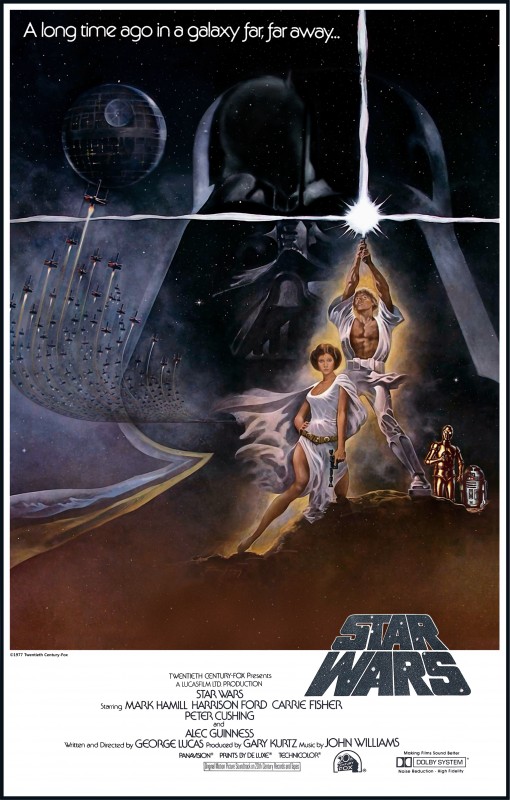
My first exposure to the genre was Star Wars: A New Hope.  I saw it when I was seven, right around the height of my dinosaur phase.  Everything about the movie completely blew me away, from the Jawas and Sand People of Tatooine to the stormtrooper gunfights and lightsaber duels.  After watching Luke blow up the Death Star, I spent the next few hours running around the yard pretending to fly my own starfighter.

In a lot of ways, I’ve never really stopped.

My parents made me wait until I was nine to watch The Empire Strikes back, because it was rated PG.  Without any exaggeration, I can say that those were the longest two years of my life.  I was literally counting down days by the end, and to pass the time without going crazy, I read up on all the books about space that I could possibly find.

My father bought the original X-wing flight simulator game somewhere around then, and I soon became totally engrossed in it.  Since the 386 was our only entertainment system (no Super Nintendo–I had to visit a friend’s house for that), X-wing became the defining game of my childhood.  I spent hours and hours on that game, to the point where I knew exactly which simulated missions the characters from the books were flying and how to complete them faster and easier.

I thought The Empire Strikes Back was a little slow the first time I saw it, but it’s since grown on me, to the point where now it’s my favorite film in the whole series.  Thankfully, my parents let me watch Return of the Jedi the next day, and for the next few months my life felt utterly complete.

Around this time I discovered the Star Wars novels and soon immersed myself in them.  The Courtship of Princess Leia by Dave Wolverton soon became one of my favorites, as well as the Heir to the Empire trilogy by Timothy Zahn and the X-wing series by Michael A. Stackpole.

But it was Roger Allen McBride who first introduced me to a different flavor of science fiction with his Corellia trilogy.  As I mentioned in V is for Vast, those books had just enough of a touch of hard science to intrigue me about the other possibilities of the genre.  That was the last Star Wars series that I read before branching out into other works of science fiction.

The Tripod trilogy by John Christopher was my first introduction to the dystopian / post-apocalyptic genre, depicting an enslaved humanity after an alien invasion.  Those books really captured my imagination for a while.  The Giver was also quite interesting and thought provoking, though since it didn’t involve spaceships or aliens it wasn’t nearly as compelling.

I read a lot of fantasy in my early high school years, including Tracy Hickman, Lloyd Alexander, and (of course) J.R.R. Tolkien.  While I enjoyed those books and immersed myself in them for a while, my true love was still science fiction.  For almost a year, I watched Star Trek: Voyager religiously with my dad.  And every now and again, I’d pick out a science fiction book from the local town library and give it a try.  That’s how I discovered Frank Herbert’s Dune.

In eleventh grade, my English teacher had us choose an author and focus our term papers solely on their books for the entire year.  She suggested I choose Orson Scott Card, but I chose Cormac McCarthy instead.  I’m not sure if that was the worst decision of my high school career, or the best decision, since assigned high school reading tends to make any book feel like it sucks.  I discovered Ender’s Game the following summer, and finished it in a delirious rush at 3am the morning after checking it out from the local library.

More than any other book, Ender’s Game cemented my love for the genre, and showed me just how powerful and moving the genre could be.  It opened so many insights into the world and human nature, reading that book made me feel like I’d opened a pair of eyes that I didn’t even know I’d had.  Looking back, that was probably the moment when I knew I would be a science fiction writer.  I’d known I was going to be a writer ever since I read A Wrinkle in Time at age eight, but to be a science fiction writer specifically, that goal was probably cemented by reading Orson Scott Card.

After high school, I served a two year mission for my church, during which I didn’t read any novels or watch any TV or movies.  When I came back, though, Orson Scott Card and Madeline L’Engle helped me to ease through the awkwardness of adjusting back to normal civilian life.  When I left for college, I expanded my horizons even further, starting with Isaac Asimov’s Foundation series and Edgar Rice Burrough’s Princess of Mars.

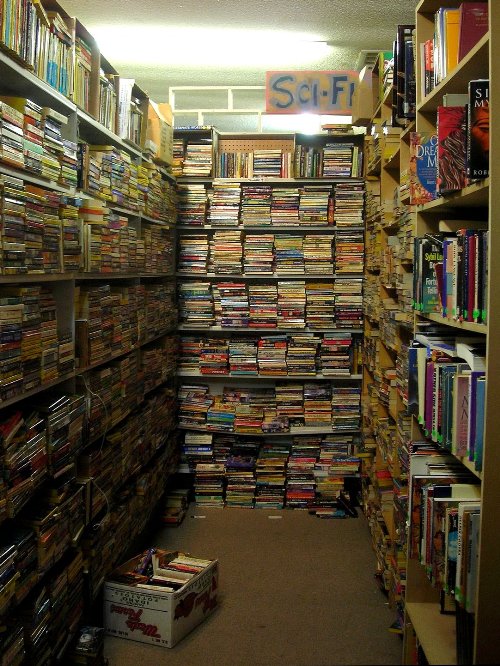
When I discovered Pioneer Books in downtown Provo, I knew I’d found my favorite bookstore in Utah Valley.  I have so many fond memories sitting cross-legged on the floor in the science fiction section, browsing through the musty used books for hours at a time.  That’s where I discovered C.J. Cherryh, Arthur C. Clarke, Robert A. Heinlein, Ursula K. Le Guin, and numerous other authors who are among my favorites today.

When I discovered Spin, Robert Charles Wilson soon became one of my favorites.  I picked up that novel as a free PDF from Tor, and read it over the summer while studying abroad in Jordan.  Once again, that same hard sf sensibility I’d gotten from Roger Allen McBride touched me in an unforgettable way.  But it was the human element of that book that really moved me–in fact, it’s always been about the human element.  The world building in Downbelow Station was great and all, but the romance of Merchanter’s Luck had a much more lasting impact.  Starship Troopers had some good ideas, but it was Mandella’s personal journey in The Forever War that moved me almost to tears.  The intrigue of the Ender’s Shadow series was quite entertaining, but it was Ender’s Game and Speaker for the Dead that really taught me what it means to be human.

I finished my first novel, Genesis Earth, shortly after returning from that study abroad, and tried to capture the same sensibility from Spin as well as the intimately human element.  Since then, I’ve written several more sci-fi novels, some of them tragic, some triumphant, but in all of them I’ve tried to get as close as I can to the personal lives of the characters.  I don’t know if I’ll ever write a character portrait so intimate as Shevek’s in Ursula K. Le Guin’s The Dispossessed, but I certainly hope to someday.

For me, science fiction started out as a wonderfully exciting entertainment and turned into something much more meaningful.  If there’s anything the genre has taught me, though, it’s that the two aren’t mutually exclusive–that you can have your adventure and learn what it means to be human as well.  Indeed, the more imaginative the adventure, the greater the truths I’ve taken from it.

Because of that, even though I’m almost in my thirties now, I can’t possibly foresee a time when science fiction isn’t a major part of my life.  It’s a love affair that’s grown just as much as I have, and continues to grow with each new author I discover and each new book I write.  When I’m old and grizzled and pushing eighty, I’m sure there will still be a part of that twelve year old boy in me, still running around the yard flying his starship.

L is for Lost Colony

worthingsagaAs we discussed in I is for Interstellar, space colonization is a major theme of science fiction, especially space opera.  Of course, things don’t always go smoothly.  Space is a really, really, really big place, and sometimes, due to war or famine or simple bureaucratic mismanagement, colonies get cut off from the rest of galactic civilization.  They become lost colonies.

Some of my favorite stories are about lost colonies: either how they became cut off, or how they reintegrate after so many thousands of years.  In many of these stories, the technology of these colonies has regressed, sometimes to the point where the descendents may not even know that their ancestors came from the stars.  When contact is finally made, the envoys from the galactic federation may seem like gods or wizards.

Because of this technological disconnect, stories about lost colonies often straddle the line between science fiction and fantasy.  After all, Clarke’s third law states:

Any sufficiently advanced technology is indistinguishable from magic.

Of course, the line between science fiction and fantasy has always been a fuzzy one.  Hundreds of attempts have been made to define it, but they all fall short.  In the end, it often breaks down to certain recurring tropes, like dragons and wizards versus ray guns and rockets, but even that doesn’t always work.

For example, Anne McCaffrey’s Dragonriders of Pern is technically about a lost colony far into the future, but it’s got dragons and castles and other tropes that belong squarely in fantasy.  Then again, the dragonriders have to fight alien worms who invade every few dozen years from a planet with a highly elliptical orbit, so there’s still a strong science fiction basis undergirding the whole thing.

And that’s just Dragonriders of Pern.  What about Marion Zimmer Bradley’s Darkover series, or C.S. Lewis’s Space Trilogy?  Trigun is more western than fantasy, but it’s also full of sci-fi tropes like giant sand-crawling monster ships and a weird post-apocalyptic backstory.  And then there’s all the Japanese RPGs that combine magic with mechas, with Xenogears as one of the best examples.  For a distinct Middle Eastern flavor, look no further than Stargate.

It’s no coincidence that all of these stories feature a lost colony of one kind or another.  When the characters don’t know that they’re living in a science fictional universe, it’s very easy to throw in tropes from other genres.  By no means is it required–Battlestar Galactica and Dune are evidence enough of that–but they certainly present the opportunity to do so.  After all, lost colony stories basically present a hiccup in humanity’s march of progress, breaking the essential science fiction narrative for all sorts of interesting side stories and tangents.

One perennial favorite of science fiction writers is to suggest that Earth itself is a lost colony from some other galactic civilization.  That forms the entire premise behind Battlestar Galactica: the original twelve colonies have been destroyed in the human-cylon wars, and the last few survivors are searching for the legendary thirteenth colony of Earth, hoping to find some sort of refuge.  Apparently, Ursula K. Le Guin’s Hainish cycle also plays with this trope, though she’s never very explicit with her world building.  It can be a bit tricky to twist the lost colony trope in this manner, but if pulled off right it can really make you sit back and go “whoa.”

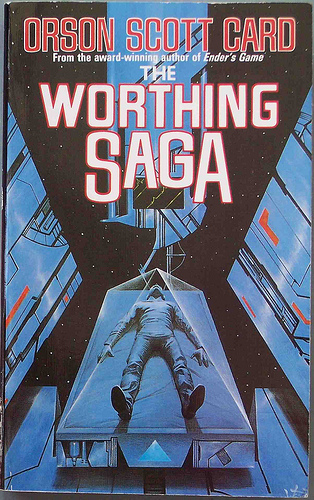
My personal favorite is probably Orson Scott Card’s The Worthing Saga, about a colony of telepaths that breaks off from a collapsing galactic empire and actually becomes more advanced than the rest of humanity.  When Jason Worthing and Justice re-establish contact, the descendents of the galactics are basically pre-industrial subsistence farmers who view them as gods–which, in a certain sense, they almost are.

It’s a great story that really entranced me, not just for the science fictional elements but also for the distinct fantasy flavor.  Orson Scott Card’s handling of viewpoint in that book is truly masterful, so that I felt as if I were viewing everything through the eyes of his characters.  Since the farmers don’t know anything about their spacefaring ancestors, all the parts from their point of view feel like a completely different story.  It was really great.

My first novel was actually a lost colony story, combined with a first contact.  I trunked it a long time ago, but many of the earliest posts on this blog are all about my experience writing it.  As for my other books, Desert Stars contains elements of this, though the lost colony in question is actually a nomadic desert society that lives on the capital planet of the galactic empire, just outside of the domes where all the more civilized folk live.  Heart of the Nebula is basically about a society that puts itself in exile in order to escape the privations of the Hameji.  And in… no, I’d better not spoil it. 😉

The lost colony isn’t one of the flashier or more prominent tropes of science fiction, but it’s definitely one of my favorites.  It’s a great way to add depth and intrigue, as well as bend genres.  For that reason, I think this trope does a lot to keep science fiction fresh.