Depending on the story, he may be a brotherly mentor figure for the main character or play some other sort of supporting role. However, don’t expect him to be much of a plot driver, unless the story is specifically about him. Because of his refusal to suck up or play office politics, he’s rarely in a position to effect change or become a whistle-blower.
Over time, this character may turn into something of a sour knight, developing a thick skin of crusty cynicism to protect his idealistic heart from all the crap he continually has to put up with. Like the Obi-wan, if he’s a mentor figure, he will probably die. If he’s the hero, though, or part of the ragtag bunch of misfits, expect him to be vindicated, possibly in a crowning moment of awesome. Rarely if ever will this guy be the villain–that’s the obstructive bureaucrat, whom this guy hates.
Lieutenant Armstrong from Fullmetal Alchemist is a good example of this trope. He’s a good soldier who was passed up on all the promotions because he refused to go along with the war crimes done against the Ishvalan people. His sister, who WAS reassigned to Antarctica (though probably by choice), is a whole other story.
Another good example of this trope is Lucius Fox from Batman Begins. The interesting thing about this one is that he’s a mentor figure who actually survives. This is probably because the story requires a lot of badassery from the hero, and Lucius is in no position to fill that role, so there’s no threat of him outshining Bruce Wayne. This is also a good example of the last DJ getting vindicated in the end.
In my own work, the best example I can think of is Tiera from Desert Stars. She’s fiercely stubborn with an uncompromising sense of honor, which results in her being stripped of her claim of inheritance due to her stepmother Shira’s wiles (although ‘stepmother’ isn’t quite the right word–how do you describe your father’s evil second wife, when he’s still married to your mother?). I’ve got some interesting plans for a sequel where she’s the main character, but that book is still in the early conceptual stages.
In my own life, I’ve actually fulfilled this trope. I don’t care to discuss the details of it publicly, but back when I was interning in Washington DC, I had a very negative experience that this trope describes perfectly. It’s one of the reasons I hate Washington so much, and decided to become a global nomad who makes a difference on the ground, rather than pushing papers in someone else’s petty empire of personal influence. It’s also one of the reasons why I started the Star Wanderers series–because I wanted to tell a story about people on the space-bound frontier, as far away from the galactic empire as possible.
I may not write many stories about vast bureaucracies or other hierarchical organizations, just because that doesn’t interest me, but whenever I do, you’ll probably see this guy pop up. As someone who’s been there, I have a lot of sympathy for this character. You’ll probably see him (or her) pop up in my work from time to time.
This trope has been on my mind recently because I’ve been on something of a Civil War trip, watching and rewatching the movie Gettysburg. It’s a fascinating movie, not the least because there are no clear bad guys. In the battle of ideologies, I side solidly with the Union, but in the battle of men, I don’t know who to side for.
General Lee is one of my favorite characters, and certainly the commander for whom I have the most respect. When General Longstreet is forced to order his men on the suicidal charge on the third day, I can’t help but cringe. And perhaps the most touching moment of the whole movie is when the wounded General Armistead asks to see his old friend, General Hancock, only to learn that he has been shot as well:
BG Armistead: I would like … to see General Hancock. Can you tell me … where General Hancock may be found?
Lt. Chamberlain: I’m sorry, sir. The general’s down, he’s been hit.
BG Armistead: No! Not … both of us! Not … all of us! Please, God!
The main appeal to me of this movie, and in a more general sense of this entire trope, is the roll that honor plays in the characters’ interactions with each other. Yes, they may be bitter enemies, and they may not hesitate to kill each other, but they aren’t fighting because they hate each other–they’re fighting because honor demands it. And just like how the Fettered gains great strength through strict obedience to his personal code, so too does the Worthy Opponent gain both strength and respect by being a man of honor.
Obviously, this sort of antagonist makes it almost impossible to tell a story with black and white morality. But with this trope, that’s kind of the point. It exists to tell us that the enemy is not so different from us, and that not every bad guy is completely evil. It doesn’t have to be used to set up an Aesop, though–when done well (as it was in Gettysburg), it’s satisfying enough on its own.
I played a lot with this trope in Stars of Blood and Glory. In that book, Abaqa, a young Hameji warrior trying to build a name for himself, falls prisoner to Danica and her band of Tajji mercenaries, who he has been taught all his life to hate. Gradually, though, they come to respect each other, to the point where … well, I won’t spoil it for you. But it was definitely fun to write. 😀
I haven’t played a lot with this trope yet in other stories, but I definitely hope to in the future. I’ve got another novel I’d like to write from Danica’s point of view, sort of a prequel novel to explore her and Roman’s origins, as well as the other Tajji mercenaries. And then there’s Heart of the Nebula, which needs a major rewrite but has some elements of this trope in it. So yeah, you can definitely expect to see more of this sort of thing from me in the future.
The world of a fictional universe isn’t fixed beyond what the author has revealed to the reader.
This is what happens when Schrödinger’s cat gets hold of Chekhov’s gun. There are a whole lot of interesting and potentially useful plot points lying around, but the writers are pantsing it as they go, playing a game of Xanatos speed chess with the readers (or the gamers, as the case may be). Consequently, the story doesn’t actually take shape until it’s been told.
As you can imagine, this trope only really works in a story medium where there’s some degree of interaction between the writer and the audience, such as video games and RPGs. However, there are some classic examples in more fixed media, such as film and books. The movie Clue is a good example, where the filmmakers made three separate endings, and secretly showed different ones in different theaters (the DVD has all three). The Choose Your Own Adventure series is also a classic example.
With the changes brought about by digital media, there are all sorts of possibilities opening up right now for this kind of storytelling. Besides the Choose Your Own Adventure type stories, there’s also the serial format, where a writer releases a chapter at a time. This is what a lot of web comics eventually become, especially the ones like Girl Genius, Schlock Mercenary, and Freefall with a HUGE extended story arc. The same kind of thing is happening in ebooks too, on a spectrum between straight-up serials and series of longer works.
As you can imagine, it can be quite a challenge to keep all the storylines straight. That’s because the one rule with this trope is that you CANNOT retcon. Until the story is told, anything can happen–but once it does, the Schrödinger wave equation breaks down, and all the possibilities drop to 0 or 1. The story becomes fixed, and in all future installments, you have to work with it.
Another interesting thing about this type of storytelling is the possibility for ascended fanon, where fan-created stuff like fanfic or fanart actually gets co-opted into the canon of the story. The flip side is that it encourages the fans to get together and analyze things so thoroughly that any surprising plot twists get predicted long before they actually happen. Still, I suppose there’s a special kind of squee in finding out that your predictions were right.
The reason I’m interested in this trope is because I’m more or less doing it with my Star Wanderers series. It’s not strictly a serial, since each novella is a complete self-contained story, but taken together they sketch out a much larger arc that I’m only starting to discover. Parts I-IV made a complete story arc in itself, all told from Jeremiah’s point of view, but right now I’m revisiting those stories from the viewpoints of some of the other characters. That, in turn, is seeding all sorts of other stories, with new characters and wider conflicts.
There are challenges, though. Today I started Part VIII: Deliverance, (from Lucca and Mariya’s viewpoints) and I got stuck on the second paragraph. The second freaking paragraph. It starts in the Zarmina system, but what class of star is it? Have I mentioned it in any of the previous stories? Thank goodness for word search functionalities, otherwise I’d be ripping my hair out!
So yeah, I’m going to have to be a lot more diligent about making and keeping a world bible. I’m usually a pantser, so outlines are kind of anathema to my creative process, but having a solid reference for the stuff that I’ve already written is quite helpful. Currently, I’m using Wikidpad, which seems to be the perfect tool for this sort of thing.
Fortunately, the challenges are a lot more fun than discouraging. I had a great time writing Dreamweaver, getting into Noemi’s head and revisiting that story from her point of view. It sounds so cliché, but that story really did write itself. I kept a window with Outworlder in the background, and whenever I needed to see what would happen next, I’d just go to it and read the next couple of paragraphs. Benefactor and Reproach have been much the same way.
Eventually, I plan to branch out a lot further, with other interesting characters and situations. I have no idea what those will be exactly, but that’s kind of the point. Until you actually pull the trigger, Schrödinger’s gun can exist in any state, from a musket to an AK-47 to a rocket-propelled grenade. Whatever form it ends up taking, the important thing is to make sure it goes off with a bang.
Whatever the case, expect to see lots of modern ruins and schizo tech mashups (horse-driven cars? Wood-wheeled bicycles?). If anarchism reigns, expect to see lots of punks roaming the wastelands in muscle cars and motorcycles. If Ragnarok Proofing is in effect and the ruins of civilization haven’t quite decayed yet, expect some variation of a scavenger world. And if someone from our modern era finds himself lost in this bizarre post-apocalyptic future, expect him to find some sort of constant to reinforce that he’s not in Kansas anymore.
Unlike dystopian settings, where society evolves (or is deliberately turned) into a horrible, hellish place, a post-apocalyptic setting represents a reboot of civilization itself, where one society has passed away and a new one is slowly picking itself up from the ashes. It has the potential to be a lot more hopeful, and to give the reader a lot more wish fulfillment. After all, who wouldn’t want to be one of the lucky survivors tasked with rebuilding civilization? Sure there may be zombies or nuclear nasties wandering about, but on the plus side, you don’t have to worry about your bills or your deadbeat job anymore.
Douglas Rushkoff has some interesting ideas about why this type of story is becoming more and more popular nowadays. In his new book Present Shock which he’s been promoting recently, he argues that many of us are so overwhelmed by a world where everything happens now that we wish we could end it all and start over. When we live in an ever-changing present without a coherent narrative to reference our past or our future, we long for something to restore that sense that we’re part of a larger story, even if that story is racing towards a horrible, tragic end.
But every ending is a new beginning, and that’s what lies at the very core of this trope. When our world passes away, what will the new world look like that takes its place? Will we learn from our mistakes, or are we doomed to repeat our worst atrocities? Will we eat each other like dogs, or will we tap into some deeper part of human nature where mercy and compassion lie?
This is all on my mind right now, because I’m writing a post-apocalyptic novel (with the working title Lifewalker) that takes place in Utah 200 years after the end. Humanity was hit by a plague that kills everyone over the age of 25, so that the only people left are orphans, teenage adults, and their babies. It’s fascinating to wonder what from our era would fall apart and what would remain, or what would be preserved and how the new society will take shape.
But it’s not the apocalypse itself that I’m interested in, so much as what happens after things stabilize. The main character is one of the few people who’s immune to the plague, so naturally he feels like a complete outcast. He’s walking the Earth, riding down the ruins of I-15 with a copy of Brandon Sanderson’s Mistborn in his saddlebag. And the people he meets … well, let’s just say I wasn’t very kind to Las Vegas.
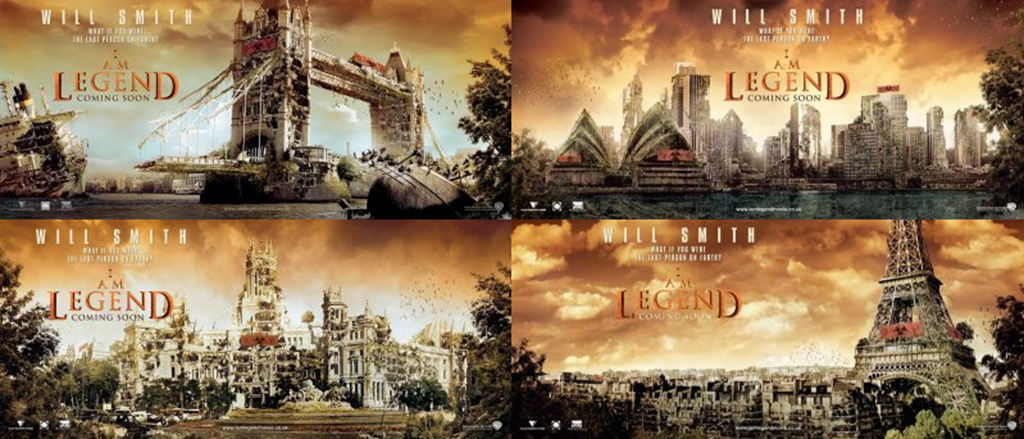
I think that’s another part of the appeal of this trope: it takes our own world and twists it into something fantastic, so that instead of having to wrap our minds around a whole new set of history and physics, we can build on the familiar in wild and interesting ways. A Canticle for Leibowitz did this very well, with another post-apocalyptic tale set in Utah. However, the most famous popular example is probably the movie I Am Legend. I love those long panoramic shots with Will Smith hunting deer in Times Square, or hitting golf balls off the wing of a fighter jet. Stuff like that really sparks the imagination because it combines something familiar with something wild and different.
Believe it or not, this trope has actually happened in real life. After the bubonic plague swept across Europe, whole cities were depopulated, with as much as 60% casualties in some places. When the Pilgrims settled at Plymouth, they were actually building over the ruins of a large Indian settlement that had been wiped out by smallpox just a few years before. And using DNA evidence, scientists now believe that all of modern humanity is descended from a small group of just 50 females who survived a global volcanic eruption some 70,000 years ago.
So yeah, this is definitely a trope I like playing with. I’m on track to finish Lifewalker by the end of May, so you can definitely expect to hear more about it in the weeks and months to come.
Also, for those of you looking for resources to help you visualize what the world will look like after the end of human civilization, here are a couple of excellent resources I’ve found. First, check out The World Without Us, an excellent book written by an environmentalist that poses a basic thought experiment: what would happen if all humans everywhere magically vanished, and all that was left was the stuff that we’ve built? What, if anything, would remain? (spoilers: not much) If you want to explore that idea but you don’t want to read the whole book, check out this wiki on Life After People, a series of History Channel documentaries that basically posed the same question. The answers may surprise you.
Of all the evils of our modern era, perhaps the most heinous is the systematic extermination of an entire race or ethnicity. These acts of genocide not only cross the moral event horizon, they create specters and villains that live on from generation to generation. Just look at how the Nazis are portrayed in popular culture–even today, they are practically mascots of the ultimate evil.
And for good reason. There really is something evil about the total annihilation of a foreign culture. It’s one of the reasons why terms like “genocide” and “ethnic cleansing” are so controversial, especially in conflicts that are still ongoing–and there are so many unresolved conflicts where the systematic and purposeful annihilation of a race or culture is still happening.
Is wholesale genocide a phenomenon unique to our modern age? Probably not, but modern science has enabled it on a scale that was previously impossible. This became all too clear to us after World War II. Only a generation before, great numbers of people believed that we were on a path of progress that would eventually culminate in world peace. If there was any of that sentiment left, it was shattered with the liberation of Auschwitz and the bombings of Hiroshima and Nagasaki. Suddenly, we realized that systematic mass destruction and genocide were not only possible, they were a modern reality.
It should come as no surprise, then, that science fiction immediately began to explore this issue. From Frankenstein to 1984, science fiction has been full of cautionary tales of science gone wrong, issuing a critical voice of warning. But after 1945, it went much further, exploring the issue in ways that can only be done in a science fictional setting.
Is genocide ever morally justifiable? In our current world, probably not, but what if an alien race was bent on our destruction? If their primary objective was the utter annihilation the human race, and negotiation was impossible? Wouldn’t it be justifiable–perhaps imperative even–to stop such a race by annihilating them first?
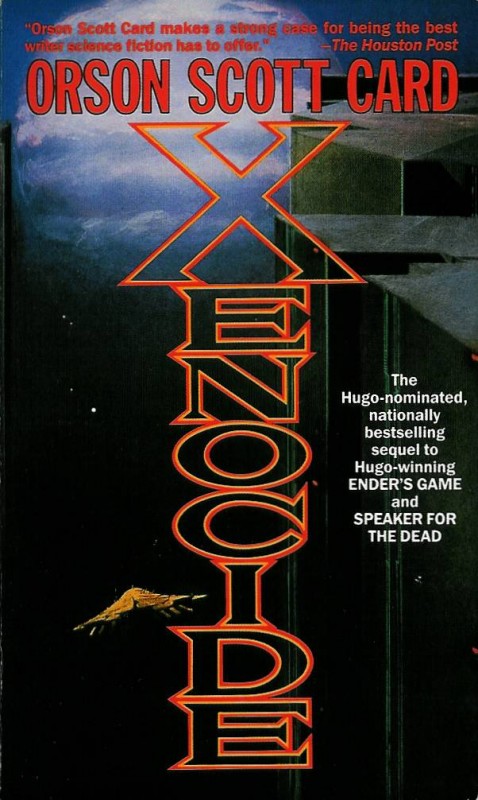
This is what is meant by the term “xenocide.” A portmanteau of “xenos,” the Greek word for stranger, and “genocide,” it denotes the complete extermination of an alien race.
Xenocide forms the core conflict of Orson Scott Card’s Ender’s Game series (hence the title of the third book) and features in The Forever War by Joe Haldeman. Battlestar Galactica presents an interesting twist, where the cylons debate the ethical questions surrounding the complete annihilation of the humans. And then, of course, there’s all the time travel stories involving Hitler–let’s not even go there.
The interesting thing about xenocide stories is that even though they describe a dilemma that does not currently exist in our modern world, they inevitably come down to issues of Otherness that lie at the very core of the evils of genocide. In order for xenocide to be morally justifiable, you have to know your enemy well enough to know that there’s no possibility of forging any sort of peace with them. And to know them that well, they cease to be quite so alien. It’s one of the major themes in Orson Scott Card’s work–that to defeat an enemy, you have to know them so well that you can’t help but love them.
In our modern world, genocide is only possible when an ethnic group is relegated to the position of Other–when they are made out to be so different and unlike us that we can never possibly relate to or mix with them. They become “sticks” (Germany), “cockroaches” (Rwanda), “animals” and “barbarians” (Israel). That is precisely why it makes us uncomfortable in stories about xenocide–because it turns the well-intentioned saviors of humanity into knights templar, or possibly the very monsters they are trying to destroy.
By positing a situation in which genocide might actually be justifiable, science fiction helps us to understand exactly why it is so reprehensible–and that’s only one of the ways in which the genre can uniquely explore these issues. That’s one of the things I love so much about science fiction: its ability to take things to their extreme logical conclusions, and thus help us to see our own real-world issues in ways that would otherwise be impossible.
Since most of my characters are human, xenocide as such isn’t a major theme in my books, but genocide certainly is. In the Gaia Nova series, the starfaring Hameji look down on the Planetborn as inferior beings and think nothing of enslaving them and slagging entire worlds. That’s how Prince Abaqa from Stars of Blood and Glory sees the universe at first, but by the end of the novel he’s not quite so sure. Stella from Sholpan and Bringing Stella Home also deals with these issues as she comes to realize how it’s possible for the Hameji to hold to such a belief system.
If genocide is one of the ugly skeletons in the closet of this screwed up modern world, then xenocide is science fiction’s way of taking those skeletons out and dignifying them with a proper burial. By wrestling with these issues in stories set on other worlds, we are better able to humanize the Other and prevent these horrors from happening again on our own. In this way and so many others, science fiction helps us to build a better world.
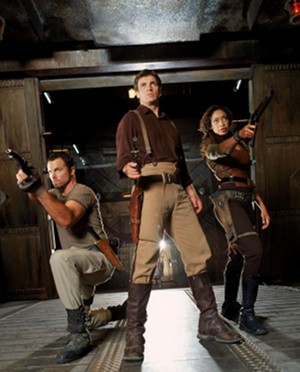
Sound familiar? Yeah, I thought so. The concept proved so catchy that it’s been redone time and again, from Battlestar Galactica to Firefly to Doctor Who. Even though Westerns aren’t nearly as popular as they used to be, many of its tropes are so well suited to Science Fiction that they drive the genre even today.
For example, adventure planets. In a typical Western, the characters travel from town to town, with a different adventure in each one. Well, in Science Fiction, the characters do the same thing, except that they’re traveling from planet to planet. And really, if you’ve got the ability to travel to other worlds, how can you not have an adventure in each one?
A large reason for the Western / Science Fiction crossover is the whole concept of space as the final frontier, which we explored earlier in this series with I is for Interstellar. There’s a very real sense of manifest destiny in the space exploration community, not because of humano-ethnocentrism (heck, we don’t even know we’re not alone in our local stellar neighborhood), but to ensure humanity’s long-term survival. The parallels between that and the westward movement in 19th century America aren’t perfect, but they do exist.
Similarly, as we explored in R is for Rebel, the notion of space as the final frontier has a special resonance with the American audience. The days of the old frontier may be over, but its spirit lives on in our culture, from guns to road trips to our glorification of the rugged, self-made individual. Today’s Science Fiction, especially the space-focused SF of Space Opera, grew out of the adventure fiction of the pulps, which thrived on that frontier American ethos.
In fiction, the frontier can still be found in two major genres: the Western, which is historical and therefore more backward-looking, and Science fiction, which is futuristic and therefore more forward-looking. Because Science Fiction isn’t burdened with all of the historical baggage of the traditional Western, it’s a much more flexible medium for story, readily adaptable to contemporary issues and concerns.
For example, where Star Trek echoes the large-scale nation to nation conflicts of the Cold War (Federation vs. Klingons and Romulans), the new Battlestar Galactica series echoes the much more asymmetrical conflicts of the post-9/11 world (Cylon agents who are indistinguishable from humans and may not even know that they are cylons). At the same time, the wholesale co-opting of Western tropes enables a latent sense of nostalgia, evident in the look and feel of Firefly, or the famous opening lines from Star Wars: A long time ago in a galaxy far, far away.
My first real experience with a wagon train to the stars type of story was probably Star Trek: Voyager, which I watched religiously with my dad every Wednesday night until maybe 9th or 10th grade. The Western-borrowed tropes are somewhat more muted in that series, but they exist, especially the planetville / adventure towns stuff. However, it wasn’t until Firefly and Serenity that I really experienced the awesomeness of a true Space Western. There were a lot of things in Firefly that I really loved, especially the character interactions, the gun-toting action scenes, and especially the starship Serenity. There were some things I didn’t like so much, like the fact that every planet is basically Wyoming, but overall I really enjoyed the show.
It wasn’t until I started getting more acquainted with straight-up Westerns that I saw the real potential for crossover between the genres. Stories about mountain men like Jeremiah Johnson really captured my imagination–what would this look like if it were set in space? In that sense, I came to the Space Western more from the classic Science Fiction side first, rather than the pulp adventure stuff. But once I discovered the crossover connection, it naturally found a way into my own work.
That’s basically how the story idea for Star Wanderers first came to me. I was lying on my bed, daydreaming about having my own starship like the Serenity, when I wondered what it would be like for a starship pilot to get roped into an accidental marriage like in the movie Jeremiah Johnson? The collision between the two ideas was like a supernova exploding in my brain. I rolled out of bed and started writing, coming up with chapter one of Outworlder almost exactly like it’s written today. And the more invested I became in those characters and that world, the more the story grew. I’m writing Part VII right now (Reproach, from Noemi and Mariya’s POV), and so long as people read them I’ll keep writing more.
Genre mash-ups and crossovers are a great way to keep things fresh and come up with some really interesting stories. Some genres aren’t very well suited for each other (Erotica and Middle Grade, for example), but others come together so well that they seem almost complementary. That certainly seems to be the case with Westerns and Science Fiction, at least here in the United States where the spirit of the frontier still echoes through the popular culture.
[NOTE: this post is a reprint of an earlier post from the Trope Tuesday series, which you can find here.]
The fantasy isn’t that Mars could actually look like this, but that NASA might actually get the funding.
One of the problems with interplanetary colonization is that Earth-like worlds are fairly rare (though possibly not as rare as we once thought). In our own solar system, the only other world that comes anywhere close (Mars) is a radiation-blasted desert with only the barest hint of an atmosphere and a surface temperature colder than Antarctica. To get around this problem, you can do one of two things: build an artificial enclosed environment to house the colony, or change the world itself to make it more Earthlike–in other words, terraform it.
The actual science of terraforming is way over my head far too complex to do it justice in this post. Instead, I’ll just point you to the Terraforming Wikipedia page as a starting point and focus on how the concept is used as a story trope.
According to tvtropes and Wikipedia, the term came from a 1942 novella by Jack Williamson titled “Collision Orbit.” The concept of changing the environment of an entire planet actually goes back much further, with H.G. Wells subverting the trope in War of the Worlds (instead of humans terraforming other worlds, the hostile Martians try to xenoform Earth to make it habitable for them). Before the U.S. and U.S.S.R. put probes on the surface of Mars and Venus, it was fairly common for writers to speculate that those planets were able to support human life, at least on a basic, rudimentary level. Once the science showed that that isn’t actually the case, terraforming as a story trope really began to take off.
Today, this trope occurs commonly across all ranges of the Mohs scale. Soft sci-fi stories (such as Firefly) use it as an excuse to have planets that look and feel like Earth. Hard sci-fi stories (such as Red Mars, Green Mars, and Blue Mars) use it as a fundamental premise, or to pose questions like “what is the ultimate destiny of human evolution?” or “how important is it to our species’ survival that we spread out beyond Earth?” Although it’s not something that we as a species have (yet) done, our present science seems to place it well within the range of the plausible, and that means that makes it fair game for any kind of science fiction.
In order to be believable, however, any significant terraforming project requires two things: resources and time. LOTS of time. We’re talking on the order of centuries and millenia here. Because of that, stories that use this trope generally fall into the following categories:
The terraforming happened a long time ago and is part of the world’s ancient (or near ancient) history.
The terraforming is on-going and directly impacts almost every element of the world’s culture and setting.
The terraforming has failed in some way, which may (or may not) make it a key element in the story conflict.
As with generation ships, the scope of this trope spans more than just the interests of a single character–it deals with the ultimate destiny of entire cultures and civilizations. In hard sci-fi stories, the planet that’s being terraformed may actually become more of a character in itself than the individual people who are terraforming it. Unless they have some form of immortality, they have little hope of ever seeing the ultimate end of it.
Of course, that almost makes the project more of a religion to the colonists than a science, with all sorts of interesting philosophical and story implications.
Why is this trope so widespread in science fiction? I can think of a few potential reasons. First, it hits on some of the key issues that lie at the very heart of the genre, such as the ultimate destiny of humanity and the ethical issues surrounding our ability to play God through the wonders of science. Also, it captures the imagination in a way that few other tropes can equal. Because the scope of any terraforming project is so vast, the implications touch on almost every key element of the story, including setting, character, and conflict.
But on an even more fundamental level, it hits on one of the key elements of any fantasy magic system: limitations. We can’t live on an alien world because the conditions are too hostile, but we can’t just wave our hands to make it Earth-like either. We have to undergo a painstaking, laborious process that could unravel at any point and throw everything we’ve worked for into chaos. We have to dedicate our whole lives to the project for dozens of generations before it will ever pay off. There are no shortcuts–none that won’t strain our readers’ suspension of disbelief, anyway. But if it all works out, then we will have created a new Earth–and how is that not magic?
Needless to say, I’m a big fan of this trope. I’ve used it in just about every science fiction story I’ve written, though I probably play with it the most in Star Wanderers. The main character of that story comes from a world where a terraformation project failed, having severe religious implications that drive the whole series. Sacrifice is largely set in orbit around a world that is midway through the terraforming process. Elswhere in the Gaia Nova universe, people build domes just as often to keep humanity from screwing over a terraformed world as they do to provide room to live on one that isn’t. After all this, though, I feel like I’ve only begun to scratch the surface of this trope. You can definitely expect to see it in my work in the future.
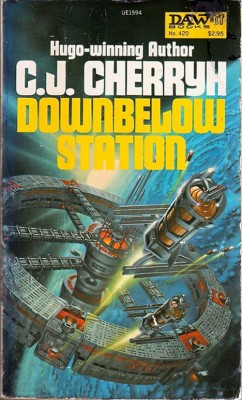
Planets are not the only setting for science fiction stories–space stations are common as well. From the Death Star (“that’s no moon…”) to Downbelow Station, the Venus Equilateral to ISPV 7 to the Battle School in Ender’s Game, space stations are a major staple of any space-centered science fiction.
The reasons for this should be fairly obvious. Before we can go to the planets and the stars, we need to have a permanent presence outside of this massive gravity well we call Earth. The easiest and most logical place to expand first is to orbit, where supplies can be ferried up without too much difficulty and astronauts can escape in case of an emergency. Indeed, with the International Space Station, that’s exactly what we’re doing right now.
In science fiction, of course, space stations go much further than they do in real life. They’re often giant orbital cities, with thousands of people living and working there permanently. Often, they feature some sort of rotating toroidal structure in order to simulate gravity. If there are settlements on the planet below, the station often serves as a major hub for commerce, serving as a waypoint for interstellar merchants and wholesalers who ferry their wares up to orbit. And if the planet is still being colonized, then the space station often serves as an important umbilical to the outside universe.
They can also have strategic value in the event of a war. Battleships need to be serviced too, after all, and a station’s position in orbit can provide an excellent platform from which to bombard or lay siege to the planet. Alternately, outposts at more distant locations like the Lagrange points can serve as a staging ground for future attacks–a sort of astronomical “high ground,” if you will. If nothing else, abandoned stations may contain supply caches that can aid a fleeing starship, or provide shelter behind enemy lines, as was the case with the first Halo game.
Stations can come in all sorts of different flavors, from the puny to the magnificent. The most eye-popping station of all is probably the Ringworld from Larry Niven’s series of the same name. As the name would imply, the station is a giant ring–so huge, its circumference is the orbit of a habitable planet, with the sun at its center! Gravity is provided by rotation, and night and day by giant orbiting panels that block out the sun at regular intervals.
My favorite stations, though, are the more realistic ones–the ones that I can imagine myself living on someday. That was one of the things I enjoyed about Downbelow Station by C.J. Cherryh–her depiction of human expansion into space is eminently believable, and her stations are a natural extension of that. I also really enjoyed her focus on the social dynamics of living on a giant station, and what it would be like to live in such a society.
The Battle School from Ender’s Game is another huge favorite of mine. One of the advantages of building a structure in space is that gravity becomes malleable, so that some parts of the structure can simulate Earth-surface gravity while others leave people completely weightless. The Battle School uses that to its advantage, with the main training room a zero-g laser tag battle arena, where the students have to learn how to stop thinking in terms of the planar dimensions, where “up” and “down” have any meaning. It’s really quite fascinating.
It should come as no surprise that space stations pepper my own works. They’re especially common in the Star Wanderers series, where few worlds have been terraformed and orbital platforms make up the majority of human living space (at least in the Outworlds). In Sholpan and Bringing Stella Home, James, Ben, and Stella are all from a space station–a distinction that is especially useful for Stella, since her Hameji captors despise the “planetborn.” Genesis Earth takes that a step further, as spaceborn Michael and Terra have never been to the surface of a planet before until midway through the novel. Just as going into space is paradigm shifting for us, the experience of walking on a planet proves just as transformative for them.
One of the best things about a good science fiction story is that it can take you to another world–literally! Well, not in the sense of actually physically taking you there, but if you want to experience the thrills of an alien world from the safety of your favorite chair, the best way to do it is to immerse yourself in a good space adventure story.
Planets are to science fiction what islands and continents are to fantasy. It’s possible to tell a story where no one ever sets foot on one, but then you’ve basically got a sea story (since space is an ocean, at least in most space opera). Even then, your characters are probably going to put into port from time to time, if for nothing else than a change of scenery to make things interesting. And if there’s anything science fiction interesting, it’s the wide variety of possible planet types.
For example, what would a planet be like if it were covered completely by water? If the world-ocean was so deep that there was no visible land? Assuming that the planet orbits within its sun’s habitable zone, where the temperature ranges allow water to exist as a liquid, then you would have a pretty interesting place. What would the hurricanes be like? A lot more intense than the ones here on Earth, that’s for sure.
Then again, suppose that the planet was a bit closer to its sun, and most of that water existed in the atmosphere as a gas. You’d have some pretty intense atmospheric pressures on the surface, but the density of the atmosphere would make it much easier to keep airships and flying castles aloft. In fact, that might be the most practical way to settle that kind of a world.
In our own solar system, there is an incredible amount of variety. On Mars, for example, glaciers of dry ice cover the southern pole, while the sun sets blue in a normally dirty brown sky. The tallest mountain actually summits above the atmosphere, and every few years, dust storms cover the whole world. And believe it or not, Mars is a lot more similar to Earth than anything else in our solar system.
On Titan, rivers of liquid methane flow down mountains of water ice, while black carbon dunes drift across a desert shrouded in orange haze. While the sun rises and sets with predictable regularity, the planet Saturn is suspended at the same point on the horizon and dominates a large portion of the sky. Don’t expect to see any rings, though–Titan orbits along Saturn’s ring plane, so the rings are mostly invisible.
Europa, one of the four Galilean moons of Jupiter, is also dominated by its host planet. Water ice covers the surface, but deep, deep below, there’s a massive liquid ocean that has never seen the light of the sun. What sort of monsters lurk in those depths–an ocean buried beneath a world?
Jupiter itself is pretty intense. A gas giant world with swirling bands of planet-sized clouds, it hosts a monstrous hurricane large enough to swallow at least two Earths. This vortex has been churning across the planet for over 150 years, and possibly as much as 350. I still remember the chills I got when I read 2001: A Space Odyssey, and the scientists’ probe dropped through the haze to a cloud deck as massive as one of our continents here on Earth.
Gas giant planets can be really interesting. They aren’t human habitable, since the gravity and pressure are so intense that anything man-made would be crushed before it could hit the surface, but those same forces can lead to some other interesting things. For example, at the lower levels, you may find storms that rain diamonds. Go further still, and you find an intense magnetic core that’s just on the verge of being able to sustain nuclear fusion. Detonate enough nuclear material down there, like they did in a short story from the Halo universe, and you can turn the planet into a star.
And that’s just our solar system. What about the hundreds of exoplanets that astronomers are now discovering? The first one to be confirmed, believe it or not, was orbiting of all things a pulsar! Imagine that–instead of the life-giving rays of a sun, the planet is bathed in highly lethal X-rays and gamma rays.
Of course, there are plenty of planets orbiting stars like our sun, but most of the ones discovered so far are hot Jupiters–gas giant worlds that orbit so close to their sun that the years are measured in hours. Some of these planets are so close that the sun is actually blasting the atmosphere away. We haven’t discovered the rocky core of a gas giant world that’s been destroyed in this manner, but theoretically it could exist.
Or what about the planets with highly elliptical orbits that traverse the habitable zone of their stars? Imagine: a world where the winters are so cold that the oceans freeze solid. After several of our Earth years, the spring brings a massive thaw. For a few short months the weather is actually quite balmy. Then, as spring turns to summer, the heat grows more and more intense, until the oceans begin to boil! When the summer reaches its zenith, the planet is nothing but a scorched desert wasteland. Soon, though, the autumn cool brings back the rains, with storms so intense that they refill the oceans in just a matter of months! Then, the deep freeze of winter begins, and the world returns to its long icy tomb.
One of my favorites, though, is the ribbon world that Asimov predicted in some of his stories. Worlds like this occur most commonly at class M red dwarf stars, which are so cool compared to our sun that planets within the habitable zone are tidally locked. This means that the sun neither rises nor sets, but remains stationary in the sky. The day side is burning hot, with either a barren desert wasteland or a giant hurricane large enough to cover most of the hemisphere. The night side, on the other hand, is so cold that all the water is completely frozen. The only habitable parts of the planet exist in a ribbon-like swath where the sun is just on the other side of the horizon, casting the land in perpetual twilight.
Believe it or not, we’ve actually discovered a planet like this in the Gliese system. Gliese 581g, or “Zarmina’s World” as the lead astronomer dubbed it, was discovered back in 2010. I was so excited by the discovery that I dedicated a blog post to it. Since then, the findings have not yet been confirmed, so it isn’t safe to call it a planet for sure, but if/when it ever is confirmed, it may be one of the first truly Earth-like planets to be discovered (at least, as Earth-like as a ribbon world can be).
In much of science fiction, there’s a tendency to make planets single biome only. Thus, you have your desert planets (Arrakis, Tatooine, Gunsmoke), your ice planets (Hoth, Gethen), your ocean planets (Calamari, Aqua), your jungle/forest planets (Dagobah, Lusitania, Kashyyyk), and even planets that are nothing but giant cities (Trantor, Coruscant). Some of the more recent series like Halo try to avert this, but even today it’s still fairly common.
If there’s anything that modern astronomy is showing us, though, it’s that the variety of planets and worlds out there is beyond anything we could possibly imagine. This is why I get a bit irked when an otherwise excellent series like Firefly makes out every planet to be like Wyoming. What about Gliese 581g? Kepler 22b? GJ 1214b? Kepler 16b?
As more exoplanets are discovered, I can’t help but believe that science fiction is going to experience a paradigm shift. What was once purely the realm of imagination is now being confirmed as reality. Alien worlds exist–alien Earths, even. And just as our conception of Mars changed from the Sword & Planet tales of Edgar Rice Burroughs’ Princess of Mars to the hard sf epics of Kim Stanley Robinson’s Red Mars, Green Mars, Blue Mars, so will our conception of other alien worlds.
I’ve got a lot of different planets in my own books, some borrowing a lot from the recent exoplanet discoveries, others leaning closer to the single biome worlds of classic space opera. In Desert Stars, Gaia Nova is kind of a cross between Arrakis and Trantor, with giant domed arcologies covering half the planet’s surface while the rest is mostly desert and wasteland. In Bringing Stella Home, Kardunash IV is (or rather, was) an Earth-like world, with forests, mountains, and oceans. In Stars of Blood and Glory, New Rigel is a straight up ocean world, while Ebitha from Star Wanderers is an ocean world tidally locked to its dwarf M class sun. I haven’t yet played with the elliptical planet, but I probably will someday.
One of the things I love most about a good science fiction story is that it takes me out of this world. With all the incredible new discoveries that astronomers are making, that aspect of the genre is only bound to get better. They’ve certainly enriched my own work, and will doubtless continue to do so in the future.
If space is an ocean and interstellar colonization is happening on a grand scale, then it should come as no surprise that so many starship captains are intrepid merchants, traveling the galaxy in pursuit of a good business deal. Whether they’re doing it legally as entrepreneurs or illegally as smugglers, you can find these guys in almost any space opera, from Star Wars and Star Trek to Firefly and Foundation.
Ever since Marco Polo and Sindbad the Sailor, intrepid merchants have played a major role throughout history. The brave adventurers who travels to exotic locales to bring you all the best deals, these are often the guys at the forefront of exploration and expansion. After all, Columbus sailed the ocean blue to find a better trade route to India–discovering a new world was just a side benefit. The British Empire had its origins in mercantilism, forming the empire to protect their trade routes (and later, to secure markets and resources for their industrialized economy).
Unlike their real-world counterparts, however, space merchanters have a lot more challenges to contend with than sandstorms and bandits. Science fictional universes are teeming with all sorts of exotic dangers, from black holes and solar flares to space pirates and strange alien races. Unless FTL communication is in force, the immensity of space often makes it impossible to know exactly what to expect on your next FTL jump. And then there’s all the normal space stuff, like busted airlocks and critical failures in the oxygen recyclers.
The best stories, though, are the ones that world build their merchanters to the point where they form their own distinct society. This may overlap with the proud merchant race, though IMO it works best when it’s more than just a hat that everyone wears. The merchanters from C.J. Cherryh’s Alliance-Union universe are a great example, where the entire society has restructured itself around the nomadic spacefaring lifestyle. Another is Heinlein’s Citizen of the Galaxy, where the free traders have developed a strict social hierarchy that defines everyone’s role in running the spaceships.
Since space-centered science fiction largely grew up in the Cold War era, I wonder how much of this trope stems out of the clash between communism and capitalism. The original Star Trek certainly shows a lot of Cold War influences, with the Klingons originally playing proxy for the Russians. Is the genre’s fascination with the adventurous space merchant somehow an outgrowth of that world-shaping conflict? And if so, how do the stories differ on the Soviet side? It makes me wish I could read Russian, since the Soviets certainly had their own fascination with science fiction and space opera.
In my own work, this trope plays a central role. Most of the major characters in my stories are merchants of one stripe or another. James McCoy from Bringing Stella Home is the son of a merchanter, and comes from a mining colony where interplanetary trade drives the local economy (setting up the conflict for Heart of the Nebula after the Hameji take over).
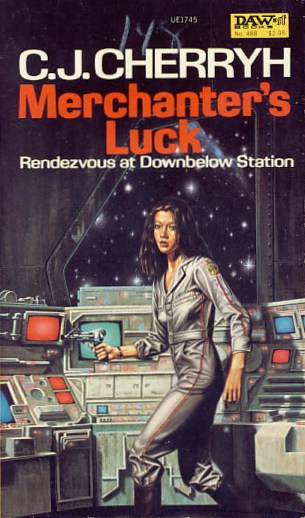
But the trope takes special prominence in my Star Wanderers novellas, which was largely a reaction to C.J. Cherryh and Heinlein. I wanted to create a spacefaring society on the starbound frontier that revolved not only around trade and colonization, but much more personal struggles like finding love and fighting loneliness. In that sense, the stories are a lot more like Merchanter’s Luck than Downbelow Station–more about the lives of individual characters than the grand sweep of galactic history.
Either way, I’m a big fan of this trope. If you’ve got any examples from your favorite books, please share! Wish-fulfillment is a huge part of any fictional genre, and science fiction is no exception. If I could leave it all behind to become a merchant to the stars, you can bet I’d do it in an instant!
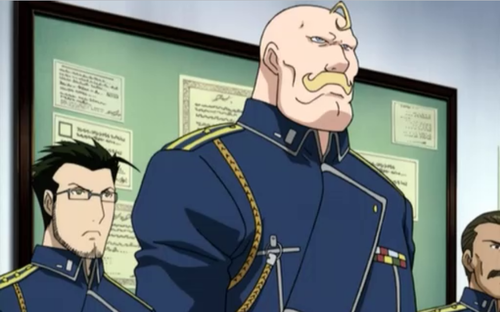 In any vast bureaucracy, you’re bound to find obstructive bureaucrats and professional butt-kissers. But if you look long and hard enough, usually somewhere towards the bottom, you may be lucky enough to find one of the Last DJs.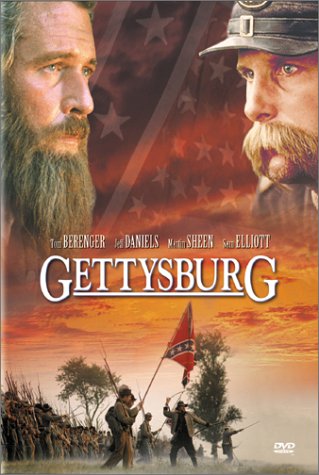

 If
If