Why I love writing novellas

Star Wanderers I (thumb)Star Wanderers II (thumb)Star Wanderers III (thumb)Star Wanderers IV (thumb)SW-V Dreamweaver (thumb)SW-VI Benefactor (thumb)thumb (Sholpan)

For the first half of this year, almost every project I’ve worked on (with the exception of an unfinished short novel) has been a novella.  It’s not a form I was familiar with when I first started writing, but I’ve come to enjoy it immensely, and look forward to writing much more in the future.

The technical definition of a novella is pretty simple, at least according to SFWA.  It mainly has to do with word length:

  • Novel — 40,000 words or more
  • Novella — 17,500–39,999 words
  • Novelette — 7,500–17,499 words
  • Short Story — 7,499 words or fewer

That one simple distinction leads to a host of other differences, though, since words and story length are so crucial to the different types of stories you can tell.

Short stories tend to be more situational.  A good short story writer (which I am not) can use the form to explore all sorts of other story elements, but there’s always something of a tradeoff.  A good short story will have strong characterization but a simplistic or nonexistent plot, or center around a compelling concept but not provide an immersive setting.  It’s a very minimalistic form–there’s always something of a sacrifice.

A good short story can pack a real punch, but it doesn’t really immerse you in another world.  It might resonate for a long time after you read it, but you finish it almost as soon as you start it.  It’s a form that I enjoy in audio form, but don’t actually read very much.  It’s great for the commute or a road trip, but not so great when I’m curled up in the lovesack looking to get lost in a book.

That’s just me, at least.  And as for writing them, I need a lot more practice before I have anything useful to say on that.

With novels, it’s exactly the opposite.  They are so expansive that they tend to have multiple viewpoints, subplots, character arcs, and setting elements all woven together in one sprawling whole.  There are differences, of course, between a 200k word fantasy epic and a short 60k word thriller, but complexity is an important part of the form.  It’s not enough to have an interesting situation, or a single mind-blowing idea–you have to have several, and they have to work together.

When done well, the effect can be tremendous.  A good novel is much more than just the sum of its parts, and the climactic moments when everything comes together can be truly spectacular.  They’re incredibly immersive, too–I’m pretty sure that some of my childhood memories are things that never happened except in the pages of a book.

But sometimes, it can be hard to get into a novel, either because it starts off slow or because from the very beginning it’s so complex.  Also, it requires much more of an investment, especially in time.  I can’t tell you how many novels I’ve checked out from the library, only to return a few weeks later with a hefty overdue fine on my account–not because I didn’t like them, but because I just couldn’t find the time to finish.

In terms of writing, all of that storytelling complexity can make the task positively gargantuan.  It depends on the length of the novel, of course, but the longer it gets, the harder it is to keep everything straight.  And when something is off and the story just doesn’t seem to be coming together, it can be incredibly difficult to figure out exactly what is broken.  Even if it’s small, or something that’s easy to fix, you can easily find yourself revising in circles.

The novella falls more or less in the “Goldilocks” zone of these other forms.  It’s long enough to give you the space you need to play with things on a novelistic scale, but short enough that you don’t have to worry about bringing all that complexity to the page.

Generally, I’ve found that there isn’t much of a difference between novellas and novelettes.  I’ve dabbled with both, and found that the difference has more to do with brevity and less to do with actual structure or form.  A well-written novelette can do all (or at least most) of the things a novella can do, just in a slightly more economical fashion.  And of course, the differences in all of these forms is subjective and fuzzy.  Your experience could very well be different.

But personally, I find novellas (and novelettes) much more fun to write because it allows me, sometimes even forces me, to get a lot more intimate with my characters and their individual points of view.  A situation or idea alone is not enough to carry the story for the required length, but exploring multiple viewpoints (or at least more than two) tends to push the story too far.  Consequently, I find myself really diving into my characters and trying to see things from their perspective.

It’s similar with novels, but without all the other subplots or character arcs, there are fewer distractions–and fewer ways to screw up.  I can stay in the character’s head without having to break out to fix something else.  Also, my first drafts tend to be a lot cleaner, with less need for massive substantial revisions.  And even if the draft is irredeemable, I can toss it out and rewrite from scratch with a lot less pain, since it’s only 30k or 40k words.

So yeah, I really love writing novellas, which is something that would have surprised me only three or four years ago.  There aren’t a whole lot of traditional markets to sell them to, but that doesn’t matter because they’re perfect for ebooks and self-publishing.  It’s also a lot easier to take a loss on a perma-free novella than it is on a full-length novel.

I’ve found that I can write a good first draft of a novella in anywhere between two and six weeks.  I wish I could do it quicker, but I’m not a very fast writer, so thirty days is a pretty good cap for a deadline.  And because they’re shorter, they tend to be quicker to revise, and easier to hand off to alpha readers who will give you a good turn-around time for feedback.

For those of you who prefer more long-form stories, don’t worry–I haven’t given up on writing novels.  In fact, I’ve got a half-finished epic fantasy novel that I’ll probably work on next, once Star Wanderers: Benefactor (Part VI) has gone through a major revision pass.  But if you enjoy reading novellas as much as I enjoy writing them, then you’ve got a treat, because I’ve got a bunch of Star Wanderers novellas that will be coming out in the next few months!

And after that?  Who knows …
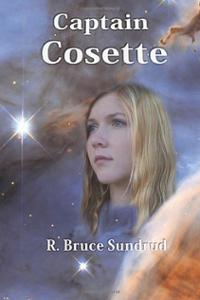
Captain Cosette by R. Bruce Sundrud

captain_cosetteSo I saw this book in my alsobots on Amazon a few months ago, and it looked interesting so I figured I’d give it a shot.  The cover is admittedly pretty bad, but it has two of my favorite things in the universe (space and girls), and besides, I’ll sample just about anything.  A few days later, I realized the sample folder on my Kindle was getting pretty big, so I decided to go through and clear some of it out.

Well, I ended up buying this one.  The beginning really hooked me, and the rest of the book did not disappoint.

Captain Cosette is basically a Cinderella story set in space, except instead of getting glass slippers and going to the dance, Cosette goes to war and becomes a knock-out starship pilot.  It’s military sci-fi with a lighter edge than Drake or Haldeman.  And it’s good.  I think I read from the 36% mark to the end without stopping.  Sundrud is really good at making you care about his characters and then putting them in peril.

One thing that I really enjoyed were all the pulpy Renee Chevalier books that Cosette always reads, which were really just tongue-in-cheek references to modern pop-culture phenomena like Twilight and Casablanca.  It broke the fourth wall at times, but I always found them hilarious, especially with some of the twists they add at the end.

Unlike some other sci-fi books that I’ve started recently and failed to finish, the science fictional elements here are not just window dressing–they really drive the plot.  I thought the teaching machine was particularly interesting, especially when it … well, I won’t give away any spoilers.  And of course, the lost colonies and border worlds were also fascinating.  Cosette comes from a backwards farming planet, and the way she thinks about things at first, you really get the sense that this has been her whole universe.  As she gradually comes to understand the geo- (astro?) politics of Union and Alliance, her awareness expands, and so does yours as the reader.  It’s very cool.

There are a couple of things I wish this book had done a little better.  The world is not nearly as immersive as I wanted it to be, and sometimes it feels like the characters are hurrying from place to place.  Also, sometimes the characters seemed to blend together a bit.  There was enough to differentiate them, but at times they sounded almost the same.  None of these issues took much away from my overall enjoyment of the book, however.  The story was solid.

So yeah, if you like the kind of stuff I like to write, you’re probably going to love this one.  At $2.99 for the ebook, you really can’t go wrong.  Even if you’re not a huge military sf fan, if you like Cinderella stories (and who doesn’t?), this one is definitely worth checking out.

T is for Terraforming

[NOTE: this post is a reprint of an earlier post from the Trope Tuesday series, which you can find here.]

The fantasy isn’t that Mars could actually look like this, but that NASA might actually get the funding.

One of the problems with interplanetary colonization is that Earth-like worlds are fairly rare (though possibly not as rare as we once thought). In our own solar system, the only other world that comes anywhere close (Mars) is a radiation-blasted desert with only the barest hint of an atmosphere and a surface temperature colder than Antarctica. To get around this problem, you can do one of two things: build an artificial enclosed environment to house the colony, or change the world itself to make it more Earthlike–in other words, terraform it.

The actual science of terraforming is way over my head far too complex to do it justice in this post. Instead, I’ll just point you to the Terraforming Wikipedia page as a starting point and focus on how the concept is used as a story trope.

According to tvtropes and Wikipedia, the term came from a 1942 novella by Jack Williamson titled “Collision Orbit.” The concept of changing the environment of an entire planet actually goes back much further, with H.G. Wells subverting the trope in War of the Worlds (instead of humans terraforming other worlds, the hostile Martians try to xenoform Earth to make it habitable for them). Before the U.S. and U.S.S.R. put probes on the surface of Mars and Venus, it was fairly common for writers to speculate that those planets were able to support human life, at least on a basic, rudimentary level. Once the science showed that that isn’t actually the case, terraforming as a story trope really began to take off.

Today, this trope occurs commonly across all ranges of the Mohs scale. Soft sci-fi stories (such as Firefly) use it as an excuse to have planets that look and feel like Earth. Hard sci-fi stories (such as Red Mars, Green Mars, and Blue Mars) use it as a fundamental premise, or to pose questions like “what is the ultimate destiny of human evolution?” or “how important is it to our species’ survival that we spread out beyond Earth?” Although it’s not something that we as a species have (yet) done, our present science seems to place it well within the range of the plausible, and that means that makes it fair game for any kind of science fiction.

In order to be believable, however, any significant terraforming project requires two things: resources and time. LOTS of time. We’re talking on the order of centuries and millenia here. Because of that, stories that use this trope generally fall into the following categories:

  • The terraforming happened a long time ago and is part of the world’s ancient (or near ancient) history.
  • The terraforming is on-going and directly impacts almost every element of the world’s culture and setting.
  • The terraforming has failed in some way, which may (or may not) make it a key element in the story conflict.

As with generation ships, the scope of this trope spans more than just the interests of a single character–it deals with the ultimate destiny of entire cultures and civilizations. In hard sci-fi stories, the planet that’s being terraformed may actually become more of a character in itself than the individual people who are terraforming it. Unless they have some form of immortality, they have little hope of ever seeing the ultimate end of it.

Of course, that almost makes the project more of a religion to the colonists than a science, with all sorts of interesting philosophical and story implications.

Why is this trope so widespread in science fiction? I can think of a few potential reasons. First, it hits on some of the key issues that lie at the very heart of the genre, such as the ultimate destiny of humanity and the ethical issues surrounding our ability to play God through the wonders of science. Also, it captures the imagination in a way that few other tropes can equal. Because the scope of any terraforming project is so vast, the implications touch on almost every key element of the story, including setting, character, and conflict.

But on an even more fundamental level, it hits on one of the key elements of any fantasy magic system: limitations. We can’t live on an alien world because the conditions are too hostile, but we can’t just wave our hands to make it Earth-like either. We have to undergo a painstaking, laborious process that could unravel at any point and throw everything we’ve worked for into chaos. We have to dedicate our whole lives to the project for dozens of generations before it will ever pay off. There are no shortcuts–none that won’t strain our readers’ suspension of disbelief, anyway. But if it all works out, then we will have created a new Earth–and how is that not magic?

Needless to say, I’m a big fan of this trope. I’ve used it in just about every science fiction story I’ve written, though I probably play with it the most in Star Wanderers. The main character of that story comes from a world where a terraformation project failed, having severe religious implications that drive the whole series. Sacrifice is largely set in orbit around a world that is midway through the terraforming process. Elswhere in the Gaia Nova universe, people build domes just as often to keep humanity from screwing over a terraformed world as they do to provide room to live on one that isn’t. After all this, though, I feel like I’ve only begun to scratch the surface of this trope. You can definitely expect to see it in my work in the future.

Trope Tuesday: Terraforming

The fantastical element here isn’t that Mars could actually look like this in a millenia or two, but that NASA might actually get the funding.

One of the problems with interplanetary colonization is that Earth-like worlds are fairly rare (though possibly not as rare as we once thought).  In our own solar system, the only other world that comes anywhere close (Mars) is a radiation-blasted desert with only the barest hint of an atmosphere and a surface temperature colder than Antarctica.  To get around this problem, you can do one of two things: build an artificial enclosed environment to house the colony, or change the world itself to make it more Earthlike–in other words, terraform it.

The actual science of terraforming is far too complex (not to mention way over my head) to do it justice in this post.  Instead, I’ll just point you to the Terraforming Wikipedia page as a starting point and focus on how the concept is used as a story trope.

According to tvtropes and Wikipedia, the term came from a 1942 novella by Jack Williamson titled “Collision Orbit.” The concept of changing the environment of an entire planet actually goes back much further, with H.G. Wells subverting the trope in War of the Worlds (instead of humans terraforming other worlds, the hostile Martians try to xenoform Earth to make it habitable for them).  Before the U.S. and U.S.S.R. put probes on the surface of Mars and Venus, it was fairly common for writers to speculate that those planets were able to support human life, at least on a basic, rudimentary level.  Once the science showed that that isn’t actually the case, terraforming as a story trope really began to take off.

Today, this trope occurs commonly across all ranges of the Mohs scale.  Soft sci-fi stories (such as Firefly) use it as an excuse to have planets that look and feel like Earth.  Hard sci-fi stories (such as Red Mars, Green Mars, and Blue Mars) use it as a fundamental premise, or to pose questions like “what is the ultimate destiny of human evolution?” or “how important is it to our species’ survival that we spread out beyond Earth?” Although it’s not something that we as a species have (yet) done, our present science seems to place it well within the range of the plausible, and that means that makes it fair game for any kind of science fiction.

In order to be believable, however, any significant terraforming project requires two things: resources and time.  LOTS of time.  We’re talking on the order of centuries and millenia here.  Because of that, stories that use this trope generally fall into the following categories:

  • The terraforming happened a long time ago and is part of the world’s ancient (or near ancient) history.
  • The terraforming is on-going and directly impacts almost every element of the world’s culture and setting.
  • The terraforming has failed in some way, which may (or may not) make it a key element in the story conflict.

As with generation ships, the scope of this trope spans more than just the interests of a single character–it deals with the ultimate destiny of entire cultures and civilizations.  In hard sci-fi stories, the planet that’s being terraformed may actually become more of a character in itself than the individual people who are terraforming it.  Unless they have some form of immortality, they have little hope of ever seeing the ultimate end of it.

Of course, that almost makes the project more of a religion to the colonists than a science, with all sorts of interesting philosophical and story implications.

Why is this trope so widespread in science fiction?  I can think of a few potential reasons.  First, it hits on some of the key issues that lie at the very heart of the genre, such as the ultimate destiny of humanity and the ethical issues surrounding our ability to play God through the wonders of science.  Also, it captures the imagination in a way that few other tropes can equal.  Because the scope of any terraforming project is so vast, the implications touch on almost every key element of the story, including setting, character, and conflict.

But on an even more fundamental level, it hits on one of the key elements of any fantasy magic system: limitations.  We can’t live on an alien world because the conditions are too hostile, but we can’t just wave our hands to make it Earth-like either.  We have to undergo a painstaking, laborious process that could unravel at any point and throw everything we’ve worked for into chaos.  We have to dedicate our whole lives to the project for dozens of generations before it will ever pay off.  There are no shortcuts–none that won’t strain our readers’ suspension of disbelief, anyway.  But if it all works out, then we will have created a new Earth–and how is that not magic?

Needless to say, I’m a big fan of this trope.  I’ve used it in just about every science fiction story I’ve written, though I probably play with it the most in Star Wanderers.  The main character of that story comes from a world where a terraformation project failed, having severe religious implications that drive the whole series.  Sacrifice is largely set in orbit around a world that is midway through the terraforming process.  Elswhere in the Gaia Nova universe, people build domes just as often to keep humanity from screwing over a terraformed world as they do to provide room to live on one that isn’t.  After all this, though, I feel like I’ve only begun to scratch the surface of this trope.  You can definitely expect to see it in my work in the future.

New Kindle! And some new old projects as well

So I came out to Tbilisi today, because MY NEW KINDLE PAPERWHITE JUST ARRIVED!

Okay, sorry for the all-caps shouting, but I’m really happy that it finally got here.  My old kindle broke down a few months ago, leaving me stranded in my tiny village without any books.  With the weather getting worse and the power outages becoming more frequent, cabin fever has started to become a problem.  So really, it couldn’t have come at a better time.

It shipped out almost a month ago, but Georgia (the country, not the state) is a fairly remote place, so it’s taken a looong time to get here.  The wait has definitely been worth it, though.  I love this device, especially the cover browsing function.  And the backlight is going to be very, very useful, what with all the power outages we get in the village.

So I’m about 100 pages into The Sword Keeper, my latest project, and I realized that I need to do a lot more worldbuilding before I can continue.  I’ve got a good handle on the characters and have more or less figured out the plot, but there are still a lot of holes in the setting.  This new project is a fantasy novel, and it seems to be leaning more towards epic than heroic, so I probably should take the time to really build the world before trying to finish the story.

I’ve been drawing a lot of inspiration from my experience here in Georgia, but right now, I feel like I’m too close to it to really take it in the right direction.  The time I spent in Jordan was a huge influence in Desert Stars, but I didn’t start it until I came home (and didn’t finish the first draft until almost two years later).  Ideas are like wine: sometimes, you just need to let them sit in the back of your head and age for a while.

So long story short, I’ve decided to put The Sword Keeper on the back burner for a while.  I’m  sure I’ll come back to it, though–the story is far too interesting to let go.  Magical thinking swords that meld with the minds of those who wield them, ancient prophecies and a secret order of warrior monks–and that’s just the backdrop.  The characters themselves are much more interesting–I have got to tell their story!

But for now, I’m going to revisit the Gaia Nova universe and finish the revisions for Heart of the Nebula.  This one is a direct sequel to Bringing Stella Home, and while it definitely still needs work, I feel like it’s almost there.  The first draft had some major problems and needed to be revamped, especially toward the end.  If all goes well, I should finish this pass before the end of November, with enough time to write another Star Wanderers story before the end of the year.

Stars of Blood and Glory is still with my first readers, but if they give it the green light, I hope to publish it sometime in February.  This one is also a direct sequel to Bringing Stella Home, with Danica, Roman, Stella, and Stella’s son Abaqa, and a couple of characters from Desert Stars as well.  I’m really excited about this story, but I figure it’s best to get some more feedback first before putting it out.

Which brings me to Star Wanderers: Homeworld (Part IV).  I can’t promise that it will be out before the end of November, but that’s what I’m shooting for.  Of course, I’m not going to put it out until I’m satisfied that it represents my best work, but even my first readers do come back with problems, I’m 99% confident I can fix them all by December at the latest.  There is nothing–absolutely nothing–like the feeling you get when you finish a story where everything just comes together.  I may not be the best judge of my own work, but I know that feeling.  You can definitely expect to see this story come out before the end of the year.

That’s about all for now.  Internet is spotty out in the village, but I’ve got a couple of interesting posts brewing in the back of my mind.  I’ll probably write them up in the next few days, and post them the next time I get a chance.  Until then, see you around!

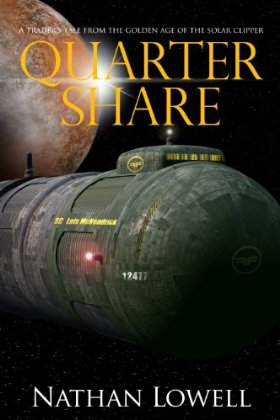
Quarter Share by Nathan Lowell

Ishmael Wang never thought he would sign up with the crew of a solar clipper, traveling the stars as part of a merchant collective.  But when his mother unexpectedly dies, leaving him with barely enough money to pay next month’s rent, he finds himself without any other choice.  Fortunately, the starfaring life suits him quite well–surprisingly well.

I picked up this novel because it appeared in the “customer’s also bought” section of my own novel, Genesis Earth.  It was a fun read, though to be honest I put it down for almost seven or eight months before finishing it.  The reasons for that should be clear by the end of this post.

Don’t get me wrong; there are things that I liked a lot about this book. The beginning set up is excellent–I really felt drawn into the story, and felt for the challenges that Ishmael was facing.  As he started to make friends and explore his new world, the wish fulfillment factor became a major draw.  I mean, who wouldn’t want to sign up with the crew of a solar clipper and travel across the stars?

But somewhere in the middle, the book started to lose steam.  Ishmael’s internal conflicts with the death of his Mom faded into the background until they completely disappeared.  Everything that he set out to accomplish, he did so successfully after the first or second try.  The story took on a sort of video game quality, where the main focus was leveling up: from quarter-share to half-share, from this test to that test, etc.  Even some of the aspects of the world-building became mundane, with mushroom-growing asteroids and space station flea markets becoming just another way to make a profit.

While there were aspects of the trading game that I liked, the lack of any real conflict made me lost interest in the story. The beginning is very strong, and the middle, though weaker, is still okay, but the ending just sort of fizzled without a real climax.  If you’re only reading for wish-fulfillment, that probably isn’t a problem, but if you want something else, you’re probably better off looking elsewhere.

Story Notebook #6

Alright, it’s time to go through another story notebook.  This one covers the spring and summer of 2010, right after I graduated.  It was a weird transitional period in my life, when I didn’t really know what I was doing or where I was going, but I was determined to keep on writing anyway.

I filled three pocket notebooks with story ideas in 2010, and last time I mistakenly thought I’d covered one that went from graduation through the end of the year.  While putting my records in order before going abroad, I found that this one actually came a little earlier.

Lots and lots of story ideas…2010 was definitely a good year for that.  So anyhow, here we go:

A planet settled by people with aircars: there will be no asphalt roads, only packed earth.

An interesting consequence of futuristic technology; too often, stories come up with something flashy without really thinking through all of the implications.  Can you imagine a world without asphalt?  If you can, then please take me there!

A task-oriented woman who thinks men are fickle because they’re always trying to come across as macho, trying to save face, etc.

This makes me think of something I heard somewhere about gender roles and politicians.  If I remember it correctly, most men go into politics for the fame, power, and glory, while most women go into politics because something in their community is broken and they feel it’s their duty to fix it.  Not sure if that’s true or not, but this story idea made me think of that for some reason.

Humanity has been domesticated by a super-intelligent alien race and bred into several different breeds with wildly varying physical characteristics.

In other words, a post-human universe where humans have been bred as pets, like dogs.  Can you imagine a world where the physical differences between humans of different races are as great as this:

Can these two even physically reproduce?

A fantasy where the traveling hero is actually the bad guy.

I think Girl Genius already beat me to that, though Othar is more of an annoyance than a genuine villain.

An interstellar Sir Richard Burton.

Now that would be an interesting series.  Sir Richard Burton was a British adventurer who went to the Middle East before doing that was cool.  He made the first English translation of the 1001 Arabian Nights (as well as the Kama Sutra, apparently), and was one of the first European explorer to sneak into Mecca–certainly the first non-Muslim explorer.  I hear he was quite a character.

A planet on a highly eccentric orbit where habitability is sustained by large glowstones that absorb high amounts of energy and emit heat slowly.

Ooh, I’d forgotten about this one.  I’ll have to use it sometime–maybe in a science fiction / fantasy mashup.  You know, with dragons and stuff.

A werewolf who is tame around just one person.

I’m pretty sure this one has been done, and I’m also pretty sure I’m not interested in reading it.  Sorry, Twilight fans–or maybe you’re welcome?

A landscape more vertical than horizontal, where the architecture reflects this (like the old Knight building).

The Knight building was a multi-split-level administration building at BYU where Leading Edge used to meet.  Lots of stairs, entrances on just about every level–it was a weird building (but not quite as weird as the JKB).  But yeah, a vertical landscape would be cool–though I guess that’s pretty common in cyberpunk, with all those cities.

An alien species that communicates only by touch.

“What the–augh!  Get it off of me!” Thus begins humanity’s first interstellar war.

Purgatory for fictional characters, where all the plot hole stories go.

I’m pretty sure that was a South Park episode.

A religious order that believes that developing math skills is the key to self and enlightenment, becuase math is the only science that is completely a priori.

Heh, I’ll bet my Dad would like that story.  It might be the first one of mine that he actually buys.

A man frames himself to go to prison so that he can go to law school / have time to write.

When you’re unemployed and struggling to make ends meet, some otherwise unsavory options begin to look pretty attractive…

What if humanity had a blight like the American Chestnut, where everyone over the age of 20 dies of a horrible disease?

I actually started writing that one.  Finished the first chapter, kind of in a pseudo-Victorian first person style, like Robinson Crusoe.  I have no idea when I’ll finish it, but the universe is really, really fascinating.

A world where novelists / storytellers convey their tales telepathically without translation into words.

And then SOPA gets passed, and all of us creative types are screwed.

What if the mountains were sentient? What would they think of the human race?

“Dang it!  Not another cavity!”

Land of the sleeping rainbows

I think this is actually a real place in southern Utah; I just thought it would make a cool story prompt.

What if the Amish really are 18th century people, guarding a natural time portal in central Pennsylvania?

That would be a fun one to research. “Hello, I’m writing a time travel novel…can I join your village for a year?”

Marital therapy that involves swapping bodies.

I’m pretty sure Disney did something like that in the 60s.  With the way the country has changed, I’m sure it would be much different if someone did it again today.

And that just about does it for this notebook.  As always, feel free to use any of these ideas in your own work.  It isn’t “stealing” if it hasn’t actually been written yet (unless congress passes a revamped version of SOPA that…hmm, that gives me an idea…).

Thanks guys!  See you around!

Trope Tuesday: Recycled IN SPACE!

Or, as my friends at Leading Edge would say, IN SPAAACE!!!

The basic idea behind this trope is that setting a story in space makes it cool and different.  The tvtropes article focuses mainly on how this trope is used in children’s cartoons, but it actually goes much wider.  In fact, most space stories are actually based on stories from other genres, or even from history.

For example, Asimov’s Federation series is based on Edward Gibbon’s Decline and Fall of the Roman Empire, David Drake’s Lieutenant Leary series is based on Patrick Obrian’s Master and Commander series, and Frank Herbert’s Dune is based on the rise of Islam.  Westerns are especially prone to get the space treatment (Firefly, anyone?), which is where we get “wagon train to the stars.”

At its worst, this trope is nothing more than a pointless gimmick.  At its best, however, it can produce some extremely good work.  The key, as always, is to work within the limitations of the setting.

One of the best examples of this is Dune.  Frank Herbert didn’t merely lift 7th century Arabia into space and call it Arrakis; he created a distinctly alien world with its own history, culture, biology, and role within the galactic empire.  For example, Herbert solved the FTL problem by linking interstellar travel to the spice, tying his space-Arabs to the politics and economics of the rest of the galaxy.

Interestingly, your space physics don’t have to be perfect for this trope to work; they just have to be believable.  For things like artificial gravity and faster than light travel, most people will accept a little hand-waving, provided that you do it well.  The important thing, as always, is the story.

Desert Stars 4.0 is finished!

And just in time; I start another job tomorrow.  So anyhow, here are the stats:

words: 99,000
chapters: 22
ms pages: 465
start date: 3 Oct 2011
end date: 25 Oct 2011

And the word splash:

Wordle: Desert Stars 4.0

Can you tell who the main characters are? 🙂

This might sound kind of cheesy, but this book has a very special place in my heart.  I started it immediately after the 2008 BYU Jordan study abroad program, though it took me until the summer of 2010 to finish it.  Even though it’s shorter than Bringing Stella Home, I think it’s much more immersive, with the world itself playing a much larger role as one of the characters.

I’m very satisfied with this draft.  I say this with everything I write, but I honestly believe that this is my best work to date.  It’s surprising to see just how much my writing has changed between drafts.  It seems to be getting better, though, so that’s very encouraging.

I haven’t launched the kickstarter campaign yet, but I hope to do that by the first of next month, so be sure to look out for that.  In the meantime, I thought it might be fun to share the prologue, to give you an idea of what the story is about.  Enjoy!

=============================================

Prologue

The boy felt scared, more scared than he had ever yet been in his young life. It was because of the strange noises in the bulkheads and the way the walls and floor shook, but mostly because everyone around him, even his parents, were scared, and he didn’t know why.

The lights in the hallway flickered as he wandered out of his cabin, and the whine of the engine rose higher and higher. It wasn’t especially loud, but didn’t sound right; the boy knew that much at least. On the other side of the ship, a door hissed as it slid open. The boy turned and saw his uncle and three of his cousins come running out of the bridge, eyes wide with fear.

She’s gonna blow,” shouted his uncle. “Let’s move!”

The boy stood rooted to the spot, his legs frozen in terror. He watched as his cousins ran to the emergency escape chutes–the ones his parents had adamantly told him never to play in–and dove through.

A groaning noise came through the bulkheads–the terrible sound of metal on metal. He closed his eyes and covered his ears with his hands, and the floor itself dropped out from under him. For a frighteningly disorienting moment, gravity vanished, leaving him floating weightless in the corridor. The taste of vomit filled his mouth and he screamed in fright, but without gravity he could only kick his legs uselessly beneath him.

The moment passed, and he fell to the hard tile floor. Tears of terror clouded his vision, and his arms and legs shook so bad he hardly noticed that the floor was shaking. The ship lurched, sending him sprawling on his hands and knees.

Hands grabbed him underneath his arms, lifting him up and carrying him away. He glanced up and recognized the face of his mother, pulling him towards the escape chutes.

Mommy,” he cried, “I’m scared.”

I know, dear,” she told him. “Mommy needs you to be extra brave right now.”

The boy nodded. Though his mother tried to sooth him, he could tell that she was just as frightened as he was. That terrified him more than even the loss of gravity.

Come on!” the boy’s father shouted, further down the corridor. “Any minute now, and–”

The lights flickered again, and an explosion sounded from deep within the bulkheads of the ship. A low hiss sounded behind them, and not from a door opening.

Oh God,” the boy’s mother cried. “Is that–”

As if in answer, a mighty wind howled throughout the ship, filling the boy’s ears with its roar. It whipped at his hair and tugged at his clothes, sucking him away like a monster from the bottom of a giant drain. Somehow, he knew that in only a few moments, they would all be dead.

Hands grabbed him, lifting him up toward the escape chute. He screamed, but the roar of the wind was so loud he could barely hear his own voice. His mother slipped something around his neck, and suddenly he was falling through the chute, into darkness.

He came to a stop in a snug little space, closed in on all sides like a glove for his body. A holoscreen lay in front of his face, with a pair of flight sticks and a miniature control board. The boy gripped the flight sticks with his hands and stared dumbly at the screen, barely able to process anything that was happening.

A distant puffing noise sounded through the ultra-soft walls, and then he was falling again–only this time, he couldn’t move his arms or legs. He was locked into position, cushioned on all sides and only able to use his hands.

Fighting back panic, he watched as the holoscreen flickered and came to life. It showed an image of space, the stars spinning wildly as noiseless flashes of light burst into being before fading into after-image amid the blackness of space. He squeezed the dual flight sticks and moved them like he was playing a computer game, but it was no use–he couldn’t equalize.

Mommy, the boy cried inwardly. Panic swept over him, and his hands and arms began to shake. He screamed, but in the tightly enclosed space, there was no one to hear him.

The glowing orb of a planet came into view, filling the screen with its brilliant light. The boy squinted as the display adjusted, showing a brown and yellow landscape framed by a curved horizon. It danced with the spinning stars, moving so quickly that everything was a blur.

A red light started blinking in the corner of the screen, and words flashed across the display. The boy didn’t know how to read, but he knew it was something bad. He tried again with the flight sticks, but that only sent him spinning in a new direction.

Without warning, the screen switched off, and the entire capsule filled with thick, pink foam. The boy gasped and tried to shield himself with his hands, but before he could cover his face it hardened around his body, freezing him into position.

The foam covered his mouth and face, but was just porous enough to allow him to breath–in short bursts, however, because his stomach was severely pinched. The spinning grew worse, until he wanted to throw up. As if from a great distance, he heard a muffled roar through the bulkheads. Everything around him grew increasingly warm, until he began to sweat. He tried to open his mouth to cry out, but his jaw was locked too tightly in place–he couldn’t move anything, not even a finger.

Mommy! he mentally screamed. Where are you?

As if in answer, something popped behind him. Inertia threw him forward, but the foam held him in place, so that all he felt was a tremor through his body. Gravity returned, so that he felt as if he were dangling upside down from his feet. Blood rushed to his head, and he swooned, redness clouding his vision.

Then, like a punch to his face, the shock of impact hit him, causing his bones to shudder. He spun even faster than before, but the foam still held him. It felt as if someone had turned him inside out, though–as if his stomach had swollen and turned to mush.

As the spinning gradually came to a stop, tears streamed from the boy’s eyes. The roaring had died down, leaving him encased in near-absolute silence. That frightened him almost more than the noise.

A sharp hiss filled his ears as the foam grew sticky and porous all around him. He thrashed against it, pulling his hands and arms free as it turned into a sticky, foul-smelling soup. Behind him, a hatch opened, and he struggled toward it, spitting to get the nasty taste out of his mouth.

He crawled out and rose to his feet, blinking in the harsh light of a foreign sun. The hot wind bit him as it blew in his face, stinging his face with sand. He raised a hand to his eye and looked around him at the alien landscape.

A lonely, rust-red desert extended in all directions, with nothing but sand and rock and distant craggy peaks to meet his eye. The sky shone a hazy yellow, completely unlike the clean white light of his family’s ship. A new fear passed through the boy–the fear of being alone.

As he stared at the land around him, he reached down to see what his mother had slipped around his neck. It was a pendant with a little black case at the end. He felt it between his fingers and knew somehow that he would never see her again.

Tears clouded his eyes, and he screamed and wailed for someone, anyone–but in the harsh desert waste, there was none to hear him.

=============================================

Good stuff. I can hardly wait to get it published!

The interior designer’s approach to story

I recently read a fascinating post on John Brown’s blog with an interesting exercise for analyzing the kinds of stories you most like to read.  By finding out what really turns you on in a story, you can have a much better idea what to write, and how to make your own stories better.

He prefaced the exercise with a story about the interior designer who helped them to decorate their house.  The designer spread out a number of home magazines in front of them, and told them to go through and tear out the pictures that most turned them on.  After doing this, they analyzed the pictures to see what they had in common, and thus discovered how to best decorate their house.

The exercise works much the same way.  First, pick out five books you really like that immediately come to mind.  Mine are:

As many of you know, these are some of my favorite books of all time.  I’ve reread three of them, and I intend to reread the other two at some point.

Next, pick out the elements that these books have in common.  Here’s what I came up with:

1) Set in a different time and place.

Not all these books are science fiction, but the all take place in a world far removed from our own.  Only Spin takes place largely on Earth, but the events of the story transform the world as we know it so much that by the end of the novel, it’s completely different. SPOILER (highlight to see) Besides, at the very end, the two main characters leave Earth by going through the giant portal to another planet, so the novel is arguably about escaping the world as we know it.

2) Stakes that are much more personal than global.

This was interesting, and highlights something I realized when I compared Merchanter’s Luck with Downbelow Station.  In all of these stories, the central driving conflicts are extremely intimate and personal.

To be sure, many of these stories also have an epic backdrop; Mistborn certainly does.  However, I was much more interested in Vin’s growth and development than I was in how the Ska would overthrow the Lord Ruler–in fact, Mistborn is my favorite book in the trilogy for that very reason.

3) Encourages deep introspection.

This shouldn’t come as too much of a surprise if you’ve followed this blog for a while, but I love love LOVE stories that make me see the world in a new way.  Thrillers and adventures are all fun and good, but if it doesn’t make me think, I’m usually like “meh” at the end.

4) Female characters who aren’t weak or passive.

This one might be a bit more controversial, but in all of these stories, I’ve noticed that the female characters are pretty strong, even if they aren’t all kick-butt Katniss wannabes (ugh…I hate Katniss).  Even in Legend, which is largely dominated by men, you still have the earl’s daughter, who is one heck of a spirited woman.

5) Life and death conflicts.

This is interesting: in all of these books, the threat of death is immanently real.  Some of them, such as Legend and On My Way to Paradise, are among the most violent books I’ve ever read.  I’m not sure what it is, but there’s something about life and death struggles that really draws me.

6) Romantic in a broad sense.

I’m using Tracy Hickman’s definition here, in which romance is all about teaching us to feel and bringing us in touch with our deepest feelings.  That’s the central theme of On My Way to Paradise: learning how to be a man of passion after witnessing some of the worst atrocities of war.

All of these books not only make me feel, they are about the feelings that they inspire.  In other words, the emotional elements of the story are both a part of and deeply embedded in the story’s central theme.

The exercises isn’t complete after this, though.  For the last part, take another five books and analyze them to see how they compare.  My second list includes:

So how does the list stack up?  Let’s see…

  1. Definitely true.  NONE of these stories take place in the world as we know it–and that’s awesome.
  2. A Canticle for Leibowitz might seem like an exception, since it follows the broad rise and fall of human civilization after the nuclear apocalypse.  But the things that really drew me to the story were the more personal elements: the novice who makes the illuminated manuscript of the electrical diagram, for example, or the abbot at the very end who SPOILER tries desperately to convince the single mother not to take her baby to the mercy killing station after the bomb fatally irradiates them.  In any case, it’s telling that A Canticle for Leibowitz made this list, whereas none of Arthur. C. Clarke’s books even came to my mind.
  3. Definitely true.  Even Citizen of the Galaxy, which is more adventure fiction than high concept sf, features a fascinating society of interstellar traders that really made me sit back and think about the way we structure our society.  Heinlein has a really awesome way of doing that with everything he writes.
  4. The only possible exception here might again be Heinlein, who had some very extremist views of women (putting it lightly).  However, if I recall, Citizen of the Galaxy has a female character at the end who helps pull out the main character from his indigent circumstances and helps him to come into his own.  Again, they might not all be kick-butt tramp-stamp vampire slayers, but they certainly aren’t weak.
  5. Less true of The Neverending Story and The Dispossessed, but while the central conflicts might not be about life and death, the threat of death (or a total loss of identity) certainly comes into play.
  6. Definitely true.  Few books have taught me to feel more deeply than The Neverending Story.  An absolutely magnificent piece of literature.

So there you have it.  According to this exercise, I should write books set in another time and place, where strong female characters face life and death decisions that personally impact the people in their lives and make the readers think and feel.  Interestingly enough, that is a PERFECT description of Bringing Stella Home, as well as Desert Stars and Into the Nebulous Deep.

Cool stuff.  Makes me want to write.  So on that note, I think I will.