Drawing up the starmaps

I’m a big fan of indirect sequels, where each book tells a standalone story but incorporates many of the same characters as other works and is set in the same world.  Sharon Creech did this with Walk Two Moons and Absolutely Normal Chaos: the main character from ANC was a minor character in WTM.

The thing is, I write space opera, which means that each novel spans at least two or three different star systems.  After four or five novels, it can get really hard to remember where all the stars are in relation to each other.  So, taking my own advice from an earlier post, I drew up a starmap for my universe.

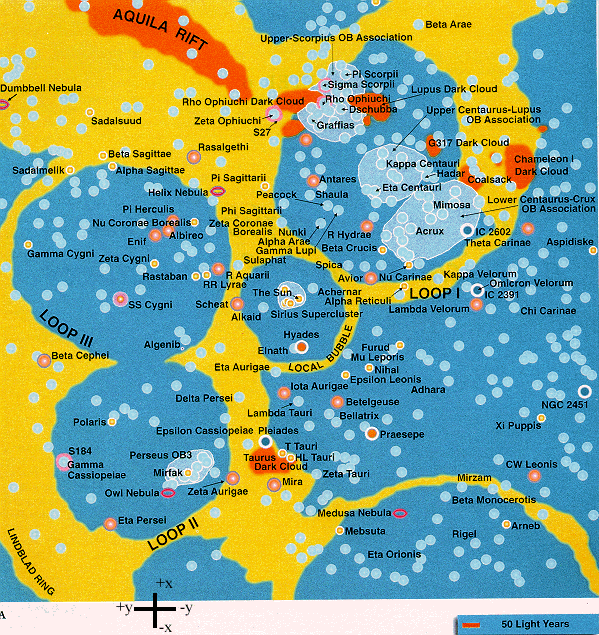
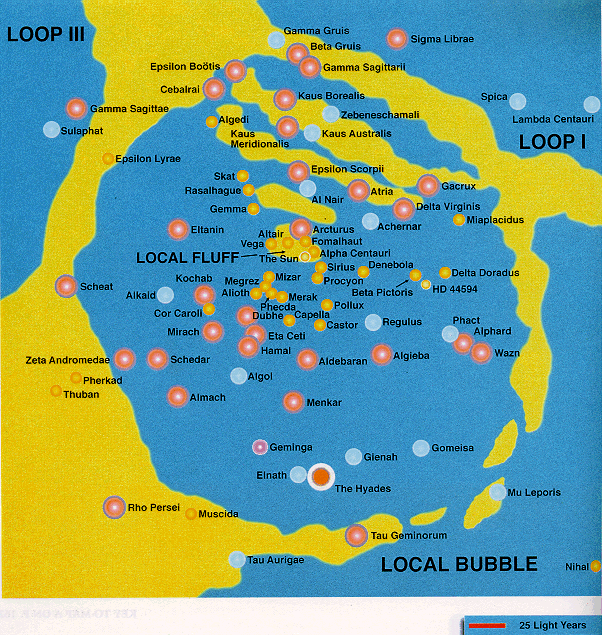
For a pattern, I used these maps of the region of space local to Sol.  I’ve since forgotten where I got them; I think wikipedia, or maybe the atomic rockets site:

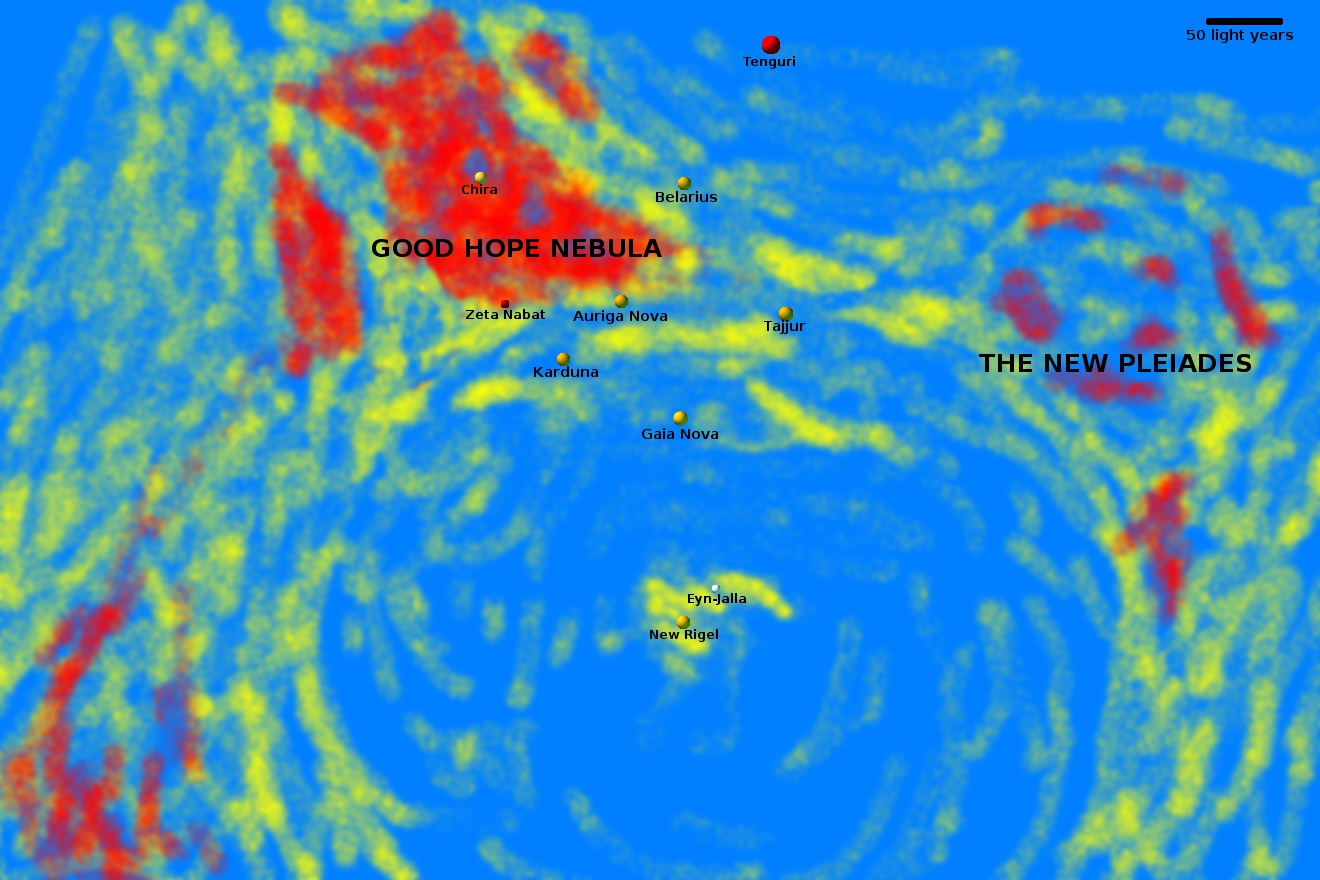
Since they’re only 2-dimensional, they have some obvious shortcomings, but for my purposes they work just fine.  The thing I like the most about these maps is that they show rough distributions of interstellar gas and dust.  In my Gaia Nova universe, areas of high density (such as the interiors of nebulae) are off limits to the FTL technology, so finding a way to show that was absolutely critical.

And so, after playing around with MS Paint and The Gimp, this is what I came up with:

It’s definitely a work in progress (seeing as I’ve only got about a dozen stars up so far), but I’ve got to be honest–I geeked out hardcore when I was finished with this thing.  Whether you’re writing fantasy or science fiction adventure (which I’d argue is a branch of fantasy), there’s just something about having a map…

The best thing is that it’s REALLY easy to update.  If I want, I can throw up half a dozen new stars in fifteen minutes–or rearrange the current arrangement of stars with the simple click of a mouse.  That’s good, because I don’t want to spend all my time drawing up maps–the map is just a tool to help me write the stories.

And oh man, I’ve got a lot of stories to tell! 🙂

More thoughts on indie publishing

Since my last post on indie publishing, I’ve been thinking a lot about this subject.  I haven’t decided to take the plunge into self published ebooks yet, but I have decided to make some changes in my writing and my career strategy, in order to position myself more favorably if/when I choose to do so.

Basically, my new strategy is something like Japan or Saudi Arabia’s approach to nuclear weapons: they don’t have an explicit nuclear program (since that would violate the nuclear non-proliferation treaty), but they have gathered the equipment, resources, and expertise together so that if they decided to go nuclear, they could do it in a year or less.

First, though, I attended Brandon Sanderson’s class lecture this Thursday, in which he had some very interesting things to say about ebooks and the publishing industry.  This was part I of his “how to get published” lecture, and here are some of the more interesting points he made:

  • Almost all the indie writers who are making it big have at least one loss leader ($.99 or less) on their list.
  • No one really knows whether indie publishing will be viable for large numbers of writers, or whether authors like Amanda Hocking and Joe Konrath are outliers.
  • Successful indie published books are typically:
    1) short (70k to 80k words)
    2) written in a pulp genre (thriller, romance, paranormal, sword & sorcery, etc)
    3) promoted very well through social networking
  • We have not yet seen any indie successes in epic fantasy, young adult / middle grade, historical fiction, or non-fiction.
  • The produce model vs. unlimited shelf space argument for going indie doesn’t apply as much to science fiction & fantasy as other genres, because:
    1) sf&f stays on the shelves in bookstores longer than other genres
    2) sf&f series grow better with a big push on the first book
    3) sf&f makes a lot of money on hardcover, unlike other genres

A lot of these points tend to mesh with what I’m hearing from my other sources–and Brandon really represents the last of the successful writers to make it big on the old model, before the ebook revolution began to take off.  He doesn’t make as big a deal on the current 25/75 split on net ebook sales as I would make, but then again, he’s making most of his money through print.

So anyways, here is what I plan to change about what I’m doing in order to better position myself to best take the ebook plunge, if/when I decide to do so:

1) Write at least 2 polished novels per year

Kris Rusch and Dean Wesley Smith make very good arguments about how being able to write well quickly is a huge asset for a writer these days.

There are many good reasons for this:

1) Writing faster gives you more practice with craft, which tends to improve quality.
2) The best way to promote  your books is to constantly write new books.
3) The limited shelf space argument against writing quickly is now moot with ebooks.

In particular, I want to increase my writing speed in order that I can have a larger list to put out if/when I decide to go with indie publishing.  It’s much harder to be successful if you’ve only got one book available for sale; if/when I decide to take the plunge, I want to have at least three.

So far this year, I’ve finished one (Bringing Stella Home), but that’s because it was already sitting in the queue and only needed a quick touch up.  I would like to get Worlds Away from Home polished before the end of the year, and possibly one other project, such as Edenfall.

2) Reduce production time to as close to one year as possible

Right now, it takes me on average about two years to write a polished, salable novel.  That’s not a problem, because I have a lot of projects in the queue, but it’s not as fast as I would like.  I wrote Genesis Earth and Bringing Stella Home while I was still a journeyman writer, figuring out my craft.  I should be able to produce a lot faster.

Towards that end, I’m going to try to get Edenfall finished and polished within a year.  Since it’s already March, that might mean getting it polished by February of next year, but I still want to try.

My biggest weakness is first drafts; I always tend to get stuck midway and drop the project for a while before I feel ready to finish it.  That’s something I would like to change.  Then again, that might just be part of my writing process, and shouldn’t be forced.  However, I certainly could go through my revisions much faster.

3) Write out the direct sequels while the first book is still unpublished

Previously, I thought it was a bad idea to write out all the books in a series or trilogy before the first one is ever picked up.  After all, a rejection from a publisher on the first book is a rejection on all the other books in the series as well.  Using this reasoning, it was much better to write the first book of another trilogy, in order to maximize how much I could submit at any given time.

With indie publishing, however, it’s much better to release the whole trilogy all at once, so that readers who finish the first book can immediately pick up the others.  Again, the paradigm here is that the best way to sell books is with other books; if they loved the one, they’ll buy the others, especially to find out what happens next.

Of course, the best model is probably to have an open series with several indirect sequels with recurring characters in the same world.  With the Gaia Nova books, that’s exactly what I plan to do: Worlds Away from Home is set in the same universe as Bringing Stella Home, but with different characters and different story arcs.

However, Genesis Earth has serious trilogy potential, and with Edenfall I’ve decided to actually write the other books.  If/when I decide to take the plunge, I want to be able to release at least the first two books in that trilogy at the same time.  In fact, Genesis Earth is perhaps the biggest reason why I’m thinking so seriously about going indie, but that’s a subject for a whole other post.

4) Experiment with pulp genres such as space adventure stories

When Brandon said that the pulp genres tend to do better, I wasn’t sure whether that includes what I write.  I write primarily science fiction, but not the kind of stories you’d read only for entertainment and promptly forget once you’re finished.  If anything, I want to write more like Ursula K. Le Guin, whose stories are so meaningful they stick with you long after you’ve finished them.

Then again, there tends to be a lot of overlap in science fiction between the thoughtful, meaningful stuff and the pulps.  Ender’s Game and Starship Troopers immediately come to mind as awesome, entertaining stories that also have a lot of depth.  In his lecture, Brandon made it clear that “pulp” does not necessarily conflict with high art–just that the primary purpose of the story is to entertain.

I can live with that–and I actually have several story ideas that would translate well with the pulp mentality.  I’d like to do a novel (or a series of novels) with Danica from BSH and her mercenary team, perhaps as a sort of origin story for Roman, Anya, Artyom, and the others.  I’d like to revisit the Hameji as well, with a sort of “Ain Jalut in space” involving Sholpan’s son (BSH was basically the Mongol conquest of Baghdad in space).  I’ve already started an “Odyssey in space,” as told from a female Telemachus character–that’s To Search the Starry Sea.  All of these are, at their core, space adventure stories, and might translate well as pulps.

5) Commit to releasing one book every 6 months if/when I take the plunge

This is related to the first strategy on the list, but it’s more of a business plan than a personal writing goal.  Basically, if/when I take the plunge, I want to:

1) have at least 3 finished, polished books to put out at first,
2) know that I can put out one book every six months at least.

This not only means developing a backlist, it means doing some soul searching as a writer to find out how difficult it is to keep up with this pace–and adjusting my writing habits accordingly.  I’m optimistic that I can, but it’s something of a paradigm shift, and I want to make sure I’ve made that shift before I take the leap.

Anyhow, these are my thoughts on how to alter my current writing strategy.  I haven’t yet decided to go indie, but when the time comes, I think that these things will help me to maximize my potential if/when I decide to do so.

Of course, what do any of us really know?
Deceptively productive day and other updates

Man, I revised through about 4k words today…and wrote a 1.5k outline for Edenfall to boot.  Not bad, considering how much time I spent putzing around reading publishing blogs and job hunting on craigslist.

Things are going well with WAFH; after a slight dropoff at the end of last week, I’m rebuilding momentum rather quickly.  But then again, I’m currently at an easy part in the draft.  Pretty soon, I’ll have to throw everything out and start from scratch.

Job hunting sucks…but what else is new?  I signed up for an online TEFL certification course, to the tune of $250 (youch!).  Hopefully, that will help land me a good teaching job in an advanced pay grade overseas.

I swear, the job market here in the states is so bad that I don’t see any other way around it but to leave the country.  Maybe if I was a CS major, or had no qualms selling people crap they didn’t need, or was willing to wipe up elderly people’s butts after they’ve defecated all over the place…no thank you.  In any case, teaching English is an adventure, and I very much look forward to it.

In the meantime, there are a few local graveyard job openings that might allow me to write on the side while I babysit a desk.  If those don’t work out, hopefully I’ll find something else before my checking account dries up sometime in March.

I’m getting really excited for Edenfall.  Last night, as I was falling asleep, I ran through the basic storyline in my head.  Fortunately, I remembered it well enough in the morning to write it all down.  It’s going to be awesome.

I’m also starting to rethink my philosophy on writing direct sequels.  I used to follow Sanderson’s line of thought; it doesn’t make sense to finish the series, because if a publisher rejects the first book, they won’t be interested in the others.  However, with ebooks and self publishing becoming more accessible and lucrative, the ability to put out a complete trilogy all at once is a great strength.

I’m thinking very seriously about putting Genesis Earth out there, but it’s the first book in a trilogy, and it would probably boost sales of all three if I could put them all at once.  Aneeka gave me a good suggestion today: put out the first book for free, while selling the other two at a competitive price.  Sadly, it will probably be a year or two before the others are ready…but my writing skills are constantly improving, so maybe I’ll be able to produce them a little faster.

Which brings me to a very interesting post I read on Dean Wesley Smith’s blog yesterday about writing speed.  Thus far, I’ve been shooting to produce one polished book per year, but after reading that post, I wonder if I should shoot for more.  Can I write two books a year and still maintain a high level of quality?  I’m not so sure; GE and BSH both required five rewrites before I got them fully polished, and Mr. Smith’s numbers don’t seem to take the revision process into account.

This year, though, I’m hoping to produce two polished books: Bringing Stella Home, which I’ve already finished, and Worlds Away from Home, which is my current WIP.  I’m only on the second draft, and there are tons of story issues, but I’m working through them fairly quickly.  I’ll probably put in another two or three rewrites before the end of the year, and still have time to finish a couple of other rough drafts–Edenfall and The Stars of Redemption (third book), potentially.

Of course, if I land a job, that might throw a kink into things–as will traveling overseas.  But as with all things, I’ll take those eventualities as they come.

(image shamelessly lifted from this site.)

Change in direction

Just a quick update on things before I go to bed.

After giving it some thought, I’ve decided to put Into the Nebulous Deep on hold for the time being.  The main reason for this is that it’s a direct sequel to Mercenary Savior, and if the first one doesn’t sell…yeah, not the best business decision.

I figure the best way to do it is to have a series of indirectly linked standalone novels set in the same world.  That way, a publisher could pick up any one of them after rejecting all the others, but if you want to bundle them into a series and sell them together, you can do that too.

That’s my strategy–I like the universe I built for Mercenary Savior, and I’m going to keep it for the foreseeable future, but for now, the trilogies and duologies will have to wait.  In any case, I’ve written down my major ideas for ITND, so I’m sure I’ll be able to pick up where I left off if/when MS sells.

Instead, I’m going to start working through the second draft of Worlds Away from Home. It needs a ton of work, but having finished the rough draft, I know that the story has potential.  At this point, I’m actually very enthusiastic about it, so hopefully that will help drive momentum.

Right now, I’m in the outlining stage.  I’m taking a page from Dan Wells and using his seven point story structure to draw out all the plot lines and character arcs.  When I did this for MS 4.0, I had to outline about fifteen arcs before I felt it was sufficiently tight; it will probably be the same for WAFW 2.0 as well.

Currently, I’m in the middle of outlining chapter six.  If all goes well, I’ll finish outlining and start writing by the end of the week.

In the meantime, I’ve been doing a lot of submitting.  Sent out another short story to Leading Edge–oh, and by the way, they accepted a poem of mine, so expect to see that in a forthcoming issue.  I also submitted the latest draft (5.0) of Genesis Earth to a few agents, so hopefully that will lead to something positive.

In other news, I’m looking for a job again.  Oh joy.  I’m hoping things will work out with the wilderness job, but if not, I still need something to tide me over for the Christmas season.  It’s stressful, but at least I’m not broke yet, which is good.  If I can’t find work and have to buy gear for the wilderness training, however, I just might be.

I’m confident things will work out, however.  I’ve found that they always do, even if not in the way I wanted or expected.  Just keep swimming.

In the meantime, check out this AWESOME 8-bit remix of one of the tracks leaked from Daft Punk’s upcoming album for the movie Tron. Dude…this makes me so incredibly happy.  And the 8-bit art!  I nabbed it and turned it into my avatar for the Quark forums.  In case you want to use it, here’s a copy.

8-bit Daft Punk FTW! The only thing more epic would be if Daft Punk and E.S. Posthumus joined forces–but if that happened, hosts of heavenly angels would descend upon our planet and usher in an era of global peace and universal prosperity. But dude, I would give my firstborn son to acquire that music.

You laugh, but I’m only half joking…

Pulling along

Just a quick post, because it’s 3:30 am and I’ve got a TON of stuff to do tomorrow, such as:

1) cleaning checks
2) replace the air filter in my car
3) go running with my bro in law
4) finish Genesis Earth 5.0
5) band practice
6) watch Inception with a bunch of friends at the dollar theater

Yeah, tons of stuff.  So anyways…

I’m amazed at how quickly I’m pulling through Genesis Earth.  Yesterday I revised through 11.7k words, and today I did about 14.1k.

At this point, most of the work is sentence and paragraph level, and has more to do with voice and rhythm than actual story.  There were a few science issues, mostly having to do with distances and velocities, but thanks to Logan I think I’ve caught most of those.  Thanks so much!

I’m also finding out that this story is much better than I used to think it was.  With all the form rejections I’ve been getting for it, I wondered for a while whether I should put it back in the trunk and let it quietly die.  Now, however, I can see that it has a lot more promise than I’d previously thought.  Even if it isn’t published as my first novel, I really do believe that this story deserves a home.

At the same time, though, I’ve noticed some major differences between my writing in this piece and my writing in the stuff I’ve written more recently.  I’m not sure exactly how to put it, but I think it has something to do with voice.  I don’t want to say that Genesis Earth is more choppy, but it does seem a lot more…matter of fact, if that makes sense.  There are also a lot more rhetorical questions, but I think that’s an artifact of the 1st person perspective.

But even if the voice in this piece is different from my voice now, it’s different in a good way.  It feels more…YA?  I’m not exactly sure, but it seems to work.  The sequels, if/when I write them, will probably be in 3rd person (ala Spin and Axis by Robert Charles Wilson), and that’s going to create a much different feel than this book.

It worked for Axis, though, so I think I can pull it off–that is, if/when Genesis Earth gets picked up by a publisher.  I don’t want to write the other two books in this trilogy until I know the first one is sold.

In unrelated news, I had a job interview today.  It was with a wilderness therapy company, the same that wait listed me for the January training.  I really hope I get in–more than anything at this point in my life, I feel that I need to gain some major life experience.  Probably the biggest stumper question was “what three words would you use to describe yourself in your last job, and what three words would your supervisor use to describe you?” A difficult question, particularly when all your recent jobs have been temp jobs.  I think I did alright, though–now, we just need to wait and see.

In other unrelated news, I threw an awesome movie night tonight.  We watched Scott Pilgrim vs. The World, and maybe fifteen people showed up–most of them from Quark, but a couple of friends from some other places too.  Man, that Scott Pilgrim movie is epic. So hilarious, so entertaining, and at the same time, so true.  And then, we went to Dairy Queen and hung out until midnight hanging out.  It was great.

In still other unrelated news, I recently ordered the anime series Planetes on DVD.  It was at a good price, and I knew I’d buy it eventually, so I allowed myself to splurge.  I am so happy I did, because the science fiction elements are done surprisingly well.  All the little details, from the zero gravity handholds in the walls to the way the stations spin, are surprisingly true to real life, and the show’s vision of 2075 is not beyond the realm of our own possible future.  In other words, Planetes is quite possibly the best rocketpunk anime show out there, and a great source for inspiration.

Well, that’s enough for now.  Tomorrow, I will finish this novel and send it out to the agent who requested it.  In the meantime, though, it’s 4:00 am and I must sleep.

Juggling projects isn’t a good antidote to procrastination

Yeah, the title basically says it all.  I’m working on Genesis Earth 5.0 and Into the Nebulous Deep 1.0, and while I’m doing really well in the one, I’m not keeping up so much in the other.

First, Genesis Earth. Since I finished the previous draft more than a year ago, I thought I’d find a lot of problems, especially with my prose.  Instead, while a lot of the sentence/paragraph level stuff needs tightening, I’m finding to my surprise that the writing isn’t all that bad.

Today, I breezed through over 8k words, and that between running, donating plasma, FHE, and a bunch of other distractions.  If I put even a moderate amount of effort into this, I can have it finished before next week.  That’s good, because I had an agent at World Fantasy request to see it; if I can put it on her desk before Thanksgiving, that can only be a good thing.

But as for my other project, ITND 1.0…yeah, it’s not coming along as well as I’d hoped.  The reasons are stupid, too–mostly just lost momentum and writer’s avoidance.

Right now, I’m stuck in a scene where I’m trying to build romantic tension between two characters.  I feel like I have a decent handle on who they are…but for some reason, it feels a little too shallow.  Maybe that’s because I’m still discovering who these characters are, maybe it’s because I tend to go deeper than most–or maybe it’s just because it’s the kind of scene that’s hard to get into, but once you’re in, it really flows.  I just haven’t forced myself to write it–maybe once I do, these problems will go away.

I do feel like I’m doing a pretty good job setting up the story.  Last week, I ran the first chapter through my online writing group, and while it definitely had issues, everyone said that they would keep reading if this was a book they’d picked up off the shelf.  That tells me that at least I’m starting in the right place.

The characters, though, and the conflict…I worry that it’s not as deep or as hard-hitting as the first book, Mercenary Savior. I skimmed over that book just a couple days ago before sending it out to a friend from World Fantasy, and…wow.  I don’t want to brag, but I think I did a good job with that one.  A damn good job.

So can I pull off that kind of depth and impact in the second book?  That’s the fear, that it won’t live up to the first one.  And certainly, the rough draft won’t be as good–not by a long shot.  But the subsequent drafts?  I don’t know.

Maybe I should just write and worry about it later, though.  When I was in the middle of Worlds Away from Home, I constantly thought to myself how crappy the draft was.  When I got to the end, though, and looked back on how far the story had come, I realized that it had potential to be at least as powerful as Mercenary Savior–perhaps even more.  And to be honest, that came as quite a surprise.

I don’t know.  I hope I’m not just deceiving myself–it can be hard, when you’re toiling in obscurity, to separate the truth from your own self-deception.  But for now, things are going well–I’m making good progress in Genesis Earth, and while Into the Nebulous Deep has lost a lot of momentum, all it really needs is a good solid block of undistracted writing to get it going again.  Life is good.

New projects and other stuff

So I started the sequel to Mercenary Savior today; I figure I can take a couple months off to finish the rough draft, then leave it in the trunk until the first one sells.

The working title of this one is Into the Nebulous Deep, which captures the main premise quite nicely (though let me know if it doesn’t jive with you).  It takes place five years after the events of Mercenary Savior. James is a lieutenant in the Colony’s civil defense forces, and has made a name for himself as an ace gunboat commander.

The basic premise is that the Colony is falling into economic ruin and must therefore make a mass exodus in order to survive.  Their only real option is to flee into the Good Hope Nebula, where FTL drives don’t work and the Hameji can’t follow them.

Deep in the nebula are newly born stars with planets and proto-planets, and they hope to re-establish themselves there.  Of course, nothing happens quite that smoothly, and James is going to find himself putting out fires most of the time.

While all that is going on, however, I hope to put him in the middle of a love triangle.  I have the ending of it planned out, and it can ONLY happen this way in a science fiction novel.  Oh man, the twist is going to be way interesting–and incredibly hard to pull off well.  I’m up for a challenge, though, and I can already tell this one is going to be fun.

For some reason, things worked out so that I started this novel on November 1st.  Because of that, I suppose I’m doing it for a nanowrimo–since hey, the rough draft is probably going to be between 120k to 140k words long, and I want to finish it before January.  Sounds tough, but I’ve got the money saved up to take off a few weeks and work on my writing, so that’s what I plan to do.

In loosely related news, I hope to start running soon.  My brother in law ran a marathon this year, and he’s going to help me get set up.  Basically, I need to get in shape for the wilderness job I hope to train for in January, and also because hey, I need to take better care of my body.  Besides, I’ve found that exercising boosts my writing tremendously, which is something I definitely need.  Exercise = win/win/win.

The most pressing thing on my mind now, however, is the article I need to write about the history of “the class that wouldn’t die.” I’m working on a very tight deadline, and absolutely must produce.  I wish I hadn’t been so flaky with the previous deadlines, but it is a volunteer magazine and I have had other pressing things taking up my time.  Not any more–I’ll get it done right away.

In the meantime, I’m tired and must get some sleep.  I wish I could function like one of Stephanie Myer’s vampires, but reality is a harsh and unforgiving mistress.  One of these days, though, I’ll be free of her–just you wait!

World Fantasy Day 3

Saturday at the World Fantasy convention was awesome. Tons of amazing panels, with excellent advice and some very interesting insights.

First, I attended “The Story Cycle vs. The Novel,” which was moderated by L.E. Modesitt.  The panelists talked about the evolution of a series and the difference between a cycle of novels vs. a continuation.  In a story cycle, there may be many books, but one ending, whereas in a more loose series, every novel is a standalone with an ending.  In another panels someone used the analogy of an avalanche vs. skipping stones, which I found quite useful.

Next, I attended “The Continued Viability of Epic Fantasy.” The panel started out by defining epic fantasy (as opposed to heroic / sword & sorcery), which they more or less agreed has the following characteristics:

  • Takes place in an alternate world
  • Is large in scope, rather than personal
  • Involves characters who are trying to save the world
  • Has a multi-strand plot with many viewpoints
  • Has an extended story arc

David Drake then blew the premise of the panel out of  the water by arguing that epic fantasy is still selling well–in fact, that the market has been expanding over the past ten years.

Drake also pointed out, however, that when you’re successful, the normal commercial rules don’t apply; first, you have to prove your chops, realizing that the publishers will lose money on your first couple of books.  That’s just a fact, and anyone who denies it is arrogant and stupid.

The next panel was “Slaughtering the Evil Hordes,” about the barbaric hordes trope in fantasy and whether it’s disturbing or a good thing.  I asked the question: “how can you have the hordes win and still make it work?” and Tom Doherty pointed to Modesitt’s Magic of Recluse as a good example of this.  Basically, you have to show the good in each side, sometimes by a shift that makes the reader suddenly and unexpectedly see the hordes in a new light.

Next, I attended “The Moral Distance Between the Author and the Work.” This panel was quite fascinating.  One of the interesting questions that was raised was whether you can deduce an author’s morals from reading their work.  At first, the panelists said that in good art, you can’t, but then Scott Edelman and Eric Flint pointed out that if you read an artist’s whole corpus, usually you can.  Nancy Kress compared artists to dandelions; over time, you grow and mature, but when you send out work, where it goes and what happens to it has nothing to do with you as the artist.

One of the best panels, however was “Authors and Ideas,” which happened the next hour.  The panelists started by agreeing that as an author, your most deeply held personal beliefs will always show up in your work, whether or not you know you believe it.  The stuff we believe most firmly, we never even think to question because it is invisible to us.  Most aliens in sci fi are less alien than the Japanese, and our own great great grandparents are more alien to us than anything else.

The panel then got on to how writing is a collaboration between the author and the reader, where the writer has no control over what the reader will take from it.  Even though your art will contain your beliefs, in order to be great it must also convey what you don’t believe–the “opposition in all things” element.  Done well, the author “shakes hands with the reader over the character’s head.”

After the panels, I had dinner at the con suite–and let me just say, the convention organizers went WAAAAY out of their way to make the con suite awesome.  They literally provided every meal, and enough of it to feed everyone who came in, which really surprised me.  A huge thanks to everyone who volunteered with organizing and running the con.

Anyway, I got into a HUGE discussion at dinner with an amazing couple who runs a used book business out of Massachusetts.  We talked about artificial intelligence, the physical limits of computer circuits, and whether it’s possible for us to one day emulate the human brain on a computer system.  Gained some very interesting insights for my novel Genesis Earth, as well as just a general fun time.  Conversations like this are one of the things I treasure about these events.

And then I bounced around the parties for the rest of the night.  Had fun, talked with Tom Doherty and a handful of authors (though not as many as last year), but probably most importantly made a bunch of awesome writer friends, with whom I will be keeping in touch after the convention.

I might not have met a bazillion agents and editors this year, but I did make a ton of friends among the aspiring writers and editors, and that definitely counts for something.  I look forward to staying in touch and supporting everyone as we break in and make our mark; we’re the next generation of an awesome literary tradition, and we’re definitely going to keep it going!

Crunch time

Sixty six percent!  I’ve officially passed the two thirds mark in the fourth revision for Mercenary Savior–and not a moment too soon.  With only a week and a half until World Fantasy 2010, it’s crunch time.  I’ll probably quit my temp job a week early in order to devote the last few days of the month to finishing it.

As I’ve been working on Mercenary Savior, though, a fascinating idea for a sequel has been stewing in my head.  It was sparked by an online conversation with one of my first readers:

Reader: I was never fully convinced that James felt he had closure
Me: I see
Reader: but I was satisfied with the thought that he would get it sometime after the story ends
he’s still young, so he’s still maturing
even at the close of the novel
Me: yeah
hmm
interesting

It’s true; James does have a lot of room to grow and mature after the events of Mercenary Savior. In that book, his character growth arc (without giving away spoilers) is about him learning to accept change and stop running from adulthood.

Nothing in that arc has much to do with the kind of person James grows up to be, however, or the significant other with whom he comes to share his life.  In other words, there’s a whole lot of untapped potential for building James’s character and giving him a romantic interest.

The question that immediately rose to my mind was: what’s the story?

Now when it comes to sequels, I think the best ones take a long, hard look at the first installment and answer the question: therefore, what? Thus, in Star Wars IV, V, and VI (which I believe to be one of the best examples of a trilogy in any medium), the Rebels defeat the first Death Star in episode IV, but find themselves on the run in episode V because the Empire knows the location of their base.  Luke uses the force to pull off a last-minute victory in episode IV, but finds in episode V that becoming a true Jedi takes a lot more discipline and self-mastery than he thought.

So I applied that principle to my own work and came up with the following overarching conflict: the Hameji occupation of Karduna is devastating the people of the Colony to the point where they collectively decide to depart en masse and establish a new community somewhere else.  It’s a logical conclusion taken from the ending of Mercenary Savior; the people are well enough off to survive, but too poor and oppressed to do much of anything else.

You may not know this, but the first story I wanted to set in this fictional universe was about a group of starfaring pioneers traveling into the heart of a nebula to escape religious persecution and establish a thriving community on the fringes of settled space.  That’s right–I basically wanted to set the Mormon pioneer exodus in space.

For various unrelated reasons, that never worked out, but the desire has always been there in the back of my mind.  What can I say–I think that pioneers are cool, and stories about colonizing unsettled new lands just fascinate me.  I’ll probably write a massive Utah pioneer epic someday.

But anyways, I started playing around with this old idea to see whether I could recycle it.  Right now, I think that I can.  The idea is that James becomes the leader for one of these emigrant groups, and has to see them safely through to a young planet in the heart of this nebula.  They decide to fly into the nebula in order to isolate themselves from the Hameji, since the FTL tech in my universe doesn’t work within a Nebula.

And then something really crazy happened.  This scene popped into my head, stronger than any other idea I’d had so far.  I imagined that a group of pirates had captured the expedition and refused to let them go unless they gave the pirates three young women to keep as slaves.

Pretty standard conflict, right?  But then, I thought: what if three young women of their own free will stepped forward and offered to sacrifice themselves to save the others?  What would James do then?

Well, it wasn’t hard to figure that out at all.  James would never let them go.  He’d fight the pirates, even if it meant risking all the lives of those he’s trying to protect.

This raises some interesting questions of morality.  Is it right to risk the lives of everyone in the community when three individuals have already offered to sacrifice themselves for the good of the whole?  Is it right to deny someone the opportunity to give their own life to save others?  Or is James just being stubborn and reckless?

At a first glance, that’s the way it looks.  But then I imagined what James would say to justify himself.  After what he learns from the events of Mercenary Savior, James would argue that the community needs to stick together–that in order for the whole to survive, everyone has to know with absolute certainty that no-one will be left behind.  Once the leader shows that he’s willing to sign his followers over, how can any of them trust him with their lives?  Under such conditions, trust breaks down and the community falls apart.

From that, a whole host of other ideas started gradually coming to mind.  How does this event tie into James’s romantic interest?  Does it tie in at all?  What would the people’s reaction be to this decision?  Coming from the background of the Colony, would they want to put the issue to a vote instead?  Is it ever right to suspend democracy when facing a crisis, and if so, under what conditions? 

So anyway, I won’t tell you what I have in mind, but I have a lot of really interesting ideas.  It’s gotten to the point, in fact, that I may just write the sequel after I get back from World Fantasy.

In closing, let me leave with this excellent track from one of ocremix’s latest albums, a rearrangement of Donkey Kong Country 2.  Believe it or not, this song could be the main theme of this novel.  Listen to it and I think you’ll see why.

Good night!

Just another update

Just another quick update, before I crash.

Went to the Book Academy Conference at UVU today.  It was fun, with several excellent panels by some local authors.  More about that in a later post.

My new mp3 player arrived today: a refurbished iRiver T10.  An ancient, nearly obsolete machine, but it’s got a good quality microphone, which all the other brands lack.  Besides, if it’s anything like my old iRiver ifp-890, it’s built to last.  With 1 GB of storage instead of 128 MB, it’s a step up in the world.

The revision of Mercenary Savior goes well, though it also goes slowly.  Only 1.2k words today, when I was hoping to finish this last chapter.  I’m right between part II and part III, with the twist ending that…well, I won’t give it away.  So far, I’ve managed to add a scene and rearrange several chapters without adding more words than I’ve cut.  That’s good–I need this draft to be tight.

I also dropped the money for plane tickets to World Fantasy 2010.  They came to about $300, which was cheaper than I was expecting.  I’ll be sharing a room in the next hotel over with Eric James Stone for about $50 per night, but there’s room for others if you’re willing to sleep on the floor.  Just let me know.

I think I’m going to experiment with my schedule next week and try waking up early to write instead of staying up late.  Maybe if I get the writing in first thing, it will help things flow later, and I won’t always feel like I’m playing catch up.  We’ll see.

One final thing: I’ll post more about this later, but I have a great idea for a direct sequel to Mercenary Savior kicking around in my head.  It would involve James leading the people of the Colony on an exodus into the heart of the Good Hope Nebula, where they would be completely cut off from the outside world–kind of like the pioneers.  It would also involve letting James grow up and giving him a romantic interest or two, something that I didn’t really do in the first book.

And before you say it, yes, I know the advice is to not waste time writing a sequel to a book you haven’t sold yet.  I think I could make this work, though.  Mercenary Savior, while far from perfect, has a lot of potential–perhaps the most potential of anything I’ve written.  I’d be surprised if I didn’t eventually find a home for it, and when I do, having a sequel already written can only be a good thing.

More on that later, though.  For now, sleeeep.