Random late night thoughts

I’ve been going on a lot of late night walks lately, just wandering restlessly around Provo.  Tonight I had some interesting thoughts about how much I’ve changed in the last year.  Surprisingly, I’ve grown a lot.

Last  year at this time, I was all geared up for World Fantasy Convention.  I had just finished Bringing Stella Home, and I my thoughts went something like this: “if I’m lucky, maybe I’ll find an agent, and they’ll like my pitch enough to see it, and after they read it they’ll want to represent me, and then they’ll sell my book somewhere, so that maybe, just maybe, I can make a living as a writer in ten years.”

Now, I don’t want to get into the whole indie vs. traditional debate, because I think it’s ultimately a false dichotomy.  However, now that I’ve gone ahead and published my own work independently, I feel like I’ve taken charge of my career in a way that I hadn’t before.  I’m no longer waiting on someone else to make my hopes and dreams come true, I’m going out and pursuing them myself.

That’s the big thing that I think has changed in the past year: I’ve gained a lot more confidence.  A year ago today, I was working a temp job in a costume company warehouse, fretting and worrying over how to make ends meet and where to find a stable job.  I had considered freelancing as a translator and teaching English in another country, but hadn’t actively pursued those options because frankly they terrified me.  And as for writing, that was the impossible dream that might come true someday, but not today.

Now, writing is still the impossible dream, but at least I’m on a path that doesn’t involve lottery thinking like the old one.  None of my books have really taken off yet, but at least I have them published and available for readers to discover, so when I do start to get some traction I’ll be in a much better position to succeed.  And either way, I’ve taken charge of my own career.

So yeah, I can say I’ve grown a lot in the past year–which is surprising, considering all I did was stay in my old college town and work odd jobs.  At least I didn’t move back in with my parents–which makes me part of an elite 15%.  But now, I think I’ve just about reached the limit of how much I can grow here in Provo.  If something doesn’t change, I worry that I’m going to start stagnating.

So in a year, where will I be?  Who knows, but if I’ve grown as much as I have since October 2010, I’ll count that as a success.

Bringing Stella Home 5.0 is finished!

That’s right; I finished the fifth draft just tonight.  110,000+ words and 550+ pages in three weeks–not bad.  Here are the stats:

ms pages: 556
words: 110,000
file size: 264 KB
chapters: 27
start date: 21 Dec 2010
end date: 11 Jan 2011

And the wordle:

Wordle: Bringing Stella Home 5.0

The song that best represents my experience with this particular draft would probably be a chip tune remix I discovered recently (as in, yesterday). It’s called “Milk in Veins,” and the only version I have is in .xm (extended module) format. I don’t yet know how to export it to mp3, but here it is:

Raina — Milk in Veins

This draft was mostly just a quick polish, but I did get some useful feedback from some World Fantasy friends; some of Stella’s reactions were off, and Anya’s parts needed better development. I don’t know if it’s publishable as is, but it’s definitely as good as I can make it without a professional editor.

I had a good time with this draft. I feel confident that I’ve got an exceptional story here, and I think I did a good job telling it. At the end of the day, it’s great to have something you can look back on and say “yeah, I accomplished that.”

Now, to send it out into the publishing world and see if it gets any takers. Who knows–maybe this could be my debut novel! Only one way to find out…

Racing along

Ugh, why do I always stay up until 2am?  And then I don’t get up until ten.  Man, I need a job–either that, or more self discipline.

Just a quick post before I hit the sack.  I’m making excellent progress with the revision of Mercenary Savior, regularly hitting between 7k and 8k per day.  Most of that is polishing work, which tends to go fast, but I’m also rearranging a few chapters, deleting scenes and putting others in a different order.

One thing that’s surprised me a lot so far is how much I’ve managed to cut.  The first draft, which I wrote on MS word, was about 135k–which runs around 145k by open office’s (flawed) word count method.  The second draft was about the same, the third a little shorter, and the fourth around 120k by open office’s algorithm. By then, I thought it was as lean as I could get it–but no, that’s not the case.  It’s all for the best, though; a 100k word novel isn’t nearly as daunting as a 145k monster, especially in science fiction.

Anyhow, today I got some feedback from C.A. Jacobs, a friend from World Fantasy (which she mailed to me…from HAWAII…), and I’m thinking I ought to change the title of this work. She suggested something like “The Fall of Karduna,” but the book is more about the individual characters than the world, so I’m thinking of something like “Saving Stella,” or even reverting back to “Bringing Stella Home.” Any thoughts?

In unrelated news, a ton of job opportunities have been opening up recently.  I interviewed for a position with the BYU Political Science department on Monday, and I’ve got another interview with a local marketing company Friday.  My sister also says that her work needs a new cook, so that could be good if the other stuff falls through.  And as for phone delivery, I’ve got until the 17th to keep up with that.

So, life is good.  Writing-wise, I’m having a very productive revision of one of my better works.  Job-wise, a lot of promising options seem to be popping up.  Social-wise, I’m doing pretty well, too; Utah is a great place to make new friends.

Oh, and English 318 starts TOMORROW!  Holy crap, I am excited!!

gnight

Q4 report, 2010

For those of you who don’t know, I do a report on my blog at the end of each quarter, giving a progress update on my writing.  I like to think it helps me keep things professional.  Whether or not it does, it’s certainly helpful to look back on how I did.

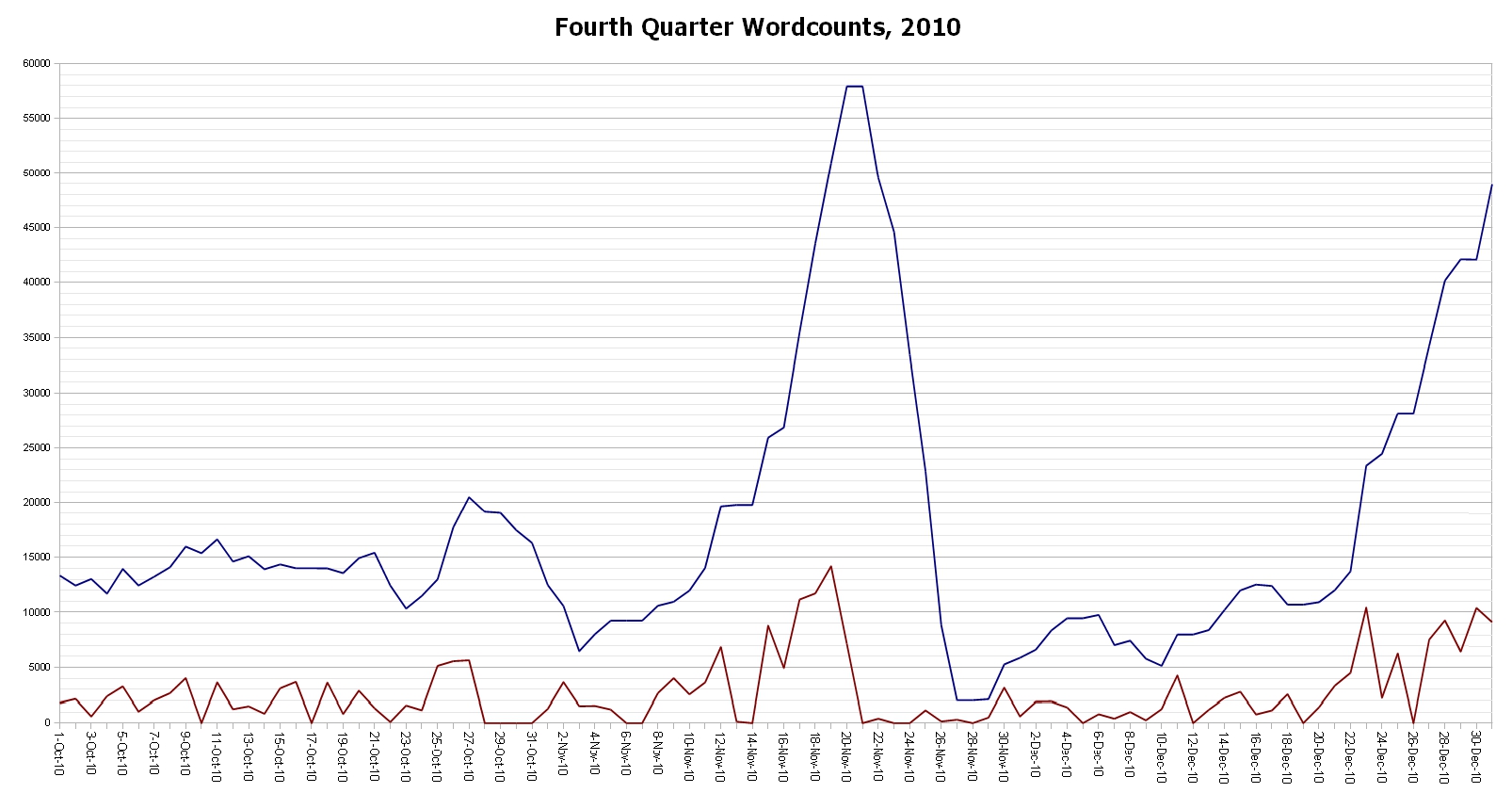
So anyhow, here’s the word count chart:

The red line represents daily word count, and the blue line is a running total for the previous seven days.  The chart includes revisions as well as original material; for revisions, I just do a wordcount of the finished version, whether or not I’ve cut out significant chunks of the text or left it largely as-is.  Maybe that skews the picture a bit, but it’s the best I can do with the tools I have.

At the beginning of the quarter, I was working 40+ hours per week at a seasonal job, so the writing was pretty slow, averaging a little less than 15k per week.  My main project was the fourth draft of Mercenary Savior, which I was struggling to get ready for World Fantasy.

The job ended October 28th, and I didn’t do any writing during the conference, which is why you see the dip at the end of the month.  But I took November off to work entirely on my writing, which is why things took off again rather quickly.

That huge peak in the middle of the quarter is from the fifth draft of Genesis Earth, which I completed in about two weeks.  The draft was already pretty well polished, but one of my hard sf friends did a read through and got back with a few major science issues which I needed to rectify.  Also, I figured it was in need of a language polish, since I finished the last revision almost a year ago and my writing (I hope) has improved a lot since then.

I was pretty surprised at how quickly it went.  The book is definitely as good as I can make it, and any further revisions without professional editorial assistance would be a less effective use of my time.

Things dropped off rather sharply, however, because I spent all of Thanksgiving week either on the road or with family.  Ah, how I love road trips…but they sure can throw a kink in the writing schedule.  I also had a hard time settling on my next big project, which is why things took a while to take off again after I got back.

After starting a sequel for Mercenary Savior and toying around with a short story idea, I decided to do a major overhaul of Worlds Away from Home.  Unlike GE, however, WAFH really, really sucks. It took me two weeks just to read through the rough draft and pick out all the troubled spots, after which I rewrote the outline from the ground up and decided to completely scrap half the book.  I started the second draft in mid-December, but it’s taken a while for things to really build steam.

Right as I was starting WAFH 2.0, a couple of other writer friends from World Fantasy got back to me with their comments on Mercenary Savior, and pointed out a few problems that I hadn’t noticed before.  I started the revision on December 21st and have been plowing through ever since.  That accounts for the huge spike at the end of the quarter–like GE 5.0, the draft has a lot fewer story problems, but does need a few things fixed for consistency, as well as a language polish.

Overall, I wrote or revised through about .25 million words this past quarter–some of which were easier than others.  I started a new project (Into the Nebulous Deep), polished one of my manuscripts to the very best of my abilities, and made significant headway on revising and polishing two others. In terms of publications, I had a major article published in Mormon Artist, and a short poem accepted for publication in a forthcoming issue of Leading Edge.

Not a bad quarter.  Now, let’s see if I can find an agent and/or publisher in 2011.

Word splurge and refining the query

So this morning, I worked on the fifth draft of Genesis Earth while Facebook chatting with some friends I made from World Fantasy.  Next thing I know, it’s 4:30 and I’ve revised through 6.5k words.

To be fair, most of that work was pretty simple–polishing the prose, cutting unnecessary verbage, and the like.  But…wow.  Talk about a splurge.

Because of that, though, I didn’t get any work done in my other project, Into the Nebulous Deep. However, I did do something I’ve been needing to do since before World Fantasy: draft a query letter for Mercenary Savior. Here it is:

Dear _______,

My name is Joseph Vasicek, and I am writing to query my science fiction novel, Mercenary Savior.  I thought my work would be a good fit for you because ______.

As the galactic empire slowly collapses under the onslaught of the starfaring Hameji nomads, the sixteen year old James McCoy sets out to rescue his older brother and sister, Ben and Stella, from the Hameji conquerors.

Things look bleak until he meets Danica Nova, captain of a down-and-out mercenary company, who takes him in and becomes his mentor.  James reminds Danica of her brother, whom she failed to save when the empire slaughtered her family years ago.  Now, she hopes to find some redemption from her demons by saving James from his own.

However, as the two of them spiral onto a collision course with destiny, neither of them realizes that Stella has become a concubine to the Hameji overlord–and that Ben has been brainwashed and made an elite shock trooper in the unit sent to hunt them down.

Mercenary Savior is approximately 120,000 words long.  While it stands on its own as a complete story, it has potential for at least one direct sequel and several indirectly connected novels set in the same universe.

My previous publications include one short story published in the December 2009 issue of Leading Edge.  I have also won first and second place in the annual Mayhew short story contest at Brigham Young University (for 2009 and 2007 respectively).  In addition, I keep a regular blog at http://onelowerlight.com/writing.

Thank you very much for your consideration.  As noted in your submission guidelines, I have included _____.

Cordially,

Joseph Vasicek

So what do you think?  Does the pitch work?  Does it resonate well, or is it boring / cliched / confusing in any way?  Any thing else egregious that I should fix before I send this out?  Please let me know!

I really suck at submitting stuff.  Right now, I’ve only got three or four queries out on Genesis Earth, and one on Mercenary Savior. Like most things, though, the only way to change that is with practice.  By next week, I want to send out at least five queries on Mercenary Savior and have the synopsis ready to go.

Also, my friend from World Fantasy had an interesting suggestion for me: try to break into the small presses with my science fiction stuff, to build a name for myself, and work my way up from there.

This runs directly contrary to Dave Wolverton’s break in with a bang philosophy, but it makes sense; very few major publishers seem to be publishing much space opera these days (with the exception of Baen).  From what I gathered at World Fantasy, science fiction is a difficult sell these days, and several sf writers are going this route.

I could write more, on other subjects, but that’s enough for now.  Good frickin night.

Excerpt from Genesis Earth

I spend a lot of time posting about my writing, but up until now I’ve never posted any of it.  Well, I figured it was time to change that and post something from my second unpublished novel, Genesis Earth.

Here’s how I’ve been pitching it in my queries:

Michael Anderson is a young, obsessive planetologist haunted by the fear that he will never live up to the legacy of his astrophysicist parents. Terra Beck is the outcast child of a bitter divorce, who only wants to run away and immerse herself in her one true passion: astronomy. Neither of them has ever set foot on Earth, but when Michael’s parents construct mankind’s first artificial wormhole, both of them are naturally chosen for the exploration mission to the Earth-like planet on the other side.

Shortly after their arrival in-system, Michael finds himself in an unanticipated first contact situation when an enormous alien ship appears out of nowhere and begins to converge on their position. When it ignores all their transmissions and shoots down their probes, the situation quickly degenerates into an emergency. To make matters worse, Terra secludes her self in the observatory and stops sharing her data with him.

Alone, twenty light years from the nearest human being, they must learn to open up and trust each other. As Michael struggles to keep the mission from falling apart, he is forced to reexamine his deepest, most unquestioned beliefs about the universe–and about what it means to be human.

Right now, I’m running it through a fifth draft before I send it to an agent I met at World Fantasy.  Here is the prologue, where Michael begins his tale.

Enjoy!

Chapter 1

Earth was a ghost that haunted me. She was the single greatest thing that set us space-born apart from the older generation, the five hundred members of the original mission team. Though Heinlein station was the only home I had ever known, I soon learned that Earth, a world I had never seen except in pictures and videos, was where I was truly from.

My parents set the decorative screens in their bedroom to cycle through pictures of old Earth. While they were busy working in the lab, I would often sneak inside and stare at those images for hours. The landscapes and skyscapes they depicted were always so alien to me. Unbroken blue expanse overhead, instead of the grayish space rock of our asteroid. That line between floor and sky known as the ‘horizon.’ Solid ground underfoot, instead of the milky starfield shining up through transparent floors. Trees, plants, and shrubbery growing freely without the aid of hydroponics. Hundreds of human beings walking down wide open-air corridors called ‘roads,’–more people than I’d ever known in my life.

When I was about five years old, I used to ask my mother to bring out her photo album–the one with actual, physical pictures from the old world. I would sit on her lap and stare wide-eyed at the pictures as she explained them to me. That was my uncle, that was my grandmother, those were my cousins: faces from an unreachable world nearly half a light year away and getting further every moment.

One day, sitting on my mother’s lap, I glanced up from the album and saw tears in her eyes. That was the first time I had ever seen my mother cry. It made me feel frightened and unprotected, even in her arms. I never asked her to show me the pictures of Earth again.

Perhaps you’ve found, as I have, that the things that frighten you incite more fascination than the things you love. I trace the beginning of my career as a planetologist to that childhood incident, sitting on my mother’s lap. Years later, when I began my graduate level education, there was never a question in my mind what I would study. I had already chosen.

To me, planetology was never about physics, geology, or chemistry. Those were only the details. It wasn’t even about making a lasting contribution to the science–at least, not when I first started. I studied alien worlds simply to turn the lights on–to dispel the ever-present ghost of Earth that had haunted me from my childhood.

Did it work? Not really. But as I grew, my fascination with Earth grew with me.

Fourteen might seem like a young age to enter one’s chosen field, but you must realize that half the people on Heinlein station were highly trained physicists and engineers. With so many scientists on board, there was no shortage of teachers for those of us who grew up on the station. My parents personally tutored me, and they were two of the most brilliant physicists Earth had ever produced. They were, in fact, the chief scientists over the Mission itself.

The Mission was the closest thing to religion that I ever had. If religious devotion is measured by sacrifices incurred on the basis of unproven belief, I suppose that everyone on the station qualified for sainthood. We had set out from Earth to create mankind’s first wormhole, or prove that it could not be done. For this, my parents had given up everything: family, friends, their homes. Everything. The only safe place for such an experiment was two light years from Earth, and so we spent my entire youth and childhood in transit, not knowing whether the Mission would succeed or fail.

My study of planetology won me a great deal of admiration from the old timers, much to my surprise. Grown-ups who only a few years ago had chastised me for playing hide-and-go-seek in the labs now treated me like someone important. The scientists and engineers routinely asked me what I thought we’d find once we’d opened the wormhole. After all, why would a fourteen year old study about alien worlds if he didn’t expect to visit them someday? They treated me as if I had run some sort of gauntlet or passed a test of tremendous faith. I was one of them, united in the hope of a successful outcome to the great experiment–or, stranger still, I was a role model to them, someone with the faith they struggled so much to keep.

They could not have been more wrong. I didn’t want to explore new planets or set foot on an alien world. The closest I ever came was through the eyepiece of a telescope, and that was the way I wanted it. My studies were purely academic.

When I turned eighteen, we arrived at ground zero. The station became a flurry of nervous energy as we maneuvered into position and set up the hundred trillion kilowatt NOVA generators and focusing mirrors for the graviton beams. With everything spread out across hundreds of cubic kilometers of space, it took us nearly two months before we were ready.

Twenty two years after embarking from Earth, on June 24th, 2143 C.E., the day of the experiment finally arrived. That day forever changed the course of my life.

At the moment of truth, I lay sprawled out on the transparent floor in my room, watching the stars turn beneath me. Large crowds had gathered in other locations to watch, but I preferred to be alone. My father’s voice came over the station-wide radio, giving his moment-by-moment report. Though I was alone, the excitement on the station was so thick could almost taste it.

I hear that it’s common for people on Earth to dream about falling from a great height. I’d never had that dream–the concept of vertigo meant nothing to me. I think I got a taste of it, however, as I watched the wormhole form in the sky.

The starfield began to spread out from a single dark point, the way a film of oil on water separates when it touches a drop of soap. The hole grew surprisingly fast, pushing the stars aside and forming a circle of warped, diffused starlight around its edge. I gasped in fright; the center was pure black, the color of an abyss. As it grew larger, I felt as if it were sucking me in. Soon, however, the hole stabilized, as if it had always been there.

As the station rotated, I discovered that the wormhole had warped the starfield beyond all recognition. I tried to find the constellations I’d known so well, but could only pick out one or two. I felt sad knowing I’d never see any of them again.

The scientists didn’t take much time off to celebrate, but when they did, they went completely wild. Alcohol was everywhere in abundance, from numerous stores and hoards that had been kept for this very occasion. The shiest, most reserved people danced drunk in the hallways, and old enemies who hadn’t talked for years walked up and down the corridors with arms on each others’ shoulders. A spirit of happy, universal friendship swept over the station. People let their guards down, took off their masks, and momentarily forgot any hard hard feelings. It was a glorious time–the end of history.

Eventually, though, the celebration lost steam, the hangovers died down, and we woke up to face the inevitable future. Our robotic probes explored the wormhole and made some basic observations of the other side.

Their findings were frightening enough to sober us all.

Graviton theory told us how to create an artificial wormhole, but it gave us no way to predict where it would open up. We could expect one of three possible outcomes: first, that the wormhole opened to a different location in our present universe; second, that it opened to a different location and different time in our universe; or third, that it opened to an entirely different universe than our own. In every meaningful way, however, we were shooting blind in the dark.

The first observations showed a universe very much like our own, with stars, galaxies, and other nebulae. Just twenty light years away, orbiting a yellow-white main sequence dwarf, the probes discovered a handful of exoplanets. One of them, a terrestrial world, orbited within the star’s habitable zone. An initial spectroscopic survey revealed that the atmosphere of the planet was rich in oxygen and nitrogen–just like Earth.

That was when we detected the signal.

The last probe to return picked up an unnatural high frequency radiation burst, originating from the system with the planet. It lasted only half an hour before dissipating, but was powerful enough to be detectable halfway through the wormhole. No naturally occurring object emitted that kind of signal. The only thing we could compare it to was the radio emissions from a standard NOVA engine–but even then, the signal was more than a hundred times more powerful than anything our technology could produce.

In other words, something strange was out there–something we couldn’t explain. The only way to find out more was to send out a mission to explore the alien star.

As the only qualified planetologist young enough to survive cryofreeze, I was an obvious pick for the mission from the very start. Though I never wanted to go, I couldn’t refuse; if I had, my parents would have killed me. This, they believed, was our moment in history–our moment to make a truly historic contribution to science and humanity. Why wouldn’t I jump at such an opportunity? Of course I would go.

I didn’t become a planetologist to set foot on alien worlds. That was the last thing I ever wanted. After we opened the wormhole, however, what I wanted no longer mattered.

Or so I thought.

Hooray for Free Books!

Last year at World Fantasy, I learned that one of the perks of an attending membership is that you get a massive bag of free books.  What’s more, there’s a table where people can informally swap books (since everyone gets a slightly different bag).

The really cool part, though, is that most people don’t have room in their luggage to pack all the books.  Some people ship them home, but most just dump them on the table for anyone to grab.  On most days, if you arrive early enough (when everyone else is nursing their hangovers), you can get some really good picks.

So this year, my unofficial goal was to hang out around the book swap table and see how much I could make in free books.  Here’s the list at final count:

Asher, Neal. Shadow of the Scorpion: A Novel of the Polity. $7.99
Asher, Neal. Prador Moon: A Novel of the Polity. $7.99
Austen, Jane, and Ben H. Winters. Sense and Sensibility and Sea Monsters. $12.95
Baker, Kage. The Anvil of the World. $14.99
Cook, Glen. Starfishers: The Starfisher’s Trilogy Volume Two. $14.95
Cook, Glen. Star’s End: The Starfisher’s Trilogy Volume Three. $14.95
Cook, Glen. Passage At Arms. $7.99
Holland, Cecelia. Varanger. $16.99
Kollin, Dani and Eytan. The Unincorporated Man. $25.95
Mallet, Nathalie. The Princes of the Golden Cage. $7.99
Marks, Laurie J. Water Logic. $16.00
North, Pearl. Libyrinth. $17.99
Pitts, J.A. Black Blade Blues. $25.99
Sanderson, Brandon. Warbreaker. $7.99
Strahan, Jonathan, and Lou Anders, eds. Swords & Dark Magic: The New Sword and Sorcery. $15.99
Turtledove, Harry. After the Downfall. $24.95
Vigneault, Francoise ed. Elfworld. $12.95
Waltz, Jason M. ed. Rage of the Behemoth: An Anthology of Heroic Adventure. $16.99
Williams, Walter Jon. Implied Spaces. $24.95

Total: $296.54

All in all, I more than made back the cost of admission and the hotel.  Not too shabby–and this list doesn’t count all the ARCs and free samplers I took as well.

Yep, World Fantasy is pretty much awesome.  Now I just need a bookshelf…

World Fantasy Day 3

Saturday at the World Fantasy convention was awesome. Tons of amazing panels, with excellent advice and some very interesting insights.

First, I attended “The Story Cycle vs. The Novel,” which was moderated by L.E. Modesitt.  The panelists talked about the evolution of a series and the difference between a cycle of novels vs. a continuation.  In a story cycle, there may be many books, but one ending, whereas in a more loose series, every novel is a standalone with an ending.  In another panels someone used the analogy of an avalanche vs. skipping stones, which I found quite useful.

Next, I attended “The Continued Viability of Epic Fantasy.” The panel started out by defining epic fantasy (as opposed to heroic / sword & sorcery), which they more or less agreed has the following characteristics:

  • Takes place in an alternate world
  • Is large in scope, rather than personal
  • Involves characters who are trying to save the world
  • Has a multi-strand plot with many viewpoints
  • Has an extended story arc

David Drake then blew the premise of the panel out of  the water by arguing that epic fantasy is still selling well–in fact, that the market has been expanding over the past ten years.

Drake also pointed out, however, that when you’re successful, the normal commercial rules don’t apply; first, you have to prove your chops, realizing that the publishers will lose money on your first couple of books.  That’s just a fact, and anyone who denies it is arrogant and stupid.

The next panel was “Slaughtering the Evil Hordes,” about the barbaric hordes trope in fantasy and whether it’s disturbing or a good thing.  I asked the question: “how can you have the hordes win and still make it work?” and Tom Doherty pointed to Modesitt’s Magic of Recluse as a good example of this.  Basically, you have to show the good in each side, sometimes by a shift that makes the reader suddenly and unexpectedly see the hordes in a new light.

Next, I attended “The Moral Distance Between the Author and the Work.” This panel was quite fascinating.  One of the interesting questions that was raised was whether you can deduce an author’s morals from reading their work.  At first, the panelists said that in good art, you can’t, but then Scott Edelman and Eric Flint pointed out that if you read an artist’s whole corpus, usually you can.  Nancy Kress compared artists to dandelions; over time, you grow and mature, but when you send out work, where it goes and what happens to it has nothing to do with you as the artist.

One of the best panels, however was “Authors and Ideas,” which happened the next hour.  The panelists started by agreeing that as an author, your most deeply held personal beliefs will always show up in your work, whether or not you know you believe it.  The stuff we believe most firmly, we never even think to question because it is invisible to us.  Most aliens in sci fi are less alien than the Japanese, and our own great great grandparents are more alien to us than anything else.

The panel then got on to how writing is a collaboration between the author and the reader, where the writer has no control over what the reader will take from it.  Even though your art will contain your beliefs, in order to be great it must also convey what you don’t believe–the “opposition in all things” element.  Done well, the author “shakes hands with the reader over the character’s head.”

After the panels, I had dinner at the con suite–and let me just say, the convention organizers went WAAAAY out of their way to make the con suite awesome.  They literally provided every meal, and enough of it to feed everyone who came in, which really surprised me.  A huge thanks to everyone who volunteered with organizing and running the con.

Anyway, I got into a HUGE discussion at dinner with an amazing couple who runs a used book business out of Massachusetts.  We talked about artificial intelligence, the physical limits of computer circuits, and whether it’s possible for us to one day emulate the human brain on a computer system.  Gained some very interesting insights for my novel Genesis Earth, as well as just a general fun time.  Conversations like this are one of the things I treasure about these events.

And then I bounced around the parties for the rest of the night.  Had fun, talked with Tom Doherty and a handful of authors (though not as many as last year), but probably most importantly made a bunch of awesome writer friends, with whom I will be keeping in touch after the convention.

I might not have met a bazillion agents and editors this year, but I did make a ton of friends among the aspiring writers and editors, and that definitely counts for something.  I look forward to staying in touch and supporting everyone as we break in and make our mark; we’re the next generation of an awesome literary tradition, and we’re definitely going to keep it going!

World Fantasy 2010: Day 2

Wow, what a tiring day.  I feel drained, mentally and physically, and I didn’t even spend all that much time at the parties tonight.

I got started a bit early, prowling around the book-swap table, where I was rewarded with some books that look really good.  If you know what you’re doing, you can totally get the price of your admission ticket in free books (and then some).  I packed super light for that exact reason.

The convention started out with an awesome panel titled “Fantasy Gun Control,” where the panelists discussed why fantasy tends to favor swords over guns, even though guns have existed since the 1300s.  Funniest quote from the panel: Walter Jon Williams asked what if Samuel L. Jackson was one of the Defense Against the Dark Arts teachers from Harry Potter, and Charles Gannon quipped “do I have to get magical on your ass?”

The other panel I attended was “The Tension Between Art & Commerce,” an excellent panel which very quickly evolved into a cage fight between Nancy Kress and her publisher, Tom Doherty.  It basically went something like this:

Tom: I don’t think there is any tension; the best art always sells the best.

Nancy: No way!  Just look at Danielle Steele: her writing is CRAP, yet she sells like crazy–and that’s the norm!

Tom: But true art endures beyond its time and sells much better over the long run.  After all, just look at Homer and the Iliad.

Nancy: Homer? Are you serious? He’s been dead, what–2,000 years?

Tom: Yeah…but my point is, if you’re a writer, you need to write what’s in your heart and not chase the market.  If you do try to chase the market, your writing will be crap, AND it won’t sell.

Nancy: True, but what about my apocalyptic novel about a plague that turns domestic dogs feral?  I got four rejections that all said: “this book is great, but it would offend dog lovers so much that we can’t publish it.”

Tom: Well, those were just stupid editors.

Nancy: Uh, Tom…one of those was from your publishing house!

Of course, those aren’t exact quotes, and Nancy was very quick to make it known that she loves Tom and appreciates him for publishing so much of her work, but that was more or less how it went.  It was hilarious.

At the  same time, the panel was quite useful as well.  Everyone mentioned how a writer’s willingness and ability to learn the craft and accept criticism is key–especially after getting an editor.  Without this capacity to learn, aspiring writers will almost never succeed, whereas those who have it have a chance.

The rest of the time I spent hanging out and shmoozing with various people.  I interviewed both Dan Wells and Peter Ahlstrom for the Mormon Artist article on BYU’s “class that wouldn’t die,” and those interviews went very well.  Those two guys are seriously awesome–way down to earth and easy to talk with.

I also pitched to a couple agents, and I think it went very well.  For one of them, I thought I saw her eyes light up as I described the characters in my novel from last year, Genesis Earth.  It might just be wishful thinking, but her response was enough to convince me that I need to give that story a thorough revision and send it out to her before the end of next month.

I worry, though, that there’s not as much demand for the kind of fiction I write.  My writing falls very solidly into science fiction (space opera, to be more specific), but everything I see here at the con is fantasy–epic fantasy, urban fantasy, paranormal, steampunk.  No science fiction, except from a couple small presses.  Just fantasy.

In the art vs. commerce panel, Ginger Buchanan claimed that science fiction was never a popular genre–that the popularity was all due to a handful of specific writers and a handful of specific works.  I’m not sure I agree with that, but it is a bit discouraging.  Speculative fiction is a fairly niche corner of the publishing world to begin it, and to see and hear people within that niche treating science fiction as ANOTHER niche…it doesn’t bode well for someone who wants to make a full time living writing it.

But then again, maybe my stuff is good enough that it’ll find a home anyways–and not just a home in a small press, but with a big enough publisher that I can actually be a full time writer.  I don’t hold any illusions about my books making me fabulously rich and famous or somehow spawning a new sub-genre unto itself, but I do think my writing is good enough that I can shoot big and hope to get somewhere–perhaps even expect it.  I don’t know, but I feel that the hope is justified, at least.

Anyhow, that’s probably more angst than you cared to read.  World Fantasy is going great, and I’m exhausted, so I’m going to hit the sack.  Good night.

World Fantasy 2010: Day 1

So today was the first day of World Fantasy, the major professional convention for science fiction and fantasy literature.  I’ve only been here for a few hours, but I can already tell it’s going to be awesome.

While making a stop in Chicago, I ran into two other writers on the same flight (one by the name of Theodora Goss who was on a panel later that evening) and ended up sharing a taxi with them.  We had some great conversations on the way down, about non-conciliatory fantasy, Dave Wolverton’s workshops, writing short stories vs novels, etc.  It was great.

So I arrived at the hotel, checked in, got situated, and immediately started running into other Utah/Mormon writers.  I was a bit surprised, because I was expecting us to have a much smaller contingent this year, but I started running into familiar faces right off the bat.

And then, as a tribute to how universal science fiction and fantasy fandom really is, a group of us cleanshaven Mormons ran into an atheist and agnostic from Seattle in the hallway and spent a delightful evening together talking about religion, why there are so many Mormon sf&f writers, more religion, dating/relationships in Utah, still more religion…and it was awesome.  They said we were some of the coolest Mormons they’ve come across, and I have to say, I very much enjoyed meeting them as well.

So anyways, I just went to one panel this evening: “Fantasy as a Rejection of the Present.”  Basically, it was all about how fantasy tends to hearken back to the forgotten values of the past, and how steampunk and contemporary urban fantasy is largely a reaction against our modern consumer culture.  There was a lot more to it as well, including a discussion of Tolkien, Lewis, and William Morris, but that was the most interesting tidbit I took from it.

It got me thinking that perhaps I should try my hand at urban fantasy.  I haven’t yet tried it because I get bored just thinking about stories set in the “real world”–but lately I’ve been thinking a lot about how screwed up this “real world” really is…perhaps some of those thoughts would translate surprisingly well into urban fantasy.

I don’t know.  Anyhow, that’s my <500 word report on tonight’s activities.  I’ll try to make another one sometime tomorrow, but I make no promises–hanging out with these people is just too much fun.  Good night.