Wow, what a tiring day. I feel drained, mentally and physically, and I didn’t even spend all that much time at the parties tonight.
I got started a bit early, prowling around the book-swap table, where I was rewarded with some books that look really good. If you know what you’re doing, you can totally get the price of your admission ticket in free books (and then some). I packed super light for that exact reason.
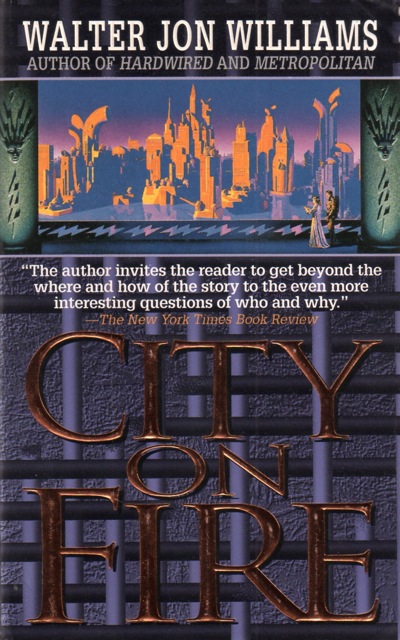
The convention started out with an awesome panel titled “Fantasy Gun Control,” where the panelists discussed why fantasy tends to favor swords over guns, even though guns have existed since the 1300s. Funniest quote from the panel: Walter Jon Williams asked what if Samuel L. Jackson was one of the Defense Against the Dark Arts teachers from Harry Potter, and Charles Gannon quipped “do I have to get magical on your ass?”
The other panel I attended was “The Tension Between Art & Commerce,” an excellent panel which very quickly evolved into a cage fight between Nancy Kress and her publisher, Tom Doherty. It basically went something like this:
Tom: I don’t think there is any tension; the best art always sells the best.
Nancy: No way! Just look at Danielle Steele: her writing is CRAP, yet she sells like crazy–and that’s the norm!
Tom: But true art endures beyond its time and sells much better over the long run. After all, just look at Homer and the Iliad.
Nancy: Homer? Are you serious? He’s been dead, what–2,000 years?
Tom: Yeah…but my point is, if you’re a writer, you need to write what’s in your heart and not chase the market. If you do try to chase the market, your writing will be crap, AND it won’t sell.
Nancy: True, but what about my apocalyptic novel about a plague that turns domestic dogs feral? I got four rejections that all said: “this book is great, but it would offend dog lovers so much that we can’t publish it.”
Tom: Well, those were just stupid editors.
Nancy: Uh, Tom…one of those was from your publishing house!
Of course, those aren’t exact quotes, and Nancy was very quick to make it known that she loves Tom and appreciates him for publishing so much of her work, but that was more or less how it went. It was hilarious.
At the same time, the panel was quite useful as well. Everyone mentioned how a writer’s willingness and ability to learn the craft and accept criticism is key–especially after getting an editor. Without this capacity to learn, aspiring writers will almost never succeed, whereas those who have it have a chance.
The rest of the time I spent hanging out and shmoozing with various people. I interviewed both Dan Wells and Peter Ahlstrom for the Mormon Artist article on BYU’s “class that wouldn’t die,” and those interviews went very well. Those two guys are seriously awesome–way down to earth and easy to talk with.
I also pitched to a couple agents, and I think it went very well. For one of them, I thought I saw her eyes light up as I described the characters in my novel from last year, Genesis Earth. It might just be wishful thinking, but her response was enough to convince me that I need to give that story a thorough revision and send it out to her before the end of next month.
I worry, though, that there’s not as much demand for the kind of fiction I write. My writing falls very solidly into science fiction (space opera, to be more specific), but everything I see here at the con is fantasy–epic fantasy, urban fantasy, paranormal, steampunk. No science fiction, except from a couple small presses. Just fantasy.
In the art vs. commerce panel, Ginger Buchanan claimed that science fiction was never a popular genre–that the popularity was all due to a handful of specific writers and a handful of specific works. I’m not sure I agree with that, but it is a bit discouraging. Speculative fiction is a fairly niche corner of the publishing world to begin it, and to see and hear people within that niche treating science fiction as ANOTHER niche…it doesn’t bode well for someone who wants to make a full time living writing it.
But then again, maybe my stuff is good enough that it’ll find a home anyways–and not just a home in a small press, but with a big enough publisher that I can actually be a full time writer. I don’t hold any illusions about my books making me fabulously rich and famous or somehow spawning a new sub-genre unto itself, but I do think my writing is good enough that I can shoot big and hope to get somewhere–perhaps even expect it. I don’t know, but I feel that the hope is justified, at least.
Anyhow, that’s probably more angst than you cared to read. World Fantasy is going great, and I’m exhausted, so I’m going to hit the sack. Good night.