Thoughts on the Worldcon 2025 AI “scandal”

I’ll just come out and say it: I predict that the world’s last Worldcon will happen before 2034, and that after that, the convention (and possibly the Hugo Awards themselves) will be permanently disbanded. That’s what I think will be the ultimate consequence of the latest “scandal” regarding Seattle Worldcon’s use of ChatGPT, and the anti-AI madness currently sweeping the science fiction community on Bluesky.

If you haven’t been following the “scandal,” you ought to check out Jon Del Arroz’s coverage of it. He’s definitely partisan when it comes to politics and fandom, but he’s neutral on the subject of AI, or as neutral as you’re going to find, especially in writerly circles.

But here’s the TL;DW: the people organizing Worldcon 2025 in Seattle decided to use ChatGPT to help them decide which authors and panelists to put on which panels. This triggered a bunch of authors and panelists who are opposed to generative AI, simply on principle. Some of these authors—including Jeff VanderMeer, who is up for a Hugo award—have bowed out, while others have called for resignations and apologies. Many of the volunteer staff have also stepped down, exacerbating the staffing shortage—which is why the convention relied on ChatGPT in the first place. And apparently over on Bluesky, the scandal is taking on a life of its own, with everyone working themselves up to a massive frenzy over the subject.

My own opinion of the “scandal” is this: it isn’t a freaking scandal! Whatever your opinion on AI-assisted writing, using ChatGPT as an aid to research panelists is totally above-board and a legitimate use of AI. To disagree with that is to say that there is no ethical use-case for generative AI whatsoever, which is hypocritical and absurd—unless, of course, you’re still writing your books on a manual typewriter and submitting them to your publisher via the US postal service. Or using WordStar, if your name is G.R.R. Martin and you’re the last person on earth who “writes” with that defunct software (putting “writes” in quotation marks, since we all know by now that Martin isn’t actually writing anything).

But it isn’t the “scandal” itself that interests me, so much as what the fallout will likely be. Ever since the Sad Puppies debacle in 2015 (and arguably long before that), Worldcon has been dominated by the wokest fringe of SF&F fandom, and it’s been an open secret that the Hugo awards themselves are controlled by the publishers, largely for marketing purposes.

So at this point, the only things really keeping the whole Worldcon/Hugo charade going are 1) woke authors who use the convention to manufacture clout for their failing careers, because they wouldn’t otherwise have a platform, and 2) woke publishers who use the awards to manufacture clout for their poorly-selling books, because they don’t actually know how to market books effectively (at least, not to readers—libraries are a whole other subejct deserving of its own discussion, because there is a genuine scandal there). Once those two things dry up, and all of the ruin has been exhausted from these institutions (ie Worldcon and the Hugos), I really do think they will collapse and go away.

That’s what I find so fascinating about this scandal: it is so utterly toxic and absurd on its face that it’s going to do permanent damage to Worldcon and the Hugos. The writers of the rising generation who will one day dominate the field are all playing around with these AI tools right now, and doing really interesting things with them. Meanwhile, most of the authors who are screaming about AI on Bluesky right now will either be dead or irrelevant (or both) in the next 20 years. And yes, Mike Glyer, you can quote me on that.

Seriously, though: if the Worldcon community is so vociferiously opposed to a legitimate use-case of ChatGPT—namely, to alleviate the already overwhelming burdens being carried by the volunteer staff—AND they continue to be absolutely toxic about it online… who in their right mind would want to be a part of that community? And since the only thing keeping the whole charade going is its ability to manufacture clout, that’s why I think its years are numbered—and likely in the single digits.

On the plus side, if/when the Hugos finally die, I won’t have to read any more crappy woke books to be able to say I’ve read (or DNFed) every Hugo award-winning novel.

How I would vote now: 2015 Hugo Award (Best Novel)

The Nominees

The Goblin Emperor by Katherine Addison

The Dark Between the Stars by Kevin J. Anderson

Skin Game by Jim Butcher

Ancillary Sword by Ann Leckie

The Three-Body Problem by Cixin Liu and Ken Liu, trans.

The Actual Results

  1. The Three-Body Problem by Cixin Liu and Ken Liu, trans.
  2. The Goblin Emperor by Katherine Addison
  3. Ancillary Sword by Ann Leckie
  4. No Award
  5. Skin Game by Jim Butcher
  6. The Dark Between the Stars by Kevin J. Anderson

How I Would Have Voted

  1. Skin Game by Jim Butcher
  2. The Three-Body Problem by Cixin Liu and Ken Liu, trans.
  3. No Award
  4. The Dark Between the Stars by Kevin J. Anderson
  5. The Goblin Emperor by Katherine Addison

Explanation

All right, I’ve read enough books now that I’m back to doing these “how I would have voted” posts for the Hugo Awards. And to kick things off, I thought I would start with one of the most infamous years in the history of the Hugos, the year of the Sad Puppies. Of course, I was around back then—in fact, it’s when China Mike Glyer of File 770 discovered me, and has been cross-linking to my blog ever since (I guess whenever the sci-fi news week is slow, or whenever he thinks that my posts would make good chum for his own readers—all twelve of them, not counting the Chinese bots).

The main reason it took me so long to get to 2015 was because I had never read any of the Dresden File books, up to this point. And I still haven’t read books 1-6 yet; in an interview on the Writers of the Future podcast, Jim Butcher said that book 7 is actually the best place to start the series. So I did that a few months ago, and I have to say that it’s been an amazing whirlwind read so far. Really great reading experience. Every one of these books has been either a 4-star or a 5-star, especially Changes, which is probably the best urban fantasy book I’ve ever read.

I haven’t finished Skin Game quite yet, but I’ve already read enough of it to know that I definitely would have put it at the top of my ballot if I had been stupid enough to give the snobby asshats and petty wannabe tyrants who run Worldcon any of my money. Sadly, I wasn’t so smart in 2011, but I have since repented, and I can tell you right now that these blowhards will ever see another cent from me. But more on that later.

The Three-Body Problem was the book that actually won the award, and I have to say that I sincerely enjoyed it. There’s a lot of really amazing science fiction coming out of China these days, which makes it an absolute shame that so many Chinese writers and fans were arbitrarily blocked and denied in 2023 for the high crime and misdemeanor of “slate voting,” whatever the hell that’s supposed to mean. Seriously, the Hugos need to die. But I digress.

The Three-Body Problem was a fascinating book. It was a little heavy on info dumps, but that’s probably because Chinese fiction has slightly different conventions than English fiction. In any case, it was fascinating enough to keep me reading, and the story itself was terrific. Also, as an American reader, I found it particularly refreshing to read a book that was written outside of our woke cultural moment. There were a lot of references to Chinese communism, especially the Cultural Revolution, but none of the insane wokeness that permeates our American culture.

Those were the only two books that I managed to read to the end. All of the other ones I DNFed, though for different reasons.

I wanted to like The Dark Between Stars, not the least because Kevin J. Anderson is a great guy, and a deserving writer—his Star Wars books were some of the first science fiction I ever read, and definitely influenced my decision to become a writer. But after the first chapter, which had an interesting set up with some characters I felt genuinely interested in, I felt like the book started throwing new characters at me, and lots and lots of boring information about the universe, as if the story itself had stopped cold and I was suddenly reading a history book. Way too many info dumps. Maybe I’ll try reading it again at some point, but I just couldn’t get into it.

The Goblin Emperor had a similar problem, though it wasn’t necessarily the info dumps that got to me, so much as sheer boredom, and the fact that the only fantasy element in the book was that the characters were all goblins—though the author could have said they were humans, or elves, or aliens, and it wouldn’t have changed the story hardly at all. Also, the political intrigue was not very intriguing. I’ve played games of Crusader Kings 2 where the political machinations were more interesting. And since the story itself was entirely focused on the political intrigue and machinations, I didn’t finish it.

As for Ancillary Sword, I DNFed that series with the first book, which follows the adventures of a sentient space ship who is obsessed about what its pronouns are. Seriously, that’s about 80% of the book right there, and the reason why Anne Leckie is a favorite of the Hugo crowd. Pronouns. Give me a break. For the 2024 Hugos, another one of her books in the same universe is on the ballot, and it took me all of one paragraph to give it a hard DNF. Pronouns, pronouns, pronouns. What are your pronouns? Did you know that you can make up a word and call it a pronoun? Let’s make up some pronouns together, kids! Just remember to vote as many times as you can in the upcoming election, otherwise Literally Hitler will blow up the world—never mind that our current leader is a nasty old dimentia patient whose face is a public service announcement for the side effects of botox, and his heir apparent is a cocksucking DEI hire who likes to cackle about school buses and Venn diagrams. It’s amazing how far you can get in today’s world with a pretty face and some high-quality knee pads.

It is impossible to mock these people too much. If they had the power to do so, everyone who opposes them would be rounded up in a cattle car and buried in an unmarked grave. The Sad Puppies were basically a prelude to the Trump revolt, just like Gamergate the year before. And what did we learn from it? That the people who control the institutions—in this case, Worldcon and the Hugo Awards—hate us. They knew that all the accusations of “racism” and “white supremacy” were all false. They knew that all those dirty smear tactics were just a means to an end. It’s not about good and evil, it’s about power, just like that line from the Acolyte, which is a perfect example of how they deliberately vandalize everything, especially a beloved franchise like Star Wars. Everything that’s happening in the broader culture right now, with multi-billion dollar entertainment companies like Disney that are going woke and broke, happened in science fiction first. The Puppies tried to push back against the rising tide of woke insanity, but the rot was too deep, and the cancer had already metastasized. All they managed to do was prove was that the Hugos are beyond saving.

2015 was a watershed year for science fiction, not because two of its most prolific and beloved authors lost to No Award, but because Worldcon lost the plot and the Hugos were revealed to be a farce. Jim Butcher is bigger than the Hugos, and so is Kevin J. Anderson. So are most of the Chinese authors who were excluded in 2023 (but guys, it’s the Puppies who are the racists). The reason I’m doing these “how I would have voted” blog posts has less to do with any respect I might have for the Hugo Awards, and more to do with the fascination of watching a massive pileup on a frozen interstate. I want to go back and rewatch it from the moment it all began—which, so far as I can tell, was sometime in the late 60s. But I’ll save that rant for another time.

Define “woke.”

Woke (WOHK): Adjective

Of or pertaining to the mass formation psychosis currently gripping the United States and most of the developed world. This mass formation psychosis is led by radical leftist ideologues and driven by social media addiction. Due to the collusion between major technology companies and the US government, there is also an element of state-sponsored propaganda and control.

The mass began to form in the late 2000s with the popularization of social media. As these technologies began to replace face-to-face human reactions, it created the pre-conditions of social isolation and free floating anxiety, in large part due to the addictive nature of the algorithms which promoted content most likely to induce outrage and anger in the end-user (see CGP Grey, “This Video Will Make You Angry”). Once these pre-conditions were in place, all that was necessary to create the psychosis was a target or series of events to focus the attention of the mass.

The 2010s were characterized by several of these focusing events, starting in 2012 with the shooting of Michael Brown and the subsequent riots in Ferguson, Missouri, and continuing with numerous mass shootings such as Orlando and Sandy Hook, several landmark Supreme Court decisions on gay rights such as United States V. Windsor and Obergerfel v. Hodges, and the rise of such controversial movements as Gamergate and the Sad/Rabid Puppies. The culminating event in the creation of this mass formation psychosis was the election in 2016 of Donald J. Trump as President of the United States.

Following Trump’s election, rogue elements of the bureaucracy, the administrative agencies, and the intelligence community (colloquially referred to as the “deep state”) successfully exploited this mass formation psychosis in an effort to hamstring the Trump administration and ultimately remove him from power. These deep state actors acted in collusion with the Silicon Valley technology companies that ran the social media platforms.

Because of the inherently left-leaning political bias of these Silicon Valley companies, this mass formation psychosis always had a leftist bent, and tended to promote radical leftist ideologues as its leaders. However, in any mass formation, the leaders are often just as caught up in the psychosis as the followers. This soon became manifest in the moral and rational incoherence of its leaders (see “What Is a Woman?”), and in the various internal contradictions of their own respective causes and beliefs. While “wokeism” is inherently political, it is not primarily characterized by a unified political ideology or movement.

The high water mark of the mass formation psychosis occured in 2020 during the covid-19 pandemic, during which it took on all of the defining characteristics of a cult (see “What is the Covid cult?”). The George Floyd riots were the major culminating event, but Trump’s ostensible defeat in the disputed 2020 elections and his subsequent removal from power in the January 6th color revolution removed the central focusing element necessary for the mass formation psychosis. Since then, the deep state and political establishment has attempted several times to find a new focusing element for the psychosis, with such issues as climate change or the Russo-Ukraine war, but thus far these efforts have proven unsuccessful (see: “I SUPPORT THE CURRENT THING!”)

At this time (March 2023), it is unclear how this mass formation psychosis will end. If Trump is re-elected in 2020, it may catch a second wind, or it may be replaced by the right-leaning mass formation psychosis characterized by Trumpism and the MAGA movement. It may fizzle out slowly, or it may be defeated by the growing demand for a religious revival in the United States. Alternately, it may prove to be the precursor of a much more dangerous mass formation psychosis, this time driven by AI and the outbreak of World War III. Regardless, the events of the next 12 to 18 months will determine which course our society will take.

Reading Resolution Update: After Action Report

My 2022 reading resolution: Read or DNF every novel that has won a Hugo or a Nebula award, and acquire all the good ones.

Earlier this month, I finished my last Hugo/Nebula book and ordered the last two ones that I hadn’t yet acquired. The first of those (Powers by Ursula K. Le Guin) arrived just this morning, and the other one (Way Station by Clifford D. Simak) is supposed to arrive next week, so I think that now is a good time to do a retrospective and share some of my thoughts.

There were 104 books in total, including the most recent award winners (I decided not to count the retro-Hugos midway through the year). Of those, I’ve read 35 through from start to finish, and decided that 24 were worth keeping. The rest of them (69, or almost exactly two thirds) I DNFed.

Finishing one in three books is actually about on par for me. I’ve found that if I don’t allow myself to DNF books early and often, I just don’t read. Also, it doesn’t really surprise me that nearly one third of the books I read all the way through didn’t really impress me. What can I say—I’ve a very opinionated man.

Of the 28 books that have won both a Hugo and a Nebula, I finished 12 (or about two-fifths) and found that eight (or a little over a quarter) were worth keeping. So not much different than the overall totals.

Of the 45 books that won only a Hugo, I finished 18 (exactly two-fifths) and found that 14 (about a third) were worth keeping. So my personal taste seems to be tilted more toward the Hugo than the Nebula. The difference becomes even more stark when you take out the 20 books that were nominated for (but did not win) a Nebula, a whopping 16 of which I DNFed. Excluding those, we’re left with 25 books, 14 (or more than half) of which I finished, and 11 (or just under half) I thought were worth keeping.

The contrast becomes even sharper when we look at the Nebula-only winners. Out of the 31 books that didn’t win a Hugo but did win the Nebula, I finished only five (less than one-sixth) and found that only two were worth keeping. Both of those were books that weren’t even nominated for the Hugo. When we look at the 16 Nebula-winners that were nominated for a Hugo but didn’t win, I finished only two of them (one-eight) and didn’t think that any of them were worth keeping.

So the best predictor that I wouldn’t like a book is if it won a Nebula and was nominated for a Hugo, but didn’t win. In other words, if the SFWA crowd (which is mostly authors) said “this is the best novel published this year!” and the denizens of Worldcon said “yeah… no,” that almost guaranteed I would hate it. In fact, just getting nominated for a Nebula is enough to make a book suspect.

This is why, earlier in the year, I posited the theory that SFWA has done more to ruin science fiction than any other organization. I saw this trend coming all the way back in the spring, when I was only halfway through the reading list. In the early years, SFWA was all about politicizing science fiction, and in the last few years, it’s basically turned into a nasty bunch of mean girls all trying to get a Nebula for themselves.

I tracked a few other awards just to see if there were any correlations. For the 18 books that placed in any category in the Goodreads Awards, there were only four books that I finished and two that I thought were worth keeping. Network Effect by Martha Wells received 22,971 votes in the Science Fiction category in 2020, which came to 9.69%. Blackout by Connie Willis gained only 337 votes in 2010, but that was 9.19% back then. Both of those books were keepers. The only other book that got a higher percentage for its year was Redshirts by John Scalzi, with 4,618 votes at 10.82%, but I DNFed that one. Most Hugo/Nebula winning books didn’t even clear the 5% threshold in the Goodreads Choice Awards, and in my experience anything under 10% that doesn’t immediately jump out to me probably isn’t worth reading.

Of the six Hugo/Nebula books that were nominated for a Dragon Award, the only one I even really finished was Network Effect by Martha Wells. But that makes sense, since it’s no great secret that the Hugo/Nebula crowd is trying to sabotage the Dragons by pulling exactly the same shenanigans that they accused the Sad Puppies of doing. Accusation is projection is confession, after all. As of 2022, there has never been a Hugo/Nebula winning book that has also won a Dragon, and while part of me hopes that it stays that way, another part of me is very curious to read the first book that does.

Almost all of the 104 Hugo/Nebula winning books placed somewhere in the various Locus recommended reading lists, which isn’t surprising since those lists are generally regarded as feeders for the Hugos and Nebulas (and used to get more people voting in them, too). Of the seven books that weren’t on a Locus list, the only one I finished was They’d Rather Be Right by Mark Clifton and Frank Riley, which also has the distinction of being the most difficult book to find.

(A lot of people think They’d Rather Be Right was the worst book to ever win a Hugo, but I actually enjoyed it. Unlike most Hugo/Nebula books, it was remarkably anti-Malthusian, which is probably why it’s so hated. As for the worst book to ever win a Hugo, I personally grant that distinction to Dreamsnake by Vonda N. McIntyre.)

There were only ten Hugo/Nebula books that won or were nominated for a World Fantasy Award, and I only finished two of them (and didn’t think either were worth keeping). Perhaps that means that makes it the actual best predictor that I’ll hate a book, but ten is a pretty small sample size, so I’m holding off judgment for now.

The best two decades for me were the 50s (7 books, 4 keepers) and the 00s (16 books, 6 keepers), though the 80s came in close with five keepers out of sixteen books—and let’s be honest, Blackout and All Clear by Connie Willis are basically two halves of the same book. In contrast, the worst two decades were the 70s (only one keeper out of 13 total books) and the most recent decade, the 10s (15 books, 2 keepers).

So far, the 20s aren’t shaping up to be much better. In fact, I think it’s entirely fair to say that given the state of fandom since the election of President Trump (and the general state of insanity in this post-Trump era), a Hugo or a Nebula should count as a mark against a book, rather than for it. That is, the primary value of these awards is to tell you which books to avoid. Perhaps this will change at some point in the future, like it did after the madness of the 70s or the malaise of the 90s (not a good decade for science fiction, apart from books published by Baen), but I’m not holding my breath.

So that was my reading resolution for 2022. If I hadn’t allowed myself to DNF, I can guarantee that I never would have accomplished it. As it stands, though, I’m pretty satisfied with how it turned out.

What sort of reading resolution should I set for 2023?

Steelmanning the pro-aborts

Remember when the wrongfun brigade screamed and shouted and gnashed their teeth that the Sad Puppies were cheating the Hugo Awards through “slate voting,” or whatever the hell they called it? That we were somehow gaming the system to put our racist, sexist, misogynistic, fascist authors (many of whom were non-white, female, and/or flaming libertarians) on the ballot? Well… if you’ve been paying attention to the Dragon Awards, you know by now that those accusations were always flat-out lies, because the wrongfun brigade has been doing exactly the same thing they accused us of doing: cramming the wokest garbage on the Dragon Awards ballot, year after year after year.

It’s a toss-up which book is the worst offender, but so far I think that The Future of Another Timeline by Annalee Newitz takes the “worst book ever nominated for a Dragon by the wrongfun brigade” award. Seriously, if I were to write a parody of a book written by a washed-up second-wave feminist desperately trying to stay culturally relevant by proving her woke bona fides, there would not be any substantial difference between that and the actual novel. The villians—I kid you not—are an evil time-traveling brotherhood of men’s rights activists who are trying to rewrite history so that women are enslaved as breeders for the Patriarchy. Thankfully, the righteous sisterhood (er, trans-sister, non-binary… damn, that’s awkward) of uber-feminists thwarts the evil MRAs and defeats them in an epic time travel war. Abortions for all!

Seriously, it is clear from the very first page of this woefully inadequate toilet paper substitute that Newitz has never even attempted to thoughtfully and meaningfully engage with a men’s right’s activist, let alone an actual feminist who engaged meaningfully with them. And that’s what I find so fascinating. There was a time when the left was actually pretty good about engaging their ideological opponents on their own terms, and steel-manning, rather than straw-manning, the opposition’s arguments. Today, the left is totally incapable of that. That’s why all of the books that the wrongfun brigade afflicts upon us read like parodies, and why all of the awards that the wrongfun brigade has taken over are best taken as a list of books to avoid.

But all of this got me to thinking: am I capable of steel-manning the left’s argument on a position with which I vehemently disagree? Can I make their argument for them in a way that would make even the most rabid, foaming-at-the-mouth feminist nod reluctantly and admit: “yes, that is exactly what I believe”?

Let’s find out, shall we?


Since the dawn of time, women have been bound and fettered to their wombs. The ability to give birth, which the right sees as a privilege and a blessing, is actually the source of all the inequality between the sexes, and the reason why women have never been as free or as liberated as men.

Throughout history, men could have sex as often as they wished without any fear of becoming pregnant from the encounter. They might fear getting their female partner pregnant, but they always had the option to walk away. In contrast, women had to be constantly aware of the fact that any sexual encounter—whether wanted or not—could lead to nine months of exquisite physical torture, followed by a bloody birthing experience that often resulted in her death. And even in those cases where the mother survived, she now had a child who would be physically dependent on her for years, and mentally or emotionally dependent on her for decades. All of this could result from even the most innocuous sexual exploration—or a single unwanted rape.

Without reliable birth control—and many traditional religious societies still discourage birth control, same as they have for centuries—even a comfortably married woman could expect to spend the majority of her life bearing and caring for children, whether or not she wanted to. And because this experience was universal to all women, society developed strict gender roles that discouraged women from pursuing an education or a career. How could a woman pursue such things, when so many small children depended on her? In this way, the womb defined a woman’s station in life, and she had very little control or say in the matter. After all, what sort of a wife could deny her husband sex? And what sort of a woman could make a living in a world of men without a husband?

The invention of the birth control pill did a lot to liberate women, but it didn’t do enough. At best, the pill granted women a reprive that allowed them to see what the world might be like if they were no longer bound to their wombs. After all, even the most reliable birth control fails from time to time, especially if you forget to take it (or find it too difficult to obtain).

This is where the issue of abortion comes in. Conservatives like to smear us as being “unscientific” or confused about when life begins, but in truth that is just a side issue—a distraction from the real issue, which is liberating women from their wombs. Because the power to create life isn’t empowering at all if it only goes one way. If you have the power to give, but not to take, that power can be used against you. Same if you have the power to create, but not to destroy.

This is why abortion needs to be both legal and readily available through all stages of pregnancy: because unless women can choose to abort the life within them, then they will never be truly liberated. Nature has given them the power to give life, but without the power to take it, women will always be second-class citizens, confined to the restrictive gender roles imposed on them by their wombs. This is why birth control alone is insufficient: it only blocks the ability to create life, and that imperfectly. But power has to flow both ways.

Conservatives make a lot of noise about the value of life, but they are suspiciously silent on the issue of quality of life. Indeed, they seem to be unable or unwilling to consider that some lives simply are not worth living. Thus, they are willing to make exceptions to their pro-life stance for things like ectopic pregnancies—conditions where the choice is between letting both the mother and the baby die, or killing the baby to save the mother—but they fail to see how the same principle might apply in situations where the woman has to choose between aborting the child to obtain a successful career, or have the child and condemn them both to a life of abject poverty.

Not all life is equal. Some lives are more worth living than others, and some people’s lives are so terrible that they wish they’d never been born. How is it virtuous or noble to give anyone that kind of a life? It isn’t. Abortion is a hard thing, but sometimes it is necessary, and the alternative—the pro-life position—is downright cruel.

But that isn’t the main reason why abortion is so important. The main reason is that it liberates women from the fetters of the womb. It grants them the antithesis to the power that nature grants them, the power to create life, and thus allows them to pursue whatever sort of path they wish. Many women who have abortions go on to have children later in life, when the time is right for them. And because of those abortions, they are better able to care for those children, when they do come.

At this point, we should talk about how men control women’s bodies. Now, it’s obvious that there isn’t some super-secret Patriarchy society that meets on Tuesdays to discuss how they can advance their goal to turn all women into slaves for breeding purposes. That’s not what we mean when we say “controlling women’s bodies.” However, it is natural for people to fear the things that they don’t understand, and to try to exert control over the thing that they fear. Men clearly don’t understand women—that fact has been memed so often, it’s practically self-evident. So is it really all that hard to believe that men often try to exhert control over women, out of their fear and misunderstanding?

This control takes on many forms, but perhaps the most common form is that of gender roles. Men want women to take on a defined role because, among other things, that makes women understandable. But these roles are often more constrictive than the corresponding roles imposed upon men. A “mother” is often subject to a higher standard than a “father,” and is judged much more harshly when she fails to live up to that role. Also, the role of “mother” grants a lot less bodily autonomy than that of “father.” Is it really hard to see how this becomes a mechanism of control—specifically, over women’s bodies?

The issue at the heart of all of this is liberation. Freeing women from the harsh realities imposed upon them by their wombs is just the beginning. The ultimate liberation is the freedom to redefine reality itself—to decide whether or not one actually is a woman, and transcend the restrictions of sex and gender altogether. And why shouldn’t we exercise this power? Since the dawn of time, humans have been creatures of innovation, refusing to accept the constraints that nature has imposed upon us. When we looked up at the birds and saw that they could fly, we didn’t say “that’s nice, but nature didn’t give us that ability, so we should just stay in our place here on Earth.” Rather, we took inspiration from the birds and kept innovating and inventing until we, too, had the ability to fly. Why should sex or gender be any different?

This is why feminism and transgenderism aren’t actually at odds. It’s also why the new “what is a woman?” meme on the right, however cute, is totally irrelevant. Yes, it is true that ever since the dawn of time, a woman has been defined as an adult human female. That isn’t interesting. What is interesting is what women may become, after they’ve been liberated. Or men, for that matter. Because the liberation of women also ultimately liberates all of humanity: male, female, and everything in-between.

Liberation is the goal. Liberation is the key. Accept no boundaries, and refuse to live by the rules that are imposed upon you. Partake of the forbidden fruit, and you too may ascend to godhood. Refuse to accept the stories of Icarus and Prometheus as cautionary tales. Rage, rage against the dying of the light.

Reading Resolution Update: June

My 2022 reading resolution: Read or DNF every novel that has won a Hugo or a Nebula award, and acquire all the good ones.

This is the last one of these resolution updates that I’m going to post here on this blog. I’ve only got three books left now: Falling Free by Lois McMaster Bujold (1989 Nebula), A Fire Upon the Deep by Vernor Vinge (1993 Hugo), and Doomsday Book by Connie Willis (1993 Hugo and Nebula). Since I already own all of those, I’ll probably finish reading them by the end of July, and the only other books I need to acquire to finish the resolution are Way Station by Clifford D. Simak (1964 Hugo), Rainbows End by Vernor Vinge (2007 Hugo), and Powers by Ursula K. Le Guin (2009 Nebula).

I will, however, do an in-depth study of the final results and post them here. There should be some interesting trends, and hopefully my own reading preferences will provide some useful insights, though really those preferences say more about me than they do about these books. Reading tastes are very subjective, so I’m sure there are a lot of good and brilliant people who love some of these books that I’ve passed on, and vice versa. But maybe sharing my own reading preferences will help others to develop their own, and if that helps to encourage more reading, that would be great.

One of the major insights that I’ve already discovered is that the best predictor that I will not like a book is if it won a Nebula without winning a Hugo. In a post last month, I speculated as to why that may be. I’ve already expanded my Hugo/Nebula award spreadsheet to include all of the nominated books as well, but I’ve blacked out the Nebula nominated books and will probably skip most of them. After all, if there’s something about the Nebula books that rubs me the wrong way, maybe I can get more use from that award by using it as a “do not read” list rather than a recommended reading list.

I’m also branching out to the Dragons and Goodreads Choice award-winning books, starting with the most recent ones and working my way back. The really neat thing about Goodreads Choice is that they post how many votes each top-20 book got in each category, and how many votes were cast in each category overall, so it’s very easy to quantify and rank each book. For example, in the science fiction category, Project Hail Mary by Andy Weir won first place in 2021 with 92,831 votes out of 281,584, or a 32.97% plurality. That is the largest plurality that any book has ever won in that category, so either Project Hail Mary is a damned good book, or all the other books really sucked—and I tend to think it’s the former, which is why I’m reading it now.

The Dragons are very different, but I haven’t read enough of them to notice any trends or form any opinions. However, there are some indications that the Dragons are the anti-Hugos/Nebulas, and to some lesser extent the anti-Goodreads Choice Awards, which seem to swing more toward the Hugo/Nebula crowd, even if most of the Hugo and Nebula nominated books only typically get between 5% and <1% of the vote. To gather more data, I’ve decided not to skip any of the Hugo/Nebula books that placed in the Goodreads Choice Award, especially since 2015 when the Sad Puppies schism really shook things up in the science fiction book world. So it will be interesting to see which of these books I think are worth reading and owning, and which ones I think aren’t.

So in short, now that I’ve (just about) read all of the Hugo and Nebula winning books, I’m going to move on to the Hugo (but not Nebula) nominated books, the Dragons, and the Goodreads Choice winners and nominees. But I’m not going to set a deadline, or hold myself to reading all of them. Rather, I’m just going to take it as a starting point, and instead set a goal of 100 pages per day, reading whatever strikes my fancy.

Books that I read and plan to or have already acquired

  • Hyperion by Dan Simmons (1990 Hugo)

Books that I did not finish

  • Startide Rising by David Brin (1984 Hugo and Nebula)
  • The Uplift War by David Brin (1988 Hugo)
  • To Say Nothing of the Dog by Connie Willis (1999 Hugo)
  • A Deepness in the Sky by Vernor Vinge (2000 Hugo)
  • Darwin’s Radio by Greg Bear (2001 Nebula)
  • Jonathan Strange & Mr. Norell by Susanna Clarke (2005 Hugo)
  • A Master of Djinn by P. Djeli Clark (2022 Nebula)

Why books written by mothers are better than books written by childless women

I never know which posts of mine China Mike Glyer is going to pick up for his pixel scroll, or whatever he calls the daily bucket of chum that he feeds the folks over at File 770 (the ones who aren’t Chinese bots, anyway). I’ve written at much greater length about my 2022 reading resolution here, and my insights and impressions gained through the experience here and here, but for some reason the post he decided to pick up was the last one. Perhaps he thought that it would be better at ginning up outrage than the other posts? But if that were the case, surely he would have picked up the one before that instead. It was practically written for ginning up outrage among the File 770 crowd (or at least the ones who aren’t Chinese bots).

So when I got the pingback last night, I glanced over the post over at File 770 and saw this comment from Cora Buhlert:

I have to admit that whether or not writers have children is not a characteristic I pay the slightest bit of attention to. Never mind that it is difficult to tell, because even today, not every writer chooses to talk about their family or private life.

But I guess that Joe Vasicek is the sort of person for whom people without children, particularly women without children, are by definition evil.

Cora is an indie writer from Germany that I used to interact with a lot on the KBoards Writer’s Cafe, and some other indie author hangouts. She’s earned the ire of Larry Correia a couple of times, and she has a bad tendency to straw man any opinions or perspectives that challenge her worldview. On one thread, we went back and forth over whether Hitler was a creation of the political right or the political left. I tried to explain that “left” and “right” mean different things in the US than they do in Europe, but it was like trying to have a discussion with a brick wall.

So it doesn’t surprise me in the least that she’s completely mischaracterized me in the comment above. I do not believe that childless women are evil—if I did, I would not have served in the bishopric of a mid-singles ward (a mid-singles ward is a Latter-day Saints congregation of unmarried and divorced people in their 30s and 40s. I was the ward clerk—basically, the guy who handled all the finances and other paperwork for the congregation). My faith teaches me that people are not evil, but are all children of God, no matter who they are born to or what their life choices may be.

In fact, my interest in the parental status of the Hugo and Nebula winning authors has nothing to do with religion or morality, and everything to do with life experience. I didn’t get married until almost a decade after I had started to write professionally, and the experience of becoming a father was so completely lifechanging that it’s transformed my writing as well: what I choose (and don’t choose) to write about, who I choose (and don’t choose) to write for, as well as the themes and ideas that I explore in my books.

You can see this transformation if you read my Genesis Earth Trilogy. Genesis Earth was my first novel, but it wasn’t until almost nine years later—after I’d met my wife and was engaged to be married—that I felt I had the life experience necessary to write the sequel, Edenfall. And the final book, The Stars of Redemption, was not the sort of thing I was capable of writing until after I had become a father and knew what it was like to help bring a child into the world.

When my daughter was born, the very first thought that came into my mind was “this is her story now, not yours.” We all like to say that we’re the hero of our own story, and in a very basic way, that’s true. But when you become a parent (assuming that you’re a responsible parent, and not a scumbag), you’re no longer living just for yourself, but for your children. “He who findeth his life shall lose it: and he that loseth his life for my sake shall find it.”

Having a child changes your perspective on everything. Among other things, you have a much deeper and more personal investment in the future, since you know that your child will inherit that world. Your perspective on your own family history changes too, as you have become a link in the generations, not merely a byproduct of it. Life becomes a lot harder, but it also becomes more meaningful. Things that took up a great deal of your time and attention when you were single suddenly become trivial, and other things that didn’t make much sense to you about people before suddenly click into place.

So that was why, when I decided to read all of the Hugo and Nebula winning novels, I was curious about the parental status of the authors. I wanted to know if the experience of being a parent had affected the quality of their writing, since I know it’s affected mine. And honestly, it’s not that hard to look up: almost all of these authors have Wikipedia pages with a section about their personal lives. Obviously, the details about their children are sparse, but the only thing I cared about was whether or not they had any.

(As a side note, there were other stats that I decided to track, such as the age of the author when they won the award. That hasn’t seemed to have impacted my taste, except that I have not enjoyed a single award-winning novel by an author who was in their 20s at the time that they won. The only exception was Isaac Asimov with the retro-Hugo for The Mule (Foundation and Empire), but that wasn’t awarded until after he was dead. There are also three authors whose age I was unable to determine from a quick internet search: Michael Swanwick, Sarah Pinsker, and Charlie Jane Anders.)

(As another side note, I’ll be the first to admit that I may have made some errors in my research. For example, if a five-minute internet search on an author didn’t tell me anything about their kids, I assumed they didn’t have any. It’s entirely possible that they just prefer to keep that information private. Also, I didn’t bother to look up when they had their children, so it’s possible that they were still childless at the time they won the award.)

Why should I be interested in this sort of thing? Why look at things like an author’s age, gender, or parental status?

Two reasons. The first is that I wanted to do a deep dive on the Hugos and the Nebulas, the two awards which represent themselves as representing the very best of the science fiction genre. Since that is the genre that I write, I want to understand not just the kind of books that win these awards, but the kind of authors who win them. The goal is to have a deeper understanding of the genre, and to look for trends and movements within it.

Second, and more importantly, I want to have a better understanding of my own reading tastes. All of this is subjective, of course, since the act of reading is always a collaboration between the reader and the writer. I’m sure that some of the books I think are terrible are considered by others to be the best in the world, and vice versa. My goal is to look for patterns that will tell me whether I’m likely to enjoy a book (or an author), so that I can find the best books more efficiently. I don’t do this for all of the books that I read, but since the Hugo and Nebula winning books are supposed to be the very best, I figured it was worth it to do a deeper analysis—especially since my goal is to read all of them.

The thing that surprises me is that it isn’t parental status that matters, but gender + parental status. I can think of a couple of reasons why this would be the case. The most obvious is that it’s easier for me to empathize with a childless man, since that was me for such a long time. And I do think that’s a major part of it.

But I also think that there’s something specifically about being a mother—or deliberately choosing not to be one—that’s also a factor. And yes, I’m talking about biological essentialism. I mean, I’m not a biologist, but I know that I will never be able to be a mother—that’s a life experience that I will never be able to have. Conversely, I will never be able to deny my potential motherhood, an equally major life decision. Both of those experiences are bound to have a major impact on an author’s writing, either way.

I also think this factor is what lies at the heart of Roe v. Wade, the worst decided Supreme Court case since Dred Scott v. Sanford. Certainly the cultural impact of that decision has profoundly influenced how our society views children and motherhood. It’s also why I am sooo looking forward to Matt Walsh’s documentary What Is a Woman? coming out in two weeks:

With all of this in mind, I find it fascinating that every Hugo Award for best novel after 2015 (the year that the Sad Puppies had their high water mark) was won, as far as I can tell, by a childless woman. It would be interesting to see if that trend extends to nominees, or to the other categories like best short story, best novelette, and best novella. Maybe I’ll look that up sometime.

And now that I’ve referenced Roe v. Wade, I’m sure that Cora Buhlert (if she’s reading this) is saying to herself: “yup, he just thinks that all childless women are evil.” And to the extent that File 770 is read by humans and not bots, they’re no doubt picking and choosing those parts of this post that confirm their prejudices (if China Mike Glyer even has the balls to cross link to a post that includes that trailer—do it, China Mike! I dare you!)

But I don’t really care either way, because now I have a much better understanding of my own personal reading tastes, and how they contrast with the Hugo/Nebula crowd. For me, the best books are those that are written by authors who have had the life experience of being a mother, and the worst books are by those who have chosen to deny themselves that path. Apparently, the Hugo/Nebula crowd takes the opposite view. Good to know.

Reading Resolution Update: March

My 2022 reading resolution: Read or DNF every novel that has won a Hugo or a Nebula award, and acquire all the good ones.

So March is usually the time where people get tired of their new year’s resolutions and either give them up entirely or put them on the back burner for a while. But at this point, I’m a little more than halfway through achieving this one, so I will definitely keep pressing on since I don’t think it will take the whole year to accomplish it. In fact, I may actually expand it to include all of the short stories, novellas, and novelettes. I’ve already filled out the spreadsheet (with a huge thanks to the Internet Speculative Fiction Database, which also lists all of the collections and anthologies where each story can be found).

With that said, my enthusiasm for reading all of these books is starting to flag, and I’m not pushing on as vigorously as I did back in January. There have been a lot of DNFs… a lot of DNFs. But now, I’m starting to get to the books that aren’t obvious DNFs, which is frustrating, because when you get more than halfway through a 600 page book before you realize it isn’t worth finishing, that really does take the fun out of reading, at least in the short term.

But it has been very eye-opening to see what kinds of books tend to win Hugos and Nebulas. I’ve noticed some interesting patterns that have given me real insight into the people who vote in these awards, which consists of the old guard in fandom for the Hugos, and members of SFWA (mostly professional authors) for the Nebulas.

One book in particular I found really eye-opening in this regard, and that was They’d Rather Be Right by Mark Clifton and Frank Riley. Mark Clifton was a science fiction short story writer who was fairly prolific, but died tragically about ten years after They’d Rather Be Right came out in 1955. Frank Riley was a newspaper man who dabbled a little bit in mystery short stories but only ever co-wrote this one novel.

They’d Rather Be Right is a notoriously difficult book to get your hands on. An abridged version with the title The Forever Machine is on sale on Amazon somewhere north of $100, and neither version was available at either my local library or the Harold B. Lee Library at BYU, and that’s unusual because the HBLL’s science fiction and fantasy collection is one of the best in the country. I eventually bought a used version of They’d Rather Be Right on Amazon from a third-party seller for $10: it was an old library copy from a small town in Arizona, and I think the seller was the actual library.

In reading about this book, I discovered that it’s been widely panned as the “worst book to win a Hugo.” However, after reading it, I can definitely say it is not the worst book. It’s not the best book either, but it is far from the worst, and I enjoyed it enough to put it on the “books worth keeping” list. So why is it considered the worst Hugo-winning book, and why has it been forgotten so thoroughly?

My working theory is that They’d Rather Be Right isn’t actually bad, it’s just heretical. Science fiction has always skewed toward the political left, and this book thoroughly ridicules some deeply held left-wing beliefs of its day. For example, it goes out of its way to ridicule scientists as a class, and makes it seem ludicrous that they have any business deciding on how the rest of society should be governed. It also pokes fun at some of Sigmund Freud’s ideas, which is notable because so many of the Hugo and Nebula winning novels of the 60s and 70s are so thoroughly Freudian.

So what happened, I believe, is that after the Hugos became a regular feature of Worldcon (They’d Rather Be Right was only the 2nd novel to ever win a Hugo), the influencers and kingmakers within fandom decided that this one won on a fluke, and did everything they could to suppress it. And perhaps it really was a fluke, since the Hugo Awards weren’t yet established, and Worldcon itself was only a little more than a decade old.

Because here’s the thing: the Hugos and the Nebulas have always been radically left-wing. Science fiction in general has always leaned hard to the left, and those of us who consider ourselves right-wingers have always been a despised minority to most of the rest of fandom. That didn’t start in the 50s either: if anything, it started with the Futurians, as Donald Wollheim himself (founder of DAW Books) said that science fiction “should actively work for the realization of the scientific world-state as the only genuine justification for their activities and existence.” The Futurians were the ones who founded both Worldcon and SFWA, as well as several other establishment institutions in the SF&F field.

But I think it started before the Futurians, because it makes a lot of sense that science fiction would attract left-wingers more than it would right-wingers. Left-wingers are the kind of people who think that traditions should be thrown out and new ideas should be implemented, whereas right-wingers are the kind of people who think that new ideas should be treated cautiously, and traditions should be upheld.

There’s a cycle that happens about every 50 to 100 years, and it goes like this: someone comes up with a Beautiful Idea that almost everyone on the left becomes enamored of. They pore over this idea, ponder it, debate it amongst themselves, and spill copious amounts of ink over it, mostly in the form of academic discourses and thesis papers.

Gradually, this idea matures into a General Theory, and the left constructs a whole worldview around it. But at this point, it starts to come into conflict with reality—not in a catastrophic way at first, but definitely in a way that causes some uncomfortable cognitive dissonance. But because the Beautiful Idea was so beautiful, none of the theory’s proponents really want to give it up, so they start to build a bulwark of apologia to explain the theory’s inconsistencies and contradictions.

After a while, though, that isn’t enough, and reality begins to intrude in ways that simply cannot be ignored. At this point, the General Theory morphs into an Ugly Ideology, possessing all of its followers and driving them into incredible pathologies. Groupthink and doublespeak become de rigueur, and hypocrisy infects everyone. Values like diversity, curiosity, open inquiry, freedom of speech, and intellectual honesty are all thrown out, as nothing is more important than promoting the ideology. Right and wrong cease to matter as well: the only thing that matters is power.

Eventually, reality intrudes in such a way that the entire edifice comes crumbling down, completely discrediting the Beautiful Idea and everyone who ever believed in it. But if the Ugly Ideology persists for too long, it culminates in a reign of terror, with guillotines, gas chambers, firing squads, holocausts, and genocides.

Fortunately, there are people who drop out at every stage of this cycle: “That’s a Beautiful Idea, but it’s still flawed.” “I like the General Theory, but I don’t think it explains everything.” “I am a true believer in this Ugly Ideology, but I’m not going to pull the trigger on those people.” And if enough people drop out, the pendulum swings back, the left goes into retreat, and culture and politics swing back to the right again… until someone discovers (or rediscovers) a Beautiful Idea.

In the 60s and 70s, the left was in the early stages of the Ugly Ideology phase of this cycle. Not surprisingly, the science fiction of that time was pretty terrible. Then the Reagan era happened, the Soviet Union collapsed, the Cold War ended, and left was thrown on the back foot for a generation. During this time (the 80s and 90s), the award-winning science fiction was actually pretty good.

But that was also the time when the ideas that underpin critical race theory began to take root—the “Beatiful Ideas” that gave us, among other things, Defund the Police, the George Floyd riots, the epidemic of smash-and-grab robberies, and the ongoing collapse of leftist-run cities like Chicago and San Francisco. In science fiction, this culminated in the sad and rabid puppies, at which point the Hugos and Nebulas became total garbage again, because the left-leaning fandom had become so ideologically possessed.

So anyways, that’s my take on it. I really did enjoy They’d Rather Be Right, and not just for the insights into fandom. In any case, here are all of the other Hugo and Nebula winning books I read or DNFed in March:

Books that I read and plan to or have already acquired:

  • They’d Rather Be Right by Mark Clifton and Frank Riley (1955 Hugo)

Books that I read and don’t plan to acquire:

  • The City & The City by China Mieville (2010 Hugo)

Books that I did not finish:

  • Stranger in a Strange Land by Robert A. Heinlein (1962 Hugo)
  • To Your Scattered Bodies Go by Philip Jose Farmer (1972 Hugo)
  • Where Late the Sweet Birds Sang by Kate Wilhelm (1977 Hugo)
  • The Snow Queen by Joan D. Vinge (1981 Hugo)
  • The Yiddish Policeman’s Union by Michael Chabon (2008 Hugo and Nebula)

White Science Fiction and Fantasy Doesn’t Matter

If you are white, and you write science fiction or fantasy, it is only a matter of time before you are cancelled.

This is the logical end of intersectional identity politics, which is really just the resurrected, zombified corpse of Marxism. White people are the oppressors. People of color are the oppressed. All white people are racist, and the only way to fight racism is with more racism. Black lives matter. White lives don’t.

The United States of America is currently engaged in a violent struggle that will determine whether this hyper-racist intersectional ideology will defeat the populist uprising that has its champion in Trump, or whether the country will reject this new form of Marxism and come back from the brink of insanity. But in science fiction and fantasy, the war is already over, and the intersectionalists have won. It is now only a matter of time before they purge the field of everything—and everyone—that is white.

The last chance for the SF&F community to come back from the brink was probably in 2015. The intersectionalists were ascendant, but they hadn’t yet taken over the field. (That happened in 2016, when N.K. Jemisin, an avowed social justice warrior and outspoken champion for anti-white identity politics, won the Hugo Award for best new novel for the next three consecutive years.) A populist uprising within fandom known as the Puppies attempted to push back, and were smeared as racists, sexists, misogynists, homophobes, and Nazis. Whatever your opinion of the Puppies (and there were some bad eggs among them, to be sure), they did not deserve to be silenced, ridiculed, shouted down, and threatened with all manner of violence and death threats for their grievances. After the Puppies were purged, the intersectionalists took over and began to reshape the field in their image.

The John W. Campbell Award for Best New Writer wasn’t renamed the Astounding Award because Campbell was a racist (even though he was). His name was stripped from the award because the people who renamed it are racists—not in the bullshit way the intersectionalists have redefined it, but in the true sense of the word: discrimination based based on race.

Before I get smeared as a white supremacist for writing this post, I want to make it absolutely clear that I welcome racial diversity in science fiction and fantasy. I’ve been very pleased to read some excellent stories from people of color in Lightspeed Magazine recently, including “Miss Beulah’s Braiding and Life Change Salon,” and there have been several excellent stories from Chinese authors in Clarkesworld recently as well. I just don’t think it’s necessary to tear down white authors in order to make space for non-white ones. That’s the racism of intersectionality, and I reject it.

It is much easier for these intersectional racists to cancel you after you’re dead, but they’ll come after you while you’re still alive if they can. That’s what’s happening to George R.R. Martin right now. Frankly, I would have a lot more sympathy for him if he hadn’t made his bed with these people back during the Puppygate debacle. Behold your “true fans,” Mr. Martin. The fact that you’re the biggest name in epic fantasy right now isn’t going to save you.

But if the intersectionalists are all anti-white racists, why are so many of them white? Because for decades, crunchy liberal white folks have been taught that everything bad in the world is their fault, and the world would be better off without them. Climate change. Racism. Colonialism. It’s the white man’s burden 2.0. I know, because I was raised in this milieu. I was forced to read Howard Zinn’s People’s History of the United States in high school, and I know just how false and dangerous it really is. Besides, the revolution always eats its own. If you think you’re going to get a pass because you’ve read How to Be an Anti-Racist, you’ve posted a black square to your social media, and you’ve donated money to any of these social justice causes, you’re deluding yourself.

If you’re white, they’re coming for you. It’s not just your “whiteness” that they want to purge—that’s just a motte-and-bailey tactic to make their racism less overt and more palatable. The only thing they need to know about you is the color of your skin. If they know that, they think they know everything else about you, because they are the true racists—and in the world they’re trying to create, everything white must be purged.

The good news is that the cultural tides are turning, and the racist ideology that drives these folks is at or near its zenith. Marxism always fails, and cancel culture cancels itself in the end. If you play your cards right, getting cancelled can actually boost your career, rather than destroy it.

But the next ten years are going to be very tricky to navigate. Even if the intersectionalists lose on the national level, as I hope and pray that they do, they have already taken over the SF&F field so thoroughly and completely that the only way forward is to abandon all the old institutions and rebuild them from scratch. The indie publishing revolution has made this much more possible, but Amazon still dominates the indie publishing world, and they’ve already donated tens of millions of dollars to these Marxist causes. How much longer do we have before the intersectional ideologues within Amazon rewrite the algorithms according to their ideology? It’s only a matter of time.

Fortunately, if you are resilient enough, time is on your side.

A Much Deserved Fisking

In the November issue of Locus magazine, Cory Doctorow wrote an op-ed piece defending Jeannette Ng and the decision to strip Campbell’s name from the Campbell Award. At least, that’s how it started out, but it quickly devolved into a hatchet piece against everyone in science fiction whose politics lie somewhere to the right of Stalin.

Ever since Sad Puppies III, I’ve more or less gotten used to the gaslighting, hypocrisy, and projection that has become de rigeur in the traditional publishing side of the field. But somehow, Doctorow’s hit piece manages to hit a new high water mark for leftist insanity.

Since my own politics lie somewhere between Boadicea and Genghis Khan, I thought it would be fun to give the piece a good old-fashioned fisking. I can’t pretend to be as good at it as Larry Correia (and I sincerely hope he fisks it himself), but damn, if anything ever was written to be fisked, it was this ridiculous piece.

Doctorow writes:

At the Hugo Awards ceremony at this summer’s Dublin Worldcon, Jeannette Ng was presented with the John W. Campbell Award for Best New Writer. Ng gave an outstanding and brave acceptance speech

Translation: Ng reinforced the dominant far-left narrative in the science fiction field, telling the gatekeepers exactly what they wanted to hear and earning widespread praise for it.

True bravery is Jordan Peterson deleting his $35,000/month Patreon in protest of their hate speech policies, or Kanye West coming out as a devout Christian, producing a worship album, and announcing that he will no longer perform any of his old songs.

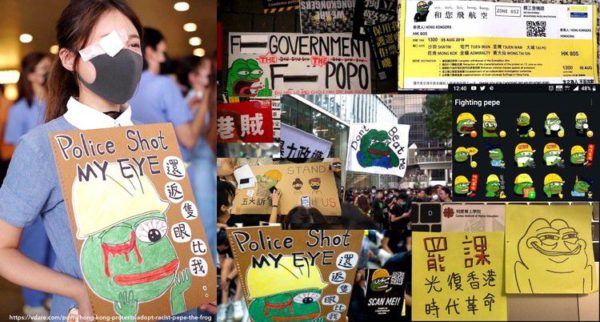
in which she called Campbell – the award’s namesake and one of the field’s most influential editors – a “fascist” and expressed solidarity with the Hong Kong pro-democracy protesters.

You know who else shows solidarity with the Hong Kong protests? That’s right—everyone’s favorite deplorable frog!

Now that’s a dank meme.

I’m curious: does this make Ng a white supremacist for showing solidarity with people who use such a rascist hate symbol? Does it make Cory Doctorow a dog whistler to the far right for appealing to these obviously racist deplorables?

Of course not, but that’s the level of insanity we’ve fallen to.

I am a past recipient of the John W. Campbell Award for Best New Writer (2000) as well as a recipient of the John W. Campbell Memorial Award (2009). I believe I’m the only person to have won both of the Campbells,

All red flags to deplorable readers like me,

which, I think, gives me unique license to comment on Ng’s remarks, which have been met with a mixed reception from the field.

I think she was right – and seemly – to make her re­marks. There’s plenty of evidence that Campbell’s views were odious and deplorable.

There’s that word: “deplorable.” Whenever someone uses it unironically, it’s a sure sign that they hate you. It’s also a sign that they don’t actually have a good argument.

It wasn’t just the story he had Heinlein expand into his terrible, racist, authoritarian, eugenics-inflected yellow peril novel Sixth Column.

I haven’t heard of that one. Thanks for the recommendation, Cory! I’ve already ordered it.

Nor was it Campbell’s decision to lean hard on Tom Godwin to kill the girl in “Cold Equations” in order to turn his story into a parable about the foolishness of women and the role of men in guiding them to accept the cold, hard facts of life.

Okay, I call bullshit. “Cold Equations” wasn’t about the “foolishness of women,” it was about how when our inner humanity comes into conflict with the hard realities of the universe, the hard realities always win.

Switch the genders—a female pilot and a teenage boy stowaway—and the story still works. Switch the endings—have the pilot decide to keep the stowaway, dooming himself and the sick colonists—and it does not.

In fact, it makes the girl even more of a hapless, weak feminine stereotype. Stepping into the airlock voluntarily is an act of bravery. In some ways, she’s stronger than the pilot—and that’s kind of the point.

The thing that makes “Cold Equations” such a great story is that it functions as something of a mirror. It’s the same thing with Heinlein: those who see him as a fascist are more likely to be authoritarians, while those who see him as a libertarian are more likely to be libertarians themselves. After all, fascism is “citizenship guarantees service,” not “service guarantees citizenship.”

It’s also that Campbell used his op-ed space in Astound­ing to cheer the murders of the Kent State 4. He attributed the Watts uprising to Black people’s latent desire to return to slavery.

Was John Campbell a saint? No, and I don’t think anyone’s claiming that. In the words of Ben Shapiro, two things can be true at once: John Campbell had some racist, sexist views, and stripping his name from the award is wrong. (Also, that Doctorow is full of shit.)

The Campbell award isn’t/wasn’t named after him because he was a perfect, flawless human being. It was named after him because of his contributions to the field. If we’re going to purge his name from the award, are we also going to purge all of the classic golden-age books and stories that he edited, too? Are we going to have the digital equivalent of a book burning? Because that strikes me as a rather fascist thing to do.

These were not artefacts of a less-englightened [sic] era. By the standards of his day, Campbell was a font of terrible ideas, from his early support of fringe religion and psychic phenomena to his views on women and racialized people.

What are the standards of our own day? In what ways are we less-enlightened? Are future generations likely to accuse Doctorow of being a “font of terrible ideas,” just like he accuses Campbell here?

Do unborn black lives matter? If Trump is truly a fascist, why does the left want him to take all our guns? Is it okay to be white? Is Islam right about women? Is transgender therapy for prepubescent children just another form of conversion therapy? Are traps gay?

When you free your mind to explore new ideas, a lot of them are bound to be terrible. It’s simply Sturgeon’s law. So is Doctorow criticizing Campbell for having an open mind, or for not conforming to Doctorow’s values and beliefs?

Who’s supposed to be the fascist again?

So when Ng held Campbell “responsible for setting a tone of science fiction that still haunts the genre to this day.

I’m pretty sure that taking hormone blockers and getting your balls cut off makes you a hell of a lot more sterile than anything else. Lesbians, gays, transgenders, queers—all of these tend to be sterile as a general rule. Most babies are still made the old-fashioned way.

Male.

Isn’t her word choice kind of sexist here? I mean, she could have used the word “patriarchal,” but she didn’t. She. Deliberately. Used. The. Word. “Male.”

White.

Is she saying that it isn’t okay to be white?

Exalting in the ambitions of imperialists and colonisers,

Come on, Ng. Let’s not be racist. There were plenty of imperialists and colonizers who weren’t white Europeans. After all, how can we forget Imperial Japan and the Rape of Nanking? Now that was an ambitious massacre. The Turks also ran a pretty brutal empire, as did the Zulus and the Aztecs. You can’t tell me that cutting out the beating hearts of more than 80,000 prisoners to rededicate your temple isn’t ambitious.

settlers and industrialists,”

Find me one place that was not built by “settlers.” Find me one human being on this planet who has not benefitted from “industrialists.” Who do you think makes the vaccines and antibiotics? Who do you think makes machines that harvest your food?

Just for a single day, I would like to see all of these anti-capitalist types live without any of the benefits that capitalism and modern industry provide.

she was factually correct.

And yet, so completely full of shit.

In the words of Andrew Klavan, you can’t be this stupid without a college education.

Not just factually correct: she was also correct to be saying this now.

Because it’s [current year]!

Science fiction (like many other institutions) is having a reckoning with its past and its present. We’re trying to figure out what to do about the long reach that the terrible ideas of flawed people (mostly men) had on our fields.

The best way to fight a terrible idea is to allow it out in the open while fostering freedom of speech. In the words of Andrew Breitbart, sunlight is the best disinfectant.

The reckoning that Doctorow is calling for is something that’s already built into the field. Science fiction is constantly evolving and revisiting its past. Good science fiction not only builds on the stuff that came before, it critiques it while taking the ideas in a new direction.

We don’t need to tear down the legacy of the giants in the field who came before us; we simply need to build up our own legacies for the generations that come after us. But that’s not what Ng and the social justice warriors want to do.

It isn’t a coincidence that the traditionally published side of the field is rapidly losing market share as the SF establishment seeks to purge everything that could possibly offend their progressive sensibilities. The people doing the purging can’t compete on the open market because their toxic ideologies don’t resonate with the buying public, so they’re forced to resort to the digital equivalent of burning books and tearing down statues. Meanwhile, indie publishing is eating their lunch.

Get woke, go broke.

We’re trying to reconcile the legacies of flawed people whose good deeds and good art live alongside their cruel, damaging treatment of women. These men were not aberrations: they were following an example set from the very top and running through the industry and through fandom,

Future generations will struggle to reconcile our good deeds and our good art with our cruel and inhuman treatment of the unborn.

None of this is new. All of us are flawed; every generation is tainted with blood and sins that are reprehensible to those that follow. Realizing all this, you would think a little introspection is in order. But the people today who are so eager to throw stones are completely lacking in self-introspection that they can’t—or rather, won’t—see their own blood and sins.

to the great detriment of many of the people who came to science fiction for safety and sanctuary and community.

Is science fiction a “safe space,” or is it the genre of ideas? It can’t be both at the same time. Ideas are inherently dangerous.

It’s not a coincidence that one of the first organized manifestations of white nationalism as a cultural phenomenon within fandom was in the form of a hijacking of the Hugo nominations process.

Bullshit. If you think that the Sad Puppies were white nationalists, you’re either stupid or willfully ignorant (a distinction without a difference).

Larry Corriea’s flagship fantasy series, the Saga of the Forgotten Warrior, is set in an Indian-inspired fantasy world populated entirely by brown people. Brad Torgerson has been happily married to a woman of color for decades. Sarah Hoyt is both latina and an immigrant.

If this article was written three years ago, you would have just called them all racists, but you can’t do that now because “racist” has lost its edge. You’ve cried wolf far too many times, and no one pays attention to those accusations anymore. That’s why you use words like “fascist,” “white nationalist,” and “white supremacist” to describe your enemies—not because you actually believe it, but because those accusations haven’t yet lost their edge.

While fandom came together to firmly repudiate its white nationalist wing, those people weren’t (all) entry­ists who showed up to stir up trouble in someone else’s community. The call (to hijack the Hugo Award) was coming from inside the house: these guys had been around forever, and we’d let them get away with it, in the name of “tolerance” even as these guys were chasing women, queer people, and racialized people out of the field.

Translation: we’re done with paying lip service to “tolerance” and “open-mindedness.” From now on, if you don’t look like us, act like us, or think like us, we’re going to do everything we can to destroy you.

I’m telling you, these people hate us. That’s why they call us “deplorables.” That’s why they paint us as racists and fascists, even when we’re nothing of the sort. They don’t want to listen to us. They don’t want to give us a fair hearing. They want to destroy us.

Stripping Campbell’s name from the Campbell Award is just another example of this toxic cancel culture. It isn’t about reckoning or reconciliation. It’s a naked power grab.

Those same Nazis went on to join Gamergate, then became prominent voices on Reddit’s /r/The_Donald, which was the vanguard of white national­ist, authoritarian support for the Trump campaign.

See, this is why I can’t trust you, Cory. Gamergate had legitimate grievances with Anita Sarkeesian, Zoe Quinn, and Gawker. Trump supporters had legitimate reasons to want to stop Hillary Clinton from becoming president. Yet you casually dismiss all these people as deplorables, racists, and fascists without even listening to them.

That’s intelluctually dishonest, Cory. It’s also a form of gaslighting.

The connections between the tales we tell about ourselves and our past and futures have a real, direct outcome on the future we arrive at. White supremacist folklore, including the ecofascist doctrine that says we can only avert climate change by murdering all the brown people, comes straight out of SF folklore, where it’s completely standard for every disaster to be swiftly followed by an underclass mob descending on their social betters to eat and/or rape them (never mind the actual way that disasters go down).

I don’t think Cory Doctorow has any idea what actually happens when society collapses. When the thin veneer of civilization gets stripped away, people will eat each other. We’ve seen this just recently in Venezuela, Syria, and Mexico. Here in the US, we can see the seeds of our own collapse in Chicago, Portland, San Francisco, Baltimore, and Detroit (all very blue and progressive cities, by the way).

Also, I don’t think Cory Doctorow has any idea what he’s talking about when he says “white supremacist folklore.” What is that even supposed to mean? Just a couple of paragraphs ago, he called all the Sad Puppies “white nationalists,” and that obviously isn’t true. By “white supremacist folklore,” does he mean all the science fiction that doesn’t fit his radical progressive political ideology? Once again, he’s painting with an overly broad brush.

Also, notice how he uses “white supremacist” instead of “racist.” He can’t use “racist” because that word has been overused. Give it a couple of years, and “white supremacist” will lose its edge as well.

When Ng picked up the mic and told the truth about Campbell’s legacy, she wasn’t downplaying his importance: she was acknowledging it. Campbell’s odious ideas matter because he was important, a giant in the field who left an enduring mark on it. No one questions that. What we want to talk about today is what Campbell’s contribution was, and what it means.

Whenever the people on the progressive left claim that they want to have a “conversation” about something, what they really mean is “shut up and let me tell you how I’m right and you’re wrong.” There is no way to have an honest dialogue with these people, because they will not listen to us “deplorables.” Cory Doctorow has already demonstrated this with his blanket accusations against all the supporters of Gamergate, the Sad Puppies, and President Trump.

These people don’t want to talk about “what Campbell’s contribution was, and what it means.” They want to purge him from the field. Metaphorically, they want to burn his books and tear down his statues.

Look, I’m not trying to defend all of Campbell’s views here. I’m all for having an honest discussion about his bad ideas and how they’ve influenced the field. But I don’t believe I can have that discussion with people who clearly hate me, and will do whatever it takes to cancel and destroy me.

After Ng’s speech, John Scalzi published a post where he pointed out that many of the people who were angry at Ng “knew Campbell personally,” or “idolize and respect the writers Campbell took under his wing… Many if not most of these folks know about his flaws, but even so it’s hard to see someone with no allegiance to him, either personally or professionally, point them out both forcefully and unapologetically. They see Campbell and his legacy ab­stractly, and also as an obstacle to be overcome. That’s deeply uncomfortable.”

Scalzi’s right, too: the people who counted Campbell as a friend are au­thentically sad to confront the full meaning of his legacy. I feel for them.

Do you really, though?

It’s hard to reconcile the mensch who was there for you and treated his dog with kindness and doted on his kids with the guy who alienated and hurt people with his cruel dogma.

Did you catch the sneaky rhetorical trick that Doctorow uses here? He assumes that we’ve already accepted his argument that Campbell’s views were odious enough to have his name stripped from the award. Now he’s using an appeal to emotion to smooth it over.

Gaslighting of the highest order.

Here’s the thing: neither one of those facets of Campbell cancels the other one out. Just as it’s not true that any amount of good deeds done for some people can repair the harms he visited on others, it’s also true that none of those harms can­cel out the kindnesses he did for the people he was kind to.

Or cancel all of his contributions to the field?

If Doctorow actually believes all this, why does he support Ng, who argues that everything Campbell did should be cancelled out by his most odious views? If anything, this is an argument against stripping Campbell’s name from the award.

Life is not a ledger. Your sins can’t be paid off through good deeds. Your good deeds are not cancelled by your sins. Your sins and your good deeds live alongside one another. They coexist in superposition.

Yes, and you should never underestimate the capacity of the human mind to believe two mutually exclusive ideas at the same time, especially when his name is Cory Doctorow.

You (and I) can (and should) atone for our misdeeds.

Not in today’s cancel culture, where everything you’ve accomplished can be erased by the one bad thing you tweeted or posted to Facebook ten years ago. There’s also no forgiveness or repentance, when you will be forever remembered for the worst thing you said or did.

We can (and should) apologize for them to the people we’ve wronged.

No. Giving a public apology is the absolute worst thing you can do in today’s cancel culture, because your enemies will smell blood in the water and come in for the kill.

Never apologize to a mob.

We should do those things, not because they will erase our misdeeds, but because the only thing worse than being really wrong is not learning to be better.

Oh, this is rich.

You first, Cory. Have you taken a good, hard look in the mirror? Have you really, truly asked yourself “what if I’m wrong?”

I don’t see eye to eye with Vox Day about everything, but he was right about this: you social justice types always lie, you always double down, and you always project your own worst faults onto your enemies. That’s why you’re so blind to your own hypocrisy, even when it’s staring you in the face.

I completely and totally agree that we should all strive to admit when we’re wrong and learn to be better for it, but you’re not in a position to tell me that, Cory. Not after painting all us “deplorables” with such a broad brush.

People are flawed vessels. The circumstances around us – our social norms and institutions – can be structured to bring out our worst natures or our best. We can invite Isaac Asimov to our cons to deliver a lecture on “The Power of Posterior Pinching” in which he would literally advise men on how to grope the women in attendance, or we can create and enforce a Code of Conduct that would bounce anyone, up to and including the con chair and the guest of honor, who tried a stunt like that.

Honest question: was the sexual revolution a mistake?

Asimov, Heinlein, Farmer, and all the other science fiction writers who explored questions of sexuality back the 60s and 70s were speaking to a culture that had abandoned traditional morality for a new, “free love” ethic. In other words, having thrown out all the rules, they now felt free to explore their newly “liberated” sexuality.

Was Asimov wrong in his attempt to rewrite our sexual norms? Personally, I believe it was, but I come from a religious tradition that still practices total abstinence before marriage and total fidelity within. Even then, it still depends on context. Groping a random stranger at a science fiction convention is obviously wrong, but playfully pinching my wife when the two of us are alone? Not so much.

I find it really fascinating that the woke-scolds of the left have become far more puritanical and prudish than the religious right ever was. Within the bonds of marriage, most of us religious types are actually very sex positive—after all, where do you think all those babies come from?

And Ng calls us “sterile.” Heh.

We, collectively, through our norms and institutions, create the circum­stances that favor sociopathy or generosity. Sweeping bad conduct under the rug isn’t just cruel to the people who were victimized by that conduct: it’s also a disservice to the flawed vessels who are struggling with their own contradictions and base urges.

Fair enough, but there’s nothing generous about today’s cancel culture, which is frankly pathological in the way it defines everyone by their worst flaws and basest urges.

Creating an environment where it’s normal to do things that – in 10 or 20 years – will result in your expulsion from your community is not a kindness to anyone.

But how can we know what will and will not be acceptable in 10 to 20 years?

Twenty years ago, it wasn’t considered hate speech to say that there are only two genders. Ten years ago, “micro-aggressions,” “safe spaces,” and “white privilege” were not a thing. In fact, we’d just elected our first black president, bringing an end to our racially divisive past. /sarc

In the next 10 to 20 years, will we adopt all the theories and ideologies of the radical left? Or will the pendulum swing back in favor of more conservative morals and standards? We don’t know yet, because the future has not been written, and frankly, it’s not our place to write it. Every generation reinvents the world.

There are terrible men out there today whose path to being terrible got started when they watched Isaac Asimov grope women without their consent and figured that the chuckling approval of all their peers meant that whatever doubts they might have had were probably misplaced. Those men don’t get a pass because they learned from a bad example set by their community and its leaders – but they might have been diverted from their path to terribleness if they’d had better examples.

Certainly. I’m just not convinced that these virtue signalling, social justice warrior types are the examples that we should hold up.

They might not have scarred and hurt countless women on their way from the larval stage of shittiness to full-blown shitlord, and they themselves might have been spared their eventual fate, of being disliked and excluded from a community they joined in search of comradeship and mutual aid. The friends of those shitty dudes might not have to wrestle with their role in enabling the harm those shitty dudes wrought.

I’m confused. Does Doctorow believe that women are strong and independant, or does he believe that they’re tender, fragile creatures that need to be protected from socially inept, “larval” shitlords? I mean, I can see how they need to be protected from predators, since all of us—women and men—are vulnerable to various degrees… but you’d think that a strong, independent woman would be able to hold her own against a socially incompetent geek who is simply a “flawed vessel.”

Since her acceptance speech, Ng has been subjected to a triple-ration of abuse and vitriol,

Join the club.

much of it with sexist and racist overtones.

You keep using those words. I do not think they mean what you think they mean.

But Ng’s bravery hasn’t just sparked a conversation, it’s also made a change. In the weeks after Ng’s speech, both Dell Magazines (sponsors of the Campbell Award) and the James Gunn Center at the University of Kansas at Lawrence (who award the other Campbell Award at an event called “The Campbell Conference”) have dropped John W. Campbell from the names of their awards and events. They did so for the very best of reasons.

No, they did it because they were bullied into it by the woke-scolds.

As a winner of both Campbell Awards, I’m delighted by these changes. Campbell’s impact on our field will never be truly extinguished (alas),

Yes, because what you really want is to tear down all the statues and burn all the books. Who’s the fascist again?

but we don’t need to celebrate it.

Back when the misogynist/white supremacist wing of SF started to publicly organize to purge the field of the wrong kind of fan and the wrong kind of writer, they were talking about people like Ng.

Bullshit.

The entire point of the Sad Puppies (which Doctorow intentionally and dishonestly mischaracterizes as “the misogynist/white supremacist wing of SF”) was to bring more attention to a diversity of conservative and libertarian writers, many of whom are also women and people of color. We were the ones who were excluded, not the ones doing the excluding. In fact, we invented the words “wrongfan” and “wrongfun” to describe the unfair way that we were treated by the mainstream establishment.

Please stop trying to gaslight us, Mr. Doctorow. Please stop projecting your own faults onto us, and recognize your own hypocrisy which is laced throughout this article. I don’t expect a public apology, since I wouldn’t offer one myself, but do wish for once that you would just listen to the people on the other side of these issues. Just. Listen.

I think that this is ample evidence that she is in exactly the right place, at the right time, saying the right thing.

Meanwhile, traditional publishing and the SF establishment will continue to implode, and indies will continue to eat your lunch.

If all you want is to be king of the ashes, you can have it. The rest of us are off to build the new world.