B is for Space Battles

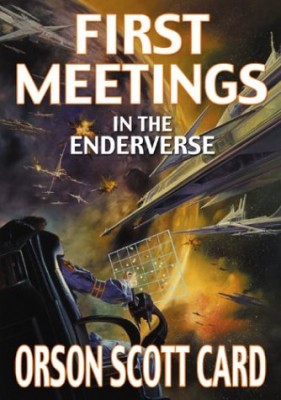
osc_first_meetingsIf you fell in love with science fiction when you were twelve, chances were it was because of the awesome space battles.  That was certainly the case with me.  When I saw Star Wars for the first time, I spent hours running around the house pretending I was flying my own starfighter.  In some ways, I’ve never really stopped. 😛

Ever since space opera became its own subgenre, space warfare has featured prominently in it, probably for the same reasons that Homer and Tolstoy framed their sprawling epics with a tale of war.  Where else are you going to find enough drama to fill volumes?  The fact that it’s set in space makes it so much cooler.

There are a lot of things about the space setting that make war stories different from those set here on Earth.  For one thing, there’s a huge element of exploration and unknown.  Even before we took the first photographs of Earth from space, there pretty much isn’t any corner on this planet that hasn’t been discovered by somebody.  In space, though, it’s still possible to stumble on a hidden planet, or find a mysterious alien artifact that can turn the tide of the war (Halo, anyone?).

For another thing, the dynamics of battle are completely different.  Sure, some stories treat space like an ocean, and there’s certainly a place for that kind of story, but the more interesting ones (at least to me) take into account all the profound differences.  For one thing, the zero gravity means that there is no “up” or “down,” which means that you have to deal with the possibility of attack coming from any direction, not just along a horizontal plane.  That concept alone drives the battles in Orson Scott Card’s Ender’s Game series, where “the enemy’s gate is down.”

One thing that really tickles me is when the story takes things a step further and incorporates things like orbital mechanics and delta-v.  I haven’t seen many books or games that do this, but the ones that do have really engrossed me by making the world feel that much more real.  Glen Cook did it in Passage At Arms, and the new Battlestar Galactica did it in the viper dogfights (though I’m not sure if they did it on the ship-to-ship scale).

The implications of real-world space physics on warfare are quite fascinating.  Rocketpunk Manifesto is an excellent blog that’s almost entirely dedicated to exploring them all, with all sorts of fascinating discussions on what the “plausible mid-future” may look like.  But even if all you’re looking for is an entertaining romp through space, the story telling possibilities are so much greater when you take the constraints of physics into account.

For example, if it takes months or even years to travel between planets, and orbital trajectories are fairly straightforward to figure out, how does it affect things if you can see the enemy fleet coming at your planet that long in advance?  If escape velocity from a gravity well like Earth is so difficult to achieve, what does that mean about the possibility of long-term planetary sieges?  And if starships are so far apart and moving so fast as to make full-on broadsides unlikely, how does that shape the battle tactics and strategy?  In spite of the physical constraints (or indeed, perhaps because of them), the possibilities are endless.

Man, I love me some good space battles.  One of my recent sci-fi favorites that features some epic battles is Wolfhound by my friend Kindal Debenham.  In my own work, you’ll find lots of them, especially in the Gaia Nova series (Bringing Stella Home, Stars of Blood and Glory, and to a lesser extent Desert Stars).  They say that the golden age for science fiction is about twelve years old, and that’s definitely true for me.  Expect to see lots more space battles from me in the future.
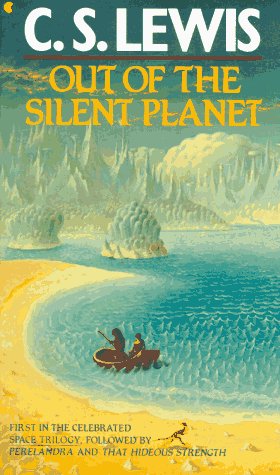
Out of the Silent Planet by C.S. Lewis

out_of_the_silent_planetWhen Doctor Elwin Ransom went on a spontaneous walking tour of rural England, he wasn’t expecting to be kidnapped by a mad scientist and taken to Mars.  He soon escapes, only to find himself lost without any way to return home.

Fortunately, the native Martians soon take him in, teaching the otherworldly stranger of their peaceful, utopian ways.  They are just as astonished to have a visitor from Earth as Ransom is astonished to be their guest.  To them, Earth is a silent planet–the only world with no spiritual connection to the rest of the universe.

The more Ransom learns about the gentle people of Mars, the more he realizes that something evil lurks in the heart of our world–and that contact between the worlds can only hasten the showdown between the forces of good and evil.

I decided to read this book after chatting with Norman Cates at Worldcon 2011, following the “When Faith and Science Meet” panel.  Some fascinating questions had popped up toward the end, especially regarding science fictional universes that are not incompatible with millenialist religions.  Norman asked if I’d read C.S. Lewis’s Space Trilogy, and when I said that most people had told me it isn’t as good as Lewis’s other work, he kind of rolled his eyes and said that it was worth checking it out and deciding for myself.

Well, I didn’t get around to reading it until this summer, but I’m glad I did.  It’s a short read, no more than 180 pages or so, and I finished it in a couple of days.  The world it describes is quite fascinating–a fantastical version of Mars that I’d actually like to visit, perhaps even more than Bradbury’s and Burrough’s.  The kidnapping in the beginning was compelling enough to hook me, but it was the immersive feel of the world that really made the book for me.

This being C.S. Lewis, the more spiritual and allegorical elements of the story lie fairly close to the surface, but it didn’t detract much from the reading experience for me.  It became fairly obvious towards the end that the whole story is basically an attempt to incorporate the Christian millenialist mythos into a mainstream science fictional setting, which is probably where most of the criticism comes from.  If you know that up front, however, and are willing to go along with it, it shouldn’t take much away from the story.  In fact, that might just be what draws you to it.

It’s interesting, because Orson Scott Card tried to do something very similar with the story of Lehi in his Earthbound series, and I think he actually failed where Lewis succeeded.  When I read A Memory of Earth, I felt that Card actually lost the best parts of both the Book of Mormon mythos and his own science fictional world by trying to force them together.  In contrast, Out of the Silent Planet feels much more coherent and compelling, and not artificial at all.

I do feel like things sped up a bit too much at the end, though.  The experience became a little less immersive for me when Lewis went from describing the alien world to bringing the millenialist themes to the forefront.  It’s almost as if the focus of the book itself shifted, and that was a little bit jarring.  I’m a big fan of metaphor, but allegory is a more difficult pill for me to swallow.

That said, I enjoyed the book, and am definitely interested in finishing the rest of the trilogy.  It’s got a lot of merit to it, and is definitely worth checking out no matter what the critics may say.

Trope Tuesday: The Hero’s Journey

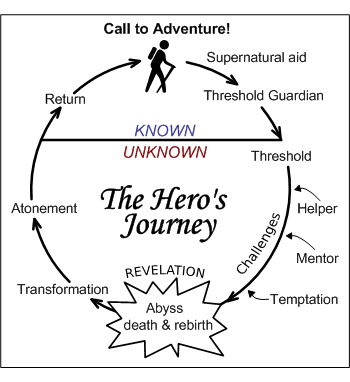
For the next few Trope Tuesday posts, I’m going to pick apart one of my favorite story patterns, the monomyth or “hero’s journey.” Other tropes come and go, but the hero’s journey is truly timeless.  If you can get it to work for you, it can do wonders for your ability to understand and tell stories.

In many ways, this is the trope to end all tropes. it is the source of almost all the major story archetypes, and can be found in the myths and folklore of almost every human culture–hence the term “monomyth.” It was first formulated by Joseph Campbell, who outlined it in his book The Hero with a Thousand Faces.  He summarized it like this:

A hero ventures forth from the world of common day into a region of supernatural wonder: fabulous forces are there encountered and a decisive victory is won: the hero comes back from this mysterious adventure with the power to bestow boons on his fellow man.

Campbell was an academic who studied mythology and folklore, and his book, though insightful, is pretty friggin dense (not to mention scientifically obsolete–he references a lot of Freud’s theories that have largely been discredited).  Later, writers like  Chris Vogler, Phil Cousineau, and David Adams Leeming analyzed and simplified the monomyth for popular audiences.

Enough background–what is it?  Basically, it’s a story pattern that resonates powerfully with readers across all genres.  In its simplest formulation, it follows three steps:

  1. Departure: The Hero leaves the familiar world.
  2. Initiation: The Hero learns to navigate the unfamiliar world.
  3. Return: The Hero masters  the unfamiliar world and returns to the familiar.

Campbell himself identified 17 stages, some of which are interchangeable:

  1. Call to Adventure: The Hero learns that he must leave the familiar world.
  2. Refusal of the Call: The Hero balks, for any number of reasons.
  3. Supernatural Aid: The Hero receives something to help him on his quest.
  4. Crossing the Threshold: The Hero ventures into the world of adventure.
  5. Belly of the Whale: The Hero passes the point of no return.
  6. The Road of Trials: The Hero’s resolve is tested, and he begins to grow.
  7. The Meeting with the Goddess: The Hero experiences the power of love.
  8. Woman as Temptress: The Hero faces and overcomes temptation.
  9. Atonement with the Father: The Hero passes the final test.
  10. Apotheosis: The Hero dies and is reborn.
  11. The Ultimate Boon: The Hero receives a gift to take home.
  12. Refusal of the Return: The Hero doesn’t want the adventure to end.
  13. The Magic Flight: The Hero uses his newly mastered skills to escape.
  14. Rescue from Without: The Hero is saved by his newfound friends.
  15. The Crossing of the Return Threshold: The Hero leaves his new world.
  16. Master of Two Worlds: The Hero reconciles the old ways with the new.
  17. Freedom to Live: The Hero uses what he has learned to live the rest of his life.

Do any of those sound familiar?  Yeah, I thought so.  It might be hard to think of a story that fits all 17 points at once, but it’s not uncommon to find one that hits seven or eight (or possibly more).

A simpler formulation by Leeming goes like this:

  1. Miraculous conception and birth
  2. Initiation of the hero-child
  3. Withdrawal from family or community for meditation and preparation
  4. Trial and Quest
  5. Death
  6. Descent into the underworld
  7. Resurrection and rebirth
  8. Ascension, apotheosis, and atonement

My personal favorite, though, is Vogler’s:

So how useful is this trope really?  Well, consider this: Orson Scott Card’s Ender’s Game was the first novel to win both the Hugo Award and the Nebula Award in the same year…and it hits up all eight points listed above.  The following year, Card published Speaker for the Dead, which also hit all eight points, and also won both the Hugo and the Nebula award.

The thing that made Star Wars more than just another campy sci-fi b-movie with (let’s face it) terrible acting and hokey dialogue is the fact that George Lucas drew so heavily from Joseph Campbell and the hero’s journey.  Think about it: Luke Skywalker passes through almost every one of the 17 points, right up to the awesome throne room finale at the end.

Well, this guy certainly helped.

Of course, it’s possible to go too far.  Lucas also tried to use the hero’s journey in the prequel trilogies, and failed miserably.  Why?  Many reasons, but mostly because he used it as a rigid checklist rather than a dynamic set of flexible guidelines.  The hero doesn’t have to have a literal miraculous conception; he just needs to be chosen in some way.  The goddess doesn’t have to be literal, and neither does the father–those stages can be represented quite loosely, or merged with others.

In my own writing, I’ve found that the best way to use the hero’s journey is to use it to understand what I’ve already written, and to trust my subconscious to fill in the next step.  In every book I read, or every movie I watch, I constantly pick it apart, looking for each of the steps.  This trains me to recognize the hero’s journey in my own work without having to break out the hammer or force things too much.

So how do you use the hero’s journey in your own work?  Do you find yourself hitting up all the points subconsciously, or do you use some other method?  Or do you hate the hero’s journey and try to avoid it altogether?  If you do hate it, I hope that my next few Trope Tuesday posts will help you to change your mind.

Sid Meier’s Alpha Centauri, aka the best 4x strategy game of ALL TIME

Sid Meier’s Alpha Centauri is, without a doubt, the best strategy game I have ever played.  I have many fond memories playing it into the early morning hours while I was in college.

I just bought it for $2.99.  What have I done??

The last time I played this game, it quite literally consumed my life.  I eventually had to delete it from my computer just to keep up with my schoolwork.

But wow, it’s so good.  And the best part, in my opinion, is the story.  Unlike other 4x strategy games, where everything is basically up in the air, Alpha Centauri has a very distinct storyline full of interesting twists and turns.

It starts out with a colony mission to (where else?) Alpha Centauri that fractures into seven factions, based not on ethnicity or nationality, but on ideology.  These are: the scientists, the religious fundamentalists, the communists, the free-market capitalists, the diplomatists, the militarists, and the environmentalists.

The last faction is my favorite, because the planet itself is a character in this story.  As you settle and explore new territory, you come across giant patches of fungus and swarms of hostile mind-worms.  The more the game progresses, however, the more you realize that the fungus is part of a giant neural network, and that it’s trying to communicate with you.  When you finally learn to communicate back–THAT’S when things get interesting.

Oh man, I love this game.  It’s a science fiction classic, reminiscent of Orson Scott Card and Arthur C. Clarke.  I just hope I can exercise some self-restraint this time–but hey, if I can moderate how much time I spend on Minecraft, surely I can do the same with Alpha Centauri.

Famous last words…

“Who would have thought…”

I would like to address this post to my fellow Mormon readers.

A couple of days ago, I got a discouraging message from some old mission friends of mine.  It said, more or less: “who would have thought that the missionary that taught us the gospel would write such a lurid book?” They were referring to my latest release, Sholpan.

To be honest, it’s been very difficult for me to publish it, because I knew that this sort of thing would happen.  I worry that my friends and family will think that I’ve done something inappropriate, or violated some moral standard, or made myself unworthy in some way.  It’s very difficult to put your writing out there under normal circumstances, much less with complications like these.

However, I would like you to know that I have prayed about this, and that the answer I’ve received is that this is a story worth telling.

Sholpan is about a girl who lives essentially LDS moral standards and falls into what may be the worst situation any of us could imagine for such a girl: slavery in the harem of a powerful warlord who has the power not only to rape her, but to kill her.  By refusing to compromise her values–and risking death to do so–she makes friends in unexpected places and gains a whole lot more power than she ever would have if she’d taken the easy path and compromised.

In other words, it’s a little bit like the story of Esther.  Yes, there are sexual themes, but they aren’t there to be gratuitous or titillating; they’re there to show that even in the face of such horrible immorality, you don’t have to compromise your values.

I know this kind of story isn’t for everyone, which is why I’ve put up warnings in the book descriptions and made it abundantly clear that this book has adult content.  And if you decide you don’t want to read it, I won’t be offended at all.  But please, don’t assume that I’ve gone off the deep end or betrayed my faith, because that’s not the case at all.

It’s a difficult position to be in; I’m sure that Stephanie Meyer’s and Orson Scott Card’s bishops get a lot of mail from fellow Latter-day Saints who feel that they ought to be excommunicated.  But these are the kinds of stories that I feel driven to write: stories that address difficult moral issues and don’t shy away from portraying evil for what it really is.

I appreciate your concern on my behalf, but my faith and spirituality are still quite strong.  You may or may not believe that after reading my books, but please don’t feel like you have to save me.  The best thing you can do is continue to be a positive influence, and let me be a positive influence for you.

The interior designer’s approach to story

I recently read a fascinating post on John Brown’s blog with an interesting exercise for analyzing the kinds of stories you most like to read.  By finding out what really turns you on in a story, you can have a much better idea what to write, and how to make your own stories better.

He prefaced the exercise with a story about the interior designer who helped them to decorate their house.  The designer spread out a number of home magazines in front of them, and told them to go through and tear out the pictures that most turned them on.  After doing this, they analyzed the pictures to see what they had in common, and thus discovered how to best decorate their house.

The exercise works much the same way.  First, pick out five books you really like that immediately come to mind.  Mine are:

As many of you know, these are some of my favorite books of all time.  I’ve reread three of them, and I intend to reread the other two at some point.

Next, pick out the elements that these books have in common.  Here’s what I came up with:

1) Set in a different time and place.

Not all these books are science fiction, but the all take place in a world far removed from our own.  Only Spin takes place largely on Earth, but the events of the story transform the world as we know it so much that by the end of the novel, it’s completely different. SPOILER (highlight to see) Besides, at the very end, the two main characters leave Earth by going through the giant portal to another planet, so the novel is arguably about escaping the world as we know it.

2) Stakes that are much more personal than global.

This was interesting, and highlights something I realized when I compared Merchanter’s Luck with Downbelow Station.  In all of these stories, the central driving conflicts are extremely intimate and personal.

To be sure, many of these stories also have an epic backdrop; Mistborn certainly does.  However, I was much more interested in Vin’s growth and development than I was in how the Ska would overthrow the Lord Ruler–in fact, Mistborn is my favorite book in the trilogy for that very reason.

3) Encourages deep introspection.

This shouldn’t come as too much of a surprise if you’ve followed this blog for a while, but I love love LOVE stories that make me see the world in a new way.  Thrillers and adventures are all fun and good, but if it doesn’t make me think, I’m usually like “meh” at the end.

4) Female characters who aren’t weak or passive.

This one might be a bit more controversial, but in all of these stories, I’ve noticed that the female characters are pretty strong, even if they aren’t all kick-butt Katniss wannabes (ugh…I hate Katniss).  Even in Legend, which is largely dominated by men, you still have the earl’s daughter, who is one heck of a spirited woman.

5) Life and death conflicts.

This is interesting: in all of these books, the threat of death is immanently real.  Some of them, such as Legend and On My Way to Paradise, are among the most violent books I’ve ever read.  I’m not sure what it is, but there’s something about life and death struggles that really draws me.

6) Romantic in a broad sense.

I’m using Tracy Hickman’s definition here, in which romance is all about teaching us to feel and bringing us in touch with our deepest feelings.  That’s the central theme of On My Way to Paradise: learning how to be a man of passion after witnessing some of the worst atrocities of war.

All of these books not only make me feel, they are about the feelings that they inspire.  In other words, the emotional elements of the story are both a part of and deeply embedded in the story’s central theme.

The exercises isn’t complete after this, though.  For the last part, take another five books and analyze them to see how they compare.  My second list includes:

So how does the list stack up?  Let’s see…

  1. Definitely true.  NONE of these stories take place in the world as we know it–and that’s awesome.
  2. A Canticle for Leibowitz might seem like an exception, since it follows the broad rise and fall of human civilization after the nuclear apocalypse.  But the things that really drew me to the story were the more personal elements: the novice who makes the illuminated manuscript of the electrical diagram, for example, or the abbot at the very end who SPOILER tries desperately to convince the single mother not to take her baby to the mercy killing station after the bomb fatally irradiates them.  In any case, it’s telling that A Canticle for Leibowitz made this list, whereas none of Arthur. C. Clarke’s books even came to my mind.
  3. Definitely true.  Even Citizen of the Galaxy, which is more adventure fiction than high concept sf, features a fascinating society of interstellar traders that really made me sit back and think about the way we structure our society.  Heinlein has a really awesome way of doing that with everything he writes.
  4. The only possible exception here might again be Heinlein, who had some very extremist views of women (putting it lightly).  However, if I recall, Citizen of the Galaxy has a female character at the end who helps pull out the main character from his indigent circumstances and helps him to come into his own.  Again, they might not all be kick-butt tramp-stamp vampire slayers, but they certainly aren’t weak.
  5. Less true of The Neverending Story and The Dispossessed, but while the central conflicts might not be about life and death, the threat of death (or a total loss of identity) certainly comes into play.
  6. Definitely true.  Few books have taught me to feel more deeply than The Neverending Story.  An absolutely magnificent piece of literature.

So there you have it.  According to this exercise, I should write books set in another time and place, where strong female characters face life and death decisions that personally impact the people in their lives and make the readers think and feel.  Interestingly enough, that is a PERFECT description of Bringing Stella Home, as well as Desert Stars and Into the Nebulous Deep.

Cool stuff.  Makes me want to write.  So on that note, I think I will.

Blurb for Bringing Stella Home and thoughts on Borders

One of the essential elements for a successful in epublishing is a killer book description, and I think I’ve got a pretty decent one for Bringing Stella Home.  However, I could use some feedback, so if you could read it and tell me what you think, that would be great. Here it is:

It is a dark time for the galactic empire. Rebellions at Tajjur and the New Pleiades sap the empire’s strength from within, while hordes of spacefaring Hamiji warriors from the outer reaches sweep ever closer to the Imperial capitol, slagging entire worlds in their wake.

When the Hameji forces conquer his homeworld, young James McCoy runs away to rescue his older brother and sister, Ben and Stella, from their grasp. Though he faces an enemy undefeated in battle and feared throughout all of inhabited space, James will stop at nothing–not even death–to get his brother and sister back.

Things start to look up when he meets Danica Nova, a Tajji mercenary captain who takes him in and becomes his mentor. James reminds Danica of her own brother, whom she failed to protect when the empire slaughtered her family years ago. Now, she hopes to find some redemption from her demons by saving James from his own.

Unfortunately, neither of them realizes that Stella has become a concubine to the main Hameji overlord–and that Ben has been brainwashed and made into an elite shock trooper in the empath squadron sent to hunt them down.

So what do you think?  Too long, too confusing, too cliche, or too boring?  The genre (if you can’t tell) is space opera / space adventure, so I’m hoping it will appeal to fans of Orson Scott Card, C. J. Cherryh, Lois McMaster Bujold, Star Wars & Star Trek, etc.  It’s also got a slight military science fiction bent to it, though I wouldn’t presume to be qualified to write true military sf.

In unrelated news, I recently did an interview with Charlie of Playground51, which appears to be down for some reason (the link is on my Blog Tour page above).  Topics discussed include how I got the idea for Genesis Earth, which parts were inspired by real life, and thoughts on book promotion.  Hopefully the site will be up again soon!

Also, I’m thinking it’s time to do a major overhaul of my blog template.  As much as I love the current one with the purple stars and nebulae, I need something with two sidebars so that my books don’t push everything else to the bottom.  If you have some ideas for a good WordPress template that still keeps the sci-fi feel of this one, please let me know!  I’m very much open to suggestions.

Finally, since the Borders liquidation is all over the news, I thought I’d share my $.02.  It’s sad, certainly, but I don’t think that the fallout will be nearly as gloomy as Joshua Bilmes claims.

Corporate-run big box stores are certainly on the way out, but there will always be a market for good stories, and in many ways the new ebook technology is causing that market to expand at a wonderful rate.  So while the predictions of the print death spiral appear to be coming true (David Gaughran did a great post recently on that), new models will emerge–indeed, are already emerging–which will fill the vacuum.

The thing that gives me great reason to hope is that these new business models give so much power back to writers.  Instead of relying on the mercies of large media corporations to build a viable career, we can now make a living by publishing independently or going with any number of small independent presses.  Readers have more choices and writers have more options.  It’s glorious.

If anything, the Borders bankruptcy has confirmed to me that I’ve made the right choice to go indie, rather than wait for New York to anoint me before launching my career.  Will I ever go with a traditional publisher?  I’d like to someday, but I no longer feel dependent on the old system to accomplish my dreams.  Instead, it’s my readers who will decide my fate, and that’s exactly as it should be.

So thanks for reading!

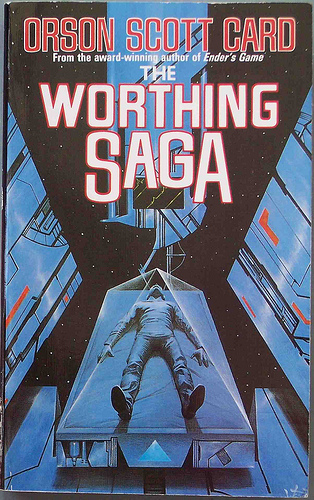
The Worthing Saga by Orson Scott Card

Somec: the miracle drug that allowed the rich and well connected to sleep through the centuries and postpone death almost indefinitely.  While the masses continued to live out their lives in normal time, the social elite watched over centuries as their investments multiplied, and their kingdoms grew into empires…

…and ultimately crumbled.

Thousands of years have passed.  Somec is unknown, except to the one man who saved humanity from its own corruption.  He has slept through the eons to find out if his last gambit brought about the peaceful and benevolent society that he hoped to leave behind.

But as he awakens from his slumber, he finds himself in a universe infinitely stranger than he could have imagined–among a people who revere him as their god.

I’ve heard that Orson Scott Card considers this book his best work, and I’d have to say, I agree with him.  Right up until the ending, it’s at least as good–if not better–than Ender’s Game, his most famous book.

The book unfolds magically from the first page, drawing you in to this beautiful, fantastical world.  The characters have depth and feeling, especially the ones from ages long past, whose stories are powerful and haunting.

I absolutely loved this book–right up to the end, which had a twist that caught me off guard, and not in a good way.

Story-wise, the ending was great.  It was a beautifully foreshadowed twist, right on the order of Ender’s Game and Speaker for the Dead.  Thematically, however, I had a hard time not feeling that it undermined everything that had come before.  I can’t get into details because I don’t want to give spoilers, but the last couple of pages jolted me out of the book and left me saying: “Huh?  How is that right?” I eventually warmed up to it, but it took a while.

Still, I’d definitely give the book five stars, or at least four and a half.  Everything about it is monumentally amazing.  The characters, the worldbuilding, the sense of wonder, the thought-provoking questions and issues it raises, and just the sheer joy of the experience of reading it.  This is a book that I can get lost in, and not just once.

As a side note, the book includes the short novel The Worthing Chronicles, as well as several short stories that take place in the same universe.  The short stories were all quite good, but personally I preferred the novel by itself.  Perhaps it’s because the epic scope came through so much better in the novel than in the stories, or because the stories didn’t allow me to spend much time with any of the characters.  Your mileage may vary, of course.

Interestingly, The Worthing Chronicles is a retelling of Hot Sleep, Orson Scott Card’s first novel.  As a writer, I find it interesting that Card revisited his first novel in this way–to basically rewrite it, keeping all the major events but telling it from the point of view of someone who meets the main character of the first (Worthing) much later in his life.  I haven’t read Hot Sleep, so I can’t compare the two, but The Worthing Chronicles turned out amazingly well.

Will I ever attempt something like this?  Not sure–but it’s interesting to think about.

“The Class That Wouldn’t Die” is up!

Just a heads up: the latest issue of Mormon Artist magazine is out, and my article about BYU’s “class that wouldn’t die” is in it! What’s more, Orson Scott Card himself commented on it.  Squeeeee!!!

If you’d like to read the full article, you can find it hereMormon Artist is published online for free, so be sure to check out the rest of the issue too.

A huge thanks to all the people who helped me out with the research–and an apology to those I should have gotten to, but ran out of time and space to include them.  My goal in writing this was to collect as many oral histories and primary sources as I could find, and put it in a context where the people who were there could tell the story themselves.  I hope I’ve done that without making too many factual errors, but if I have, please let me know.

Also, I would like to personally thank everyone who was a part of Xenobia and the class that wouldn’t die–the people who started LTUE, Leading Edge, and Quark, which have become the bedrock of BYU’s thriving sf&f community.  Thank you so much–all of this stuff has greatly impacted my life, helping me to connect with like-minded friends and to grow tremendously as a writer.  We really do stand on the shoulders of everyone who’s come before, so thank you!

Squeeeeeee!!!!!

An interesting concept

Last night, I was hanging out with a friend of mine and a couple of girls in the apartment complex where I currently live.  We got to talking about books, and one of the girls said something really interesting:

Every book needs to have one thing that the main character knows that the reader doesn’t know, and one thing that the reader knows that the main character doesn’t know; otherwise, it’s too boring.

That’s a fascinating concept.  I know that both things are important, but I’ve never connected them together.

When the reader knows something that the main character doesn’t, it can make for great suspense.  A good example of this is this scene from Xenogears, when the characters are trying to hunt down a monster in the sewers (skip to 6:37):

It’s harder to pull off having the characters withhold information from the readers, but it can be done. I think a good example of this is the scene from Star Wars V: The Empire Strikes Back when the Millenium Falcon arrives at Bespin and C3PO gets shot:

Granted, nothing really vital is withheld here, since by this point Master Yoda has seen Luke’s friends in danger, and Bobba Fett has clearly followed them to Bespin–but the audience still doesn’t know exactly what’s going on, and so it creates suspense.

In terms of Orson Scott Card’s MICE quotient, this would definitely fall under the “information” component of stories. In Brandon Sanderson’s class (and in my own reading), I’ve focused a lot on character, setting (milieu), and plot (event), but I haven’t thought a lot about information.

I wonder how my own novels measure up to this principle. Let’s see…

In Genesis Earth, there are a lot of things that Michael and the reader doesn’t know, but not much that one knows and the other doesn’t. There are, however, quite a few things that Terra knows that the reader doesn’t. Those all come out in the middle, though. In terms of information withheld from the reader, I suppose you could count Terra’s feelings for Michael, in the buildup before the climax, but that’s about it.

In Mercenary Savior, the reader knows a TON of stuff that James doesn’t know–it’s a major source of the suspense in that novel. In terms of things the characters know that the reader doesn’t, there’s much less, but I can think of a few things Danica knows that are kept mysterious until a key climax. Those aren’t foreshadowed until maybe 50 or 100 pages before the reveal, but I suppose it still counts.

Thinking WAY back to my first practice novel, Ashes of the Starry Sea (which I will probably never publish), there is, again, a TON of stuff the reader knows that the characters don’t. Basically, every character is clueless in some crucial way, and the resulting comedy of errors drives the plot. In terms of information withheld from the reader, though, there’s not as much. There is a point where Ian runs off without an explanation, but I’m not sure if that’s just my own poor writing. I could probably pull it off in a revision, but I don’t know when or if that will ever happen.

So yeah, I suppose I’ve done that in my own writing. I suppose it’s much easier to do this in third person, however–Genesis Earth is entirely in first person, and there isn’t anything Michael thinks about that the reader doesn’t see. He is an unreliable narrator at times, but he’s not the character withholding the information–and if he was, I don’t think it would have worked very well.

In any case, it’s a very interesting principle. I’ll have to keep it in mind.