How I Would Vote Now: 1994 Hugo Awards (Best Novel)

The Nominees

Moving Mars by Greg Bear
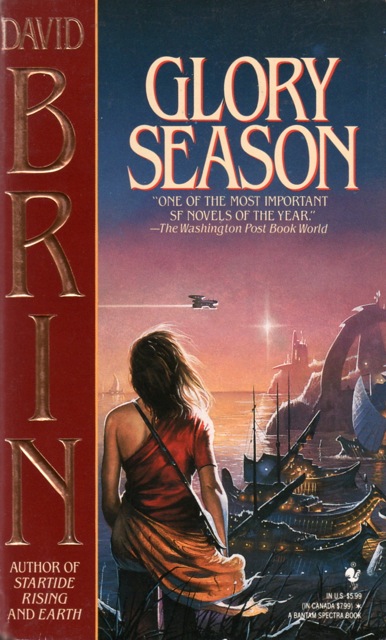
Glory Season by David Brin

Virtual Light by William Gibson

Beggars in Spain by Nancy Kress
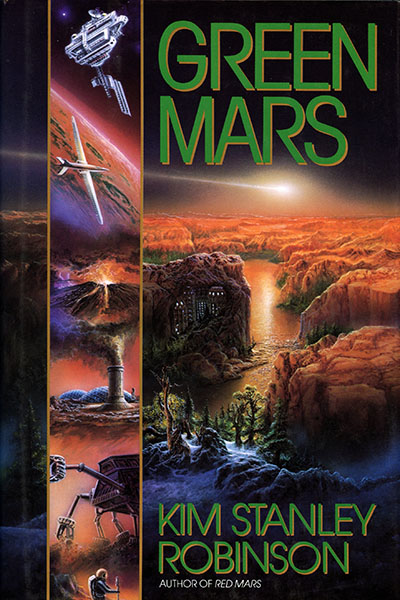
Green Mars by Kim Stanley Robinson

The Actual Results

  1. Green Mars by Kim Stanley Robinson
  2. Moving Mars by Greg Bear
  3. Beggars in Spain by Nancy Kress
  4. Glory Season by David Brin
  5. Virtual Light by William Gibson

How I Would Have Voted

(Abstain)

Explanation

None of these books/authors are so terrible (or so woke) (except maybe for Kim Stanley Robinson) that I would have ranked them below “no award.” With that said, I just didn’t think any of these books were good enough for me to vote for.

Greg Bear’s Moving Mars is basically a sci-fi retelling of the 60s student protest movement on Mars. That’s the big draw. The more I learn about what was actually happening in the 60s, though, the more insufferable I find the hippies and their ideological descendants to be. Needless to say, I DNFed this one.

I skipped the book by David Brin, because he’s just such a dogmatic atheist. I tried his Uplift books and DNFed them for much the same reason. If you’re going to be so dogmatic in your religious views that you cannot build a fictional world where the opposite views might plausibly be true, I have no time for you. That’s equally true for theists as for atheists (unless, of course, the book falls into the religious fiction genre).

I tried Virtual Light, but DNFed it only a couple of pages in, due to some explicit violence against children. Now that I’m a father, I have a really low tolerance for that kind of stuff. I’ve also found Gibson to be a bit too dark and gritty for my taste. He seems to occupy the same literary niche as Neal Stephenson, and rub me wrong in much the same way.

It’s been so long since I DNFed Beggars in Spain that I’ve forgotten what my issue with it was. I found the basic premise to be quite interesting, and got about halfway through the book. Ultimately, though, I think I just got bored with it. But I might come back to this one. Of all the books on the Hugo ballot this year, this is the one I’m most willing to try again.

As for Green Mars, I just couldn’t get into it. Part of that is how insufferable I find KSR’s self-righteous liberal politics to be, but another part was the sexual content in the first few pages. I read Red Mars back in college, when my threshold for those kind of content issues was much lower, but I did come very close to DNFing it after the farm orgy scene. Also, Red Mars was a bit of a slog for my younger self, since I never really latched on to any of the characters. Same with Green Mars. Just a lot of people doing a lot of things, when it was clear that all the (crunchy liberal) author really cared about was the capital “I” Idea. Pass.

Trope Tuesday: Settling the (Final) Frontier

I love stories about colonization, especially when they’re set in space.  There’s just something about a small group of rugged pioneers striking out into the harsh, unforgiving wilderness to make a new life for themselves.  Maybe it’s just something about my American heritage, or all those 4x games I played as a kid, but I doubt it.  Ever since the dawn of time, we humans have been on the move, looking for new and better places to call home.  Small wonder, then, that so many of our stories, both ancient and modern, are about settling the frontier.

Since space is the final frontier, this trope is very common in science fiction.  Heinlein was a huge fan of it, but he wasn’t the only one to play with it–not by a long shot.  John Scalzi (The Last Colony), Nancy Kress (Crossfire), C.J. Cherryh (40,000 in Gehenna), Anne McCaffrey (Freedom’s Landing), and Kim Stanley Robinson (Red Mars, Green Mars, and Blue Mars) are just a few of the many science fiction writers who have explored this trope in their works.  In recent years, several sci fi miniseries (Battlestar Galactica, Terra Nova) have used it as a major premise as well.  And of course, you have all the classic 4x games like Masters of Orion and Alpha Centauri.

Space Colonies can come in a variety of different flavors:

  • Lost Colony — What happens when the original colonists lose all contact with the outside universe and no one thinks to check up on them for a while.  Can either turn into a story of survival or a clash of cultures, if/when they ever re-establish contact.
  • Cult Colony — Religion is one of the few things that will drive massive numbers of people to leave everything behind and start over in a new world.  Just look at the Pilgrims for a real-world examples.  In space colonies of this type, you can expect to see some extremely radical people, since the isolation of deep space tends to compound their fundamentalist tendencies.  Expect these to be both weird and frightening.
  • Space Amish — Something of a combination of the two, except with much more primitive technology.  Expect to see log cabins, horse- (or giant lizard) drawn carriages, and other tropes closer to the Western genre.  Sometimes, they may be hiding a superweapon.
  • Penal Colony — Australia in space (ahem…IN SPAAACE!!!).  What happens when the empire needs a place to conveniently exile all the troublemakers and rabble rousers.  Not a place for the faint of heart.
  • Wretched Hive — What happens to a penal colony when the prisoners actually run the place.  Like the previous type, except taken up to eleven.  Or not, depending on the history and culture.  Tatooine is the eponymous example.
  • Death World — As the name would suggest, this is not the kind of place you’d want to homestead.  Anyone who does is bound to be a badass.  The Empire and the Federation often recruit most of their soldiers from here.
  • Company World — I couldn’t find this one listed on tvtropes.  Basically, it’s a planet that is owned and governed entirely by a private corporation, which expects to make a tidy profit off of the place.  The colonists are basically indentured servants (since robots simply wouldn’t do) and have almost no property or rights.  Expect the story to be about sticking it to the man.

These are just a few of the many possibilities that you can play with when settling the frontier.  In my opinion, however, the essential elements are as follows:

  • The story is not just about exploring a new world, but establishing some kind of a permanent presence there.
  • By coming to the new world, the colonists must leave everything from their old, familiar lives behind.
  • The colonists must resolve the story conflict through their own self-reliance, not by waiting for an outside force to save them.

I’ve only dabbled with this trope, but it does play a role in many of my stories, most notably in the Star Wanderers series.  Genesis Earth also has elements of it as well, though it’s not the main driver for the plot.  It is a major factor in Heart of the Nebula, though, the (currently) unpublished sequel to Bringing Stella Home.  And in my future books, you can definitely expect to see this trope again.

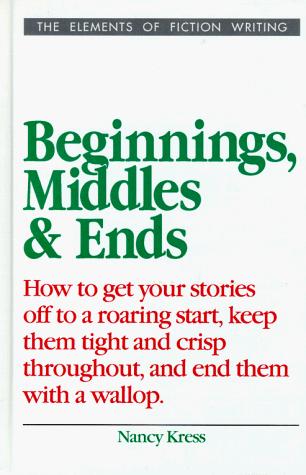
Beginnings, Middles, and Ends by Nancy Kress

I finished last week’s book a couple of days late, but I’m still going to count it.  It’s a book on writing by Hug0-award winning science fiction author Nancy Kress, and for anyone interested in writing stories in any genre, I’d highly recommend it.

Kress wrote this book back in the early 90s, after publishing six novels and a handful of short stories.  She also taught creative writing, and from the calibre of her writing advice, that’s abundantly clear throughout the book.  She tackles just about every aspect of story creation in a straightforward, methodical way, with a calm, almost motherly tone that is reassuring without being too heavy-handed.  She picks apart just about every element that is essential to a good story, and explains how it all works in a way that is clear and makes sense.

Because this was written back in the 90s, there are some artifacts of traditional publishing that make the book feel dated.  For example, the first few chapters focus on how to construct a beginning that will sell to an over-stressed, over-worked editor, with less of an emphasis on how to hook general readers.  Aside from that, however, much of her advice is still quite applicable to today’s indie writers.  The book’s main focus is on story, and good storytelling is important no matter which market you’re writing for.

The section on beginnings was a bit overwhelming, with so much “you must do this, you must not do this” kind of advice that it would probably kill my creativity if I were reading it as I was just starting a new book.  However, the sections on middles and ends were quite insightful, and sparked a ton of great new ideas for my current project.  Either way, her advice is spot on.

If you’re a new writer, I would recommend picking this book up after you’ve written a practice novel, or after you’ve finished a couple of short stories.  If you’re already an experienced writer, I would still recommend it, because even if most of the advice isn’t new, it will help you see much more clearly how a good story comes together.  It’s a short, easy read, but it’s so packed with good information that I’ll definitely reread it.  Highly recommended.

Worldcon 2011: Saturday

Alright, I should just write this up and finish my convention report before life sweeps me away completely.

Saturday was the main day of the con.  To be honest, I forgot all the panels I went to, except this really awesome one by a guy at NASA on near Earth objects (NEOs).  Holyfreakingcow there are thousands of these objects AND WE ARE SENDING MISSIONS TO THEM!!!  So cool!

I went to a kaffeklatsch with Nancy Kress, which turned out to be quite an interesting experience.  She’s an extremely gracious person, much like Tracy Hickman, and gave some excellent career advice: 1) no matter the obstacles or difficulties, always find a way to keep writing, and 2) always be true to the story.

Had dinner with some other Utah writers, and I wish I could say it was pleasant, but for some reason it got very antagonistic.  I know it takes two to tango, but I honestly don’t know what I did to make it that way.  Perhaps stress levels were running high, or people misread my tone, but the conversation at our table completely fell apart at least twice.  It was very wierd.

Part of it might have to do with the fact that I’ve become something of a trailblazer for indie publishing within the SLC / Utah Valley writing community.  Which brings me to another side note: everyone talks about how militant and polarizing self publishers are, when in my experience it’s the advocates of traditional publishing who tend to adopt an us vs. them attitude.  To be sure, there are plenty of desperate to be published writers who take the indie path just to “stick it to the man,” but those people tend to fade away once they realize it isn’t a silver bullet.

Anyway, the Hugo Awards in the evening were great!  Robert Silverberg presented the award for Best Novella, and for fifteen minutes he was my favorite person in the world.  So hilarious!  I’ve tried to find a video, but there doesn’t seem to be one up yet.  Utah writers were nominated in six categories, and even though none of them won, the competition was pretty dang good, so I don’t feel so bad about losing.

All in all, it was a great convention!  I had a lot of fun, even if I did feel a little exhausted by the end of it.  I’m not sure if I’ll be attending future worldcons in my current capacity as a beginning writer, but I most likely will buy supporting memberships in order to vote in the Hugos (and download the voting packet).  It’s a good community, and I’m glad to be a part of it.

World Fantasy Day 3

Saturday at the World Fantasy convention was awesome. Tons of amazing panels, with excellent advice and some very interesting insights.

First, I attended “The Story Cycle vs. The Novel,” which was moderated by L.E. Modesitt.  The panelists talked about the evolution of a series and the difference between a cycle of novels vs. a continuation.  In a story cycle, there may be many books, but one ending, whereas in a more loose series, every novel is a standalone with an ending.  In another panels someone used the analogy of an avalanche vs. skipping stones, which I found quite useful.

Next, I attended “The Continued Viability of Epic Fantasy.” The panel started out by defining epic fantasy (as opposed to heroic / sword & sorcery), which they more or less agreed has the following characteristics:

  • Takes place in an alternate world
  • Is large in scope, rather than personal
  • Involves characters who are trying to save the world
  • Has a multi-strand plot with many viewpoints
  • Has an extended story arc

David Drake then blew the premise of the panel out of  the water by arguing that epic fantasy is still selling well–in fact, that the market has been expanding over the past ten years.

Drake also pointed out, however, that when you’re successful, the normal commercial rules don’t apply; first, you have to prove your chops, realizing that the publishers will lose money on your first couple of books.  That’s just a fact, and anyone who denies it is arrogant and stupid.

The next panel was “Slaughtering the Evil Hordes,” about the barbaric hordes trope in fantasy and whether it’s disturbing or a good thing.  I asked the question: “how can you have the hordes win and still make it work?” and Tom Doherty pointed to Modesitt’s Magic of Recluse as a good example of this.  Basically, you have to show the good in each side, sometimes by a shift that makes the reader suddenly and unexpectedly see the hordes in a new light.

Next, I attended “The Moral Distance Between the Author and the Work.” This panel was quite fascinating.  One of the interesting questions that was raised was whether you can deduce an author’s morals from reading their work.  At first, the panelists said that in good art, you can’t, but then Scott Edelman and Eric Flint pointed out that if you read an artist’s whole corpus, usually you can.  Nancy Kress compared artists to dandelions; over time, you grow and mature, but when you send out work, where it goes and what happens to it has nothing to do with you as the artist.

One of the best panels, however was “Authors and Ideas,” which happened the next hour.  The panelists started by agreeing that as an author, your most deeply held personal beliefs will always show up in your work, whether or not you know you believe it.  The stuff we believe most firmly, we never even think to question because it is invisible to us.  Most aliens in sci fi are less alien than the Japanese, and our own great great grandparents are more alien to us than anything else.

The panel then got on to how writing is a collaboration between the author and the reader, where the writer has no control over what the reader will take from it.  Even though your art will contain your beliefs, in order to be great it must also convey what you don’t believe–the “opposition in all things” element.  Done well, the author “shakes hands with the reader over the character’s head.”

After the panels, I had dinner at the con suite–and let me just say, the convention organizers went WAAAAY out of their way to make the con suite awesome.  They literally provided every meal, and enough of it to feed everyone who came in, which really surprised me.  A huge thanks to everyone who volunteered with organizing and running the con.

Anyway, I got into a HUGE discussion at dinner with an amazing couple who runs a used book business out of Massachusetts.  We talked about artificial intelligence, the physical limits of computer circuits, and whether it’s possible for us to one day emulate the human brain on a computer system.  Gained some very interesting insights for my novel Genesis Earth, as well as just a general fun time.  Conversations like this are one of the things I treasure about these events.

And then I bounced around the parties for the rest of the night.  Had fun, talked with Tom Doherty and a handful of authors (though not as many as last year), but probably most importantly made a bunch of awesome writer friends, with whom I will be keeping in touch after the convention.

I might not have met a bazillion agents and editors this year, but I did make a ton of friends among the aspiring writers and editors, and that definitely counts for something.  I look forward to staying in touch and supporting everyone as we break in and make our mark; we’re the next generation of an awesome literary tradition, and we’re definitely going to keep it going!

World Fantasy 2010: Day 2

Wow, what a tiring day.  I feel drained, mentally and physically, and I didn’t even spend all that much time at the parties tonight.

I got started a bit early, prowling around the book-swap table, where I was rewarded with some books that look really good.  If you know what you’re doing, you can totally get the price of your admission ticket in free books (and then some).  I packed super light for that exact reason.

The convention started out with an awesome panel titled “Fantasy Gun Control,” where the panelists discussed why fantasy tends to favor swords over guns, even though guns have existed since the 1300s.  Funniest quote from the panel: Walter Jon Williams asked what if Samuel L. Jackson was one of the Defense Against the Dark Arts teachers from Harry Potter, and Charles Gannon quipped “do I have to get magical on your ass?”

The other panel I attended was “The Tension Between Art & Commerce,” an excellent panel which very quickly evolved into a cage fight between Nancy Kress and her publisher, Tom Doherty.  It basically went something like this:

Tom: I don’t think there is any tension; the best art always sells the best.

Nancy: No way!  Just look at Danielle Steele: her writing is CRAP, yet she sells like crazy–and that’s the norm!

Tom: But true art endures beyond its time and sells much better over the long run.  After all, just look at Homer and the Iliad.

Nancy: Homer? Are you serious? He’s been dead, what–2,000 years?

Tom: Yeah…but my point is, if you’re a writer, you need to write what’s in your heart and not chase the market.  If you do try to chase the market, your writing will be crap, AND it won’t sell.

Nancy: True, but what about my apocalyptic novel about a plague that turns domestic dogs feral?  I got four rejections that all said: “this book is great, but it would offend dog lovers so much that we can’t publish it.”

Tom: Well, those were just stupid editors.

Nancy: Uh, Tom…one of those was from your publishing house!

Of course, those aren’t exact quotes, and Nancy was very quick to make it known that she loves Tom and appreciates him for publishing so much of her work, but that was more or less how it went.  It was hilarious.

At the  same time, the panel was quite useful as well.  Everyone mentioned how a writer’s willingness and ability to learn the craft and accept criticism is key–especially after getting an editor.  Without this capacity to learn, aspiring writers will almost never succeed, whereas those who have it have a chance.

The rest of the time I spent hanging out and shmoozing with various people.  I interviewed both Dan Wells and Peter Ahlstrom for the Mormon Artist article on BYU’s “class that wouldn’t die,” and those interviews went very well.  Those two guys are seriously awesome–way down to earth and easy to talk with.

I also pitched to a couple agents, and I think it went very well.  For one of them, I thought I saw her eyes light up as I described the characters in my novel from last year, Genesis Earth.  It might just be wishful thinking, but her response was enough to convince me that I need to give that story a thorough revision and send it out to her before the end of next month.

I worry, though, that there’s not as much demand for the kind of fiction I write.  My writing falls very solidly into science fiction (space opera, to be more specific), but everything I see here at the con is fantasy–epic fantasy, urban fantasy, paranormal, steampunk.  No science fiction, except from a couple small presses.  Just fantasy.

In the art vs. commerce panel, Ginger Buchanan claimed that science fiction was never a popular genre–that the popularity was all due to a handful of specific writers and a handful of specific works.  I’m not sure I agree with that, but it is a bit discouraging.  Speculative fiction is a fairly niche corner of the publishing world to begin it, and to see and hear people within that niche treating science fiction as ANOTHER niche…it doesn’t bode well for someone who wants to make a full time living writing it.

But then again, maybe my stuff is good enough that it’ll find a home anyways–and not just a home in a small press, but with a big enough publisher that I can actually be a full time writer.  I don’t hold any illusions about my books making me fabulously rich and famous or somehow spawning a new sub-genre unto itself, but I do think my writing is good enough that I can shoot big and hope to get somewhere–perhaps even expect it.  I don’t know, but I feel that the hope is justified, at least.

Anyhow, that’s probably more angst than you cared to read.  World Fantasy is going great, and I’m exhausted, so I’m going to hit the sack.  Good night.