A lawful good character acts as a good person is expected or required to act. He combines a commitment to oppose evil with the discipline to fight relentlessly. He tells the truth, keeps his word, helps those in need, and speaks out against injustice. A lawful good character hates to see the guilty go unpunished.
Although most Lawful Good characters are unambiguous, their conflicts are often quite complicated. This is because their dedication to the moral code is itself a weakness which an intelligent villain can exploit. Typically, this is done by putting them in a situation where they have to choose between being lawful (catching the bad guys) or being good (saving all the innocent people who will die in the process). A smart Lawful Good character, however, will come up with a third option that turns the ethical dilemma on its head, though it might require a heroic sacrifice.
Very often, these kinds of characters appeal to us because they represent some higher ideal which we wish we could follow. However, that’s not always the case, especially in more cynical works like A Game of Thrones, where the most lawful good characters also tend to be the most stupid. Ultimately, it all comes down to the bias of the writer; even when you’re trying not to be didactic, it’s hard not to use the Lawful Good character as a vehicle for some sort of message.
A shallow Lawful Good will be little more than a paragon for whatever virtue they’re meant to represent. A more nuanced Lawful Good will have some sort of a flaw (besides the backhanded ones), or some sort of internal conflict connected with their moral code to make them more human and relatable.
My favorite Lawful Good would probably be Sir Galahad from Le Morte d’Arthur, but mostly because of the sharp counterpoint he provides next to all the thugs and criminals other Knights of the Round Table. Carter from Halo: Reach is a pretty cool Lawful Good, though he wasn’t my favorite (that would be Jorge). And even though he’s a complete idiot, Ned Stark is still the only adult character from A Game of Thrones that I found remotely likable.
In my own work, Jalil from Desert Stars starts out as Lawful Good, though he shifts to Lawful Neutral in the middle and up to Neutral Good by the end. In Bringing Stella Home / Sholpan, Lars and Narju definitely fall under this alignment, putting a lot of pressure on Stella to live up to their ideals. I explore Lars’s idealistic character a bit further in Heart of the Nebula, a direct sequel to Bringing Stella Home which I hope to release later this year. And in Star Wanderers, Noemi tends to fall under this alignment–though the story is not so much about saving the world as it is about saving each other.
Alternate versions put 20th Century Fox in the Lawful Evil slot.
I love personality tests. There’s something immensely satisfying about putting yourself on a grid that tells you something new and insightful about yourself and the people around you. My personal favorite is the Meyers-Briggs test (I’m an ENTP), but I like playing around with others as well.
Character alignment is what you get when you combine fictional characters with the role they’re supposed to play in the story. It’s a way to categorize the different ways they react to problems and ethical dilemmas, and to see which are inclined to be enemies and which are inclined to be allies.
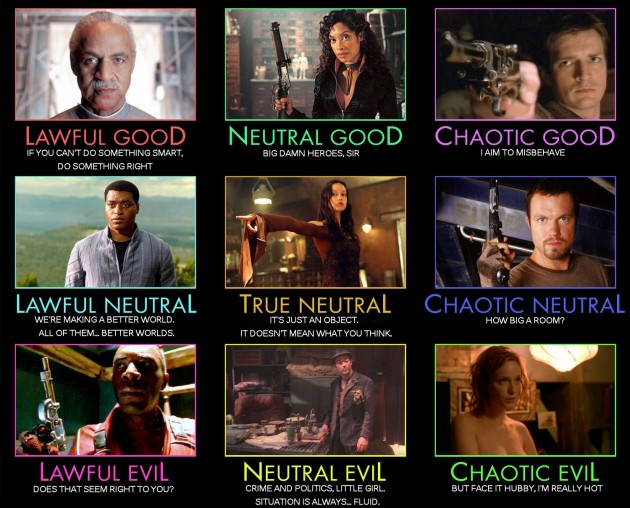
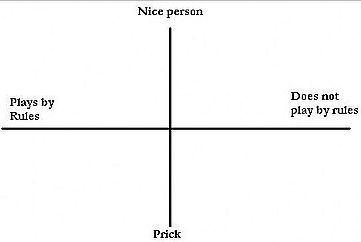
These systems initially arose out of RPG systems like Dungeons and Dragons, which use numbers, charts, and statistics to turn a story into a playable game. There are many different kinds of alignments, but the most well-known is probably the one used by D&D, which charts characters along a good-evil axis and a lawful-chaotic axis. In practice, the result looks a little like this:
Of course, that’s a very simplified version. The tvtropes page goes into much greater depth, but I’ve personally found that this page right here does a much better job explaining the concepts behind the chart.
The horizontal axis, law vs. chaos, describes how much the character values order and authority vs. their own independence and freedom. Lawful characters value honor and obedience, while chaotic characters value innovation and rebelliousness. Characters who are neutral with regards to law and chaos generally respect authority, but put their own interests first and go against the established norms when that’s the best way to further their own ends.
The vertical axis, good vs. evil, describes how well (or poorly) characters tend to treat other people. Good characters are altruistic and make sacrifices to protect the defenseless, whereas evil characters will kill, rob, or torture the innocent simply for the evulz. Characters who are neutral with regards to good and evil don’t like to hurt others, but are not above pursuing questionable means to achieve their own goals.
Put together, the alignments create a 9-square chart, like the one at the top of the post. While it’s certainly not obligatory to fill every slot, doing so can add a greater degree of depth to your story, as it certainly did with Firefly.
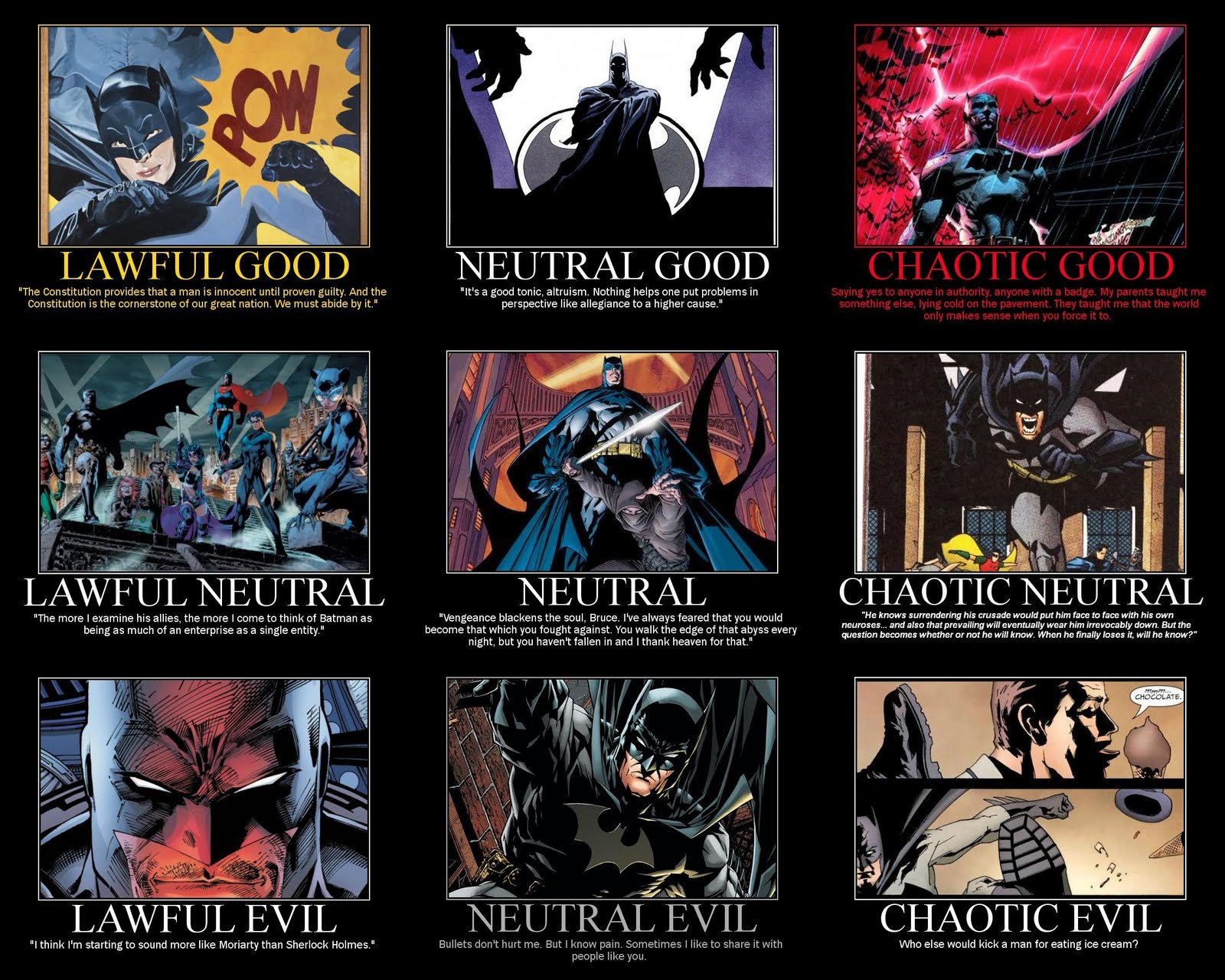
As with any formula, however, there is danger in holding too closely to the chart and becoming inflexible. In real life, people switch alignments all the time, just as personalities can change and evolve (in high school, for example, I was an INTP). Not only that, but some characters even fulfill all the possible roles, depending on the incarnation and the story.
Because I'm BATMAN!
The point is, character alignment is just a tool, not a hard-and-fast rule that needs to be used with every story. If it’s a helpful way to think about your characters and set them up with interesting conflicts, great. If not, don’t sweat it; Homer and Shakespeare were telling great stories long before this chart.
I’m going to be going overseas soon, so I expect my internet access is going to be spotty for the next couple of months. Because of that, I’m going to write up a bunch of Trope Tuesday posts on each of the nine alignments and schedule them to post automatically. So stay tuned for more!
I would like to address this post to my fellow Mormon readers.
A couple of days ago, I got a discouraging message from some old mission friends of mine. It said, more or less: “who would have thought that the missionary that taught us the gospel would write such a lurid book?” They were referring to my latest release, Sholpan.
To be honest, it’s been very difficult for me to publish it, because I knew that this sort of thing would happen. I worry that my friends and family will think that I’ve done something inappropriate, or violated some moral standard, or made myself unworthy in some way. It’s very difficult to put your writing out there under normal circumstances, much less with complications like these.
However, I would like you to know that I have prayed about this, and that the answer I’ve received is that this is a story worth telling.
Sholpan is about a girl who lives essentially LDS moral standards and falls into what may be the worst situation any of us could imagine for such a girl: slavery in the harem of a powerful warlord who has the power not only to rape her, but to kill her. By refusing to compromise her values–and risking death to do so–she makes friends in unexpected places and gains a whole lot more power than she ever would have if she’d taken the easy path and compromised.
In other words, it’s a little bit like the story of Esther. Yes, there are sexual themes, but they aren’t there to be gratuitous or titillating; they’re there to show that even in the face of such horrible immorality, you don’t have to compromise your values.
I know this kind of story isn’t for everyone, which is why I’ve put up warnings in the book descriptions and made it abundantly clear that this book has adult content. And if you decide you don’t want to read it, I won’t be offended at all. But please, don’t assume that I’ve gone off the deep end or betrayed my faith, because that’s not the case at all.
It’s a difficult position to be in; I’m sure that Stephanie Meyer’s and Orson Scott Card’s bishops get a lot of mail from fellow Latter-day Saints who feel that they ought to be excommunicated. But these are the kinds of stories that I feel driven to write: stories that address difficult moral issues and don’t shy away from portraying evil for what it really is.
I appreciate your concern on my behalf, but my faith and spirituality are still quite strong. You may or may not believe that after reading my books, but please don’t feel like you have to save me. The best thing you can do is continue to be a positive influence, and let me be a positive influence for you.
That’s right! After much wrangling, I formatted it this morning and published it to Amazon this afternoon. In less than 24h hours, it should be up for sale!
In many ways, Bringing Stella Home is a lot different from Genesis Earth. For one, the scope is much larger, with the rise and fall of galactic empires and a war leaving billions dead in its wake.
At the same time, however, the stakes are very personal. It’s not about turning the tide of human history or saving millions of lives; it’s about one boy who doesn’t want his world to fall apart, and will do anything to save the people he loves.
I put a content warning in the description because there’s a lot of darkness in this book. It’s not for everyone; I know that some of my friends would find it shocking and offensive. However, it isn’t my intention to glorify evil or celebrate immorality; rather, by portraying it honestly, I hope to make the struggle against it that much more meaningful. There is, after all, an opposition in all things.
Writing this book was a watershed moment for me. Not only is it the first book in a series which I hope to continue across many books, but it marked a shift in my writing. Before the rise of indie publishing, I thought this would be the one that finally broke through the iron gates of the publishing industry and made my debut. Perhaps that was why I was so reluctant to send it out; I didn’t want to experience the crushing blow of rejections from agents who didn’t think they could sell it, or editors who think that science fiction is dead.
But now, I don’t have to break through those iron gates; now, I can send this story out into the world and let the readers decide whether it’s any good. And that’s exactly what I intend to do.
For all those of you who have helped bring this project up to this point, I want to sincerely thank you by giving you a free copy of this ebook. I’ll be sending it out tomorrow, most likely; if for some reason I miss you, please email me and I’ll correct the mistake. They say that writing is a solitary art, but this day and age, that’s no longer true. So once again, thank you.
It’s been an exciting journey thus far, and something tells me that it’s only getting started. I can hardly wait to see what the future will bring!
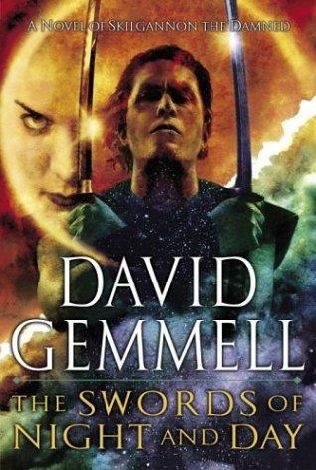
A thousand years ago, a young warrior named Skilgannon helped the princess Jianna escape an attempt on her life. They became lovers, and when she retook her throne, she made Skilgannon her chief general. When she ordered the abject annihilation of her enemies, he loved her too much to refuse her–and thus became Skilgannon the Damned.
Now, the wizard Landis has recalled Skilgannon back from Hell to defeat the tyrant queen known as the Eternal. For hundreds of years, the Eternal has ruled the world, using the arcane arts of a fallen civilization to achieve immortality and crush all who oppose her.
When the Eternal learns of Landis’s treachery, the only hope for freedom lies with Skilgannon, the axeman Harad, the huntress Askari, and the Drenai ranger Alahir. But how can they defeat an enemy who commands nearly all the armies of the world? Who has lived a dozen lifetimes and simply steals the bodies of her clones whenever she is killed?
But most of all, how can Skilgannon defeat the Eternal when she is none other than Jianna, his beloved?
The Swords of Night and Day is a direct sequel to White Wolf, the first David Gemmell novel that I read. I have to admit, I wasn’t particularly impressed with White Wolf; it meandered a lot and didn’t seem to have any clear direction.
That is most certainly not the case with The Swords of Night and Day, however. I was hooked from the very beginning, and could hardly put it down until the shocking, mind-bending twist at the end. It tied up all the loose ends from White Wolf and completed Skilgannon’s character arc in a surprising yet satisfying way.
One of the reasons I think I love David Gemmell so much is because he captures so perfectly the experience of being a man. In that, I suspect that Gemmell is to me what Jane Austen is to most women.
But even though Gemmell’s characters might be crass, vulgar, chauvanistic, and downright detestable at times, there is always something heroic deep inside of them–something worth redeeming. And when he does redeem them, it surprises me how powerful it is–even when he redeems someone I don’t want him to.
With The Swords of Night and Day in particular, one of the things that particularly fascinated me was the fictional cosmology of the Drenai universe. With magic that can resurrect people’s spirits from hell, the story must inevitably deal with questions of the afterlife. Yet even so, there’s still enough ambiguity and latent potential that it never felt stilted or labored. If anything, it felt a bit like Tolkien’s cosmology in The Silmarillion, where all the stuff about gods, angels, and the undying lands only added to the sense of wonder.
I love just about all of David Gemmell’s books, but this one in particular was well worth the time and experience reading it. I wouldn’t recommend starting with this one, though: better to read Legend, White Wolf, and The King Beyond The Gate first. But if you’ve read and enjoyed those ones, you will DEFINITELY love this one. I certainly did.
Eons ago, in the Days of Fire, demons feasted upon the souls of men the way that men feast on cattle. Those days ended when the second most powerful demon betrayed his people, damning them to purgatory so that men could inherit the Earth.
Four thousand years have passed, and the demons are beginning to come back. The dread Kreyakin, advance guard to the demon invasion, have already passed into the world of men. In order to open the portal to the other world, however, they must cast a spell requiring the lives of three kings.
Two of the kings have already been sacrificed. The third lies within the womb of the Princess Axiana.
The fate of the mortal world now lies in the hands of three aged warriors–Nogusta the swordsman, Kebra the bowman, and Bison the brute–and a handful of unlikely fugitives. Together, they must stand against the dread Kreyakin and all the forces of hell.
Alright, my attempt at a jacket blurb really doesn’t do this book justice. I want to say it was one of the best Drenai books I’ve ever read, but the truth is it’s just like every other book in the Drenai saga, which is to say that it’s awesome.
I think I’ve figured out why I love David Gemmell’s books so much. It’s because his books so perfectly capture what it means to be a man. Women read Twilight because it perfectly captures the experience of being a teenage girl in love, and Gemmell’s books–all of them–capture what it means to be a man.
I’m not just talking about the platonic ideal of manhood–I’m talking about the everyday reality as well. Two men sitting together in “companionable silence.” A warrior who scoffs when his commander sends some lesser men to accomplish a mission, then after getting chided says “I spoke in haste,” and the matter is dropped. Guys who tackle problem after problem, from fighting duels to fleeing from armies from helping the inexperienced princess with her messy childbirth, and do so without flinching, because hey, someone’s got to do it.
But the ideal is definitely there too, because in every single one of Gemmell’s books, circumstances conspire to push his characters right up to the very limits of their abilities. When that happens, their true character shines out, and the most unlikely ones rise to great feats of heroism, often sacrificing their lives in the process.
Indeed, if there’s one underlying theme in all of Gemmell’s books, it’s about heroism and what makes a true hero. It’s awesome.
The best part, though, is how Gemmell redeems even the darkest characters. I can’t say much about this book without giving away the ending, but let me just say it was extremely satisfying. Evil is not some slimy b-movie monster–it’s a quality that everyone possesses in varying degrees, alongside the potential for greatness.
In this way, I think Gemmell is the antithesis of George R. R. Martin. While both authors write in shades of gray, Martin emphasizes how even the noblest, most honorable people have an ugly black stain somewhere in their character, whereas Gemmell focuses on the potential within all of us to rise above the darkness in our souls and accomplish feats of greatness. His heroes are dark and gritty, but at the end of the day, they are heroes nonetheless.
In short, this book was awesome. If you’ve ever read a book by David Gemmell and loved it, I guarantee you’ll love this one. I certainly did.
Tenaka Khan was a child of two nations and an outsider to both. Half Nadir, half Drenai, the only home he ever knew was in the ranks of the Dragon, the elite fighting forces of the Drenai. But now, a mad dictator rules the land, and the Dragon has been destroyed.
With all his friends dead at the hand of the evil Drenai emperor, Tenaka has only one desire: to steal into the palace and assassinate him. Along the way, however, he makes a number of friends, all of whom seek the same thing, but all for different reasons. As they join forces with the Skoda rebels, Tenaka realizes that he not only has something to die for–he has something to live for.
But in order to defeat the mad emperor, the rebels must fight the Joinings–terrible creatures made from man and beast, who slaughtered the Dragon years before. Only the Nadir can save them–but the Nadir want nothing more than to ravage the Drenai.
If you’ve read my review of David Gemmell’s Legend, you know why I love his books. This one was no less incredible. Parts of it were just as poignant as anything in Legend, and the ending, while bittersweet, was no less satisfying.
It’s really fascinating to me, because Gemmell’s books are not particularly flowery or well written. His descriptions are sparse, his prose is unassuming, his characters, while distinguished from each other, sound more or less the same, and his viewpoint is often inconsistent. But in terms of raw storytelling, his books are unequaled by anything else I’ve ever read.
He makes me fall in love with his characters: I cheer for them when they rise to the heroic deeds that circumstances demand of them, I cry when they fall short of what they could have been, and I weep when they give their lives in the service of something greater than themselves, which is almost invariably the case.
My favorite part of any David Gemmell book has got to be the order of warrior priests known as the Thirty. They don’t show up in every book, but they show up in many of them, and they always share the same characteristics. The warrior priests are dedicated to the Source (Gemmell’s equivalent of God in his Drenai universe), and have the supernatural abilities to speak telepathically, put thoughts into others’ minds, shield their comrades from the magic of the Chaos brethren, and leave their bodies to fly across the world and do battle in other dimensions beyond the grave.
The way the order is run is absolutely fascinating. One person is the mouth, the other the ears, the other the heart, etc. The most unlikely characters always fill the particular roles–but always for good reason. They fight to defend the innocent and pure, but more than that, they always have some great destiny to perform–a destiny that invariably pits them against the forces of Chaos in some great, decisive battle. In that battle, all of them invariably die, except for the weakest among them, who goes out to found the next order of the Thirty.
I don’t know about you, but this kind of stuff, just makes me want to jump up and down. This is fantasy at its best–good versus evil, warriors facing death, and the most unlikely heroes rising to the level of greatness that war and honor demand of them. Throw in a little magic, a brotherhood of evil sorcerers bent on crushing all that is good in the world, and terrible monsters the likes of which exist only in nightmares, and I am so there, man–I am so there.
In short, this book was nothing less than awesome. If you love any book by David Gemmell, I think you’ll enjoy this one. It’s got everything you could possibly expect from heroic fantasy, and more.
Almost twenty years have passed since the fall of the Targaryen dynasty–twenty years since the last of the dragons was seen in the Land of the Seven Kingdoms. Now, the libertine Robert Baratheon sits on the Iron Throne, blind to the conspiracies and secret combinations that surround him.
In this dangerous time, Ser Jon Arryn, the King’s Hand, dies of mysterious causes. Most of the realm accepts the official story that the death was natural, but when Arryn’s wife Lysa sends a letter to her sister, Catelyn and her husband Ser Eddard Stark immediately suspect that the death was orchestrated by the Lannisters. Only one thing remains: to travel to King’s Landing and uncover the proof. Soon, King Robert calls on Ser Eddard to become his new Hand, giving them the perfect opportunity to do this.
Little does Ser Eddard know, the intrigue goes much deeper than any of them realize. For the Lannisters are gathering an army, and Queen Cersei and her brother, Ser Jaime, harbor a secret that would tear the realm apart. Meanwhile, the last of the Targaryens bears a child prophesied to rule the world, while far to the North, an ancient evil bides its time, waiting to sweep the seven kingdoms with horror the likes of which has not been seen in a thousand years.
Winter is coming–and the people of the Seven Kingdoms are ill prepared to face it.
Everyone seems to be talking about George R. R. Martin’s Song of Ice and Fire series these days–next to The Wheel of Time, it’s probably the biggest epic fantasy line of the last ten or fifteen years. Martin is well known for killing off his characters and writing in shades of gray, so I thought it would be good to give this series a try.
As soon as I picked up the book, I was hooked. Martin knows how to craft a beautiful, engrossing fantasy world. In order to leave no doubt on that point, observe:
Yeah, that pretty much sums up what Martin did with his Land of the Seven Kingdoms. It’s an awesome fantasy world, and I found myself lost in it from the first page.
I must admit, however, after hearing so much about the Song of Ice and Fire series, I was surprised at how few characters died in this book. That’s not to say everyone survived–in fact, Martin killed my favorite character, which made me feel HORRIBLE–but I was expecting there to be more. However, this is the first book in the series, so I assume that the really crazy stuff happens later.
While overall I loved A Game of Thrones, I admit I did have a few misgivings about the book. Martin really does write in shades of gray, and while that makes the story unpredictable and surprising, it also makes things very dark and austere. Martin seems to have no interest in redeeming his characters, and when any of them try to be noble, he cuts them down at every turn.
Personally, I don’t care for that. Flawed characters may be more relateable, but seriously flawed characters (or characters with no interest in overcoming their flaws) turn me off. In this way, Martin is practically the antithesis of David Gemmell; whereas Gemmell makes you love his characters despite their flaws, Martin keeps you reading in spite of the fact that you hate all his characters.
How does he do it? By creating a beautiful, wondrous world. By crafting a masterful story full of intricate twists and turns. By making you hate some of the characters so #%$^! much that you have to stick around and see how they die. It’s all entertaining and extremely engrossing, but at the end of it all, I didn’t come away with any real love for Martin’s characters–except perhaps for a couple of Eddard’s kids, who are still young enough to be somewhat innocent.
I suppose it’s all a part of this new non-conciliatory movement in fantasy. Don’t get me wrong; A Game of Thrones is an EXCELLENT book, but it’s very…non-conciliatory. If that’s your thing, more power to you, but I personally prefer stories about redemption, where romance still lives and even the most unlikely character can be a True Hero, if only for a few fleeting, glorious moments.
Tuesday Sept 11th, 2001
Day of the Terrorist Attacks on the WTC and Pentagon
Today has been an incredible day. In describing the events that happened today, one of the teachers said that “the world has changed significantly from what it used to be.” There’s no doubt that that’s true. It’s so strange, I’m still having trouble computing it; it seems almost like a dream; that tomorrow we’ll get up and nothing will be different.
On September 10th, 2001, I resolved to keep a daily journal for one full year (and actually followed through on it until June the next year). That journal turned into a detailed account of my personal reaction to the 9/11 terrorist attacks, the most historic, world-changing event to happen in my lifetime.
September 11th was the first day of school for my junior year in high school.
I first heard the news in 2nd period, which was AP US History with Mr. Gunn. I was excited to see his class, see what the year would be like, etc. Everyone was scrambling for a test. He came in a bit late, and was visibly shaken. He told us that the test was cancelled, and then broke the news to us.
I don’t think anyone computed it right then. I know I didn’t. I heard about it, and immediately my love of storms, breaking news, and perilous events kicked in. But I knew that what had happened was big – and not cool one bit.
I choked down the impulse to get excited, but I did want to know more – a lot more. I asked several questions about what had happened, but there wasn’t much info right then. I had no idea what the incredible magnitude of the event was; I still have trouble, it’s like something from a movie or something.
Needless to say, that was the weirdest first day of school I’ve ever had. Classes went on as scheduled, except for the last period of day, which was canceled for an impromptu school-wide assembly. Everything was upside down, with teachers and students trying simultaneously to launch another school year while doing everything they could to find out what the hell was happening on the news.
I didn’t get to a TV until the mid-afternoon, during my lunch break.
CNN was on, and they were showing footage of the Trade Center and the second plane ripping through it. They showed the buildings on fire and the scene around the buildings. It was incredible; eerie…it was really then that I started to comprehend the sheer magnitude of what had happened.
I watched footage of the Trade Center as the building collapsed – that was incredible. I watched the footage reels play over and over again. There was one of someone at the very foot of the building shooting the building as it burned, then caught it as it began to collapse, and then it started jiggling around as the guy and everyone around him scrambled as fast as they could to get out of there!
It was surreal. In the middle school just across the street, kids burst out laughing when they watched the second plane hit the other tower–then looked around in frightened disbelief as they realized that it was real. I remember looking at the photographs from the New York Times the next day and thinking I was reading a superhero comic, not the newspaper. It just didn’t compute.
I had a ton of questions on my mind that day, and they generally went in this order:
1) Was anyone I personally know hurt or killed in the attack?
2) Were any of the victims friends or family of people I know?
3) Is there going to be a war?
We’re going to remember this day for years and years, it’s incredible. The world has changed; I can feel it. It seems tonight like the stuff on the news is amazing and true, but it doesn’t seem real – not in the sense that I think any of us fully understand everything that’s gone on – everything about everyone who’s been affected by this, including ourselves.
For me, it feels exciting and horrifying at the same time, and I almost feel as if it’ll be gone tomorrow, or at least people will still be reporting on it and nothing will have changed from tonight’s events. Of course, that’s not true.
Interestingly enough, I had been watching the news on an almost daily basis for over a year, waiting for something like this to happen. When the second Palestinian intifada began in 2000, I spent all my free time at school on the internet, checking on the latest developments in the Middle East. When the nightly news stopped covering it, I became so disgusted I stopped watching TV news.
So I already knew who Osama Bin Laden was. I knew all about the Taliban and their egregious human rights abuses in Afghanistan. I heard about the USS Cole only hours after it was attacked, and I was disgusted that the US government wasn’t doing more to defend us from terrorism.
So when the 9/11 attacks happened, I felt simultaneously excited and guilty. Finally, after months and months of slow news, something BIG is happening! But people are dying, too–thousands of people. Is it wrong to be excited? But I’m sad too–does that make it all right? How should I feel about this?
I’m not scared, I’m not terrified like the terrorists want, I’m not angry about all this – I’m just in shock, waiting to see how it all plays out. This is BIG!
Of course, the mental and emotional impact of the attacks were much larger than I understood at the time. I didn’t feel a sense of peace in my life until sometime the next week, when I watched a special LDS devotional broadcast from the Mormon Tabernacle in Salt Lake City. Even then, the impact of the attacks continued to transform me in ways that I didn’t fully understand.
Before the end of the school year, I wrote a short story that amalgamated all of the ways that the events of that year had changed my life. It was my first creative writing project since elementary school that I’d actually finished, and I found it surprisingly cathartic. If you care to read it, you can download it here:
The writing is terrible, the plot is cheesy, and it gets a little preachy towards the end, but it’s more honest and genuine than anything else I can possibly say.
After the shock and horror and fear and sadness, the events of that day ultimately brought me closer to God and the people around me. It also led to a lifelong fascination of Middle Eastern cultures alien to my own–and the desire to show that no matter our background or culture, we are all equally human.
That’s the best way to defeat evil–become a better person because of it.
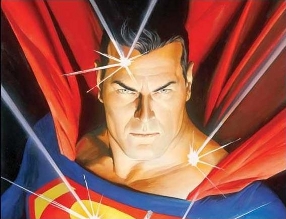 Lawful Good is the character alignment that is the most unambiguously heroic. These are the white hats, the caped crusaders, the knights in shining armor who fight for Truth, Justice, and the American way. They might not always be smart, and they might not always be nice, but you can always count on them to do the right thing…always.